Tag: CAS

  • Experience is the Key Architect of the Brain in Childhood Apraxia of Speech

    Brain


    I went to my state’s annual school based symposium for SLP’s this weekend and one of the keynote speakers was Dr. Amy Meredith CCC-SLP.  She is a professor at Washington State University and specializes in Childhood Apraxia of Speech with a focus on Early Literacy Skills.  Of all the things she said, the one quote that really stood out to me was this:

    “Experience is the key architect of the brain.”

    What does this mean?  Well,  you could interpret it in different ways I suppose, and put your own twist and connotations on it.  For me though, it means this.

    The brain is adaptable and can change.  For someone with a neurological disorder like apraxia, it means those pathways can be re-written.   Oh and haven’t I seen that already with Ashlynn?  Occupational Therapy, Physical Therapy, Speech Therapy, and swimming have already been re-wiring her pathways.

    An architect is defined as a person who designs and makes buildings.  Studies show the brain is literally capable of changing structure!

    Dr. Meredith cited a very recent study (Kadi et al., 2014) that found children with idiopathic apraxia (idiopathic meaning of no known origin), had significantly thicker left posterior supramarginal gyri than controls.  However, kids treated with a motor based approach to apraxia showed a significant decrease in the cortical thickening area after 8 weeks, and resulted in improved speech as well.

    That is amazing people!  Therapy literally changed the structure and size of the brain!! We know therapy changes function.  That’s why we all spend thousands of dollars on therapy, but to know that it actually changes the structure?  To me, that’s really something.

    This also tells me to never give up.  Not that we would, but now we have research to back us up!

    Literacy:

    Of particular interest to me was the literacy piece.  I know Ashlynn is at risk for learning disabilities.  One sobering study she cited was a Raitano et al. (2004) study which examined pre-literacy skills in subgroups of children with speech sound disorders (not CAS specific).

    Basically, the results indicate children with SSD’s  (speech sound disorder) performed more poorly than the controls, and children with SSD and LI (language impairment) add an additive risk factor for deficits in pre-literacy skills.    Lewes et al. (2004) conducted a follow up study and found children with CAS improved articulation but continued to have difficulties with:

    syllable sequencing
    nonsense word repetition
    language abilities
    reading and writing

    Right.  Okay.  So, what do we do about this?!?  Well

    Experience is the Architect of the Brain

    Let’s amp up their pre-literacy skills and give them more exposure and experience to things like:

    naming letters and letter sounds
    categorizing pictures by rhyme or initial sound
    identifying things in their environment that start with a certain sound etc

    Programs she recommended were Phonic Faces and the Lindamood Bell Program.  Dr. Meredith runs “Camp Candoo” over the summer for kids with apraxia focusing on speech sound production and early literacy using Phonic Faces.  Her data taken over the past three summers shows significant improvement in all pre-literacy skills after the two week intensive.  It was so compelling, I’m seriously going to try and get Ashlynn in this summer.  I’m also actually thinking of doing a small group a day with the kids I see in private practice with apraxia and Ashlynn.  It would give me experience, and benefit Ashlynn while also benefiting all the other kids.  We’ll see.  I always have big plans.
     

  • She observes more than we know.

    It started with the name disintegration at Thanksgiving.  My concerns about her writing were brought up to the staff as she flitted playfully around her preschool room while we talked.  I cried and I made tough decisions.

    She noticed.

    I didn’t know it at first.  It started out innocently with her asking when she would see Dione (her private OT) again.  I told her I had to apply for more funding and then we could see her.  I figured that was the end of it…..but it came up again.

    ” I need to see Dione,” she said again randomly one day.

    Me: “Oh I know honey, I’m still waiting on funding and hopefully we’ll see her soon.”

    Weeks passed.

    Again out of the blue she says one day, “Mommy.  I NEED  to see Dione.”

    Me: “Oh sweetie, I know.  Hopefully soon.  I applied and now I’m just waiting to hear back.”

    Crying.

    “MOMMY!! BUT I NEED TO SEE HER.”

    Me looking confused, “honey, what’s wrong?  why?”

    Ashlynn talking through tears, “because I need to practice my yetters (letters).”

    With my heart breaking in two I give her a hug.  I tell her that her letters are perfect, and that she always works so hard and she has nothing to worry about.

    That got me thinking though.  I am the FIRST one to defend her receptive language, her comprehension.  However, apparently I’m also the first one to talk about heavy things in front of her and just assume she was too busy being a kid to notice.  Not true…..apparently.

    Fast forward a month.  Her dad had a bad day at work.  Nothing catastrophic, but a pretty tough day. I was relaying it to her grandma (her dad’s mom) one day when she dropped her off for me to take Ashlynn to school.  Ashlynn seemingly oblivious, was playing on the curb and sidewalk, jumping down, climbing up, being a kid!

    I took her to class and the kids have to “check in.”  They get their name and place it under a feeling picture.  Ashlynn ALWAYS picks happy.  She is happy!  However, today, she placed it under sad.  “Ashlynn” I say, “you put your name under sad?”

    “Yeah, I sad mommy”  she said.

    “You’re sad??  Why?” I asked.

    “I sad for daddy…for his work,” she said.

    I absolutely folded.  What’s worse, I would have never known she felt sad about what I was telling her grandma if she hadn’t of “checked in” right after that.

    Are typical kids able to express these feelings, or do they just stuff them too?  Stuff situations they don’t understand, or is it because of Ashlynn’s apraxia?  My mom made a good point that Ashlynn would have probably brought it up “out of the blue” eventually like she did her OT and letter concerns.

    Maybe.

    I don’t know.

    All I know, is my child is so much more than you see, what I see, what anyone sees.  A five year old shouldn’t have to worry about needing help for writing, or worry that her daddy had a hard day at work.  It makes me wonder what else she worries about of which I have no idea.

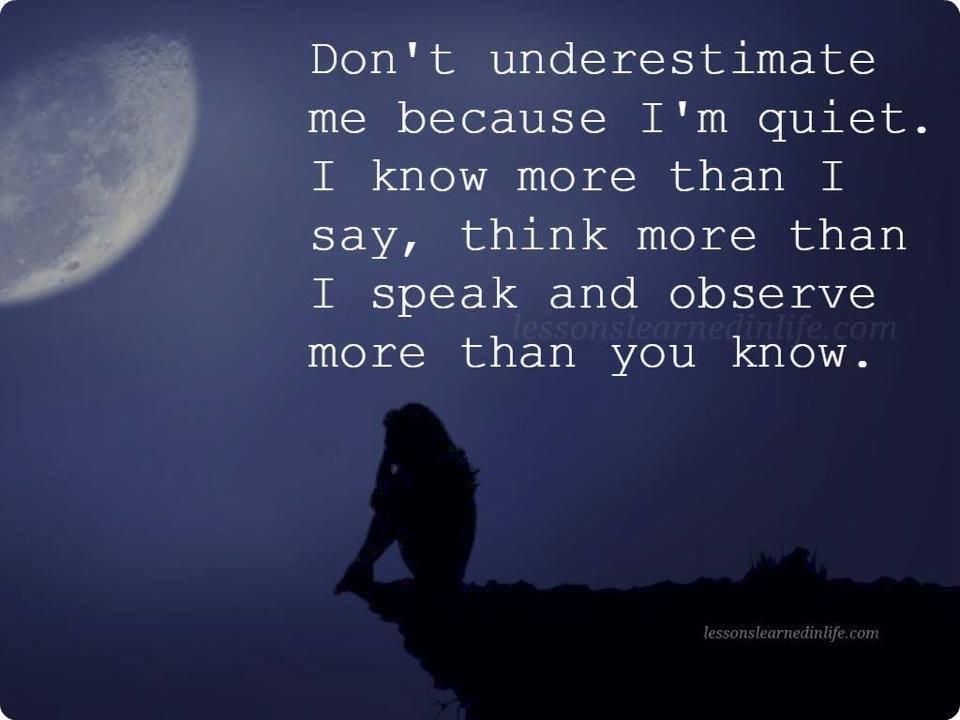
    I love this meme: “Don’t underestimate me because I’m quiet.  I know more than I say, think more than I speak and observe more than you know.”

    I will try to never underestimate you again, Ashlynn.  You were born to move mountains.

    thinks more

  • SLPMommyofApraxia Top Posts of 2014

    SLPMommyofApraxia Top Posts of 2014

    top posts 2014
    Graphics by MyCuteGraphics

    [mojoitem platform=’wordpress’ type=’themes’ item=’popular’ quantity=’3′ seller=’ [pinit] ‘ aff=”]

    I initially started blogging as a writing outlet to express my feelings; however, it is has turned into so much more.  I’m so grateful for everyone who emailed me or reached out to tell me their story this past year, and look forward to connecting with many more.

    Here are my top ten viewed posts from 2014

    1. Interview with Sharon Gretz, founder of apraxia-kids about her journey with a son who has apraxia and what parents should be seeing in therapy:  Read here

    2. If we don’t say we’re scared, does it mean we don’t have fears? Read here

    3. Apraxia is elusive, even to professionals. Read here

    4. Interview with Tonya from Therapy Fun Zone about motor planning issues related to gross and fine motor skills. Read here

    5. What is DTTC therapy for CAS?  An interview with Dr. Ruth Stoeckel from the Mayo Clinic.  Read here

    6. The Day I realized Apraxia was a blessing.  Read here

    7. What is your future like when you have global apraxia.  Read here

    8. Apraxia: How does that affect her vision/hearing? Read here

    9. There are no easy answers, only tough choices.  Read here

    10. Apraxia Intensive Training Institute aka Bootcamp.  Read here


    In case you missed it.  These are 10 of my personal favorites

    1. Did I cause her apraxia? Read here

    2. Just Love: Read here

    3. She really does have special needs: Read here

    4. People will forget what you said…but will never forget how you made them feel: Read here

    5. I saw the light go out in her eyes: Read here

    6. My apraxia star sparkled at her first Walk for CAS: Read here

    7. Kids say the Darndest things….unless they don’t because they have CAS: Read here

    8. Working our way out of the apraxia tunnel: Read here

    9. Wait, is she the ……R word?: Read here

    10. Oh my goodness…Ashlynn turns 5: Read here


  • What exactly is CAS?

    What is Childhood Apraxia of Speech?

    Definition and characteristics

    Childhood Apraxia of Speech is a speech disorder that results from difficulty with programming, planning and sequencing the precise movements needed for clear speech.

    The American Speech/Language Hearing Association (ASHA), denotes three main characteristics that must be present for a diagnosis of CAS.

    • Inconsistent production on consonant and/or vowels in repeated productions of syllables and words.
      • An example of the word doggy for my daughter who has apraxia ended up being produced doddy, do-yee, daddy, da-yee.
    • Difficulty sequencing syllables and words of increasing complexity.
      • The child might be able to say “dada,” but when words or added like “my dada” the child might say ‘da-da-da.’
    • Errors with prosody
      • Prosody can include syllable stress, and kids with CAS might stress the first syllable in each word: BAnana instead of baNAna or may give equal stress to every syllable BA-NA-NA.
      • Can include difficulty with volume control.  This was definitely true with my daughter.  She could not be loud even when she tried in her younger toddler years.
      • May have prolonged sounds and prolonged pauses, possibly giving the child ad staccato sound to their voice

    Other soft signs that should be considered include:

    Speech

    • Vowel errors and/or reduced vowel inventory
      • May have a tendency to reduce vowels to the schwa (uh).  For example, buh-buh/bye bye.
    • Groping
      • The child’s mouth seems to make a lot of unnecessary movements while they “grope” for the correct placement
    • Loss of words or sounds that were previously produced
    • Consonant omissions in the initial position of words
    • May be more successful with automatic versus volitional speech
      • A child may say “mama” but then when asked to repeat “mah” may be unable to do so correctly
    • Limited babbling as a baby, or limited sound variation in their babbling
    • Typically comprehends much more than they can speak

     Non-speech

    • Oral apraxia (difficulty planning and executing non-speech oral motor movements
      • May have trouble blowing raspberries, puckering, sucking out of straw or blowing out a candle
    • General awkwardness or clumsiness
    • Limb apraxia
    • Low muscle tone

    Who diagnoses Childhood Apraxia of Speech?

    According to ASHA, a qualified Speech/Language Pathologist is the IDEAL professional to diagnose CAS.  However, diagnosis can be tricky, so you want to make sure you find an SLP who has experience and/or specializes in CAS.  Currently, CAS is both over-diagnosed and under-diagnosed, so don’t be afraid to ask questions to gauge your SLP’s experience and knowledge of it.  A good SLP will not mind being asked questions about their experience with CAS or answering questions related to it.

    The Childhood Apraxia of Speech Association of North America provides an advanced training for SLP’s who already have extensive experience in the disorder called the Childhood Apraxia of Speech Intensive Institute.   You can read more about my boot-camp experience here:

    What should therapy for CAS look like?

    There are many programs out there that say they are geared toward the treatment of CAS.  There is a growing body of evidence that the principles of motor learning affect the most change.  In short, you should be seeing:

    •    frequent repetitions of target sounds or words (mass practice)
    •    feedback that is specific.  The SLP should be giving them feedback such as “you’re lips were open, not closed,” rather than just “good job” “try again” or “that was great.”
    •    carefully chosen speech targets that take into account the child’s current phonetic repertoire and then practicing a variety of movement gestures (sound to sound, syllable to syllable, word to word) with these sounds.
    •    Cues – can be visual (SLP may pop her hand out for /p/) verbal (close your lips and use your humming sound), or tactile (SLP may use physical touch cues on the child like in PROMPT).

    For a great description on what parents should look for in CAS treatment, see my interview the executive director and founder of apraxia-kids.org Sharon Gretz.


    For a detailed description of DTTC, a therapy approach for apraxia, see my interview with Dr. Ruth Stoeckel from the Mayo Clinic.


    A note about the school-age population

    Since I have spent most of my 10 year career in the schools, I think it’s important to also address some symptoms SLP’s may see that vary slightly from toddler presentations.

    By the time a child with CAS reaches Kindergarten, an SLP may run into three scenarios:

    • The child who has almost resolved due to intense and appropriate early intervention
    • The child who is still struggling significantly with motor planning, and is very unintelligible.
    • The child is still essentially non-verbal

    In scenario one, a child’s speech may be highly intelligible, with only residual articulation errors evident like a lisp, or an /r/ distortion of substitution.  It’s important to review the file closely and see what prompted the initial diagnosis of CAS.  This is important, because children may have additional issues after the CAS is resolved.  With one particular 4th grader, his speech only contained persistent errors with three speech sounds; however, his sentence formulation, grammar and syntax remained very problematic.  What is syntax?  One element is to correctly sequence the words in a sentence.  If a child had difficulty with the planning and sequencing of sounds, it ‘s not far off to think he/she may also have difficulty sequencing words correctly in a sentence.  I treated him differently and used the principles of motor learning to guide his treatment, unlike my other kids with an expressive language delay that never had an apraxia diagnosis.

    Other issues may include: pragmatics, narrative language, and persistent prosodic errors.

    In scenario two, a child may be speaking but is highly unintelligible.  By this age, they might actually have a vast repertoire of sounds, and actually be able to produce most sounds correctly in isolation.  One year I had a five year old walk through my school door.  One day he took out an alphabet BINGO and proceeded to name all the letters and letter sounds correctly in isolation.  However, this kid could not string two sounds together or consistently.

    In scenario three, the child may still be essentially nonverbal.  Until the child can commit to a motor speech exam, meaning he can or will at least attempt to imitate a variety of sounds and movement gestures, a definitive diagnosis cannot yet be made.  Aside from using Assistive Technology which can eventually facilitate speech, I would recommend starting with a functional core vocabulary book you two can make together that includes highly motivating syllables or words the child can work toward using sounds in his current repertoire.  With one five year old I had, he could only produce bilabials (b,p,m) and and /n/.  We started with word and word approximations to help him be more successful:  i.e. 1. no 2. bah/ball 3. mah-mah/mama etc.  Then we drilled them using the principles of motor learning that included massive amounts of repetition, involving visual and verbal cues, using specific feedback.


    CAS is a complicated disorder that is many times over-diagnosed and under-diagnosed.  In addition, the treatment approach varies from other traditional speech sound disorders.

    For resources I recommend the apraxia-kids.org webiste.  There is a wealth of information for parents and professionals.

    To find  CASANA certified SLP’s see the professional friends directory on the apraxia-kids webiste.

    Laura Smith is a speech/language pathologist in the Denver Metro Area specializing in Childhood Apraxia of Speech.  CASANA recognized for advanced training and expertise in Childhood Apraxia of Speech, she splits her time between the public schools and the private sector.  She is dedicated to spreading CAS awareness.  Her passion is fueled by all of her clients, but especially her own daughter who was diagnosed with Childhood Apraxia of Speech.  For more information visit SLPMommyofApraxia.com

    CAS


  • Christmas note for Santa’s lap

    Christmas note for Santa’s lap


    image


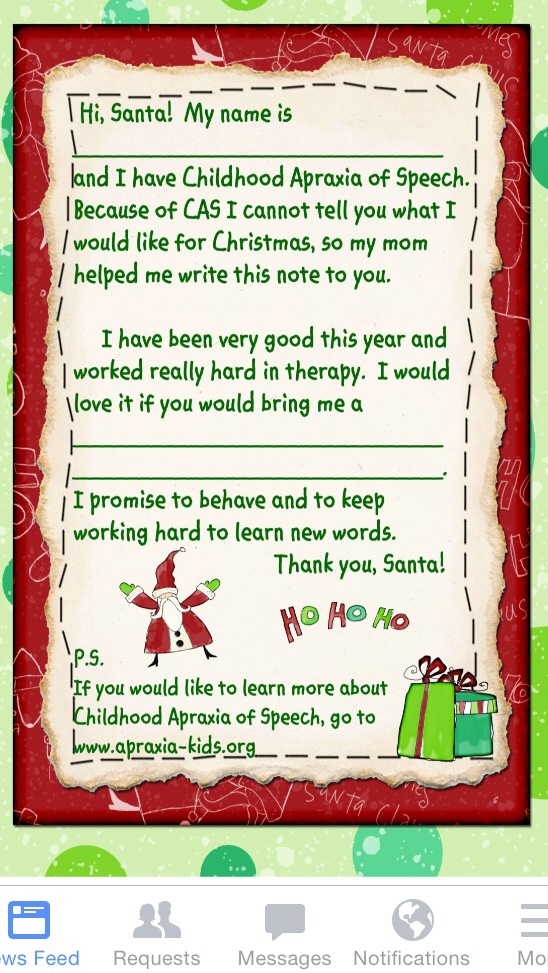
    When I had Ashlynn, I definitely never thought she wouldn’t be able to talk to Santa and tell him what she wants for Christmas, and I’m sure other parents of kids who are/were nonverbal have felt the same way.  A parent friend of mine made these cards for kiddos who want to talk to Santa, but who can’t yet use their own voice.  Thanks so much to Shelley for sharing with all of us!


    CAS Christmas Note


  • Apraxia? How does that affect her vision and hearing?

    So today I took Ashlynn to her 5 year checkup at the doctor’s office.  Her pediatrician is one I met at a pediatrician’s office, but who decided to go work at a family medicine facility.  I love the pediatrician, but having her housed in a general practice creates some challenges….such as today.

    The regular physician assistant was out on vacation, so  another one was there to fill in.  Though she was friendly and seemed good with kids, she really had no clue.

    This was the first year they did a vision and hearing screening on Ashlynn.  I didn’t know what they were doing until she asked,

    “Is she better with shapes or letters?”

    Huh?  Oh.  I realized then she was talking about the vision board.  Oh Lord help me, “The shapes I guess.”

    Ashlynn knows her shapes, and knows many of her letters, but as I’ve written about before, word recall really gets in her way.  I’ve had to tell professional after professional, “You need to have her point for it to be a better indicator of what she really knows.”  Today though I thought screw it.  Whatever.  Let’s just see what happens.

    She takes her out into the hallway and has Ashlynn stand back at a distance.  She points to a star.  “What’s this?”

    Ashlynn, “A rectangle.”

    Me (talking silently to myself): Oh boy, I can see how this is going to go.

    And it went.  She missed every single shape.  When the P.A asked her simple yes/no questions, “Is this a star?” she decided to answer, “no.” For EVERYTHING.

    “Any concerns with her vision?”

    Me:  “No.  She has apraxia.  When she gets put on the spot she has severe word finding issues and just gives you an answer trying to please you.”

    P.A. looks at me skeptically.

    Sigh.  I hate apraxia. This girl can spot a spider on the wall an entire room away, notice her daddy’s new haircut within seconds, or when decorations in the house change, within minutes.  No…I have zero concerns about her vision.

    Back in the room, we wait for the hearing test.  She comes back with a hand held device.

    P.A. “Now raise your hand when you hear the beep.”

    I mean really?  I wanted to start laughing.  My daughter has global motor planning issues!  I should have laughed, because as the saying goes, if you don’t laugh, you’ll cry.

    P.A. “Do you hear that?”

    Ashlynn: “No”

    P.A. turning up volume.  Ashlynn’s eyes dance in recognition. “Did you hear that sweetie?”

    Ashlynn: “No”

    My mind starts to wander.   I have absolutely NO concerns at this point in time with vision and hearing.  She’s passed all of her school screenings and this girl can be distracted by the tiniest noise.  Just ask all of her teachers, including in swimming.  This girl can hear. However, here I am watching this and I wonder, how many more professionals will underestimate her?  This P.A. was ready to pass on a referral for hearing and vision.  It’s not fair.  This is why I don’t want a cognitive test in the spring.  This is why……

    P.A. “Ma’am?”

    Okay, reel yourself in Laura.

    The rest of the visit went great.  Her pediatrician praised her speech and was genuinely impressed.  She laughed when I told her about the screening, and said if I didn’t have concerns she doesn’t either. That’s why I love this woman.  She has a son with autism, and she knows, just like I know, a mother is your best reporter.  She is the expert on her child.  She respects my decisions even if she doesn’t agree with me, and that is the kind of person I need helping me and my child.


    fcef745bba7298fd9b4b7952660573ae