Category: dyspraxia

  • Adulting with Apraxia

    Adulting with Apraxia

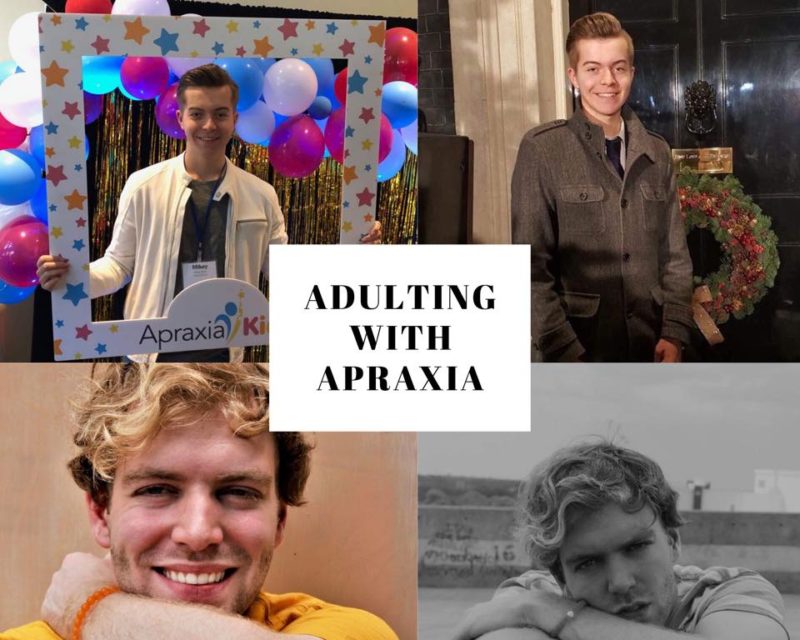
    I’m so excited to have some of the two largest apraxia social media influencers with me today to talk about what it is like to be “Adulting with Apraxia.” Mikey Akers from Mikey’s Wish and Jordan LeVan from Fighting for my Voice are both young men living with verbal apraxia.  In the UK, verbal apraxia is known as verbal dyspraxia. 
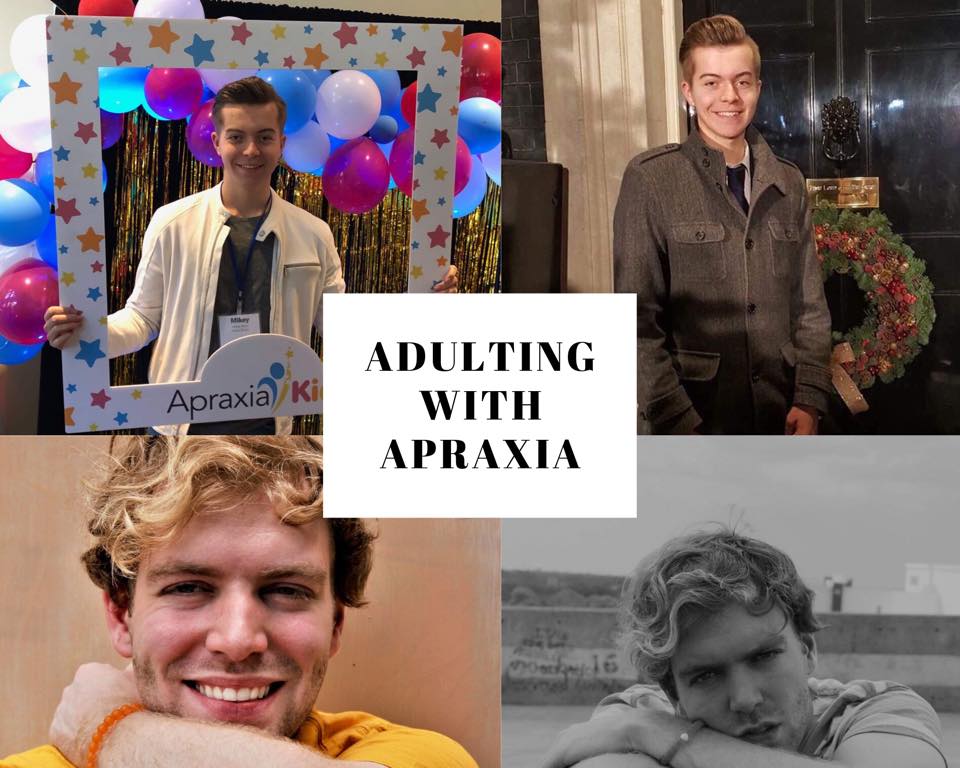
    Jordan and Mikey were talking one day about various issues that affect them in their adult life and wanted to write a piece together.  I think it’s such an important topic, as apraxia cannot be cured and many adults live with residual effects and experience difficulties in which others might not even be aware.  For example, Jordan once was talking about his struggle to find a job. It took him around a year just to find gainful employment. Today our hope is to go beyond the misconception that apraxia is just a speech disorder of childhood and talk about what it’s like, “adulting with apraxia.”

    Let’s get to it!  

    1. Let’s begin by talking about some of the residual effects both of you deal with today.  Let’s start with word finding. Mikey, you have said before that your word finding issues make it look like a lack of confidence when that is not the case at all.  Jordan, you have described moments when the word is in your head but it simply will not come out of your mouth. Will you both elaborate on this? 

    Jordan: Essentially, my speech disorder is known for the following: your brain having trouble sending your mouth signals, for accurate movements of speech. So, at times, I’ll know the exact word I want to say; however, my brain simply didn’t send that signal to my mouth. More occasionally, words are harder to get out, as well as words with multiple syllables. I also do struggle vocal fluency, so my voice is essentially monotone a lot of the times. I have to be putting effort in directly in the given situation to create those various tones people display in their voice when they’re happy, excited, and sad. 

    Mikey: Word finding is one of my biggest struggles now that I have found a voice. It is what holds me back, where my speech is concerned. It is what stops me from engaging in conversations with people that I don’t know. It affects my confidence and self esteem and it is the main cause of the anxiety that I have surrounding my speech. At times I stop mid sentence because the word I need isn’t there. This makes my speech disjointed as I pause, frantically looking for the word I need or one that means something similar. Everyone’s had those “the word’s on the tip of my tongue” moments, right? Well it’s like that but it’s every time that i want to talk. As far as talking is concerned I lack confidence but I am confident in every other area of my life.


    2. Mikey you have been open about your anxiety.  Does this exacerbate your word finding difficulties or is this a separate issue altogether?  Jordan, do you struggle with anxiety as well and if so how?

    Jordan: I was diagnosed with Generalized Anxiety Disorder, as well as Anxiety due to chronic health issue known as Apraxia. I first received help whenever I was twenty years old. My anxiety related to Apraxia relates to thoughts about, “What are they gonna think about my speech?” “Does she/he/they think I’m “dumb” if I can’t get a word out?” Naturally, not being able to get words out is so anxiety provoking. You go in for the word, but it just hesitated to come out from your lips. Your face feels tense now, your palms are sweaty now, and you’re trying to catch your breath back from having trouble over trying to get that word out. You would feel one of the things I just mentioned most likely just from occasionally not getting a word out right the first time. I’ve learned how to cope with my Anxiety with therapy. Therapy is now becoming socially accepted in our generation, as it should be. It’s the one resource that’s made me okay with essentially owning my voice.

    Mikey: It’s a vicious cycle. I have huge anxiety where my speech is concerned, this stems from the years of people not understanding what it was that I was trying to say. I know that I now have a voice that others can understand but I worry when I try to talk to someone who doesn’t understand my difficulties that my words won’t come. I worry that they won’t be able to understand what it is that I am trying to say or that they will think that I am stupid for being an adult and not being able to speak properly. Then because I am worrying so much and feel anxious the words really won’t come, no matter how hard I try to force them out, even though I know in my mind what I want to say. Frustrating is an understatement but I am determined to keep fighting to overcome this debilitating anxiety.

    3. It has been reported that many individuals with apraxia have difficulty with modulating vocal volume.  This can be where the person is speaking too softly and cannot be heard over ambient background noise, or conversely may be speaking too loudly and not realize it.  Do either of the above scenarios happen to you and if so how?

    Jordan: I speak to softly. This happens typically in my day to day life when a person will tell me they can’t hear me. Even when I’m trying my best to speak louder. I can speak louder, but it often comes out louder than I would like it too. People have even been shocked at me yelling. My own mom said to my own speech therapist, “So, he can yell?” A little funny story. Scenarios of this currently happen to me in classroom settings, work, and on the phone.

    Mikey: When I was younger I had a very loud, high pitched voice when I was at home and felt at ease with those around me. I never realised just how loud I was but I was constantly being told not to shout. When I was at school or around unfamiliar people I would choose not to speak. Now I have a normal level of speech when I feel comfortable but the minute I am out and about amongst people I don’t know my voice reduces to little more than a whisper. My mum always asks me why I am whispering as she can’t hear me, I don’t even realise that I am doing it.

    4. Both of you have mentioned that it may take you slower than some people to process language.  In the apraxia community at large we have a saying, “I know more than I say, I think more than I say, I notice more than you realize.” Do either of you relate to this saying?

    Jordan: I do with some of the following, I don’t believe so much with the “…I notice more than you realize.” Because if somebody makes a misconception about my speech, I’ll directly inform them. I usually will express my thoughts in given situations, however, I won’t expand further into the conversation because of difficulty. I can feel mental exhaustion from speaking, and sometimes I simply need a break to recharge. I’ve been able to expand on conversations even further now in my adult life with incorporating hand movements and hand gestures. 

    Mikey: I can definitely relate to this. People assume that  because I struggle to verbally express my thoughts and feelings that I have no opinion on subjects that are being discussed, which just isn’t the case. This happens more when I am in a larger group as the conversation flows so quickly that by the time I have processed the beginning of the discussion and have found the words to reply the conversation has usually moved on to the next topic. If people just slowed down the conversation they would realise just what I ‘know’, ‘think’ and ‘realise’.

    5. With this flurry of struggles hiding beneath the surface, how does this present in social situations?  Work situations?

    Jordan: I believe in social situations a majority of people assume I’m either nervous or shy. I get told quite often that I am so shy. In reality, I’m not really that shy. I believe everybody can be to a certain extent. It may also look like in work situations that I don’t know what I’m doing, since my speaking is at a slower pace than others with word difficulty. Others have came up to me and asked, “Have you got that ‘good good’?” I asked, “No, why do you ask that?” He asked “Aren’t you high?” I said “No, what would make you think that?” Then he didn’t answer, and he handed me my tray of food. Other assumptions about me being under the influence of drugs has also happened with police officers and doctors. We will get to that part soon. 

    Mikey: In social situations, with friends, I am very confident and outgoing but it takes a long time to reach this level of comfort. I put up protective walls and only those with the patience to keep chipping away and get to know me get to meet the real me. If it’s a social event where I don’t know many of the people attending then I probably come across as extremely quiet and shy. Maybe even being mistaken as rude, although this really isn’t the case.

    6. It has been reported that individuals with apraxia struggle with foreign language in highschool.  Did either of you and if so what accommodations were made? 

    Jordan: I did struggle with foreign language, since it does rely on pronouncing the words correctly. Because of my speech disorder, grading based on pronunciation isn’t practical. In high school, they essentially counted the credits without participation in class. In college, I’m actually exempted from foreign language classes. The accommodation board wants to make sure my speech isn’t critiqued by professors. 

    Mikey: I never studied a foreign language in school. I was so far behind in all my other lessons, due to my severe struggles with literacy, that I had extra English lessons when everyone else was learning French. Everyone thought that this would be more beneficial to me than trying to learn a foreign language.

    7. Have you found people in the general public to still be rude or intolerant of your speech differences?  If so how?

    Jordan: Yes. I’ve had people in customer service tell me if I don’t speak so slow they’d take my order. I’ve had doctors say “Well, Verbal Apraxia seems to be a speech issue. This doesn’t affect your reading or anything else.” Meanwhile I didn’t grasp reading until I was nine years old. I’ve had people try to rush my speaking, laugh at me, and say “Any day now buddy.” The general public wants fast and immediate speech responses. It’s because we live in a world where we are constantly going. My general speaking may take some more time. It doesn’t make it a bad thing, everybody’s voice is different. It just seems like if you don’t fit the “norm” you can be considered an inconvenience.

    Mikey: I have very rarely experienced any rudeness or intolerance because of my speech issues. I have only had 1 incident when a bus driver asked why I was being stupid as he didn’t understand me and this situation was very quickly dealt with, ending in an apology and another person being educated in Verbal Dyspraxia. I have had some people ask about my speech as they are genuinely interested in learning more about my diagnosis. When we get into a conversation with people that we meet in social situations (as a family) we find out that they had just assumed that I was hard of hearing, like my dad. I am still very much in the safety net of education though as I haven’t ventured out into, the slightly less forgiving, working world yet.

    8. Have either of you had a run in with law enforcement and were mistaken for being under the influence of alcohol or drugs?  If so, how was it handled? 

    Jordan: I was pulling out of a gas station one night, and I forgot to immediately turn on my headlights until I pulled out. The police officer pulled me over, and I asked why was I pulled over? He said it was because I didn’t turn on my headlights until after. I responded with “Oh yeah, I didn’t realize I didn’t have them on until after I left. I’m sorry.” He then asked me, “Are you drunk?” I said, “No sir.” He then asked, “Are you high then?” I said, “No sir?” He then asked me if I’d ever drank, ever smoked, and continually asked these two questions five times over each. Each time he would re-ask the question, in this ten question trivia game of his, my speech would become more disorganized, because of the pressure of the situation. He was smirking. I’m sure in his mind the assumption was “When people lie, their speech becomes more disorganized.” He then let me go after his game was over. 

    Mikey: No, thankfully I have never had a run in with the law.

    9. Person first language (I’m a person with apraxia versus I’m apraxic/dyspraxic) is a hot button topic.  It used to be, person first language was the law of the land until individuals with autism started saying they wanted to be referred to as autistic.  Do either of you have a preference?

    Jordan: I don’t really have a preference. I feel like the message that comes with “I’m an individual who has Apraxia” serves a reminder to me, that I am more than my Apraxia. However, I know this even if this is said or not. I feel like in our day and age, more people are owning what makes them who they are. I feel like saying I’m apraxic, doesn’t take away that at core, I’m a human being.

    Mikey: I have no preference, it’s not something that bothers me. I am a person who lives with verbal dyspraxia/apraxia and in my mind that is not going to change whatever term someone else chooses to use.

    10. What final message do you have for others who may be “adulting with apraxia” in the shadows? 

    Jordan: Apraxia is a tricky, still very poorly understood, neurological based condition that isn’t outgrown. I’m sorry if the term, Childhood Apraxia of Speech, made you also believe as a kid, that this is only a condition present in childhood. You didn’t do anything wrong, so please don’t ever blame your child self. Have compassion for yourself and how far you’ve come. Self comparing yourself to a person without your condition is a toxic. Would you ever compare an individual in a wheelchair with an able bodied person? 
    If you would like to go back to speech therapy, it isn’t just for kids. If you’re ever feeling any negative mental health side effects from living with Verbal Apraxia, reach out for help. I know these resources aren’t always accessible for everybody, but at least talk with someone. Know that you aren’t alone. I hope one day I can hear your story. I want to actually. Literally message me, I’ll be cheering you on.

    Mikey: Don’t be ashamed of your diagnosis, talk to others, let your employers know which areas you struggle with. Be honest about your feelings with those around you and more importantly be honest with yourself. The term Childhood Apraxia of Speech is misleading, this diagnosis doesn’t just disappear when you become an adult. You really are not alone, there are many of us living with verbal dyspraxia/apraxia as adults. If anyone ever needs to talk, I am always ready to listen.

    You two are amazing and as a mother to a child with apraxia but also as a speech/language pathologist I can’t thank you enough for your bravery, insights, transparency, hope, honesty and encouragment to those living with your diagnosis. I can’t wait to see what the future has in store for you both!

    SLP Mommy of Apraxia is a website dedicated to disseminating research, information, and stories about Childhood Apraxia of Speech (aka verbal apraxia, aka verbal dyspraxia). Follow us on Facebook, Instagram, YouTube





  • Will you push me, Mama?

    Will you push me, Mama?

    “Will you push me, Mama?”

    Lying on the couch after work, mindlessly scrolling social media when my sweet nine year old daughter says, “Will you push me on the swing, Mama?”

    I’m a pediatric speech/language pathologist and my job is AMAZING, but it’s also very demanding and zaps me mentally and physically by the end of the day. An introvert at heart, I need alone time to recharge and refuel. Needless to say, pushing her on the swing was not on my agenda for the night. However, as I looked into her bright eyes sparkling with hope, I put my phone down and asked her to give me five minutes. Enthusiastically she ran to the clock, figured out how long five minutes would be, and then bounded out the door.

    “Will you push me, Mama?”

    There was a time my daughter with apraxia couldn’t say “Mama” and had to go to speech therapy to learn it. Once she had words, she had to learn how to put them together to make a phrase because she also has a developmental language disorder. There was a time she had to go to speech therapy to learn how to add the /s/ to /s/ blend words, words in which an /s/ is next to another consonant as in “swing.” There was a time she had to learn how to use verb tenses correctly and once she understood and used verb tenses correctly, there was a time she had to then practice “interrogative reversals” in order to ask questions correctly. Those days seemed so long. The struggle seemed so long. Yet here she stood, effortlessly doing all those things as though she never spent hours in therapy offices learning how to do them. Here she stood asking to be pushed on the swing, something most kids were doing while she was working hard to find her voice.

    “Will you push me, Mama?”

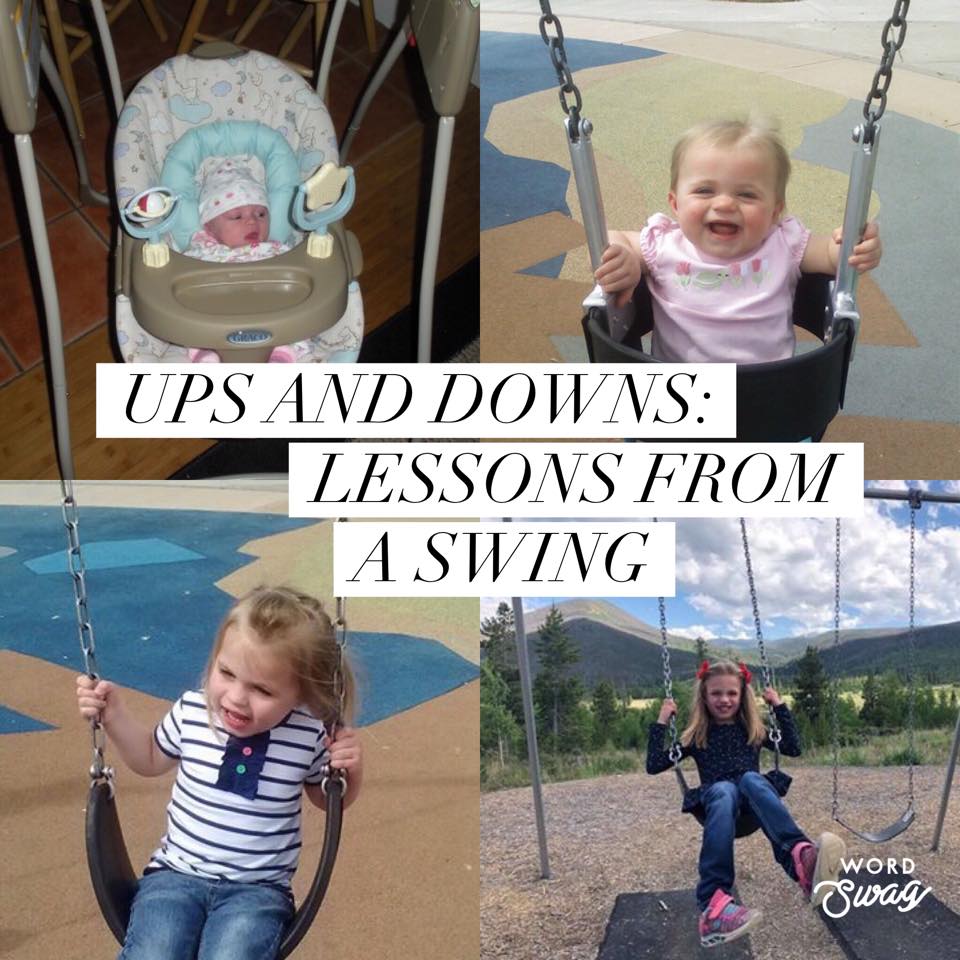
    Though my daughter can pump her legs herself now and swing, there was a time she had to spend hours in occupational therapy and physical therapy before her core strength could even support the act of sitting up on and pumping a swing. Then, once she was strong enough, she needed more therapy to get the coordination of the movements down. As she got taller, she then needed to learn how to change the motor plan and move her ankles out to the side so her feet wouldn’t hit the ground. Yet, here she stood, able to do all of these things now but still asking me to push her. She’s nine years old. We are getting close to her never asking me this question again and the gravity of that sunk in. Would this be the last time she asked me to push her? My mind flashed back to her beautiful smile when she is swinging. She literally came out of the womb and hogged the swing in the nursery. The nurses all laughed and mused at the baby who was only happy in the swing. It never stopped there. I have numerous pictures, too many to count, of her swinging in various ages of her life.

    “Will you push me, Mama?”

    I thought about how swings go up and down and up and down and how Ashlynn smiles and giggles through it all. I thought about how swings are a lot like life in that way. Ashlynn has a lot of challenges. She has a genetic mutation called BCL11A that has caused numerous disabilities and her life is anything but easy street. If anything, it’s more like the swing in that there are ups and downs, successes and challenges. Through it all though, she smiles.

    “Will you push me, Mama?”

    I thought about all the areas I’ve had to push her. Sometimes I wonder if I pushed too hard. Did I let her be a kid enough? Will she only remember speech therapy, occupational therapy, physical therapy, and tutoring? Nights struggling through homework? Nights struggling through activities of daily living that are so hard for her, such as brushing her teeth or getting dressed, because I know she needs to learn to do them for herself?

    “Will you push me, Mama?”

    So on this cool summer evening in June, tired from work and craving alone time, I got up and pushed her for an hour that night in the backyard. We laughed and giggled and made up games. I reveled in the fact my daughter still wanted me to push her, and I prayed to find a balance in the future of pushing her not a breaking point, but further and further to her potential. Oh, and making sure we find time to keep smiling and laughing along the way.

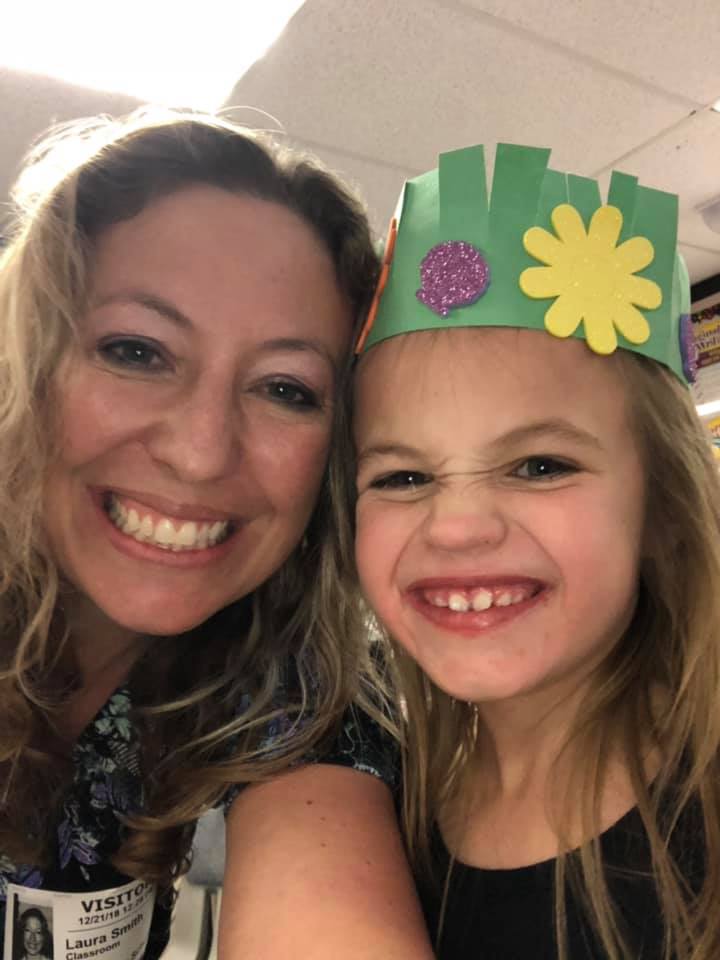
    Laura Smith is a mother to two beautiful children, one of which was diagnosed with a rare genetic mutation that caused a multitude of learning challenges.  She is a Denver based Speech/Language Pathologist now specializing in Childhood Apraxia of Speech. To learn more visit SLPMommyofApraxia.com

  • Shaming parents about home carryover

    Shaming parents about home carryover

    I’ve been on this special needs journey with Ashlynn for a long time now.

    I have grieved, recovered, grieved, and recovered again. I have developed thick skin.  I have felt guilt, then peace, more guilt, and then peace.

    I thought I was past all the BS.  I have accepted Ashlynn has severe needs.  I have accepted my journey with Ashlynn is going to be MUCH longer than I ever anticipated and I have embraced it.  This girl goes to school from 8 to 2:45, and almost every day after school she has some sort of therapy or tutoring strategically scheduled to help her overcome all of her learning disabilities.

    I’ve been done making excuses for not doing homework.

    I finally just started being honest and saying “We will see. She is a very busy and overscheduled little girl,” when therapists would ask about homework .  Ashlynn goes to school and then has therapies after school, and then we hope to get home to eat and then finally do her SCHOOL homework.

    That doesn’t mean there isn’t any other homework.  Oh no.  For all the therapies she receives after school there is also homework.  Always homework.  So not only does the average kid NOT go to therapy or tutoring everyday after school, they also then don’t have the homework assignments from said appointments after school.

    My daughter has it all.

    Go to school and get homework, and then attend therapy and tutoring that takes away from homework time after school and receive MORE homework on top of school homework for the extra after school services.  Oh, and my daughter has global motor planning issues, so any homework assigned is usually homework that needs to be done everyday.

    Everyday my daughter is expected to do regular school homework and then follow through homework for OT, PT, Speech and tutoring as well.

    If for some reason said homework isn’t done or done to the fidelity of a therapist’s expectations, I get to see the raised eyebrows and judgemental eyes.  I know what they are thinking even if they don’t say it.  “You couldn’t carve out 5 minutes for some simple yoga poses?  Speech word practice? Sight word drills?”

    Again, I thought I was past this.  I was done feeling guilt.  My whole life is running around trying to get my daughter the help she needs and then coming home and trying to be a mom and get dinner and then at least getting through her school homework. I have been done for a LONG time apologizing for not getting the therapy homework done.

    That was until today

    Two weeks ago I put Ashlynn into a therapy called oral facial myology to help with her mouth breathing, tongue thrust and immature swallow.  I knew going into this the homework component was going to be big.  I knew this! We received a sticker chart to keep us honest.  Ideally she would do the exercises 2x – 3x  a day and we would reconvene in 10 days.

    Today was our second follow-up appointment. I was so proud of Ashlynn!  We had done the exercises every single day!  A handful of days we managed 3x, most days we did 2x a day, and on three days including one where she spent the night at her grandma’s we did 1x a day.

    I was proud of us.  That was no easy feat. Sometimes it cut into bedtime but I knew this was important and I was willing to go the extra mile.

    My sails were immediately shredded within 5 minutes of our second visit.

    The swallowing therapist was warm and inviting as usual.  We were seven minutes late because we were driving from PT and I had forgotten to ask the physical therapist to end 5 minutes before and instead she ended 5 minutes late.  We still made it though! School ended at 2:45, we were at PT at 3:30 and then we were at swallowing therapy at 4:25. I was proud of myself for getting her to all these places.

    “How did the homework go?  Did you complete it?” the therapist asked Ashlynn.  Ashlynn enthusiastically nodded yes as I took out the sticker chart and the therapist looked on disapprovingly.  So there are three days here you could only do one practice session?  For this program to be successful, she needs to be doing the exercises at least 2x a day.

    “There are a couple days we did three!  Does that cancel out the three days we could only fit in one?” I laughed nervously.

    I looked up to a face of disapproval.

    “For this program to work, you really need to be more consistent,” she lectured.

    I swallowed a big swallow and collected our things. I think I literally gulped back tears.  I was paying a lot of money for this therapy.  Of course I wanted to see it be successful.  Of course I wanted to practice with Ashlynn as much as I could.  Guess what though?  I also needed to make sure we completed her homework and read at least 10 minutes per night.  Then and only then did I need to make sure she was doing her homework for reading tutoring, OT, PT, and speech as well.  Oh and she also needed to eat at some point and take a shower.  Being a kid?  Nope.  That’s not in the cards apparently.

    The guilt and responsibility is overwhelming

    I cried as I left the swallowing woman’s office.  I was trying!  I thought Ashlynn and I had done amazing!  We practiced what seemed like every spare minute we had together, which actually is very little spare time together!  I was proud of our dedication, but this woman had only criticism.  She told me if the program was to work, I really needed to get more serious about practice.

    I went home that night in a state of anger.

    I was yelling at my kids, my husband, the computer..really anyone who would listen.  I was devastated at having a therapist, a well respected therapist basically tell me if I didn’t take the homework seriously and with the fidelity it needed to be, my child wouldn’t improve.

    I railed against everyone and then I messaged an ally.

    The ally I messaged is an SLP who specializes in apraxia and oral facial myology.  I was so lucky to meet her at L.A.’s Walk to Talk for Apraxia when I took Ashlynn at 8 years old.  Her name is Lisa Klein and she has a reputation for not only being an amazing therapist, but being an incredible friend, mentor, and encourager. I barely know her yet knew I needed to talk to her.   Fortunately for me, she told me I could call her on my way home and like a crazy mom who is desperate I did.  I talked in a long winded series of run on sentences and questions and when I stopped she said the most impactful thing to me that brought me to tears.

    Laura, first of all, you are a great mom and that girl has come so far because of you.

    I started balling.  Not like crying either or tearing up.  No. Chest heaving ugly cry balling.  I just needed that validation.  She went onto say things that our myofunctional therapist suggested too like going every other week.  She brainstormed how to get in practice or what exercises we absolutely couldn’t miss. She said all of this though with compassion and free from judgement, and that is exactly the type of therapist I aim to be too.  We need to meet parents where they are at and we need to know parents are under an insane amount of pressure and are doing the best they can with the tools that they have.  I need a therapist to understand that.  I’m constantly shocked by the number of therapists who have so most judgement. I say this all the time but I say it again.  Please, if you are a therapist reading this please have compassion and understanding for the parents.  We are fighting daily battles and crying tears no one ever sees.  Please be kind.  Please.

  • Did I cause her apraxia?

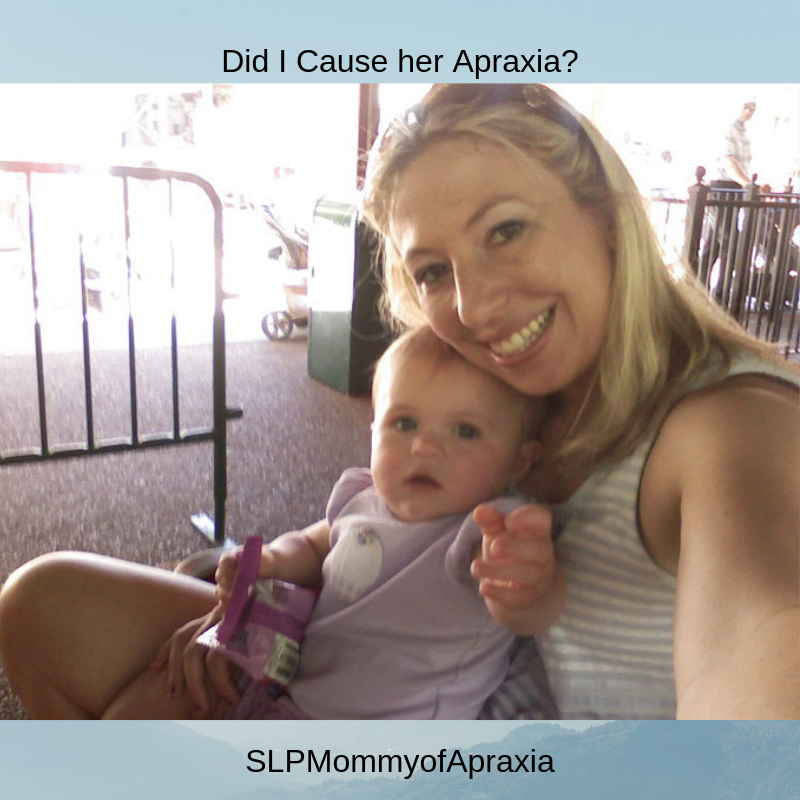
    Did I cause her apraxia?


    When Ashlynn was first diagnosed with Childhood Apraxia of Speech, I think most parents will relate when I say I spent (pointless) hours wondering what had caused it.

    Back in 2012 when Ashlynn was diagnosed, the most current information we had at the time was that it could have three main causes:

    1. Brain Trauma such as a stroke in utero
    2. Genetic causes
    3. Idiopathic – meaning of no known cause

    Though I knew this, I couldn’t help but cycle back to questions.  Questions that kept me up at night.  Any parent of a child with special needs has probably done this endlessly.  It is probably one of the main causes of sleep deprivation in special needs parents right behind “am I doing enough? and goes something like this.

    Was it that time when I was 6 months pregnant and I had the stomach flu?  Did I wear the painting mask long enough when I painted her baby room?  Was it because I had to have a C-Section?  What about the vaccines, giving her Tylenol, or that time she bumped her head?  Maybe it was……..

    And before I know it, I’m deep into the weeds unable to find my way out.

    It doesn’t help I had been privy to professional “inside” comments with colleagues who blamed parents for lack of reading, lack of talking, lack of stimulation etc.  You can read about my snub to those “opinions” in my article where I snub the 30 million word gap theory.

    It also didn’t help I would hear stories from other apraxia mamas who would share their personal experiences of being blamed and shamed.  

    So, I sought answers. It was a revolving door of specialists, waiting lists, and additional diagnoses, but still no answers as to the cause.  I would cycle through periods of acceptance and guilt, such as in this post I wrote when she was a little over 4 about a year after her CAS dx.

    Earlier this year, I thought we had found our answers when we went to rehabilitation specialist at Children’s Hospital who diagnosed her with dystonic cerebral palsy. Though I had more answers to her disability profile, I still didn’t have any answers as to what caused all the issues.

    No answers that is, until we found ourselves in the office of a genetic doctor and genetic counselor.  This is not to be confused with general genetic testing that a pediatrician can order either.  It was there that we would learn the cause of everything.  It was there, I would finally know why Ashlynn had apraxia, dyspraxia, hyptonia, ADHD, dysarthria, SPD, CP, and learning disabilities.  The answer was housed in a small set of letter and number combinations called:

    BCL11A

    A quick pub med article revealed that of the few case studies we have, children shared commonalities with:

    1. Non-verbal or low verbal status
    2. Abnormal muscle tone
    3. Gross motor delays
    4. Childhood Apraxia of Speech
    5. Dysarthria
    6. Hypotonia
    7. Dyslexia susceptibility

    The doctor explained the genetic mutation was “de novo” meaning it was not inherited and happened at conception.  It was a complete fluke when the sperm and egg came together that this mutation happened on the 2nd chromosome.

    Is it possible to be completely stunned and then not surprised at all at the same time?  Is there a word for that?  If there is, that is how I felt.  I knew as a professional researching this endlessly it wasn’t my fault.  Mom guilt though.  Mom guilt is a real thing.  It is strong, irrational, and overwhelming. So, in that sense, I wasn’t surprised.

    Knowing though that a genetic mutation was the single cause for all of her disabilities was shocking, but then quickly reaffirming. So many things went through my mind with the biggest one being,

    “This really wasn’t my fault, and furthermore, there is nothing more I could have done to change this.”

    The genetic landscape regarding apraxia is a new and quickly changing field.  We are going to see more research and information coming out now recommending that genetic testing be pursued.  Look for a follow up post with me talking about this new and changing frontier.

    For now though, I need time to process and learn.  A mother does better research than the FBI after all, when searching for answers about their child.


    Laura is a speech/language pathologist specializing in Childhood Apraxia of Speech and mom to two amazing children, one neurotypical and one neurodiverse. Laura is a speaker, writer, Denver Walk Coordinator for Apraxia, and is the voice behind the website SLPMommyofApraxia where she is passionate about Apraxia Awareness. 


  • When inclusion works: my hope for the rest of 3rd grade

    When inclusion works: my hope for the rest of 3rd grade

    This past break, I went over my posts from 2018, and read the article I wrote at the beginning of the year.  In it, I begged parents to teach their children to be kind as I wrote about the importance of inclusion.

    You can read about here.

    I was filled with worry and trepidation as Ashlynn started third grade.

    Last year in second had been one of her worst years with peers and friendships.  She frequently came home with bloodied shirts from her picking her fingernails.  Many times, the nurse had to change her shirt it was so bad.  She always reported that she hadn’t played with anyone at recess and my heart broke for her nearly everyday.  In second grade, she was also bullied in the bathroom but thankfully some other students heard and told the teacher.  Fresh off the heels of a great summer, I worried to see her go back to school again.

    This year though in third grade, has been one of her best years for growth not only academically, but also with friends and feeling like she was part of the class.

    The teacher told me at parent/teacher conference in November that she had told her class if they see Ashlynn sitting alone to go grab her and include her because many times it’s not that she doesn’t want to play; but rather that she has a hard time jumping into a situation.  The teacher went on to explain the kids initially did it because they were instructed to, but as they got to know her they now do it because they wanted to.

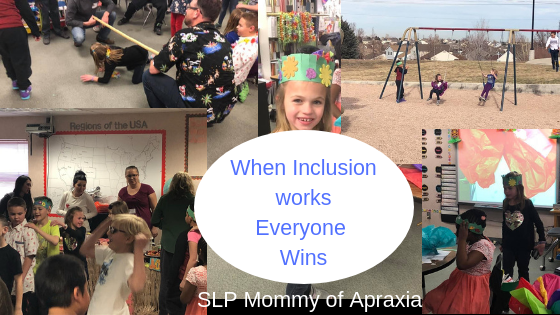
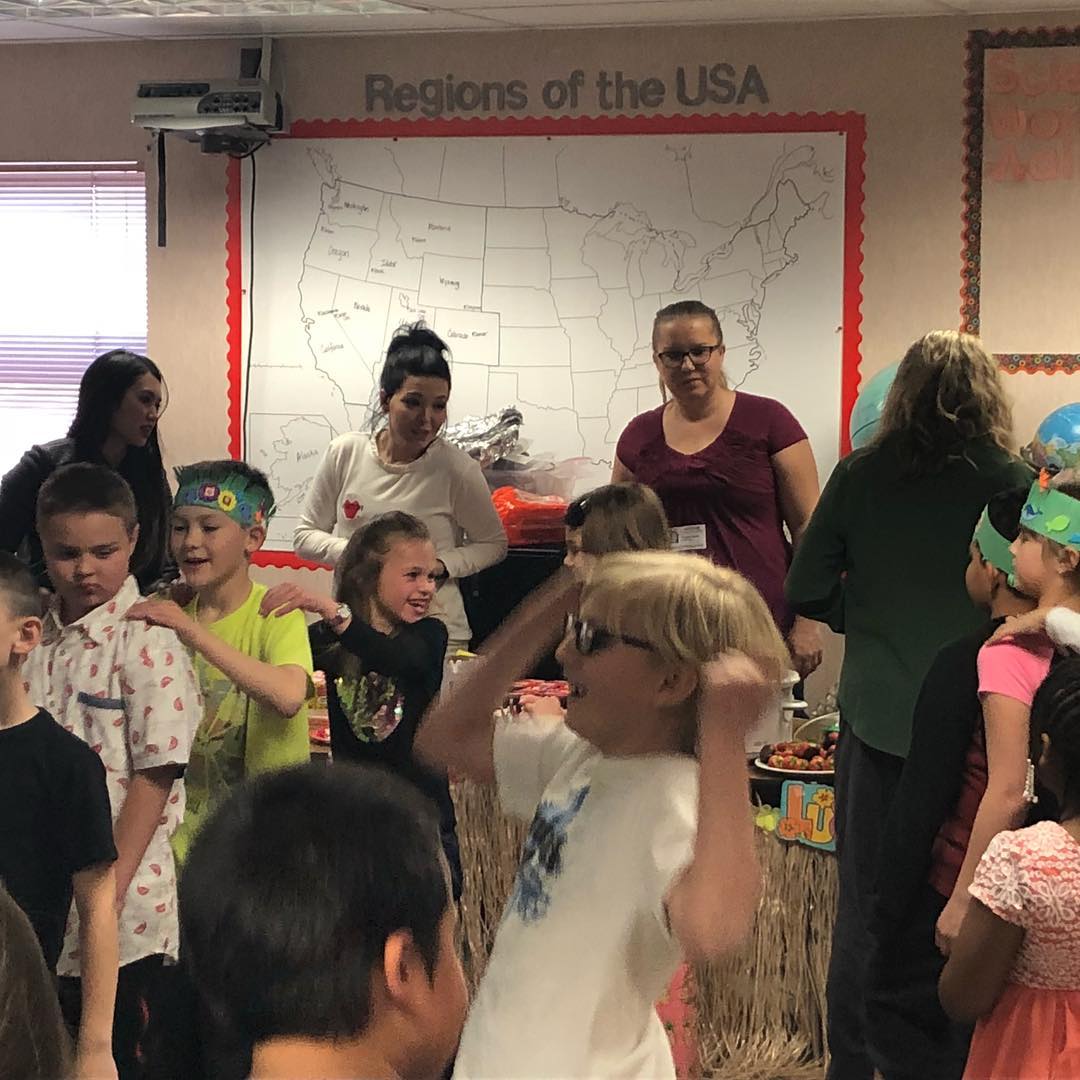
    Every year before winter break, 3rd grade throws a Luau party to add some fun and a twist to a normal Winter celebration.  I volunteered to run a craft with the class. I couldn’t believe what I saw when I got there.  Ashlynn was completely assimilated into the classroom as one of the kids, and not the “special ed kid” or the “ILC kid.”

    As she talked to her friends I thought of her speech therapy.   As she navigated the limbo stick like any of the other classmates I thought of her work in occupational and physical therapy. Her special education teacher wrapped up her current progress monitoring showing how she had rocked her goals because she knew it would be the best Christmas present to see all of her success and she was right.

    As she completed some seat work independently I thought of her TA who understands the difference between enabling and helping.

    This is how inclusion is supposed to look. Every human whether they have differences or not all want the same thing. They want to feel useful, included, and loved. Her smile says it all.

    Honestly I didn’t need any Christmas presents this year.  My cup was overflowing.  I just pray as Winter Break is over and she heads back to school, that the second semester will be as amazing as the first.

    Laura Smith is a mother to two beautiful children, one of which was diagnosed with a constellation of issues including apraxia that can be traced back to a genetic mutation entitled BCL11A. She is a Denver based Speech/Language Pathologist now specializing in Childhood Apraxia of Speech.

  • Disabilities, extraordinary abilities, and lessons in neurodiversity

    Disabilities, extraordinary abilities, and lessons in neurodiversity

    Neurodiversity and learning disability were never in my vocabulary before I had my daughter.

    I had never been exposed to learning disabilities of any kind really, and I had no idea the extraordinary gifts those who are neurodiverse had to offer this world.

    No, when I was in second grade, I was in my egocentric world and our teacher had us write “a book.”  It was a short story and we were to write on the typical school paper that has a box at the top to draw an illustration and then lines at the bottom to write the story.  Writing was always my thing.  Art….was……not.  I usually skipped the picture and went straight to writing.  In my defense though, I never technically had an art teacher.  However, even if I had, I’m sure I would have still been that defiant snotty little girl who turned up her nose at art.

    During one edit, the teacher told me the book was great but I needed illustrations.  I argued with her.  Her job wasn’t to teach me how to draw, her job was to teach me how to write.  Drawing was for the kids who didn’t know how to write and I knew how, so what did it matter anymore?  Did I mention I also went to a Catholic school, so I was marked down automatically for being sassy?  I never pulled that again, but it didn’t stop me from internally rebelling against drawing.

    “When will I EVER need to know how to draw as an adult?” I indignantly exclaimed to my mom.

    My Catholic school teacher had the last laugh though when I became a speech/language pathologist and discovered I needed to know something I didn’t know how to do.  You guessed it.  Draw.

    “What is that?  Is that a dinosaur?” one kid would ask of my drawing of a horse.

    “That’s supposed to be a bird?” another asked of my drawing of an airplane.

    Yes friends.  That sassy, know it all second grade girl started wishing she had paid more attention to art.

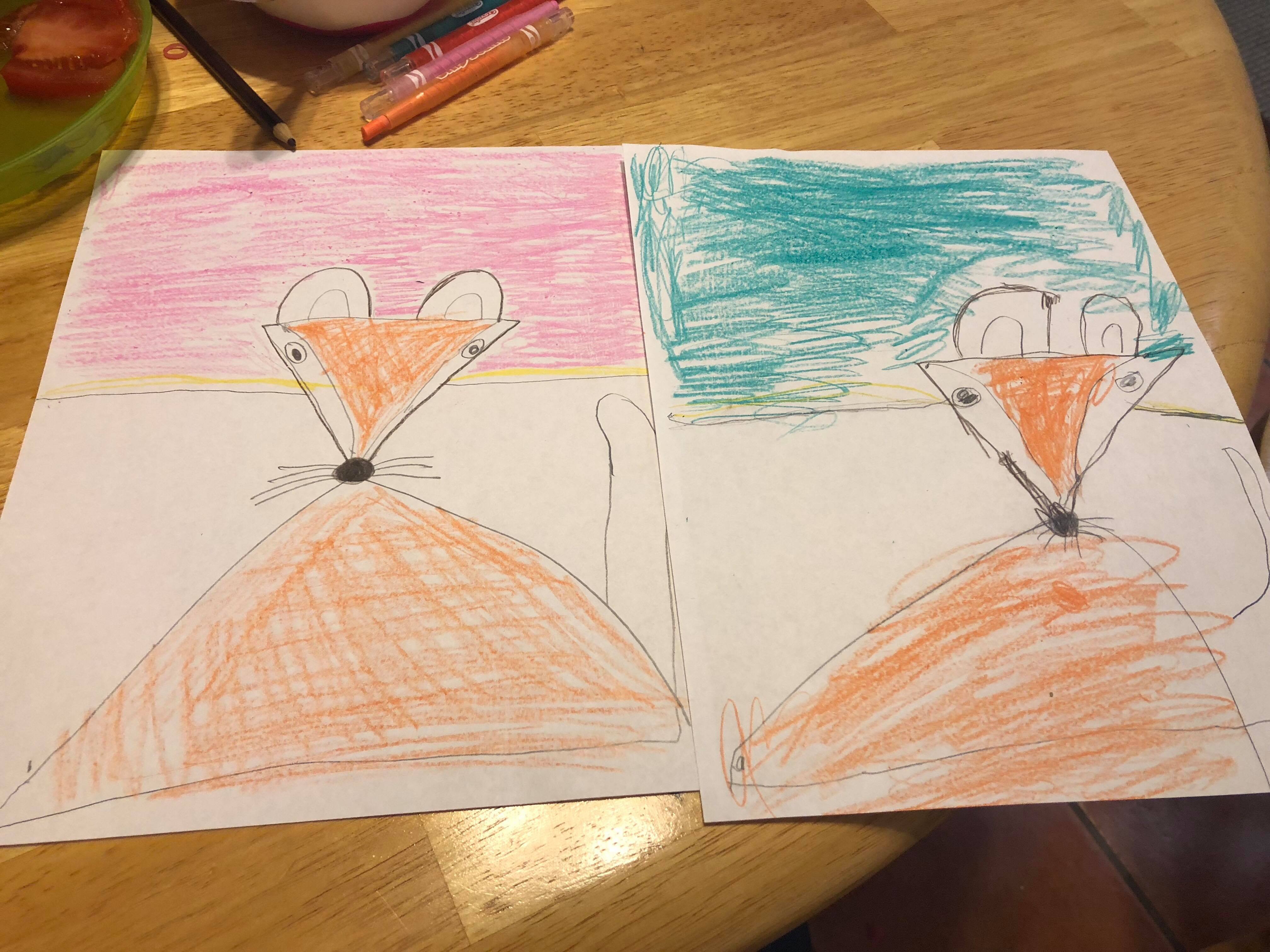
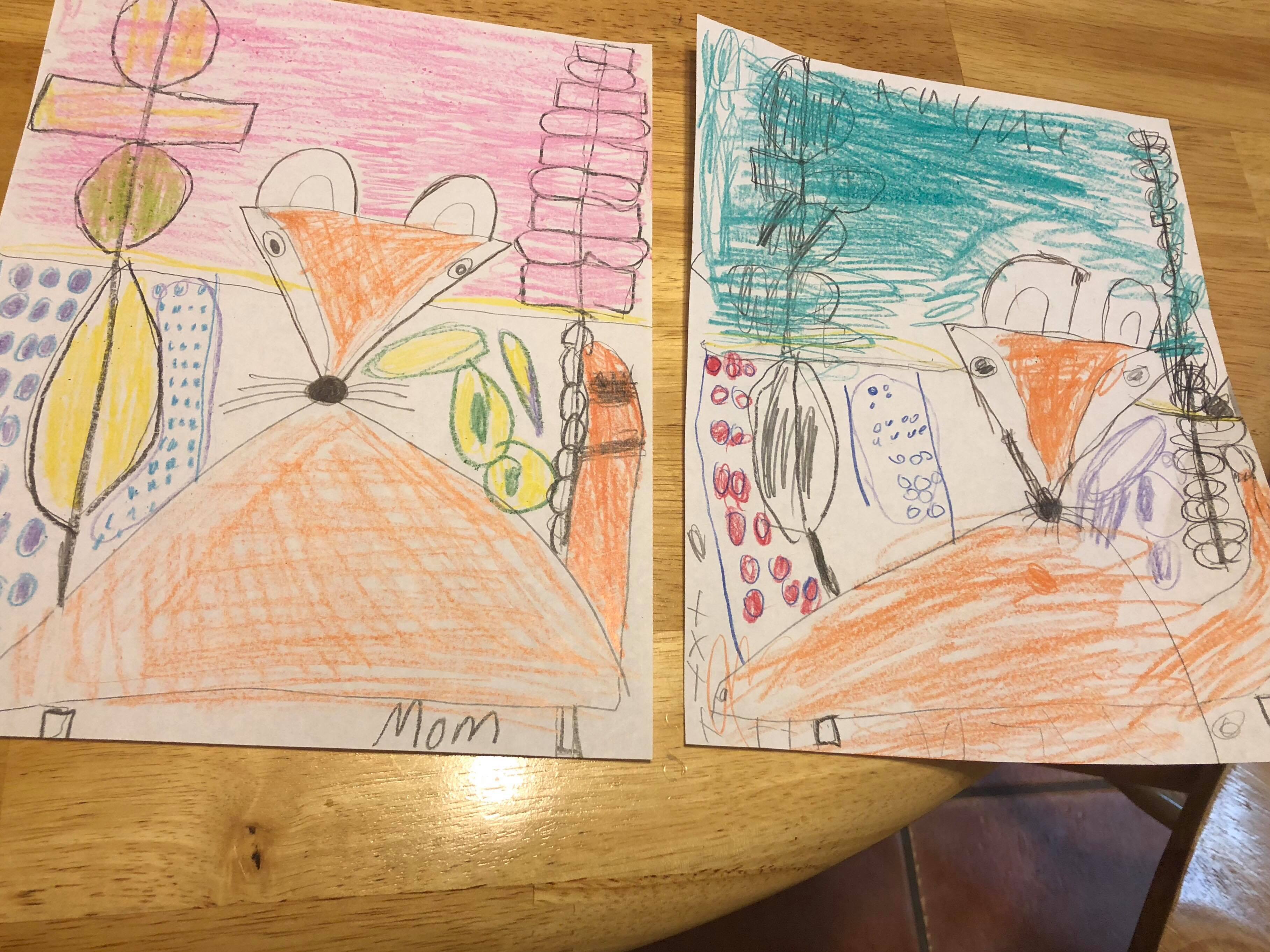
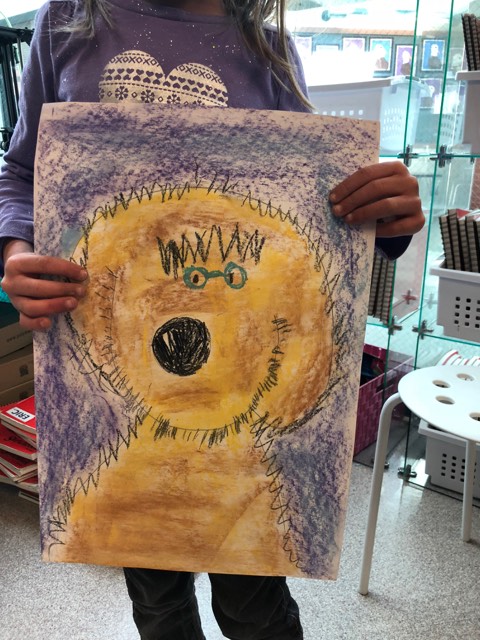
    Fast forward 30 years and I have a little past second grade daughter myself.  She has a laundry list of learning disabilities, many stemming from an etiology in motor planning and cerebral palsy.  Everything for Ashlynn seems hard.  She has had to fight and claw her way to learn anything through hours and hours of therapy.  I’m not kidding.  In Elementary school, she started coming home with art pieces from art class that were nothing short of amazing.  They were so amazing, it was sadly hard for me to believe that she did them without help.  However, her art teacher maintained she taught all the kids in a very structured way, giving them multiple opportunities for practice (think motor planning) before completing the final piece. This was Ashlynn’s best one from last year.

    Despite this, Ashlynn had never demonstrated to me independently she could draw even remotely close to this on her own.

    That was, until tonight.

    “Mommy, do you know how to draw a fox?” Ashlynn asked me tonight at dinner.

    “Oh baby, I don’t really know how to draw much of anything,” I answered while my husband snorted his drink out his nose in laughter before adding,

    “That much is true!  Mommy is not an artist.”

    I shot him an evil glare but unfortunately there was no denying the truth.

    “Can I teach you how mommy?  I learned how to draw a fox in art?” Ashlynn offered.

    I agreed and after dinner she had gathered paper and coloring utencils and set to work.  I really wasn’t sure what to expect.

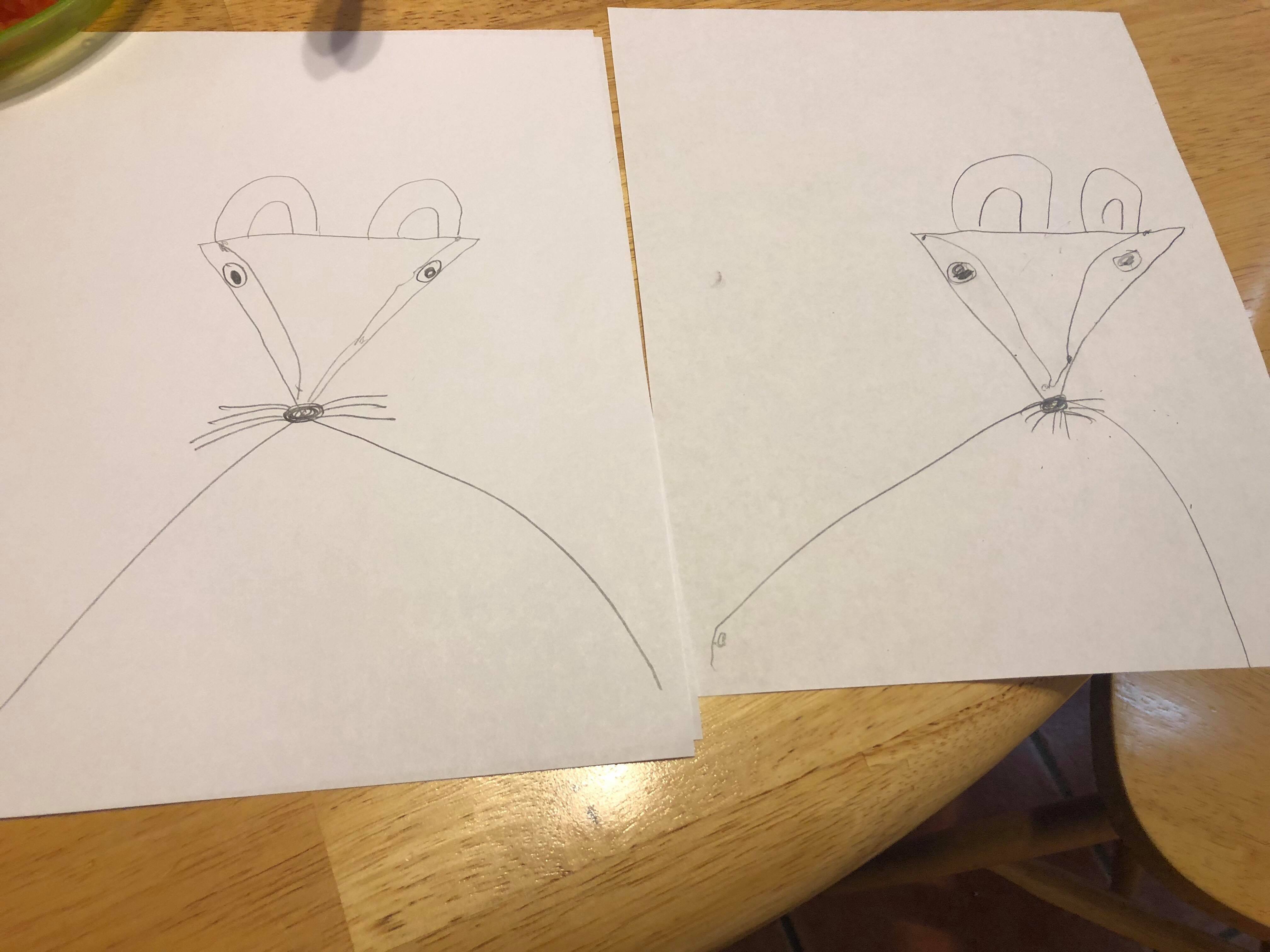
    “Put your fist in the middle of the paper like this, and now draw a line across the top,” she instructed.

    I complied.

    “Now connect this line to this line and see?  We made an upside-down pizza,” Ashlynn continued.

    I looked at the perfect triangle and my mind raced back to three days earlier at OT where the therapist told me Ashlynn’s hardest shape to draw is a triangle because of the diagnal lines. I stared incredulously again at Ashlynn’s perfect triangle.

    “Mom!  Are you paying attention?”

    She then took me in precise detail through the rest of the picture.

    I was impressed by this.

    “You are such a great teacher Ashlynn,” I said.

    “I know mommy because I want to be a teacher you know that.  A teacher and a dog walker because that’s my deal.”

    I smiled.  She just produced a compound complex sentence.  This girl with apraxia and a language disorder just said that.

    Next was the colors.

    I fought back tears.  This was incredible.  I watched her color the page with her wrist fluidly and precisely moving back and forth and my mind flashed back to when her OT told me that until she is able to isolate her wrist from her arm, she would always have trouble coloring within the lines.  I marveled at her wrist now.  Isn’t that crazy?  What mom would marvel at their child’s wrist and control unless they had witnessed how hard that skill was to master.

    Next was texturing and drawing the trees.

    She used these terms I had never heard like “we have to jump and bump.”  I followed along dutifully.  At the end of her lesson I praised her.  It was incredible.

    “But Mommy, we aren’t done!” she said as she got out two new blank pieces of paper.

    She told me we had to write about them.

    Write?  Like actually write?  This girl with motor planning, dyslexia, and dysgraphia now wanted to write about the fox?  She began writing but immediately messed up her spelling. As she peered over at my page that she had dictated, she decided to just copy my sentence. I watched her form the letters as she had been taught and practiced throughout her years of OT and copy my sentence. There was a time, she couldn’t even copy her name, I thought to myself.

    “Sorry, mommy, ” she said, “I can’t write really good yet.”

    I responded, “That’s okay, because I can’t draw very well.”

    “But I can teach you!” she said happily.

    With tears in my eyes I told her,

    “If you teach me how to draw, I’ll teach you how to write.”

    “DEAL!” was her enthusiastic response.

    So that’s the deal.

    Thirty years later my art teacher was a 9 year old girl with cerebral palsy, severe motor planning deficits and a laundry list of learning disabilities whose greatest wish in the world is to be a teacher.  Little does she know, she already is.