Category: developmental coordination disorder

  • Report cards are bittersweet with special needs

    Report cards are bittersweet with special needs

    End of the year is here! Summer is around the corner and the excitement of summer is palpable. There is something else though that is tangible I hold right before the excitement of summer.  It’s a small manila envelope that holds the children’s report cards.

    When I was a kid, I LOVED report card season.  My report card was always glowing.  I couldn’t wait to take it home and show my parents who would shower me with accolades and possibly reward me with ice cream.  I could not WAIT to open up that envelope and see the delicious and positive contents hiding inside.

    Ashynn, my first born child with apraxia and related learning disabilities was the second time aside from myself that I had looked at report cards.  I remember opening up her first one and feeling like someone had sucker punched me.  Despite her working hard every night, and going to therapy almost every night, the scores were more than concerning.  The grades were absolutely devastating.

    Yes I KNEW she has on an IEP. Yes I KNEW she had a modified curriculum and the report card shows her performance based on same aged peers.  Yes, I KNEW that.  It didn’t make the blow any less intense.   How was it fair?? While other kids played soccer or did gymnastics, mine spent every spare minute in a therapy and yet she was still behind.  Again I ask you, “How is that fair??”  As she went through first grade I started taking longer and longer to open that envelope.  You have to work up to putting yourself through that kind of pain again.

    Ashlynn is in second grade now.  Her manila envelope aka report card was sent home first.  I saw it in her backpack. Yes, I saw it.  I never pulled it out.  Why would I?  I know what I’m going to see.  I’m going to see that in spite of the fact that she has therapy after therapy and tutoring after tutoring after school; she remains dificient in most areas of her life. Despite her positive attitude, her resiliency, and her stellar attention to task and work ethic in therapy…she has true disabilities that will persist throughout her entire academic career and will be highlighted by the scores on her report card.

    Yeah so that report card. It kinda makes me sick.  I have to work up to reading it and it usually takes a couple of weeks.

    One day later a same manila looking envelope ended up in my son’s backpack.  I found myself excited and ready to tear into it!  I had a hard time waiting until we drove home.   I was over the moon to read the narrative,

    “It has been a pleasure to be Jace’s Kindergarten teacher.  He is outgoing, inquisitive, and comes to school excited to see his friends. He is a hard worker and determined to do his best. He takes great pride in his work.”

    I looked at the description with awe.  The same could have been written about my daughter with disabilities, yet, this person, MY SON, had scored all three’s (A’s) and my daughter still remained far behind.

    My daughter is outgoing, inquisitive and loves to see her friends too.  She is a hard worker and is determined to do her best.  She takes great pride in her work too.

    The next morning I received a text from her special education teacher.

    “Did you read A’s Progress Report yet???”

    I had been caught.  I felt ashamed, but I wrote back honestly and said,

    “Looking at her report card is so painful I have to work up to looking at it.  It usually takes a week or more.”

    She wrote back that after her IEP in March she had completely revamped her programming and she encouraged me to look at it.  I thanked her and sighed a heavy sigh.  I wanted to see all the progress which would be on the special progress reports that are added to the report card based on her IEP (Individualized Education Plan) goals, but I would have to look at the report card too which I knew still had low scores.  I looked at the two manila envelopes lying on the floor in the living room.  One opened, and one un-opened.  I want to read all the wonderful progress, but I’m just not ready to get punched in the gut today with the other papers sitting behind it.

    Not yet.

    I will.

    I promise I will.

    I just can’t face it yet today.

  • Diagnosis, Disability, and Finding your Tribe

    Diagnosis, Disability, and Finding your Tribe

    ​Parenting children is hard.  That isn’t a secret.  Parenting a child with a disability has even extra challenges that shake us to our core.

    I have a daughter with special needs and numerous learning challenges.  When she was almost three, she received her first diagnosis of Childhood Apraxia of Speech, a rare and severe speech disorder in children.  That was the beginning of many a “dark day” in my parenting journey with her.  I remember putting her in her car seat, tears in my eyes as her bright blue eyes smiled back at me and seemed to ask, “why are you crying?”  I sobbed that day.  I cried for so many reasons.  Fear, uncertainty, guilt and confusion.  I texted a friend I was devastated, and I truly felt like I had the wind knocked out of me.

    Slowly I found a community of parents who had children with apraxia as well; and I started to feel hope again.  I started to believe what was possible for their children was possible for mine as well.  I found my tribe, as I like to say.  All these parents understood me, my daughter, our challenges and the significance of our small successes!  I discovered there was a walk to honor kids like mine and spread awareness.  I connected with others in my community and no longer felt alone.  I no longer felt devastated but instead felt blessed by the friendships I had formed.

    My daughter has went on to receive multiple and additional disabilities since that first one of apraxia.  I can’t lie.  Each new diagnosis, report, or low test score feels like a punch in the gut all over again.  However, we have our people now.  We have our tribe.  We have others who understand.  They understand that sometimes you are in such a state of deep grief you can do nothing else but cry and cannot face the world that day.  We also know that stage doesn’t last, and when a member of our tribe is down, we will rally around them and be ready to pick they back up when they are ready to face the day again.

    I learned that some of my darkest nights were followed by the most glorious sunrise; and I found that sunshine in the community around us.  No one should suffer alone.  No matter the struggle, we should all find others who understand our unique situation in the world.  For us, community was the light that found its way into the dark tunnel of grief and showed us the way out.

  • Not walking to jumping jacks. A journey through OT and PT

    Not walking to jumping jacks. A journey through OT and PT

    There is this video of Ashlynn learning to walk.  It’s a video I have only reviewed once because it used to break my heart.  My daughter was 17 months old and still not walking.  My husband and I bought her the kid version of a walker, and almost every night we would encourage her to “walk” with it from one side of the room to another.   At the time, I of course knew she was delayed.  Why I didn’t seek early intervention for these delayed milestones is still beyond me.  Pride is a nasty bugger.

    Anyway, I was determined to help her and work with her just like I was doing with speech.  I just knew this walker would be the bridge that completed the gap.  She was excited and stood up with it right away.  Soon, it quickly started to roll away and Ashlynn’s legs, unable to keep up stretched out behind her and left her tumbling to the floor.  Despite the failure, my husband and I were excited and cheered her on in video after video.

    It still wasn’t until almost a year later she finally was put into PT and OT for delays in gross and fine motor skills due to motor planning.  This sounds crazy, but when she was identified through Child Find close to her 3rd birthday, I still had never heard the terms dyspraxia or developmental coordination disorder.  I knew she was delayed, but I didn’t know why.  I kept thinking she must have cerebral palsy or something.

    Today at the age of 8 years and 3 months, my daughter executed 10 jumping jacks.  “What’s the big deal?” you might say.  It is so difficult to explain the steps it took to get there, but I’m going to try because it absolutely blows my mind.

    It started with just a simple jump.  My daughter had to be taught how to even jump.  They started her on a trampoline in which she could only march, and graduated to her feeling the bouncing motion with her body and she bounced with her feet planted on the tramp holding a bar for balance.  Soon after she was able to catch air on the trampline, which paved the way for an actual jump on hard ground.  Learning how to bend her knees and propel herself upwards was a challenge, but once she had succeeded we had assumed she had the jumping thing down.  We were wrong.

    Jumping vertically was one motor plan, jumping forward was another.  It took her more time and effort in OT and PT to learn how to jump and then to jump forward.  Once she had that down, we assumed she had the jumping thing down.  We were wrong.

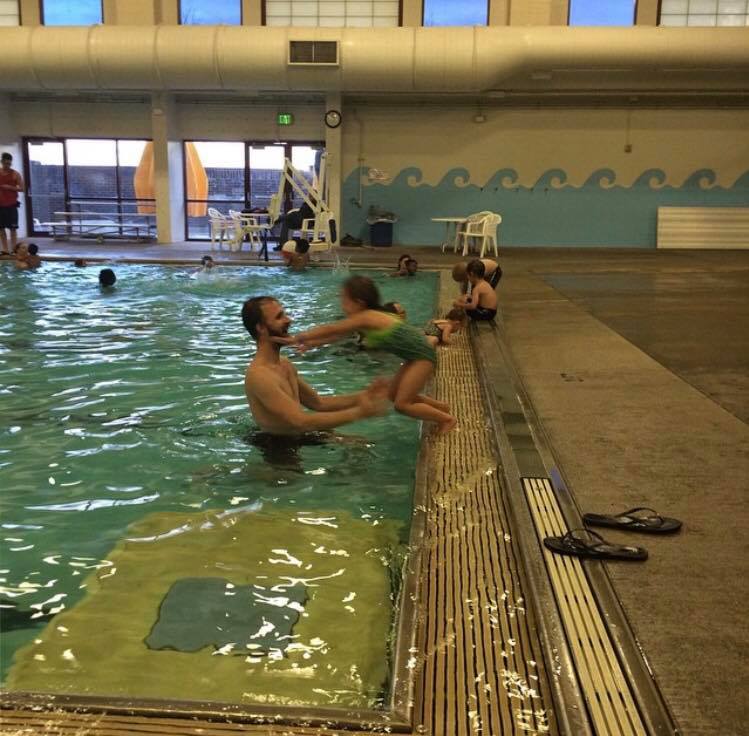
    Jumping off a ledge, or even a small curb is completely different than just jumping forward because the depth change is a different motor plan and involves spatial awareness and balance.  It would be more time and effort spent in therapy to learn this and not only learn it, but to keep increasing the distance of the ledge.  Jumping into the pool took a very long time for example.

    Ashlynn pool jump 5 1/2

    Next came skipping.  I had no idea skipping involves hopping, as we basically “step-hop” (as her therapists would say).   “Step-hopping” is harder because it requires a child to be able to hop on one foot.  That is yet another different motor plan from jumping together with two feet.  Oh, and it also requires a child to “alternate” their steps. Ashlynn was still taking the stairs one foot a time.  She would have to learn to alternate climbing.  During this time she first learned to gallop with one leg.  This stage lasted awhile until she could finally coordinate her second leg to follow suit.  After awhile, a slow and methodical skip began to take form.

    I might add crossing midline, vestibular activies, and balancing goals were also being worked on.  When you put all of these skills together, the last mother of all motor plans and total body coordination is nothing other than a

    JUMPING JACK.

    A Jumping Jack!  A fun activity most typical kids pick up one day around 5 years old in gym class. No therapy required.

    My daughter has been able to execute about two jumping jacks for awhile, but actually getting the motor plan down to do ten in a row was taking a collaborative effort between OT and PT.  Ashlynn true to her nature, always practiced at home.

    Tonight, at the age of 8 years and 3 months, my daughter who walked late and consequently went on to learn every gross motor skill through extensive time and work in therapy, executed 10 jumping jacks independently.  Her excitement was so palpable she asked me to record her, and she never asks me to record her because she always freezes!

    THIS moment is Ashlynn’s first place blue ribbon.  THIS moment, basically 3 years beyond her neurotypical peers, is our gold medal. I have long since toughened my skin to all the precocious and amazing things my facebook friends’ children are doing.  None of that matters.  Comparison is the thief of joy. What matters is my daughter wakes up everyday and fights to do things most others take for granted and she attacks it with a drive and determination that is unprecedented.  I have come to realize, my daughter learned the key to success early on; and though I still worry about her future, I know I shouldn’t.  I know I shouldn’t because I have inspirational quotes constantly running through my head.  Babe Ruth: “It’s hard to beat a person who never gives up.”  Michael Jordan: “I have failed over and over in my life and that is why I succeed.”

    So many others too.  Too many.  Ashlynn always succeeds.  She has this internal motivation and drive.  She competes with no one else either.  She measures herself to the bar she has set for herself and strives to do better than she did the day before.  It is remarkable.  It is what ALL of us should be doing everyday.  Can you imagine how amazing this world would be, if instead of getting older and accepting our “place” in life, we all woke up striving to be better than the day before.  Setting goals and not stopping until we reached them?  Always aiming higher, and higher and higher?  When did we as adults stop doing that?  When did I stop doing that?

    I don’t know when I stopped, but I know when I started again.  I started again after watching Ashlynn.  Watching her literally fight her own body and failing two many times to count.  But then, I have watched her rise victoriously too, time and time and time again.

    As a child I always cared what people thought. I always measured my worth by the A on the paper, the awards I won, the medals I received, and all the accolades that were given to me.  The problem is that leaves one in a very vulnerable position.  Ashlynn learned the game of life early.  We need to strive to be a better version of ourselves than we were the day before.  The only person we should be competing against is our past self.

    I had a parent tell me the other day that there is a certain beauty in parenting our kids because we celebrate everything so much more.  I had to agree.  The human experience is this exact sentiment.  We take for granted our health, until we don’t have it.  We take for granted the sunshine, until we are knee deep in the snow.  We take for granted our children’s laughter, until we watch them go through pain.  We take for granted finding love, until we get our heart’s broken and so on and so forth.

    Parenting Ashlynn has made me realize this tenfold.  We take for granted our legs, until they don’t work or cooperate.  We take for granted our speech, until we have no voice to communicate.  We take for granted all the mundane things we do like getting dressed or brushing our teeth, until you see someone like Ashlynn struggle for years to get it down. You take for granted your ability to do a jumping jack, until you see over a span of not days, not months, but years, YEARS, of all the little wins along the way that were fought and won just to be here where we are today, watching the executing of 10 simple jumping jacks.

    [wysija_form id=”1″]


  • Whatever it takes: A day on the brink

    Whatever it takes: A day on the brink

    Ashlynn had oral surgery today to fix a ridiculously thick upper labial frenulum that was impacting her front teeth.  I have anxiety.  That’s no secret.  I was pretty nervous.  I had like every prayer warrior I could think of praying for her.

    It’s not that serious of a surgery in the grand scheme of things; but she was going to have to take a valium the night before, and then one and hour before and one right before surgery.

    I gave her the valium pill  (meaning I watched wringing my hands while my husband gave her the pill) and waited.  The surgeon said the pharmacist may fuss at the prescription, especially since she is tiny, but not to worry.  Um……telling a worrier not to worry is like telling the sun not to come up.  Actually it might be worse.  It made me freak out more than had he said nothing and just prescribed the pill.

    I immediately decided she would sleep with me, because if I woke up I needed to hear her breathing. That was basically a joke because the valium made her hyper and crazy emotional.  She would laugh hysterically and then just start balling uncontrollably.  Every emotion was magnified and out of her control.  She talked incessantly and didn’t get to bed until 10!!  Despite this, I kept her home from school because I figured she would feel pretty tired.

    Wrong

    She woke up on the right side of the bed happy and ready.  In hindsight, I should have just sent her to school and then taken her out when it was time for the procedure.  She was also (and she told me multiple times) very MAD I was not letting her go to school. It’s amazing right?  She has no close friends, struggles in every subject, and was just bullied recently…..but she’s mad I didn’t send her.  Her internal resolve and determination is incredible.

    Anyway, I digress.  I let her graze on food all day since she would only be able to eat soft foods after the surgery.  I gave her the second valium an hour before and it made her hyper again.  She was talking incessantly, and at the doctor’s office she was literally jumping and running in the lobby.  If you know my child, she is pretty much the opposite of a sensory seeker, so seeing her do this on a drug that’s supposed to make you sleepy was crazy town.

    The doctor made the decision in light of her behavior not to give her the third valium. The procedure went amazing.  The surgeon and his team were amazing and awesome with kids.  Ashlynn though was awesome too.  High tolerance for pain means she didn’t even flinch when the needle went in for the anesthetic.  He asked her to close her eyes, but I explained she wasn’t going to be able to do that on demand because of her motor planning issues, but seeing a needle wasn’t going to freak her out.  She gave blood for her genetic testing last summer staring at the needle and joking with the flabotomist that she was “taking a lot of blood wasn’t she?”  The flabotomist remarked in her whole career Ashlynn was the only person who smiled giving blood. LOL

    So that’s the good part.  Everything else was pretty much a shit show.  I’m sorry to cuss, but sometimes it’s the only words that cut it. The doctor’s orders were clear.  Relax, take it easy, eat soft foods, do medicated mouthwash rinses (which turned into salt water rinses since Ashlynn can’t spit), alternate ibuprofen and tylenol, and keep lips closed and ice the outside. Sounds basic.  I got in my car and turned on Imagine Dragons “Whatever it Takes.”  I told Ashlynn it was our song.  We do whatever it takes to help her.  We never give up. We do what it takes.  I was feeling pretty good.

    However, Ashlynn apparently thought it was opposite day.  She immediately and incessantly kept talking.  I kept telling her to keep her lips closed and then she would burst into tears that I was being mean to her and not letting her talk.  I calmed her down with the promise of a present.  That was short lived because she kept biting the ice pack (hello SPD).  If I corrected her to not bite it, she became hysterical.  Hysterical = bad because she could rip out the sutures.

    “Fine just give me the ice pack and talk.  Throwing a tantrum will rip out the sutures.”

    We picked up her brother, and he was trying to be helpful and told her (nicely) to stop talking so she doesn’t bleed.  That was code for “Let’s go to War” in Ashlynn’s world and they started fighting on the way home.  My stress was at a 10.

    Once home, she decides she’s famished.  Not hungry…FAMISHED.  She can only eat soft foods.  I feed her two bowls of noodles, 5 yes FIVE pieces of bread, countless squares of cheese, a banana, and then an ensure calorie drink I had my husband pick up on the way home.  After dishes I go downstairs and find her eating gummies she got out of the storage room!!

    “What the hell are you doing??”  You can’t eat gummies!!!”

    Not my finest moment I know.  She burst into tears I was yelling at her.  Told me again how mean I was being.  Again, she is supposed to be resting.  Most kids who took valium would be asleep.  Nope.  Not my kid.  I go downstairs again to find her bouncing on our big yoga ball.

    “Ashlynn….you’re supposed to be taking it EASY!!  Get up upstairs and watch a movie!!”

    Ashlynn hates movies.  She is 8 years old and due to a visual processing motor problem and language processing issues, she cannot follow the story line of an entire movie and therefore has never watched one completely through.  She bursts into tears again, throws a tantrum and guess what?  Her suture finally decided it had enough stress and started bleeding.

    I got a washrag and applied pressure just like the doctor said to do.  She seemed to realize it was somewhat serious now.  My son was majorly freaking out trying to help me out.  Ashlynn was still mad I had been mean to her.

    Bedtime came and I had to try and do a salt water rinse.  She still can’t spit.  She has one motor plan.  Swallow.  She can’t chew gum either for this reason.  First sip.  She swallows.  Second sip.  She swallows.  Third sip, she somewhat spits all over my mirror but I praise her.  Fourth sip, she swallows.  Fifth sip, spits all over my mirrors.  I have NO idea if any reached her suture, but we tried.

    She’s finally in bed. I have the song “Whatever it takes” on again.  Tomorrow is a new day.  Dang parenting his hard, but I can’t give up.

    Whatever it takes.

    Playing on snapchat trying to get her to be quiet and keep her lips closed!
  • “She’s a puzzle” or…. she has dyspraxia

    “She’s a puzzle” or…. she has dyspraxia

    [wysija_form id=”1″]

    It’s no secret apraxia, dyspraxia, and developmental coordination disorder are not well known. Ask any parent, or heck, even any professional, and you will find out pretty quick few people really know what it is.

    Hey, I was one!  I was one of those professionals before my daughter was born. Here’s the thing.  I had my bachelor degree and masters degree AND my SLP CCC certification, and yet I had very few pages detailing apraxia of speech. Dyspraxia?  Developmental Coordination Disorder?  Pretty sure I never even learned those two terms.  My masters degree program taught us to research, but should I have really had to “google” to figure out how to treat a kid with apraxia?  Shouldn’t that have been addressed in school? Shouldn’t dyspraxia and developmental coordination disorder at least been given a shoutout like all the other rare disorders I had to remember including Fragile X and Rett Syndrome?

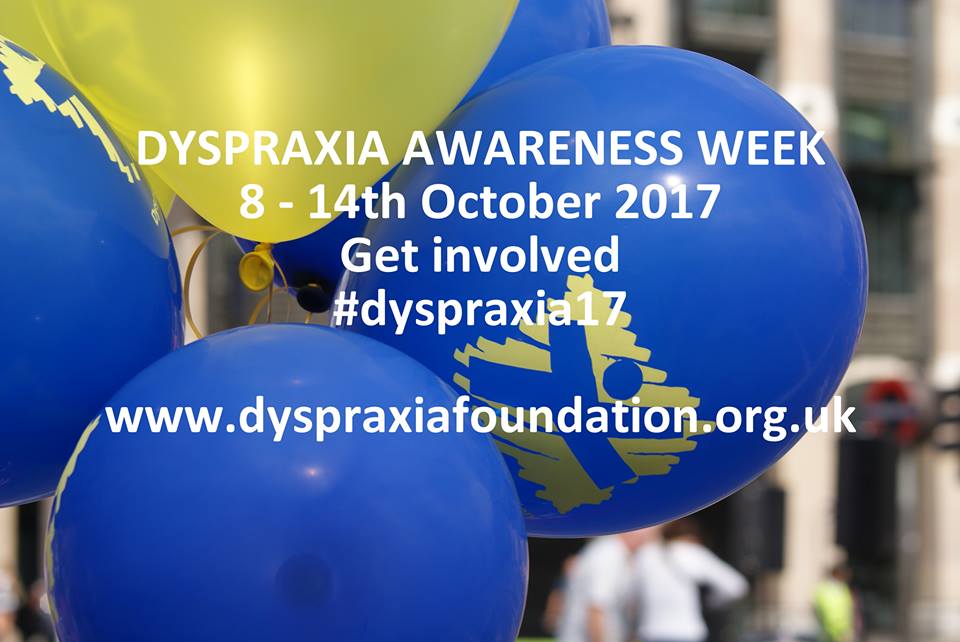
    I digress though.  THIS is why we need dyspraxia awareness week, this year October 8th through the 14th.  Oh, I should mention awareness week was started in the UK by the dyspraxia foundation.  I hope to carry it over here to the U.S., because just because my daughter lives here it doesn’t mean it’s any less prevalent. 

    When I took my daughter in for her first Child Find Evaluation, I remember the PT(physical therapist) telling me,

    “She’s a puzzle.”

    If you are a professional reading this like I was once, you probably didn’t think much about that last statement.

    “She’s a puzzle.”

    We all have one of those kids on our caseloads that we just can’t quite put our finger on exactly what’s going on; and part of the diagnostic process is testing a kid and finding out all the pieces to the puzzle to help develop the best treatment plan for the child.  Sounds about right.

    I can tell you though, hearing your child is a puzzle is quite frankly heartbreaking as a parent.  A puzzle is something you haven’t figured out yet.  As a noun, the definition of a puzzle is, ” a game, toy, or problem designed to test ingenuity or knowledge.” As a verb, the definition of puzzle is “to feel confused because they cannot understand or make sense of something.” So, with those two things in mind, think of how you might feel when professionals who treat children who exhibit similar problems like your child tell you “She’s a puzzle.”

    I don’t want professionals to tell me she’s a puzzle.  I don’t want to know that she’s so unusual that her very being challenged your knowledge, or that you are confused by her.  I mean seriously?  As I’m further on in this journey now, and as I’ve been able to talk to numerous parents nationwide who have a child with apraxia and dyspraxia, I can tell you she’s not a puzzle at all.  Her presentation, to varying degrees, is exactly the same presentation as other children with her disability.  This includes a high likelihood of sensory processing disorder and attention problems to name a couple. Despite this, I was still told last week by someone that her attention issues are a “puzzle.”  Sigh

    This fabulous research article probably puts it best in their opening statement positing,

    Dyspraxia is an enigma to many people, both professional and lay alike

    Enigma now!  It’s ridiculous if it weren’t completely true.  Dyspraxia IS an enigma to both professional and lay people alike.  Listen, the only puzzle, or enigma that I can see after being on this journey for about 5 years now is this.  It’s puzzling THAT PROFESSIONALS IN THE FIELD don’t know about apraxia and dyspraxia.  Now THAT is the puzzle.  I’m including myself friends.  I’m not exempting myself.  How is it, that according to some data it’s prevalent in as high as 10% of the population, yet my daughter is “a puzzle.”  There’s something wrong with that.

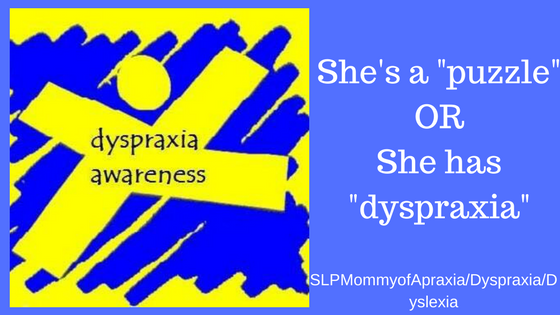
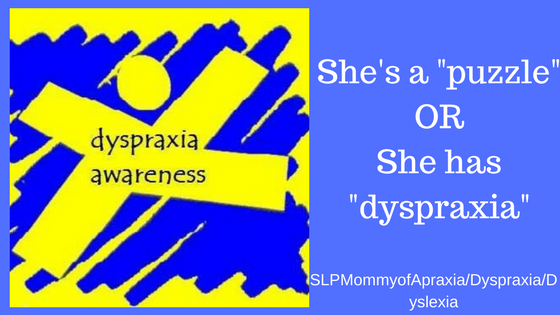
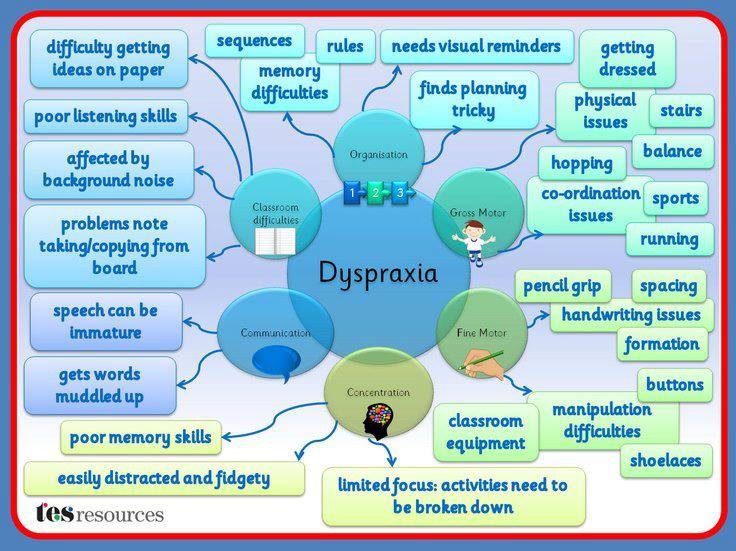
    A simple google search of dyspraxia, apraxia, and dyslexia though will reveal a list of symptoms that are exactly what my daughter has and experiences.  She’s not a puzzle at all.  She fits in all the little boxes of these graphics completely, like the one below. I could quite literally check every…single….box. I guess all the separate boxes resemble a puzzle, but if you put them together they all fit perfectly to complete that big box in the middle: dyspraxia.

    Ultimately though, this article is more than a rant.  This is a dyspraxia awareness post and this is what I want to see.  I want to see these disorders as understood and as well known as other relatively rare global developmental delays like Down Syndrome.  When a professional hears the word “Down Syndrome,” I can guarantee a list of characteristics common to those with DS will pop into their head.  There are always varying severities of course; but a professional is going to know what to expect and be better equipped to help them.

    I hope there is a day no other person with dyspraxia is told they are a puzzle or an engima and instead is greeted with, “Oh dyspraxia?  Okay.  We know exactly how to help you.”

  • Why you are the CEO and CFO in special needs parenting

    Why you are the CEO and CFO in special needs parenting

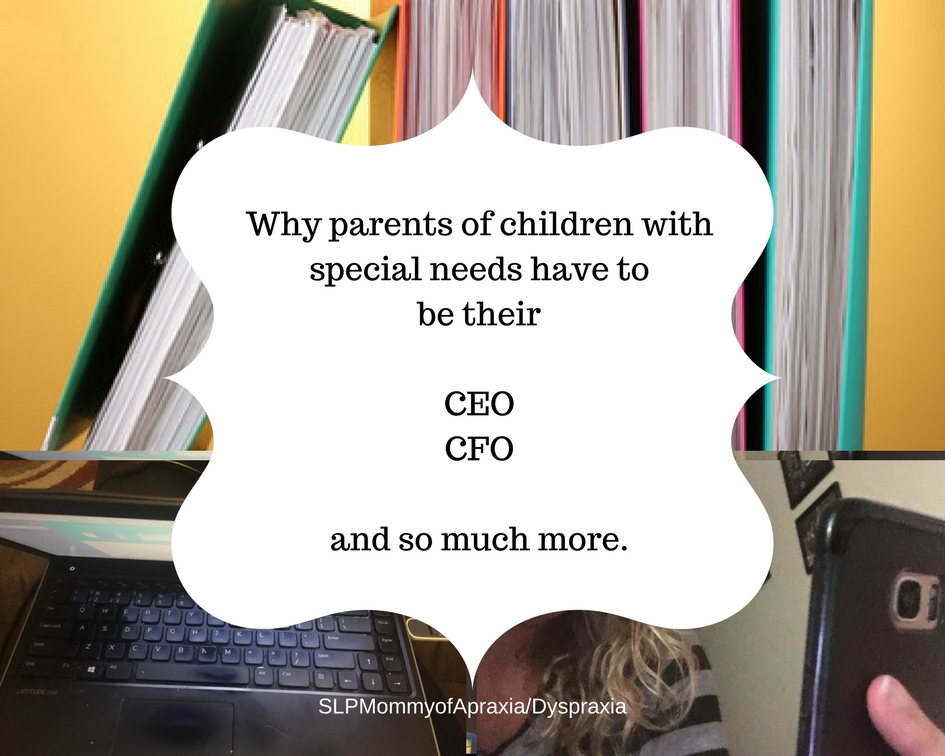
    A discussion in one of my groups the other day centered around the fact that parents of kids with special needs have to be the CEO on their child.  This extends beyond the idea that we are experts on our child.  The CEO, by definition, is in charge of making all management decisions.

    Parents of children with special needs have to be the CEO, and there is LOT to manage.

    Some days, it can feel unmanageable.  A CEO is typically responsible for the success of a company, which is no doubt stressful; but a parent feels they are responsible for the success of something even greater than a company……

    Parents feel they are responsible for the success of their child’s future.

    I know all parents feel this way about all of their children of course, including those with special needs.  However, the stakes are higher when you have a child with some sort of delay or disability.  A child with special needs is already starting life behind the eight ball.  A parent of a child with special needs feels intense responsibility to give them the best chance at a normal life, which is hard enough in this world without a disability!

    Parenting a child with special needs is a juggling act.

    When a parent has a kid with special needs, they spend their time not only at the pediatrician, but are bounced from specialist to specialist in many cases, just in an effort to get an actual diagnosis.  Kids with special needs in many cases have visited developmental pediatricians (different from regular pediatrician), neurologists, and psychologists. They have had blood taken, scans done, and more doctor visits to discuss results.  They have been poked, prodded, and examined more than the neuro-typical peer.  Their tiny bodies might have been subjected to sleep studies, sedation, and sometimes surgery.

    Therapy is always in the mix.  They may see occupational therapists, physical therapists, speech therapists, play therapists, behavior therapists, early interventionists, vision therapists and the list goes on.  Seeing a therapist always means another new evaluation, where this child who struggles anyway is subjected to tests and judgement calls as to their performance compared to typical peers.

    Obviously, there are only so many hours in a day and so a parent; the CEO if you will, has to choose  and prioritize many of the above listed appointments and even others not on this list.

    Unless you have been in this position, you have no idea how excrutiatingly difficult it is to decide which doctor or therapy your child needs most or more.

    Remember what I said before.  As a person making these decisions, the weight of your child’s future feels like it lay squarely on your shoulders.  Hopefully, you can get an appreciation of how big that weight becomes.

    Let’s not forget though, money.  All of these things cost money.  Insurance in many cases does not cover the brain scans, the MRI’s, the evaluations and the therapies.

    It causes a parent to become the CFO for their child as well.

    A CFO is responsible for the financial affairs.  Oh, and in the case of a parent with special needs, one doesn’t count on paying thousands of dollars out of their budget when they are starting a life with their partner, buying their home, and preparing for a new baby.  I had a supervisor tell me once at a private practice, no one can afford therapy, because no one counted on the huge hit to the budget these therapies, doctor appointments, and evaluations will cost your family.

    If you are lucky to get some sort of disability, Medicaid, or scholarship to help fund the cost; it’s not without another price.

    Time.

    All of these applications take an enormous amount of time.

    Parents need to gather required documentation, letters from insurance companies, doctors, evaluations, tax returns, and medical records to name a few.  A parent will spend hours filling out paperwork, spending time on the phone, and listening to hold music.  This time is well spent if a parent can get insurance to cover or get money to help with expenses; however, prioritizing time and finding time is not easy when we are shuffling our kids to doctor appointments and therapy appointments (see above).  This on top of finding time to put them in “typical” kid stuff like soccer or gymnastics and letting them go to birthdays like other kids do; in hopes that they can feel “normal” at least some of their childhood.

    If we are lucky, there are times we CEO parents find the perfect team.  We’ve got the diagnosis, the plan and team of therapists to treat it, and we see our child do the most amazing thing in the entire world……

    Make PROGRESS

    It’s probably the most beautiful gift in the entire world and in that moment; all the guilt, all the stress, all the worry, all the money, and all the time was 100% worth it.