Category: BCL11A

  • The exploding genetic findings in Childhood Apraxia of Speech

    The exploding genetic findings in Childhood Apraxia of Speech

    Evidence is increasingly suggesting that genetics should be pursued as a cause in CAS.

    (Morgan & Webster, 2018)

    An article recently came out in the Journal of Paediatrics and Child Health from Australia about new genetic recommendations for pediatricians.  Australia is more on top of research because unlike the United States, research is actually funded there rather than having to be raised by non-profits and other donors to actually move forward.

    In it, the authors discuss the exploding findings related to genetic research and Childhood Apraxia of Speech.

    This current interest was catapulted by the discovery that a mutation on a gene called FoxP2 was implicated in both heritable and de novo causes of CAS up to almost 100% prevalence in affected individuals.  Since that time, more genetic testing has been increasingly pursued and recommended in children who have CAS plus additional neurodevelopmental disorders.

    16p.11.2 – Associated with CAS, moderate cognitive disability, autism, epilepsy, language disorder, and dysarthria.

    The authors go on to discuss many other genetic disorders currently being implicated in CAS among other neurodevelopmental co-morbidities such as:

    GRIN2A – CAS, dysarthria, and oral-motor impairments

    SETBP1 – CAS, expressive language disorder but in tact receptive language disorder, decreased fine motor skills, ADHD, and autistic traits.

    KANSL1 – Feeding difficulties, CAS, dysarthria and hyptonia

    ELKS/ERC1 – CAS, delayed walking, language and reading difficulties, intellectual impairments, psychiatric manifestations, and ADHD. ASD was dx in some but had a low prevalency.

    BCL11A – Associated with CAS, dysarthria, hypotonia, and general oral and gross motor dyspraxia.

    These lists are not exhaustive and profiles of each disorder are not complete since the field of genetics is so new and reported cases are relatively small and based off of individual case studies.

    The authors conclude that in cases of confirmed CAS (with the confirmed word being important since there is quite a bit of misdiagnosis) a referral to genetics should be considered since increasing evidence is showing the at CAS is a genetic disorder.

    Another study in 2013 by Worthey et.al, concluded that whole exome sequencing (WES)  supports genetic heterogenity in Childhood Apraxia of Speech.  To clarify, since genetics was VERY confusing to me as a parent going through it, whole exome sequencing is different from a microarray and different from the standard genetic testing a pediatrician can order when screening for Syndromes such as Down Syndrome or Fragile X.

    A lot of parents will say, well I had genetic testing and all results were negative.  The question though really needs to be what kind of genetic testing did they have?  Whole exome or partial exome testing is typically ordered through a genetics department that not only has a doctor specializing in genetics but is paired with a genetics counselor.

    We are going to see a lot more genetic links in the future, but it’s important that parents and professionals know what genetic testing for which to ask.


    Laura Smith is a mother to two beautiful children, one of which was diagnosed with apraxia and dyspraxia. She is a Denver based Speech/Language Pathologist now specializing in Childhood Apraxia of Speech. To learn more visit SLPMommyofApraxia.com

  • Did I cause her apraxia?

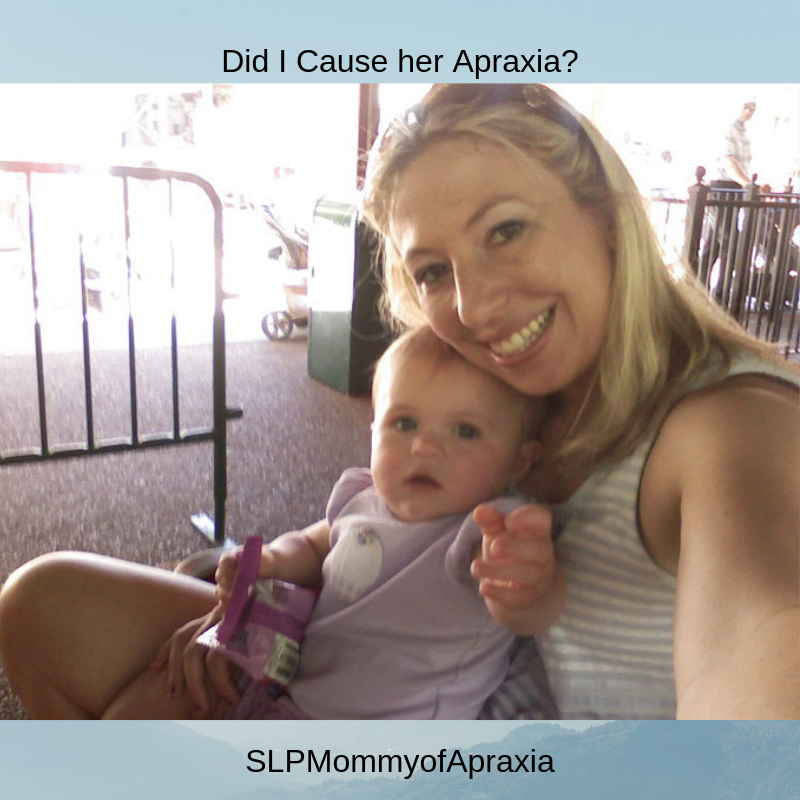
    Did I cause her apraxia?


    When Ashlynn was first diagnosed with Childhood Apraxia of Speech, I think most parents will relate when I say I spent (pointless) hours wondering what had caused it.

    Back in 2012 when Ashlynn was diagnosed, the most current information we had at the time was that it could have three main causes:

    1. Brain Trauma such as a stroke in utero
    2. Genetic causes
    3. Idiopathic – meaning of no known cause

    Though I knew this, I couldn’t help but cycle back to questions.  Questions that kept me up at night.  Any parent of a child with special needs has probably done this endlessly.  It is probably one of the main causes of sleep deprivation in special needs parents right behind “am I doing enough? and goes something like this.

    Was it that time when I was 6 months pregnant and I had the stomach flu?  Did I wear the painting mask long enough when I painted her baby room?  Was it because I had to have a C-Section?  What about the vaccines, giving her Tylenol, or that time she bumped her head?  Maybe it was……..

    And before I know it, I’m deep into the weeds unable to find my way out.

    It doesn’t help I had been privy to professional “inside” comments with colleagues who blamed parents for lack of reading, lack of talking, lack of stimulation etc.  You can read about my snub to those “opinions” in my article where I snub the 30 million word gap theory.

    It also didn’t help I would hear stories from other apraxia mamas who would share their personal experiences of being blamed and shamed.  

    So, I sought answers. It was a revolving door of specialists, waiting lists, and additional diagnoses, but still no answers as to the cause.  I would cycle through periods of acceptance and guilt, such as in this post I wrote when she was a little over 4 about a year after her CAS dx.

    Earlier this year, I thought we had found our answers when we went to rehabilitation specialist at Children’s Hospital who diagnosed her with dystonic cerebral palsy. Though I had more answers to her disability profile, I still didn’t have any answers as to what caused all the issues.

    No answers that is, until we found ourselves in the office of a genetic doctor and genetic counselor.  This is not to be confused with general genetic testing that a pediatrician can order either.  It was there that we would learn the cause of everything.  It was there, I would finally know why Ashlynn had apraxia, dyspraxia, hyptonia, ADHD, dysarthria, SPD, CP, and learning disabilities.  The answer was housed in a small set of letter and number combinations called:

    BCL11A

    A quick pub med article revealed that of the few case studies we have, children shared commonalities with:

    1. Non-verbal or low verbal status
    2. Abnormal muscle tone
    3. Gross motor delays
    4. Childhood Apraxia of Speech
    5. Dysarthria
    6. Hypotonia
    7. Dyslexia susceptibility

    The doctor explained the genetic mutation was “de novo” meaning it was not inherited and happened at conception.  It was a complete fluke when the sperm and egg came together that this mutation happened on the 2nd chromosome.

    Is it possible to be completely stunned and then not surprised at all at the same time?  Is there a word for that?  If there is, that is how I felt.  I knew as a professional researching this endlessly it wasn’t my fault.  Mom guilt though.  Mom guilt is a real thing.  It is strong, irrational, and overwhelming. So, in that sense, I wasn’t surprised.

    Knowing though that a genetic mutation was the single cause for all of her disabilities was shocking, but then quickly reaffirming. So many things went through my mind with the biggest one being,

    “This really wasn’t my fault, and furthermore, there is nothing more I could have done to change this.”

    The genetic landscape regarding apraxia is a new and quickly changing field.  We are going to see more research and information coming out now recommending that genetic testing be pursued.  Look for a follow up post with me talking about this new and changing frontier.

    For now though, I need time to process and learn.  A mother does better research than the FBI after all, when searching for answers about their child.


    Laura is a speech/language pathologist specializing in Childhood Apraxia of Speech and mom to two amazing children, one neurotypical and one neurodiverse. Laura is a speaker, writer, Denver Walk Coordinator for Apraxia, and is the voice behind the website SLPMommyofApraxia where she is passionate about Apraxia Awareness.