Category: ADHD

  • Dyspraxia Dancing Queen at Thirteen

    Dyspraxia Dancing Queen at Thirteen

    Long ago before I knew terms like Dyspraxia, or Developmental Coordination Disorder or Dystonic Cerebral Palsy, I knew my daughter was falling behind in her developmental milestones. She only “army crawled” and nine months and didn’t fully crawl until well after a year. Learning to walk seemed like a pipe dream goal. I would observe on social media other people’s babies learning to walk and crawl so early. I would feel an initial mix of awe with an immediate sinking feeling of despair. Why couldn’t Ashlynn do these things? I was even a THERAPIST. Granted a SPEECH therapist, but I had worked alongside occupational and physical therapists. Why was she so behind??

    This was a video taken of her around 15 months. We had bought her a “walker” to help her stabilize and learn to walk. She never ever gave up but it broke my mama heart. Her legs are weak. They literally seemed to give out beneath her. Yet she smiled looking up at me with that positive attitude and unbreakable determination.

    Ashlynn did learn to finally walk at around 19 months. However, she would remain unsteady on her feet and any incline variance would threaten a potential fall or crash. Every gross motor skill a child learns thereafter Ashlynn learned with the help of physical and occupational therapy.

    In school plays, even if Ashlynn could overcome the dyspraxia and learn the dance moves, her ADHD and SPD sensory overload had her usually standing the whole time and just watching everyone else. I watched her at school dances, monster balls, and school plays with tears in my eyes because she wasn’t able to participate like everyone else.

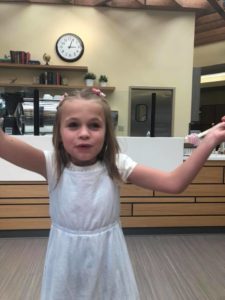
    Fast forward years ahead. We were at a wedding tonight. Ashlynn is 13, two months shy of 14. She has never had formal dance lessons and honestly PT is spent stretching out her tight muscles and OT is spent helping her complete daily living tasks in the home. That’s why tonight was so amazing.

    Ashlynn danced her heart out not only keeping the beat to the “Cupid Shuffle,” but also DOING the cupid shuffle!

    An Imagine Dragons song lyric popped into my head “I’m an apostrophe, I’m just a symbol to remind you that there’s more to see,” and I started thinking developmental delays are much like this. They may have taken a more unconventional route, and it didn’t look as clean as formal as the original, but they did things their way and the outcome is the same. In fact, I might argue, the outcome is even better. I’ll leave you, reader with another lyric from that same song,

    “I’m just a product of the system, a catastrophe, and yet a masterpiece.”

    At the time, due to my conditioning of the “system” in which we live, Ashlynn’s diagnoses seemed like catastrophes. I was honestly and embarrassingly now, devastated. How silly. If only I had know then what I know now, those differences are what makes her a unique and unparalleled “masterpiece.”

    Keep dancing my dyspraxia queen. You’ve earned every step.

  • Woes of regression

    Woes of regression

    If you’ve ever watched your baby fail to meet the simplest of milestones..

    If you’ve sat in meetings and offices and were told things like 1% percentile

    If you’ve felt a pain you can’t describe that is only eased by hope..

    You know why regression hurts so much.

    If you’ve ever driven your child back and forth to countless therapies..

    If you’ve ever felt a mix of pride, happiness, grief and so much more when they finally met a goal..

    If you’ve cried because you are always filled with a hidden grief but ecstatic at the same time when they made progress..

    You know why regression hurts so much.

    If you’ve ever watched your baby spend hours in an office while others kids played…

    If you’ve ever comforted them when they said life wasn’t fair needing comfort yourself because you agreed…

    But then watched them say a new word, jump, or write a letter thanks to those therapies..

    You know why regression hurts so much

    If you’ve ever been faced with professionals who don’t understand your child or their disability..

    If you’ve ever stayed up all hours with bloodshot eyes scouring Dr. Internet just to help your child..

    If you’ve ever then found a team and plan that was finally working for your child..

    Then..

    You know why regression hurts so much.

    Laura Smith, M.A. CCC-SLP is the mother to two beautiful children, one of which has a rare genetic mutation that caused a variety of developmental disabilities. She is the author of Overcoming Apraxia and has lectured throughout the United States on CAS and related issues. Currently, Laura is a practicing SLP specializing in apraxia at her clinic A Mile High Speech Therapy in Aurora, Colorado. 

  • The IEP meeting I wanted to attend.

    The IEP meeting I wanted to attend.

    I never knew before I had a child with an IEP (individualized education plan), how awful these meetings can be for parents.

    Before I had my daughter, IEP meetings were part of my job and I attended them weekly with a room full of colleagues and the parent or parents. I had no idea how it felt being on the parent side. I do now and it feels scary, nerve wracking, and very intimidating.

    I haven’t gone back and added it up, but today was at least the 9th and probably 10th IEP meeting (individualized education plan) we’ve had for my daughter Ashlynn. I don’t think I’ve ever had a meeting where I wanted to go to it. I can particularly remember the meetings that gutted me. Looking back it probably wasn’t any one educator’s fault. It was my position in the process of it all. It was like additional problems kept adding up. Just when I thought I had apraxia down, she would get ADHD, dyspraxia, issues with memory, issues with language comprehension……and the meetings were full of her can’ts. I could talk about how to write a strengths based report or run a strengths based meeting, but in the end even that wouldn’t have been enough to fill or patch the holes from the stab wounds from all of her can’ts.

    This time though was different.

    Starting last year, Ashlynn started to turn a corner. She was no longer speaking in as many “scripts” but was formulating her own novel sentences. She grew exponentially on her reading. The special education team got to know her and they saw what I saw and believed what I believed Ashlynn was capable of. Instead of the words “she requires more repetition than most,” hurting my soul, I was encouraged because they said it with the conviction behind it that they would get her those extra reps because she is capable.

    This entire past year I’ve felt the momentum and seen her IEP goals in action in Ashlynn’s everyday life.

    From SPED, I’ve seen Ashlynn finally understand money, time, and her math facts. She has RETAINED these facts. Did it take one hell of a lot of repetition? You betcha, but they did it and when Ashlynn has learned something, it’s like riding a bike; she doesn’t lose it. Ashlynn’s reading has continued to improve and we are working toward closing that gap. We aren’t there yet, but I SEE it. I SEE it and I feel the momentum. I’ve seen it within her book choices and through her reading out loud. In addition, many skills she needed accommodations for she is now independent with. She has mastered the classroom routine, she doesn’t need direct line of sight supervision for safety, and she is independent with basically all of her ADL’s (Activities of Daily Living). The one that made me smile was teaching Ashlynn to stop and think and give her time to process and understand what was being said so that she could give a thoughtful answer instead of just blurting out anything. We all laughed because she will frequently now tap her brain and say “hmmmm” to give herself time to think. Again, seeing IEP goals materialize in my child is not something I can quite explain. It’s phenomenal.

    From her SLP I saw the direct result from her working on formulating more complex sentences with “so” and “because” come to life at home. In addition, all the vocabulary work done in speech has seemed to literally lift Ashlynn out of her language disorder fog. Where before language was literally just flying over her head, she is comprehending and making connections like she was never able to before, and again I’m seeing that in her everyday conversations with me as well.

    From PT we remarked at how she can perform tasks like standing on one leg for 6-9 seconds and doing jumps etc, something that once seemed like a pipe dream with her hypotonia, cerebral palsy, and major motor planning problems. I told her how she could now ride a bike with no training wheels and that Ashlynn chooses to do workout videos and could follow along.

    From OT we marveled at her mastery of her ADL’s around school, how she can tie her shoes now, and her ability to follow up to 3 step directions that involve motor planning tasks. With adapted graph paper, Ashlynn’s can complete writing assignments and really is just working on putting it all together: getting thoughts on paper, letter formation, spacing, punctuation and legibility. She can do all of those tasks adequately if given separately. I’ll take that. There was a time she couldn’t write her name. That took “more repetition than most, ” but I smiled this time. I had it all wrong before when that phrase would burn me. No one said she can’t do it, and that’s what’s important. More repetition than most? Deal. Bring it on. THAT we can do.

    From mental health she is doing great with whole body listening and finding more peers to play with and inserting herself into play on the playground. Next step is learning how to engage socially with peers in conversation.

    The whole meeting was amazing. I was on cloud nine. The takeaway? Ashlynn’s going to make it.

    I sat there and thought back to Ashlynn’s early days. Was this really the same girl? The girl who would get too distracted she couldn’t even hang up her coat and backpack and get to class without assistance? Was this the girl who spent all of preschool, kinder, and preschool just learning the letters of the alphabet, much less learning how to read? Was this the girl who spent Kinder, 1st, and 2nd grade trying to master addition and subtraction and now was rocking that but also money and time? Was this the girl who was so clumsy and uncoordinated that she couldn’t ride a tricycle or put her shoes on the right feet much less tie them?

    It was and she was freaking killing it.

    Though there were many, many, many times I felt defeated, I NEVER was defeated. I always held the vision for Ashlynn. I held it steadfastly in my mind and promised her that even if I was the only person who ever saw her potential, I would never give up on her and I would fight to the end. I was prepared for war. I listened to inspirational songs and videos to keep the faith. I also worried and fought and lost sleep and prayed. Oh did I pray, but it wasn’t that she would overcome. I always knew that you see. I always knew she had a divine purpose. I prayed for a team that would see Ashlynn like I do and help her fly.

    A couple of months ago, filled with gratitude, I nominated her SPED teacher for a district award.

    It’s called the Golden Heart Award and is bestowed to any educator in special education who has gone above and beyond for a student in the program. Because coincidences are the Universe or God’s way of talking to us, Colleen received notice she was awarded this honor TODAY – the day of Ashlynn’s IEP.

    I thought to myself,

    “Sounds about right.”

    Laura Smith, M.A. CCC-SLP is a 2014 graduate of Apraxia Kids Boot Camp, has completed the PROMPT Level 1 training, and the Kaufman Speech to Language Protocol (K-SLP). She is the author of Overcoming Apraxia and has lectured throughout the United States on CAS and related issues. Currently, Laura is a practicing SLP specializing in apraxia at her clinic A Mile High Speech Therapy in Aurora, Colorado. 

    Purchase Overcoming Apraxia on Amazon.

  • Top Ten SLP Mommy of Apraxia Posts for 2018

    Top Ten SLP Mommy of Apraxia Posts for 2018

    Hi readers!  I haven’t been as active on the blog as usual because my goal for 2018 was to write a book and I’m happy to say I completed that goal!  My goal of 2019 is for it to be published, so we will see!  In the meantime, I did manage to get some blogging done and here are my top 10 posts for 2018!  Thank you so much for your support and your love throughout the years.  It truly means so much.

    1. The Problem With School SLP’s

    A

    2. Interview with Mikey: The Wish That Turned Into a Passion

    3. Apraxia as a Symptom to a Bigger Picture

    4. Strategies to Promote Speech and Language in the Pre-Verbal or Minimally Verbal Child with Apraxia

    5. This School Year, Teach your Children to be Kind

    6. Finding our Umbrella

    7. Good SLP’s are Addressing the Head in the Hands

    8. The 6th Apraxia Awareness Day Brought Smiles, Tears, and a Jaw Dropping Moment

    9. Report Cards are Bitter Sweet in Special Needs Parenting

    10. Old Faces, New Faces, and the Passing of the Torch

    Cheers to an eventful 2018.  It was a year full of pain and happiness, love and sorrow, and hope and despair.  May we all remember that life can be intensely beautiful and irreparably sad all at once, because that my friends, is the definition of living.

    This 2019, I wish you all the gift of perspective in life.  We all have bad things happen.  We all have stress and we all have pain.  We also all have a choice, and that choice is to wake up each morning with a grateful heart and to focus on our happy and joyful moments rather than be sucked into the pain of despair and heartache.  There was a time Ashlynn’s dx seemed like the darkest event in my life, but I realized it was the beginning of my testimony to some of the most beautiful characteristics this human life affords us.  May God bless us all this year and always.
    Love and Peace,

    Laura

  • Disabilities, extraordinary abilities, and lessons in neurodiversity

    Disabilities, extraordinary abilities, and lessons in neurodiversity

    Neurodiversity and learning disability were never in my vocabulary before I had my daughter.

    I had never been exposed to learning disabilities of any kind really, and I had no idea the extraordinary gifts those who are neurodiverse had to offer this world.

    No, when I was in second grade, I was in my egocentric world and our teacher had us write “a book.”  It was a short story and we were to write on the typical school paper that has a box at the top to draw an illustration and then lines at the bottom to write the story.  Writing was always my thing.  Art….was……not.  I usually skipped the picture and went straight to writing.  In my defense though, I never technically had an art teacher.  However, even if I had, I’m sure I would have still been that defiant snotty little girl who turned up her nose at art.

    During one edit, the teacher told me the book was great but I needed illustrations.  I argued with her.  Her job wasn’t to teach me how to draw, her job was to teach me how to write.  Drawing was for the kids who didn’t know how to write and I knew how, so what did it matter anymore?  Did I mention I also went to a Catholic school, so I was marked down automatically for being sassy?  I never pulled that again, but it didn’t stop me from internally rebelling against drawing.

    “When will I EVER need to know how to draw as an adult?” I indignantly exclaimed to my mom.

    My Catholic school teacher had the last laugh though when I became a speech/language pathologist and discovered I needed to know something I didn’t know how to do.  You guessed it.  Draw.

    “What is that?  Is that a dinosaur?” one kid would ask of my drawing of a horse.

    “That’s supposed to be a bird?” another asked of my drawing of an airplane.

    Yes friends.  That sassy, know it all second grade girl started wishing she had paid more attention to art.

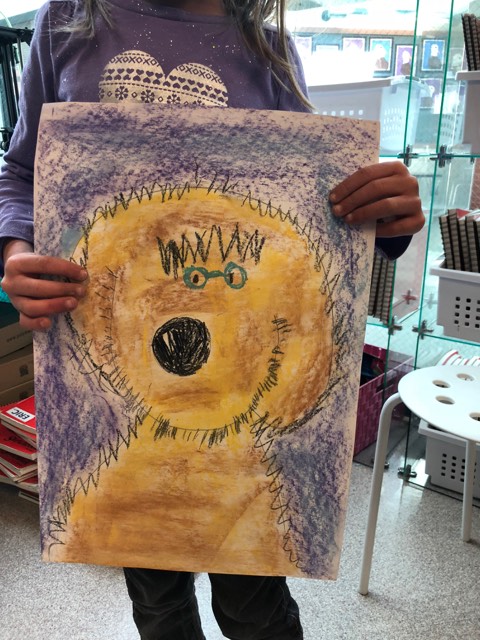
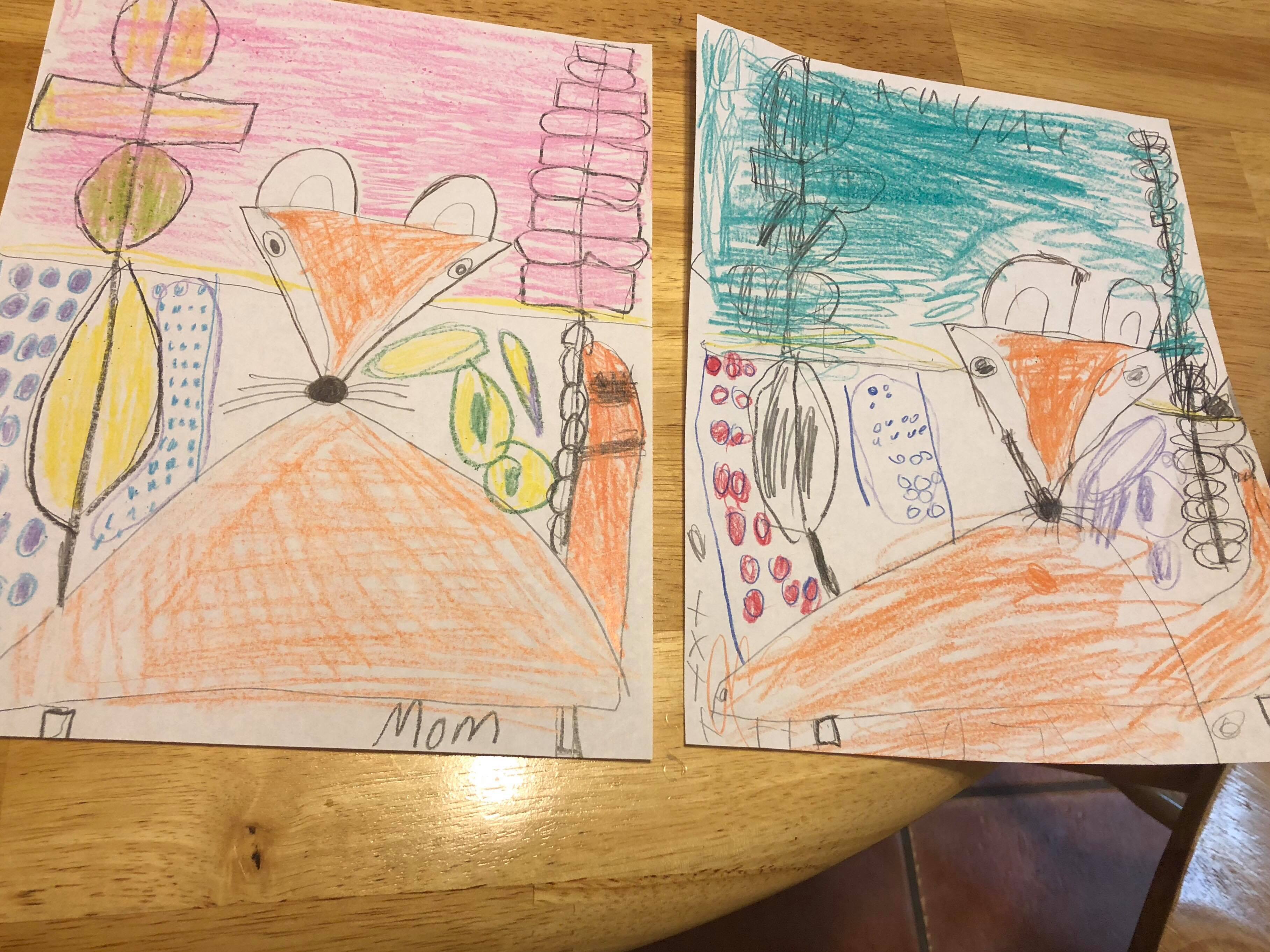
    Fast forward 30 years and I have a little past second grade daughter myself.  She has a laundry list of learning disabilities, many stemming from an etiology in motor planning and cerebral palsy.  Everything for Ashlynn seems hard.  She has had to fight and claw her way to learn anything through hours and hours of therapy.  I’m not kidding.  In Elementary school, she started coming home with art pieces from art class that were nothing short of amazing.  They were so amazing, it was sadly hard for me to believe that she did them without help.  However, her art teacher maintained she taught all the kids in a very structured way, giving them multiple opportunities for practice (think motor planning) before completing the final piece. This was Ashlynn’s best one from last year.
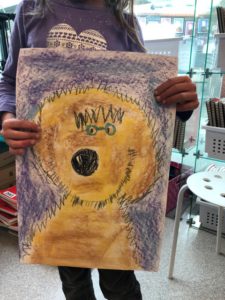
    Despite this, Ashlynn had never demonstrated to me independently she could draw even remotely close to this on her own.

    That was, until tonight.

    “Mommy, do you know how to draw a fox?” Ashlynn asked me tonight at dinner.

    “Oh baby, I don’t really know how to draw much of anything,” I answered while my husband snorted his drink out his nose in laughter before adding,

    “That much is true!  Mommy is not an artist.”

    I shot him an evil glare but unfortunately there was no denying the truth.

    “Can I teach you how mommy?  I learned how to draw a fox in art?” Ashlynn offered.

    I agreed and after dinner she had gathered paper and coloring utencils and set to work.  I really wasn’t sure what to expect.

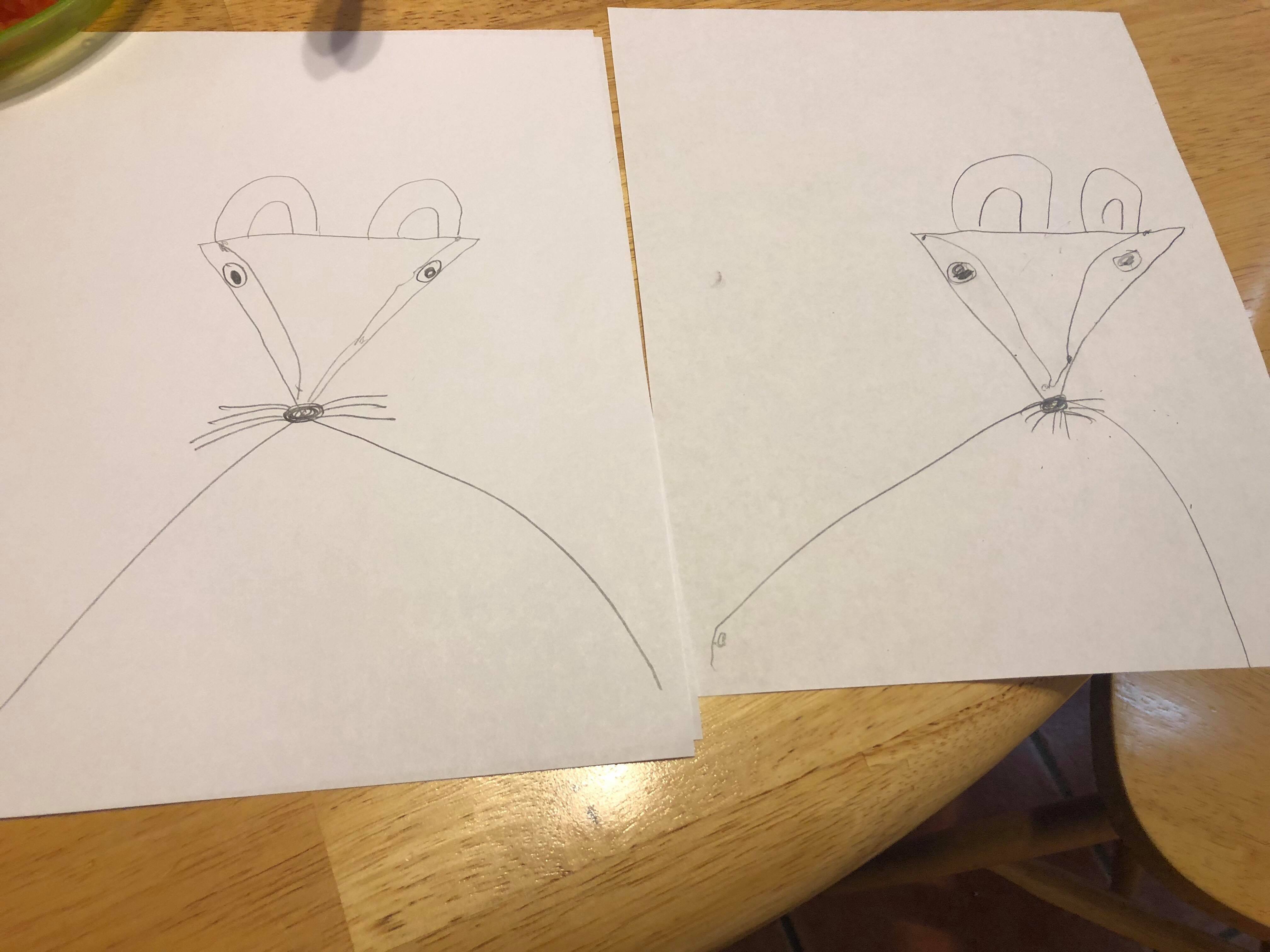
    “Put your fist in the middle of the paper like this, and now draw a line across the top,” she instructed.

    I complied.

    “Now connect this line to this line and see?  We made an upside-down pizza,” Ashlynn continued.

    I looked at the perfect triangle and my mind raced back to three days earlier at OT where the therapist told me Ashlynn’s hardest shape to draw is a triangle because of the diagnal lines. I stared incredulously again at Ashlynn’s perfect triangle.

    “Mom!  Are you paying attention?”

    She then took me in precise detail through the rest of the picture.
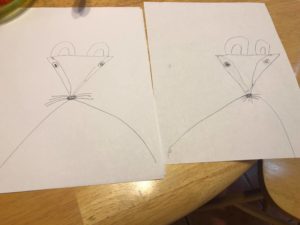
    I was impressed by this.

    “You are such a great teacher Ashlynn,” I said.

    “I know mommy because I want to be a teacher you know that.  A teacher and a dog walker because that’s my deal.”

    I smiled.  She just produced a compound complex sentence.  This girl with apraxia and a language disorder just said that.

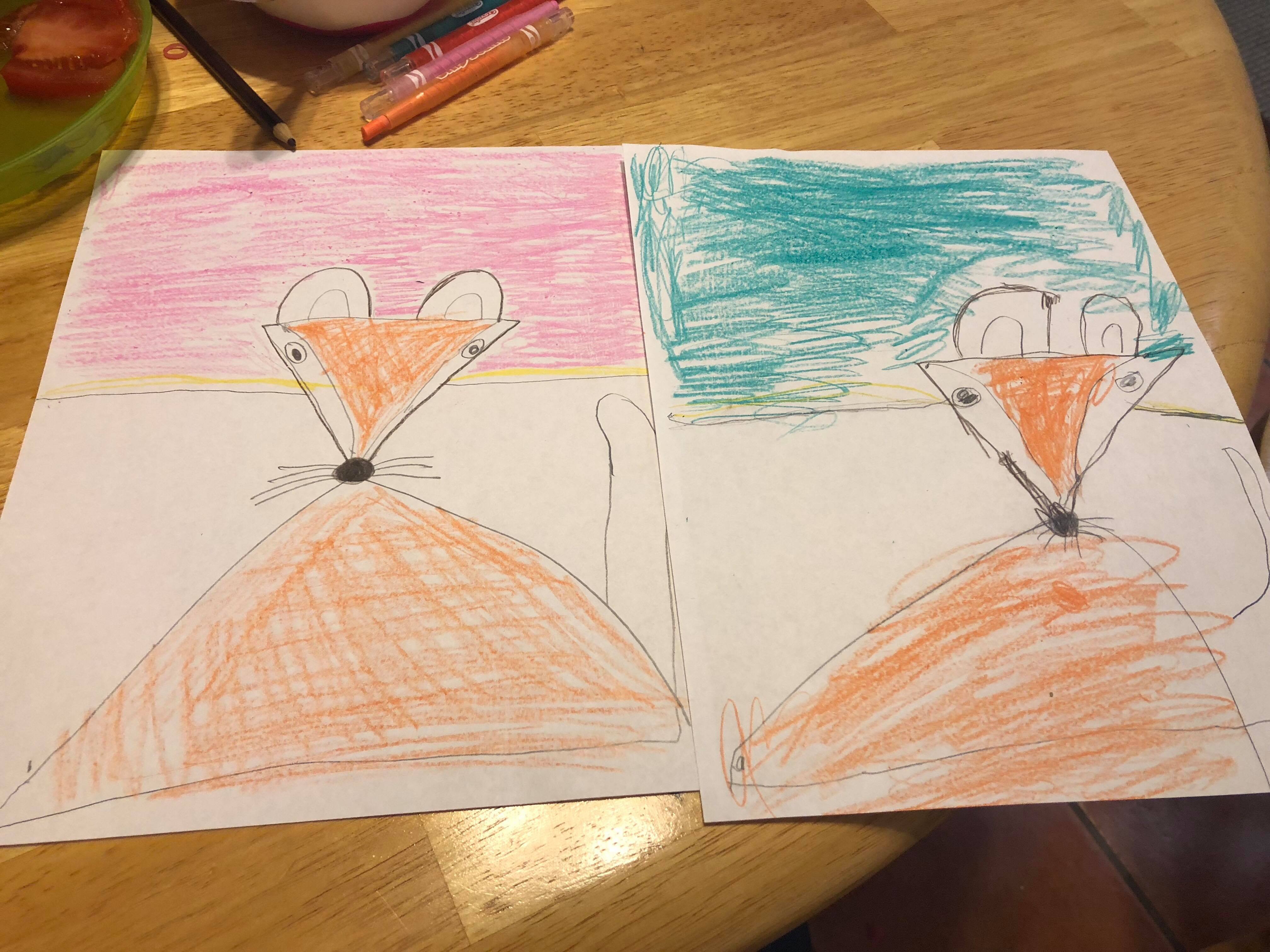
    Next was the colors.
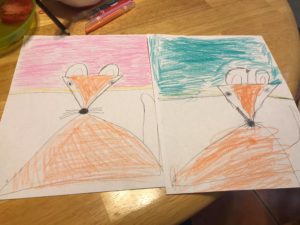
    I fought back tears.  This was incredible.  I watched her color the page with her wrist fluidly and precisely moving back and forth and my mind flashed back to when her OT told me that until she is able to isolate her wrist from her arm, she would always have trouble coloring within the lines.  I marveled at her wrist now.  Isn’t that crazy?  What mom would marvel at their child’s wrist and control unless they had witnessed how hard that skill was to master.

    Next was texturing and drawing the trees.
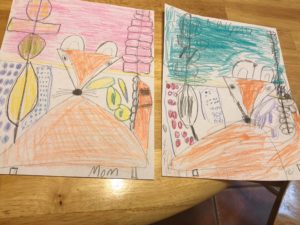
    She used these terms I had never heard like “we have to jump and bump.”  I followed along dutifully.  At the end of her lesson I praised her.  It was incredible.

    “But Mommy, we aren’t done!” she said as she got out two new blank pieces of paper.

    She told me we had to write about them.

    Write?  Like actually write?  This girl with motor planning, dyslexia, and dysgraphia now wanted to write about the fox?  She began writing but immediately messed up her spelling. As she peered over at my page that she had dictated, she decided to just copy my sentence. I watched her form the letters as she had been taught and practiced throughout her years of OT and copy my sentence. There was a time, she couldn’t even copy her name, I thought to myself.

    “Sorry, mommy, ” she said, “I can’t write really good yet.”

    I responded, “That’s okay, because I can’t draw very well.”

    “But I can teach you!” she said happily.

    With tears in my eyes I told her,

    “If you teach me how to draw, I’ll teach you how to write.”

    “DEAL!” was her enthusiastic response.

    So that’s the deal.

    Thirty years later my art teacher was a 9 year old girl with cerebral palsy, severe motor planning deficits and a laundry list of learning disabilities whose greatest wish in the world is to be a teacher.  Little does she know, she already is.
     

  • SLP’s integral role in the five components of reading

    SLP’s integral role in the five components of reading

    When I was younger and learned to read, I remember I was taught phonics.  I remember the phonics workbooks I had, and would read the rules at the bottom of the page for spelling.  It was all very systematic. Little did I know at the time, phonics was just one part of the five components of reading that can contribute to reading disorders.

    Today, a concept called whole language dominates our public education systems.  Not every school district or school uses this approach, but very many of them do and it is at a detriment to our children who have reading disorders.  Some critics go so far as to say whole language is “anti-phonics.”  I don’t believe it’s quite that extreme.  However, for kids who have reading disorders, the vast majority struggle with phonemic awareness and decoding, which a whole language curriculum is not even close to adequately addressing.

    I’m fortunate that when I started my career, Ashlynn’s SLP was very knowledgeable on the topic.  I had no idea that learning about the five components of reading before my child was even conceptualized would come back and benefit her some day.

    So, what are the five components of reading?

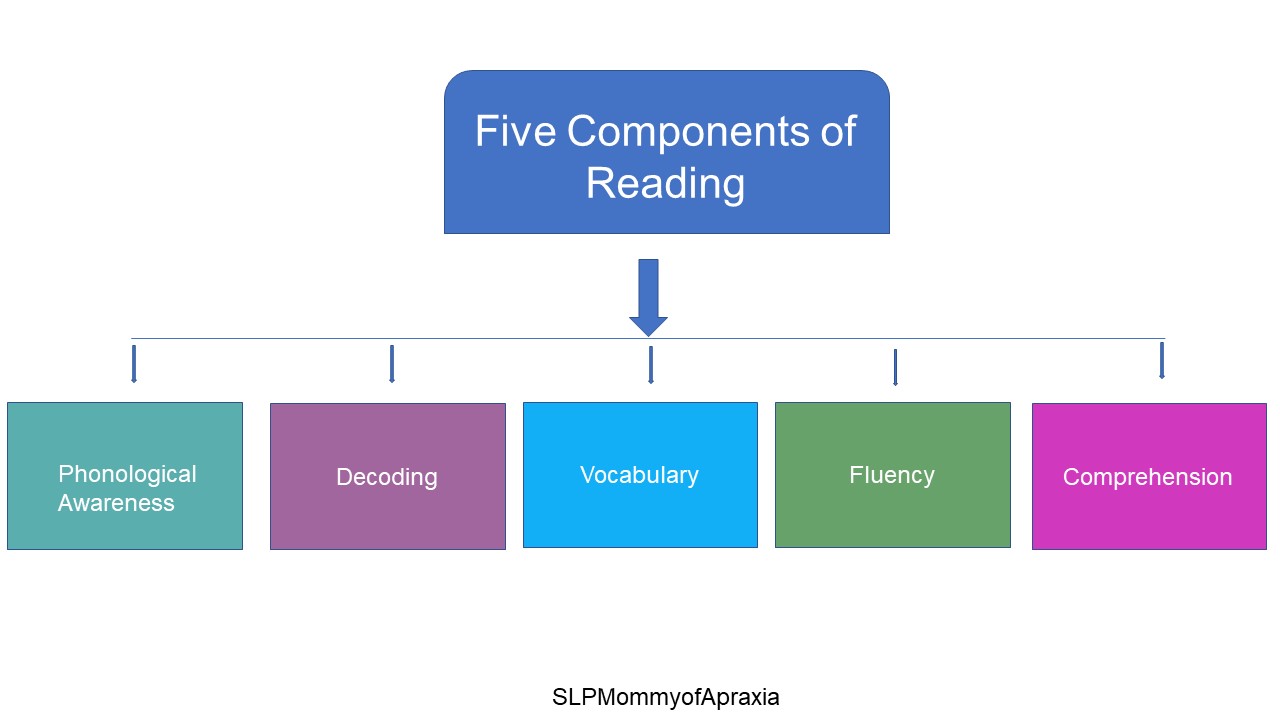
    They are: Phonemic Awareness, Decoding, Fluency, Vocabulary, and Comprehension. These areas were identified by the National Reading Panel that was convened by Congress in 1999. It’s very important that parents and educators are aware of these five components, because weaknesses in any one component can cause a child to struggle to read.

    Speech/Language Pathologists can play a big role in reading.  They are trained and certified to treat children with three of the five components.  A Speech/Language Pathologist can work on phonemic awareness, vocabulary, and comprehension.  This is why they are frequently on IEP’s when children have reading disorders.  It is very infrequent that the older school-aged child with dyslexia is seeing the SLP to work on their “sounds.”

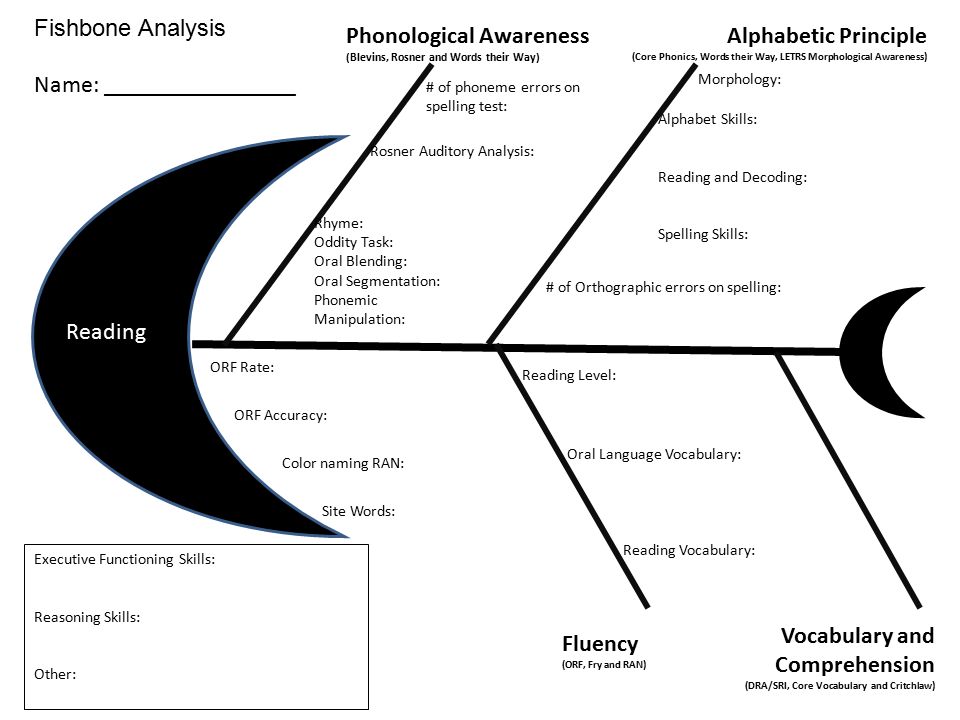
    Parents and educators all need to be aware and familiar with these five components if they want to help children effectively who are struggling to read.  During my time in Denver Public Schools, an excellent teacher advocated the use of a “fishbone” analysis when testing kids who were struggling to read.


    As you can see, it contains the five components of reading, and spaces to document a child’s performance in all five areas.  It could be possible to have a child who has difficulties in all of these areas.  However, more frequently a couple of areas usually stand out.  One area that is frequently a problem is with phonological awareness skills.  This can be tricky because elementary school children many times get identified with a reading disorder past the time that instruction with phonological awareness is taught.  Teachers jump right into reading instruction without realizing the child is lacking the basic building blocks for reading in the first place.

    So what is phonological awareness?

    Phonological awareness refers to a child’s ability to manipulate sounds out loud.  Tasks included in this umbrella might be to identify the initial sound in a word, blend sounds, segment sounds, identify the last sound in a word, or be able to identify and formulate rhyming words.  Logically it would make sense why this is a building block skill.  If a child can’t do these things out loud, it’s going to be very difficult to transfer these skills when looking at graphemes (letters).

    Phonics/Decoding

    Phonics refers to the actual act of sounding out words.  To do this skill, children need to have mastered knowing letters and letter sounds, and then be able to use this knowledge of letter sounds to “decode” a word.

    Vocabulary

    A child’s vocabulary many times affects background knowledge, which is important in reading.  If the words they are trying to read hold no meaning due to low vocabulary skills, it is going to be harder for them to understand what they are reading.  In addition, a child with weak vocabulary skills will have a harder time monitoring their comprehension when reading sentences.  I see this all the time as an SLP. An example of this would be if a child were to read the sentence “He saw the dog.”  Instead of “saw” he/she read “sam” and they would continue reading.  Many children without a language disorder would realize “He sam the dog” didn’t make sense and go back and try and fix the sentence so that it makes sense. Kids with language disorders have a very difficult time with this skill.

    Fluency

    Fluency refers to a child’s ability to read text accurately and quickly while maintaining good expression.  The ability for a child to read fluently helps with comprehension.  If a child’s fluency is slow and choppy, they may be allocating so much brain power to decoding that they are not monitoring comprehension. If a child lacks expression in their reading, this too can affect comprehension.

    Comprehension

    Comprehension is simple terms, means understanding what we read.  Kids with a mixed receptive/expressive language disorder or an auditory processing disorder frequently experience difficulties with text comprehension.

    What does this mean for parents?

    The bottom line for parents is that reading is a complicated process that has many components.  A deficit in one or more of the above listed components can cause a child to struggle when learning how to read.  Children with speech and language disorders are at high risk for reading disabilities. Being aware of all five components helps parents be more informed regarding treatment approaches and options their child may need to catch up in reading.

    This article contains information from the National Reading Panel’s Findings


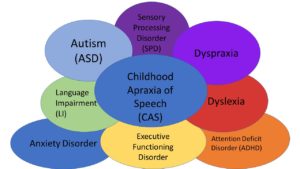
    Laura Smith is a first and foremost a mom to two amazing children, one of which who carries a constellation of invisible labels including: Childhood Apraxia of Speech, dysarthria, SPD, ADHD, MERLD, dyspraxia, dyslexia, and cerebral palsy. She is a speech/language pathologist specializing in Childhood Apraxia of Speech following her daughter’s diagnosis.  SLPMommyofApraxia is her space to share her professional and personal experiences related to the complex but beautiful world of neuro-diversity and to spread a message of hope, positivity, acceptance, and kindness.