Category: Therapy for apraxia

  • Motivating Games for Speech Therapy Tested by Kids!

    Motivating Games for Speech Therapy Tested by Kids!

    As fun as I try to make speech therapy, as an SLP, I’m aware I sometimes need to inspire motivation!  Sometimes, we need to switch things up, or try new games and activities!  I recently asked my facebook community what their kiddos top motivating games are to play in speech therapy while working on targets. I had many of them, but some I don’t use much and others I haven’t heard of!  I hope you enjoy the suggestions as much as I did.  P.S.  Parents always ask what make good presents for SLP’s.  Games and therapy materials are ALWAYS appreciated and are a gift that keeps on giving!

    Don’t Break the Ice was the most popular game reported on my facebook page poll!

    I currently don’t have this game, but when I did I’ve worked on final /p/ saying “tap” or final /t/ saying “hit” or final /s/ saying “ice.”  So many more ideas you can do.

    Pop the Pirate

    Pop the Pig!

    Pop the Panda!

    I was wandering around Toys R Us one day and found this game.  So many good possibilities!  VC words: eat, in.  CVC words: push, down.  CVCV words: Panda, bamboo

    Honeybee Tree

    My kids request this one a lot.  I’ve worked on everything from targeting the word “in” and “out” when we put the leaves in and take them out, or just working on /l/ and saying “leaf” everytime we put a stick in.  As a bonus to work on prosody, we sing “Baby Bumblebee” too.

    Crocodile dentist

    A game kids will either love or hate.  You push down the teeth one at a time until the crocodile chomps you.  Work on targets: teeth, down, push OR just have the child say a target word before he pushes down a tooth.  We can work on prosody too with this game using our “scared voice” as we push the teeth down and then are LOUD voice when we get chomped.

    Jenga:

    A classic.  You can have the child say a target word before pulling out each piece.

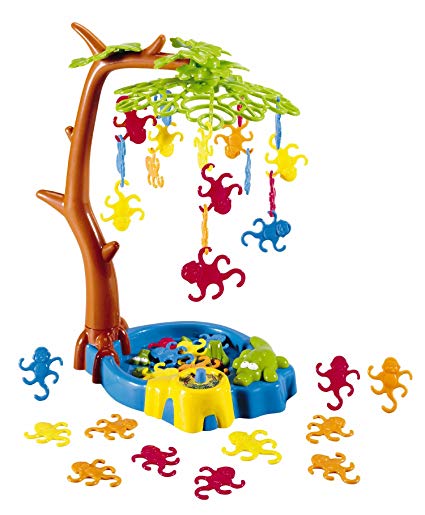
    Monkeying Around!

    I had a girl who would literally say and do anything as long as she could play this game.

    Don’t Spill the Beans.

    I had one kid working on final /n/ and we first worked on “on” everytime we but a bean on, and then moved to “bean on” maintaining articulatory accuracy for both final /n/, until we worked ourselves right up to “put the bean on.”

    Guess Who

    This game is great for working on syntax within question forms among other things!

    Zingo has a bunch of words our kids are working on and is a favorite in therapy and at home!  How do you use Zingo?

    Catch the Fox!


    Thrift store wish list!

    There are some games that are GOLD but aren’t sold anymore.  If you see one, pick it up!

    Cariboo!! So versatile and so popular among SLP’s, there are even programs that make customized layouts to set over the board to practice target words and sounds.

    Puppy Racers.  Rec from a reader but doesn’t look like it’s made anymore.


    Have any more suggestions?  Add it in the comments below.

  • A Gift of Speech Printables Giveaway!

    A Gift of Speech Printables Giveaway!

    Today I’m featuring A Gift of Speech’s Shannon Archer!  Included in this bundle will be THREE separate activities you can print out and start using!

    Interactive Multisyllabic Words! Minimal to No Prep Activities in color and black & white! Practice multisyllabic words with multi-modalities: visual, auditory, tactile, verbal, and FUN!

    Activity include 23 pages of interactive activities to practice multi-syllabic words!

    This activity was created to help work on multisyllabic words in an interactive way. There are 3 and 4 syllable words included in this practice. This activity includes:

    1. 20 interactive pages 10 in color and 10 in black & white. There are 24 different multisyllabic words in these pages (3 and 4 syllables). The activity was designed to use backward chaining or syllable build up. Thus the syllable divisions might look different. This is to account for the coarticulation in the words.
    2. 2 color pages with images and syllable support dot with the words.
    3. 2 different crowns to cut, color, and practice with.
    4. Circle interactive cut, color, and fold pages (which includes 6 multi-syllabic words).

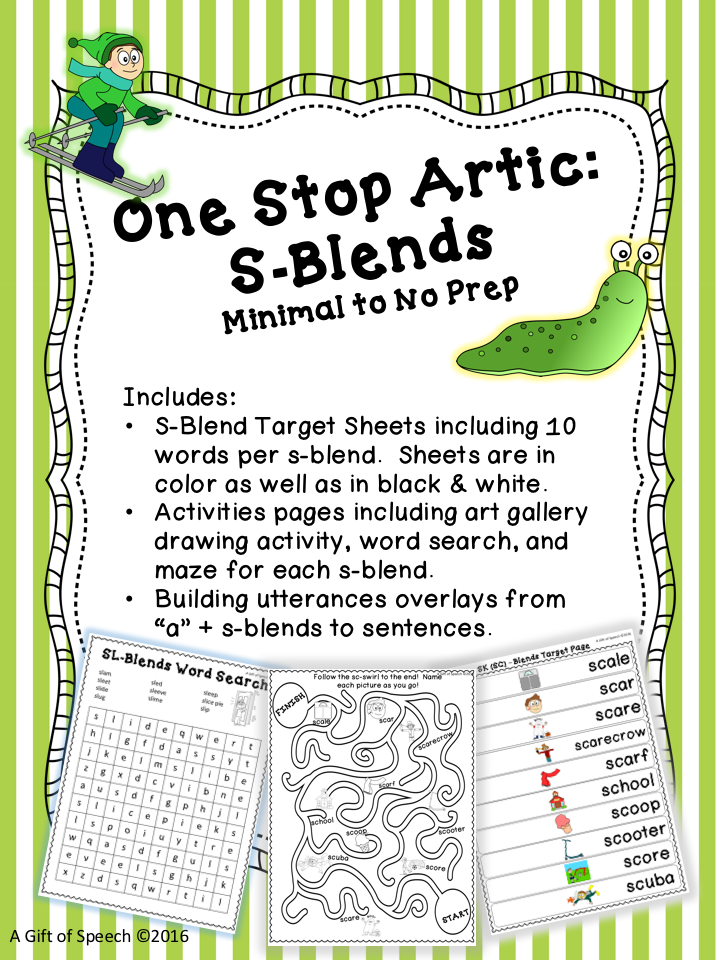
    The One Stop Articulation activity for s-blends includes activities for practicing s-blends. We start with a target page including 10 words for each blend sound (sk, sl, sm, sn, sp, st, sw). Then there are 3 activity pages for each blend. There is an overlay to support movement from the s to the following consonant blend sound as well as coarticulation and increasing the length of utterance. This activity include no-prep and minimal prep activities for articulation practice.


    Expanding Utterances was created to help with building utterances (MLU). This is perfect for working with individuals with CAS, articulation disorders, or expressive language disorders. This activity combines a subject, verb, article/preposition, and object to create phrases and sentences. You can start with “bunny”, “a bunny”, “see a bunny”, “I see a bunny”, and then to “The girls saw the bunny”.

    The subjects include pronouns and basic subjects. The verbs include 8 basic verbs in present, present progressive, past, and future tenses (look for more verbs coming soon). There is a set of 3 articles and 12 alternative words (prepositions and some prepositions with articles). The Keep Talking 1 comes with 23 cvcv words, 40 multisyllabic words (CVCVCV and CVCVCVCV), 38 plural multisyllabic words, and 16 trochee words. The parts of speech are color coded (modified Fitzgerald key) for additional cueing. Also included are blank color coded cards so that you can make your own words. I use this system with the created object cards as well as mas produced articulation card sets. There are full color and find and color activities to add some fun.


    a Rafflecopter giveaway

  • Apraxia and the village.

    Apraxia and the village.

    I work in the schools a few days along with my private practice work.  I say I work in the schools because I like working in Ashlynn’s school, and that’s partially true.  However, I have always in my career had at least one child on my caseload with apraxia in every school in which I have worked.

    If you have a child with apraxia, you’re probably thinking, “what’s the big deal?”

    If you are an SLP, you might be thinking, “Wow!  I’ve only ever had one, or none, or….”

    Anyway, if you are in the apraxia community, you know about the “apraxia coincidences” and if you know me, you know I don’t believe in coincidences.  So part of me feels like I’m put at a school I am at because I can be of service and have a connection to a particular child, with Ashlynn’s school being no exception.

    Currently I have a 4th grader that I see and I can only say so much because of confidentiality, but I love this boy.  Actually, I wrote about him once.  You can read about it here, but it turns out, I was right.  He’s gifted.

    Ha!  As I went to link that last post, I had actually included this graphic two years ago.  How things come full circle right?

    Anyway, his nonverbal IQ is off the charts and now he’s in the gifted program.  However, he’s a fourth grader and still can’t read or write, such is the extent of his disability.  I can’t imagine being so smart, but being unable to read or write.  Such is his life.

    We have every AT tool at his fingertips.  Technology though still hasn’t totally caught up to the extent of his disability.  His grades remain sub-par, and he is unable (and many times defeated so he’s unwilling) to produce any written work.

    There are sooo many people in this boy’s life who believe in him and who want to help him.  Meeting after meeting takes place behind the scenes.  I’m serious.  If you don’t work in the schools, you have NO idea the mobilization and time occurring on behalf of our children.  I know his parents don’t.

    Anyway, after at least two major meeting of the minds with every professional expertise (OT, Speech, SPED, gen ed, ATRT specialist, TA), we finally came up with a plan we thought will help him become more independent with his school work regardless of current reading, writing, or spelling ability.

    We set a meeting date of today with ALL of these above listed professionals and the child.

    Let me take a quick digression.

    A week ago, I posted on my SLP Mommy of Apraxia/Dyspraxia Fb page that the librarian at the school stopped me to show me this book called “Fish in a Tree.”  The book is written by a woman who had dyslexia as a child, and writes a fictional novel based on real life events about her life and the people in it.

    The librarian read this one chapter to me the other week, in which the girl’s teacher listed famous minds of our past and current generation.  They all were brilliant, but as it turned out, they were all believed to have had dyslexia.  I was so inspired.  I couldn’t WAIT to read it to my 4th grader.  The librarian was going to read it aloud to the entire class during library time, but she wanted me to read it to this child first so he knew we were all thinking of him.

    Today I got the chance.  I asked him if he knew the names of the people and what they were famous for.  He didn’t disappoint.  He can’t read, but he knew most of them as I read them to him:

    Thomas Edison? – “Invented the light bulb”

    Alexander Graham Bell?  – “Invented the telephone”

    Albert Einstein? – “Really, really, really smart.” 🙂

    Walt Disney? – “Made Pluto!”

    The list went on, and as I read the pages to him, some he knew and some he didn’t, I swear I could see a spark glow in his eyes and it was everything I could do not to cry.  People, this boy is as brilliant as all these people I was reading to him.  I honestly believe that, and it’s not just me….EVERY professional who works with him feels the same way; but if  you can’t read, and you can’t write and you’re in the fourth grade, you don’t feel that way.

    I barely got through reading the entire thing without completely breaking down.  When I finished there were stars in his eyes.  I’m telling you.  Bright, bright stars, and he smiled as he said, “Wait, all those people were like me!  They couldn’t read, but they were super smart and they invented stuff BECAUSE they weren’t typical.”

    I nodded my head.  That may not be a completely accurate assessment but I sure wasn’t going to contradict it, would you?  Oh, and I should mention, his comment came after a therapy session we had a few weeks ago in which I showed him Mikey from Mikey’s Wish who was talking about “neurotypical” and “neurodiverse.”  I knew he was alluding to this because he was inspired by the idea of being “neurodiverse.” (Thanks Mikey).

    As fate or coincidence would have it (coincidences aren’t coincidences), let me take you back to the meeting of all the professionals, the village, that helps this 4th grade student.  We scheduled another meeting, this time to include him.  It just happened to be that it was right after I read him those excerpts on these brilliant minds needing to find another way to express themselves.

    I took him to class where the meeting was about to take place, and his awesome 4th grade science and math teacher, who had already prepped him (for being in such a daunting meeting by himself with so many adults) told him we are here because we believe in him, and sometimes great minds have to find another path to greatness.

    His eyes lit up.  “Like Albert Einstein, and Disney, and the guy who invented the telephone!”

    People, the tears were in full force behind my eyes, but I still didn’t let them go.

    As the entire special education and general education team piled in, I watched this incredible strong and resilient 9 year old, listen to the plan set before him.  He was surrounded by people who loved him, but still.  He was outnumbered by 1:9 and he listened to our plan on how to help him read and write using technology, and, get this….his VOICE.   Yes, his VOICE would be a huge part in his written output via voice memo, and that’s possible, because he has one.

    We are all under no illusions.  We know this will be hard for him.  We know he will be frustrated and maybe even resist.  But literally, 8/9 people at that table believe he is capable (the 1 out-liar being him), and as one of his reading specialists said, “Maybe he doesn’t believe he can do this, but hopefully he will remember all the adults who think he can and it will keep him moving forward.”

    I was so proud to be sitting there as part of his team….his village; because we all know, these kids need a village.  I was trying pretty hard to reign in my emotions.  I thought about how lucky Ashlynn is to have this village too.  I don’t need doubters in her corner, I need believers; and I really know we have that.

    Oh, and about my 4th grader.  Believe me when I tell you he has BIG ideas.  His ideas cannot be adequately explained through his reading, his writing, or even his voice. I predict one day these BIG ideas will be turn into something even bigger.  I look forward to seeing it.


  • The problem with school SLP’s.

    The problem with school SLP’s.

    I only realized after being a part of the special needs community that school SLP’s have a bad rap.  Like a really, REALLY, REALLY bad rap.  

    I’m preparing a talk next month for Colorado school SLP’s, and every time I prepare a talk for this demographic, I have to tell you they have a special place in my heart.  No, it’s not just because I started as one and work as one part time, but it’s because I have literally worked under, with, and around many, many, MANY of them. I have worked with so many of them, and I can tell you they are a jack of all trades.  They are the EXPERT in eclectic, and may be the ONLY person in the school who understand in depthly just how a student’s unique communication challenges actually affect them in school.

    In the schools, you don’t have the option to specialize.  Kids from every disability show up on your caseload and you are expected to be the expert.  It might be hard to understand as a parent, but there are soooo many different disabilities and speech and language disorders, and a parent (rightly so) expects the SLP to do right and best for their baby.

    Every single SLP I know and have met has a desire in their heart to help children.  Please, let that sink in.

    When I took Ashlynn to her first private SLP who had never worked in the schools she was asking me about qualification.  She asserted that she could never be a school SLP because she felt it was unethical to not qualify students who clearly had some sort of speech or language problem.  I had a hard time refuting her.  Aside from saying qualification is different in the private versus educational sector, I really had no excuse.  I know that funding is limited in the public sector so that obviously plays a part in qualification.  I also know if every SLP took her stance, than NO kids would be serviced in the public schools, and is that really what we are going for?

    Public school SLP’s have caseloads that are probably double if not more of the private SLP.

    Where the private SLP can see kids 1:1, school SLP’s rarely have that luxury.  With weekly caseload averages around 45 to 55 and some maxing out at 90 (Yes 90 people I’ve seen it), even the most skilled SLP will not be able to do what a private SLP can do 1:1 for 45 minutes (though they will kill themselves trying).

    The result?  Parents become outraged at the lack of progress or progress they feel the child should be making. They surmise the school SLP just isn’t as good as the private SLP and they become disillusioned and write them off.  They post memes about preparing for battle when going into an IEP meeting! This honestly breaks my heart.  I feel bad for the parent who feels the SLP doesn’t care, and I feel bad for the SLP who is trying to manage an unmanageable caseload, writing IEP’s at night, or staying up until 2 Am (true story from an SLP I just talked to last week) to write a lesson plan, only to be ravaged by a parent unsatisfied with the results.

    I’m not sure if everyone is aware of this, but ANY SLP in ANY setting is as qualified as the next SLP by basic certification standards.  What does that mean?  That means, as long as an SLP received their masters degree and the Certificate of Clinical Competence (CCC) through ASHA they can work anywhere.  So that means, your school SLP can apply for a job at Children’s Hospital right now and probably get hired tomorrow (because in case you didn’t know there is an SLP shortage as well).  For some reason though, there is this perception that the school SLP just isn’t as good as the private SLP.  If it’s true, it probably has MORE to do with caseload and workload size than it actually has to do with the qualification of the SLP.

    I get calls and emails all the time from concerned school SLP’s desperate to meet the needs of their kids with apraxia but not knowing how.  They want to see the kid more, or see the child 1:1, but their caseload simply does not allow for it.  They cannot add more hours to the day, yet they still call, or write and wonder if there is something they have not yet thought of.  Oh, and here’s a dirty secret.  Listen close.

    Are you listening because this is VERY important.

    If an SLP feels in their heart a child needs private, supplemental speech services, they CANNOT say it.  People, they CANNOT tell you this.  Why?  Well, their license and job is on the line.  In most cases, school SLP’s are told not to recommend any sort of outside therapy.  Why do you ask? Why?

    I’ll tell you.  If a school SLP recommends outside services, the parent can sue the district and win, and potentially disbar an SLP from ever practicing again.  Are you asking why again?  I’ll tell you.  If a school SLP recommends outside services, they are essentially saying that the child can not benefit or make progress from the therapies provided by the school, and the school is required by law to show progress.  If the SLP recommends outside service thereby saying the school is inadequate, the school gets worried or they will get sued for not providing adequate services and the SLP potentially fired.

    Would you take that risk?

    I’m not saying unilaterally every school district would do this, I’m just saying, school SLP’s are told this is a possibility, and so they would find it best not to recommend outside services.

    You need to know this as a parent of a child with any disability.  Some SLP’s will risk their professional license and recommend this to you.  Let me  tell you though what they are risking.  They are risking 4 years of a bachelor degree, 2 years of a masters degree, 1 year of a clinical fellowship, and the usually 3 years of probationary status as a teacher.  That is an entire decade of work and dedication to a profession they love and believe in.  Would you take the risk then to recommend a parent pursue outside therapy?  This is where they are at!  It is truly a catch 22.

    If you are upset about your school services, you probably have every right to be!  I was VERY unhappy with Ashlynn’s preschool, in-class only, speech/language services.  However, it is important to place the blame on the right entity and in most cases I can assure you it is NOT on the school SLP’s shoulders.  In Colorado, the Colorado Department of Education mandated an inclusion model only of special education services in preschool thus making it extremely difficult for any school SLP to pull a student out into a 1:1 session.

    My message today is this: School SLP’s are some of the most phenomenal group of people I ever have the honor to speak with or to. They do not get the option to specialize, and so they pursue advanced training and expertise in every disability that may affect communication: from Apraxia to Angelman’s Syndrome, from Developmental Delay to Down Syndrome, from Cerebral Palsy to Stuttering, from Language Impairment to Nonverbal Learning Disability, from Assistive Technology to Autism, from Auditory Processing Disorder to Articulation Disorder,  school SLP’s will see it all and be expected to rise to the challenge.  They cannot “refer out” or “discharge for lack of progress” as an can be done in private speech. No, the school SLP is expected to figure it out regardless of the lack of resources, lack of funding, or lack of time.

    They will be faced with limited or no space, they will be strapped with high caseloads, and criticized by parents; yet they will persist and pursue only becoming better for it, because of their love for the children and the profession.  I personally have witnessed it time, and time, and time again!

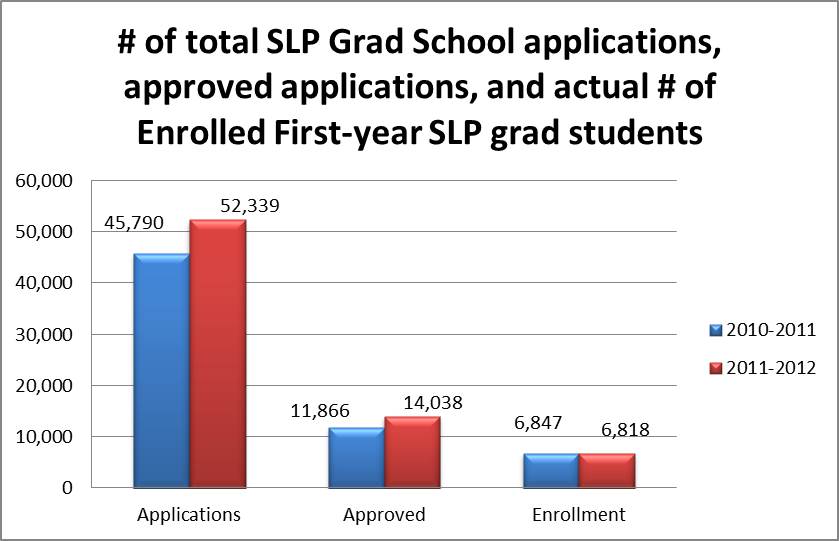
    I can tell you firsthand, getting into graduate school for speech/language pathology is VERY difficult.  It is highly competitive, and here in Colorado, the average COLLEGE GPA was a minimum of 3.87 when I applied.  I found this graphic from 2011 but I can tell you things have not changed much.  There is a HUGE gap between the number of applicants and the number of people selected. 

    The disparity should be striking, and please remember that MANY of these applicants will be YOUR school based SLP.  If you have the mentality that “C’s get degrees” and you are certain your school based SLP fits the latter, let me correct you.  NO average C students make it to graduate school in the first place for speech/language pathology.

    Truth

    For my final thoughts I wish not to be adversarial.  I hope that this article has persuaded you, a parent OR SLP, to reach out to the other side and bring about the change you wish to see.  I have the unique perspective of being on both sides, and as such, I have the utmost RESPECT and LOVE for both sides.  I truly wish for there to be a conduit of communication, and not a  ridge of animosity and distrust; and at the the forefront, I wish to impart a spirit of solidarity between my professional and special needs relationships.

    To read more from SLPMommyofApraxia follow her on facebook, pinterest, or twitter.


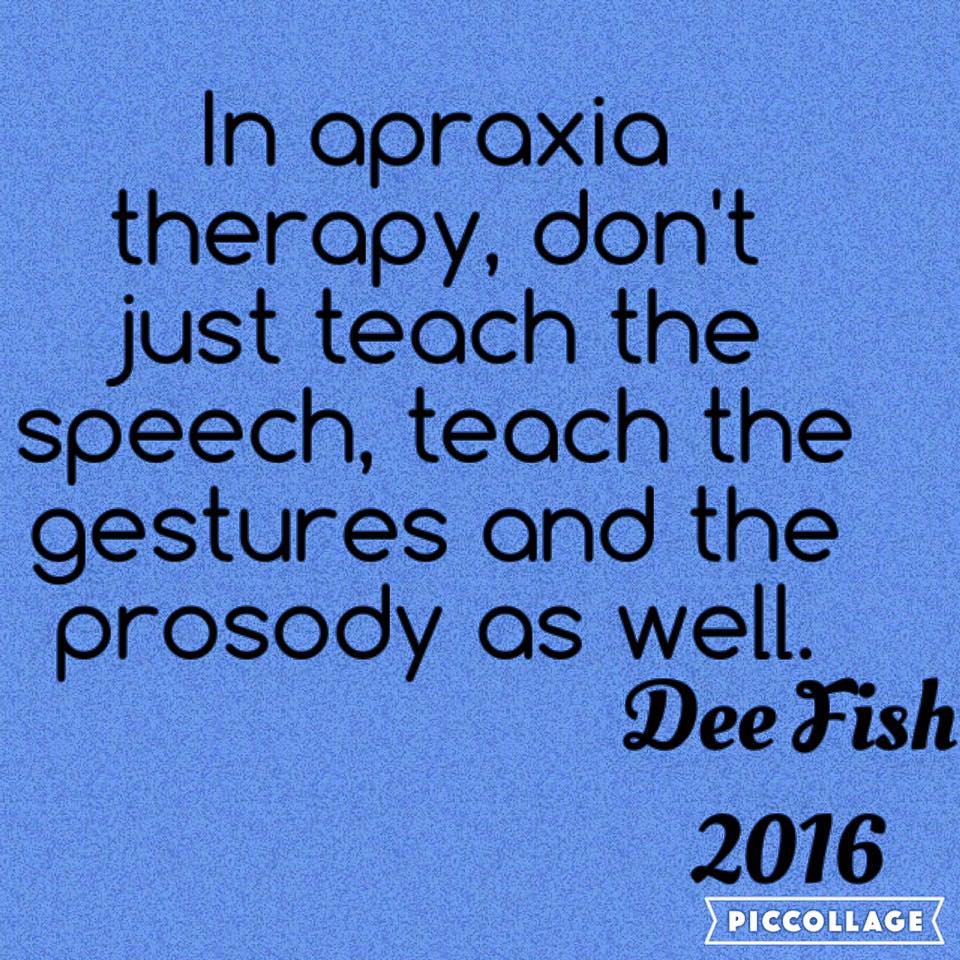
  • Don’t just teach the speech.  The importance of co-articulation and prosody in the treatment of CAS

    Don’t just teach the speech. The importance of co-articulation and prosody in the treatment of CAS

    Co-articulation.  Prosody.

    Those are two words you might have seen when researching apraxia.  If you are treating a kid with apraxia or you have a child with apraxia and are not familiar with these terms, you NEED to familiarize yourself with them.

    To have a diagnosis of apraxia, you need three main criteria:

    1. Inconsistent productions with sounds
    2. Difficulty with co-articulatory transitions
    3. Errors with prosody (stress, intonation, pitch, rate, volume)

    Recently, I’ve noticed (maybe hoped) that information is getting out there, and SLP’s who are treating apraxia are at least using principles of motor learning and focusing on movement gestures (sound sequences) and NOT sounds or sound patterns.  This is awesome because this step and this step alone will help take a child from nonverbal to verbal.  Common approaches such as Kaufman and PROMPT teach SLP’s to do this step, and do it well.  I can speak as an authority on this matter because I made it a point now to be trained in both.

    Here’s the problem. I’m not seeing a lot of emphasis on co-articulatory transitions or prosody.

    “It’s okay, I just want my kid to talk!” you might say, and YES.  This is the most important thing.  HOWEVER, our kids’ fate doesn’t have to be one of disordered prosody and odd sounding speech as they get older.  Depending on the severity it may be, but it doesn’t HAVE to be, and that is where we come in.

    I would like to see SLP’s who have a good understanding of motor planning now also focus on helping the child “sound” more natural in their speech.

    Here’s the thing about apraxia.  When kids with apraxia learn a certain motor plan, they learn it well and they say it the same way consistently.  This is a good thing in terms of learning the appropriate sound sequences, but if we don’t also consider prosody and co-articulation, we are teaching them to sound robotic, staccato, or monotone; and they WILL learn this motor plan for these features as well, and not necessarily grow out of it.

    Okay, so let’s focus on co-articulation and prosody.  How do we incorporate it?

    Prosody

    Prosody is actually one of my favorite activities to incorporate in therapy.  You can choose to do it in both structured and unstructured tasks, which makes it dynamic and versatile in terms of weaving it into therapy.  The most obvious way is to make sure, even when you are doing the very direct and structured work of making sure a child is articulating every sound in a word, you do so with varying your intonation.  For example, let’s take the word “daddy.”  This was my daughter’s favorite word.  Ashlynn would frequently omit the medial /d/ and say “da-eee.”  When we corrected her, we would make a point of stressing the medial /d/ sound, effectively causing a staccato type prosody.  Think about it.  We would make her say “daDEE.”  We don’t say “daDee” in everyday speech.  We say “DAdee.”  If we don’t go back and try and get this natural stress pattern along with the correct articulation, we are teaching the child to say “daDEE”  which sounds off.  This is something we should be conscious of starting from the very early beginning of therapy.

    Focused and direct work with prosody should also be targeted.  Not to be self-serving, but I created a game I sell on teachers pay teachers just because I wanted something fun to specifically target this area.  I called it, “say it like a costume character” and I have various characters and the child has to say the target word the way the “costume character”would say it.  This provides not only practice for articulatory accuracy, but also variation at the supra segmental level.  The kids LOVE it.

    Other activities I’ve done include singing songs that vary the volume.  Recently, I just had a child sing BINGO with me, and we shouted the first letter and then had to be quiet the remaining letters.  Obviously, this child is more verbal and in a later stage of apraxia resolution; however, even in the early stages, the SLP could request a child say a target word loud vs soft.

    As with everything else, I love using books.  A recent one I read was “Going on a Bear Hunt” and the child had to say the repetitive phrase “I’M not scaaared” each time it came up in the book varying the stress and rate.  Right now I’m moving into the “Old Lady” books.  If you haven’t seen them, they seem to have one for every holiday, event, or season and you can have the child “sing” certain parts with you.

    Co-articulation

    Kids with apraxia already have an extremely difficult time sequencing longer syllables or putting words together.  You may notice, that when kids with apraxia do start combining words, they articulate every single sound.  That’s what we want right?

    Yes and no.

    Let’s take the the phrase “come here.”  A typical English speaker will say “com-ear” when beckoning someone.  Say it out loud as though you are calling someone.  I doubt you articulated the /h/ in “here.”  If you did, you would end up having a slower rate and maybe sounding more robotic.  Let’s do another one.  Let’s take the phrase, “Put it on.”  How many times do we say that to our kids?  Now say it out loud.  Did you articulate every single sound, or did it sound something like, “pudi-on.” My bet is on the latter.

    Though our kids do need to know how to articulate all sounds correctly in various syllable shapes, they ALSO need practice sounding more natural and it’s up to us, SLP’s and parents, to help them.


  • An open letter to millennial cynicism, indifference or neither?

    An open letter to millennial cynicism, indifference or neither?

    Non-profit.

    What does that word mean to you exactly?  No really, I have over 300 email subscribers, 1300 fb subscribers,  and….this can’t be right…but according to my statistics I see 10,000 visitors per month.  That’s crazy considering I get maybe 40 likes on a good day on my fb page and a couple comments per month on the blog.  I know SOMEONE is reading this blog though,  so sincerely, I want to hear from you.

    I never thought about non-profits much before I became involved with CASANA. My family is Catholic, so my mom donated (and still does) to Little Sisters of the Poor, St. Jude’s, and I think…maybe some veterans group because my dad and her dad are veterans.

    When I started a family of my own, I followed in my mom’s footsteps donating to St. Jude’s and a couple of  times to March of Dimes.  My sister donate (s) (ed) to St. Jude’s too and at one point we had the conversation that the free stuff they send us with their mailers, which include note pads and address labels has at this point, exceeded the price in the donation we actually sent in!  Basically, what good was our donation actually doing?  It didn’t stop us from donating though.

    Well, then I had a daughter, and then she went onto have delayed milestones, and THEN she went on to be diagnosed with Childhood Apraxia of Speech, and THEN, I found CASANA.  CASANA…which in my mind was this HUGE non-profit.  Actually, though, I didn’t KNOW I had found CASANA at the time.  In my sad, lonely hour of desperation, I found a facebook group called “Apraxia Kids: Every Child Deserves a Voice.” It had a bunch of followers, so it seemed legit.  Only problem was, I had to request to join!  Why is that a problem, you ask?  Well, let me put it this way.  When your children go to bed, and you are awake, and one of them has just been diagnosed with a rare disorder….you have questions, you are sad, you want to meet someone….ANYONE…who knows what you are going through. Oh, and I’m a millennial, and I like things NOW.

    I was approved very quickly. Yes!  Score!  I read through some posts and posted my own.  I was sad and lonely and needed someone to tell me it would be okay.  Numerous people responded quickly.   I liked that. I hate to admit I’m that typical millennial…but instant gratification..yep.  This was my group!  One of them was Sharon Gretz.  That name meant nothing to me at the time, but she was kind, and welcoming, and seemed to understand.  I went on to post many, many more posts from my first.  Each time I was met with wonderful and supportive comments, and most of the time, Sharon would comment as well.  I’m not quite sure how long I was in the group, but I realized Sharon knew her stuff.  This Sharon lady got it.  Then I realized, this Sharon lady was the admin to the group.  She basically ran it and moderated it.  I appreciated her dedication to not only helping and responding to me, but to most of the posts that were written.

    Through the group I found out an apraxia conference was coming to Denver, where I lived.  My daughter was dx the previous year and I KNEW I had to go.  The conference seemed big and important.  I knew Sharon would be there and she asked people to say hi to her.  I still had not connected CASANA to apraxia-kids.org in my mind.  I actually never gave it a though that Sharon ran a non-profit and was behind the fb group but also the conference.  Seriously, not one thought in my mind.  I knew she was connected to apraxia though and she would be there.

    I met her and it was awesome.  There are only so many times I can talk about the encounter, so read more of my blog if you are interested.  I sat with a group of SLP’s who talked about a bootcamp.  This was when I first realized that apraxia-kids, the fb group and the website, was connected to a non-profit called CASANA.  I started to realize that Sharon was the founder.  After that conference, I had decided I wanted to get into bootcamp, but I also felt guilty because I had no money or funds to donate to CASANA.  I remember telling a previous bootcamp graduate and excellent SLP in NY Christine Murphy, that I felt incredibly guilty to know I had taken so much from CASANA and wasn’t able to give back.  As many parents who read this know, having a kid with apraxia means a lot of money goes to therapies since most insurances don’t cover.  She told me not to worry.  She said she had seen I was active in the apraxia-kids fb group, and THAT was giving back to CASANA.

    That really hit home with me.  It made me wonder why that was giving back.  Why would responding to posts be giving back to CASANA?  Then I realized.  Sharon takes her job as admin to that group very seriously.  She wants to give people help and advice, and not just ANY help and advice, but quality advice.  I remembered how she had approved my request to join late at night, and then answered my post. I realized in that moment, Sharon works more than her 9-5 for that non-profit.  She literally works around the clock.

    I was accepted to the bootcamp, and that’s where I REALLY understood the connection.  I met most of the CASANA staff members and was blown away.  These two women were once moms like me, who founded this non-profit not only of the love for their children, but to help other moms in their situation…moms like…ME.

    CASANA was offering this costly intensive training for minimal cost to the SLP’s attending it, so that quality therapy and expertise would be available to families spread out through the entirety of North America.  Yes friends.  Many neighbors to the north…aka…Canadians were there.  Sharon was VERY clear at the start of bootcamp that her expectation for every SLP in that room sitting before her would be dedicated to CAS education and awareness.  I actually was a little scared of disappointing her, her expectations seemed so large.  However, I KNEW this was a woman dedicated to the cause and dedicated to her non-profit.

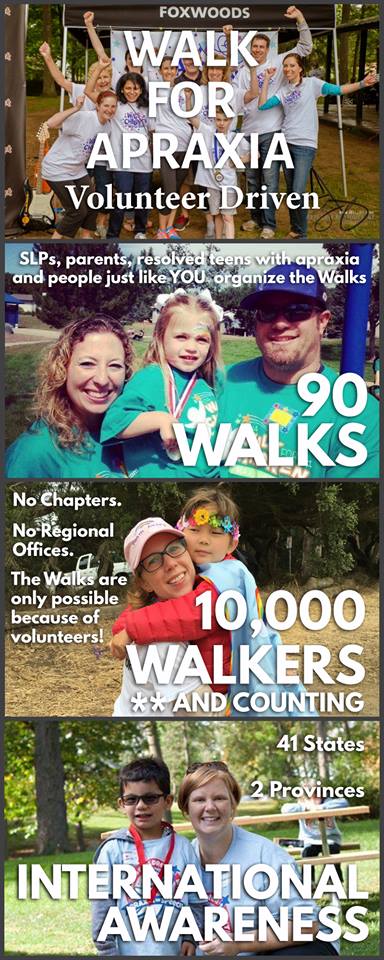
    After bootcamp, I went back to my Denver community and through a course of a conversation with Sharon realized the Denver Walk wouldn’t happen. As most of you know, this is what prompted me to become a walk a coordinator, and actually, my last post highlighted for me that this is how MOST walk coordinators around North America find themselves in the same position.  That was kinda news to me.  As I mentioned in my last post, I met another CASANA staff member through this endeavor named Justin, and if there were ever a person meant for his job as event manager…it’s him.  Calm, encouraging, kind, and supportive; despite 90 other walks taking place nationwide, Justin never makes you feel rushed or that you don’t matter.  Encouraging, passionate, and ALWAYS positive, Justin will help any person coordinating a walk feel they are the best.  We need him!  He talks to ALL 90 of us every year as part of his paid position.  The walks literally could not happen if we weren’t taking directions from Justin.

    That is why I was so taken aback to receive a private message the night after my walk from a random person in the U.S.  She was concerned about a post I made in the Ronda Rousey: Knock out Apraxia group in which I said 85% of funds go back to the community.  She said I was “mis-leading” donors.

    People, let’s just say she caught me on the wrong day.  I literally get this post after I am sitting on my couch, utterly worn out and exhausted from coordinating a walk of over 400 people….for FREE.  Literally, the last thing I need/want to hear after spending months and hours of my free time coordinating a walk for a non-profit I know personally now and believe in, is how I am misleading people.

    NO

    F that.

    What is wrong with this generation?  I actually typed that in and found this enlightening article. http://www.givinginstitute.org/news/258798/Breaking-Through-Millennial-Cynicism.htm

    Why doesn’t my generation trust non-profit’s anymore?  I wish I could say this woman was an outlier, but I don’t think she is.  My own husband the year I first coordinated the walk (and this was after I had received all this education from CASANA for only $500 and a plane ticket to go to bootcamp) asked me about the company’s money.  We actually pulled up the public IRS form.  I can’t recall exactly what it said Sharon made, but it was less than our salaries and I reminded him she literally worked around the clock.  She answered me in the wee hours at night when I needed her.  I’m not saying she does that all the time, but she  did that time.

    Something being touted this year, by others and by myself was that 85% of donations go directly back to the community via research, education, grants for therapy, and iPads for kids. This percentage was based on an independent audit of the 2014 form.  The reason for an audit and not just looking at numbers like the public can do on the IRS form is, if one were to JUST look at the money spent on grants or on iPads, it does NOT take into account the person (or persons) behind the scenes getting paid to process that paperwork and do the dirty work.  You can’t just look at one number that shows what is donated, without taking into account that some salary money ALSO made that happen.  It’s just common sense.  You can’t have CASANA donating this and that without someone behind it actually processing it.

    Oh..and what about the walks that actually bring in most of the donations.  They have two staff members helping 90 volunteer walk coordinators with that task.  TWO.  They rely on volunteer coordinators to  maximize the amount of money going directly back into programs and grants.  These people shouldn’t have to work for free!!  Yes…gasp.  They have a salary.  If they weren’t there, no walks could happen period. Volunteers can do a lot, but we can’t do everything.  Let me tell you, these two people work beyond their 9-5.  I have had them email and message me back and give me their private telephone numbers so they would be available on the weekend when walks take place.  That should speak volume to their dedication. They DESERVE their salary and work over their salary and shouldn’t be scrutinized and judged.

    I told this person that the Denver community had benefited greatly.  I knew numerous families who had received an iPad, and literally know tons of families, including myself,  who have now received the grant from Small Steps for therapy.  Oh, and we also have THREE SLP’s in the area who have been trained by CASANA under their “education” agenda.  That’s three SLP’s available to consult, provide differential dx, and to also see kids with apraxia for therapy ensuring they get the best possible therapy.  Folks, that is DIRECTLY affecting our community, and just because it’s not categorized under “therapy” on an IRS document, it doesn’t mean it wasn’t the outcome.  Just ask my clients, or the other bootcamper’s clients, or the people who have attended any presentation we have given.

    That brings us to research.  This person was concerned that in 2014, 30K was given to a research study.  Gasp.  How dare they?  I mean, really, what is the alternative?  CASANA should invest thousands of dollars into helping kids get speech therapy that doesn’t work for apraxia?  Seriously people, that is not an exaggeration.  Apraxia is THAT serious of a speech disorder.  If you are reading this blog and have any familiarity with apraxia at all, you know that is a potential outcome of the disorder, no matter HOW MUCH therapy you have.  We need research so we know what to do!!  So that the future generation of SLP’s currently in graduate school are TAUGHT what to do, unlike me.  If it wasn’t for CASANA, I still wouldn’t know how to help my kid!  I helped her for a year using what I thought were “research based” interventions….and they were…but NOT for apraxia!

    Finally, lets talk awareness.  Have you ever told someone  your kid has apraxia and they didn’t know what that was?  Okay let’s all have a good laugh now!  bahahahahahahaha

    I mean, parents reading this are ALL nodding their head right now and being like yeah…most people I say apraxia to don’t know what is is.  So guess what we need?  AWARENESS.  We need people to be aware so our kids can get the help and understanding they need for their unique needs and profile.  Guess what this takes?  A PERSON driving that.  A person who gets  a salary.  CASANA makes TONS of graphics, informational brochures, inspirational and informational memes for all of us to share spreading awareness. Apraxia Awareness Day is now a THING thanks to them.  I’m not quite sure what category that falls under on the IRS form..but I’m thinking it’s probably salary.   I could go on but this post is getting long.

    Bottom line is, why are we so cynical of non-profits?   I know it’s partly because major ones make the news14344244_1657729304539794_3707920287651978254_n about scandals, but people, CASANA is not this organization.  If it were, do you really think 90 volunteers nationwide would commit to coordinating walks that take an unfathomable amount of work and time?  All 90 of us know the staff members at CASANA and we don’t get ANYTHING in return than what CASANA offers to EVERY child and family affected by apraxia: quality research, education for parents and professionals, speech therapy grants, and iPads for kids.  We don’t get anything more, oh wait, I take that back.  They gave us a picture frame last year to frame our favorite walk picture.
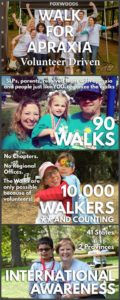
    Come on!  Stop the cynicism.  Support the cause!  Our children need you!  Our children deserve a voice, and CASANA is working tirelessly!  With event managers texting on weekends, to the executive director responding to fb posts written by  desperate sad parents at night, CASANA is a non-profit dedicated to making sure every family feels supported and EVERY child has a voice!

    Oh, and as a last word, I do really want to hear from you.   What does the word non-profit mean to you?  Does it incite doubt and suspicion or hope and inspiration?  Maybe, you just have never thought about it much and indifference is the best word to use?  I don’t know.  That’s why I’m asking this last one is NOT rhetorical.  Tell me your thoughts.