Category: dyspraxia awareness

  • 1st Day of 3rd Grade

    1st Day of 3rd Grade

    My dearest Ashlynn,

    Your courage amazes me daily.  It inspires me and pushes me beyond any limit real or imagined.  Today was your first day of 3rd grade.  You have been waiting for this day since the last day of 2nd grade.  Actually, quite possibly since the first day of 2nd grade when you told me,“After 2nd grade you I will be in 3rd grade!”

    I emphatically responded,

    “We need to make it through 2nd grade first!”

    We bought you a new backpack, new outfit, new shoes, and you got a new haircut.  Two out of the four items went as planned.  The backpack and new shoes went off without a hitch.  The other two? Well Ashlynn, it’s just not our style to have a few hiccups is it?

    Getting a new haircut is always an adventure.  Your dyspraxia, ADHD, SPD, and receptive language issues make following specific commands somewhat challenging don’t they?  I stepped in to help guide your head where it needed to go so the stylist would stop reminding you of how hard it was for you to follow those simple commands.

    Then came the new outfit.  We picked it out together!  I didn’t think we needed to try it on because I know what size you are and I was sure it would fit.  Last night we hung it up on your dresser anticipating the first day of school! However, this morning when you went to put it on you were more confused than ever.  I came into help and realized I had bought you a romper! That flowey material fooled both of us didn’t it!!  I could have sworn it was a dress.  A romper though?  Yeah, not a friend to the girl who has dyspraxia.  I apologized and offered other options in your closet.  We chose a pretty sun dress you hadn’t worn much, but I still felt bad.

    You took it in stride though!

    All morning you were jumping up an down and excited to go to school and I marveled at you.  School is so hard for you.  Last year you came home with bloodied shirts or completely different shirts because you had so thoroughly stained yours from picking your finger nails.  Almost every assignment you completed you struggled in, and many times you ate and played alone.  How on Earth were you excited to go back to that?

    Three days before we saw an ex client of mine who is your age.  Her apraxia is resolved and she has residual learning disabilities.  She told us how she didn’t want to go back to school because she was bullied and you sat there un-phased.   I thought to myself if I were in either of your shoes I would feel like my client; yet I was so grateful you are you.

    You have a strength and internal resolve I am working towards.  You have courage and resiliency I have yet to conquer.  Where my instinct is to run back your instinct is to jump forward.

    I am inspired by you.  I am always going to be here by your side.  I’m going to love you, but I’m going to push you.  I’m going to do everything in my power to help you obtain the tools you need in order to live life on your terms.

    It took me many years to believe and even more to practice this simple advice:

    Heck it takes grown men and women to follow this advice, and let’s face it.  Some die before they ever follow this advice at all. YOU embody this.  YOU are a living testament to this.

    Pursue it all Ashlynn!  I’ve always got your back and I’m your biggest fan!

    Love,

    Mommy

  • Executive functioning home intervention

    Executive functioning home intervention

    Let’s talk executive functioning.  If you follow my facebook page SLPMommyofApraxia (click here), you already know we are making our house an executive functioning friendly zone and you might have read a prior post I wrote a  “What is Executive Functioning, and Why Do You Need to Know?”

    What does an executive functioning friendly zone mean exactly?  I decided to put all of it into a post so you can see and hopefully help others who may have children with similar issues.

    Before I begin, I just want to say this:

    Children with learning differences, many, many, MANY times benefit from the use of visuals.  There have a been a handful of cases in my career where visual aids actually confused the student more; but for the most part, visual aids benefit everyone.  This visual from northstarpaths really explains why:

    Executive functioning (EF) deficits are a common comorbidity with a variety of conditions including: ADHD, OCD, ID and others just to name a few.

    Visuals are AMAZINGLY helpful for children with EF dysfunction.   The problem is, most teaching involves auditory input.  The teacher (or parent) talks, children listen, and learning takes place.  For kids like my daughter, who have a language processing impairment, the teacher (or parent)  talking is basically the equivalent to the teacher in the Peanuts comic series.  All the children hear are “wah wah, wah wah wah wah.”

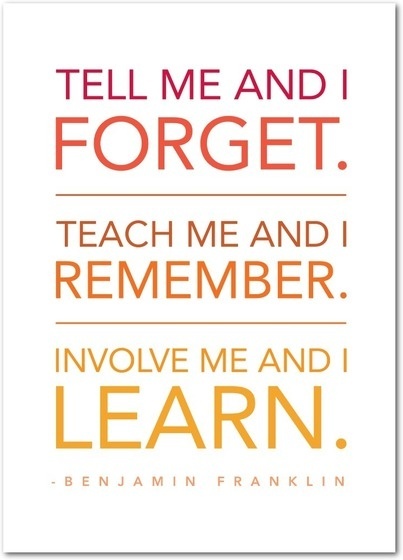
    Visuals bridge the gap.  I couldn’t say it better than Benjamin Franklin, who himself had a learning disability when he said,
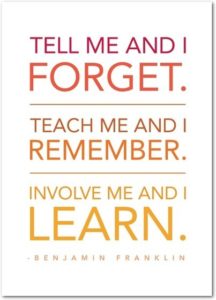
    Aside from just visuals though, kids with EF dysfunction benefit from organization and time management strategies.  The following is what we currently have implemented in my home.

    Morning Routine

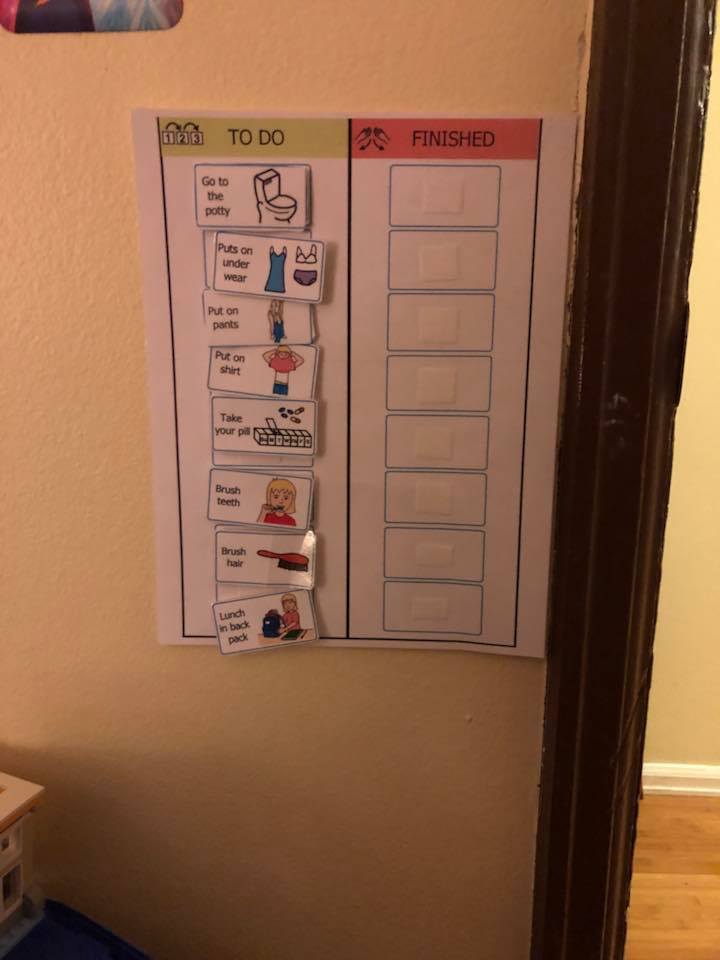
    The most recent example from my personal experience involved the steps to getting ready for school.  If I told Ashlynn what to do, she immediately forgot or I had to go through step by step and tell her, which is not promoting independence.  With the help of her SPED teacher, we made this visual schedule and she was successfully completing all of her steps without our help in about two weeks.
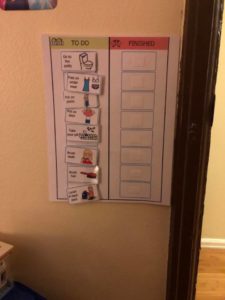
    Restroom steps

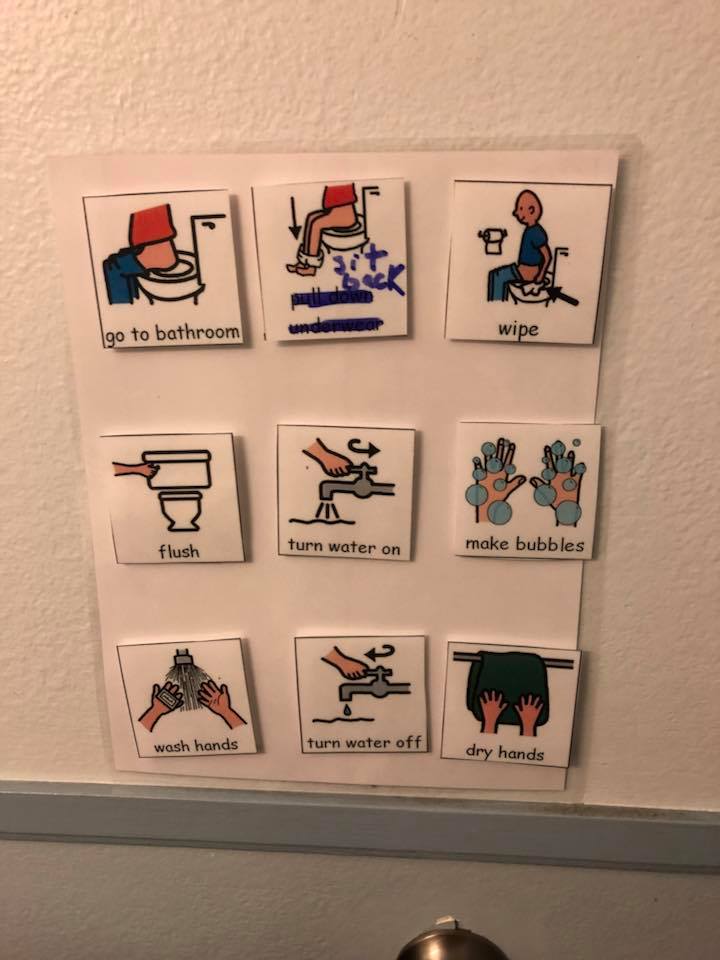
    We decided to make a visual schedule for completing bathroom steps.  Let me tell you that we have been working on remembering these for AT LEAST a year.  Last year in 2017, I sent her to Adam’s Camp and remember telling the therapists she can say all the steps but still is not consistent.  After Adam’s Camp she came home being able to sing them as well, and still, we could not get consistency.   So we made a visual schedule a little different than her morning schedule and it looked like this.
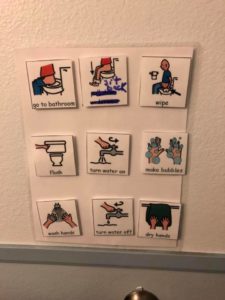
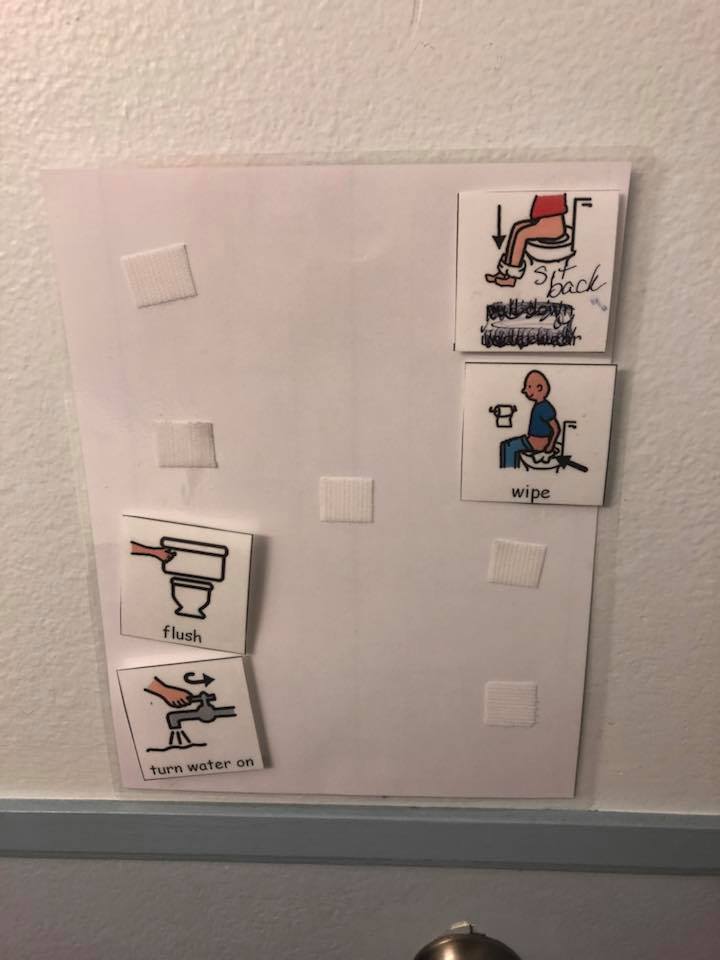
    This was NOT successful.  It probably has too many steps and it doesn’t have the nice left to right motion the morning schedule this, so I modified and made this.
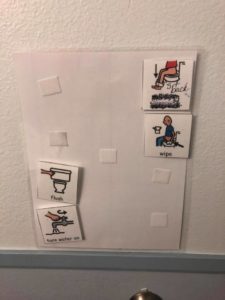
     

    I’d be lying if I said this was a complete success right off the bat, but it has worked better than any other strategy to date and now that the summer has hit, we have made sure she has to go back and complete her steps every single time.

    Cleaning her room

    The next step was to tackle completing a basic chore like cleaning her room.  I can’t even begin to explain the difficulty with this.  What I do know, is that many adults with ADHD continue to struggle with disorganization into adulthood.  It behooves us now to help our kids develop strategies that are going to serve them well throughout their lives.

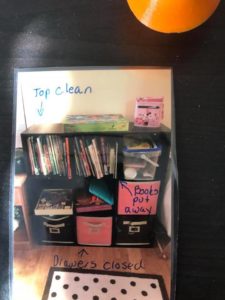
    The first step is to make sure everything has a place.  Classrooms are set up this way for a reason.  There is a specific space for each and every item that is used or played with in a classroom.  If not, things will inevitibely end up in a pile of clutter.  Ashlynn and I went through her room and designated certain drawers and bins for different things.  Everything has a spot.  There is a bookshelf, a lego bin, a writing utencil drawer, a baby clothes bin, you get the idea.

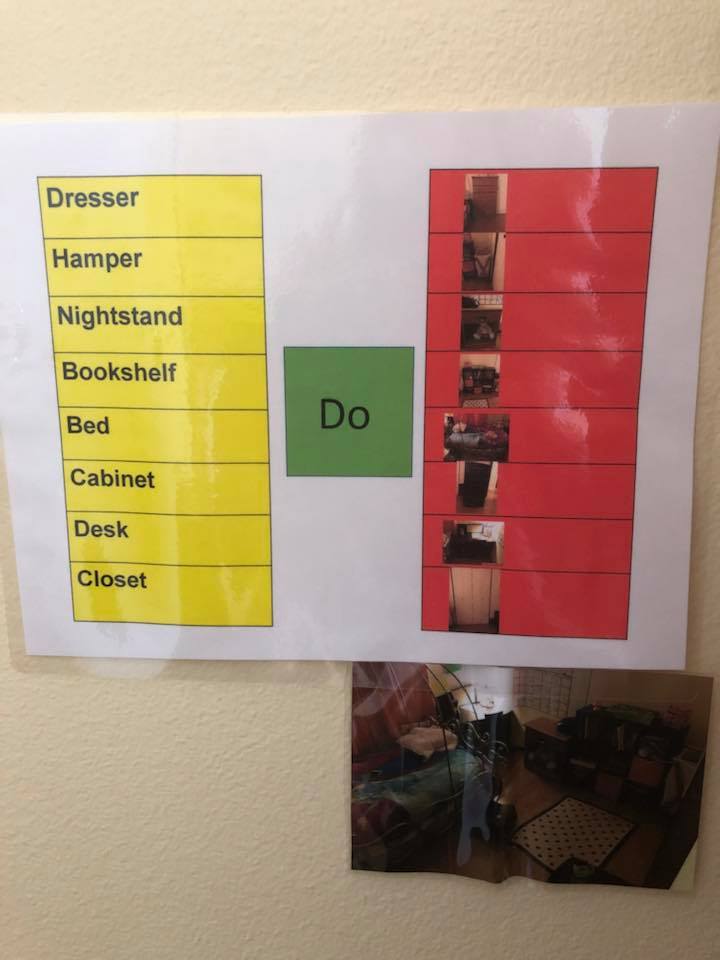
    I then created a visual schedule of each piece of furniture that she could check off as she went about her cleaning routine.
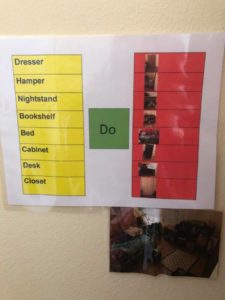
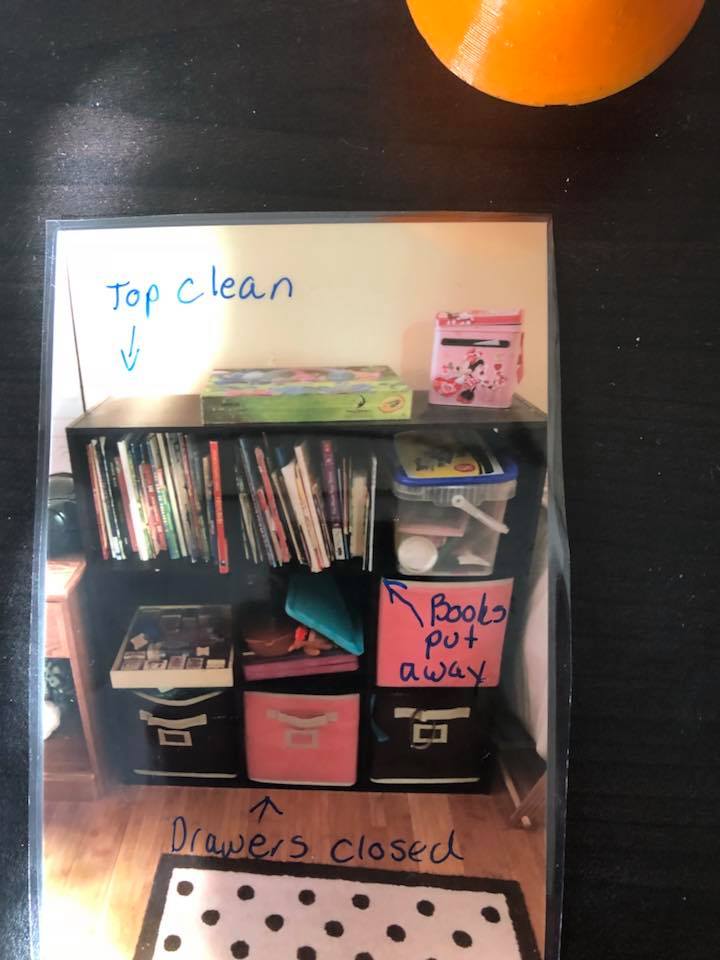
    I know it’s hard to read, but basically each furniture item is listed on the left, with a picture representation on the right of what it looks like done.  The picture on the bottom is a grand finale picture of what the entire room should look like clean after completing all of the steps for one last check.

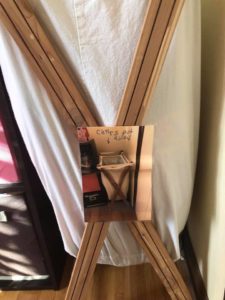
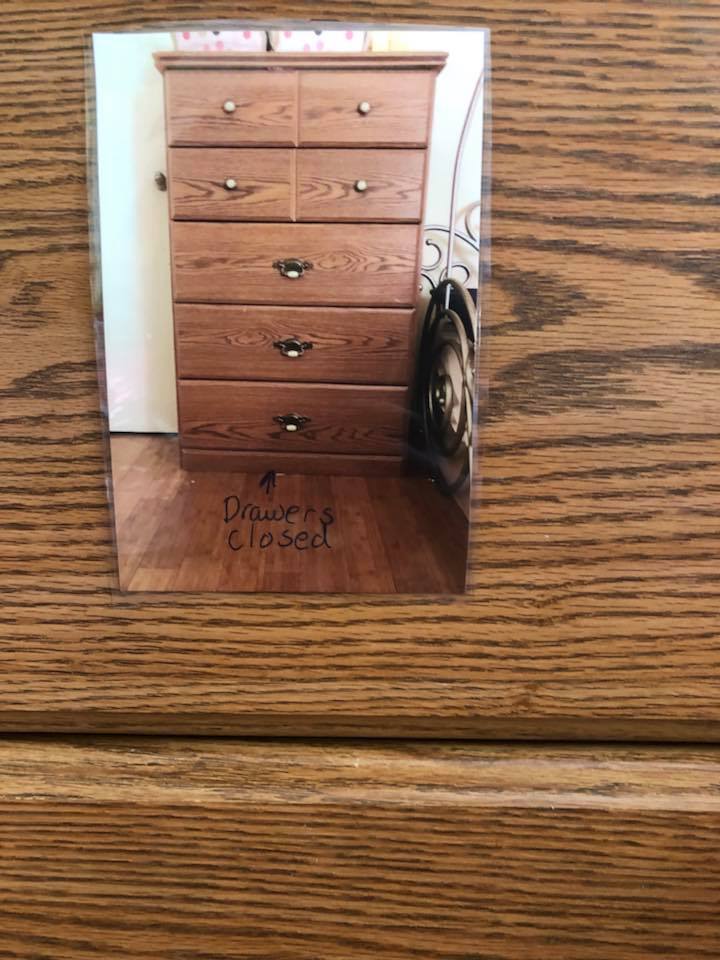
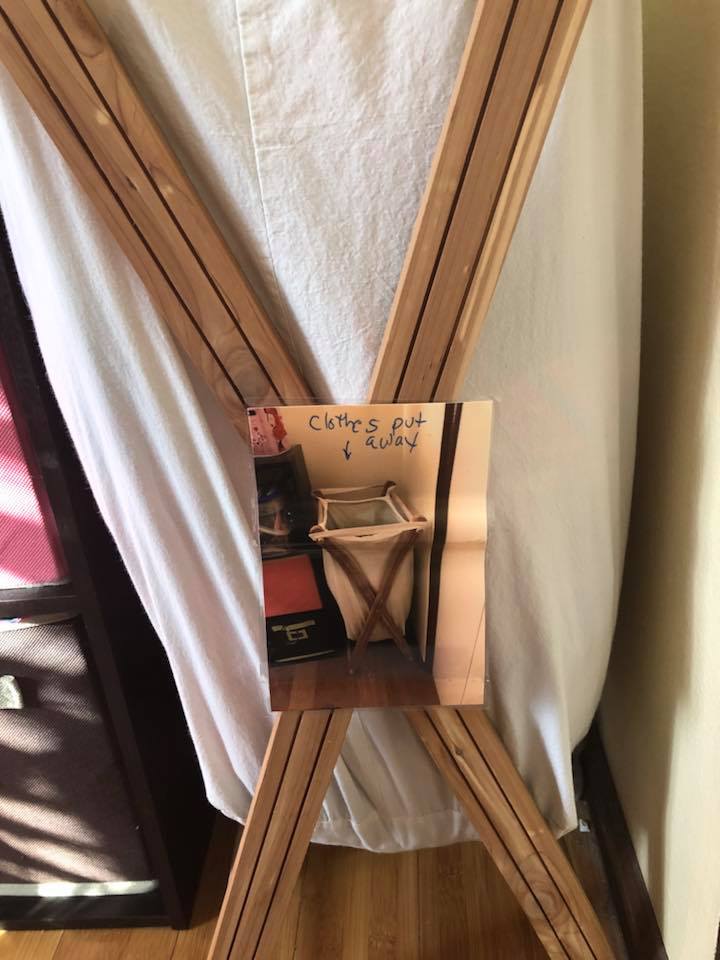
    Next up was to have bigger picture velcroed to all of the furniture items so she could see as she was cleaning them what they are supposed to look like.  I know it seems redundant, but seriously if you have a child who struggles this, then you will relate when I say that a dresser with closed drawers looks fine with clothes hanging out of it to her.  Same with a picked up hamper.  I even have a picture showing what the closet should like closed and no that doesn’t mean it is closed until it hits the piles of crap.  It means actually closed and looking neat.
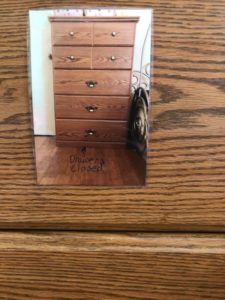


    I have to add that these helped, but still had to be taught.  In fact, it’s still a work in progress.  Some nights, I am so frustrated and just want to pull my hair my out.  I’m only human after all.  I do though, in those times, try and decompress and remind myself this is not a *fix* but a lesson.  Ashlynn doesn’t learn like other kids and that’s okay.  I have to realize though that all of this will pay off in the long run, and when we start early kids have the best outcomes.

    Homework

    Oh man don’t we hear horror stories about homework from parents of kids with varying learning differences.  Teachers make homework sound so easy.  Ten minutes for every grade you are in, so a first grader shouldn’t be more than 10 minutes a night.

    Say….what???  That assignment just took my kid an hour….and then when we went to second grade, that so called 20 minute assignment just took upwards off and on of two HOURS?  Minutes?  What?

    Know that homework can always be modified, but there are strategies that can be put in place to help with this too. Number one is to just start with a place that is going to make them successful for learning.  If you are like me, my first baby is the one with learning differences so instead of preparing for the ultimate learning environment, we were more focused on transitioning my son from a crib to a toddler bed and spent our money on that.  Needless to say, our kitchen table became her homework place.  Yes, the place that she eats and the chair in which she sits that her feet don’t touch on the ground yet is what we thought would be the perfect location for her to sit down and do that quick assignment in 10 minutes.  I should mention too it’s a thoroughfare in my house, so my kid with ADHD was also constantly distracted by the events taking place all around her.  Can we talk about set up to fail???

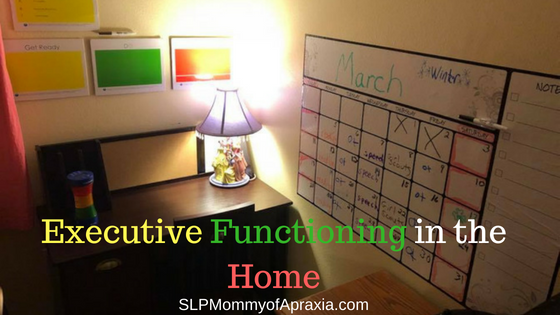
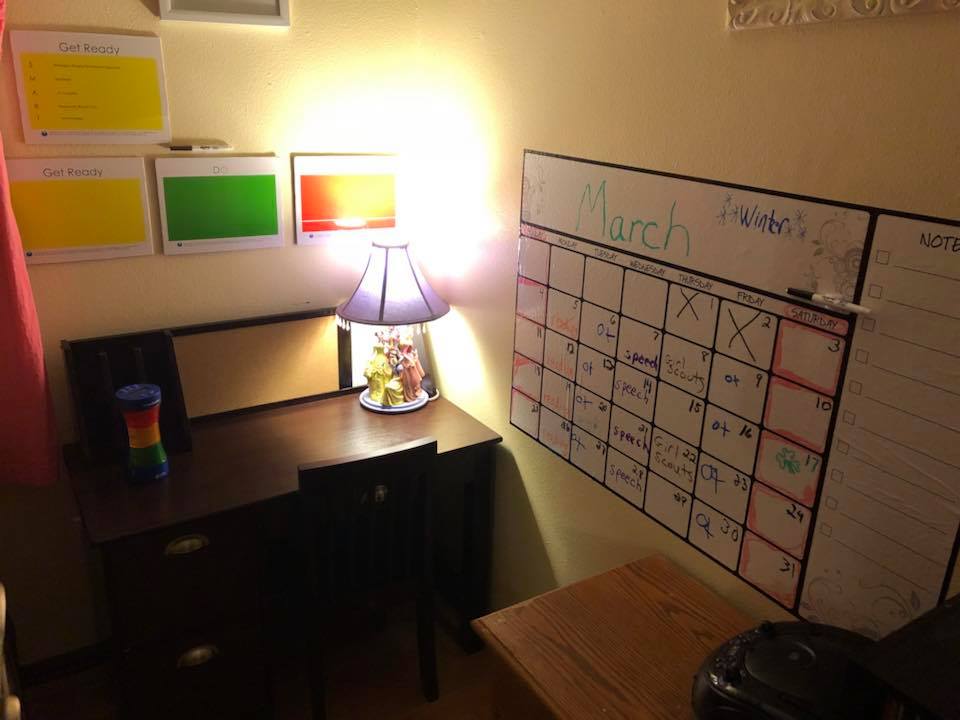
    I redid her room and created a homework corner.  I bought her a new desk in which she sat at a 90 degree angle, perpendicular to the floor, and decked it out with strategies from executive functioning queen Sarah Ward from the website Cognitive Connections.
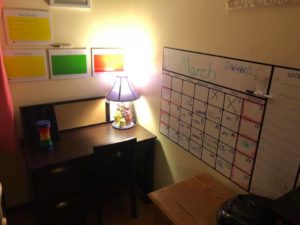
    New desk with feet on the floor

    As you can see, I have her own desk, in a corner of her own room, that is quiet and in which her feet touch the floor!

    Get ready, do, done boards

    The colored board above the desk are suggestions from the cognitive connections website.  In the yellow, we write everything we need to get ready.  It might be as simple as a pencil and it might be more complicated if doing a project.  (To modify for non-readers, you can tape or velcro pictures that you need.).

    The green stands for “doing.” These are the steps you need to do to reach the finished project.  The finished project then is the red board and reflects what the assignment looks like when it is finished.  For lower level, you can put a picture of what a completed assignment looks like, or for readers you can simply write it.  Sarah Ward also recommends to “start with the end in mind,” meaning kid with EF deficits benefit from knowing what the end is supposed to look like and then working backwards. For a more elaborate description, go see Sarah Ward talk.  She’s amazing.

    Calendar

    We have tried a few different things to help Ashlynn learn time, and I’m not just talking time management.  Ashlynn has had a lot of difficulty learning the seasons, days of the weeks, the months, and understanding the difference between yesterday, today, tomorrow, last week, next week etc.
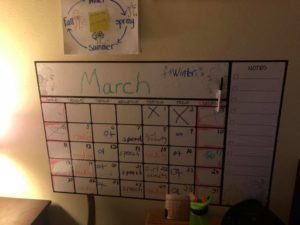
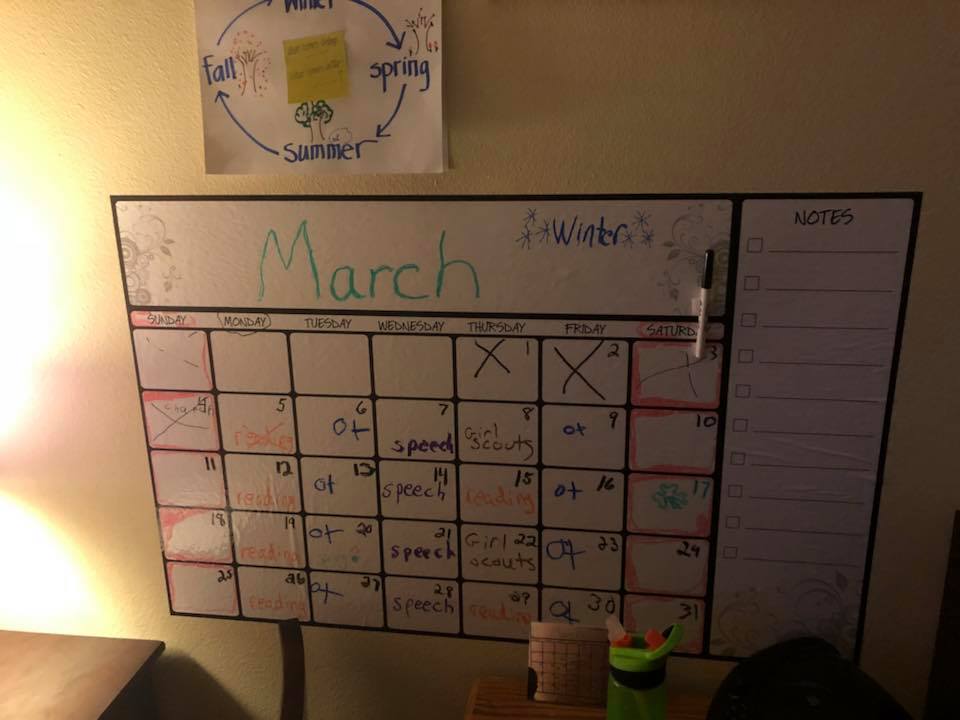
    I decided to buy this peeling dry erase calendar at target.  It’s huge and sits right by her desk.  Every month, she helps me write the month and the days.  We then go through and write her therapy/activity schedule and color code them.  Each activity is written in a different color.  The weekends are shaded on red since she has a difficult time understanding that Saturday and Sunday are one unit (the weekend) when they are split up on a normal calendar.  We then marked an X for each day that had passed and talked about yesterday and tomorrow.  This calendar has been AMAZING.  I might be so bold as to say it almost helped her understand days of the week right away.

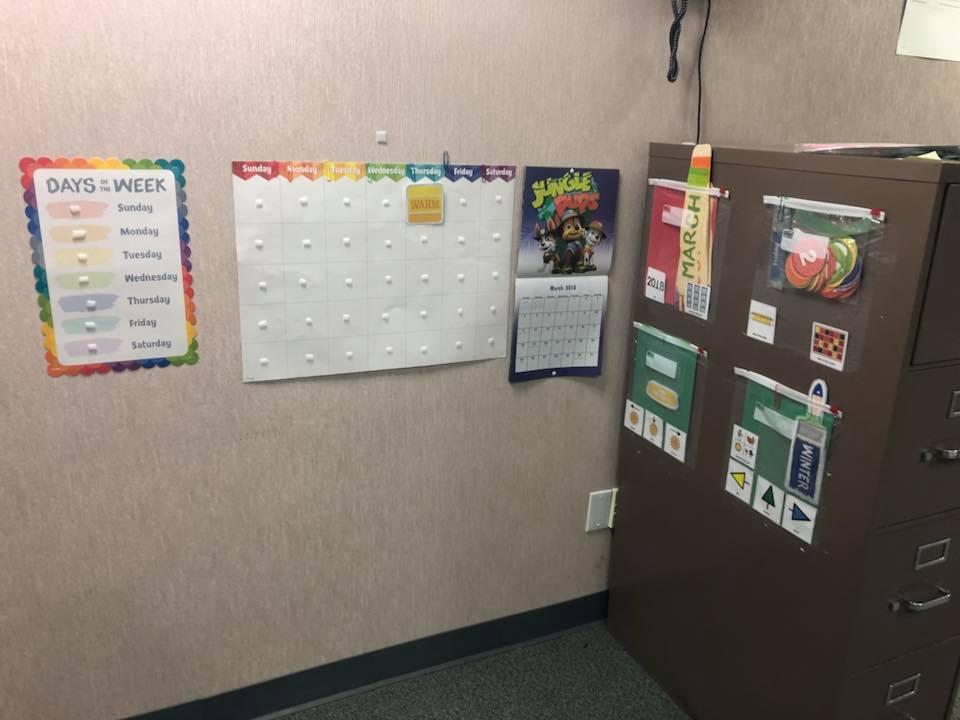
    Her school though also hit this hard visually and created the following corner in the SPED room just for her.
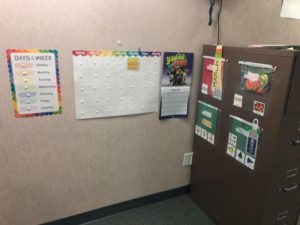
    This picture is also hard to see, but basically you see the basic calendar color coded by day in the middle.  To the left, each day of the week is color coded.  On the file cabinet on the right, the months are placed and she has to pick out the right month each day for added repetition.  The days are in the second bag, and there are tiles for the season and then arrows to talk about the concepts yesterday and tomorrow.  A normal calendar was provided as a reference to keep track of how her modified calendar related to a typical calendar.

    Timer

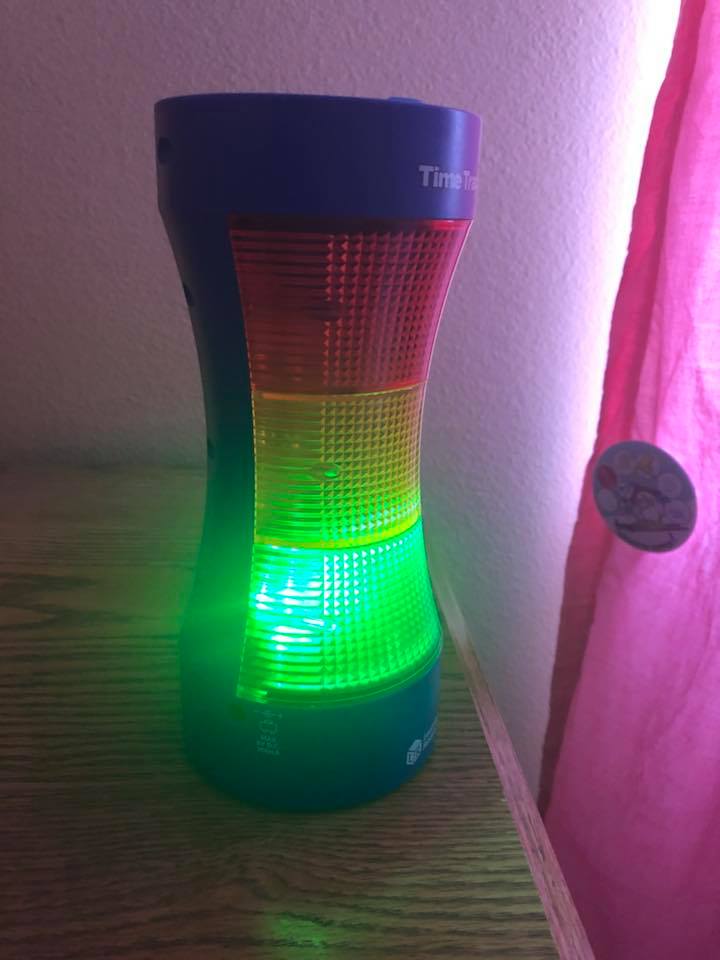
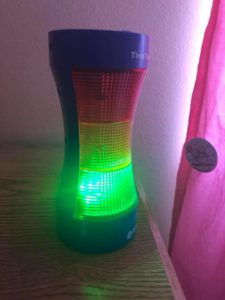
    Last to come is the timer I used for all of these tasks!  Time management is another HUGE skill that is difficult for those with EF deficits.

    The timer is from the autism community store here in Denver, but I’m sure you can find them on Amazon or other places.  This timer is amazing!!  The colors stand for different things similar to a stoplight.  Green means go, yellow means caution you are nearing the end, and red means you need to be done or stop NOW. What is best, is that each color is completely customizable by time.  For her morning routine, we usually set it for 3-3-3.  For homework, it might be  2-20-2.  Did I mention it also comes with sound?  So that means every color it changes to also has a sound to go with it, aka, an auditory cue.
    The impact

    I have to admit, there were times that as even I were making all of these materials and buying all these things that I wondered will this really make a difference?  Was all this work really worth it?? My answer came from Ashlynn.  As I was making these visuals, she probably thanked me more than 10 times.  She knows how she learns.  She was just waiting on me to help her.

    Laura Smith is a mom to two children, one of which who has multiple learning differences.  She is also an SLP (speech/language pathologist) specializing in CAS (Childhood Apraxia of Speech), a passion that was fueled by her daughter’s dx in 2012.  To learn more, visit slpmommyofapraxia.



  • Lessons from a bicycle: Just keep pedaling

    Lessons from a bicycle: Just keep pedaling

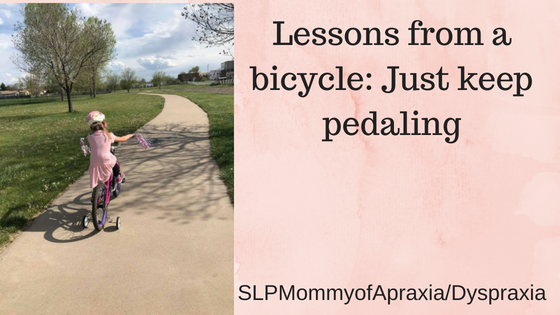
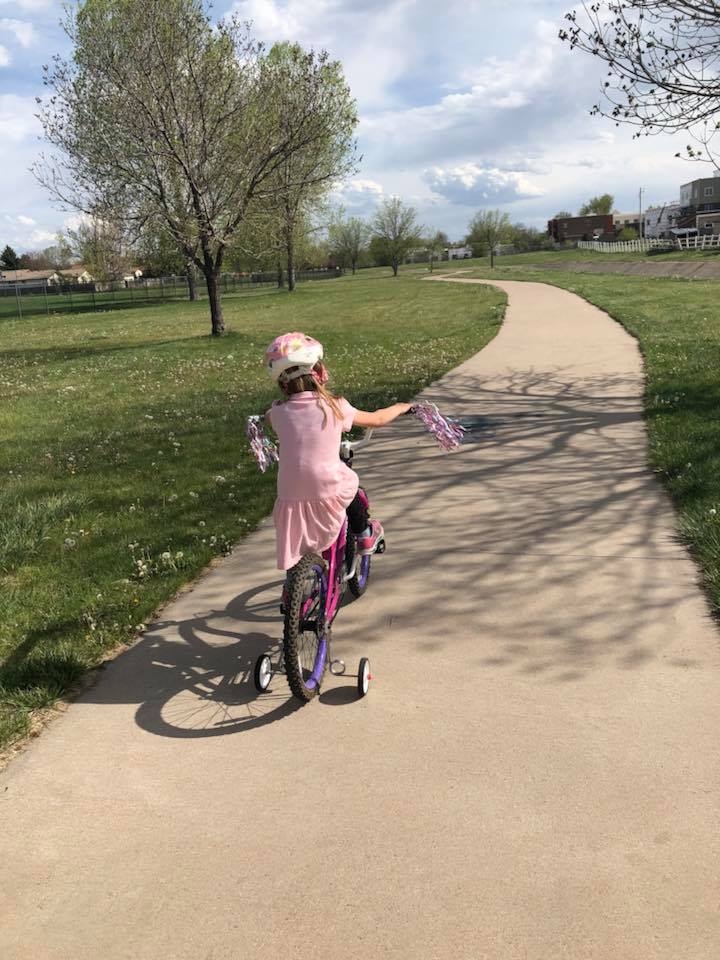
    Ashlynn is 8 1/2 years old.  Currently, she is riding this big girl bike, and yes, it still has training wheels; although the wheels are much smaller and looser than they have ever been.  Last year she took quite a tumble and refused to ride it, but this year she is back on it and pushing harder than ever before.

    Due to the severity of her dyspraxia, we have increased her time in private OT to 2x a week along with the OT and PT she gets in school.  The new private OT place is VERY focused on bilateral coordination, balance, strength, and sensory issues.  We noticed a difference right away in terms of her sensory issues, but we are also noticing a HUGE difference in her strength and increased endurance.

    She could TOTALLY, TOTALLY ride without training wheels, but she has a few more obstacles.  One is that different variables aside from a smooth plane throw her off.  This was true when she learned to walk too.  She could walk provided the surface was even and smooth; however, once anything changed she was falling to her knees.  This could include the slightest incline going downhill, uphill, or slant in the road.  Well, the same is true for learning to ride a bike as well.

    I should also mention, she doesn’t have typical reflexes thanks to her dyspraxia either; so where most children would at the very least put their legs down to help catch themselves, Ashlynn panics and ends up falling over.

    As I watched her tonight at the park, a wave of sadness rushed over me.  It’s so weird, these cycles of grief.  l know Ashlynn has dyspraxia.  I know it will take her longer to overcome this obstacle, and I also know she WILL overcome it.  However, I start to worry.  Am I doing enough?  Am I helping her enough?  What about those special needs bicycle camps another mom told me about.  Should I have picked that this year instead of choosing to send her back to the $3000 special needs camp she loved and adored last year?  After all, there is only so much money to go around.  Am I choosing the right thing?

    On the way home, she was gaining confidence.  Where I walked beside her on the way to the park, I was now jogging and at times running to make sure I kept up on the way home.  She was doing great with her balance.  We were riding on the sidewalk, and she would only tip over when going past a driveway where there would be a downward slant.  I would run beside her and steady the handle bars.  I started to notice though that she would stop pedaling during these times.  I encouraged her to KEEP pedaling through the hardest obstacle, which was the driveway. I realized the reason she was losing her balance wasn’t necessarily because of the driveway, or obstacle; but because she would STOP pedaling during it.

    It reminded me recently of a white water rafting trip we just took the kids on.  I joked (but was dead serious) that I only slightly panicked most of the time.  On the bus ride to the drop off, the guide was going through all of the safety precautions and I started to freak out. Truth be told, I actually go to the bank of the river and told the guide we weren’t going.  Fortunately for me and my family, he convinced me to get on the raft.  This after I explained dyspraxia and her difficulties with balance and coordination and my concerns for her safety and ability to follow directions if bumped out of the raft.

    He told me he would put me right behind her, would have straps my kids could hold onto for balance, and during the times he didn’t need me to paddle, I could hold onto her shoulder.  However, he did say that when he told us to paddle, he NEEDED us to paddle because that is what was going to ensure the best stability in the raft for getting through rapids.  I struggled with my fear.  I looked at my kids eager to go, my husband shaking his head at me disapprovingly for threatening to allow my fear to ruin the fun; but then ultimately I thought of Ashlynn and how she faces every fear head on and I knew I had to do the same and do what the guide told me to do.  I put every ounce of my being into paddling when he said to paddle and made sure I was in step with my husband’s paddle on the other side.

    During the times I didn’t have to paddle though, yes, I was holding her shoulder. 

    Not to make excuses, but I did watch this girl drown once and I still can’t re-read that post.

    Anyway, back to the bike.  At the driveways I kept yelling “keep pedaling Ashlynn.”  She stopped after awhile and told me she wanted to get off and walk her bike home.

    “No, Ashlynn.  I’m sorry.  I’m not yelling at you okay?  I’m proud of you!! I’m just telling you that to get through the hard parts you have to KEEP pedaling okay?  Remember last weekend when we went white water rafting and our guide told mommy and daddy to keep paddling during the really big rapids?”

    “Yes,” she replied hesitantly.

    “I was really scared Ashlynn.  I was so scared if I didn’t have my hand on your shoulder you would pop out but I knew to get through the rapid as smoothly as we did I had to keep paddling and not stop.”

    “Yeah?” she said.

    “Yeah baby.  So that’s all okay?  Don’t give up!!  During the hard times we have to keep paddling.  You have to keep pedaling and you won’t fall okay?”

    She looked ahead of her with grit on her face and she flexed her thigh muscles and started pedaling again.  I ran beside her all the way home.

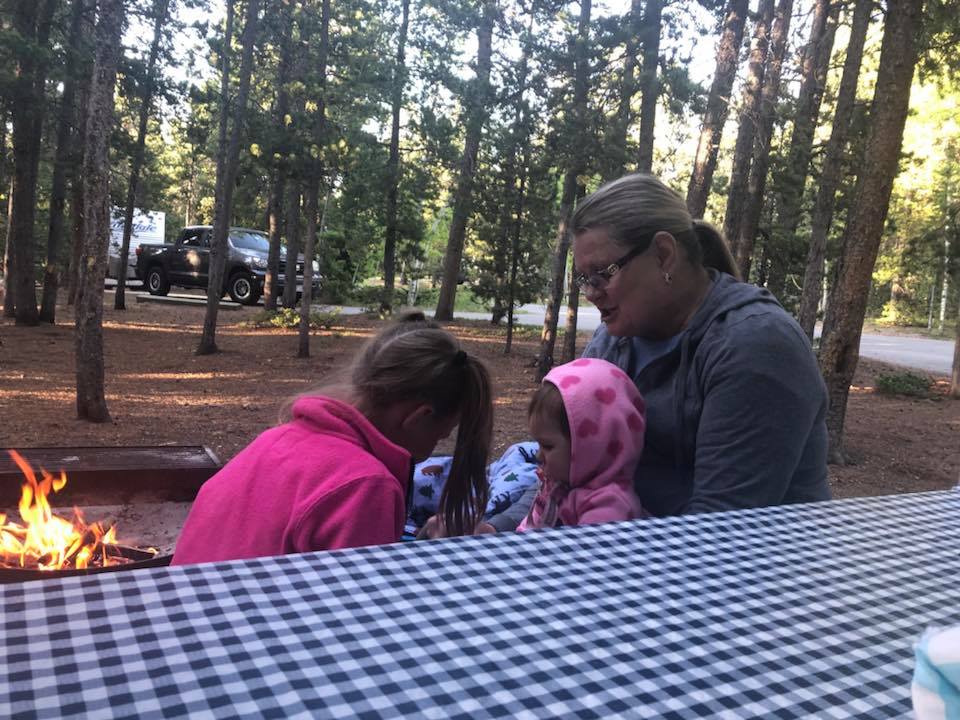
    As I was reflecting, I remembered a moment on our camping trip we came back from yesterday.  She was sitting with her Grandma and baby cousin reading “Brown Bear” to her.  I took this video, and when she caught me she said with a big grin,

    “I want to be a teacher mama.”

    As I hugged her tonight, I told her,

    “You already are.”

  • Report cards are bittersweet with special needs

    Report cards are bittersweet with special needs

    End of the year is here! Summer is around the corner and the excitement of summer is palpable. There is something else though that is tangible I hold right before the excitement of summer.  It’s a small manila envelope that holds the children’s report cards.

    When I was a kid, I LOVED report card season.  My report card was always glowing.  I couldn’t wait to take it home and show my parents who would shower me with accolades and possibly reward me with ice cream.  I could not WAIT to open up that envelope and see the delicious and positive contents hiding inside.

    Ashynn, my first born child with apraxia and related learning disabilities was the second time aside from myself that I had looked at report cards.  I remember opening up her first one and feeling like someone had sucker punched me.  Despite her working hard every night, and going to therapy almost every night, the scores were more than concerning.  The grades were absolutely devastating.

    Yes I KNEW she has on an IEP. Yes I KNEW she had a modified curriculum and the report card shows her performance based on same aged peers.  Yes, I KNEW that.  It didn’t make the blow any less intense.   How was it fair?? While other kids played soccer or did gymnastics, mine spent every spare minute in a therapy and yet she was still behind.  Again I ask you, “How is that fair??”  As she went through first grade I started taking longer and longer to open that envelope.  You have to work up to putting yourself through that kind of pain again.

    Ashlynn is in second grade now.  Her manila envelope aka report card was sent home first.  I saw it in her backpack. Yes, I saw it.  I never pulled it out.  Why would I?  I know what I’m going to see.  I’m going to see that in spite of the fact that she has therapy after therapy and tutoring after tutoring after school; she remains dificient in most areas of her life. Despite her positive attitude, her resiliency, and her stellar attention to task and work ethic in therapy…she has true disabilities that will persist throughout her entire academic career and will be highlighted by the scores on her report card.

    Yeah so that report card. It kinda makes me sick.  I have to work up to reading it and it usually takes a couple of weeks.

    One day later a same manila looking envelope ended up in my son’s backpack.  I found myself excited and ready to tear into it!  I had a hard time waiting until we drove home.   I was over the moon to read the narrative,

    “It has been a pleasure to be Jace’s Kindergarten teacher.  He is outgoing, inquisitive, and comes to school excited to see his friends. He is a hard worker and determined to do his best. He takes great pride in his work.”

    I looked at the description with awe.  The same could have been written about my daughter with disabilities, yet, this person, MY SON, had scored all three’s (A’s) and my daughter still remained far behind.

    My daughter is outgoing, inquisitive and loves to see her friends too.  She is a hard worker and is determined to do her best.  She takes great pride in her work too.

    The next morning I received a text from her special education teacher.

    “Did you read A’s Progress Report yet???”

    I had been caught.  I felt ashamed, but I wrote back honestly and said,

    “Looking at her report card is so painful I have to work up to looking at it.  It usually takes a week or more.”

    She wrote back that after her IEP in March she had completely revamped her programming and she encouraged me to look at it.  I thanked her and sighed a heavy sigh.  I wanted to see all the progress which would be on the special progress reports that are added to the report card based on her IEP (Individualized Education Plan) goals, but I would have to look at the report card too which I knew still had low scores.  I looked at the two manila envelopes lying on the floor in the living room.  One opened, and one un-opened.  I want to read all the wonderful progress, but I’m just not ready to get punched in the gut today with the other papers sitting behind it.

    Not yet.

    I will.

    I promise I will.

    I just can’t face it yet today.

  • Diagnosis, Disability, and Finding your Tribe

    Diagnosis, Disability, and Finding your Tribe

    ​Parenting children is hard.  That isn’t a secret.  Parenting a child with a disability has even extra challenges that shake us to our core.

    I have a daughter with special needs and numerous learning challenges.  When she was almost three, she received her first diagnosis of Childhood Apraxia of Speech, a rare and severe speech disorder in children.  That was the beginning of many a “dark day” in my parenting journey with her.  I remember putting her in her car seat, tears in my eyes as her bright blue eyes smiled back at me and seemed to ask, “why are you crying?”  I sobbed that day.  I cried for so many reasons.  Fear, uncertainty, guilt and confusion.  I texted a friend I was devastated, and I truly felt like I had the wind knocked out of me.

    Slowly I found a community of parents who had children with apraxia as well; and I started to feel hope again.  I started to believe what was possible for their children was possible for mine as well.  I found my tribe, as I like to say.  All these parents understood me, my daughter, our challenges and the significance of our small successes!  I discovered there was a walk to honor kids like mine and spread awareness.  I connected with others in my community and no longer felt alone.  I no longer felt devastated but instead felt blessed by the friendships I had formed.

    My daughter has went on to receive multiple and additional disabilities since that first one of apraxia.  I can’t lie.  Each new diagnosis, report, or low test score feels like a punch in the gut all over again.  However, we have our people now.  We have our tribe.  We have others who understand.  They understand that sometimes you are in such a state of deep grief you can do nothing else but cry and cannot face the world that day.  We also know that stage doesn’t last, and when a member of our tribe is down, we will rally around them and be ready to pick they back up when they are ready to face the day again.

    I learned that some of my darkest nights were followed by the most glorious sunrise; and I found that sunshine in the community around us.  No one should suffer alone.  No matter the struggle, we should all find others who understand our unique situation in the world.  For us, community was the light that found its way into the dark tunnel of grief and showed us the way out.

  • Not walking to jumping jacks. A journey through OT and PT

    Not walking to jumping jacks. A journey through OT and PT

    There is this video of Ashlynn learning to walk.  It’s a video I have only reviewed once because it used to break my heart.  My daughter was 17 months old and still not walking.  My husband and I bought her the kid version of a walker, and almost every night we would encourage her to “walk” with it from one side of the room to another.   At the time, I of course knew she was delayed.  Why I didn’t seek early intervention for these delayed milestones is still beyond me.  Pride is a nasty bugger.

    Anyway, I was determined to help her and work with her just like I was doing with speech.  I just knew this walker would be the bridge that completed the gap.  She was excited and stood up with it right away.  Soon, it quickly started to roll away and Ashlynn’s legs, unable to keep up stretched out behind her and left her tumbling to the floor.  Despite the failure, my husband and I were excited and cheered her on in video after video.

    It still wasn’t until almost a year later she finally was put into PT and OT for delays in gross and fine motor skills due to motor planning.  This sounds crazy, but when she was identified through Child Find close to her 3rd birthday, I still had never heard the terms dyspraxia or developmental coordination disorder.  I knew she was delayed, but I didn’t know why.  I kept thinking she must have cerebral palsy or something.

    Today at the age of 8 years and 3 months, my daughter executed 10 jumping jacks.  “What’s the big deal?” you might say.  It is so difficult to explain the steps it took to get there, but I’m going to try because it absolutely blows my mind.

    It started with just a simple jump.  My daughter had to be taught how to even jump.  They started her on a trampoline in which she could only march, and graduated to her feeling the bouncing motion with her body and she bounced with her feet planted on the tramp holding a bar for balance.  Soon after she was able to catch air on the trampline, which paved the way for an actual jump on hard ground.  Learning how to bend her knees and propel herself upwards was a challenge, but once she had succeeded we had assumed she had the jumping thing down.  We were wrong.

    Jumping vertically was one motor plan, jumping forward was another.  It took her more time and effort in OT and PT to learn how to jump and then to jump forward.  Once she had that down, we assumed she had the jumping thing down.  We were wrong.

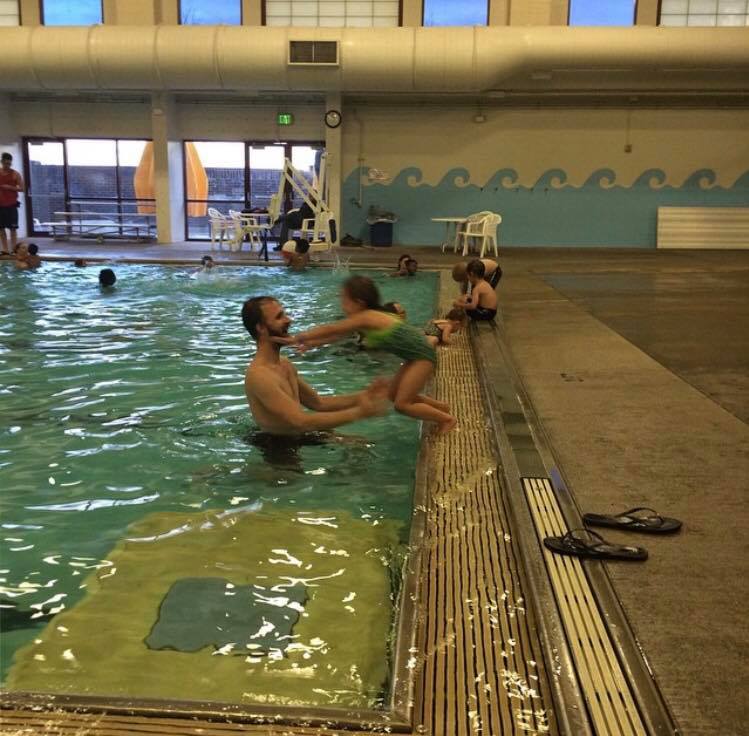
    Jumping off a ledge, or even a small curb is completely different than just jumping forward because the depth change is a different motor plan and involves spatial awareness and balance.  It would be more time and effort spent in therapy to learn this and not only learn it, but to keep increasing the distance of the ledge.  Jumping into the pool took a very long time for example.

    Ashlynn pool jump 5 1/2

    Next came skipping.  I had no idea skipping involves hopping, as we basically “step-hop” (as her therapists would say).   “Step-hopping” is harder because it requires a child to be able to hop on one foot.  That is yet another different motor plan from jumping together with two feet.  Oh, and it also requires a child to “alternate” their steps. Ashlynn was still taking the stairs one foot a time.  She would have to learn to alternate climbing.  During this time she first learned to gallop with one leg.  This stage lasted awhile until she could finally coordinate her second leg to follow suit.  After awhile, a slow and methodical skip began to take form.

    I might add crossing midline, vestibular activies, and balancing goals were also being worked on.  When you put all of these skills together, the last mother of all motor plans and total body coordination is nothing other than a

    JUMPING JACK.

    A Jumping Jack!  A fun activity most typical kids pick up one day around 5 years old in gym class. No therapy required.

    My daughter has been able to execute about two jumping jacks for awhile, but actually getting the motor plan down to do ten in a row was taking a collaborative effort between OT and PT.  Ashlynn true to her nature, always practiced at home.

    Tonight, at the age of 8 years and 3 months, my daughter who walked late and consequently went on to learn every gross motor skill through extensive time and work in therapy, executed 10 jumping jacks independently.  Her excitement was so palpable she asked me to record her, and she never asks me to record her because she always freezes!

    THIS moment is Ashlynn’s first place blue ribbon.  THIS moment, basically 3 years beyond her neurotypical peers, is our gold medal. I have long since toughened my skin to all the precocious and amazing things my facebook friends’ children are doing.  None of that matters.  Comparison is the thief of joy. What matters is my daughter wakes up everyday and fights to do things most others take for granted and she attacks it with a drive and determination that is unprecedented.  I have come to realize, my daughter learned the key to success early on; and though I still worry about her future, I know I shouldn’t.  I know I shouldn’t because I have inspirational quotes constantly running through my head.  Babe Ruth: “It’s hard to beat a person who never gives up.”  Michael Jordan: “I have failed over and over in my life and that is why I succeed.”

    So many others too.  Too many.  Ashlynn always succeeds.  She has this internal motivation and drive.  She competes with no one else either.  She measures herself to the bar she has set for herself and strives to do better than she did the day before.  It is remarkable.  It is what ALL of us should be doing everyday.  Can you imagine how amazing this world would be, if instead of getting older and accepting our “place” in life, we all woke up striving to be better than the day before.  Setting goals and not stopping until we reached them?  Always aiming higher, and higher and higher?  When did we as adults stop doing that?  When did I stop doing that?

    I don’t know when I stopped, but I know when I started again.  I started again after watching Ashlynn.  Watching her literally fight her own body and failing two many times to count.  But then, I have watched her rise victoriously too, time and time and time again.

    As a child I always cared what people thought. I always measured my worth by the A on the paper, the awards I won, the medals I received, and all the accolades that were given to me.  The problem is that leaves one in a very vulnerable position.  Ashlynn learned the game of life early.  We need to strive to be a better version of ourselves than we were the day before.  The only person we should be competing against is our past self.

    I had a parent tell me the other day that there is a certain beauty in parenting our kids because we celebrate everything so much more.  I had to agree.  The human experience is this exact sentiment.  We take for granted our health, until we don’t have it.  We take for granted the sunshine, until we are knee deep in the snow.  We take for granted our children’s laughter, until we watch them go through pain.  We take for granted finding love, until we get our heart’s broken and so on and so forth.

    Parenting Ashlynn has made me realize this tenfold.  We take for granted our legs, until they don’t work or cooperate.  We take for granted our speech, until we have no voice to communicate.  We take for granted all the mundane things we do like getting dressed or brushing our teeth, until you see someone like Ashlynn struggle for years to get it down. You take for granted your ability to do a jumping jack, until you see over a span of not days, not months, but years, YEARS, of all the little wins along the way that were fought and won just to be here where we are today, watching the executing of 10 simple jumping jacks.

    [wysija_form id=”1″]