Category: Childhood Apraxia of Speech

  • A source of hope: Natalie’s walk with apraxia

    A source of hope: Natalie’s walk with apraxia

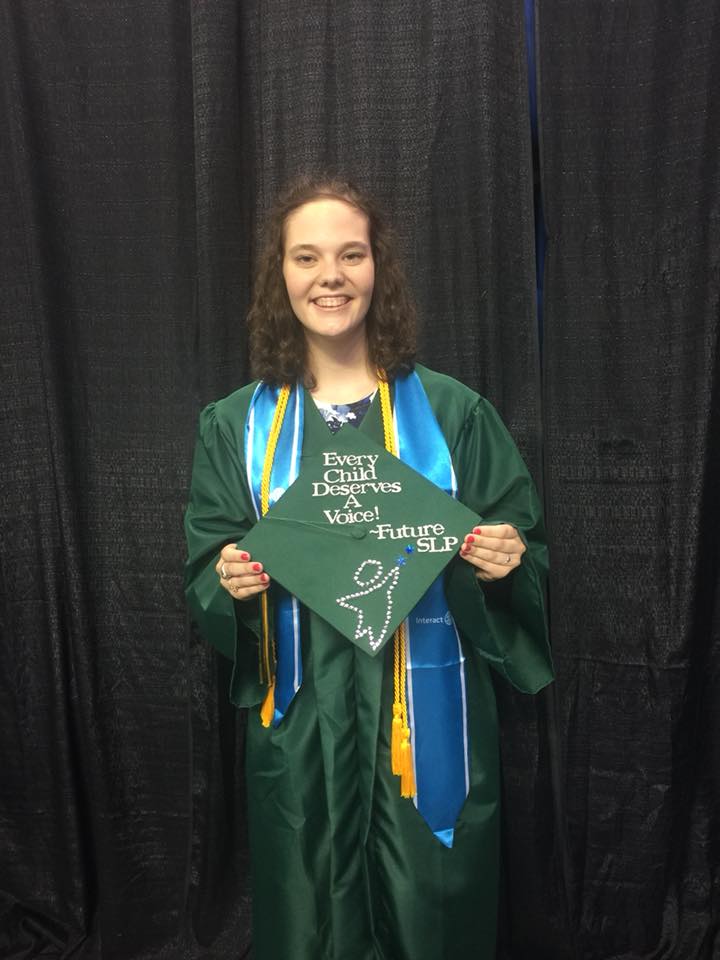
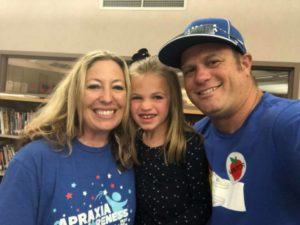
    Hi Natalie!  I had so much fun meeting you in person at the Apraxia National Conference this past July!  I had already heard so much about you within the apraxia walk community, as you overcame apraxia and are now a walk coordinator for your area! All by the age of 16! That’s amazing! Let’s start with you telling us a little bit about yourself.  

    What do you remember about speech therapy and how long were you in it?

    I just remember playing games and making crafts. I was in speech when I was 2 through second grade.

    When did you know you had apraxia?

    I was diagnosed with apraxia when I was two and a half.

    How has apraxia affected your life, or has it?  Do you have any residual issues?

    Yes, apraxia has affected my life on multiple levels. I have been diagnosed with anxiety because of the slow processing. I don’t feel like I have enough time to finish tests. I also still have problems with my sensory. Also when I get tired my speech starts to slip.

    What was your school experience like?

    My parents and I have had to fight for everything I have in place. I have a 504, which allows me more time on test, but the 504 is for my anxiety and not for apraxia because no one understands what apraxia is at my school. I have to tell my teachers what I have and explain what it means.

    Most parents are so worried about the future when their child gets an apraxia diagnosis.  What would you tell them?

    Apraxia is a long journey. It takes time. Don’t rush your kid’s speech, it will come. Everything happens for a reason and apraxia has influenced their life for some reason or another.

    What do you wish more people knew about apraxia?

    Apraxia doesn’t just affect your speech, it affects your processing speed and much more.

    What inspired you to become a walk coordinator at such a young age?

    I want to help families with kids with apraxia. My family has gone through the same things as others have. My parents didn’t know if I would ever be able to talk and live on my own. I want to give families hope, the same hope my parents got from Kate Hennessey.

    Thank you so much Natalie, for all of your advocacy work and continued mission to spread awareness and help other kids with apraxia!  You are absolutely a face of hope and inspiration!

    To see a news story on Natalie click here: Teen finds her voice and uses it to help others. 

  • Top Ten SLP Mommy of Apraxia Posts for 2018

    Top Ten SLP Mommy of Apraxia Posts for 2018

    Hi readers!  I haven’t been as active on the blog as usual because my goal for 2018 was to write a book and I’m happy to say I completed that goal!  My goal of 2019 is for it to be published, so we will see!  In the meantime, I did manage to get some blogging done and here are my top 10 posts for 2018!  Thank you so much for your support and your love throughout the years.  It truly means so much.

    1. The Problem With School SLP’s

    A

    2. Interview with Mikey: The Wish That Turned Into a Passion

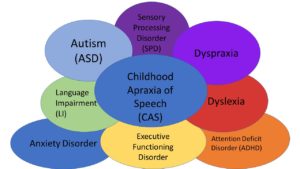
    3. Apraxia as a Symptom to a Bigger Picture

    4. Strategies to Promote Speech and Language in the Pre-Verbal or Minimally Verbal Child with Apraxia

    5. This School Year, Teach your Children to be Kind

    6. Finding our Umbrella

    7. Good SLP’s are Addressing the Head in the Hands

    8. The 6th Apraxia Awareness Day Brought Smiles, Tears, and a Jaw Dropping Moment

    9. Report Cards are Bitter Sweet in Special Needs Parenting

    10. Old Faces, New Faces, and the Passing of the Torch

    Cheers to an eventful 2018.  It was a year full of pain and happiness, love and sorrow, and hope and despair.  May we all remember that life can be intensely beautiful and irreparably sad all at once, because that my friends, is the definition of living.

    This 2019, I wish you all the gift of perspective in life.  We all have bad things happen.  We all have stress and we all have pain.  We also all have a choice, and that choice is to wake up each morning with a grateful heart and to focus on our happy and joyful moments rather than be sucked into the pain of despair and heartache.  There was a time Ashlynn’s dx seemed like the darkest event in my life, but I realized it was the beginning of my testimony to some of the most beautiful characteristics this human life affords us.  May God bless us all this year and always.
    Love and Peace,

    Laura

  • Favorite Winter Children’s books for Speech Therapy

    Favorite Winter Children’s books for Speech Therapy

    Favorite Winter Children’s books for Speech Therapy

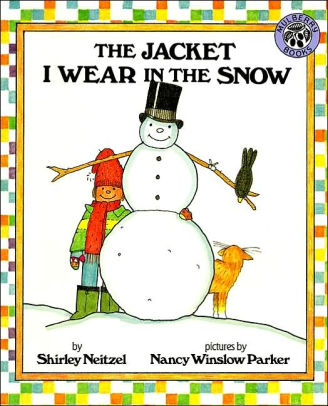
    1. The Jacket I Wear in the Snow by Shirley Neitzel
      A great repetitive, rebus style book!  So many target words in this book include: cap, scarf, mittens, sweater etc.  Good for winter clothing vocabulary and sequencing too!

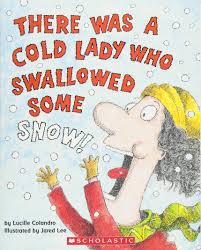
       2. There was a Cold Lady Who Swallowed Some Snow by Lucille Colandro
           Lucille Colandro always makes my list for favorite books because her Old Lady series contains all the elements I work on with apraxia therapy including repetition, prosody, and sequencing!

    Activity: Find my book companion in my TpT store here: Cold Lady Book Companion

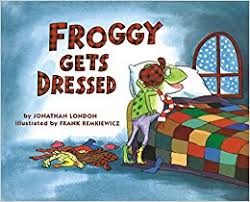
    3. Froggy Gets Dressed by Jonathan London
    Another great winter clothing repetitive book that the kids LOVE.  I work on target words “out” and “in” a lot in this book since Froggy is always going outside and inside; however, I can also hit “put on” when he’s putting on his clothes or work on prosody when Froggy and his mom are yelling back and forth to each other.

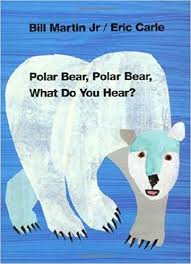
    4. Polar Bear, Polar Bear by Eric Carle
    It’s a classic for a reason!  Repetitive and engaging, kids love to participate in the book read.

    5. Bear Snores On by Karma Wilson
    Love the Bear book series!  Bear is hibernating and sleeps through a winter party while his friends all gather in his lair to escape the cold. Target words for this book include: “on” in the early stages or “snores on” when working on /s/ blends.

    Activity: Free character cutouts from Making Lemonade in Second Grade available on TpT here:

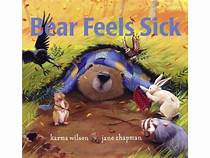
    6. Bear Feels Sick by Karma Wilson
    I was going to stick to a top five list, but I couldn’t resist adding another Bear book.  Kids relate to poor bear feeling sick and the familiar and lovable characters are always heartwarming!  Target word in this book is “sick” so you have to make sure you have a kiddo who can produce both /s/ and /k/; but if they can, this is a great target word.

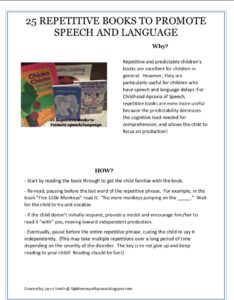
    Below you will find a free graphic I have on my TpT store explaining how to use repetitive books with your child to promote language and practice speech. My targets and books are always strategically selected based on the child’s sound repertoire. Click the picture to get the free download.

  • Favorite Holiday books for Speech Therapy

    Favorite Holiday books for Speech Therapy

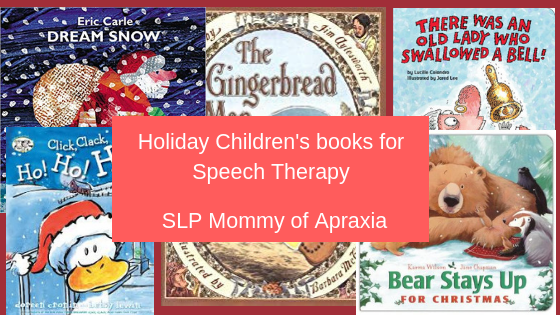
    6 Favorite Children’s Holiday books for Speech Therapy

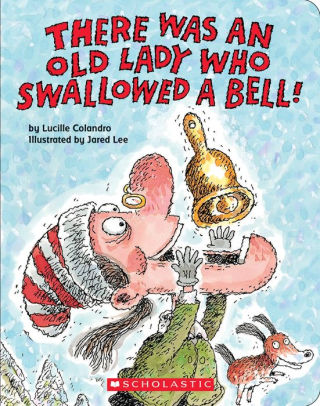
       1. There Was an Old Lady Who Swallowed a Bell by Lucille Colandro
    As with all the Lucille Colandro Old Lady Books, this is a repetitive children’s holiday book.  Nice target words that are repeated include “bow” and “hat” that can be used for repetitive practice.  The pictures in this book too are colorful and fun.

    Activities:
    Book Companion Pack on my SLP Mommy of Apraxia TpT store.  Find it here.

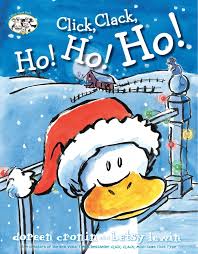
       2. Click, Clack, Ho! Ho! Ho! by Doreen Cronin
    Kids laugh at this funny, repetitive book in which duck gets stuck in a chimney
    and the barn animals take turns trying to get duck out.  The words for good
    repetition in this book include “uh oh” “oh no” and “ho ho ho,” which are nice
    CV and VC targets in the early stages of therapy.

    Activities: Free sequencing and comprehension book companion from Thumb Bunny Speech.
    Find it on her TpT here. 

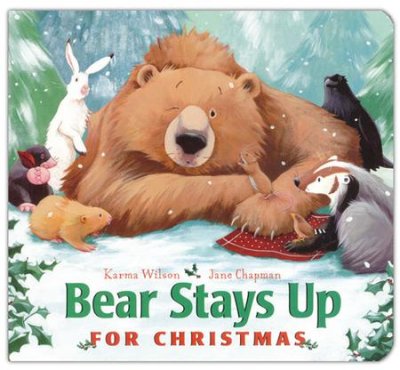
    3. Bear Stays Up for Christmas by Karma Wilson
    Bear’s friends help Bear stay up for Christmas in a sweet and heart warming book. Repetitive Targets I use in this book include “up,” for the early stages of apraxia, expanding to “stays up” for kids who may be working on /s/ blends.

    Activities: I found a free read aloud companion on TpT from Making Lemonade in 
    Second Grade.  Get it here.

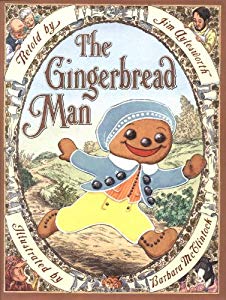
    4. The Gingerbread Man by Jim Aylesworth
    The classic tale of the Gingerbread Man is told in this fun story about a mischievous
    cookie.  Love a lot of repetitive targets in this book such as “me” or the entire phrase
    “you can’t catch me” (which can also target prosody), “man” in Gingerbread Man and the word
    “back” expanding to the phrase “come back” if possible.

    Activities:  Book companion pack on my SLP Mommy of Apraxia TpT store. Find it here. 

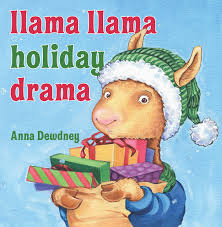
    5. Llama llama Holiday Drama by Anna Dewdney
    Llama llama is impatient for Christmas in this relatable book about a child’s anticipation
    for Christmas. I love the rhymes in this book and the repetition of “mama” and “llama”
    that can be targeted for repetitive practice, depending on the child’s repertoire.

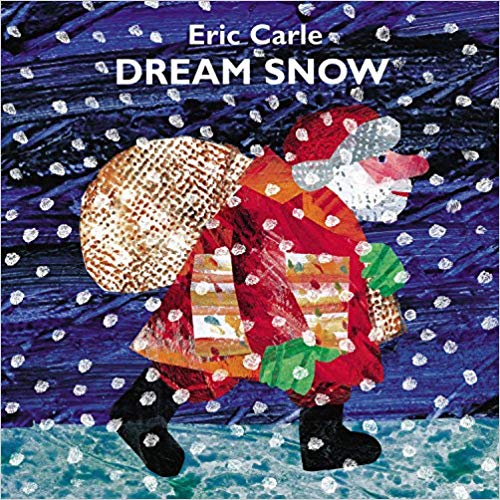
    6. Dream Snow by Eric Carle
    Interactive with colorful and vibrant pictures, this book is a children’s favorite.
    Targets for this book include counting to five and repeating the words “on” or “snow” as
    each animal is covered with a blanket of snow.

    Activities: Freebie on TpT by Mrs Plemons Kindergarten.  Find it here. 

    Below you will find a free graphic I have on my TpT store explaining how to use repetitive books with your child to promote language and practice speech. My targets and books are always strategically selected based on the child’s sound repertoire. Click the picture to get the free download.


  • Disabilities, extraordinary abilities, and lessons in neurodiversity

    Disabilities, extraordinary abilities, and lessons in neurodiversity

    Neurodiversity and learning disability were never in my vocabulary before I had my daughter.

    I had never been exposed to learning disabilities of any kind really, and I had no idea the extraordinary gifts those who are neurodiverse had to offer this world.

    No, when I was in second grade, I was in my egocentric world and our teacher had us write “a book.”  It was a short story and we were to write on the typical school paper that has a box at the top to draw an illustration and then lines at the bottom to write the story.  Writing was always my thing.  Art….was……not.  I usually skipped the picture and went straight to writing.  In my defense though, I never technically had an art teacher.  However, even if I had, I’m sure I would have still been that defiant snotty little girl who turned up her nose at art.

    During one edit, the teacher told me the book was great but I needed illustrations.  I argued with her.  Her job wasn’t to teach me how to draw, her job was to teach me how to write.  Drawing was for the kids who didn’t know how to write and I knew how, so what did it matter anymore?  Did I mention I also went to a Catholic school, so I was marked down automatically for being sassy?  I never pulled that again, but it didn’t stop me from internally rebelling against drawing.

    “When will I EVER need to know how to draw as an adult?” I indignantly exclaimed to my mom.

    My Catholic school teacher had the last laugh though when I became a speech/language pathologist and discovered I needed to know something I didn’t know how to do.  You guessed it.  Draw.

    “What is that?  Is that a dinosaur?” one kid would ask of my drawing of a horse.

    “That’s supposed to be a bird?” another asked of my drawing of an airplane.

    Yes friends.  That sassy, know it all second grade girl started wishing she had paid more attention to art.

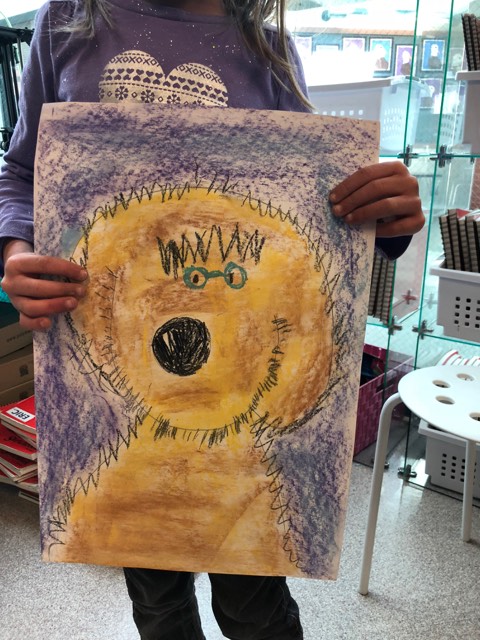
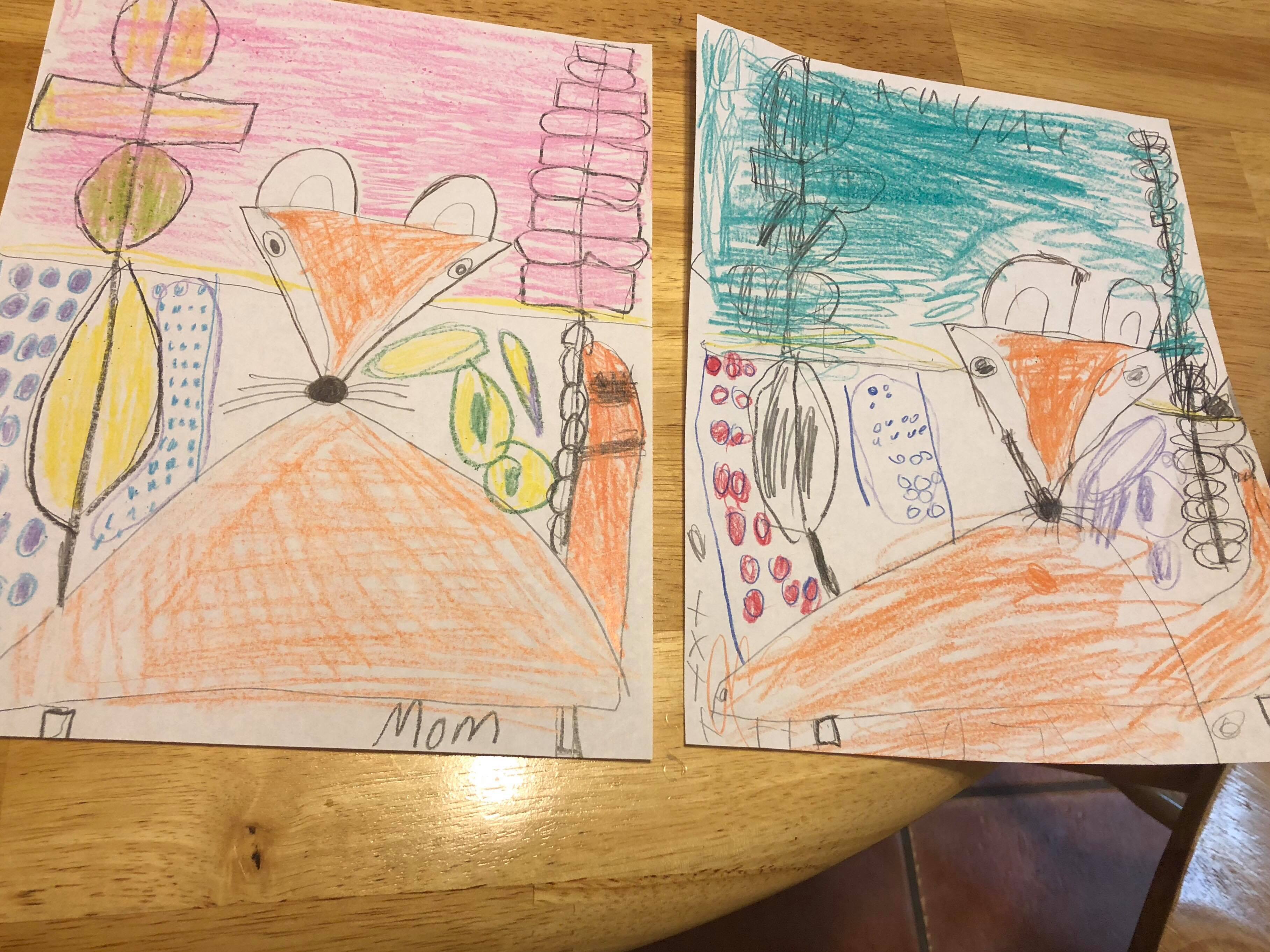
    Fast forward 30 years and I have a little past second grade daughter myself.  She has a laundry list of learning disabilities, many stemming from an etiology in motor planning and cerebral palsy.  Everything for Ashlynn seems hard.  She has had to fight and claw her way to learn anything through hours and hours of therapy.  I’m not kidding.  In Elementary school, she started coming home with art pieces from art class that were nothing short of amazing.  They were so amazing, it was sadly hard for me to believe that she did them without help.  However, her art teacher maintained she taught all the kids in a very structured way, giving them multiple opportunities for practice (think motor planning) before completing the final piece. This was Ashlynn’s best one from last year.
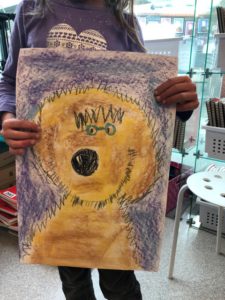
    Despite this, Ashlynn had never demonstrated to me independently she could draw even remotely close to this on her own.

    That was, until tonight.

    “Mommy, do you know how to draw a fox?” Ashlynn asked me tonight at dinner.

    “Oh baby, I don’t really know how to draw much of anything,” I answered while my husband snorted his drink out his nose in laughter before adding,

    “That much is true!  Mommy is not an artist.”

    I shot him an evil glare but unfortunately there was no denying the truth.

    “Can I teach you how mommy?  I learned how to draw a fox in art?” Ashlynn offered.

    I agreed and after dinner she had gathered paper and coloring utencils and set to work.  I really wasn’t sure what to expect.

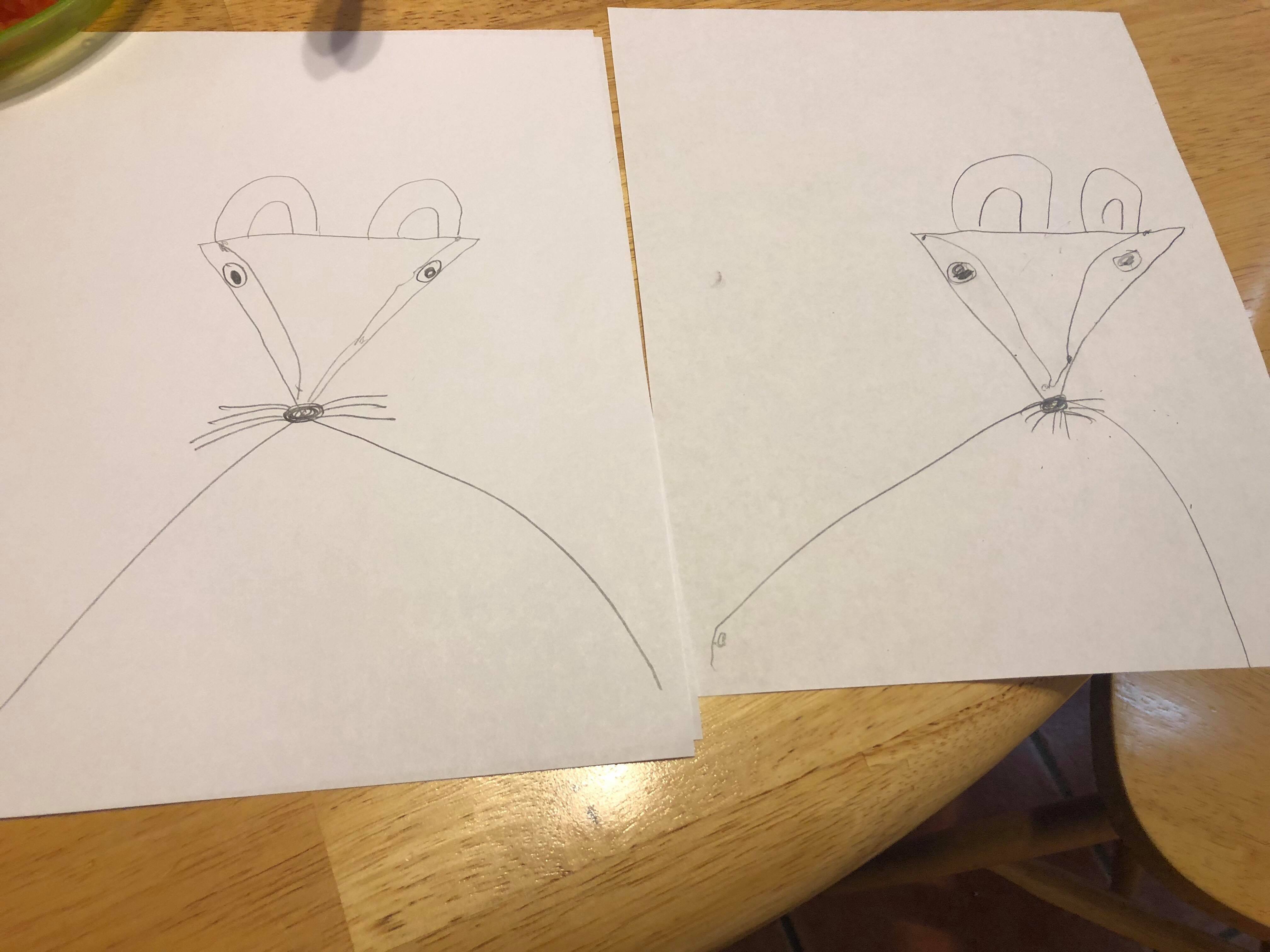
    “Put your fist in the middle of the paper like this, and now draw a line across the top,” she instructed.

    I complied.

    “Now connect this line to this line and see?  We made an upside-down pizza,” Ashlynn continued.

    I looked at the perfect triangle and my mind raced back to three days earlier at OT where the therapist told me Ashlynn’s hardest shape to draw is a triangle because of the diagnal lines. I stared incredulously again at Ashlynn’s perfect triangle.

    “Mom!  Are you paying attention?”

    She then took me in precise detail through the rest of the picture.
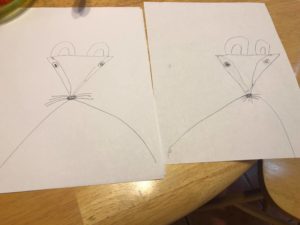
    I was impressed by this.

    “You are such a great teacher Ashlynn,” I said.

    “I know mommy because I want to be a teacher you know that.  A teacher and a dog walker because that’s my deal.”

    I smiled.  She just produced a compound complex sentence.  This girl with apraxia and a language disorder just said that.

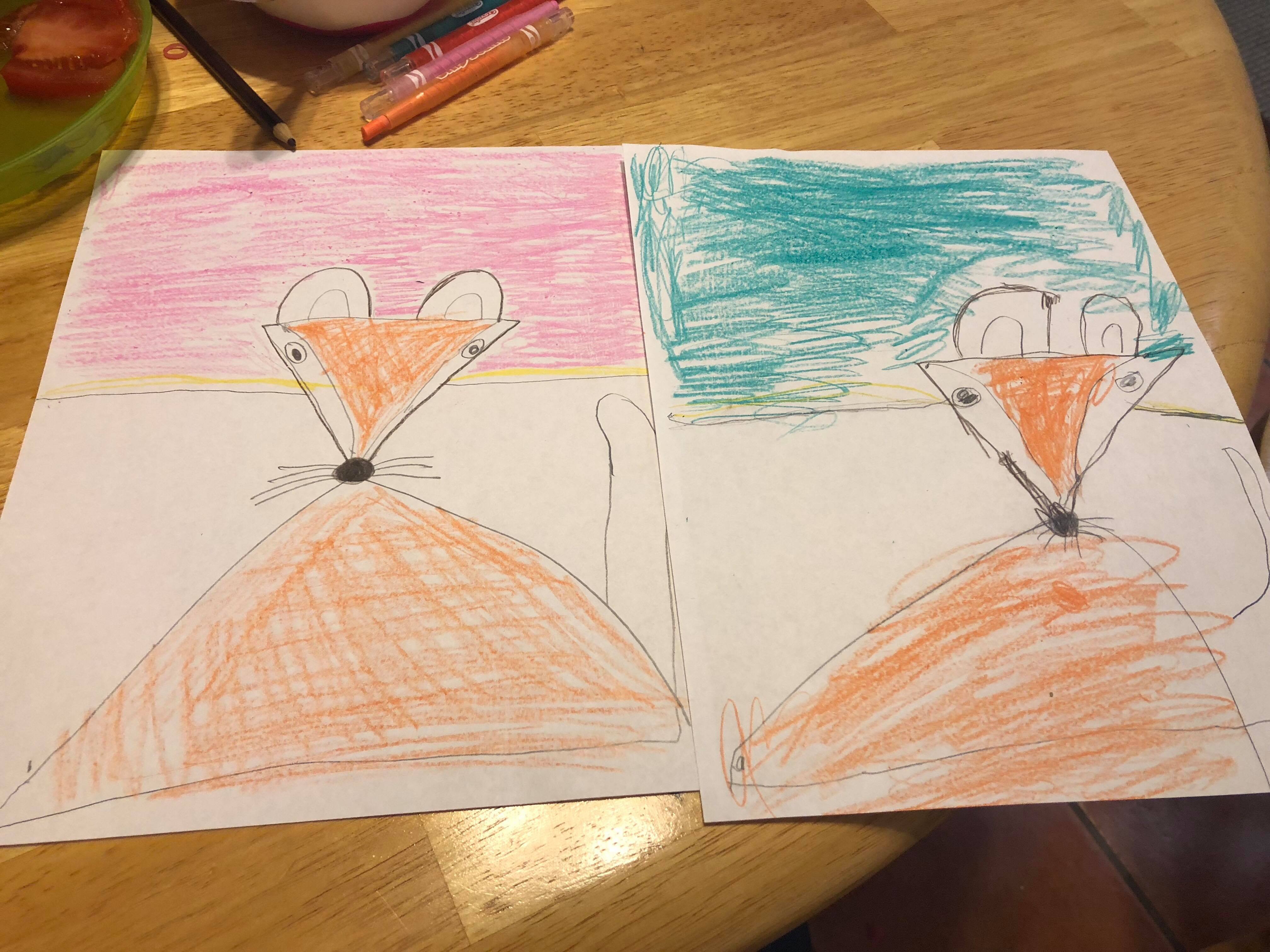
    Next was the colors.
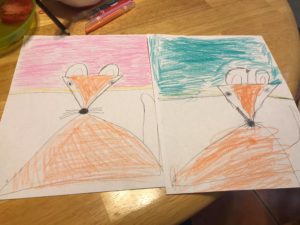
    I fought back tears.  This was incredible.  I watched her color the page with her wrist fluidly and precisely moving back and forth and my mind flashed back to when her OT told me that until she is able to isolate her wrist from her arm, she would always have trouble coloring within the lines.  I marveled at her wrist now.  Isn’t that crazy?  What mom would marvel at their child’s wrist and control unless they had witnessed how hard that skill was to master.

    Next was texturing and drawing the trees.
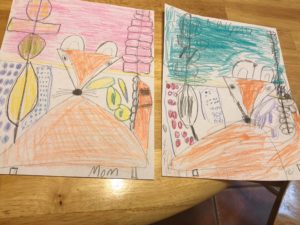
    She used these terms I had never heard like “we have to jump and bump.”  I followed along dutifully.  At the end of her lesson I praised her.  It was incredible.

    “But Mommy, we aren’t done!” she said as she got out two new blank pieces of paper.

    She told me we had to write about them.

    Write?  Like actually write?  This girl with motor planning, dyslexia, and dysgraphia now wanted to write about the fox?  She began writing but immediately messed up her spelling. As she peered over at my page that she had dictated, she decided to just copy my sentence. I watched her form the letters as she had been taught and practiced throughout her years of OT and copy my sentence. There was a time, she couldn’t even copy her name, I thought to myself.

    “Sorry, mommy, ” she said, “I can’t write really good yet.”

    I responded, “That’s okay, because I can’t draw very well.”

    “But I can teach you!” she said happily.

    With tears in my eyes I told her,

    “If you teach me how to draw, I’ll teach you how to write.”

    “DEAL!” was her enthusiastic response.

    So that’s the deal.

    Thirty years later my art teacher was a 9 year old girl with cerebral palsy, severe motor planning deficits and a laundry list of learning disabilities whose greatest wish in the world is to be a teacher.  Little does she know, she already is.
     

  • Thank you for choosing me to be your mom

    Thank you for choosing me to be your mom

    It’s Halloween, 2018.  You are a freshly turned nine-year old.  You are 9 years old. My mind immediately repeats a phrase from my dad,

    “Mr. Baskall, here’s your little baby girl.”

    I remember I would roll my eyes and scoff at him.

    “Ugh dad!” I would lament as he looked at me with eyes brimming with pride.

    I don’t have any words to describe or memorialize your entrance into this world, but I have your pictures.

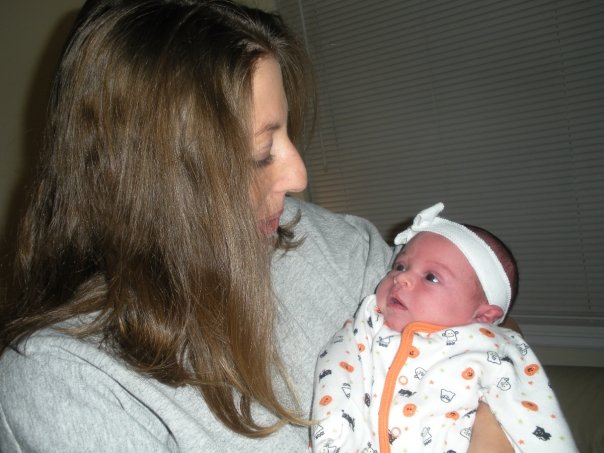
    Halloween, 2009 was the most magical holiday that I have ever experienced.  It was the first holiday I ever experienced as a mom.  I was a mom.

    I was a mom!!

    On Halloween’s prior, the entire holiday was full of self-entitlement, but the Halloween of 2009 was full of something completely different.  I had given life to the most beautiful angel.

    My normally highlighted hair was brown, which is actually my natural color.  I had diligently not dyed my hair while pregnant with Ashlynn to ensure no harmful chemicals crossed my scalp, into my bloodstream, crossing the placenta and then hurting my baby.  I remember taking every precaution to ensure I had the healthiest baby my body could possibly produce.  An avid craft beer drinker from Colorado, I would refuse to even take a sip while pregnant.  I ate my lunch meat warm to avoid lysteria and eliminated all caffeine so my developing fetus was never exposed to any stimulant in utero.  I wore an industrial style mask when I painted her baby room to ensure she was exposed to no harmful fumes.

    So confident was I in ensuring I had followed every caution and recommendation, the thought never even once crossed my mind I would have a child with any sort of developmental delay.

    Life sure answered back with a big middle finger and boisterous laugh at that one.

    Every Halloween though, I become nostalgic.  I remember that new mom holding that tiny baby in her cute onesie with the pumpkin bum and beaming with pride.  I remember my husband dutifully reporting to work each day, but taking time to hold, hug, kiss and fawn over the tiny human we had somehow created together.

    I remember my heart being so full I thought it could actually burst from the amount of love that it was trying to contain inside.  Every Halloween, ironically, reminds me just what a GIFT life actually is. Yes, this day of the dead reminds me of how lucky any of us are to actually live.  Halloween always reminds me of how blessed I was to have a baby.

    I had no idea then, all the challenges life had in store for Ashlynn.  When I look at that picture, I see the instant connection a mother has to her child.  Our eyes are fixated on each other, and I know she trusted me to be the person to never give up on her.  I remember what an honor it is that Ashlynn chose me to be her mom, and I renew my commitment to never, ever, EVER, give up on her.

    I love you Ashlynn Kay.  Thank you for choosing me to be your mom.  I hope I never let you down.