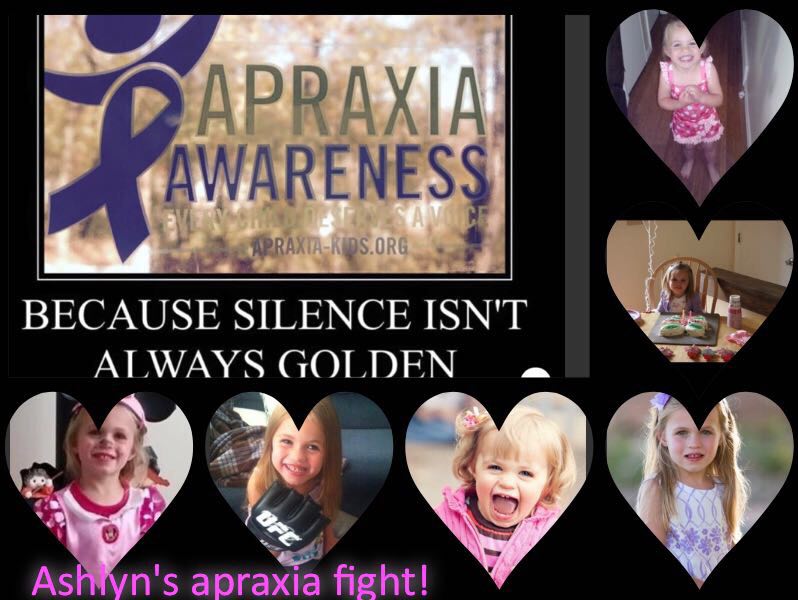
It has been awhile since I posted directly about Ashlynn’s speech. Once we all started to understand her, it didn’t seem as pressing anymore. Her dyspraxic components (gross and fine motor skills) definitely started to take precedence. However, she is still in speech for a reason, and that reason being percentile ranks well, well, well below average.
Ashlynn is 6 years and 2 months. She can say every single sound in the English language correctly, including an /r/, which is a victory for me! If you’re an SLP you understand immediately; but if you’re not, you should know that an /r/ error is basically an entirely different monster that usually takes years to remediate. Unfortunately, she also has a profound frontal lisp. If you’re an SLP, again you understand immediately why I added unfortunately; but if you’re not, you should know that a lisp is also an entirely different monster that takes A LOT of time to remediate.
Though I am paying for private therapy, a lisp is pretty low on the priority list. She is understood in most contexts with varying communicative partners. You might ask, “What is she in speech for then?”
Oh baby, that is a loaded question. We are called speech/LANGUAGE pathologists for a reason. Where there is a speech delay (referring to sound production), there is frequently a language delay. Language runs the gammit from receptive (what you understand), to expressive (what you say). Expressive language includes but is not limited to: vocabulary, grammar, syntax, narrative language, and word finding. Ashlynn has deficits in EVERY…SINGLE….ONE of those language areas.
Her “speech” goals span the spectrum of just understanding complex directions and sentences, to actually producing sentences with a variety of nouns, verbs and adjectives.
There is a physical therapist overseas who is marketing a therapy strategy that is supposed to be amazing for apraxia. He doesn’t understand the uproar about a PT marketing therapy for a very specific and misunderstood speech disorder like apraxia. May I direct your attention to my above statement about us being language therapists too. He may have found some style that helps speech sound production, but is he the guy you want when your child has a low vocabulary? Struggles with word finding? Can’t get pronouns or tenses straight?
Um yeah. Probably not. He won’t have a clue what to do, and an SLP will be automatically incorporating these elements into therapy. Oh, but I digress. That’s another topic!
So for Ashlynn, she is working to her expand her vocabulary using more verbs and adjectives, but also to make sure she is using the correct pronouns, verb tenses, and temporal concepts (tomorrow, yesterday, last night etc).
Word finding is a huge piece, but also vocabulary. Vocabulary encompasses skills such as describing, defining, telling how two things are alike or different, categorizing, etc. We are working on it though.
Pronouns are getting better after correcting her for at least a year. She knows the difference, but when she is speaking she messes them up. She is doing pretty good with subject/verb agreement and using present and regular past tense, but still needs to work on irregular past tense.
Receptive language is also low. I’m hoping we will see this improve as she is on her attention medication now and better able to focus. She knows most of her positional concepts, but other ones like farthest, widest, etc are more difficult. She knows the difference between all wh? questions (what, when, where, who, why), and can answer basic questions; but she is lost as they become more complex, particularly with a book that contains a lot of text.
Oh and I forgot to mention phonemic awareness. She is stuck at around 50% accurate for identifying rhymes and initial sounds. Her SPED teacher is using both whole language and phonics approaches for her reading. Edmark is a program that she uses and I have seen amazing progress with in regard to her other students, so I hope Ashlynn will be the same.
Sometimes it’s a blessing a curse because I feel like I know too much. I know her deficits, and I know if not remediated, what additional deficits they will cause. I also hate that lisp, but seriously, priorities. Everyone can understand her…..lisp or not, so that’s going to wait.
Her next IEP will be this coming Spring. I’m looking forward to all the growth she will make between now and then. We’ll keep on keeping on, and I’ll believe, like I always believe, that great things are waiting to happen. When we look for negative things, we will find them, but the opposite is true too! Here’s to 2016! Cheers!
This year was definitely a big year for me and for apraxia awareness! I coordinated the Walk for Apraxia in Denver, I was honored to be published in the ASHA blog and on The Mighty twice; and of course as you all know, my story on Ronda Rousey having apraxia went viral and was featured in national publications and on Good Morning America! This lead to our popular facebook group Ronda Rousey: Knock out Apraxia, and numerous posts featuring our apraxia fighters attached to the hashtag #knockoutapraxia. It has been quite a year!
Thank you to all who follow along, everyone who helps raise awareness, and all who have reached out via email or phone and connected to me!
Here are my most viewed posts of 2015!
1.) Her Fight our Fight: The day we met Ronda Rousey. Read here
2.) Strategies to promote speech and language in the pre-verbal, or minimally verbal child with apraxia. Read here
3.) What is Childhood Apraxia of Speech? Read here
4.) Repetitive books that are great for speech and language. Read here
5.) Why nature weighs more heavily than nurture. Read here
6.) Prognosis is not just a funny word, there is nothing funny about it. Read here
7.) Global Apraxia, you brought your A-Game, but my daughter’s game is better. Read here
8.) Interview with Reagan, a 17 year old with CAS. Read here
9.) Feed the Snowman Articulation Game for high repetitions. Read here
10.) Interview with Sharon Gretz, the Executive Director of CASANA (apraxia-kids.org) about what you should be seeing in therapy. Read here
In case you missed it
These are some of my personal favorites and topics since I started blogging throughout the years
1.) IEP on the other side of the table chronicled Ashynn’s first IEP meeting and how I experienced first hand how difficult they are on a parent. Read here
2.) Ashlynn Play Boats with Daddy details persistent language and dyspraxic issues, but also progress and success. Read here
3.) DTTC: Evidence based treatment in CAS is an interview with national expert Ruth Stockel from the Mayo Clinic on treatment using this method. Read here
This year we spent Christmas in Utah with my husband’s brother and his family, and the day after Christmas we went up to a ski resort where Ashlynn could get a cheap lesson with the purchase of an adult lift ticket. She has been only once before with us this year where we just had her practice getting the feel for it.
Even though she’s only six, I really try to add additional activities like this as I can afford them, because if there is one line that has really stuck with me in all of my learning and experience with apraxia, it’s:
Experience is the key architect of the brain
Especially, experiences and interventions that are done early while the brain is still developing. When the brain is still developing, you have an opportunity to rewire the neurological pathways, just like we did with speech. Ashlynn’s speech disorder is a motor speech disorder. It stems from a motor planning issue, which is why it requires principles of motor learning. If we could get Ashlynn to speak clearly ( and we have), we can also give her the best opportunity to live a life where she can do anything she wants to do, global apraxia or not. At least, that’s what I believe.
Therapies like OT and PT are necessary, but I also believe activities like swimming (which we have her in privately year round) and now skiing I know will all work together to rewire her brain.
We knew skiing would be a challenge. It requires balance, coordination, and well, motor planning. You know, all the things she has a disability in. That was okay with us. We’ll start early and hopefully skiing will help improve all of those things too, even if she can’t ski.
The first time we took her, my husband was so proud. He must of carried her up a small hill close to 20 times and had her stay on her skis and just slide into his arms. She fell a lot, but she was happy and smiling, and just the fact she could stay up a lot of the time too was amazing. It’s amazing because we have seen her work so hard to do any gross motor task. She was significantly delayed in walking, running and jumping. Once she could walk she still fell CONSTANTLY and that lasted well into her third and fourth year of life. Any terrain change or objects in her path, and she would immediately hit the pavement. I don’t know what we expected for her first time, but I don’t think we expected her to be able to stand up at all.
We were wrong, and our hearts swelled with pride.
So back to this trip. Her second trip. We put her in a two hour lesson.
“Will you be with her?” I fretted.
“Yes, Laura. I’ll stay with her,” Cody assured me.
He went into buy the lesson and came back out with a registration card and also informed me we would not be allowed to be with her. Inside I started to panic.
“This card asks if there are any learning disabilities they should be aware of. Should I put something?”
I blinked at him indredulously. He’s usually the practical and realistic one about her disability. Should he put something??? Was he joking?
“Yes you need to put something! Our daughter has a disability in EVERYTHING that is required to ski!!”
“Okay, Laura. Calm down. Just tell me what to put.”
I had him write down global apraxia, a disorder that affects balance, coordination, and planning motor movements; along with difficulty with attention and following complex directions.
I was still panicking. We can’t leave her alone with teenage instructors! She requires professional teachers. This was a mistake. We should have looked up the disability program. I know they have them because a psychologist I worked with who taught me how to snowboard was also an instructor for the disabled population at a ski resort.
“Laura, stop helicoptering,” he said dryly, and just like that off my baby went holding her daddy’s hand.
I looked at my 3 year old son. He was having a meltdown. He has some sensory issues too, the exact opposite of Ashlynn though. He is hypersensitive to things and right now he was screaming his new ski boots were too tight and he didn’t want to go skiing.
Sigh. Dealing with him helped take my mind off of Ashlynn.
Cody came back in and said we will be able to see her class from the lodge. Yes! I raced up to find a seat. Cody said they were teaching the kids inside first on some equipment. I could go look through the glass. I went downstairs and she had an instructor giving her 1:1 attention and she was happy. Laughing. My anxiety went down a little. I was happy they were still inside. It was literally around 0 degrees outside, and I was worried Ashlynn could get frostbite. Due to her additional expressive language delay she doesn’t tell anyone when she is cold, but also her under-responsive sensory system doesn’t feel cold like we do.
Back upstairs, one of her cousins had already come back, cheeks red and feeling sick from being so cold. Oh man. We’ll see how this goes when she gets out there.
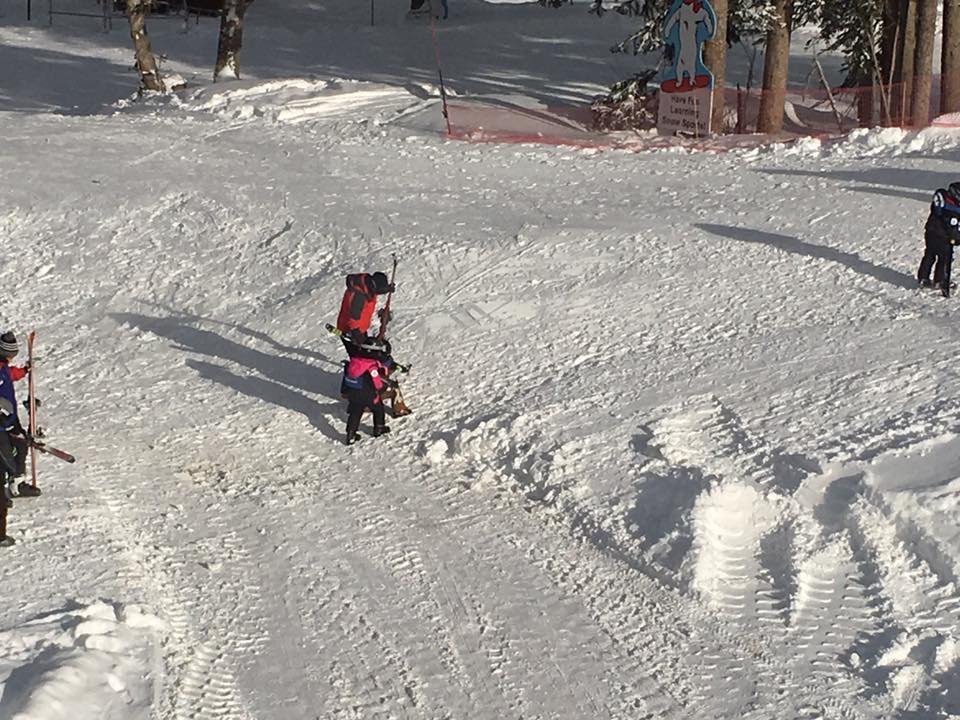
Then I saw her. I looked down from the second story of the lodge to see my little girl with her pink and black coat in line with the other kids. Skis in hand she was marching in her ski boots through the snow. I almost cried. I was thinking about how long it took her to walk and how ANYTHING would throw her off, and here she was walking in ski boots that are already hard to walk in, tromping through snow that has varying terrain, and she was holding equipment that throws off balance. She didn’t fall once and proceeded to get on the “magic carpet” that took her up the hill.
A kid in front of her fell. My heart sank. I knew she was next. I prepared myself for her to fall, and I watched this.
The first head in line by the cones is Ashlynn, standing on her two feet, riding up the magic carpet. I blinked back tears. It’s hard to describe if you aren’t a parent, but that is my heart in that pink and black coat. I would die to protect her, and I was watching her spread her wings and fly, or ski, so it were.
I watched her until she rode out of view.
Meanwhile in the lodge, more of her cousins came back to warm up. I kept staring out the window but never saw her come down. I asked her 14 year old cousin where she was. It was a spot on the other side of the lodge. I raced over and looked out and soon my husband joined me. It was a little ski area school with very small hills. They were teaching the kids how to push their heels out to stop. As I watched all the other kids go, I thought to myself I’d just be happy if she made it to the instructor without falling. She fell a few times, but then, at the very end, after getting up at least 4 times……
….her heels went out and she stopped on her own.
Tears immediately welled in my eyes. I looked over and my husband was literally crying. Our hearts were leaping for joy.
We went back inside and I sat down. I didn’t plan on going snowboarding this trip. For one, I just barely learned before Ashlynn was born and I fall a lot. My muscles are always screaming the next day from pushing me back up so many times. Second, I have really bad knees. Most people don’t know because they’ve been bad since I was 17, but they will just randomly give out on me and snowboarding is particularly hard on them. It just didn’t seem worth the pain or embarrassment anymore. My husband though had brought all my stuff this trip in a misguided belief he would be able to get me to go out on the slopes.
Well anyway, as I was sitting there I couldn’t stop thinking about Ashlynn. She has a disability that makes her work harder than everyone else to ski. She has fallen her entire life. I can’t imagine. She fell multiple more times trying to learn to ski, and yet she always got back up. No temper tantrums, no tears, just her discreet determination. What the hell was my excuse? I don’t have a disability. I may have bad knees, but it’s not a disability.
“Let’s go Cody. I’m ready.”
He looked at me and didn’t skip a beat. He said he had to go out to the truck to get my board and he’d be back.
I fell. A LOT. I fell so much that as I predicted, I’m in pain. After falling at least 15 times I was frustrated and embarrassed. How the heck does Ashlynn never get frustrated?? Again I thought, you don’t have a disability. Get back up. And you know what? I had fun out there in the fresh air and beautiful snow-capped mountains spending time with my husband!
I have seen this meme on disabilities and it never spoke to me until today.
I realized today personally what that means.
I checked facebook and my nephew who is only 20 commented on my pictures that he was so proud of her, and that she teaches him a lot about fighting and never giving up. I teared up again. When Ashlynn came back from ski school I read her what people had commented and she smiled and said, “Jerod say that to me?” She looked so proud.
My husband told her he was so proud of her with tears in his eyes. She replied, “yeah, but I fall a lot daddy.”
We both jumped in and gushed that everyone falls and it’s the getting back up part that counts.
She smiled and replied, “yeah, and we try again tomahyo (tomorrow).”
Yep Ashlynn. That’s right baby. When we fall, we get back up and we try again tomorrow.
So yeah, this Christmas I learned the only disability in life is bad attitude and if my daughter with an actual disability doesn’t use that as an excuse, neither will I.
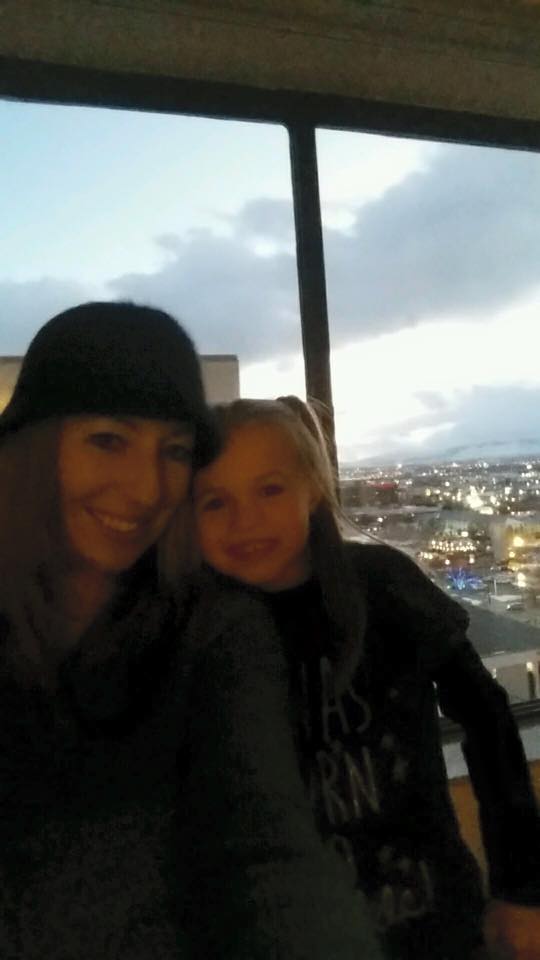
Me and Ashlynn at the hotel in SLC. “You’re wearing your fancy hat mommy,” she said. We’ve come along way!
When I worked in Denver schools early on in my speech therapy career, I became numb to the phrase, “Thank you so much. Thank you for everything.” The parents were soooo grateful for my help, and I didn’t understand. It was my job.
“You don’t have to thank me,” I would reply. “Is there anything else I can do? Any other goals you would like to be written?”
The response was always the same. “No, no? Just thank you. Thank you so much.”
Early on in Ashlynn’s special education career, no one really seemed to know her. Every time I went to school for a meeting, I always saw more at home than what they would report at school. That is disheartening to be honest. I know I’m a professional in an educational world, but that doesn’t mean I’m an expert in education. I’m an expert in speech and language development. I wanted the “experts” in education to report on my child and I saw more at home than what they said they did at school.
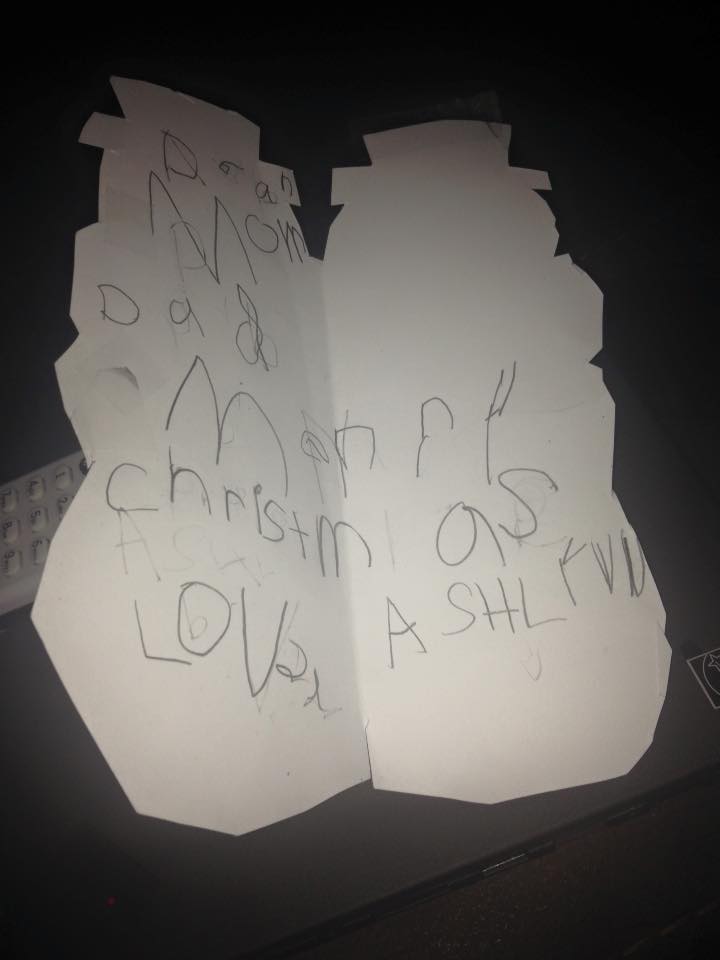
I have spent soooo many posts waiting for a teacher who would believe in her. Waiting for “professionals” to see what I see. Today, before Christmas break, Ashlynn came home with this:
If you have followed me or my story, you know that Cody, Ashlynn’s dad, is a realist. He might tear up at her IEP meetings, but overall, he’s pretty practical about our situation. When I am distraught over test numbers and percentile ranks, he is the one to calmly remind me she always makes progress and never goes backward.
Please direct your attention the above picture. When I saw it, I had an internal cheer. Okay, this is it!! Finally! The money we are dumping into Kindergarten Enrichment, OT, and Speech is paying off!! Last year at this time she STILL couldn’t write her name after years of practice.
I looked over and saw Cody choked up. I paused and realized how huge this was. I’m always looking at the next goal I never celebrate these moments. I’m proud, I’m INCREDIBLY proud, and it hit me. Ashlynn came home with something I didn’t know she could do.
That has RARELY happened before, and it’s been happening more and more this year.
There was a time I was sad at the thought it took a team of people,
a TEAM of professionals
to help Ashlynn do things typical kids do so naturally. When we handed out the teacher Christmas gifts this year, I wanted to hug each person: the teacher, the SPED teacher, the para, the SLP, the OT, the PT, the psychologist, and THANK THEM. Thank them for helping my child. I remembered me a few years ago wondering why people were thanking me for doing my job…and that’s when it hit me.
I get it now.
Ashlynn’s TEAM this year is a dream team. Every…single….one……. believes in her.
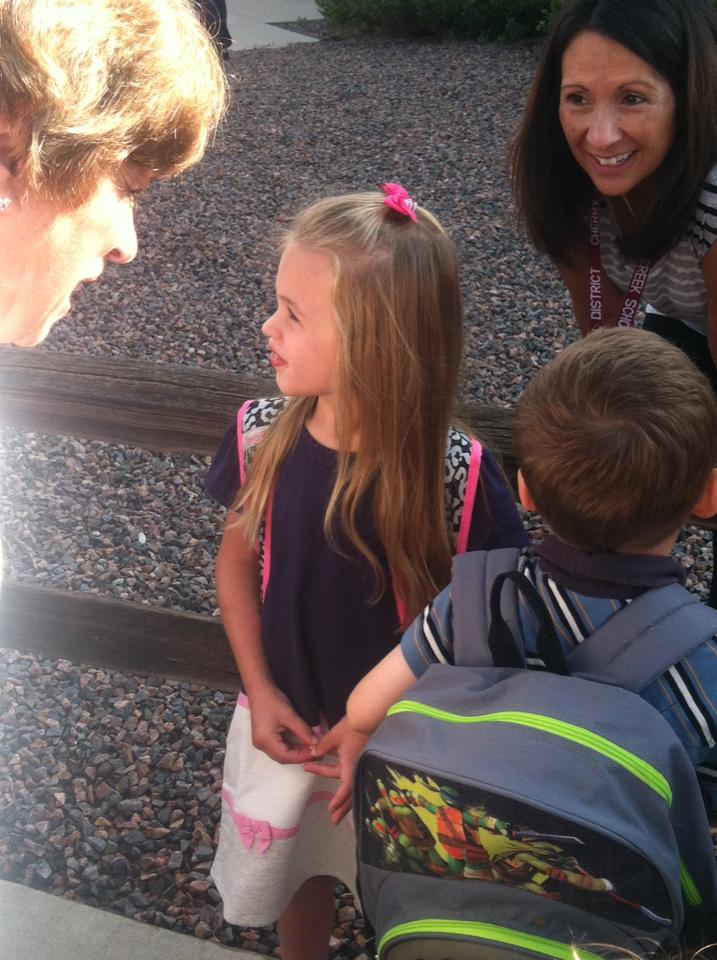
This is Ashlynn’s first day of school pic. The adult in the front is her teachers aid, and the adult in the back is her school SLP. From day one they were there for her. For the record, they both consider this “just doing their job.” For me though, I knew she was taken care of from the start. Ronnie, her teachers assistant (T.A), has bought her a book for her birthday AND for Christmas; and if you don’t know what T.A.’s make, let me put it bluntly and tell you they make shit.
When I have told Ronnie thank you for buying Ashlynn these gifts, she only smiles as though she had no other choice and says “Of course!! It was her BIRTHDAY!!”
It is incredibly humbling to know her salary, and know that she STILL felt like she owed my child a present. I wish I could buy her the world. I feel helpless to prove to her how much that means to me.
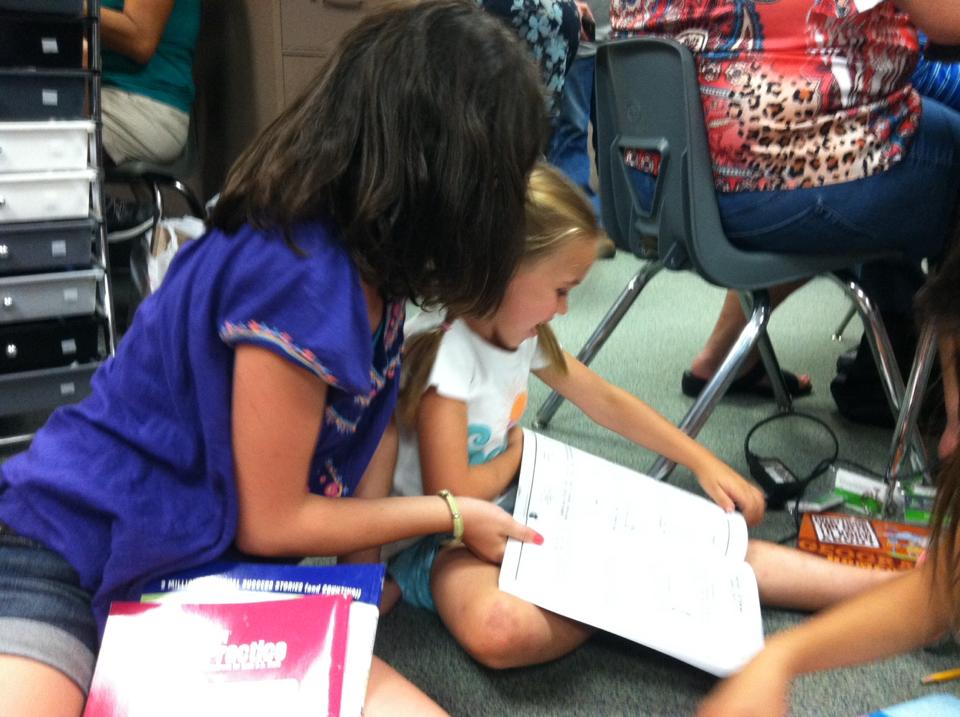
Which brings me to my next picture. Ashlynn’s SPED teacher is one of the best. I really don’t even know where to start. Teaching is her calling. Her compassion, passion, and drive is so infectious, it spills into her children, her biological children that is. This is a picture of her youngest daughter “teaching” Ashlynn during a tornado drill. Her daughter wants to be a teacher, and judging from her current skills, is well on her way! Colleen has high expectations. Can I just cry right now?? Ms. Colleen has HIGH expectations from my daughter.
I can’t tell you how many times I have told various teachers and therapists that Ashynn is capable. She will rise to the occasion. I also remember the countless “you poor thing” pity stares as though I were in denial. That never deterred me from saying it though.
True to form, I wrote a note at the beginning of the year to Colleen in Ashlynn’s back and forth book and I said, “Ashlynn will rise to the occasion.”
Now that Ashlynn has Colleen, she is proving it.
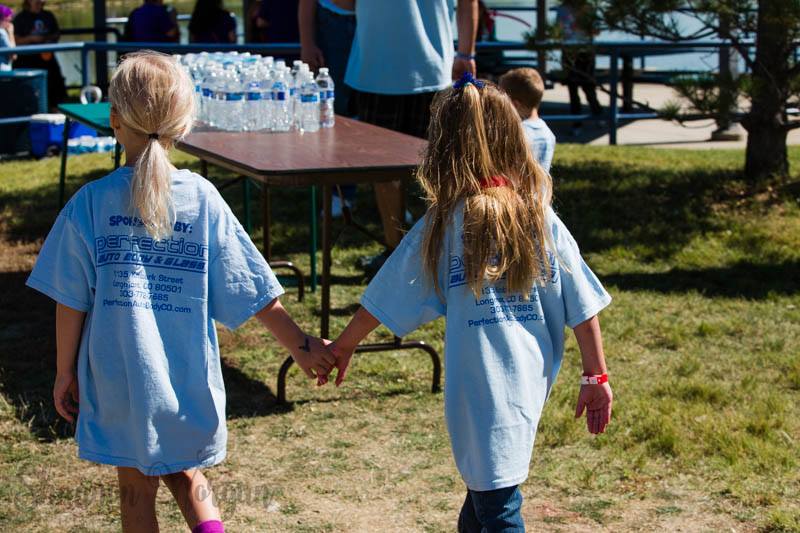
This next picture is Ashlynn at the Walk for Apraxia of Speech. The other girl in the picture is the daughter of Ashlynn’s school OT. I’m a writer, and I can’t even….I can’t even….express the words to describe what this meant. Why on Earth the school OT took time our of her weekend to bring her children to Ashlynn’s walk is beyond me. I have no other choice but to feel blessed and humbled. Even better is what these women are teaching their daughters.
This last picture is Ashlynn’s Kindergarten teacher. I’m so blessed to be in a district who values inclusion. This is Ashlynn’s general education Kindergarten teacher. Ashlynn is in a very restrictive special education program, and sometimes kids in this program don’t feel as part of their general education peers as they should. Ms. McDermott, her general education teacher, values and treasures Ashlynn as part of her class. She tracks Ashlynn’s progress and knows her skills just as well as Ashlynn’s SPED teacher. In addition, she strives to ensure the children LOVE school. She is a gem and in short, teaching is her calling too.
Though the words sound so empty, they are filled with deep emotion. “Thank you.” I’ll never take it for granted again.
Hi Kelly! I’m so thrilled to have you guest post! Your daughter Reagan’s post was a hit. Parents, especially in the early stages of an apraxia diagnosis, are really looking for hope. Since CAS was not officially recognized until 2007 by the American Speech and Language Hearing Association (ASHA), older children like Reagan, or adults with CAS may or may not have known that was their speech disorder. If you are familiar with my story and Ronda Rousey, she did not know until I handed her the CASANA brochure that she had apraxia!
That being said, I have so many questions for you! I know parents and my readers will find you just as inspirational as Reagan!
In the TV interview, you said she was dx at 2 ½ by a developmental pediatrician. That is very early to be dx, and impressive to me since CAS was not well known then. Also, not many people today, including myself a couple years ago, know that there is such a doctor as a developmental pediatrician who is different than just your regular pediatrician. Can you elaborate on your journey to her diagnosis?
Reagan’s pediatrician told me she would talk when she felt like it – Reagan had repetitive ear infections and had her 1st set of tubes at 2 ½. Her pediatrician said they would send a referral for the county to interview Reagan for speech and hearing. I also went to an audiologist.
I found out from the audiologist that Reagan had spent most of her life not hearing because of the fluid in her ears. I fired the pediatrician and went to a new pediatrician with a background in speech pathology. Reagan started speech, OT & PT 3 times a week at her daycare.
When Reagan was 5, Dr. Nancy Roizen, developmental pediatrician moved to Syracuse University Hospital. Her husband, Michael Roizen was the Dean of the medical school. And also partners with Dr. Oz. Dr. Nancy Roizen didextensive testing and was diagnosed formally with severe speech apraxia.
2.) The TV reported that Reagan was enrolled in speech therapy every day. It was fascinating for me to read that she didn’t remember her early days of speech therapy, especially since the news reported she had it every day. What did therapy look like and where did she receive it?
Reagan was enrolled in a day school which was very structured. She would have speech therapy on the playground – swinging learning her a, b, c’s. Counting. They made speech, OT and PT very fun so it was always part of her day and not “therapy”. One of the schools she attended was Jowonio in Syracuse, New York.
You said that Reagan didn’t speak a sentence until she was 9. I may have had my over-sensitive apraxia mommy radar on, but it looked to me like you were trying not to cry. I truly understand as a fellow apraxia mommy how heartbreaking that must have been. What was your most heartbreaking experience with apraxia and what would you say to parents who have children right now who are school age and still struggling to speak a word or sentence?
Your mommy radar was spot on. I was ready to lose it. Reagan was 5 and my other daughter Riley was 2 ½. A therapist at school stopped me in the hall as I was leaving to head to work. She said, “I just don’t know how you manage it all.” I burst into tears. I had never cried over Reagan’s diagnosis. Jowonio school is well known for working with special needs children and typical children. When I would look around at children in wheelchairs, children with chronic health issues, I felt fortunate that Reagan was healthy and very happy.
On your journey with your child you must remember that they are children. You need to sometimes just let them go play and loosen the reins on therapy and homework. It can be overwhelming to you and your child.
Reagan is a typical child with a speech disorder that affects her reading and writing. Reagan has always thought she was fine; it was the person listening to her that had the problem.
4.) Many parents, including myself are terrified of bullying and just the ability to make friends. Reagan appears to be so self-confident and well rounded. Did she experience any bullying and how has her friendships been? What do you advise parents in regard to ensuring our children grow up with Reagan’s confidence?
Reagan was made fun of in 4th grade. They thought she was deaf. Reagan and her speech pathologist put on a presentation in front of the class so that she could educate her classmates on apraxia. Reagan has a few friends and knows many people. Reagan works and is a senior in high school. She is quite busy so she may see her friends for an outing once on the weekend and that’s about it for the week.
If someone made fun of Reagan, Reagan thought it was their problem, not hers. Having a sibling close in age made it easier for Reagan to manage friends.
5.) I always say life is about lessons, and I’m sure you have learned many through Reagan. What has your experience with Reagan and apraxia taught you, if any?
Reagan can do anything she sets her mind to. I just need to back away and let her grow on her own time table. No helicopter mom for her.
Example…When you drop your child off for swim lessons and you want to tell the teacher she has speech apraxia and she understands but cannot speak that well….that’s it. Don’t say anything else. Reagan just wants to be treated like every other kid.
6.) Is there anything else you would like to add?
Patience and perseverance. If you have any questions, don’t hesitate to email me. I would be happy to answer any questions.
Thank you so much Kelly for agreeing to this interview. It has truly been a pleasure getting to know Reagan, and I’m thrilled to speak to the mama who knows the intimate details. Your daughter is a gem, and she is so fortunate to have a mother like you.
Thank you! When Reagan was little and the doctors asked me if Reagan had discipline problems, I would laugh and say,
“Reagan was born with wings. She is an angel.” And she is 🙂
Kelly is a married mother of 2 teenage girls. She’s from Syracuse, New York but is currently residing in Iowa. She worked full time in Syracuse as a paralegal, and now works as a mortgage analyst in Des Moines. If you would like to contact her, she is happy to answer any questions via email@ klcrabtree7@gmail.com
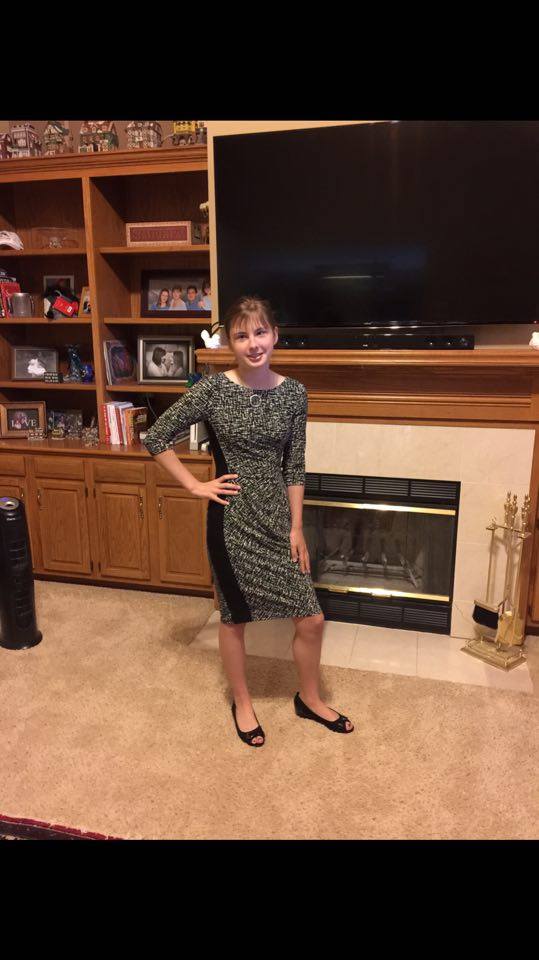
I’m so excited to introduce you all to Reagan! She is a 17 year old girl with apraxia of speech. She is positive and inspirational, active in social media groups giving parents and children words of hope and encouragement. I wanted to interview her to get her perspective on having Childhood Apraxia of Speech and I’m willing to bet as a fellow worried parent, some of her answers may surprise you as they did me!In the news story here: High school student gives voice to kids struggling with speech, Reagan’s mom says she was dx at 3, but didn’t speak a full sentence until 9. The news clip also says Reagan was enrolled in speech therapy every day at the age of 3. Watching this news clip made my jaw drop, especially now that I know Reagan a little bit better.
Hi Reagan! I am so happy to have stumbled across your news story in our Ronda Rousey: #knockoutapraxia group! You are truly an inspiration, and really give a great perspective.
1.) What do you remember about your early days in speech therapy?
I don’t really remember my early days of therapy.
2.) When did you know you had apraxia?
I knew when I was like ten. I did a little presentation on apraxia in fourth or fifth grade because they thought I could be deaf. I told my class what it was.
3.) How has apraxia affected your life, or does it?
Apraxia has affected my life not in a lot of ways; but I know sometimes I need to repeat and slow down what I’ve said.
4.) You often say you want to be a voice for kids who have apraxia. Tell us what you mean by that?
Be a role model for the kids who have apraxia and tell them it will get easier.
5.) What do you wish more people knew or understood about apraxia?
I would like people to understand that we get everything they say but can’t get our words out all the time.
6.) What is something you would like to say to all the kids out there with apraxia currently struggling to speak?
It will get easier and easier but it will take some time. I train myself to say new words that I have the same way for awhile. I listen to myself and train my brain how to say it right.
7.) What inspires you and what do you want to be when you grow up?
Journalists, because they have good stories to tell but sometimes sad, and they find time to have fun on air. I want to be a journalist or a producer. I would love to be on tv or behind the scenes.
Thank you so much Reagan! It has been great getting to know you, and I am so impressed with your desire to continue apraxia awareness and help so many others! As proof, she made this poster for Ashlynn one day, just out of the kindness of her own heart.
In a follow up post, look for my interview with Reagan’s mom!
Reagan is 17 years old and is a senior in highschool. She’s aspiring to be a journalist. Follow her on Twitter @ ApraxiaReaLynn





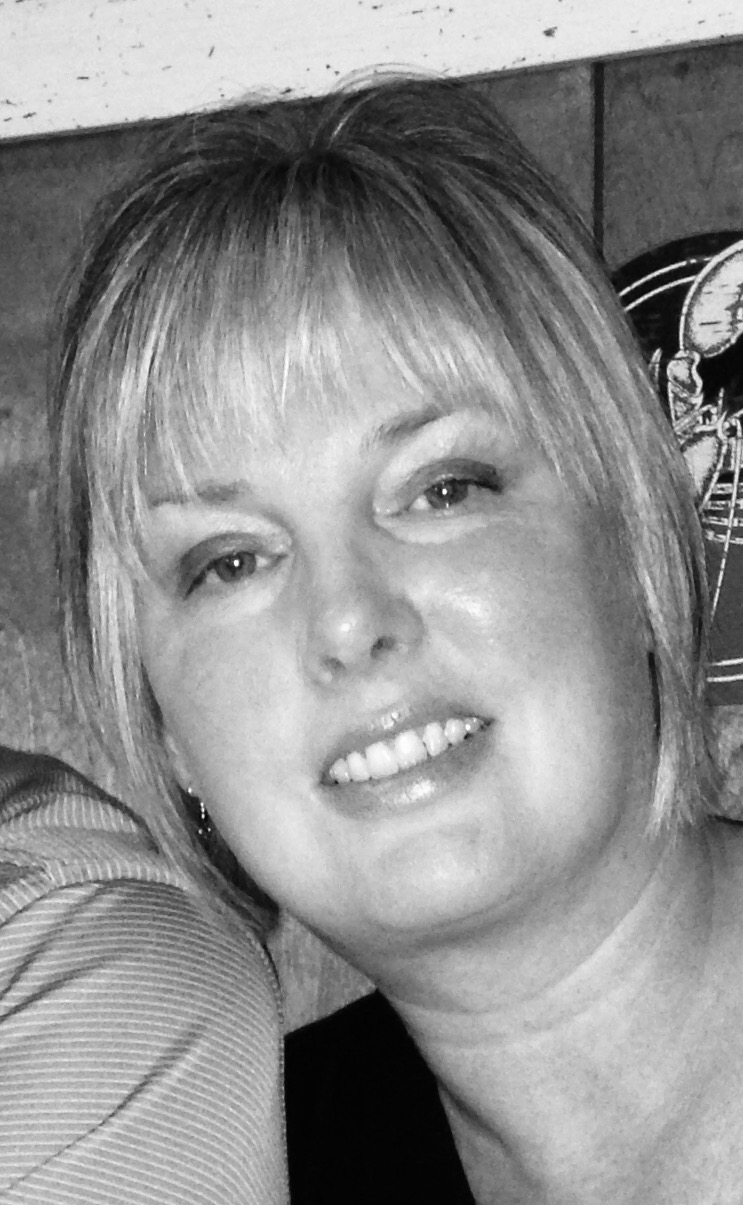

 ly is a married mother of 2 teenage girls. She’s from Syracuse, New York but is currently residing in Iowa. She worked full time in Syracuse as a paralegal, and now works as a mortgage analyst in Des Moines. If you would like to contact her, she is happy to answer any questions via email@ klcrabtree7