Tag: Therapy

  • Grouchy ladybug activity for easy repetition practice for apraxia.

    Grouchy ladybug activity for easy repetition practice for apraxia.

    I have a little secret.  I’m a speech/language pathologist, but at times, I’m artistically challenged.  I
     can’t tell you how many times my kids have laughed at my pictures.  I do think back to grade school and I remember getting mad about art activities telling my teachers I would never need to use art EVER in the real world.

    Oh life sure has a sense of humor!

    Being artistically challenged however, doesn’t mean I am creatively challenged!  With apraxia of speech, you have to get creative.  Unfortunately, there are two facts about apraxia that can be challenging.

    Fact # 1
    Apraxia requires therapy based on motor learning theory (ASHA, 2007).  This means that children require a few therapy targets per session while hitting A LOT of repetitions.  This is what is referred to as “mass” practice.

    Fact # 2
    Having to say multiple repetitions is not always *fun.*

    These two don’t really go together, but it’s up to the SLP to make it fun with a little creativity!

    This doesn’t mean I’m not guilty of busting out the cards and doing drills; however, I really try not to do this very often.  At most, I use this as a warm up.  Kids quickly tire of articulation cards and lose motivation.  It happened to my daughter.  Her initial sessions were set up with 15 minutes of drill and then 15 minutes of  a functional scripted play activity.  However, after a couple months, the sessions started turning into 25 minutes of drill and only 5 minutes of play because it was taking her longer and longer to practice the same old cards week after week because she was bored and losing interest!

    There are many games that lend themselves to repetitions, but today I’m going to introduce you to a quick little activity that you can use with almost any target and that kids absolutely LOVE.  The materials you need are:

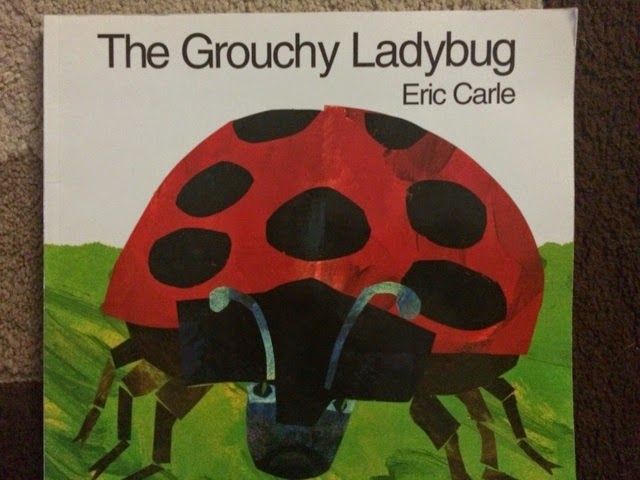
    “The Grouchy Ladybug” book by Eric Carle
    Construction paper
    Glue.

    Yep, that’s it.  Pick the therapy target, and you’re on your way.  This week my target for one client was “ladybug.” ( This is a C1V1C2V2 + CVC syllable shape), for another it was “bug” (A CVC syllable shape), for another it was “grouchy” (for working on ‘r’ blends), and yet another had to say the entire “grouchy ladybug.”  While reading, I stop and pause right before their word.  For example, “Oh, you’re not big enough said the grouchy lady ____.”  I then wait for the kiddo to plug in their target cueing and correcting as needed. The word “Grouchy Ladybug” is repeated 33 times in this book!  That means before you even start the activity, the child has already had 33 instances of practice!

    To read about getting practice in with repetitive books see here: Repetitive books great for apraxia therapy

    I also want to mention, that most Eric Carle books are also available in Spanish, so for you bilingual SLP’s out there; this is also a great activity to do with them!
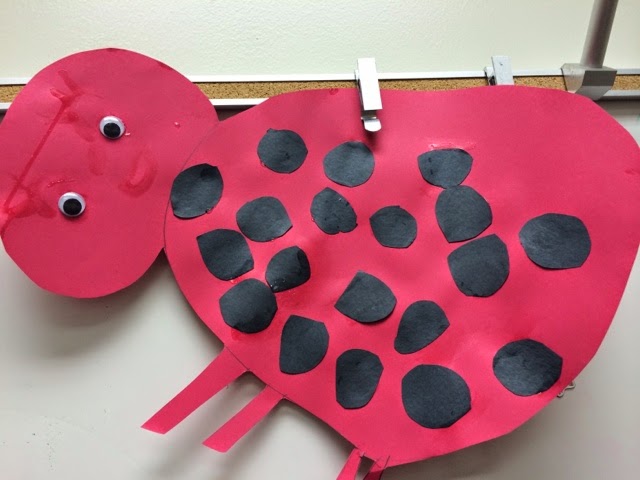
    Now for the activity.  Feel free to laugh.  I know my strengths and I know I’m no artist, but let me tell you, all my kids LOVE doing stuff like this.  I drew an (admittedly sad) outline of a ladybug using red construction paper, and had the kiddos glue on black spots.  Every time they glued on a spot they had to say their target word 5 times.  There are 20 dots on this ladybug, which meant they said their target sound 100 times! It didn’t matter that the ladybug wasn’t perfect, kids just love crafting their own creations and you can feel good about getting a TON of repetitions in!

  • January book of the month: The Jacket I Wear in the Snow

    January book of the month: The Jacket I Wear in the Snow

    Winter is in full swing, and there is no shortage of books that talk about winter, snow, and winter clothing vocabulary. Also, the preschool in my district has winter clothing vocabulary on as part of the curriculum, so it’s perfect!

    The book is a repetitive, rebus style book that is great for practicing vocabulary, early reading skills, sequencing, and as always speech!

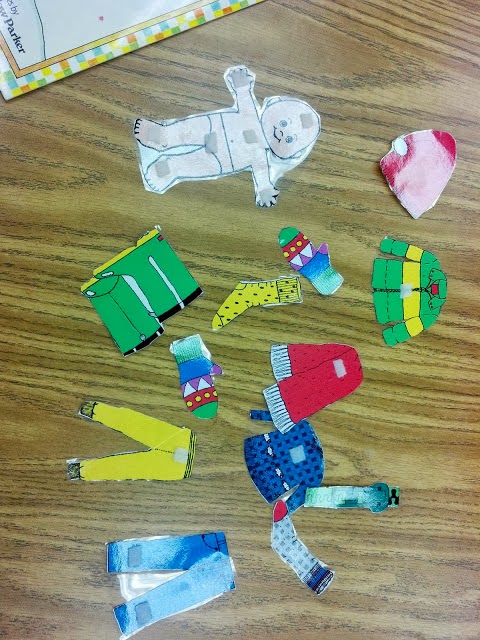
    I started with some cutouts from the story I found here:
    Winter clothes

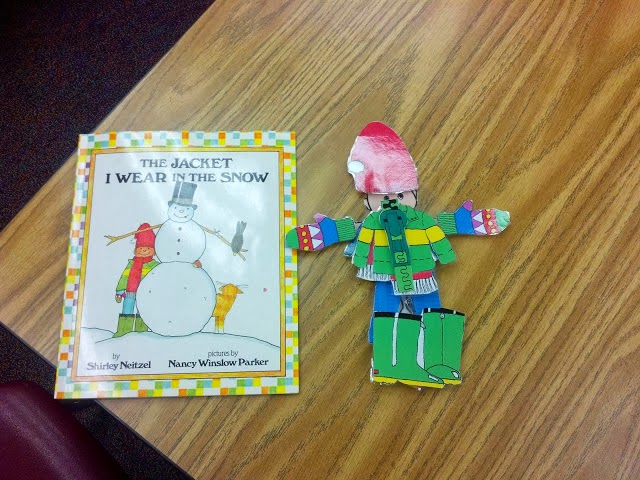
    Then I printed them out, laminated them, and put velcro on so that the kids could dress the boy.  I used a printout doll from the website you can find here: Paper dolls

    This was the final result and it’s just so darn cute! All my kids from preschool up to even 4th grade love dressing up the boy.  For my speech kids, I strategically pick a clothing item for a sound they are working on.  There are a lot of good options including ‘s’ blend words that seem to be a constant therapy target for at least one group a year.  For a child with apraxia, there are some good basic CVC words you can use (i.e. cap, boot, sock,), or in my daughter’s case since her speech is improving so much, I gave her most of the cards and she had to practice recall while I read the book.  The use of the cutouts provide a visual and tactile aid to help kids learn and recall the vocabulary, so you will see I try to make cutouts to go with books I have whenever I can get my hands on them.  Unfortunately, I’m not very talented in the drawing department, so I have to rely on other sources as you see I did here!

     For my older kids, we did silly things to practice following directions with spatial concepts: on top, under, over, etc to work on receptive language, and then they had to do a retell.  Again, the visuals really help in being able to sequence and retell the story for those kiddos who have weaknesses with language processing.

  • Pete the Cat home speech/language activities

    Pete the Cat home speech/language activities

    I was introduced to Pete the Cat, by Eric Litwin last year when my daughter went to preschool. Not only does it have a catchy song the kids can sing and listen to online here:( http://www.thelearninggroove.com/song-index-contents/pete-the-cat—i-love-my-white-shoes#!pete-the-cat-i-love-my-white-shoes/c164e), but it is great for teaching a variety of things in speech/language.  I’ll start with it’s benefit for apraxia.

    Research has shown that books encourage speech and language development.  My mentor taught me to use a literacy based approach to therapy whenever possible.  Not only do the kids enjoy it, but books provide vocabulary in context, which is more meaningful to children than just an artic card.  The use of repetitive story books are generally advocated for apraxia.  If you want to read more, you can find a great article here: http://www.apraxia-kids.org/library/repetitive-books-an-effective-therapeutic-tool-for-children-diagnosed-with-apraxia-of-speech/

    Pete the Cat is highly predictable and very repetitive, offering the perfect platform for intense practice needed for apraxia.  The carrier phrase in this book is, “I love my……”  The predictable sentence is “I love my ___ shoes.”  The shoes start out as white, but change colors depending on various items Pete steps in.

    Depending on your child’s verbal output, you could have them say the entire carrier phrase giving them the appropriate prompts and cues as needed, or just have them say one word.  Ashlynn is able to say the entire carrier phrase independently, but needed cueing to complete the rest of the sentence.  It’s fascinating to watch the motor plan during these activities, because once it has the plan, it doesn’t want to give it up easily. For example, after repeating “I love my white shoes” multiple times, she required a lot of modeling and cueing to change the motor plan to say, “I love my blue shoes.”

    I also created a book companion pack available in my store if you’re interested!


  • “I see” with DIY binoculars

    “I see” with DIY binoculars

    If you have a child in speech, or a speech language pathologist yourself, you are probably familiar with the term “carrier phrase.” A carrier phrase refers to the initial component of a sentence that stays constant (usually a subject and verb, allowing for a fill in the blank at the end (the predicate). Common examples include:
    “I want ______.”
    “I have ______.”
    “I see _______.”
    “I like________.” 
    This list is not exhaustive, but does give you an idea. In the educational arena, these are frequently referred to as sentence stems. 
    Carrier phrases are used in a variety of therapy strategies for a variety of disorders. The predictability allows the child to practice learned skills beyond the word level, moving into the phrase and sentence level.  It decreases the cognitive load needed to form a sentence AND remember the learned skills, because the sentence stem, or initial phrase remains constant. In this way, the child can practice their skills at a higher level of complexity (phrase or sentence level) but doesn’t have the increased demand to also generate a new and novel sentence.
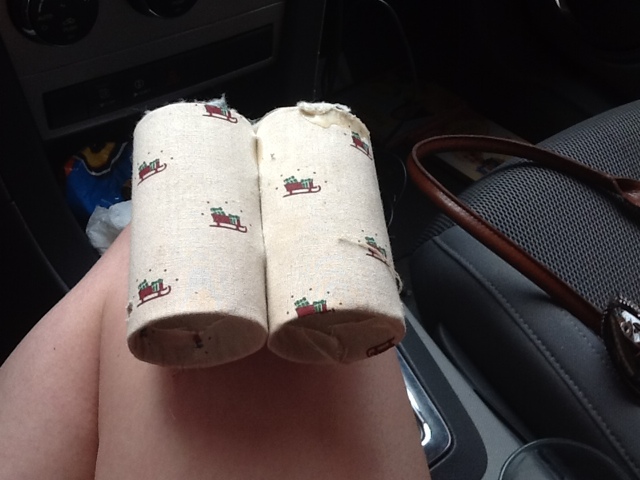
    To practice her words in a sentence I have a great idea that comes from my fabulous and creative mentor Deborah Comfort, who is currently the private practitioner seeing my daughter. She had Ashlynn pick out some fabric swatches from a book she had at the end of the session last week.  For the next session, she had hot glued the fabric onto two toilet paper rolls and then hot glued the toilet paper rolls together side by side. She poked some holes in the top and threaded some yarn, and Presto, they gave a set of DIY binoculars. Using the carrier phrase “I see_____” they practiced a variety of words with targeted sounds at the sentence level. 
    Ashlynn loved it of course! It’s also more fun than sitting at a table practicing flash cards. As you’ll frequently read in my posts, I am a big proponent of multi-sensory learning and this fits the bill. Maybe tomorrow we will take it to the zoo! Great carryover practice and lots of fun!