Tag: speech/language pathology

  • Mind the (30 million word) Gap: Beyond the catchy headline.

    Mind the (30 million word) Gap: Beyond the catchy headline.

    About a year ago, NPR published an excellent article discussing how the 30 million word gap needs reframing.  The idea of the word gap started with two developmental psychologists Betty Hart and Todd Risley in the 1960’s. I first learned about the study as an undergraduate student in my speech and language development classes. I remember as a naive student learning that parents who didn’t talk to their children as much caused children to have a depressed vocabulary.  I didn’t realize how dangerous this type of lesson was, as not only was the study itself fraught with racial bias, but it essentially “blames” parents when a child has a reduced vocabulary. I was taught this in a class where I was studying to be a speech/language pathologist who would help kids with legit language disorders. Does one see the problem? I was being taught about language disorders and simultaneously was learning about a study that said children have reduced vocabularies because their parents didn’t talk to them.

    I only realized after I had a child with a communication disorder, just how judgemental professionals can be.  This is in light of me being a white, graduate level speech/language pathologist. I started to realize how well-intentioned studies like the 30 million word gap end up blaming parents instead of doing what they say they intend to do, which is to help close the gap.  

    Now a new research article has caught fire and is making the rounds. Instead of blaming parents for not talking to their children, it’s blaming parents for not reading to their children.  Today I invited two professionals with me to dissect the article and review it from our varying perspectives.  I (Laura Smith, Speech/Language Pathologist) will be commenting from the view of monolingual children with Developmental Language Disorders (DLD).  Teresa Gillespie (Bilingual Speech-Language Pathologist) will be commenting on the perspective of (culturally and linguistically diverse variables to consider for bilingual speech-language assessment and intervention), and Kara Viesca (Associate Professor of Teaching, Learning and Teacher Education) will be commenting from the perspective of multilingual language development.  Hello ladies! Thank you so much for being here! I can’t wait to break down this very important topic!

    1. What are the positives to a study like this? 

    Kara: We do know the positive benefits of reading with children and this study appears to be seeking to underscore those benefits and wanting to inspire more reading with children. 

    Laura: I can’t find any.

    Teresa: When I look at the landmark study by Betty Hart and Todd Risley regarding the “word gap,” I remind myself that the purpose of their study was to explore the differences in language development and later academic achievement between children from lower socioeconomic levels and those from higher socioeconomic levels. They sought to understand the causes of these differences. From this perspective, I think that a positive in studies about “word gap,” “talk gap,” or “language gap,” is that researchers continue to search for and explore the reasons for the differences in the language development and educational performance of children from lower versus higher socioeconomic levels.

    2. What are the dangers in a study like this? 

    Kara: We live in a very diverse society with a lot of complexity in the differences across home life based on cultural and linguistic practices. A study like this is can be used to promote the cultural and linguistic norms of one cultural group (White, middle-class, monolingual English speaking) over those of another and in the end blame parents and families for students performing in particular ways in school.

    Laura: As a Speech/Language Pathologist (SLP) and mother to a child with a language disorder, simply reading a book will not be enough to ever acquire the vocabulary or language naturally in kids with DLD. These children require explicit and direct instruction and engagement with a book. I get concerned when I see studies like this because SLP’s are quick to spread the “positive” message on the benefits of reading and how many more words a child is exposed to when being read to; however, this can flirt with the dangerous idea that children who continue to struggle with language or have a low vocabulary have it because they were not read to enough. Instead, there is a possibility that the child has a legitimate language disorder.

    Teresa: As a Bilingual Spanish/English-speaking Speech-Language Pathologist, I received specialized training on the different culturally and linguistically diverse factors to consider in bilingual speech-language assessment and intervention practices, including during the review of research study results that may affect those practices. When I look at the results of the original study by Hart and Risley, I ask myself how they apply to the population of individuals whom I serve. I work with bilingual Spanish/English-speaking Kindergarten – 12th grade students with identified speech-language difficulties in both Spanish and English. I can’t apply the results of the Hart and Risley study to the population I serve because they did not include bilingual Spanish/English-speaking individuals in their study. In fact, to my knowledge, there currently aren’t any published “word gap” research studies in the United States that include bilingual speakers of English and languages other than English. It would be inappropriate for me to apply the results of any “word gap” study to my bilingual speech-language pathology practices that consider vocabulary and language development in only the English language, which is a second, and sometimes a third, language for the population I serve. Any professionals, such as General Classroom Teachers, Special Education Teachers, Reading Interventionists, Speech-Language Pathologists, etc., who work with bilingual speakers of English and languages other than English need to consider the vocabulary and language development in English as well as the languages other than English in order for their services or assessment/intervention practices to be sound. This is true for not only bilingual speakers, but also for trilingual and multilingual speakers. The results of numerous research studies in the professional fields of psychology, speech-language pathology, linguistics, etc., indicate that considering the vocabulary and language development in only the English language for bilingual speakers underestimates their overall language abilities. When the vocabulary and language development of bilingual speakers focuses only on the English language, then the application of the results of the “word gap” studies becomes about English language proficiency and not true language abilities.    

    3. What biases are present?  

    Kara: We have to be honest about the reality that biases are always present in all studies as well as in our educational practices and policies. One of the typical biases we have is based on what we consider “normal” — this is how we create and perpetuate ideas about gaps. If we consider it “normal” for children to have the linguistic practices of White, middle-class, monolingual English speaking families, than students who come from different backgrounds will often appear to have a “gap.” If the norm was altered to mirror the linguistic and cultural practices of students from Latinx, bilingual English/Spanish families from the working class, then the students who currently appear to not have a gap, would appear to have one. In education around language, we hold English monolingualism and White middle-class culture as the norm for which all students should strive–a clear, pervasive and ongoing bias that continually positions certain students to have “gaps.” This study holds this same bias, assuming a particular norm is what all students and families should be aiming for that doesn’t account for legitimate, helpful and valuable cultural and linguistic variations that occur across families and cultural groups.

    Laura: In terms of children with language/learning disabilities, they are not even addressed in the study.  The article didn’t prove anything except to show that kids who are read to are exposed to more vocabulary and then cite other (biased) studies showing how exposure to more vocabulary is linked to the later vocabulary trajectories.

    It’s important to mention studies showing how children with DLD have difficulty picking up vocabulary implicitly and need explicit instruction, before making conclusions that their vocabulary exposure contributed to their acquisition and retention. 

    Teresa: One of the biases is that children from lower socioeconomic levels come from homes where they receive less vocabulary and language development experience. This is not the case. The results of a recent study by Douglas Sperry, Linda Sperry, and Peggy Miller indicated that children with fewer vocabulary words and low language development skills did not all come from homes with lower socioeconomic levels or less vocabulary and language development experience. There was a wide variation in home language experience among all socioeconomic levels.

    Another bias is that children have the same kind of language enrichment experience at home regardless of cultural and linguistic background. This is not true. Different languages and cultures provide different language enrichment experiences at home. Even different dialects and subcultures provide different language enrichment experiences at home. There can be oral language experiences that do not include parents reading books to their children. Instead, the parents tell and retell folktales or sing ballads that share the knowledge, ideas, and beliefs of their culture to their children. In the absence of factors that negatively impact language development, these children do not experience any less academic achievement than those children whose parents read to them from books. There can be language experiences that do not include parents providing comments or asking questions about what their children are doing, how they are doing it, etc. Again, in the absence of factors that negatively impact language development, these children do not experience any less academic achievement than those children whose parents provided comments or asked questions about their children’s various activities.

    A third bias is that children who have adequate vocabulary skills and “typical” language development in English will experience academic achievement. Again, this is not the case. There are children who exhibit adequate vocabulary skills and “typical” language development in English who do not experience academic achievement. Also, provided with the appropriate supports, both in the home and school environments, children exposed to a language or languages other than English, as well as English, can and do experience academic achievement. To focus on vocabulary and language development in only the English language for bilingual, trilingual, or multilingual speakers is to diminish the benefits of bilingualism/multilingualism, and possibly cause members of other cultures to feel less important or respected.

    4. What suggestions do you have for supporting children’s linguistic development?

    Kara: My area of focus is in multilingual language development, so from that perspective I suggest doing as much as possible with language, particularly in authentic ways for meaningful communicative purposes. Children who live multilingual lives have developed strong communication abilities that respond to the communities and people they seek to communicate with. Too often at school, we don’t acknowledge this and focus on “gaps.” I’ve even sat at the table with a state commissioner of education who said, “These kids are showing up to school with no language.” I quickly called him out on this statement, because the kids he was talking about (and why I was at the table) are bilingual/multilingual students who, barring disabilities, have expansive language skills. They just might not be the language skills we have set as the norm or value in our schooling practices. In fact, this practice of constantly comparing multilingual students to their monolingual peers and identifying “gaps” creates an ongoing context of deficit thinking towards multilingual students. I resist focusing on gaps to the extent we do in education as I think we get too bogged down in “needs” and “gaps” and don’t work with students from a position of their strengths and learning assets. A child who did not have the traditional White, middle-class, monolingual English speaking literacy experience before they came to Kindergarten did have a lot of important linguistic and cultural experiences that offer strengths to that learner in school. We just have to learn to see those strengths, embrace them and work with students to grow them. 

    Laura: From the perspective of children with DLD, linguistic development is enhanced through therapy and direct and explicit instruction.  No amount of just talking to or reading to the child with DLD is going to help them overcome a language disorder. That doesn’t mean talking to and reading to children with language disorders doesn’t “help” but it’s not the entire piece of the puzzle.  Parents and professionals can change the way in which they read and talk to the child and employ strategies that help the child with DLD process and use language effectively, but this is done through the skilled care and recommendations by the speech/language pathologist. In sum SPEECH THERAPY is the most effective way to treat language disorders and build vocabulary.

    Teresa: For me, the most important suggestion for professionals in the United States who work to increase the vocabulary and language development of bilingual/multilingual speakers is to encourage the continued understanding and use of the native or home language(s) while fostering the acquisition of English. English language development can successfully occur in an “additive bilingual” environment. An “additive bilingual” environment not only promotes the continued learning of the native or home language(s) while learning English, but also preserves the cultural identity or identities of the speaker, which leads to a feeling of being valued.

    The most important suggestions for parents of bilingual/multilingual speakers of English and a language or languages other than English are to maintain the native language(s) in the home environment, and become as familiar as possible with the academic expectations for each grade that your child attends. It is also important to become as familiar as possible with the academic resources available to your child at the school and district levels. These resources promote student academic achievement, and are helpful to parents who may not feel confident supporting their child’s academic learning in the home environment.     

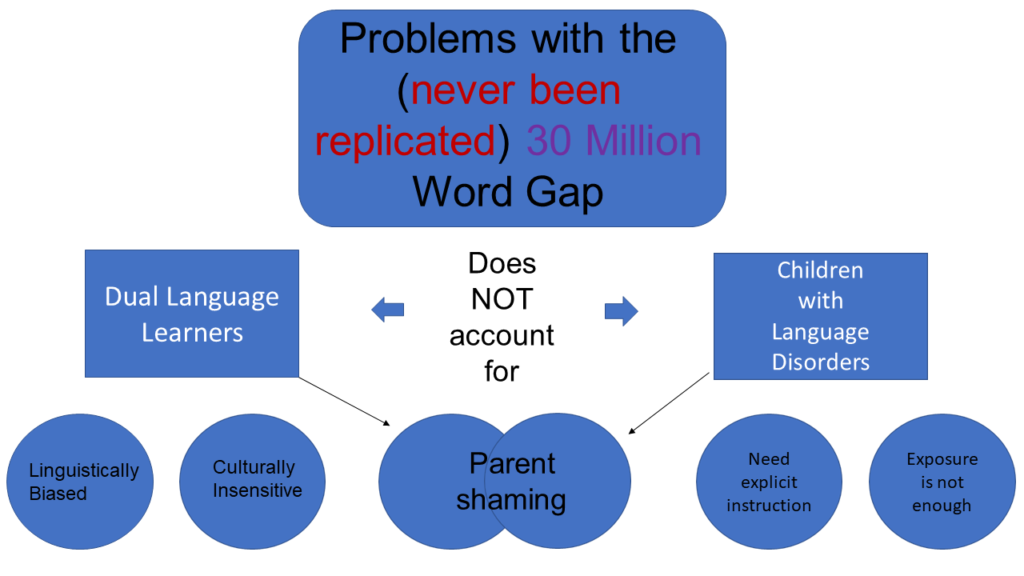
    Thank you BOTH SO MUCH! I hope we have provided alternative perspectives that will get professionals thinking instead of blindly re-sharing a catchy research article. In summary, I think we all agree the 30 million word gap is inflated, has never been replicated, is inherently biased, and beyond the catchy headline doesn’t hold a lot of substance or provide any meaningful information. So please everyone, “Mind the Gap” and let’s not fall in feet first.
    Kara Mitchell Viesca, PhD is an Associate Professor of Teaching, Learning and Teacher Education at the University of Nebraska Lincoln. Her scholarship focuses on advancing the policy and practice of educator development for teachers, particularly of multilingual learners. She has been awarded $4.6 million in federal funding to support quality teacher learning initiatives for teachers of multilingual students and has published her research in a variety of academic journals. For more information, please visit: https://cehs.unl.edu/tlte/faculty/kara-viesca/


    Teresa Rizzi Gillespie, M.S., C.C.C., CBIS, is a Certified, Bilingual Speech-Language Pathologist and a Certified Brain Injury Specialist. She received her Bachelor of Arts degree in Speech Pathology and Spanish from the University of Denver. Teresa received her Master of Science degree from Vanderbilt University, Department of Otolaryngology and Hearing and Speech Sciences. She is currently pursuing Advanced Certification in Bilingual Speech-Language Pathology through the Bilingual Speech-Language Pathology Extension Institute, Teachers College, Columbia University. Teresa has been providing speech-language services to Kindergarten – 12th grade students in the largest public school district in Colorado since 2002. Prior to working in the public schools, she worked at Children’s Hospital Colorado, Rose Medical Center, and in private practice. Teresa has presented English Language Learners with Exceptional Needs (ELLEN) Project trainings through the Colorado Department of Education. She has been a guest lecturer in the Graduate School of Professional Psychology at the University of Denver, Latinx Psychology Specialty, and has served as a Consultant for an online second language acquisition class offered by the same program. Teresa is passionate about meeting the speech-language needs of Dual Language Learners, and consistently advocates for the appropriate assessment and identification of language difference versus language disorder.

    Laura Smith, M.A. CCC-SLP is a 2014 graduate of Apraxia Kids Boot Camp, has completed the PROMPT Level 1 training, and the Kaufman Speech to Language Protocol (K-SLP). She has lectured throughout the United States on CAS and related issues. Laura is committed to raising and spreading CAS awareness following her own daughter’s diagnosis of CAS and dyspraxia. She is the apraxia walk coordinator for Denver, and writes for various publications including the ASHA wire blog, The Mighty, and on a website she manages slpmommyofapraxia.com.  In 2016, Laura was awarded ASHA’s media award for garnering national media attention around apraxia detailing her encounter with UFC fighter Ronda Rousey, and also received ASHA’s ACE award for her continuing education, specifically in the area of childhood motor speech disorders. Currently, Laura is a practicing SLP specializing in apraxia at her clinic A Mile High Speech Therapy in Aurora, Colorado.

  • Hammering out apraxia with David Hammer

    Hammering out apraxia with David Hammer

    Hi Dave!  Thank you so much for coming on to guest blog!  You know you are famous in the world of apraxia, so I am honored you are willing to guest blog!  Your contributions to the field of Speech/Language Pathology and more specifically apraxia are inspiring.  It’s an absolute honor to know you and I can’t thank you enough, speaking as a mother of a child with apraxia, for all you have done to advance the field.  Recently, you just announced your retirement set for the end of this year.  Though I am sad, I am so grateful for your enormous contribution to the field and am so happy you joined me today to share your knowledge!  I normally pick a specific topic, but for you, my readers wanted to ask questions related to apraxia and see what you had to say!

    I feel humbled by your kind words, Laura, and also feel blessed to have been in this great field for 40 years.  I will return the thanks for all that you have done in the Apraxia community as you wear the hats of an SLP and a mother of a child with apraxia. I often talk in my presentations about how SLPs have to wear so many hats – their SLP hat, their parent counselor hat, their psychologist hat, their OT/PT hat, etc. given that we are dealing with the “whole” child and not just the “hole” where speech emerges!  I applaud anyone in this profession that looks at children this way. I am fine with answering a wide range of questions so I will proceed…

    Can you start though by introducing yourself first including how and why you became interested in apraxia?  Also, what is your involvement with Apraxia Kids?

    I started out working for Children’s Hospital of Pittsburgh, PA after graduating from the University of Pittsburgh.  Through my first office window I look directly at the building that housed the speech clinic where I was trained! I began to specialize in stuttering but then Luke Lasky, Sharon Gretz’s son, came into my life through a referral from my esteemed boss, Dr Tom Campbell.  It wasn’t long before I became fascinated by this challenging motor speech disorder and from that point, my career passion changed. Having been a part of the beginning stages of what is now known as Apraxia Kids has been quite rewarding. To see this organization grow from 2 parents observing their 2 boys with CAS through my two-way mirror in dyad treatment to what it is today is remarkable.  I left Children’s Hospital after 35 years as a practicing therapist and administrator and joined the Apraxia Kids staff (then CASANA) where I have been the last 5 years. I recently announced my retirement plans for the end of 2019. It has been quite a journey!

    Is it necessary and beneficial to get an MRI or do specific genetic testing or any type of medical testing for that matter.  If so, why?

    This is always a challenging question and one that I answer for parents often.  Let’s start with discussing a neurology appointment. I do not feel that all children with CAS need to see a neurologist, unless they demonstrate what we call “soft signs” such as clumsiness, inability to cross midline, hand tremors, imbalance, staring spells, etc.  In those cases you would want to rule out other potential medical diagnoses. But to ask a neurologist who likely had very minimal training on CAS to evaluate whether or not a child (who is usually very reluctant in a physician’s office) shows features of CAS is unfair and could potentially lead to misdiagnosis. Also, CAS is not a medical diagnosis.  Studies have concluded that a high percentage of children with CAS show normal MRIs.  There is no conclusive brain imaging or genetic tests to diagnose CAS. It is a clinical diagnosis to make and should be done by a speech-language pathologist.  The child’s SLP may suggest genetic testing or neurological testing if they see indicators of other concerns but to routinely have all children get an MRI, have genetic testing done, or a neurological examination is not what I recommend.  Unfortunately, some of our SLPs in Canada in certain provinces are required to send all children to a physician to get a CAS diagnosis which can certainly slow the process of getting children the therapy help they so desperately need. Some parents just want to make sure every rock has been overturned and will seek out genetic testing and/or neurological testing.  I would never stop them from doing that but will discuss the pros and cons.

    What are other conditions that are common with Childhood Apraxia of Speech?  

    I would say fine motor planning struggles, sensory issues and anxiety are 3 that come to mind first.  I added anxiety to that list just recently as I talk to more and more parents and SLPs about how children who struggle to communicate seem to have more anxiety than is typically seen. It makes sense when you think about it as communication is such a vital part of what makes us human and social beings.

    For the child with profound apraxia, where do you even start?

    First of all, you must make sure that the child has the foundational skills for communication such as joint attention, ability and willingness to imitate (any motor movements), and a certain level of cognitive ability.  Some of the children can’t make use of motor speech therapy until those foundational skills are in place and a lot of time is wasted just trying to get speech first. If those foundational skills are intact or to a point where the child can benefit from therapy, then the starting point would be for me building on whatever the child has in their vocal/verbal repertoire.  We can use expressions, animal noises, vehicle sounds to build speech from creatively. The foundational element is the syllable for motor speech work so we would not work much in isolation but would constantly be looking at sequencing sounds to build motor plans. I would work on a very few words in the initial stages when a child has profound CAS to build these motor plans in hopefully functional ways.  The targets for this early practice are critical and should allow for the child to feel early success or they will lose their motivation for trying quickly. Speaking for them is very challenging, and it is not much fun to have to repeat syllables and words over and over, so to get them to take vocal/verbal risks is the challenge for the SLP and parent/caregiver alike.

    Is it possible for a child to have apraxia, sensory issues, and other language disorders such as Mixed Expressive/Receptive Language Disorder and it not automatically be autism?

    For sure.  I have seen a number of children for evaluations who come in with a diagnosis of autism spectrum disorder who really reflect severe CAS with mild-moderate sensory issues.  I also see it the other way around where parents are holding on to a CAS diagnosis when it is apparent that the child is also showing features of autism. For some parents, they think that when the speech symptoms “go away” their child will just be like all other children, but this is not always the case when there are complicating dual diagnoses. I can certainly understand why parents would hold on to something that appears more “fixable” despite the challenges that CAS brings.

    Is there any research on regression in speech motor planning when a child has a growth spurt?

    I know of no evidence of this, but my psychology and child development training throughout the years coupled with my experience show me that there is always a chance of regression and or behavioral change when there is a growth spurt that sets the “system” in a whirlwind until it can again settle down. It’s an interesting question and one that would be fascinating to study.  Overall, however, we do not see significant regression in speech for children with CAS. We are likely to see what I call the “plateau effect” where there are periods of leveling off of progress while a child is apparently consolidating his/her gains. I stress to parents that they should think of these as “input phases” where their verbal input, practice, etc should still continue and even heightened despite the output not changing much.  Then you tend to see this followed by a spurt of progres but it often cycles back. The journey of CAS is not a straight line of progress.

    You’ve presented before on best practices for apraxia with a co-morbidity of autism.  Are there any resources available for this?

    There are not many resources currently.  Key points to be made here have to do with differential features, for example children with CAS ofen averting eye gaze due to lack of communication success and children on the spectrum often avoiding eye contact due to perceived aversiveness to looking an another’s face.  Both groups may demonstrate sensory issues which is why misdiagnosis is so easily done. One article from the April 2011 Journal of Autism and Developmental Disorders comes from Larry Shriberg and his group called “The Hypothesis of Apraxia of Speech in Children with Autism”.  

    Is there a connection between apraxia and reading struggles?

    A very high percentage of our children with CAS struggle with reading and show evidence of struggles in the preschool ages with foundational phonological awareness skills.  It is critical that SLPs and parents make sure there are foundational elements of literacy incorporated into therapy sessions and home practice/stimulation. There is nothing better for parents to do then read to their children daily.  I usually suggest at least one book for pleasure and one that incorporates some degree of speech practice time. I think this is one of the biggest frustrations I hear from parents – just when they think the child is overcoming the motor speech challenges, along comes major literacy struggles which then pervade learning in school.  It is this constant “getting over the next hurdle” that requires a lot of perseverance for parents.

    Do difficulties eating or picking eating often accompany apraxia?

    As I mentioned before, with seeing so many children with CAS having sensory issues of one degree or another, it would make sense that picky eating may be a component of these sensory deficits.  It is difficult to sort out whether there is oral planning challenges contributing to eating difficulties and the possibility that it may be more of a weakness issue (e.g. a child with dysarthria or combined CAS/dysarthria) needs to be investigated.

    Let’s end it with something fun.  Do you prefer plain socks or fun socks?  

    On me or on others? – haha!  I would say I tend to wear plain socks most of the time, but when I was a practicing therapist, I had a LOT of fun kid-themed ties that I think helped children feel even more comfortable when they came to see me.  Oh, I do have a pair of dinosaur socks that were gifted to me by a child’s parent when her child ended therapy, knowing that a major theme in our therapy had been dinosaurs! Ironic that I just bumped into that parent and her now older child when I went to see Hamilton the other night!  Both experiences were amazing as I marveled at what Lin-Manuel Miranda and this parent/child duo had accomplished!

    Thank you so much Dave!  It’s been an honor to have you, to know you, and to consider you a mentor and friend!  Your contribution to the field cannot be measured. As a mother to a child with apraxia, I’m so grateful to you. 

    …and I am so grateful for you, all the parents/caregivers out there on this journey, the children who truly are superheroes, and the SLPs who passionately want to help, ALL of whom have inspired me in this field!


  • The problem with school SLP’s.

    The problem with school SLP’s.

    I only realized after being a part of the special needs community that school SLP’s have a bad rap.  Like a really, REALLY, REALLY bad rap.  

    I’m preparing a talk next month for Colorado school SLP’s, and every time I prepare a talk for this demographic, I have to tell you they have a special place in my heart.  No, it’s not just because I started as one and work as one part time, but it’s because I have literally worked under, with, and around many, many, MANY of them. I have worked with so many of them, and I can tell you they are a jack of all trades.  They are the EXPERT in eclectic, and may be the ONLY person in the school who understand in depthly just how a student’s unique communication challenges actually affect them in school.

    In the schools, you don’t have the option to specialize.  Kids from every disability show up on your caseload and you are expected to be the expert.  It might be hard to understand as a parent, but there are soooo many different disabilities and speech and language disorders, and a parent (rightly so) expects the SLP to do right and best for their baby.

    Every single SLP I know and have met has a desire in their heart to help children.  Please, let that sink in.

    When I took Ashlynn to her first private SLP who had never worked in the schools she was asking me about qualification.  She asserted that she could never be a school SLP because she felt it was unethical to not qualify students who clearly had some sort of speech or language problem.  I had a hard time refuting her.  Aside from saying qualification is different in the private versus educational sector, I really had no excuse.  I know that funding is limited in the public sector so that obviously plays a part in qualification.  I also know if every SLP took her stance, than NO kids would be serviced in the public schools, and is that really what we are going for?

    Public school SLP’s have caseloads that are probably double if not more of the private SLP.

    Where the private SLP can see kids 1:1, school SLP’s rarely have that luxury.  With weekly caseload averages around 45 to 55 and some maxing out at 90 (Yes 90 people I’ve seen it), even the most skilled SLP will not be able to do what a private SLP can do 1:1 for 45 minutes (though they will kill themselves trying).

    The result?  Parents become outraged at the lack of progress or progress they feel the child should be making. They surmise the school SLP just isn’t as good as the private SLP and they become disillusioned and write them off.  They post memes about preparing for battle when going into an IEP meeting! This honestly breaks my heart.  I feel bad for the parent who feels the SLP doesn’t care, and I feel bad for the SLP who is trying to manage an unmanageable caseload, writing IEP’s at night, or staying up until 2 Am (true story from an SLP I just talked to last week) to write a lesson plan, only to be ravaged by a parent unsatisfied with the results.

    I’m not sure if everyone is aware of this, but ANY SLP in ANY setting is as qualified as the next SLP by basic certification standards.  What does that mean?  That means, as long as an SLP received their masters degree and the Certificate of Clinical Competence (CCC) through ASHA they can work anywhere.  So that means, your school SLP can apply for a job at Children’s Hospital right now and probably get hired tomorrow (because in case you didn’t know there is an SLP shortage as well).  For some reason though, there is this perception that the school SLP just isn’t as good as the private SLP.  If it’s true, it probably has MORE to do with caseload and workload size than it actually has to do with the qualification of the SLP.

    I get calls and emails all the time from concerned school SLP’s desperate to meet the needs of their kids with apraxia but not knowing how.  They want to see the kid more, or see the child 1:1, but their caseload simply does not allow for it.  They cannot add more hours to the day, yet they still call, or write and wonder if there is something they have not yet thought of.  Oh, and here’s a dirty secret.  Listen close.

    Are you listening because this is VERY important.

    If an SLP feels in their heart a child needs private, supplemental speech services, they CANNOT say it.  People, they CANNOT tell you this.  Why?  Well, their license and job is on the line.  In most cases, school SLP’s are told not to recommend any sort of outside therapy.  Why do you ask? Why?

    I’ll tell you.  If a school SLP recommends outside services, the parent can sue the district and win, and potentially disbar an SLP from ever practicing again.  Are you asking why again?  I’ll tell you.  If a school SLP recommends outside services, they are essentially saying that the child can not benefit or make progress from the therapies provided by the school, and the school is required by law to show progress.  If the SLP recommends outside service thereby saying the school is inadequate, the school gets worried or they will get sued for not providing adequate services and the SLP potentially fired.

    Would you take that risk?

    I’m not saying unilaterally every school district would do this, I’m just saying, school SLP’s are told this is a possibility, and so they would find it best not to recommend outside services.

    You need to know this as a parent of a child with any disability.  Some SLP’s will risk their professional license and recommend this to you.  Let me  tell you though what they are risking.  They are risking 4 years of a bachelor degree, 2 years of a masters degree, 1 year of a clinical fellowship, and the usually 3 years of probationary status as a teacher.  That is an entire decade of work and dedication to a profession they love and believe in.  Would you take the risk then to recommend a parent pursue outside therapy?  This is where they are at!  It is truly a catch 22.

    If you are upset about your school services, you probably have every right to be!  I was VERY unhappy with Ashlynn’s preschool, in-class only, speech/language services.  However, it is important to place the blame on the right entity and in most cases I can assure you it is NOT on the school SLP’s shoulders.  In Colorado, the Colorado Department of Education mandated an inclusion model only of special education services in preschool thus making it extremely difficult for any school SLP to pull a student out into a 1:1 session.

    My message today is this: School SLP’s are some of the most phenomenal group of people I ever have the honor to speak with or to. They do not get the option to specialize, and so they pursue advanced training and expertise in every disability that may affect communication: from Apraxia to Angelman’s Syndrome, from Developmental Delay to Down Syndrome, from Cerebral Palsy to Stuttering, from Language Impairment to Nonverbal Learning Disability, from Assistive Technology to Autism, from Auditory Processing Disorder to Articulation Disorder,  school SLP’s will see it all and be expected to rise to the challenge.  They cannot “refer out” or “discharge for lack of progress” as an can be done in private speech. No, the school SLP is expected to figure it out regardless of the lack of resources, lack of funding, or lack of time.

    They will be faced with limited or no space, they will be strapped with high caseloads, and criticized by parents; yet they will persist and pursue only becoming better for it, because of their love for the children and the profession.  I personally have witnessed it time, and time, and time again!

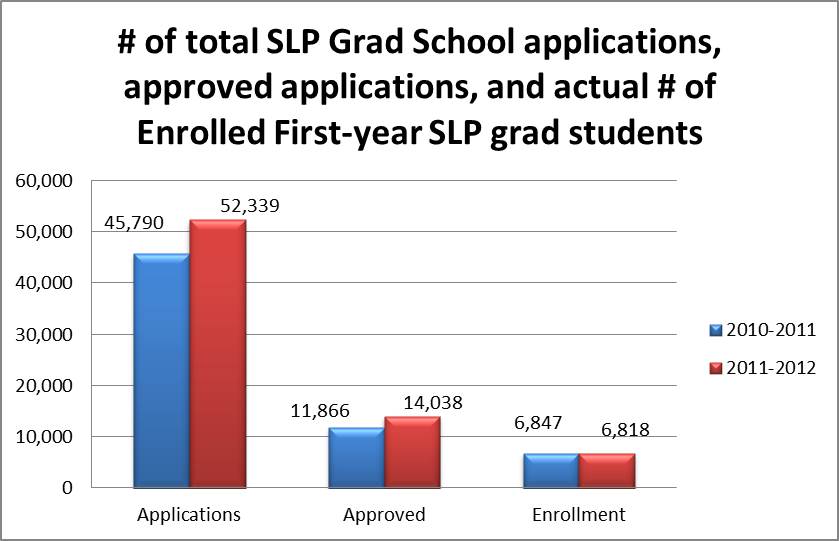
    I can tell you firsthand, getting into graduate school for speech/language pathology is VERY difficult.  It is highly competitive, and here in Colorado, the average COLLEGE GPA was a minimum of 3.87 when I applied.  I found this graphic from 2011 but I can tell you things have not changed much.  There is a HUGE gap between the number of applicants and the number of people selected. 

    The disparity should be striking, and please remember that MANY of these applicants will be YOUR school based SLP.  If you have the mentality that “C’s get degrees” and you are certain your school based SLP fits the latter, let me correct you.  NO average C students make it to graduate school in the first place for speech/language pathology.

    Truth

    For my final thoughts I wish not to be adversarial.  I hope that this article has persuaded you, a parent OR SLP, to reach out to the other side and bring about the change you wish to see.  I have the unique perspective of being on both sides, and as such, I have the utmost RESPECT and LOVE for both sides.  I truly wish for there to be a conduit of communication, and not a  ridge of animosity and distrust; and at the the forefront, I wish to impart a spirit of solidarity between my professional and special needs relationships.

    To read more from SLPMommyofApraxia follow her on facebook, pinterest, or twitter.


  • All it takes is a spark, to light a match, to ignite a fire.

    All it takes is a spark, to light a match, to ignite a fire.

    Once upon a time, there was an 18 year old girl who received a full ride scholarship to her local metro university.  She took public transportation to get there since she couldn’t afford parking, and simultaneously worked 30 hours while going to school full time.  Each day she walked onto the train, she wasn’t sure she would actually receive her bachelor’s degree, but she decided she would take it day by day, one step at a time, and see where life led.

    One day, 4 1/2 years later, she boarded the same train with a cap and gown in hand riding to the downtown convention center.  This center, the location of her graduation from Metro State University for a Bachelor of Arts degree in Speech Communications.

    She could hardly believe it.  Walking across the stage, surreal. She had accomplished something she was never sure she would achieve, and it felt awesome.  This was the end of her academic career to be sure.  Though her emphasis was in disorders and she had taken the coursework to be certified as a Speech/Language Pathology Assistant, she would use her umbrella “Speech Communications” degree to now move up in the car dealership in which she was working to become the customer relations manager.

    Insert recession.  The car dealership was turned upside down.  Future plan….shattered.

    Cue phone call from local school district inquiring about an interview as she was one of the few to complete the SLPA certification and they would like to interview her for a new position.

    Complete interview and accept new position.

    Introduce Deborah Comfort and Roberta Fehling.  Two seasoned SLP’s.  Pioneers.  Feminists.  Glass ceiling breakers.  I was to work under them.  They both would laugh at this description, but I can tell you I was in awe of them.  I didn’t even think I would complete my bachelor degree and I’m a millennial.  These were two baby boomers who had not only completed their Bachelor Degrees but had Masters Degrees.

    The Spark

    I was inspired by them.  Their accomplishments ignited a spark in ME.  A spark, I wasn’t yet willing or ready to realize.  I tried to push it down and blow it out.  Graduate school wasn’t meant for people like me.  I grew up in a humble and modest home, with a common phrase of my dad’s being “poor people have poor ways” and I can tell you, graduate school is NOT one of them.

    Long story short, they both believed in me.  They both urged me to continue my education, but there was no money for grad school and women like them wouldn’t understand that “poor people have poor ways.”

    Deborah decided to push harder.  I arrived to work one day with her personal recommendation letter along with applications and GRE dates to get into graduate school.  I remember scanning the paperwork and then scanning her face.  She really believed in me that much, and just to be clear, Deborah was TOUGH.  I knew she didn’t do this to just anyone.  Why did she believe in me, I wondered.  Could I really be like her and have a professional degree and job?

    The flame.

    I applied to one distant learning school so I would still be able to work and earn an income.  It’s hard to get into graduate school for speech, and most applicants apply to many schools.  Oh well,  if I didn’t make it, it wasn’t meant to be, I reasoned.

    Well, here I am, so I guess you know by now I made it.  I completed it. However, I never attended the graduation ceremony……. and I regret that.

    This past year, the American Speech/Language Hearing Association (ASHA) which is the governing body that certifies SLP’s, gave me an award for media outreach champion for my encounter and subsequent press coverage of Ronda Rousey and Childhood Apraxia of Speech.  I was to be recognized at the annual ASHA conference in November.  I wanted to go sooooo bad, but finances aren’t great.  Therapy, and doctor copays for a child with global apraxia are pretty crippling.  There were other personal circumstances as well that made it seem out of reach.

    I kept thinking about how I regretted missing my Master’s degree graduation. It felt silly, but I didn’t want to regret another thing.  Have you ever heard of this by Paul Coelho?

    cvbdh9g

    I believe it.  Oh my goodness do I believe it.  Problem is, I have to be willing to listen to the Universe.

    Case in point?  My husband’s incredibly giving extended family from out of state offered to pool their money and pay for it knowing we were kinda strapped for cash in this particular time of our lives.  I rejected it.  I felt it was charity and if I really wanted to go I could charge the entire thing on a credit card.  They offered one last offer, and I STILL declined it.

    I was talking to someone about it, and she challenged me on this.   She urged me to accept the offer with grace, knowing I would make the same offer to someone else if I were in the position to do so.

    Yes, of course I would, but I don’t know.  It still felt silly.  Accept money from people so I could go receive an award?  It seemed self-serving and somewhat selfish.  I can’t say it didn’t poke at me though.

    A good friend and fellow apraxia mom Linda Power, offered to go and pay for the hotel.  She had lived in Philly for a time, knew her way around, and was excited to go back.  In this way, I would have a companion, and would only have to pay for the price of my plane ticket and ASHA registration.

    15078825_10209008642705851_7668510586666114774_n

    Hmm….that offer was tempting.  Plus, I don’t believe in coincidences.  What a coincidence Linda lived in Philly for four years and she’s a close friend of mine and would like a quick girl getaway.  Hmmm…November happens to be my birthday month.  I could ask everyone to just give me money instead of presents to pay for my plane ticket.

    I asked my mom if that was rude.  She didn’t think so, so there we were!  Philadelphia, Pennsylvania!

    14963167_10209008644945907_4891507901433323510_n 15036682_10209008640865805_7787349381983248850_n 15073509_10209008633705626_5009174444215355534_n 15109348_10209008635465670_7727723592551490885_n

    SUCH an amazing time!

    The fire

    I attended the ASHA convention last year, and I never thought to attend the award ceremony, which is ironic, because it’s the ONLY reason I went this year and that’s only because I was part of it.

    I left soooooo inspired.  I heard story after story of SLP’s in the field and their lifetime accomplishments.  The stories were personalized and part of a video montage.  Each story was unique and touching.  I had tears and Linda had tears.  I couldn’t believe this girl from Colorado who never truly believed she would finish college was sitting in a room with these esteemed people.  If you ever attend ASHA, I highly recommend going to the award ceremony.  It will make you proud to be in this field.

    Also, it made me want to do even better.  It made me want to aim even higher.  More importantly, seeing the stories of these ordinary people who did extraordinary things, made we want to be more like them.

    I don’t know what the future holds.  I guess I’ll just do what I have always done, starting from that highschool graduate who stepped foot on public transportation to go to college.  I’ll keep putting one foot in front of the other, day after day, because if I do that, I don’t know where it will take me but it takes me further than I am now.  It take me further AND my sweet girl Ashlynn.  Kids learn through example, or I learn from her.  It seems like a mutual enterprise in this house.

    That’s what she does though.  She wakes up every day putting one foot in front of the other, and for her, even THAT simple act isn’t easy….yet she does it.  So again, I have to ask myself,

    What’s my excuse?

    d31728415a28a04cb66c101f264c308e


  • Why nature weighs more heavily than nurture

    Why nature weighs more heavily than nurture

    Nature versus nurture.  It’s a phrase that comes up in my profession, even if it’s unspoken.  I’m in the business of child language development, and nothing raises more eyebrows about nurture than a child who can’t talk…. or who has poor vocabulary knowledge…… or is lacking in language skills.

    Oh it comes up in psychology too.  We’ve all heard the stories of twins separated at birth and raised in different environments.  How do they turn out?  Are they a product of their environment, or did nature play a bigger part?  I don’t really know the answers to those particular studies except what I’ve seen on talk shows like all of you.

    However, I’m here to talk about speech and language development.   I’m a professional in it, but nothing could have taught me more about nature versus nurture than having two of my own children.

    Maybe that’s why it took me until my daughter with CAS was almost three to get tested.  Was I in denial?  What the heck?  Well,  I’ve seen the eyebrows from fellow colleagues about children I’ve treated.  I’ve been privy to the comments, “well, his parents just never read to him!” or  “they just don’t talk to their children” or “those parents anticipate all of his needs that he has no NEED to talk.”  So yeah, I’m pretty sure THOSE comments were exactly why I waited so long.

    Deep breath.

    Teachers and speech/pathologists, we need to talk.  This talk is cancerous.  If only you KNEW what a parent who has a child with delays goes through on a daily basis, you would instantly take back your words.

    I am a speech/language pathologist, and had been practicing five years prior to the birth of my daughter.  I might have been unknowingly pompous once.  Let’s face it, I was.  I was convinced my first child, my daughter, would come out practically gifted.  Heck, I had a master’s degree in childhood language development and disorders.  If anyone could give their child the upper hand, it was going to be this mama.  I remember when she was very young, maybe a month, I had a red and green light rattle that I would slowly move around her visual field.  I even think I wrote on facebook I was having withdrawals from my job and was just doing some “speech therapy” with my child.

    I remember cooing at her, using “motherese,” talking to her while I went about my activities, and even using baby sign with her paired with visual models each time she went to “eat” “drink” or wanted “more.” I remember locking toys out of reach so she would have to request them, demanding some sort of verbal response before she received anything of interest, and having her use AAC on my iPad. We (I) sang nursery rhymes, sang our ABC’s, and had letters all over the house like in the bathtub and on the fridge.  I read religiously to her EVERY, SINGLE, NIGHT.  She was going to be a prodigy.  I just knew it.

    It pains me to write her whole story in this post.  I have an entire blog for that.  Suffice it to say, things didn’t quite turn out as I had envisioned.  Her SLP mama who knew the tips and tricks didn’t seem to know the key to unlocking her voice, or her other motor skills.  Despite nightly therapy sessions, it seemed I was to be the only SLP on the planet who had a child who couldn’t talk.  Who I couldn’t TEACH to talk.  Despite going to work everyday and helping my students find their voice, my daughter struggled with hers.

    Despite throwing myself in research, attending conference after conference on early intervention, or consulting with my colleagues, my daughter STILL struggled to speak.

    I’ve come a long way in this journey, but let’s just say my guilt and feelings of failure for Ashlynn were so strong that I specialized in the disorder.  I love what I do, and I love CAS, but I thought at least if I were a specialist I could finally and truly say I really did EVERYTHING I could to help her.

    “You’re an SLP” you might be saying.  “I have parents who don’t care like that.”

    Let me just tell you, that your parents are now MY parents and I have treated many kids with CAS….and I can tell you with absolute, positive, and definitive truth, that EVERY mother feels or has felt like me.  They may manifest it in different ways, but isn’t that to be expected?  We are all individuals after all.  However, every mother I have met is worried.  Every mother I have met is a praying woman.  Every mother I have met feels helpless.  I felt helpless and I’m a speech pathologist!!!

    My dear colleagues, I don’t want to get another phone call from a mother in Arizona who has a bubbly voice and seemingly carefree personality, confess that despite every night that she lays her head on her pillow pleading with God that her child gets better and praying it was nothing she did, the SLP told her if she had just read to her daughter more, she would have been in a different position.

    This is not okay.

    If you don’t believe that mother, than believe me.  I have finally come to terms with the fact that nothing I could have done would have made my daughter talk on time.  Please, please, don’t add to that mother’s guilt.  I assure you, she is full to the brim already with it….despite the fact there is nothing she could have done.

    I have another SLP mommy I have met now with a child who has CAS get a note from an SLP that stated,”still remains delayed despite excellent familial support.”

    That statement, seemingly benign, implies that that SLP believes nurture plays more than nature, and she is having a difficult time reconciling such delays that are accounted for….GASP…..an actual disorder.

    Friends, speech and language disorders are your livelihood.  Please stop assuming nurture played more of a part.  My son was born in the midst of my daughter’s diagnosis.  He never received the FRACTION of therapy my daughter did, and he said mama at 8 months old.  He went onto to say and do things that left me speechless.  Not  because I doubted him, but because based on my experience with my daughter with global apraxia, I didn’t have to TEACH him any of it!  Time after time, I shook my head asking him, “how can you say that?” or “how can you do that?  I haven’t taught you that yet!”

    If this journey has taught me anything, it’s that speech and language delays really ARE an actual disorder like we all learned in graduate school; and SLP’s, your role couldn’t be more important.  Please don’t taint it by coming in with an assumption “if only they had…..”

    Come in with the assumption that “they have….and they are spent.”  Please, please be the parent’s champion as much as you are the child’s.


    nature vs nurture


  • The Gingerbread Man Speech/Language Activity/Companion Pack

    The Gingerbread Man Speech/Language Activity/Companion Pack

    Slide1

    The Gingerbread Man is a classic story that all my kid’s love.  It is a repetitive style book, and as you know, I love using repetitive books in therapy!  The first page has some pictures to cut out and use while reading the story as props.  You can even glue them onto popsicle sticks if you’re so inclined!


    Slide3


    Next, if you’ve bought any of book companions, you know what a fan I am of sequencing activities.  This one contains one too with sequencing grid.

    Slide4


    The mini book in this unit works on “where” questions and teaching early spatial concepts.  The child glues the gingerbread men on a preceeding page in the correct places in the mini book.


    Slide6


    The next four pages contain 8 sets of rhyming words in picture and written form for you kids to match or play with to work on early phonemic awareness skills.


    Slide7

    Slide8


    The last two pages have sentence stem activities for repetitive practice for regular past tense and an irregular past tense verb using the story vocabulary.Slide12

    Slide11


    To get this activity, go to my TpT store!