Tag: speech/language pathologist

  • Who diagnoses Childhood Apraxia of Speech?

    Who diagnoses Childhood Apraxia of Speech?

    Many parents often wonder who diagnoses Childhood Apraxia of Speech? They wonder where to seek help when questioning if their child has Childhood Apraxia of Speech (CAS).

    Many professionals claim to be able to diagnose, and in fact parents report getting their child a diagnosis from professionals such as neurologists, developmental pediatricians, and psychologists to name a few.  This is concerning because CAS is a speech disorder, and only speech/language pathologists are qualified to diagnose.  In addition, not just any speech/language pathologist (SLP) is qualified to diagnose either.  SLP’s need to have advanced knowledge and expertise in motor speech disorders and motor learning principles.

    The American Speech/Language Hearing Association has a position statement on the matter.

    You can read it here.  https://www.asha.org/policy/PS2007-00277/  
    It’s important to look to credible resources such as these because even this position statement states it must not only be any SLP, but also and SLP who specializes in motor learning theory with skills in differential diagnosis.

    In it, it says:

    “It is the policy of ASHA that the diagnosis and treatment of CAS are the proper purview of certified speech-language pathologists with specialized knowledge in motor learning theory, skills in differential diagnosis of childhood motor speech disorders, and experience with a variety of intervention techniques that may include augmentative and alternative communication and assistive technology. It is the certified speech-language pathologist who is responsible for making the primary diagnosis of CAS, for designing and implementing the individualized and intensive speech-language treatment programs needed to make optimum improvement, and for closely monitoring progress.”

    There is sometimes confusion that CAS is a medical diagnosis. It is a label for a speech diagnosis. There may be co-occurring medical issues, but the speech problem does not require diagnosis by a medical SLP or doctor. School SLPs may be discouraged from making a diagnosis of CAS because they are expected to use the federal impairment categories, which include speech-language impairment, but not specifically apraxia.

    Other professionals  who do not have the skills and training of a speech/language pathologist may contribute to overdiagnosis.

    Getting a diagnosis of apraxia, a serious neurological speech disorder is a potentially emotionally traumatizing event to a family.  Professionals have an ethical responsibility to adhere to guidelines given from reputable sources such as the American Speech/Language Hearing Association.  However, if CAS is suspected, it would be appropriate for another professional to refer the child to a speech/language pathologist with advanced knowledge in motor speech disorders to provide a differential diagnosis.  In addition, the speech/language pathologist will be able to make recommendations for the treatment plan, recommended frequency of therapy visits, and personalized goals that other professionals cannot do.


    Laura Smith is a mother to two beautiful children, one of which was diagnosed with apraxia and dyspraxia. She is a Denver based Speech/Language Pathologist now specializing in Childhood Apraxia of Speech. To learn more visit SLPMommyofApraxia.com

  • Top Ten SLP Mommy of Apraxia Posts for 2018

    Top Ten SLP Mommy of Apraxia Posts for 2018

    Hi readers!  I haven’t been as active on the blog as usual because my goal for 2018 was to write a book and I’m happy to say I completed that goal!  My goal of 2019 is for it to be published, so we will see!  In the meantime, I did manage to get some blogging done and here are my top 10 posts for 2018!  Thank you so much for your support and your love throughout the years.  It truly means so much.

    1. The Problem With School SLP’s

    A

    2. Interview with Mikey: The Wish That Turned Into a Passion

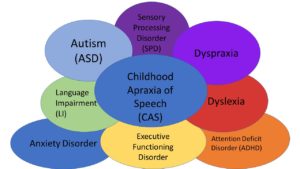
    3. Apraxia as a Symptom to a Bigger Picture

    4. Strategies to Promote Speech and Language in the Pre-Verbal or Minimally Verbal Child with Apraxia

    5. This School Year, Teach your Children to be Kind

    6. Finding our Umbrella

    7. Good SLP’s are Addressing the Head in the Hands

    8. The 6th Apraxia Awareness Day Brought Smiles, Tears, and a Jaw Dropping Moment

    9. Report Cards are Bitter Sweet in Special Needs Parenting

    10. Old Faces, New Faces, and the Passing of the Torch

    Cheers to an eventful 2018.  It was a year full of pain and happiness, love and sorrow, and hope and despair.  May we all remember that life can be intensely beautiful and irreparably sad all at once, because that my friends, is the definition of living.

    This 2019, I wish you all the gift of perspective in life.  We all have bad things happen.  We all have stress and we all have pain.  We also all have a choice, and that choice is to wake up each morning with a grateful heart and to focus on our happy and joyful moments rather than be sucked into the pain of despair and heartache.  There was a time Ashlynn’s dx seemed like the darkest event in my life, but I realized it was the beginning of my testimony to some of the most beautiful characteristics this human life affords us.  May God bless us all this year and always.
    Love and Peace,

    Laura

  • The problem with school SLP’s.

    The problem with school SLP’s.

    I only realized after being a part of the special needs community that school SLP’s have a bad rap.  Like a really, REALLY, REALLY bad rap.  

    I’m preparing a talk next month for Colorado school SLP’s, and every time I prepare a talk for this demographic, I have to tell you they have a special place in my heart.  No, it’s not just because I started as one and work as one part time, but it’s because I have literally worked under, with, and around many, many, MANY of them. I have worked with so many of them, and I can tell you they are a jack of all trades.  They are the EXPERT in eclectic, and may be the ONLY person in the school who understand in depthly just how a student’s unique communication challenges actually affect them in school.

    In the schools, you don’t have the option to specialize.  Kids from every disability show up on your caseload and you are expected to be the expert.  It might be hard to understand as a parent, but there are soooo many different disabilities and speech and language disorders, and a parent (rightly so) expects the SLP to do right and best for their baby.

    Every single SLP I know and have met has a desire in their heart to help children.  Please, let that sink in.

    When I took Ashlynn to her first private SLP who had never worked in the schools she was asking me about qualification.  She asserted that she could never be a school SLP because she felt it was unethical to not qualify students who clearly had some sort of speech or language problem.  I had a hard time refuting her.  Aside from saying qualification is different in the private versus educational sector, I really had no excuse.  I know that funding is limited in the public sector so that obviously plays a part in qualification.  I also know if every SLP took her stance, than NO kids would be serviced in the public schools, and is that really what we are going for?

    Public school SLP’s have caseloads that are probably double if not more of the private SLP.

    Where the private SLP can see kids 1:1, school SLP’s rarely have that luxury.  With weekly caseload averages around 45 to 55 and some maxing out at 90 (Yes 90 people I’ve seen it), even the most skilled SLP will not be able to do what a private SLP can do 1:1 for 45 minutes (though they will kill themselves trying).

    The result?  Parents become outraged at the lack of progress or progress they feel the child should be making. They surmise the school SLP just isn’t as good as the private SLP and they become disillusioned and write them off.  They post memes about preparing for battle when going into an IEP meeting! This honestly breaks my heart.  I feel bad for the parent who feels the SLP doesn’t care, and I feel bad for the SLP who is trying to manage an unmanageable caseload, writing IEP’s at night, or staying up until 2 Am (true story from an SLP I just talked to last week) to write a lesson plan, only to be ravaged by a parent unsatisfied with the results.


    I’m not sure if everyone is aware of this, but ANY SLP in ANY setting is as qualified as the next SLP by basic certification standards.  What does that mean?  That means, as long as an SLP received their masters degree and the Certificate of Clinical Competence (CCC) through ASHA they can work anywhere.  So that means, your school SLP can apply for a job at Children’s Hospital right now and probably get hired tomorrow (because in case you didn’t know there is an SLP shortage as well).  For some reason though, there is this perception that the school SLP just isn’t as good as the private SLP.  If it’s true, it probably has MORE to do with caseload and workload size than it actually has to do with the qualification of the SLP.

    I get calls and emails all the time from concerned school SLP’s desperate to meet the needs of their kids with apraxia but not knowing how.  They want to see the kid more, or see the child 1:1, but their caseload simply does not allow for it.  They cannot add more hours to the day, yet they still call, or write and wonder if there is something they have not yet thought of.  Oh, and here’s a dirty secret.  Listen close.

    Are you listening because this is VERY important.

    If an SLP feels in their heart a child needs private, supplemental speech services, they CANNOT say it.  People, they CANNOT tell you this.  Why?  Well, their license and job is on the line.  In most cases, school SLP’s are told not to recommend any sort of outside therapy.  Why do you ask? Why?

    I’ll tell you.  If a school SLP recommends outside services, the parent can sue the district and win, and potentially disbar an SLP from ever practicing again.  Are you asking why again?  I’ll tell you.  If a school SLP recommends outside services, they are essentially saying that the child can not benefit or make progress from the therapies provided by the school, and the school is required by law to show progress.  If the SLP recommends outside service thereby saying the school is inadequate, the school gets worried or they will get sued for not providing adequate services and the SLP potentially fired.

    Would you take that risk?

    I’m not saying unilaterally every school district would do this, I’m just saying, school SLP’s are told this is a possibility, and so they would find it best not to recommend outside services.

    You need to know this as a parent of a child with any disability.  Some SLP’s will risk their professional license and recommend this to you.  Let me  tell you though what they are risking.  They are risking 4 years of a bachelor degree, 2 years of a masters degree, 1 year of a clinical fellowship, and the usually 3 years of probationary status as a teacher.  That is an entire decade of work and dedication to a profession they love and believe in.  Would you take the risk then to recommend a parent pursue outside therapy?  This is where they are at!  It is truly a catch 22.

    If you are upset about your school services, you probably have every right to be!  I was VERY unhappy with Ashlynn’s preschool, in-class only, speech/language services.  However, it is important to place the blame on the right entity and in most cases I can assure you it is NOT on the school SLP’s shoulders.  In Colorado, the Colorado Department of Education mandated an inclusion model only of special education services in preschool thus making it extremely difficult for any school SLP to pull a student out into a 1:1 session.

    My message today is this: School SLP’s are some of the most phenomenal group of people I ever have the honor to speak with or to. They do not get the option to specialize, and so they pursue advanced training and expertise in every disability that may affect communication: from Apraxia to Angelman’s Syndrome, from Developmental Delay to Down Syndrome, from Cerebral Palsy to Stuttering, from Language Impairment to Nonverbal Learning Disability, from Assistive Technology to Autism, from Auditory Processing Disorder to Articulation Disorder,  school SLP’s will see it all and be expected to rise to the challenge.  They cannot “refer out” or “discharge for lack of progress” as an can be done in private speech. No, the school SLP is expected to figure it out regardless of the lack of resources, lack of funding, or lack of time.
    They will be faced with limited or no space, they will be strapped with high caseloads, and criticized by parents; yet they will persist and pursue only becoming better for it, because of their love for the children and the profession.  I personally have witnessed it time, and time, and time again!

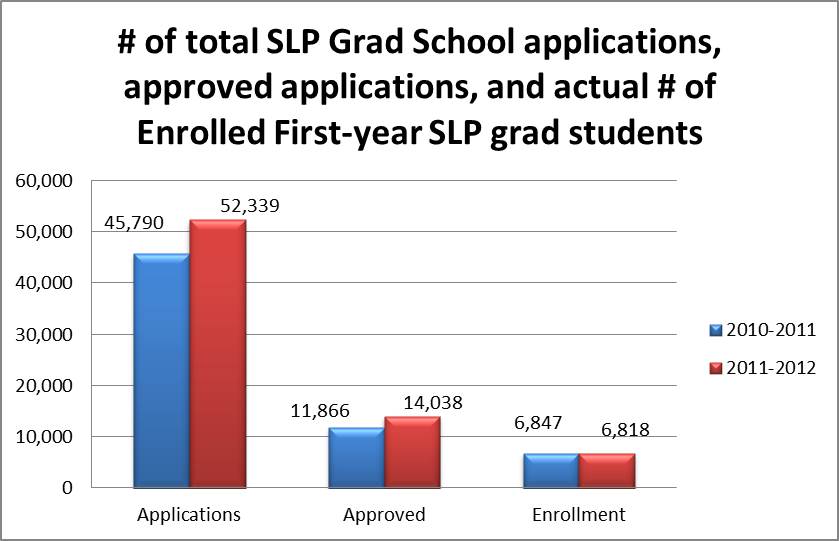
    I can tell you firsthand, getting into graduate school for speech/language pathology is VERY difficult.  It is highly competitive, and here in Colorado, the average COLLEGE GPA was a minimum of 3.87 when I applied.  I found this graphic from 2011 but I can tell you things have not changed much.  There is a HUGE gap between the number of applicants and the number of people selected. 
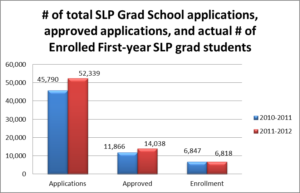
    The disparity should be striking, and please remember that MANY of these applicants will be YOUR school based SLP.  If you have the mentality that “C’s get degrees” and you are certain your school based SLP fits the latter, let me correct you.  NO average C students make it to graduate school in the first place for speech/language pathology.

    Truth

    For my final thoughts I wish not to be adversarial.  I hope that this article has persuaded you, a parent OR SLP, to reach out to the other side and bring about the change you wish to see.  I have the unique perspective of being on both sides, and as such, I have the utmost RESPECT and LOVE for both sides.  I truly wish for there to be a conduit of communication, and not a  ridge of animosity and distrust; and at the the forefront, I wish to impart a spirit of solidarity between my professional and special needs relationships.

    To read more from SLPMommyofApraxia follow her on facebook, pinterest, or twitter.


  • Why I’m angry and even more passionate as we approach the 4th annual Apraxia Awareness Day.

    Why I’m angry and even more passionate as we approach the 4th annual Apraxia Awareness Day.

    I love Apraxia Awareness Day, ever since I celebrated my first one when Ashlynn was new to the dx.  It’s always a time of excitement, renewed hope and resolve, support, and community who comes together filling up facebook and my newsfeed with their apraxia fighters.

    I’ve been honest and open about telling my own early experience with apraxia, which wasn’t much.  I’ve been the first one to admit I barely learned anything about it in graduate school, yet earned my Clinical Certificate of Competence and was for all intents and purposes an “expert.”  Such the expert that I missed it in my own daughter.

    People, that’s a problem!  I was a good student.  I did my best to learn all the content presented to me.  I still didn’t learn about childhood apraxia like I should have, although I should be grateful my graduate school acknowledged it.  I just heard the other day that someone’s professor didn’t *believe* in it.  Didn’t *believe* in it???  Like it’s some damn mythical creature??  Don’t put me in a room with that man, seriously.   I will lose my shit.

    Anyway, I digress.  Tonight I was seeing a client, and her mom had a previous Early Intervention SLP throw out the word apraxia in a flippant way.   She tossed the word around like it was a carefree beach ball bouncing around the pool, and it was only after mom had googled it some 6 months later did she realize apraxia doesn’t carry with it the carefree connotation of summer.  In fact, it’s  a serious dx in which some will never fully overcome.  She expressed her concerns.  The SLP wrote her back to just google apraxia and she would feel better.  If you are anyone who knows anything about apraxia and your are reading this, you KNOW that googling apraxia doesn’t make one feel better.  Better???  Are you kidding me right now??  If ANYTHING, googling apraxia of speech puts a parent on an immediate road to panic!

    The mom was telling me that as much as she’s mad about the disservice done to her daughter, she was more upset about the potential disservice being done to children currently in the SLP’s care who have parents who might not look up apraxia and understand it for the serious dx that it is.  I defended the SLP saying I might not have realized how serious the dx was early on in my career either.  I stressed that THIS is the exact reason I feel awareness is so important and that we have to do our best to spread it where we can.

    I left that session and returned a call from a client I evaluated a month ago.  The mom was basically beside herself.  Her daughter is being seen at a local (renowned) hospital and has been for the past 6 months or so.  Her daughter was born pre-mature with a significant birth history.  As fate would have it, or actually, if you know me, as *concidence* would have it, the NICU SLP ended up being her daughter’s Early Intervention SLP much later.  This woman fell ill, but before she quit she told this mom that she suspected apraxia, even though the child was young.  This mom did what anyone does, googled apraxia.  What happened to her happened to many of you reading this now who googled it for the first time.

    You started reading characteristics and a pit immediately formed in your stomach.  The more you read, the more you saw your own child on those pages and the more scared you became.  Fear and uncertainty crept in.  You eventually try and look for success stories.  You many find some, but you can’t find anything to satisfy you.  You may cry.   Eventually though, you recognize  you are the expert on your child and you are going to get them help no matter what the cost.
    It was after this that this mom found me and drove 2 hours and paid out of pocket for an evaluation.  She had actually said she found my blog, and her daughter sounded very similar to mine.

    As I started the evaluation, this girl actually reminded me of MY daughter.

    Even though the girl was young at 2.5, she cooperated fully with a speech articulation test and a motor speech evaluation.  She had ever single dx marker AND sub-marker of apraxia.  I could literally transpose my awareness day article I wrote for ASHA for Apraxia Awareness Day and she fit every, single one.  Oh, and FYI, to be dx with apraxia, you DON’T need to be dx with every single one!   Forget me and my writing though.  How about the ASHA technical report.  Yeah, she fit all those too.

    Anyway, the mom almost cried and said incredulously, “so you believe me?”

    I felt so bad.  This poor mom.  She knew more than the professionals treating her kid.  She had tried to tell them what her daughter did at home, but she always felt unheard.  That is bullshit.  A mother is an expert on her own child.  Professionals need to LISTEN to the mother.  I’m not saying dx because the mother said so, but don’t dismiss a mother’s concerns or reports.

    Anyway, I wrote my report.  I didn’t even write suspected Childhood Apraxia of Speech like I normally would when I evaluate a 2 year old.  It was THAT obvious.

    Not only did she have the top three markers:
    *Inconsistent errors
    *Difficulty with co-articulatory transitions
    *Disordered prosody (in this case, equal stress patterns on the few two syllables she had)

    but ALSO
    *vowel errors
    *tendency to centralize a vowel to shwaa
    *oral apraxia
    *feeding issues
    *higher receptive than expressive language
    *groping for sounds and words
    *co-morbid fine and gross motor delays
    *no babbling
    *pop out words
    *loss of words
    *low tone

    Anyway.  My report was so thorough anyone who read it would at least be compelled to treat it as suspected CAS.  Right??  Right??

    WRONG

    That was the phone call.  This mom had given them my report hoping that even though they made her feel like SHE was crazy, they would read a report from an SLP with expertise in the area who has a DAUGHTER with it too, and help her.

    NOPE

    “I can see what’s she’s saying, but I still don’t think it’s as dire as she made it seem.  I still don’t think it’s apraxia,” said one SLP.

    Mom is defeated.  The only thing keeping her there is basically no other options, but she’s about to leave.  I was livid.

    I AM livid.

    Okay, this isn’t ego on my part.  At this point, I’m beside myself that if these TWO SLP’s can’t even recognize it’s one of the most obvious cases I’ve had lately, how is this ethical?? How do they read my report listing EVERY dx marker, and still remain firm her speech will come and it’s just because she was premature and has a language delay? Mom is going to leave, but I feel like something else needs to be done for all the other potential kids they will miss.

    Why, WHY would they at the LEAST not say they disagree but would treat it as suspected apraxia?

    How is this still happening?  How after ALL the freaking work CASANA has done, disseminating information, funding research,  awareness efforts they have headed….HOW is this STILL happening??

    I’m sure I’ll be in a better mood Saturday (or I better be since I’m announcing all my giveaway winners), but I’m mad right now.  I’m mad because for all we seem to do, I still hear stories like this.  It’s not okay.  I don’t care if it a rare disorder.  I….DON’T….CARE.  If you are an expert in speech, the experts in speech need to know what they are doing or refer on!!  Heck, I”m really good at stuttering therapy.  I have a bunch of stuttering continued education, but I would never hesitate to refer a child on to an expert who sees it EVERY DAY if a mom had concerns.  In fact, I have recently!

    I’m just shaking my head right now.  If I’m an SLP and I read a report from an outside SLP who specializes in a certain area, I would not roll my eyes.  I would make sure I knew the facts.  I would make sure I learned the facts or consulted others.  I consult others all the time!

    My mentor Deborah told me early on, if I ever hit a stage where I know it all, I need to retire.  Best advice ever.  Her point of course is that we never know it all.  There is always more to learn.

    I’m angry because a mom went through this once.
    I’m angry because a mom and child are going through this again.
    I’m angry because a mom and her child will go through this in the future.
    I’m angry because for every awareness success story I feel like I hear double the failure.
    I’m angry because it’s not just professional, it’s personal.

    You know what? For the 4th Annual Apraxia Awareness Day, I want MORE than awareness.  I WANT change.  I want SLP’s to educate themselves and if they aren’t sure, I want them to put aside their ego and consult someone.

    Is that too damn much to ask?

    26ff8d8e901263fc0635d26b91a4596a

  • Why nature weighs more heavily than nurture

    Why nature weighs more heavily than nurture

    Nature versus nurture.  It’s a phrase that comes up in my profession, even if it’s unspoken.  I’m in the business of child language development, and nothing raises more eyebrows about nurture than a child who can’t talk…. or who has poor vocabulary knowledge…… or is lacking in language skills.

    Oh it comes up in psychology too.  We’ve all heard the stories of twins separated at birth and raised in different environments.  How do they turn out?  Are they a product of their environment, or did nature play a bigger part?  I don’t really know the answers to those particular studies except what I’ve seen on talk shows like all of you.

    However, I’m here to talk about speech and language development.   I’m a professional in it, but nothing could have taught me more about nature versus nurture than having two of my own children.

    Maybe that’s why it took me until my daughter with CAS was almost three to get tested.  Was I in denial?  What the heck?  Well,  I’ve seen the eyebrows from fellow colleagues about children I’ve treated.  I’ve been privy to the comments, “well, his parents just never read to him!” or  “they just don’t talk to their children” or “those parents anticipate all of his needs that he has no NEED to talk.”  So yeah, I’m pretty sure THOSE comments were exactly why I waited so long.

    Deep breath.

    Teachers and speech/pathologists, we need to talk.  This talk is cancerous.  If only you KNEW what a parent who has a child with delays goes through on a daily basis, you would instantly take back your words.

    I am a speech/language pathologist, and had been practicing five years prior to the birth of my daughter.  I might have been unknowingly pompous once.  Let’s face it, I was.  I was convinced my first child, my daughter, would come out practically gifted.  Heck, I had a master’s degree in childhood language development and disorders.  If anyone could give their child the upper hand, it was going to be this mama.  I remember when she was very young, maybe a month, I had a red and green light rattle that I would slowly move around her visual field.  I even think I wrote on facebook I was having withdrawals from my job and was just doing some “speech therapy” with my child.

    I remember cooing at her, using “motherese,” talking to her while I went about my activities, and even using baby sign with her paired with visual models each time she went to “eat” “drink” or wanted “more.” I remember locking toys out of reach so she would have to request them, demanding some sort of verbal response before she received anything of interest, and having her use AAC on my iPad. We (I) sang nursery rhymes, sang our ABC’s, and had letters all over the house like in the bathtub and on the fridge.  I read religiously to her EVERY, SINGLE, NIGHT.  She was going to be a prodigy.  I just knew it.

    It pains me to write her whole story in this post.  I have an entire blog for that.  Suffice it to say, things didn’t quite turn out as I had envisioned.  Her SLP mama who knew the tips and tricks didn’t seem to know the key to unlocking her voice, or her other motor skills.  Despite nightly therapy sessions, it seemed I was to be the only SLP on the planet who had a child who couldn’t talk.  Who I couldn’t TEACH to talk.  Despite going to work everyday and helping my students find their voice, my daughter struggled with hers.

    Despite throwing myself in research, attending conference after conference on early intervention, or consulting with my colleagues, my daughter STILL struggled to speak.

    I’ve come a long way in this journey, but let’s just say my guilt and feelings of failure for Ashlynn were so strong that I specialized in the disorder.  I love what I do, and I love CAS, but I thought at least if I were a specialist I could finally and truly say I really did EVERYTHING I could to help her.

    “You’re an SLP” you might be saying.  “I have parents who don’t care like that.”

    Let me just tell you, that your parents are now MY parents and I have treated many kids with CAS….and I can tell you with absolute, positive, and definitive truth, that EVERY mother feels or has felt like me.  They may manifest it in different ways, but isn’t that to be expected?  We are all individuals after all.  However, every mother I have met is worried.  Every mother I have met is a praying woman.  Every mother I have met feels helpless.  I felt helpless and I’m a speech pathologist!!!

    My dear colleagues, I don’t want to get another phone call from a mother in Arizona who has a bubbly voice and seemingly carefree personality, confess that despite every night that she lays her head on her pillow pleading with God that her child gets better and praying it was nothing she did, the SLP told her if she had just read to her daughter more, she would have been in a different position.

    This is not okay.

    If you don’t believe that mother, than believe me.  I have finally come to terms with the fact that nothing I could have done would have made my daughter talk on time.  Please, please, don’t add to that mother’s guilt.  I assure you, she is full to the brim already with it….despite the fact there is nothing she could have done.

    I have another SLP mommy I have met now with a child who has CAS get a note from an SLP that stated,”still remains delayed despite excellent familial support.”

    That statement, seemingly benign, implies that that SLP believes nurture plays more than nature, and she is having a difficult time reconciling such delays that are accounted for….GASP…..an actual disorder.

    Friends, speech and language disorders are your livelihood.  Please stop assuming nurture played more of a part.  My son was born in the midst of my daughter’s diagnosis.  He never received the FRACTION of therapy my daughter did, and he said mama at 8 months old.  He went onto to say and do things that left me speechless.  Not  because I doubted him, but because based on my experience with my daughter with global apraxia, I didn’t have to TEACH him any of it!  Time after time, I shook my head asking him, “how can you say that?” or “how can you do that?  I haven’t taught you that yet!”

    If this journey has taught me anything, it’s that speech and language delays really ARE an actual disorder like we all learned in graduate school; and SLP’s, your role couldn’t be more important.  Please don’t taint it by coming in with an assumption “if only they had…..”

    Come in with the assumption that “they have….and they are spent.”  Please, please be the parent’s champion as much as you are the child’s.


    nature vs nurture


  • First annual Apraxia Awareness Day! What it means to me as a mom and SLP

    First annual Apraxia Awareness Day! What it means to me as a mom and SLP

    I never thought when I was going through school to be a speech/language pathologist, or when I became a speech/language pathologist, that I would one day have a child who would have apraxia. It’s funny, because before I had Ashlynn, I was still drawn to the disorder. I was highly disappointed about the information that was available on it in graduate school. I think I have a packet of maybe 20 papers that discusses Childhood Apraxia of Speech (CAS), and that’s it. Luckily, I had an amazing mentor who was able to take me to a conference given by Ruth Stoeckel from the Mayo Clinic in 2005. I still have her packet today, and have shared the knowledge I gained there with many colleagues.
    In 2008, I had a child enter my school and on my caseload when he was in Kindergarten.  He did have an IEP from Early Intervention; however, therapy had been primarily unsuccessful.  One day, he pulled out an alphabet BINGO game I had on my shelf.  He proceeded to say every letter sound in isolation.  I quickly realized he must have Childhood Apraxia of Speech (CAS)!  Apraxia is a motor planning disorder that affects a child’s ability to accurately plan, sequence, and execute the sounds needed for intelligible speech. Since he could say all the sounds in isolation, it was clear to me the breakdown must have been in the sequencing.  I pulled out my packet from Ruth, and searched for resources.
    Fortunately by the end of the school year, he was talking in sentences!  That’s the power of information.  That’s the power of awareness.  That’s the power I hope other SLP’s who may only have a 20 page packet from grad school get when they are called attention to Apraxia Awareness Day.
    I am so grateful that there is now an Apraxia Awareness Day, not only for the children affected by CAS and their families, but also for the professionals who treat it.  We all know that early identification is key, but many kids can be identified much sooner than they are!  I currently am in another school building, in almost the exact same situation.  I have a child from a bilingual home come into Kindergarten nonverbal.  Now that I have more experience, now that I’m armed with more information and more tools, we started making progress the first week.  Though I’m happy for his progress, I am sorry for it’s tardiness.   Especially, for his sake.  He is so smart.  He can point to any sight word in English AND Spanish, but just can’t put those sounds together coherently.  He’s frustrated and embarrassed.  This shouldn’t have to happen to any more kids, and this is what Apraxia Awareness I hope, will accomplish.
    As for my daughter?  I could never have fully appreciated the disorder outside the disorder, if it wasn’t for her.  In her I see it’s humanity and complexity,  it’s heartbreak and hope,  it’s tenacity and victory!  My 3 year old daughter has taught me more about CAS then graduate school, then professional developments, or my professional experience.  I can only believe that God chose me to be an SLP for a reason, and that my daughter has CAS for a reason.  I don’t want to disappoint Him, and I don’t want to disappoint her;  so I stand up for all the kids who DESERVE  a voice to raise awareness on this first ever Apraxia Awareness Day!