Tag: speech therapy

  • What’s new in my speech therapy office?

    What’s new in my speech therapy office?

    Poke-a-dot books

    I am absolutely OBSESSED with the Poke-a-Dot books! I recently had a few new clients with a high interest in dinosaurs, so I knew the Poke-a-Dot dinosaour book was a MUST have for the clinic.

    While I was at it, I decided to also “add to cart” the Poke-a-Dot Old MacDonald and the Poke-a-Dot Goodnight Animals. You can never have too much of a good thing right? If you’re looking for ideas on how to use these books in therapy, check out my instagram post on five goals to target using the Poke-a-Dot Ocean book.

    Dinosaurs and more dinosaurs, oh my!

    To appease a few of my clients with an insatiable appetite for all things dinosaurs, I also added some dinosaur magnets that are versatile. They stick to the file cabinet and also are fun to “fish for” with a simple fishing magent!

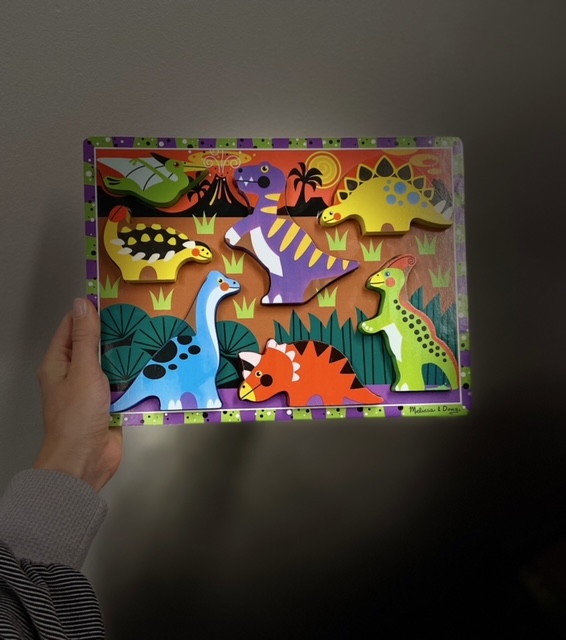
    Add a dinosaur chunky puzzle by Melissa & Doug to not only work on speech but fine motor skills!

    While I was there, I couldn’t resist adding another Melissa & Doug sound puzzle to my collection. Did you know you can also “fish” for these pieces as well? Kids love to fish and this is such a fun and easy way to incorporate more fun into a simple puzzle activity! For ideas on goals to target in therapy using this activity check out my Instagram post here.


    Laura Smith, M.A. CCC-SLP is a 2014 graduate of Apraxia Kids Boot Camp, has completed the PROMPT Level 1 training, and the Kaufman Speech to Language Protocol (K-SLP). She is the author of Overcoming Apraxia and has lectured throughout the United States on CAS and related issues. Currently, Laura is a practicing SLP specializing in apraxia at her clinic A Mile High Speech Therapy in Aurora, Colorado. 

  • The Verified Guide to Grants for Speech Therapy

    The Verified Guide to Grants for Speech Therapy

    Children alone come with an expensive price tag. Finding out your child has special needs makes that price tag even pricier. In some cases, the price is too high and families simply cannot afford private speech therapy.

    In many cases of severe speech disorders such as childhood apraxia of speech, the stakes are too high just to have school speech therapy hope to treat it the way it needs to be treated.

    I found a few resources online as to places that may potentially fund speech therapy, but many were dead ends. For that reason, I compiled I guide that I have personally verified to help fund speech therapy.

    United States Nationwide Resources:

    First Hand Foundation – Provides case grants for medical needs including grants for speech therapy.

    Friends of Man – Works through Referring Professionals (caseworkers, case managers, health care workers, social workers, counselors, teachers, clergy) who apply on behalf of their patients and clients needing mobility equipment, prosthetics, glasses, dentures, hearing aids, and much more.

    Orange Effect Foundation – OEF’s mission is to make sure children with speech disorders receive the speech therapy and technology equipment they need…especially when the children’s family doesn’t have the financial means.

    Rite Care Scottish Rite Childhood Language Program (SRCLP) – Have clinics in various parts of the United States and provide diagnostic evaluations and treatment of speech and language disorders as well as learning disabilities. Depending on the area there is a waitlist or income requirements.

    Small Steps in Speech – provides grants on behalf of children with speech and language disorders for therapies, treatments, communicative devices, and other services aimed at improving their communication skills.

    United Health Care Children’s Foundation – “UHCCF’s mission is to help fill the gap between what medical services/items a child needs and what their commercial health benefit plan will pay for. UHCCF grants provide financial help/assistance for families with children that have medical needs not covered or not fully covered by their commercial health insurance plan.”

    Statewide resources:

    Local community centered boards – Non-profit organizations designated as the single entry point into the long-term service and support system for persons with developmental disabilities. They are responsible for intake, eligibility determination, s ervice plan development, arrangement of services, monitoring, etc.) Google your local community centered board for more information.

    Local Universities – Many times offer low cost, affordable speech therapy.

    Alabama

    The Hudson Family Foundation

    The Hudson Family Foundation provides individual grants that offer financial support to children and their families living with a life-altering or terminal disease or who have experienced an unexpected circumstance, accident, or tragedy. The grants are used to help ease the financial stress that these situations can create for a family. The Hudson Family Foundation serves children and families in the states of Alabama and Georgia.

    Florida

    The Gardiner Scholarship Program – The Gardiner Scholarship Program provides eligible students a scholarship that can be used to purchase approved services or products in order to design a customized educational program for the student. Scholarships can be used for specialized services such as speech or occupational therapy, instructional materials, tuition at an eligible private school, contributions to a college prepaid account and more. 

    Georgia

    The Gardiner Scholarship Program – The Gardiner Scholarship Program provides eligible students a scholarship that can be used to purchase approved services or products in order to design a customized educational program for the student. Scholarships can be used for specialized services such as speech or occupational therapy, instructional materials, tuition at an eligible private school, contributions to a college prepaid account and more. 

    Michigan

    Family Hope Foundation – Family Hope Foundation is an established non-profit organization providing resources, activities, support, and funding for therapies to families of children with special needs in West Michigan.

    NWO Apraxia Support – NWO Apraxia Support is a 501(c)(3) regional nonprofit organization dedicated to supporting families impacted by and raising awareness about Childhood Apraxia of Speech (CAS) and other invisible disabilities (including, but not limited to SPD, anxiety, epilepsy, non-specific learning disabilities, ADHD, dyslexia, autism, Tourette’s syndrome, and other speech and language disorders), as well as providing grants to fund supplemental therapies, treatments, activities, or equipment that will enhance the lives of individual children impacted by CAS and other invisible disabilities.

    Ohio

    NWO Apraxia Support – NWO Apraxia Support is a 501(c)(3) regional nonprofit organization dedicated to supporting families impacted by and raising awareness about Childhood Apraxia of Speech (CAS) and other invisible disabilities (including, but not limited to SPD, anxiety, epilepsy, non-specific learning disabilities, ADHD, dyslexia, autism, Tourette’s syndrome, and other speech and language disorders), as well as providing grants to fund supplemental therapies, treatments, activities, or equipment that will enhance the lives of individual children impacted by CAS and other invisible disabilities.

    Washington

    Elevations – A Children’s Therapy Resource – A 501c3 nonprofit, our Spokane-based organization coordinates directly with therapy providers to identify and serve children with special needs. We work with families to help with the cost of critical therapy services. 

    International Programs:

    UK

    Disability Living Allowance

    Laura Smith, M.A. CCC-SLP is a 2014 graduate of Apraxia Kids Boot Camp, has completed the PROMPT Level 1 training, and the Kaufman Speech to Language Protocol (K-SLP). She is the author of Overcoming Apraxia and has lectured throughout the United States on CAS and related issues. Currently, Laura is a practicing SLP specializing in apraxia at her clinic A Mile High Speech Therapy in Aurora, Colorado. 

  • Shaming parents about home carryover

    Shaming parents about home carryover

    I’ve been on this special needs journey with Ashlynn for a long time now.

    I have grieved, recovered, grieved, and recovered again. I have developed thick skin.  I have felt guilt, then peace, more guilt, and then peace.

    I thought I was past all the BS.  I have accepted Ashlynn has severe needs.  I have accepted my journey with Ashlynn is going to be MUCH longer than I ever anticipated and I have embraced it.  This girl goes to school from 8 to 2:45, and almost every day after school she has some sort of therapy or tutoring strategically scheduled to help her overcome all of her learning disabilities.

    I’ve been done making excuses for not doing homework.

    I finally just started being honest and saying “We will see. She is a very busy and overscheduled little girl,” when therapists would ask about homework .  Ashlynn goes to school and then has therapies after school, and then we hope to get home to eat and then finally do her SCHOOL homework.

    That doesn’t mean there isn’t any other homework.  Oh no.  For all the therapies she receives after school there is also homework.  Always homework.  So not only does the average kid NOT go to therapy or tutoring everyday after school, they also then don’t have the homework assignments from said appointments after school.

    My daughter has it all.

    Go to school and get homework, and then attend therapy and tutoring that takes away from homework time after school and receive MORE homework on top of school homework for the extra after school services.  Oh, and my daughter has global motor planning issues, so any homework assigned is usually homework that needs to be done everyday.

    Everyday my daughter is expected to do regular school homework and then follow through homework for OT, PT, Speech and tutoring as well.

    If for some reason said homework isn’t done or done to the fidelity of a therapist’s expectations, I get to see the raised eyebrows and judgemental eyes.  I know what they are thinking even if they don’t say it.  “You couldn’t carve out 5 minutes for some simple yoga poses?  Speech word practice? Sight word drills?”

    Again, I thought I was past this.  I was done feeling guilt.  My whole life is running around trying to get my daughter the help she needs and then coming home and trying to be a mom and get dinner and then at least getting through her school homework. I have been done for a LONG time apologizing for not getting the therapy homework done.

    That was until today

    Two weeks ago I put Ashlynn into a therapy called oral facial myology to help with her mouth breathing, tongue thrust and immature swallow.  I knew going into this the homework component was going to be big.  I knew this! We received a sticker chart to keep us honest.  Ideally she would do the exercises 2x – 3x  a day and we would reconvene in 10 days.

    Today was our second follow-up appointment. I was so proud of Ashlynn!  We had done the exercises every single day!  A handful of days we managed 3x, most days we did 2x a day, and on three days including one where she spent the night at her grandma’s we did 1x a day.

    I was proud of us.  That was no easy feat. Sometimes it cut into bedtime but I knew this was important and I was willing to go the extra mile.

    My sails were immediately shredded within 5 minutes of our second visit.

    The swallowing therapist was warm and inviting as usual.  We were seven minutes late because we were driving from PT and I had forgotten to ask the physical therapist to end 5 minutes before and instead she ended 5 minutes late.  We still made it though! School ended at 2:45, we were at PT at 3:30 and then we were at swallowing therapy at 4:25. I was proud of myself for getting her to all these places.

    “How did the homework go?  Did you complete it?” the therapist asked Ashlynn.  Ashlynn enthusiastically nodded yes as I took out the sticker chart and the therapist looked on disapprovingly.  So there are three days here you could only do one practice session?  For this program to be successful, she needs to be doing the exercises at least 2x a day.

    “There are a couple days we did three!  Does that cancel out the three days we could only fit in one?” I laughed nervously.

    I looked up to a face of disapproval.

    “For this program to work, you really need to be more consistent,” she lectured.

    I swallowed a big swallow and collected our things. I think I literally gulped back tears.  I was paying a lot of money for this therapy.  Of course I wanted to see it be successful.  Of course I wanted to practice with Ashlynn as much as I could.  Guess what though?  I also needed to make sure we completed her homework and read at least 10 minutes per night.  Then and only then did I need to make sure she was doing her homework for reading tutoring, OT, PT, and speech as well.  Oh and she also needed to eat at some point and take a shower.  Being a kid?  Nope.  That’s not in the cards apparently.

    The guilt and responsibility is overwhelming

    I cried as I left the swallowing woman’s office.  I was trying!  I thought Ashlynn and I had done amazing!  We practiced what seemed like every spare minute we had together, which actually is very little spare time together!  I was proud of our dedication, but this woman had only criticism.  She told me if the program was to work, I really needed to get more serious about practice.

    I went home that night in a state of anger.

    I was yelling at my kids, my husband, the computer..really anyone who would listen.  I was devastated at having a therapist, a well respected therapist basically tell me if I didn’t take the homework seriously and with the fidelity it needed to be, my child wouldn’t improve.

    I railed against everyone and then I messaged an ally.

    The ally I messaged is an SLP who specializes in apraxia and oral facial myology.  I was so lucky to meet her at L.A.’s Walk to Talk for Apraxia when I took Ashlynn at 8 years old.  Her name is Lisa Klein and she has a reputation for not only being an amazing therapist, but being an incredible friend, mentor, and encourager. I barely know her yet knew I needed to talk to her.   Fortunately for me, she told me I could call her on my way home and like a crazy mom who is desperate I did.  I talked in a long winded series of run on sentences and questions and when I stopped she said the most impactful thing to me that brought me to tears.

    Laura, first of all, you are a great mom and that girl has come so far because of you.

    I started balling.  Not like crying either or tearing up.  No. Chest heaving ugly cry balling.  I just needed that validation.  She went onto say things that our myofunctional therapist suggested too like going every other week.  She brainstormed how to get in practice or what exercises we absolutely couldn’t miss. She said all of this though with compassion and free from judgement, and that is exactly the type of therapist I aim to be too.  We need to meet parents where they are at and we need to know parents are under an insane amount of pressure and are doing the best they can with the tools that they have.  I need a therapist to understand that.  I’m constantly shocked by the number of therapists who have so most judgement. I say this all the time but I say it again.  Please, if you are a therapist reading this please have compassion and understanding for the parents.  We are fighting daily battles and crying tears no one ever sees.  Please be kind.  Please.

  • Hammering out apraxia with David Hammer

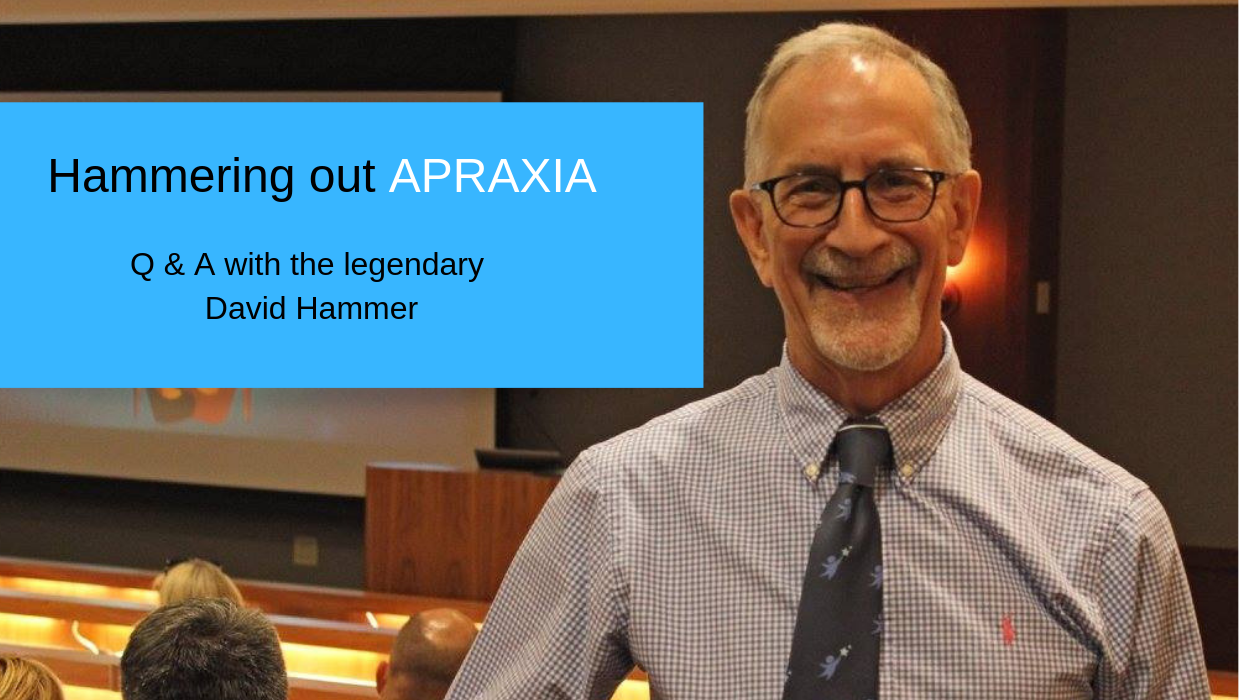
    Hammering out apraxia with David Hammer

    Hi Dave!  Thank you so much for coming on to guest blog!  You know you are famous in the world of apraxia, so I am honored you are willing to guest blog!  Your contributions to the field of Speech/Language Pathology and more specifically apraxia are inspiring.  It’s an absolute honor to know you and I can’t thank you enough, speaking as a mother of a child with apraxia, for all you have done to advance the field.  Recently, you just announced your retirement set for the end of this year.  Though I am sad, I am so grateful for your enormous contribution to the field and am so happy you joined me today to share your knowledge!  I normally pick a specific topic, but for you, my readers wanted to ask questions related to apraxia and see what you had to say!

    I feel humbled by your kind words, Laura, and also feel blessed to have been in this great field for 40 years.  I will return the thanks for all that you have done in the Apraxia community as you wear the hats of an SLP and a mother of a child with apraxia. I often talk in my presentations about how SLPs have to wear so many hats – their SLP hat, their parent counselor hat, their psychologist hat, their OT/PT hat, etc. given that we are dealing with the “whole” child and not just the “hole” where speech emerges!  I applaud anyone in this profession that looks at children this way. I am fine with answering a wide range of questions so I will proceed…

    Can you start though by introducing yourself first including how and why you became interested in apraxia?  Also, what is your involvement with Apraxia Kids?

    I started out working for Children’s Hospital of Pittsburgh, PA after graduating from the University of Pittsburgh.  Through my first office window I look directly at the building that housed the speech clinic where I was trained! I began to specialize in stuttering but then Luke Lasky, Sharon Gretz’s son, came into my life through a referral from my esteemed boss, Dr Tom Campbell.  It wasn’t long before I became fascinated by this challenging motor speech disorder and from that point, my career passion changed. Having been a part of the beginning stages of what is now known as Apraxia Kids has been quite rewarding. To see this organization grow from 2 parents observing their 2 boys with CAS through my two-way mirror in dyad treatment to what it is today is remarkable.  I left Children’s Hospital after 35 years as a practicing therapist and administrator and joined the Apraxia Kids staff (then CASANA) where I have been the last 5 years. I recently announced my retirement plans for the end of 2019. It has been quite a journey!

    Is it necessary and beneficial to get an MRI or do specific genetic testing or any type of medical testing for that matter.  If so, why?

    This is always a challenging question and one that I answer for parents often.  Let’s start with discussing a neurology appointment. I do not feel that all children with CAS need to see a neurologist, unless they demonstrate what we call “soft signs” such as clumsiness, inability to cross midline, hand tremors, imbalance, staring spells, etc.  In those cases you would want to rule out other potential medical diagnoses. But to ask a neurologist who likely had very minimal training on CAS to evaluate whether or not a child (who is usually very reluctant in a physician’s office) shows features of CAS is unfair and could potentially lead to misdiagnosis. Also, CAS is not a medical diagnosis.  Studies have concluded that a high percentage of children with CAS show normal MRIs.  There is no conclusive brain imaging or genetic tests to diagnose CAS. It is a clinical diagnosis to make and should be done by a speech-language pathologist.  The child’s SLP may suggest genetic testing or neurological testing if they see indicators of other concerns but to routinely have all children get an MRI, have genetic testing done, or a neurological examination is not what I recommend.  Unfortunately, some of our SLPs in Canada in certain provinces are required to send all children to a physician to get a CAS diagnosis which can certainly slow the process of getting children the therapy help they so desperately need. Some parents just want to make sure every rock has been overturned and will seek out genetic testing and/or neurological testing.  I would never stop them from doing that but will discuss the pros and cons.

    What are other conditions that are common with Childhood Apraxia of Speech?  

    I would say fine motor planning struggles, sensory issues and anxiety are 3 that come to mind first.  I added anxiety to that list just recently as I talk to more and more parents and SLPs about how children who struggle to communicate seem to have more anxiety than is typically seen. It makes sense when you think about it as communication is such a vital part of what makes us human and social beings.

    For the child with profound apraxia, where do you even start?

    First of all, you must make sure that the child has the foundational skills for communication such as joint attention, ability and willingness to imitate (any motor movements), and a certain level of cognitive ability.  Some of the children can’t make use of motor speech therapy until those foundational skills are in place and a lot of time is wasted just trying to get speech first. If those foundational skills are intact or to a point where the child can benefit from therapy, then the starting point would be for me building on whatever the child has in their vocal/verbal repertoire.  We can use expressions, animal noises, vehicle sounds to build speech from creatively. The foundational element is the syllable for motor speech work so we would not work much in isolation but would constantly be looking at sequencing sounds to build motor plans. I would work on a very few words in the initial stages when a child has profound CAS to build these motor plans in hopefully functional ways.  The targets for this early practice are critical and should allow for the child to feel early success or they will lose their motivation for trying quickly. Speaking for them is very challenging, and it is not much fun to have to repeat syllables and words over and over, so to get them to take vocal/verbal risks is the challenge for the SLP and parent/caregiver alike.

    Is it possible for a child to have apraxia, sensory issues, and other language disorders such as Mixed Expressive/Receptive Language Disorder and it not automatically be autism?

    For sure.  I have seen a number of children for evaluations who come in with a diagnosis of autism spectrum disorder who really reflect severe CAS with mild-moderate sensory issues.  I also see it the other way around where parents are holding on to a CAS diagnosis when it is apparent that the child is also showing features of autism. For some parents, they think that when the speech symptoms “go away” their child will just be like all other children, but this is not always the case when there are complicating dual diagnoses. I can certainly understand why parents would hold on to something that appears more “fixable” despite the challenges that CAS brings.

    Is there any research on regression in speech motor planning when a child has a growth spurt?

    I know of no evidence of this, but my psychology and child development training throughout the years coupled with my experience show me that there is always a chance of regression and or behavioral change when there is a growth spurt that sets the “system” in a whirlwind until it can again settle down. It’s an interesting question and one that would be fascinating to study.  Overall, however, we do not see significant regression in speech for children with CAS. We are likely to see what I call the “plateau effect” where there are periods of leveling off of progress while a child is apparently consolidating his/her gains. I stress to parents that they should think of these as “input phases” where their verbal input, practice, etc should still continue and even heightened despite the output not changing much.  Then you tend to see this followed by a spurt of progres but it often cycles back. The journey of CAS is not a straight line of progress.

    You’ve presented before on best practices for apraxia with a co-morbidity of autism.  Are there any resources available for this?

    There are not many resources currently.  Key points to be made here have to do with differential features, for example children with CAS ofen averting eye gaze due to lack of communication success and children on the spectrum often avoiding eye contact due to perceived aversiveness to looking an another’s face.  Both groups may demonstrate sensory issues which is why misdiagnosis is so easily done. One article from the April 2011 Journal of Autism and Developmental Disorders comes from Larry Shriberg and his group called “The Hypothesis of Apraxia of Speech in Children with Autism”.  

    Is there a connection between apraxia and reading struggles?

    A very high percentage of our children with CAS struggle with reading and show evidence of struggles in the preschool ages with foundational phonological awareness skills.  It is critical that SLPs and parents make sure there are foundational elements of literacy incorporated into therapy sessions and home practice/stimulation. There is nothing better for parents to do then read to their children daily.  I usually suggest at least one book for pleasure and one that incorporates some degree of speech practice time. I think this is one of the biggest frustrations I hear from parents – just when they think the child is overcoming the motor speech challenges, along comes major literacy struggles which then pervade learning in school.  It is this constant “getting over the next hurdle” that requires a lot of perseverance for parents.

    Do difficulties eating or picking eating often accompany apraxia?

    As I mentioned before, with seeing so many children with CAS having sensory issues of one degree or another, it would make sense that picky eating may be a component of these sensory deficits.  It is difficult to sort out whether there is oral planning challenges contributing to eating difficulties and the possibility that it may be more of a weakness issue (e.g. a child with dysarthria or combined CAS/dysarthria) needs to be investigated.

    Let’s end it with something fun.  Do you prefer plain socks or fun socks?  

    On me or on others? – haha!  I would say I tend to wear plain socks most of the time, but when I was a practicing therapist, I had a LOT of fun kid-themed ties that I think helped children feel even more comfortable when they came to see me.  Oh, I do have a pair of dinosaur socks that were gifted to me by a child’s parent when her child ended therapy, knowing that a major theme in our therapy had been dinosaurs! Ironic that I just bumped into that parent and her now older child when I went to see Hamilton the other night!  Both experiences were amazing as I marveled at what Lin-Manuel Miranda and this parent/child duo had accomplished!

    Thank you so much Dave!  It’s been an honor to have you, to know you, and to consider you a mentor and friend!  Your contribution to the field cannot be measured. As a mother to a child with apraxia, I’m so grateful to you. 

    …and I am so grateful for you, all the parents/caregivers out there on this journey, the children who truly are superheroes, and the SLPs who passionately want to help, ALL of whom have inspired me in this field!


  • Favorite Thanksgiving books for Speech Therapy

    Favorite Thanksgiving books for Speech Therapy

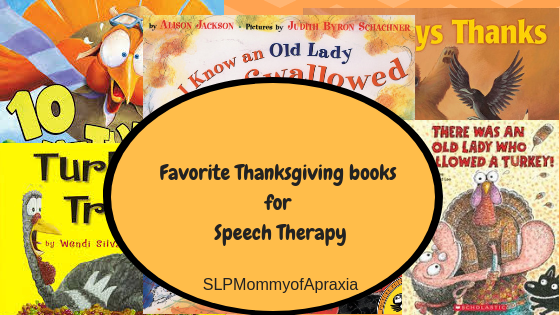
    5 Favorite Children’s Thanksgiving books for Speech Therapy

    1. I know an Old Lady Who Swallowed a Pie 
      Repetitive in nature, there are great words for repetitive practice including “pie” and “cider.”  (Tip: I change the “perhaps she’ll die” part to “I don’t know why.”)

    Activities:
    Book Companion Pack on my SLP Mommy of Apraxia TpT store.  Find it here.

    2. 10 Fat Turkeys by Tony Johnston
    Kids love this book about ten silly turkeys who do tricks and take turns falling off the fence.
    They love repeating the phrase “gobble gobble, wibble wobble!” and you will too!

    Activities:
    Freebie for this book courtesy of Simple SpeechFind it on her TpT store here.

    3. Turkey Trouble by Wendi Silvano
    Turkey is worried about being Thanksgiving Dinner for Farmer Jake!  Kids laugh at turkey’s
    creative costumes and clever idea to ultimately avoid being eaten, in this funny, and repetitive
    book.

    4. Bear Says Thanks by Karma Wilson
    In this heart warming book, Bear decides to throw a feast but his cupboards are bare!  As his
    friends stop by with dishes of food, “Bear Says, Thanks.”

    5. There Was an Old Lady Who Swallowed a Turkey, by Lucille Colandro
    Kids love the crazy Old Lady who his back and eating all kinds of crazy things!  I love to work
    on prosody with her books as well as speech.

    Activities:
    Freebie book companion courtesy of Fun in Speech available on her TpT store here. 

  • Good SLP’s for apraxia are addressing the head in the hands

    Good SLP’s for apraxia are addressing the head in the hands


    Therapy for apraxia is direct and intense.  Any task that involves motor planning is this way.  Motor planning any skill, whether it be learning to shoot hoops, hit a tennis ball, or learning to speak when your etiology is motor planning (apraxia), instruction needs to be intense and involve a lot of repetitive practice.

    I remember when I attended an intensive 4 day training, Dr. Ruth Stoeckel from Mayo clinic was asked how many repetitions SLP’s should be looking to get in therapy.  She hesitated and expressed concern about giving a number.  I didn’t understand her hesitation at the time.  It was a simple question, how many repetitions should we be trying to get in therapy?  We were all professionals.  We all understood that this number would be in the ideal circumstance, and that many factors would decrease the number.  Still, she was hesitant to give a number.  She did finally say in the ideal circumstance, we are looking to get around 200 reps per session.

    I now realize why Dr. Stoeckel was hesitant to throw out that number.  It’s not only because it can only happen in the most ideal circumstances and we might frequently fall short.   The main concern is that a number doesn’t take into account a child’s emotional health.

    Let me say it again.  Yes our goal is to get a lot of reps, but it doesn’t take into account a child’s emotional health!

    I was talking to a student who is Ashlynn’s para right now and he is looking to earn his special education degree.  He expressed concern that others seemed so much smarter than him and he was worried he wouldn’t be as good a teacher.  He was the only person in Ashlynn’s life thus far who recognized her anxiety and nail picking and fixed it by buying her a rubber band ball.  His professor actually admonished him for it.  It just went to show his professor sitting at the university was completely out of touch with what was going on the field, and that was my point to this young man.

    I have met brilliant SLP’s.  Seriously brilliant.  “C’s get degrees” does not apply in my field.  I’m not trying to boast either, it just doesn’t happen.  Graduate school for speech/language pathology is extremely competitive, and average GPA’s, AVERAGE, were 3.88 to 3.97 at the time I was trying to get into graduate school.  That means a fair amount of current SLP’s held college level GPA’s that were 4.0.

    It’s important to have the best of the best teaching our children to talk; however, a GPA can never account for what I would consider to be one of the most important qualities in an SLP.  It’s a quality I can’t even succinctly put into one word, but it is by and far the most important.  It is a therapist’s ability to read and then respond to the emotional health of their student or client.  If we, in our quest to get 200 reps completely disregard any signs of emotional anxiety, distress, or defeat in the child; we have lost everything we had hoped to gain.

    Let me say that again.  If we sacrifice a child’s emotional health for the sake of getting in so many reps, we have lost EVERYTHING.

    Speech therapy is predominately speech and language therapy, but the counseling aspect I believe is significantly underscored. My graduate program did include a class on counseling in speech therapy, but it was geared primarily to the adult population or for those who stutter.  Our pediatric field recognizes now the importance of counseling in stuttering therapy, but there is very little information out there on counseling and our kids with not just apraxia, but also a phonological disorder, articulation disorder, or a language impairment.

    What Dr. Stoeckel was trying to tell us in her hesitation of throwing out a number of reps we should be targeting, is that if we sacrifice their emotional health and our trust relationship with them for the sake of getting in a certain amount of reps, we have sacrificed everything.

    I get sent videos from time to time asking for advice, and usually what I find striking is NOT the speech therapy that is being done, but the absolute blind eye turned to a child’s nonverbal signs of emotional distress.  I remember watching one video and the child was enrolled in PROMPT therapy.  The SLP was kind, competent, and skilled at what she was doing.  What she never even once acknowledged though was that the child would constantly put his head in his hands when she asked him to repeat anything.  Nothing was said.  Nothing at all!  Not, “It’s okay, I know this is hard, but you got this!” or “I know it’s so hard and I can see you are frustrated so let’s take a break.”

    Nothing. Just, “Say it again, try again.”

    It was all about reps and speech and reps and speech and reps and speech and reps and speech.

    I’m here to tell you, if we aren’t addressing the head in the hands, the best and the smartest SLP in the world isn’t going to make progress.  I told this student, if we aren’t addressing the nail picking that causes bleeding, the best and smartest SPED teacher in the world isn’t going to make progress.

    Let’s go back to motor planning though, since the research is telling us that is the most effective form of treatment for apraxia.  If we liken it to another motor skill like basketball, is the job of a coach JUST to teach the kid the right technique and the right form to shoot a basket?  Or, is the job a coach to also encourage, foster, and nourish their confidence as well?  In that analogy, it seems obvious; yet with speech therapy we still don’t seem to be there yet.

    A final example comes from a newer client of mine.  Completely nonverbal at the age of 7, her school SLP, who is amazing, risked her job to recommend private therapy.  After three months, she was making progress, but much, much slower then I wanted.  She had major avoidance behaviors and if she were asked to repeat anything again she would point to something else, pretend her finger hurt, or try to get off topic.  The avoidance behaviors decreased the more she developed trust and had success, but I still felt like I was missing something.
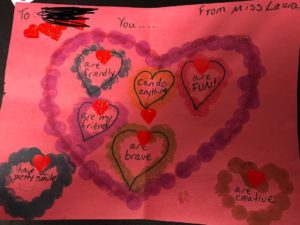
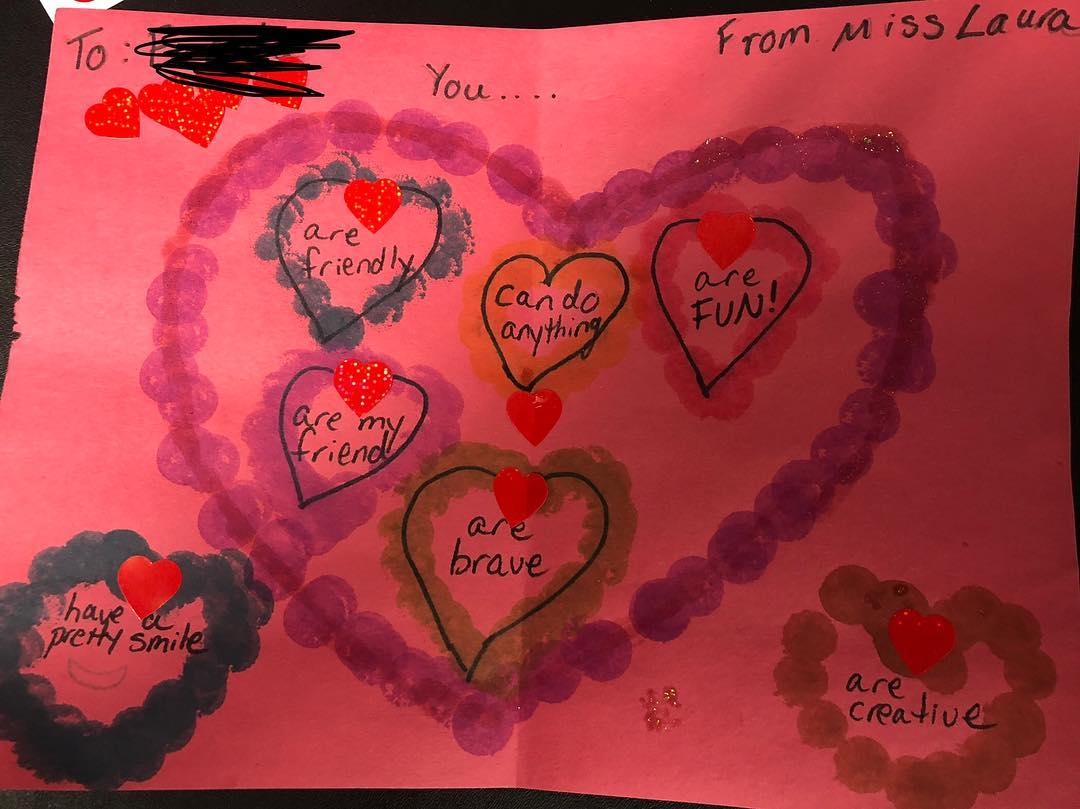
    Since Valentine’s day was coming up, I decided we would take a break from speech and do something fun.  Make Valentine’s.  I still embedded a few target words in the activity, but for the most part, the focus was on the Valentine.  She made one and I made one.  When I showed her mine, I read all the things I wrote about to her.  I stressed that she was brave and could do hard things.  Her brown eyes searched my face, wanting to believe me.  When I read she was creative, she proudly pointed to the Valentine she had made, and I nodded in affirmation.  After the session, I had her mom come in and read it.  She beamed as her mom read the words on the page.  Before she left I looked her in the eye again and told her she was brave and could do hard things.  This time, though her eyes still searched my face, she nodded her head.

    The next day her school SLP sent me a video.  She had a breakthrough and said two new words and her confidence was through the roof.  We both decided taking time to address her emotional health was going to be just as critical to her speech progress as were the principles of motor learning.


    My message today is this.  You can have the smartest, most competent, adept and amazing SLP in the world;  but if they aren’t addressing the head in the hands, the avoidance behaviors, or a child’s emotional heath; they are sacrificing EVERYTHING. In our quest to provide good therapy for apraxia, we keep in mind the principles of motor learning, but ALSO what it means to be a child’s coach and champion.  That might mean some sessions we elicit 0 reps, but what we gain in trust is immeasurable.

    Be the therapist who is looking to give good therapy, but who first and foremost is always looking for and then addresses the head in the hands.  Your kids will thank you.