Tag: Motor speech disorder

  • Summer speech with a little sidewalk chalk

    Summer speech with a little sidewalk chalk

    Looking for a fun way to incorporate some speech practice into your summer schedule?  All you need is some sidewalk chalk and your kid!

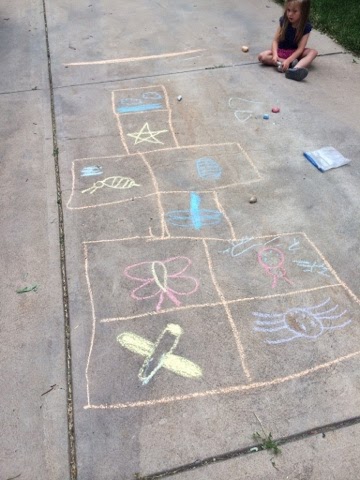
    I picked some sound combos Ashlynn is currently working on in speech and drew them in the boxes of a hopscotch grid.  We then would throw a rock and whatever the rock landed on, we would hop to that picture and say the picture.  She was so busy having fun, she didn’t really realize I was working on her /l/, /l/ blends, and /s/ blends!   Not sure if you can see here, but we have a firefly, spider, butterfly, ladybug, dragonfly, bumblebee, roly poly, star, and clouds in the sky.  

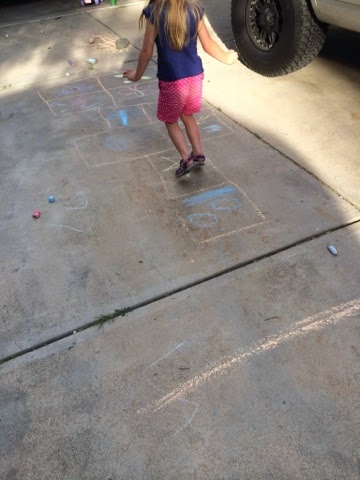
    As a bonus, since Ashlynn has global apraxia, the added jumping and keeping feet in the boxes would make any PT or OT happy too!

    Look at those good jumps!  My heart smiles at this picture because jumping did not come easy.  If you’re interested, you can read about here: Jumping on the bed

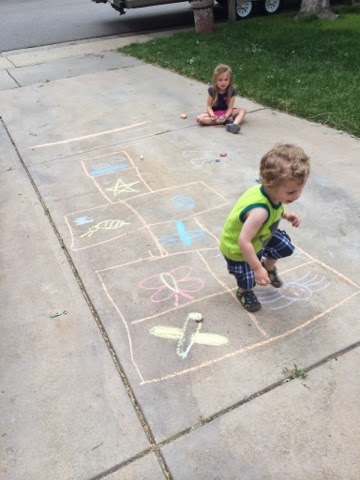
    Not to be outdone, her 24 month old brother was hopping right along too and practicing speech! Fun for everyone, and momma stays sane with kids entertained!

  • Private speech evaluation

    I have been antsy since the poor and disappointing experience I had in the school district.  Poor Ashlynn has once again been subjected to constant therapy all day long.  In addition, I couldn’t stop thinking that I still have a month until she starts school and therapy, and then it might be another month or more after that to “give the therapist a chance.”  We could potentially be losing two months of valuable time that she could be working on speech!

    A thought came to me in the middle of the night, when my mind was racing once again with how I could help her more; and I realized that my insurance probably covers therapy.  I discovered that it did! 

    I decided Ashlynn can’t wait.  There is so much research showing that early intervention is key, and as her mom AND as an SLP, I know she is at a prime stage in development to effect the most change.  She is open and willing to practice, and even opens the app on my iPad everyday that is just to practice speech.  We have to act NOW.  As much as I pride myself on keeping up on the current research, I am not an expert on apraxia.  You might be thinking, what did you go to school for then?  Well, let me tell you, the scope of practice for speech/language pathology is extremely vast and it grows everyday.  Let me list just a few disorders as a school based SLP I am responsible for treating:

    Articulation/Phonological disorder
    Receptive or Expressive Language Disorder
    Auditory Processing Disorder
    Stuttering
    Autism Spectrum Disorders
    Global Developmental Delay
    Cerebral Palsy
    Down’s Syndrome
    Apraxia
    Cleft lip and palate
    Velopharygeal deficiency

    This list is not exhaustive.  Basically, this list is a group of the most common disorders I see in the schools.  SLP’s are also responsible for:

    Voice disorders and pathology
    Traumatic Brain Injury
    Aphasia
    Dysphagia (swallowing disorders)
    Dysarthria

    This second list is more commonly seen in medical settings and not so much treated in the schools.

    My point in this list is to show that all SLP’s have knowledge and training in all these areas.  However, it’s much like a general practitioner.  Your primary care doctor knows a little about a lot; but if you really want an expert opinion you may choose to go to someone who specializes in just a certain part of the body.  Someone who deals with your certain condition daily and who sees a variety of types.  The field of speech/language pathology is not there yet, but there are SLP’s who choose to focus on just one or a few areas thereby becoming more of an “expert” in that particular disorder.

    In the schools, it’s pretty safe to say the SLP’s are experts in phonological, articulation, and language disorders since these are the most common disorders seen; and the average SLP will work with these disorders daily.  In addition, most school-based SLP’s are extremely knowledeable about the law as it relates to them.  However, the average school based SLP will not see as many less prevalent disorders such as apraxia or stuttering; and though qualified to treat it, may or may not be an “expert” so to speak in the disorder.   After the IEP meeting, I decided I want to get “expert” help for Ashlynn from someone who deals with apraxia daily or almost daily. 

    I took her into a private SLP yesterday who came recommended by other mommies of apraxic children.  I left the session with my mommy sense saying “yes, yes, yes!”  This is exactly who and what we need!  She was extremely knowledgeable in treating apraxia, knew and quoted all the references in the literature, and had Ashlynn working to talk the entire time!  I’m so excited not only for Ashlynn, but also for me to learn from her as I set out to become an expert in this disorder as well.

  • IEP on the other side of the table

    So yesterday we had Ashlynn’s initial eligibility meeting.  I am so used to be the one running the meeting and telling parents the results of testing, that it was a little surreal to be on the other side of the table. 
    I have to say that the entire process was underwhelming and I left less than impressed.  You would think that knowing I am an SLP for a neighboring school district that they would have had their @&it together, but they didn’t. 
    To start, the evaluating SLP informs me that she can have the finished IEP to me in about a week to two weeks.  I initially agreed, but it is best practice to send the finished IEP home with the parents.  I shared that in my district we usually send the IEP home with the parents, which had her back peddling and saying that she could do that but I would have to wait a bit after the meeting for her to make corrections.  I told her that was fine with me, since that is how I do it when I am running an IEP meeting.
    Next, she starts reading the reports to me, and they are loaded with errors and mistakes.  Did she not proofread before she sat down with me?  I understand a few mistakes and errors, but honestly there were errors all over the page!  At this point, I’m still trying to keep my cool even though the first impression is not very good.  Next, the SLP who will be seeing Ashlynn comes breezing in late.  When she sits down, the evaluating SLP asks her if she would like for her to go over the Speech report.  Really?  The SLP who will be treating my child didn ‘t read the speech report before I got there?  Afterward, she went through the goals and then asked “Jane” if she had anything to say.  Quickly, Jane began to explain that she is there two days a week and goes into the classroom and sees the kids in a group.  She told me that it is a great language enriched classroom that Ashlynn will get a lot out of.  Um…Ashlynn has APRAXIA.  I’m really fuming at this point.  All the research for apraxia says that children need intense one-on-one sessions 3-5 times a week.  In addition, apraxia isn’t a language disorder, it’s a motor speech disorder!! Finally, the law is very clear that kids receive services based on their NEED.  It is illegal to base service delivery time on the amount of time the therapist is there.  In my district, if a therapist has a child with apraxia who needs more time than she is physically in the building, the speech coordinator sends an additional SLP or SLPA to provide services! 
    I immediately hop in and ask her if she is familiar with any of the apraxia research.  Now she gives me a deer in the headlights look.  Maybe, hopefully, she was thinking to herself she should have prepared a little better, especially since the child’s mother is an SLP!!!  She stammers that David Hammer came and talked to them about two years ago, and she has Kaufman cards etc.  I said great, that she would understand how the service delivery is different for children with apraxia then.  That Ashlynn needs very specific motor planning therapy that is not easily addressed in the context of a language based group therapy session.  She was quick to say that she also pulls kids aside when she is in the classroom, and will leave worksheets with Ashlynn’s sounds for that week with the teacher to work on for the days she is not there. 
    I asked her if she would be using the Kaufman method then.  She replied she would have to get to know Ashlynn before she picked one method or sounds to work on.  Fair enough, but this woman did not so much as glance at this IEP before she came to this meeting.  It’s unbelievable.  If this is the level of professionalism she offers to a fellow SLP’s child, then what does she offer to parents who aren’t as educated as myself??  I’m so angry!!
    After that, she excused herself since it was the end of the day and she needed to get home.  What?  Really?  I’m not the one who scheduled this meeting for the end of the day.  I could have come in first thing in the morning.  This woman is going to be my daughter’s case manager, and she leaves the meeting early?  Unbelievable. 
    After she leaves, the classroom teacher jumps in to give me a packet of papers to fill out.  In addition, she tells me that her classroom is a really great language enriched classroom  (there’s that phrase again, but it sounds good right?) that will be really great for Ashlynn because all the kids are basically working on the same things.  At this point, my bitch side starts to come out.  I interject that I am worried that Ashlynn will be getting cookie cutter treatment when what she really needs is a teacher and SLP who can help her with her motor speech disorder.  Now the teacher gives me a deer in headlights look.  Sigh.  I’m not trying to intimidate anyone or be pushy, but come on people!  I’m not asking of them anything I wouldn’t expect from myself.
    We then talked about Ashlynn’s start date.  They said they were going to have her start November 5th even though her birthday is October 20th, because there will be fall break and they don’t want to have her start school only to have to take a break.  They reasoned that with the transitions and all it would be better to just have her start November 5th.  Well that sounds good, but guess what?  My daughter doesn’t have autism.  She has NO problem with transitions or separating from me.  She loves school, loves kids, and has never cried when I left her somewhere.  Plus, the law is very clear that under FAPE, a district must offer services to a child on their 3rd birthday.  When I explained all this, low and behold they told me that her morning class in fact doesn’t start until November 5th, but she could come to the afternoon preschool until then if I so chose.  I told them I would be coming by the week before her Birthday to observe the afteroon preschool class.  Ugghh
    After that, the teacher left!  This is ALSO illegal by the way.  A general education teacher is required by law to stay the entire meeting, and it only makes sense right?  They are the one who is going to be with my child most of the day, so they need to know what specific needs the child has!! 
    I did make it clear to the evaluating SLP that it did not seem the SLP who left early knew much about apraxia, and that I would give it chance; but if I didn’t start to see progress, or feel that she is using a motor based approach to therapy with Ashlynn, I would take it higher.   Time is precious with apraxia.  Early intervention is key.  My daughter can’t afford to be at the hands of someone who doesn’t or can’t help her right out of the starting gate! 
    I left very frustrated.  My husband told me to calm down and wait and see how it goes before I get my feathers ruffled.  Time is of the essence though, and there is nothing more important than my daughter.
    My advice to any parent walking into these IEP meetings is to bring an advocate.  I work in the school district and know the law, and if you are a parent at one of MY IEP meetings, I follow it.  However, if an IEP team did all this to ME, an SLP for a neighboring school district, what do they get past the average famiy who doesn’t know the ins and outs??  You have rights parents!  You are an integral, if not most important member of the IEP team.  Don’t be bullied because you didn’t know.

  • Oral apraxia

    Looking back, there were SO many signs that told me Ashlynn had apraxia. Before she even spoke, there were things she couldn’t do that I knew wasn’t normal. However, my family, my husband’s family, and even my husband told me she would do it on her own time, or all kids develop differently, or to stop being so critical of her. Despite my training and perhaps wanting to believe them, I ignored these signs even though deep down I knew something was wrong.

    What were these early signs?

    For one, Ashlynn never blew raspberries. To this day, and she is almost three, she still can’t.
    Ashlynn couldn’t blow out candles or blow bubbles, and to this day, she still can’t.
    It took until she was almost two to learn how to drink from a straw, and even now she frequently sputters and chokes when drinking.

    Well meaning family members told me I was being too picky about these things, but my mommy instincts were right.

    Other signs were feeding issues. For the most part, Ashlynn was a great nurser. However, poor nursing can be an early sign. She also did really well when I introduced puréed solids. After that, her feeding issues became more complex. She struggled with masticating or chewing her food and then swallowing it. This oral motor sequence was very difficult for her to learn.  I was scared to death to even give her Cheerios when she was 9 months to a year because she would immediately swallow them.

    When family members or friends would offer crackers or other food items, I would panic. However, I was told by everyone, including my husband that I was babying her. How would she ever learn if I didn’t let her eat it? I was so frustrated thinking I was being paranoid and being a helicopter parent already, but guess what? I KNEW my baby better than anyone, and if I just would have listened to and trusted myself, she might have got help sooner.

    Other signs of oral apraxia which she has include: not being able to lick her lips, not being able to spit out food, stuffing or overfilling her mouth, and not being able to pucker her lips for a kiss 🙁

    What really makes me mad, is my college training didn’t train me in this. These are things I have learned just on my own. Of course one could argue that graduate school teaches us how and where to find these answers, and of course our ongoing professional development requirements provide opportunities to learn this, but its not enough. Every SLP needs to know this stuff!

    I had a professor, Patty Walton, for my undergrad and grad degree here in Denver who taught a stuttering class. It was the only class she taught because she had a full time private practice with a focus on stuttering. She said that what she realized, is SLPs were graduating without any knowledge on how to treat stuttering. She might have been an expert, but she at least wanted SLPs to have a basic knowledge in the treatment of the disorder. In fact, she had met many a therapist who admitted they didn’t feel comfortable treating stuttering.
    She and other stuttering experts have definitely done a great job of educating newer therapists, because most therapists I meet who are around my age or younger feel very comfortable treating stuttering.

    In my opinion, apraxia is the new stuttering. In my speech department for my school district, no one is trained in PROMPT that I know of, and when people have a child who they suspect have apraxia, they borrow the set of Kaufman cards or the Easy Does it For Apraxia book out from the department.  I have faxed multiple clinicians the information I had on apraxia from the professional development I attended when Ruth Stoeckel was here because they didn’t have any information on apraxia at all!!  My field needs to address this! I don’t know where my road will take me, but I want to make sure we have SLPs graduating with a clear understanding of motor speech disorders and treatment.