Tag: Living with CAS

  • What if we don’t prove them wrong?

    What if we don’t prove them wrong?

    I had a client recently who told me a well-meaning friend called her five year old son with apraxia “retarded.”  Apparently he meant it in a “well-meaning way” asking about services, but understandably the term shocked, appalled, angered, and then saddened her. Isn’t it interesting what we all presume about a child based on nothing more than their speech?

    She went onto say she didn’t even correct him because at this point she’s just tired.  She’s just tired of explaining it and what did it matter anyway.  She also went on to say she was mad at apraxia all week, and she wished they were in the future when she will hunt this man down and show him her successful, happy, thriving, “retarded” son.

    I smiled.  That moment.  Yes.

    What, when, and where will that moment be?  I know it will come.  I know one day, A will have her moment in the sun.  Maybe others won’t even know it is her moment.  Maybe it will just seem completely normal and average, but to me, I will revel in her moment.  I will cry in her moment.  I will cry tears of joy.  Tears no one may understand.  Maybe she won’t even understand.

    Will she roll her eyes in typical teen fashion and scold me for embarrassing her?  Will she smile too from the pride she feels in her own self?

    Yes.  That moment.

    I talk about that moment with every mother who has a child with apraxia.  That moment when our children will prove them all wrong, even if “them all” will be long gone or distant memories.  Hurtful memories are never too distant when their pain was so raw, and they seem to leave open wounds on our hearts and in our minds, seemingly unaffected by the passage of time.

    That moment.

    When the same eyes that cried tears of fear and sadness will now drop tears of triumph, victory, and pride.

    That moment.

    The vision of that moment, whatever it may be, keeps me going.  Keeps me fighting.  Keeps me working.  Keeps me hoping.

    I know it will be there.  Just like I knew she would talk.  Just like I knew she would sing.  Just like I knew she would ride her tricycle.  That moment has and will always be there, and in that moment, nothing on this planet will be sweeter.

    In that moment, maybe I shouldn’t look at it as proving them all wrong, but rather proving US right.

    d72ced984da23e4bc651d33fcc0f1223

  • I need to remember they are my sunshine, when skies are gray.

    I always say they aren’t any easy answers, only tough choices in this game of parenting.  Sometimes, I think I know too much.  The special education teacher approached me yesterday about placement for Ashlynn going into Kindergarten.  Her attention is such a problem.  It could be related to the apraxia and sensory processing disorder, or it could be something else.  Who the hell knows.  I know she was giving me professional courtesy by asking what I thought would be best, but I have no professionalism when it comes to my children.  I’m their mama, plain and simple.  It is just tooo hard to be both.

    I could tell this woman was clearly hinting toward a program called ILC.  It basically means a more restrictive special education programming where Ashlynn would have a teacher’s aid assigned to her, but it would be integrated full time into the Kindergarten classroom  FML.  Decisions, decisions.

    I don’t want her to have that “label.”  Yes I know, I’m an SLP and I work with those labels everyday and yes, I love each and everyone of those kids.

    I also know this.  I know that this past week my colleague was working with a high functioning kiddo with ASD, also in “ILC.”  He is also mostly mainstreamed in regular education, holding his own.  The class was doing a compare/contrast assignment on characters in a story.  He did an amazing bubble map and flow chart and compared the characters, even comparing their feelings.  When he went back to class, the SLP had him share his work, including the great insight on the character feelings.  The teacher responded, “oh, well he could have just said one was a boy and one was a girl.”  I’m sorry, but I had to  wonder, was it because this boy was in ILC?  He had come up with something way more abstract than just one was a boy and one was a girl…but whatever.

    I had pretty much already decided last night Ashlynn wasn’t a fit for ILC.  I mean sure, extra teacher support would benefit her greatly, but she can do this.  Don’t underestimate her.  Oh, and may I mention I came to that decision easily (meaning tears).

    Then today happened.  The one day I’m not at my daughter’s school, I come home to find out my daughter “ran away” at recess, and no one found her until they did a head count.  She was still on school grounds “collecting rocks in a bucket with a friend” when they found her.

    So….is this the wake up call I need to admit my daughter needs this special programming?  If she had a teacher’s assistant, she would never be out of someone’s sight.  Ugh.  I hate this!!!

    Oh, and did I mention the social worker reminded me I still hadn’t filled out the “the Vanderbilt.”  For those of you that don’t know, that’s a test for ADHD.  Again, FML. All these decisions are freaking overwhelming.

    Then, as I was going home, my mother-in-law who watches my kids told me that Ashlynn, exasperated over something today exclaimed, “bummer!!”  When asked who said that, she matter of factly told her, “my mommy.”

    Smiles

    Oh, and Jace sang “You are My Sunshine” all the way through today.  Yep, he learned that from me.  I sing it to them every night.

    And I remembered.  That is what life is about.  Not the special programming, the teacher’s aid, the ADHD test, the “running away and, and, and…….

    Life is about my rays of sunshine.  Everytime.  Everywhere.  Always.  No matter what.  I wouldn’t trade it.

    “You are my sunshine, my only sunshine.  You make me happy, when skies are gray.  You’ll never know dear, how much I love you.  Please don’t take my sunshine(s) away.

    sunshine

  • Experience is the Key Architect of the Brain in Childhood Apraxia of Speech

    Brain


    I went to my state’s annual school based symposium for SLP’s this weekend and one of the keynote speakers was Dr. Amy Meredith CCC-SLP.  She is a professor at Washington State University and specializes in Childhood Apraxia of Speech with a focus on Early Literacy Skills.  Of all the things she said, the one quote that really stood out to me was this:

    “Experience is the key architect of the brain.”

    What does this mean?  Well,  you could interpret it in different ways I suppose, and put your own twist and connotations on it.  For me though, it means this.

    The brain is adaptable and can change.  For someone with a neurological disorder like apraxia, it means those pathways can be re-written.   Oh and haven’t I seen that already with Ashlynn?  Occupational Therapy, Physical Therapy, Speech Therapy, and swimming have already been re-wiring her pathways.

    An architect is defined as a person who designs and makes buildings.  Studies show the brain is literally capable of changing structure!

    Dr. Meredith cited a very recent study (Kadi et al., 2014) that found children with idiopathic apraxia (idiopathic meaning of no known origin), had significantly thicker left posterior supramarginal gyri than controls.  However, kids treated with a motor based approach to apraxia showed a significant decrease in the cortical thickening area after 8 weeks, and resulted in improved speech as well.

    That is amazing people!  Therapy literally changed the structure and size of the brain!! We know therapy changes function.  That’s why we all spend thousands of dollars on therapy, but to know that it actually changes the structure?  To me, that’s really something.

    This also tells me to never give up.  Not that we would, but now we have research to back us up!

    Literacy:

    Of particular interest to me was the literacy piece.  I know Ashlynn is at risk for learning disabilities.  One sobering study she cited was a Raitano et al. (2004) study which examined pre-literacy skills in subgroups of children with speech sound disorders (not CAS specific).

    Basically, the results indicate children with SSD’s  (speech sound disorder) performed more poorly than the controls, and children with SSD and LI (language impairment) add an additive risk factor for deficits in pre-literacy skills.    Lewes et al. (2004) conducted a follow up study and found children with CAS improved articulation but continued to have difficulties with:

    syllable sequencing
    nonsense word repetition
    language abilities
    reading and writing

    Right.  Okay.  So, what do we do about this?!?  Well

    Experience is the Architect of the Brain

    Let’s amp up their pre-literacy skills and give them more exposure and experience to things like:

    naming letters and letter sounds
    categorizing pictures by rhyme or initial sound
    identifying things in their environment that start with a certain sound etc

    Programs she recommended were Phonic Faces and the Lindamood Bell Program.  Dr. Meredith runs “Camp Candoo” over the summer for kids with apraxia focusing on speech sound production and early literacy using Phonic Faces.  Her data taken over the past three summers shows significant improvement in all pre-literacy skills after the two week intensive.  It was so compelling, I’m seriously going to try and get Ashlynn in this summer.  I’m also actually thinking of doing a small group a day with the kids I see in private practice with apraxia and Ashlynn.  It would give me experience, and benefit Ashlynn while also benefiting all the other kids.  We’ll see.  I always have big plans.


  • It’s hard to explain how global apraxia affects so much

    It’s hard to explain how global apraxia affects so much

    We went on a Santa Train again this year at Georgetown Loop Railroad.  Ashlynn has never talked to Santa before.  When she was 3, she cried and clung to her dad for dear life.  When she was 4, we went on a different Santa Train, and though she wasn’t scared, she was too reserved to say anything audible enough for him to hear.

    This year a four year old girl was sitting across from us.  As her parents were asking her what she was going to ask Santa for, she eagerly said she wanted another Elsa doll.

    Ashlynn’s not really into Frozen, or any movie really.  Though each year we try, she just has no desire to sit and watch TV…much less a movie.  As for toys, we took her around a toy store three times leading up for her birthday, and though she was mildly interested, it’s just not like the “kid in a toy store” image that might usually come to mind.

    Fortunately, I have my friend Kim, an SLP who also has a son with global apraxia.  I also have a 7 year old client with it too, and interestingly enough, they all are similar in these areas.  They don’t have an overt interest in movies, TV, or toys.  Why?  I really don’t know.  The toys I think has to do with their struggle to play with toys they would cognitively be interested in, but can’t mainuplate because of the gross and fine motor apraxia.  That happened to her last year when she actually asked for baby clothes but then couldn’t put them on or take them off the baby.   To engage in imaginative play is equally as challenging due to their delayed speech and language skills.  Who knows.

    All I know I I started to feel sad listening to this four year old chatter away about what she wanted….until it was Ashlynn’s turn to sit with Santa.  Though he kept asking her what she wanted, what she wanted was to talk.  She asked him “What’s this?” and “What are you doing?” until he smiled and then moved onto another kid.  As he was walking away, she grabbed me frantically and said, “I need presents!!”

    Smile

    Oh Ashlynn.  That’s my Ashlynn and she’s perfect and in that moment I had nothing to be sad about. All she wanted, all she’s ever wanted is to engage people in conversation, and then as an afterthought she thinks about herself.  Even then though, she had nothing specific.  Just presents.  From the outside I’m sure she looks like a typical 5 year old, and it’s hard to explain just how involved her needs are, or how they affect so much.

    However, today, she asked for presents from Santa Clause just like a typical 5 year old and she will find them waiting for her on Christmas morning.

    from the outside in

  • The high of summer! The fear of “back to school.”

    The high of summer! The fear of “back to school.”

    Oh summer, how I love thee. Filled with swimming lessons, play dates; visits to the park and zoo.

    During summer, I get to see my children be children. Their carefree smiles light up a room, and the echoes of their laughter can be heard long after they lay down their head. Yes, therapy appointments are a way of life for Ashlynn, but even speech and occupational therapy bring positive updates from the session and we can quickly return to our days of play.

    This summer I signed up to a few good facebook pages I found: MamaOT and Inspired Treehouse. I LOVE these pages! Instead of the packet of ideas I would get heaped upon my shoulders during the school year, these pages provide an idea a day to do with your child. Simple, easy, fun! When I just get one idea a day, the load seems MUCH more manageable. I was so inspired, I tried to do the same for speech and language on my SLP Mommy of Apraxia page, since I’m usually doing something related throughout my day with my kids since that at least, comes naturally to me. I really think they helped Ashlynn, and I felt good about incorporating some sort of speech, sensory, or occupational/physical therapy at home.

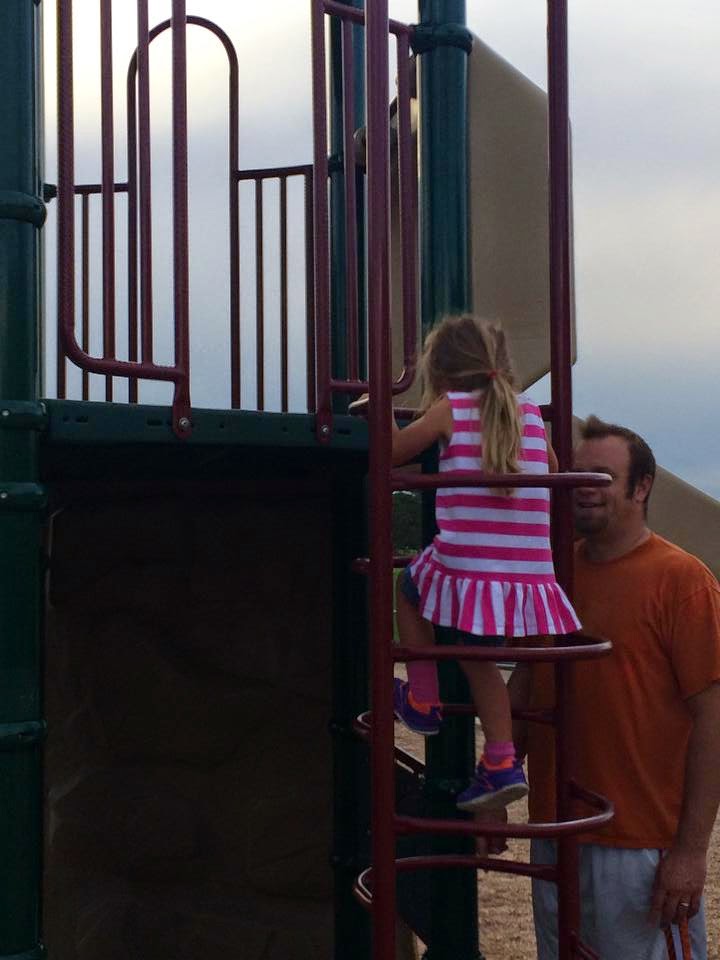
     My husband and I also saw HUGE improvements this summer in the motor realm. Ashlynn climbed a play structure that she had yet to conquer at our nearby park. Who knew how much core stability, bilateral hand coordination, and crossing midline play a part in climbing a simple play structure! Well, I’ll tell you who know.

    Parents of children who have dyspraxia!

    At the local amusement park, she was riding the tea cups independently. My husband shot a video. During the first two go rounds she was just sitting there, but by the third go round she figured out how to spin the wheel to spin her teacup! You should hear my husband cheer. Who knew how much core strength, bilateral hand coordination, and crossing midline play a part in being able to operate a simple teacup ride.

     Oh yeah, parents of children who have dyspraxia.

     However, now summer is coming to an end. I see facebook posts ripe with updates along the lines of “I’m so happy school is coming up!” Or memes like this one:

    Not me. School. Sigh. What can I say? I have a love/hate relationship with school.

     I firmly believe school helps children develop their social skills and gives them important language models, which is especially important for kids with speech and language delays. The first week my daughter went to school shortly after she turned three, she came home singing a tune I actually could decipher, and at that time she was nonverbal! That my friends, is the power of school!

     On the other hand, school brings new fears and new worries. I always thought, once she starts talking, I’ll be okay.

     Not true.

    Now I’m worried about her phonemic awareness skills, language lag, slow processing speed, and being able to write.

     My God how much do kids need to do and know now just to be ready for Kindergarten???

     I’m not looking forward to the IEP meeting, the parent/teacher conferences, the comparisons I try not to make when I’m visiting her classroom.

     Quite frankly…. It SUCKS. Apraxia STILL sucks!

     So no. I’m not ready for Ashlynn to go back to school. My SLP friend and mother to two young boys with apraxia who has a blog: Landon Journey just posted this song lyric the other day:

    If I could make days last forever
    If I could make wishes come true
    I’d save every day like a treasure and then,
    Again, I would spend them with you.

    As my brother says though, “Life’s not fair. Get used to it.”

    So farewell summer! I bid you adieu. You have been so kind to us this year. We have made castles in your warm sand, felt the glow of the sun upon our face, cooled off in your waters, and celebrated the milestones and successes at our pace. Though I’m anxious for the coming school year, I have faith you will be waiting on the other side.  Welcoming my children to your sunshine, casting light onto their beauty.

  • Did I cause her apraxia?

    Did I cause her apraxia?

    It starts with a question: 
    Did I cause her apraxia?  I know I’m not the only mom to wonder this, or worse, believe this.  This is where the guilt sets in.  It set in early and would tap on my shoulder in the shower, at lunch, or when I was trying to go to bed.

    Even though I’m an SLP, and I tell parents all the time that the speech delays are not their fault, I still felt like somehow I must have done something wrong.  Maybe my C-Section had something to do with it.  Could it have been the petocin, the pain meds, the stress? Maybe if I had only taken my pre-natal vitamins more strictly and just dealt with the fact they made me sick.  Then, after she was born, maybe I didn’t talk to her enough.  Maybe I didn’t give her enough attention.  Maybe it’s because I went back to work and she was sad her mom wasn’t there full time.  Maybe it’s because I talked to her TOO much.  I was trying TOO hard to make her talk she never had a chance to just be herself.

    Ugh, enough already!  It’s exhausting to feel this way.  It’s exhausting to go through every scenario in my mind wondering if there was something else I could have done, not done, tried to do.  She has apraxia and the truth is, there is nothing I could have done to prevent it.

    I know it’s not my fault, but….is it really not my fault?
    Now, I just have to believe this. That’s the hard part. I’m not alone because I read stories almost daily on my support group page of parents wondering if it was the c-section, should they have breastfed or breastfed longer?  Was it the food they ate, a cold they got, a toxin they were exposed to……the list goes on.  Theories with no basis that mothers will beat themselves up over.  Well, I want to tell you to stop it.  I know it’s hard, I know it’s still in the back of your mind, but if our thoughts become our truths, then this thought process is a cancer.   Further more, it doesn’t matter.  It doesn’t change the fact your child or my child has it.  What does matter are our actions right now to make it better.  To fight for our child and help them through it.

    How I actually banished the guilt
    I have finally shed my guilt over it, and the credit is due to my son.  My typically developing son who is so eager to be older and to grow up.  He learns things and picks up things without me literallymighty doing anything.  He is 18 months and already sings his ABC”s.  I have NEVER worked on this song with him. That’s how easy talking is supposed to be.  Despite my daily dose of the alphabet song with Ashlynn well into her third year, she only could sing it at 3 1/2.  My son, on the other hand, picked up the iPad, listened to it on repeat for a couple days, and started singing it.  I remember watching a video on facebook of a friend’s  2 year old when Ashlynn was the same age and crying thinking what a bad mom I was.  This little girl was younger than Ashlynn, singing her ABC’s and I’m supposed to be an SLP no less and still my little girl wasn’t singing it.

    Last night we were eating noodles for dinner.  My four year old with apraxia kept resorting to using her fingers, and I kept prompting her helping her to use her fork.  It’s hard to pick up spaghetti noodles that need to be scooped rather than stabbed.  I briefly looked back at my son in his highchair, and he was not only scooping up the noodles like a pro, but he was stabilizing the bowl with his other hand to steady it.  I looked at this situation in awe.  Again, I have maybe once showed my son how to scoop with a fork instead of stab, and here he was, doing it as well, if not better, than Ashlynn.  That’s how easy it’s supposed to be.  He picked that up without any special help from me, and even after years of practice with Ashlynn, she still has a hard time.

    I start to realize even more, her progress or lack of progress or slow progress is apraxia’s fault.  It’s not my fault or her fault.

    This morning I was asking my kids what they wanted for breakfast.  I threw out two ideas to my son and he shook his head and said ‘no.’  I have never taught him the word no.  I never had to teach him that instead of stomping his feet and throwing a tantrum, he could simply say, ‘no.’  He just does it.  There was a time that the child throwing tantrums instead of saying ‘no’ was my daughter at 2 1/2.  Myself, my husband, and my mother-in-law literally had to tell her for months to stop and say “no.”  Yes, that happened.  I actually had to teach a child to say “NO.”  Chances are if you have a child with apraxia, you have been there done that.

    If you are a mother and are looking for something to fault, then I suggest you personify apraxia and fault the disorder.  It’s not your fault.  You hear me?? It’s NOT your fault.  Even if you have two kids with it, it’s still not your fault.  Stop the guilt.  Stop the obsession with trying to figure out why your child has it.  It doesn’t matter anyway.

    I say this to you again as a parent AND an SLP; talking should be easy.  Though it is a highly complex skill that parents only fully realize when they see their child struggle, a child should talk regardless of what you did or didn’t do.

    I just want to say one more thing.  I think parents get the message that it’s their fault when the SLP (myself included) gives them suggestions for home.  These suggestions might be to make their child grunt or make some type of sound or word approximation everytime they want something.  Don’t let them get away with saying a sound wrong that you have heard them say correctly in therapy.  Don’t let them point and give them what they want when they can say a word for it etc. etc.

    I want to tell you we say these things not to fault you.  Parents of typically developing children didn’t make their child talk.  Their child just naturally did so.  Don’t listen to your family member, or well meaning friend or whomever, tell you it is your fault because you never made them talk.  Children don’t have to be made to talk.  I really  BELIEVE this now with my son.  My pivotal moment occurred when I realized I have never made him talk.  He talks so much I can’t make him stop talking. In fact, the one time I did try to teach him a word I was trying to get him to say “Jake” when requesting the show “Jake and the Neverland Pirates,” since Jake would be easier to say.  Well guess what?   He didn’t say Jake, he said pirates instead and has continued to do so.

    So there you go.  I am the same mom, the same SLP I was with him as I was with Ashlynn;  and I am here to tell you I tried my DANGDEST to get her to talk.  I did everything I knew how to do as a professional.  Guess what though?  She has APRAXIA.

    Yes.  Apraxia.  I’ve channeled all that guilt and blamed it on Apraxia.  I wish you the same!