Parents are always looking for ways to incorporate speech and language activities at home. Whether it is to stimulate a typically developing child’s vocabulary and language, or to help a speech or language delayed child; baking is great and fun way to work on speech and language.
The first and most important rule before you start, is you have to accept the fact that your toddler will make a mess, and that is just part of the process, or um, fun.
When I do baking or food activities with kids in school, they absolutely love it. That’s the key. When kids have fun they are at their best learning. Also, baking is a multi-sensory activity, meaning many sensory systems are activated. When children are using multiple sensory systems, acquisition and retention of skills is more likely. Baking with your kids inherently promotes:
Vocabulary development
Sequencing
Following directions and comprehension
Pragmatic language – the social piece of language
Let me explain a little bit further.
Vocabulary Development:
For the young child, words are learned best in context. Certain authors refer to this as “event-based knowledge.” Many of children’s first words are usually embedded within scripts that are part of their daily lives. Examples could be: bottle, cookie, doggie, bath, etc. These words are said to them frequently throughout the contexts of their daily lives. Baking provides the same event-based knowledge experience, and exposes them to new vocabulary.
Sequencing:
The ability to understand sequences and to sequence is an important skill. Sequencing most simply refers to the order of things. When kids get into school, sequencing is very important to understanding: patterns, math, a story etc. Following a sequence of steps is inherent in baking and makes it the perfect activity for this skill.
Following directions and Comprehension:
These two things fall under receptive language skills; however, they are very important to the development of overall language skills. Kids who are good at retaining and following directions have less difficulty in school since they are not devoting a lot of their cognitive load on simply understanding and remembering what they are supposed to do. Baking is a fun and easy way to help your child practice these skills at home.
Pragmatic Language:
This is usually referring to the “social” element in language. This involves the way language is used to communicate with others.
With a little forethought, baking can also be a way to sneak in more direct speech language targets while working with your kid at home.
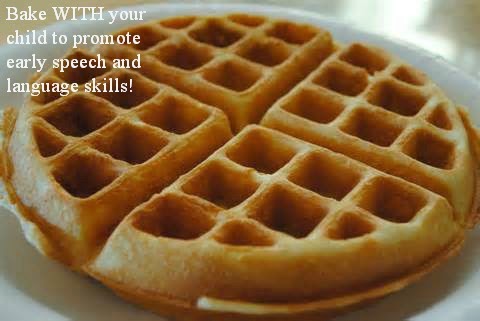
Muffin Mondays and Waffle Wednesdays
This summer I implemented Muffin Mondays and Waffle Wednesdays. Ashlynn is VERY interested in what day of the week it is, so I did this to also give her a framework of her week.
Ashlynn’s current speech/language needs include: syntax (the form or structure of a sentence), and consonant blends (two consonants found together in a word: sp, st, sl, fl, bl, for example).
It’s important to know your child’s goal, and then structure your baking around the goal. Get creative, but it’s not as hard as it seems. In Ashlynn’s case, I chose the words: spoon, flour, stir. For syntax, I had her ask me “Can I do it?” to work on her questions forms.
Then each time we used a spoon I had her repeat “spoon.” While she was mixing the batter, I would ask her what she was doing and cue her as needed to say the “st” blend in “stirring.” Instead of using 1 cup of flour, I broke it up into four parts to give her more practice saying “flour” each time she poured in the flour. For an extra bonus, she had to put “stir flour” together in a simple phrase. I would hold the spoon until she said the desired words, and then I would give her the spoon back when she was successful! She loved it.
If your child isn’t yet talking as much as Ashlynn, hum the ‘m’ sound while you mix the batter or if your child isn’t great at imitating yet, just have him/her make any vocalization to request an item. If they can’t yet imitate even a vocalization, imitate any spontaneous sounds they make to provide an opportunity for vocal play. If they aren’t really vocalizing yet, don’t get discouraged! Practice turn taking and reciprocal play. They pour then you pour. You stir then they stir.
With other clients who needed a final stop, I might have chosen the word “dump” and then every
time we pour in an ingredient, we work on the word “dump.”
Really, the possibilities are endless!
In addition, you can also tell your SLP that you incorporated some great “distributed” practice throughout your child’s day. In motor learning approaches to therapy, mass practice refers to the production of a large number of repetitions of a single target(what you should be seeing in therapy) and distributed practice refers to hitting targets with a greater amount of time between trials or sessions. However, distributed practice is very important for stabilization and generalization! Parents are the greatest asset when it comes to carryover, because you are in a better position to afford the child numerous opportunities for distributed practice! In addition, you can do it in ways that are fun and multi-sensory in the child’s natural environment.