Tag: Home practice for apraxia

  • Speech/language with simple Christmas chains

    Speech/language with simple Christmas chains

    We’re in the Christmas spirit around here and we started with a classic Christmas chain.

    * I first had Ashlynn sort the strips into their respective color piles. Great for developing early sorting and categorizing skills.

    * I then instructed her to put glue on the “end” of the strip.  Many kids with language delays have difficulty with positional words and she is no exception.  She kept wanting to glue in the middle, so I had to keep reminding her “no, not the middle, put the glue on the end. (Also great for O/T practice)

    * We then put the strip “through” the other strip.  During this, I made sure to emphasize “through” because again, this is another word that kids have difficulty with.

    * Once the chain had three links, we repeated, “white, green, red”  and then each time, I would stop and ask her what comes “next” or “after” emphasizing those two concepts.

    *Also, having her identify what comes next is the beginning of early patterning and sequencing skills.

    * Finally, at the end of the activity, we counted the links!

    * For a bonus, write words or tape pictures of target words to practice!

    Easy and fun!

    Skills addressed:
    Colors
    Sorting
    Sequencing/Patterns
    Concept vocabulary (next to, after, through, end, middle)
    Following directions
    Counting
    Speech goals

  • Sound Box books idea from: Trust me, I’m a Mom blog

    I recently met via the Facebook support group, a mom who has dedicated her blog to ideas parents can do at home for speech carryover. I had never heard of these “Sound Box Books” but they sound great, and apparently, may even be at your local library. Read about here!

    Trust Me, I’m a Mom: Let’s Talk Tuesday – Sound Box Books, Activity & a…: ‘Let’s Talk Tuesday’ is a bi-weekly post series with ideas on how you can help your child of any ability, but especially tho…

  • Superhero Brave

    Superhero Brave

    For those of you familiar with my blog, I’ve spoke of “Ben” before. A little boy on my school caseload from a Spanish speaking family who has CAS and is nonverbal. However, IQ testing shows him in the 75th percentile! He’s sooo smart. I met him last year in Kindergarten, and we formed an instant bond.

    His Kindergarten teacher was frustrated that he wouldn’t talk; and I’m not sure if she felt it was a reflection on her, but she really wasn’t that supportive of him.
    This year is different! He has a new teacher and she sees what I see, what I saw. She’s sees a smart, friendly, lovable little boy who wants to talk, but just needs people to believe in him and boost his confidence. Every time I see her she starts a sentence with, “you won’t believe this” or “I LOVE him.” Yesterday she told me she believes this year is going to be HIS year. Starting from the first day when she was going around having kids do introductions, she frowned upon getting to Ben and having the other children speak up and say, “Oh he doesn’t talk.” She immediately stuck up for him, telling the other children yes he did talk and that people talk in different ways. Some use Spanish, some English, some use their hands, some use gestures, and some use devices.
    Ben’s corners of his mouth got just a little bit wider.
    Another day, one of the kids noticed that Ben appeared to be talking to the class frog and remarked, “Look! I think Ben is talking!”
    Her reply?
    “Of course he’s talking! Didn’t I tell you Ben talks?”
    Ben’s chest puffed out just a little bit further.
    And then there was today. The icing on the cake.  I picked him up and she calls me over to brag about an assignment he finished first and attempted to share with the class. Picking up on her hint, I praised him loudly in front of the other children. As we leave the too, a little classmate returning from the bathroom enthusiastically called, “Bye Ben!” Now Ben knows how to say bye with perfect clarity. In fact, he says it to me everyday. He pressed his lips together, but the anxiety was too much and the boy left before Ben uttered a sound. I decided to scratch the lesson plan for that day, and instead I asked him if he knew what brave meant.
    I had him draw a picture of someone he thought was brave and I told him I would do the same. We sat at different tables, and I told him not to peek.
    When he was finished, he drew a picture of Hulk and Captain America. I asked him why they were brave and with a smile he pantomined strength and then pantomined a sword motion. I verified he thought they were brave because they were strong and had swords to which he eagerly nodded his affirmation. I then wrote on the back that Hulk and Captain America are brave because they are strong, have swords, and I added they fight bad guys. He tapped my arm and held up three fingers. I said, “three bad guys?” to which he nodded apparently satisfied.
    He then pointed to my picture. I asked him if he wanted to see mine and he again nodded yes. As he looked at a picture of a little boy with a blue school uniform, he looked at me puzzled. I asked him, “Don’t you know who this is?” Ironically, I had also just happened to also draw him holding a sword fighting a word bubble in his head! What luck!
    “It’s you Ben.”
    His eyes lit up and he pointed to himself incredulously.
    “Yes” I said. “You are my superhero because even though talking is so scary, you still try, and that’s what makes you brave.”
    Now that smile was a full blown grin.
    I went onto tell him I needed him to be even more brave than he already was though. I needed him to be superhero brave when it’s time to talk. We then stapled the pages and walked back to class.

    At the end of the day, the Facebook support group had convinced me to tell his parents about the lesson; and since they only spoke Spanish, I decided to go out with the teacher at dismissal and have her translate. When I walked in the classroom, all the kids were sitting on the carpet with their backpacks on their backs in preparation to go home.  In the middle was Ben, with his backpack on, but our book in his lap. It did mean something to him!  As luck would have it, BOTH parents came to pick him up that day.  As the teacher translated, his mother choked up and gave him a big hug as they left to go home.

    Now his chest was puffed out just about as far as it go!  That’s what superhero brave is all about!


  • “I see” with DIY binoculars

    “I see” with DIY binoculars

    If you have a child in speech, or a speech language pathologist yourself, you are probably familiar with the term “carrier phrase.” A carrier phrase refers to the initial component of a sentence that stays constant (usually a subject and verb, allowing for a fill in the blank at the end (the predicate). Common examples include:
    “I want ______.”
    “I have ______.”
    “I see _______.”
    “I like________.” 
    This list is not exhaustive, but does give you an idea. In the educational arena, these are frequently referred to as sentence stems. 
    Carrier phrases are used in a variety of therapy strategies for a variety of disorders. The predictability allows the child to practice learned skills beyond the word level, moving into the phrase and sentence level.  It decreases the cognitive load needed to form a sentence AND remember the learned skills, because the sentence stem, or initial phrase remains constant. In this way, the child can practice their skills at a higher level of complexity (phrase or sentence level) but doesn’t have the increased demand to also generate a new and novel sentence.
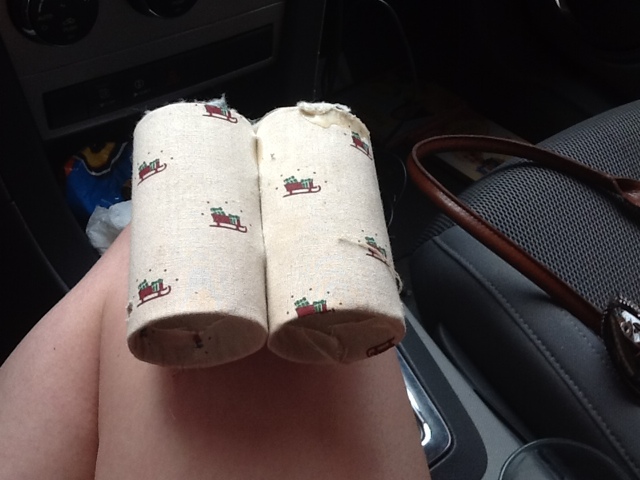
    To practice her words in a sentence I have a great idea that comes from my fabulous and creative mentor Deborah Comfort, who is currently the private practitioner seeing my daughter. She had Ashlynn pick out some fabric swatches from a book she had at the end of the session last week.  For the next session, she had hot glued the fabric onto two toilet paper rolls and then hot glued the toilet paper rolls together side by side. She poked some holes in the top and threaded some yarn, and Presto, they gave a set of DIY binoculars. Using the carrier phrase “I see_____” they practiced a variety of words with targeted sounds at the sentence level. 
    Ashlynn loved it of course! It’s also more fun than sitting at a table practicing flash cards. As you’ll frequently read in my posts, I am a big proponent of multi-sensory learning and this fits the bill. Maybe tomorrow we will take it to the zoo! Great carryover practice and lots of fun!
  • Speech Stickers App for Apraxia Review

    Speech Stickers App for Apraxia Review

    Speech Stickers is the first app that I downloaded for Ashlynn (my daughter with apraxia) when she had first turned three.  I chose it because it was cheap, and said it was developed for children with apraxia.  The app is simple in design with not a lot of bells and whistles; however, my daughter loved practicing her speech with this app.

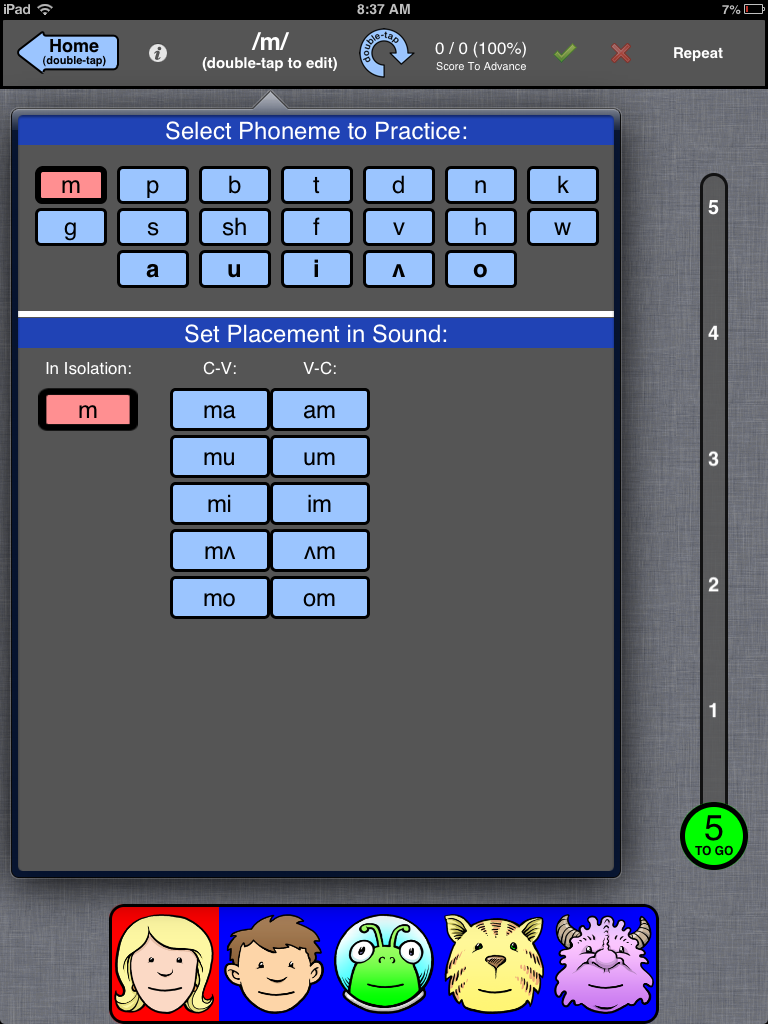
    The app is set up for kids in the very early stage of apraxia therapy.  The child can practice sounds in isolation and in CV(consonant-vowel) and VC(vowel-consonant) combos. The app is based around blocked practice with a lot of repetition that is necessary for apraxia therapy.

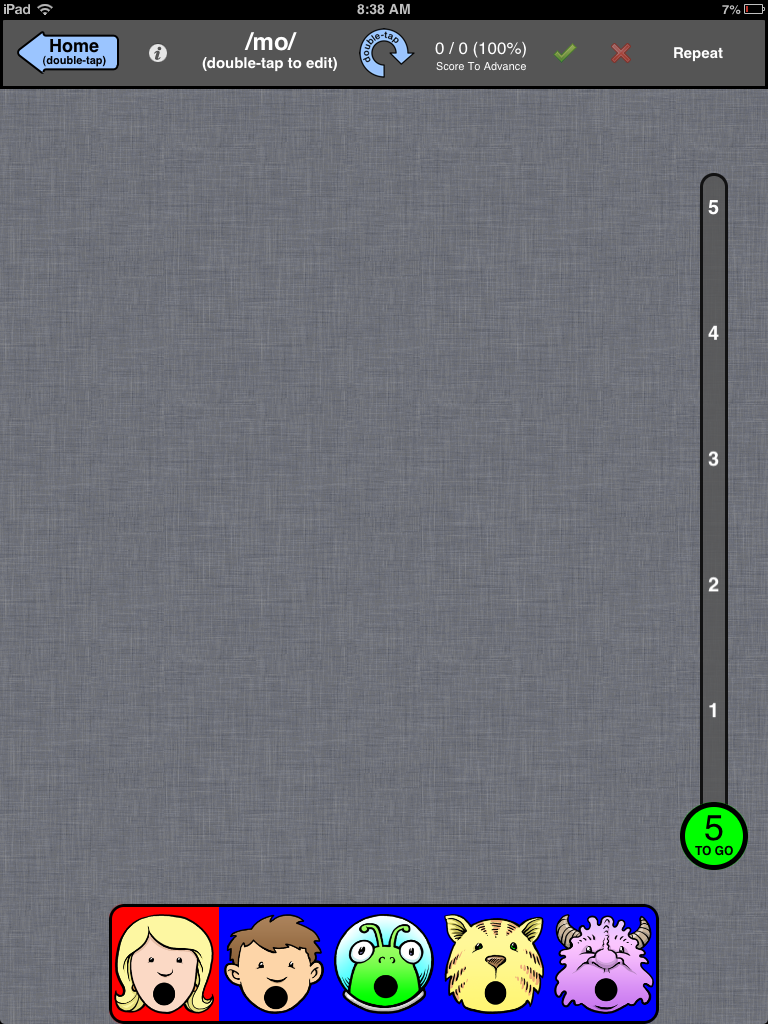
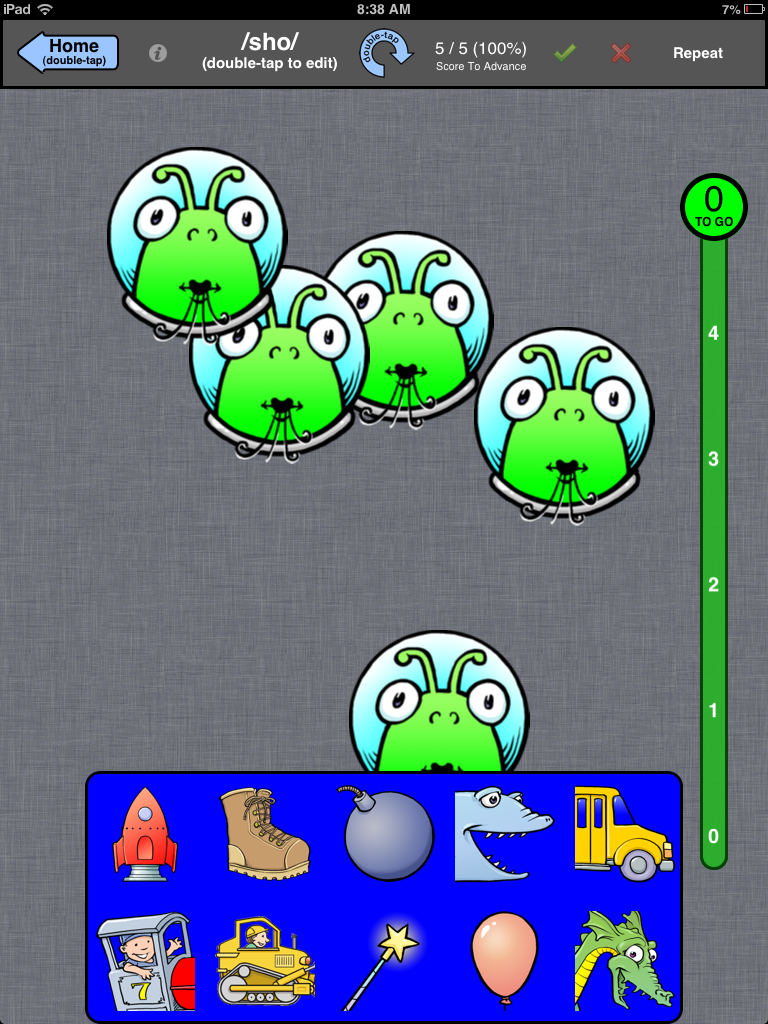
    After you pick your sound or sound combo, you can then decide how many times times the child has to say it before they get a “sticker” or a little animation as a reward.  Then, the child chooses between five characters on the bottom, all of which have a different pitch to their voice.  This is a bonus too, because children with apraxia have difficulty with “prosody” or the melody of speech.  The characters’ mouths model the correct placement.  The above picture is showing ‘m.’  Below the characters are modeling ‘mo.’ This is also great because it gives the kids a visual cue for the correct mouth posture.

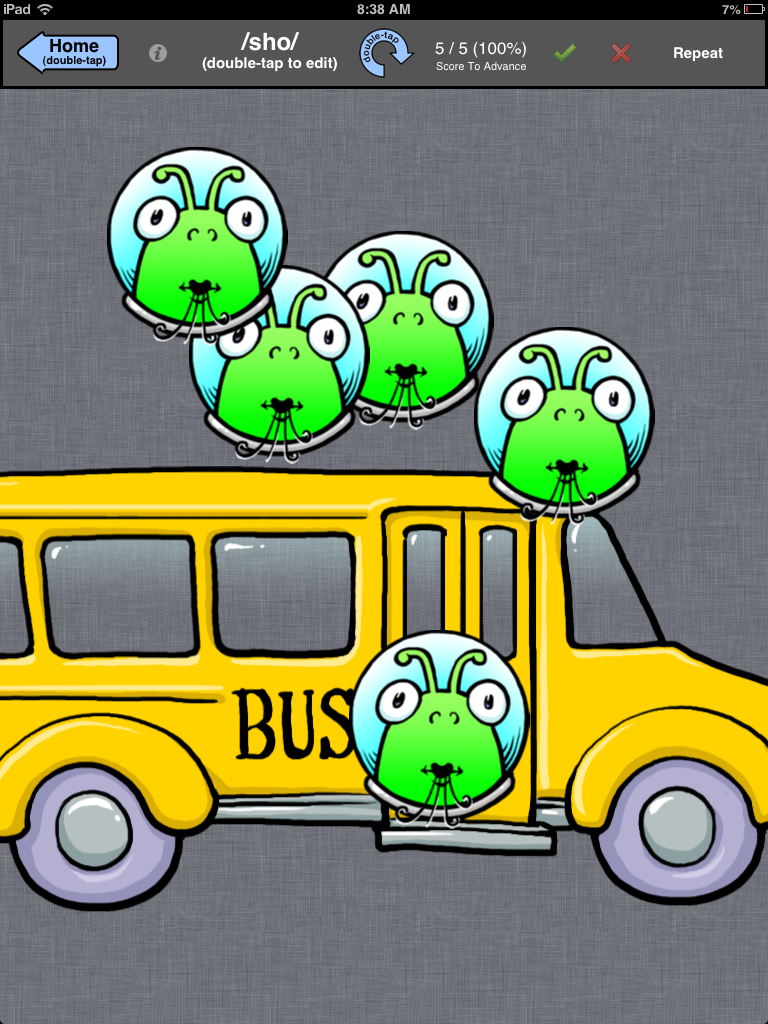
    A scoring bar at the top help score and keep track of data. You must press the green check or the red x to move onto the next practice sound.  The app is designed so that the bar can also turn upside down so that the therapist can discreetly score; however, my daughter picked up on this in a heartbeat and would push the buttons haphazardly just so she could move on!    Once you reach the set number you earn a “sticker” or reward.  You can choose from eight stickers seen below:

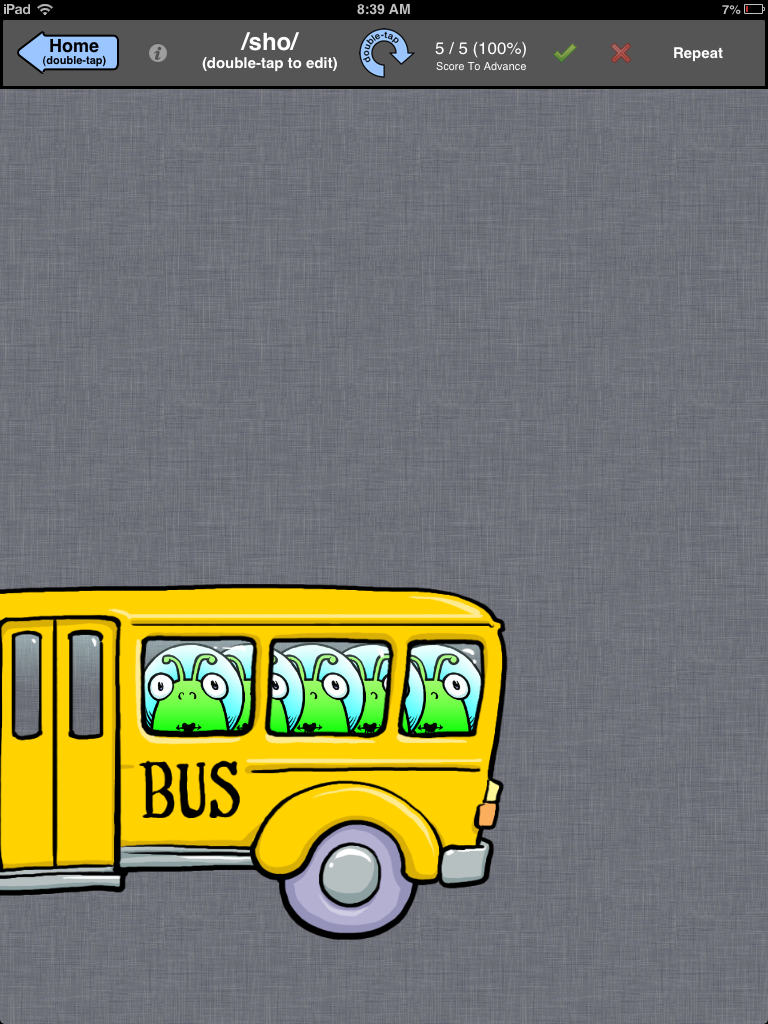
    They are so simple, but my daughter loved them.  I chose the bus just so you can get an idea of the animation.

    It has been almost three years since I have used this app for Ashlynn, but the app lives on with all of my clients!  Kids of all ages and disabilities LOVE this app.

    I have a 5th grade boy with Down Syndrome who laughs every time he earns a sticker and watches the animation.

    I have a 3 year old who loves picking the alien because it reminds him of a popular TV show right now “The Octonauts!”

    I could go on!  Really, I can’t say enough about this app, and when I reached out to the creator Carol Fast MSPA, CCC-SLP I realized why this app is soo good.  Here are some comments from her:

    “It’s truly been a labor of love for me and I’m always gratified to find that other SLPs appreciate what we do. I’m glad that you found Speech Stickers to be helpful for your daughter and other students.  I work mostly with preschoolers and have found a special interest and passion in my little nonverbal CAS kids. I really love helping find their true voice. This is probably the most rewarding work I’ve done in over 30 years as an SLP.”

    Thank you Carol!  Thank you for your passion for working with kids who have CAS and for a great app that allows us to get a lot of repetitions of targeted syllable shapes in a fun and engaging way for the kids.

    What I Love: 
    – Works on early developing syllable structures
    – It really helped us work on final consonants when my daughter wasn’t adding them.  Helped us get the final ‘n’ and final ‘t’
    – Gives a reward in the form of a short animation that is interesting to kids
    – Models different pitches and inflections, which is difficult for kids with apraxia

    What it’s Missing
    I would like the option for the child to record their voice
    – As an SLP, I would appreciate the option to email the data
    – It doesn’t include more complex syllable structures such as CVC and CVCV, so it’s only applicable for the early stages of therapy

    Impressions:
    This app was helpful during the early stages of therapy, when Ashlynn was struggling to sequence basic syllable structures.  She had just turned three, and was motivated to practice speech.  In addition, she loved the sticker rewards.  It did help us get those final consonants that she was struggling with too.
    As an SLP, I have also used this app with a five year old, and he enjoyed it too.  For the price, I would recommend this app if you have a kiddo in the early stages of therapy.

  • December book of the month

    December book of the month

    Product Details

    December book of the month is The Gingerbread Man.  This classic book has so many repetitive opportunites jam packed in the pages, and the kids absolutely love it!

    Tonight, Ashlynn’s word was “man” which combines a bilabial sound ‘m’ with a final consonant ‘n.’  On almost every other page the Gingerbread man shouts,

    “Run, run, fast as you can.  You can’t catch me I’m the Gingerbread man!”  Then, various characters procede to try and catch him while calling “come back, come back!”  It didn’t take long before Ashlynn was shouting “come back” along with me.

    As usual, depending on your child and their needs, you can have them repeat the word, a phrase, or an entire sentence with the target sounds embedded in it.  For older kids, it’s another great sequencing/retell activity to do after you read the book.  My school aged kids really like cutting out felt characters and placing them on a felt board while retelling the story. 

    Happy reading!!