Tag: Home practice for apraxia

  • Strategies to promote speech and language in the pre-verbal or minimally verbal child with Apraxia

    Strategies to promote speech and language in the pre-verbal or minimally verbal child with Apraxia

    The great thing about speech and language, is that it a task that can be worked on in any activity.  Familiar routines in the home provide the perfect platform for encouraging speech and language, because this “routinized language” is predictable and context based.

    A fellow SLP and mommy of apraxia, Kim from Landonjourney.blogspot.com and I teamed up for Part I in my series of parent strategies to promote speech at home.  We wrote a list of some of the most effective strategies to encourage early speech in the pre-verbal child, including those with Childhood Apraxia of Speech (CAS).  Part II in the series will focus on strategies for the verbal child with CAS.

    Parents ask a lot, “How do I get my child to practice speech at home?”  Well, we are here to tell you, you don’t need worksheets and flashcards.  Basically, with kids who are minimally verbal, we look for opportunities to model and encourage functional language.  Functional language refers to language the child is more apt to use frequently throughout their day, or may be highly motivating to them.

    With kids who have apraxia, not only do we think just about functional language, but words that also contain simple syllable structures.    These are some of our favorite strategies and targets and how we incorporate them:


    Powerful motivators:

    As moms, Kim and I know that when you have a child who is nonverbal, you anticipate their needs for them.  After all, our babies can’t tell us when they hurt, or where they hurt if they are crying.  They can’t tell us they’re hungry or thirsty; and if they have global apraxia like our kids, they may even have trouble pointing to communicate to us that way.  However, as SLP’s we know that kids need to be motivated to communicate.  If we keep anticipating their needs, they never have a reason to really force themselves to try at something they know is hard for them anyway.   As the parent, you are truly the best person to encourage them to try, even when it’s hard.

    Teach and pair signs with a verbal model:

    Some worry that teaching sign will inhibit speech; however, as long as you make sure to always pair sign with verbal models and give verbal reinforcement after the child uses a sign, sign language can be a powerful bridge to helping the child say it once they begin speaking.

    • “help” “more” “go” and “bye” are good beginning signs to teach. Always provide a verbal model when you sign to your child, but encourage your child to sign, and reinforce any attempt by repeating the word and modeling the sign before giving your child what they want.

    Cloze activities:

    • Cloze activities are great for our kids with CAS because their mouth/body gets ready to respond, and the response is familiar. It reduces cognitive allocation and helps get the motor plan “set.” We do cloze for everything.
      • “Turn the music (pause) ” on, and wait for “on.”
      • “Ready, set (pause)” go!  We do “go” at every green light and I start the sentence and he tries to finish it. This has helped him feel more success at speaking “on command.”
      • “One, two _____” three!
      • Sing nursery rhymes and pause before the last word.  Ashlynn and I would sing “The Itsy Bitsy Spider” and “The Wheels on the Bus” and I would pause before some words that had simpler syllable structures.  For example “down came the rain and washed the spider (pause) out.” or “The wheels on the (pause) bus go round and round.”
      • Read repetitive story books, pausing before the predictable repetitive words.  To read more about repetitive books and to get a free download on how to use them visit my on repetitive books that are great for apraxia.

        • Keep reading for more cloze ideas. 

    Require your child to respond to your yes/no questions:

    • assessing your child’s understanding (i.e. Do you want to go outside?) can often be done with simple yes/no questions before your child is verbally able to respond more.
      • I require my child to answer yes/no questions in anyway he can. Before he could nod/shake his head (difficult for motor planning), I modeled the response based on how I knew he reacted.  Do you want help? (giggle giggle). Yes (nodding my head), I want help. I had to physically move his head before he was able to do this. Now, I will say “yes” or “no” and wait.  This has also helped my son to be able to say yes/no, and they are words we have targeted often. 

    Focus on functional words:

                (These are some of our favorites, but individualize them for your child!)

    1. Bye-bye

                * Bye bye is good because it can also signal the end to an activity if the child cannot say “more.” We say bye to each activity, place, and even to our toys at bedtime.  This works on the motor planning for waving, and then saying bye bye.

    1. In

                * Emphasize each time you put them in: bed, the bath, car-seat, highchair, stroller, park swing.

    * Model when pouring a drink in their cup etc.

    1. Out

                * Emphasize each time you take them out of: crib, bath, car-seat, highchair, stroller, park swing

    * In the kitchen, model each time you take food out of a container, the fridge, a cupboard.

    * In the bathroom, model when squeezing out: toothpaste, shampoo, tissue, diaper wipes, etc.

    1. On

    * Emphasize each time you put music on, water on, lights on.

    * In the bath, “ok let’s turn the water (pause) on.

    1. Down

    * Emphasize when going down the stairs, getting them down from highchair, putting them down,                                       when something falls down, playing “Ring Around the Rosie,” etc.

    * Use a cloze procedure here too, “uh oh! The cup fell (pause) down.” Or “We all fall (pause)                                                down.”

    Again, these are some of our favorites, but work with your SLP to determine your own that work for your child.  Other suggestions:

    Uh oh

    Hi

    Nigh-Night

    More (Mo)

    Child’s age

    Mama

    Dada

    Put

    Done

    Do

    Set activities to song:

    • Based off of research done with melodic intonation therapy, music can provide a bridge to stimulate language.
    • Have fun and make up your own silly songs set to melodies you already know, to make it easy.
      • During bath time, I would sing a body parts song to Ashlynn set to the tune of “Mary Had a Little Lamb”:
        • “Now we’re washing Ashlynn’s hands, Ashlynn’s hands, Ashlynn’s hands, Now we’re washing Ashlynn’s hands while we are taking a bath.”  You can use a cloze procedure here too: “while we are taking a (pause) bath.” 
    • To get on demand phonation, something that is hard for our kiddos,  set songs to Row, Row your Boat and change it to:
      • Row, row, row your boat, gently down the stream, if you see your feet, don’t forget to scream. For my son, this song works to assess areas that he often can’t tell me/show me on command, but in a song, he gets his body ready and is more interested/able to do so.

     Repeat and reinforce spontaneous utterances.  

    • If your child says a sound or word, try to say it back at them and encourage them to say it again.  On demand speech is hard for our kids, so getting them to imitate back to you might be easier when you first imitate something they just said.
      • Ashlynn had a “go to” sound “a dah” that she said for everything.  I would tell her, “a dah?  dah dah, dah, dah” and see if I could get her to say it again on demand.  If she did, then I would change the vowel and see if I could get that on demand, “a dee, dee, dee, dee.”  Play around with sounds and have fun with your child.  This should be a low stress activity and just seem like fun to your child.

    Praise and Encourage ALL communicative attempts           

    • Our kids know talking is hard. A little bit of praise goes a long way!

    Laura Smith M.A. CCC-SLP is a speech/language pathologist in the Denver Metro Area specializing in Childhood Apraxia of Speech.  CASANA recognized for advanced training and expertise in Childhood Apraxia of Speech, she splits her time between the public schools and the private sector.  She is dedicated to spreading CAS awareness.  Her passion is fueled by all of her clients, but especially her own daughter who was diagnosed with Childhood Apraxia of Speech.  For more information visit SLPMommyofApraxia.com  

    Kimberly Haas-McEneny M.S. CCC-SLP, mom to two boys: one with CAS and the other with suspected CAS.  Kim is a Bilingual SLP practicing in Syracuse, NY at the Syracuse City School District. She blogs about her experiences with being both a mom and SLP at landonjourney.blogspot.com
    Parent strategies


  • Initial ‘T’ tic-tac-toe

    Initial ‘T’ tic-tac-toe

    One thing I’ve found, is that as an SLP, finding materials for apraxia can be challenging.  This is mostly due in part to the fact that syllable shape and complexity matter more for apraxia than they do for other speech sound disorders.

    For example, if you were working on the ‘T’ sound and opened a typical articulation workbook, it wouldn’t be uncommon to see a variety of single syllable and multi-syllabic words mixed in together.  As an SLP specializing in apraixa, I need materials and FUN worksheets that my kiddos with apraxia can use without having to say, “Let’s skip that word” or “Don’t worry about that one.”

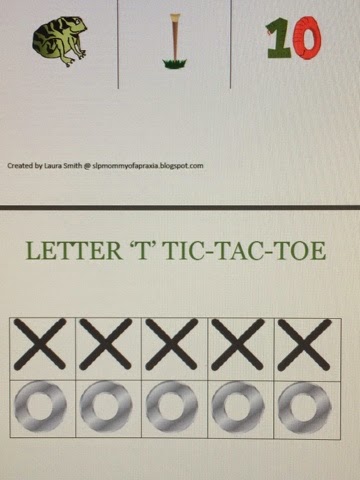
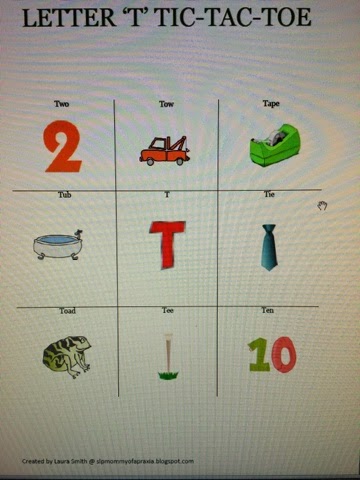
    Here is a tic-tac-toe game I made for a kiddo right now who needs a review and extra practice for initial ‘T.’ You will notice the syllable shapes are simple: CV and CVC.

    To get more repetitions in, I also had a basic deck of cards (minus the face cards) sitting by our game.  We had to pick a card and whatever number we picked was how many times we had to say our word!

    If you’re interested, you can find it on my TpT site here: Letter ‘T’ tic-tac-toe

  • Speech & Language with puzzles

    Speech & Language with puzzles

    Sorting is an important foundational skill that sets up the building blocks for logical thinking and organizing.  These skills are necessary for later educational development in math (i.e. order of operations, geometry), reading (identifying main idea and relevant details), and writing (developing a topic sentence and organzing relevant details).

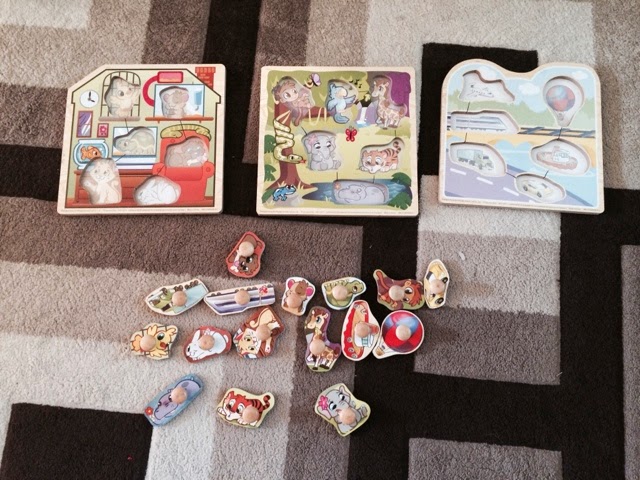
    Most parents have simple puzzles like this at home.  When my daughter was two, I held the pieces and gave her two choices.  She would have to make a sound or word approximation (because of the severe apraxia) to request and then I would give her a piece and she would find the appropriate place.

    Now that she is 4, I laid out the pieces as you see below, and she sorted them using a sentence: “A cat is a pet.”  “A tiger is a zoo animal.”

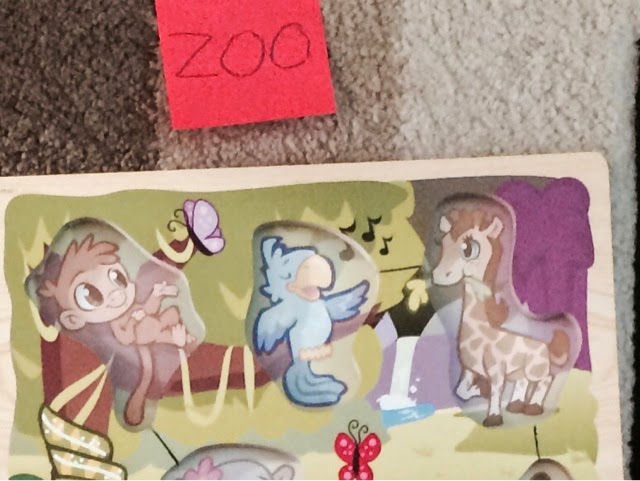
    To promote pre-literacy skills (exposure to print, print awareness), I wrote the name of the category on a sticky note and put it above the puzzle.

    That’s it!  Happy playing!
    Skills addressed:
    Sorting
    Classifying
    Expressive language
    Early-literacy skills
  • Speech and Language with Post it Notes

    Speech and Language with Post it Notes

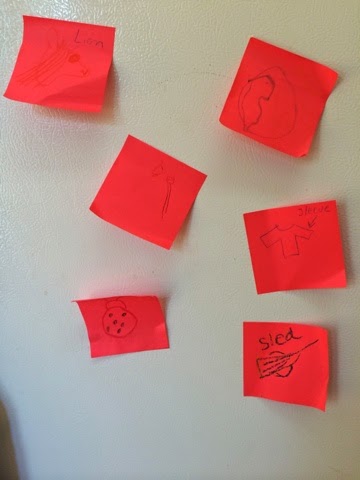
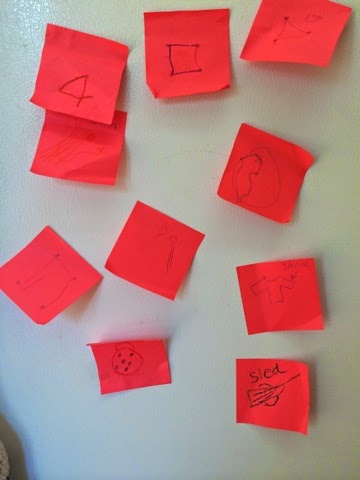
    My daughter loves Post it Notes.  LOVES them.  She loves writing some small scribble on them and then proudly sticking them up around the house to put on display.

    Today we drew pictures that included her target sounds to work on speech, but we also drew shapes to work on our pre-writing strokes for OT.

    Based on the response from my facebook post, my kid’s not alone in loving them!  Try it!  Easy and fun way to get speech practice in at home.

  • Baking with speech and language

    Baking with speech and language

    Parents are always looking for ways to incorporate speech and language activities at home.  Whether it is to stimulate a typically developing child’s vocabulary and language, or to help a speech or language delayed child; baking is great and fun way to work on speech and language.

    The first and most important rule before you start, is you have to accept the fact that your toddler will make a mess, and that is just part of the process, or um, fun.

    When I do baking or food activities with kids in school, they absolutely love it.  That’s the key. When kids have fun they are at their best learning.  Also, baking is a multi-sensory activity, meaning many sensory systems are activated.  When children are using multiple sensory systems, acquisition and retention of skills is more likely.  Baking with your kids inherently promotes:
    Vocabulary development
    Sequencing
    Following directions and comprehension
    Pragmatic language – the social piece of language

    Let me explain a little bit further.

    Vocabulary Development:  

    For the young child, words are learned best in context.  Certain authors refer to this as “event-based knowledge.”  Many of children’s first words are usually embedded within scripts that are part of their daily lives.  Examples could be: bottle, cookie, doggie, bath, etc.  These words are said to them frequently throughout the contexts of their daily lives.  Baking provides the same event-based knowledge experience, and exposes them to new vocabulary.

    Sequencing:  

    The ability to understand sequences and to sequence is an important skill.  Sequencing most simply refers to the order of things.  When kids get into school, sequencing is very important to understanding: patterns, math, a story etc.  Following a sequence of steps is inherent in baking and makes it the perfect activity for this skill.

    Following directions and Comprehension:

    These two things fall under receptive language skills; however, they are very important to the development of overall language skills.  Kids who are good at retaining and following directions have less difficulty in school since they are not devoting a lot of their cognitive load on simply understanding and remembering what they are supposed to do.  Baking is a fun and easy way to help your child practice these skills at home.

    Pragmatic Language:

    This is usually referring to the “social” element in language.  This involves the way language is used to communicate with others.

    With a little forethought, baking can also be a way to sneak in more direct speech language targets while working with your kid at home.

    Muffin Mondays and Waffle Wednesdays

    This summer I implemented Muffin Mondays and Waffle Wednesdays. Ashlynn is VERY interested in what day of the week it is, so I did this to also give her a framework of her week.
    Ashlynn’s current speech/language needs include: syntax (the form or structure of a sentence), and consonant blends (two consonants found together in a word: sp, st, sl, fl, bl, for example).

    It’s important to know your child’s goal, and then structure your baking around the goal.  Get creative, but it’s not as hard as it seems.  In Ashlynn’s case, I chose  the words: spoon, flour, stir.  For syntax, I had her ask me “Can I do it?” to work on her questions forms.

    Then each time we used a spoon I had her repeat “spoon.”  While she was mixing the batter, I would ask her what she was doing and cue her as needed to say the “st” blend in “stirring.”  Instead of using 1 cup of flour, I broke it up into four parts to give her more practice saying “flour” each time she poured in the flour.  For an extra bonus, she had to put “stir flour” together in a simple phrase.  I would hold the spoon until she said the desired words, and then I would give her the spoon back when she was successful!  She loved it.

    If your child isn’t yet talking as much as Ashlynn, hum the ‘m’ sound while you mix the batter or if your child isn’t great at imitating yet, just have him/her make any vocalization to request an item.  If they can’t yet imitate even a vocalization, imitate any spontaneous sounds they make to provide an opportunity for vocal play. If they aren’t really vocalizing yet, don’t get discouraged!  Practice turn taking and reciprocal play.  They pour then you pour.  You stir then they stir.

    With other clients who needed a final stop, I might have chosen the word “dump” and then every
    time we pour in an ingredient, we work on the word “dump.”

    Really, the possibilities are endless!

    In addition, you can also tell your SLP that you incorporated some great “distributed” practice throughout your child’s day.  In motor learning approaches to therapy, mass practice refers to the production of a large number of repetitions of a single target(what you should be seeing in therapy) and distributed practice refers to hitting targets with a greater amount of time between trials or sessions.  However, distributed practice is very important for stabilization and generalization!  Parents are the greatest asset when it comes to carryover, because you are in a better position to afford the child numerous opportunities for distributed practice!  In addition, you can do it in ways that are fun and multi-sensory in the child’s natural environment.


  • January book of the month: The Jacket I Wear in the Snow

    January book of the month: The Jacket I Wear in the Snow

    Winter is in full swing, and there is no shortage of books that talk about winter, snow, and winter clothing vocabulary. Also, the preschool in my district has winter clothing vocabulary on as part of the curriculum, so it’s perfect!

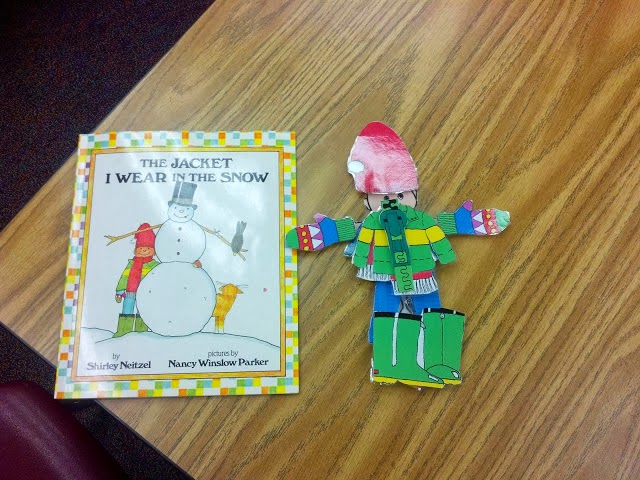
    The book is a repetitive, rebus style book that is great for practicing vocabulary, early reading skills, sequencing, and as always speech!

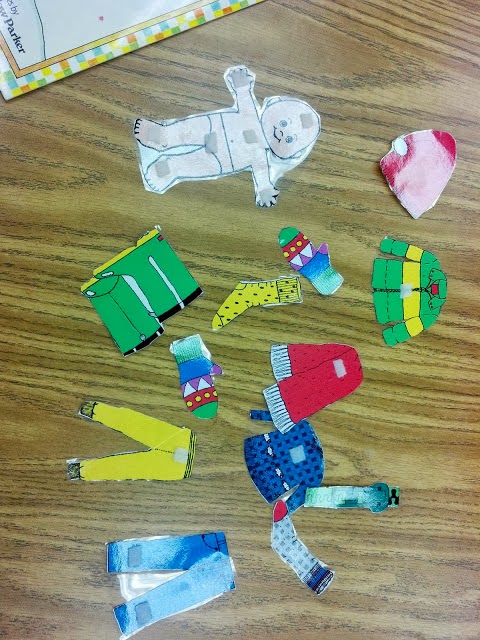
    I started with some cutouts from the story I found here:
    Winter clothes

    Then I printed them out, laminated them, and put velcro on so that the kids could dress the boy.  I used a printout doll from the website you can find here: Paper dolls

    This was the final result and it’s just so darn cute! All my kids from preschool up to even 4th grade love dressing up the boy.  For my speech kids, I strategically pick a clothing item for a sound they are working on.  There are a lot of good options including ‘s’ blend words that seem to be a constant therapy target for at least one group a year.  For a child with apraxia, there are some good basic CVC words you can use (i.e. cap, boot, sock,), or in my daughter’s case since her speech is improving so much, I gave her most of the cards and she had to practice recall while I read the book.  The use of the cutouts provide a visual and tactile aid to help kids learn and recall the vocabulary, so you will see I try to make cutouts to go with books I have whenever I can get my hands on them.  Unfortunately, I’m not very talented in the drawing department, so I have to rely on other sources as you see I did here!

     For my older kids, we did silly things to practice following directions with spatial concepts: on top, under, over, etc to work on receptive language, and then they had to do a retell.  Again, the visuals really help in being able to sequence and retell the story for those kiddos who have weaknesses with language processing.