Tag: daughter with apraxia

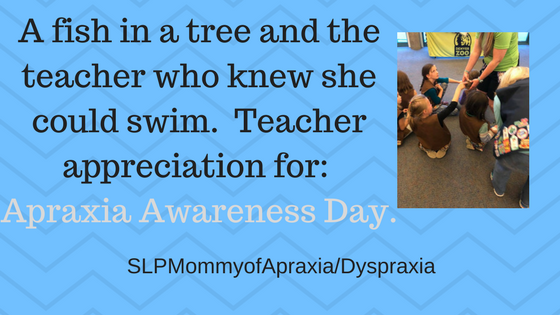
  • A fish in a tree and the teacher who helped her swim

    A fish in a tree and the teacher who helped her swim

    Ashlynn is in 2nd grade and is in Girl Scouts.  She has been in Girls Scouts since Kindergarten.  She loves it; but honestly, Ashlynn loves most activities and new adventures.  Yes she has apraxia, dyspraxia, SPD, ADHD, learning disabilities and a language processing disorder; but despite all of those disabilities she is a true extrovert that one.

    Ashlynn’s Girl Scout troop leader is seriously amazing.  If there were an award, I would nominate her to be the best girl scout troop leader in the state, because she is.    A girl scout troop leader is a volunteer who donates their time.  This woman though I think must be a real life saint who deserves a salary.  When Ashlynn first started Girl Scouts I wrote a post about how she became misty eyed and told me that she knew what Ashlynn was going through.

    When I first met her, I noticed something a little off with her speech.  Later I found out she has a hearing disability, and has had one since birth.  From the beginning she was very concerned about Ashlynn’s needs.  I was also surprised to learn that she had never had anyone with a disability before.  She told me she just wanted to make sure this experience was the best possible experience for her, and that she was willing to make accommodations or help her however she could.  We ended up having to make a few accommodations, especially with requirements. For example, in Kindergarten the girls needed to have memorized their name AND address to earn a special pin.  It took everything we could do for Ashlynn to learn the address, but we could just not get the phone number at that time.  Ms. E made an accommodation like a trained special education teacher would; and said as long as she can memorize one of the two, she would earn her pin.

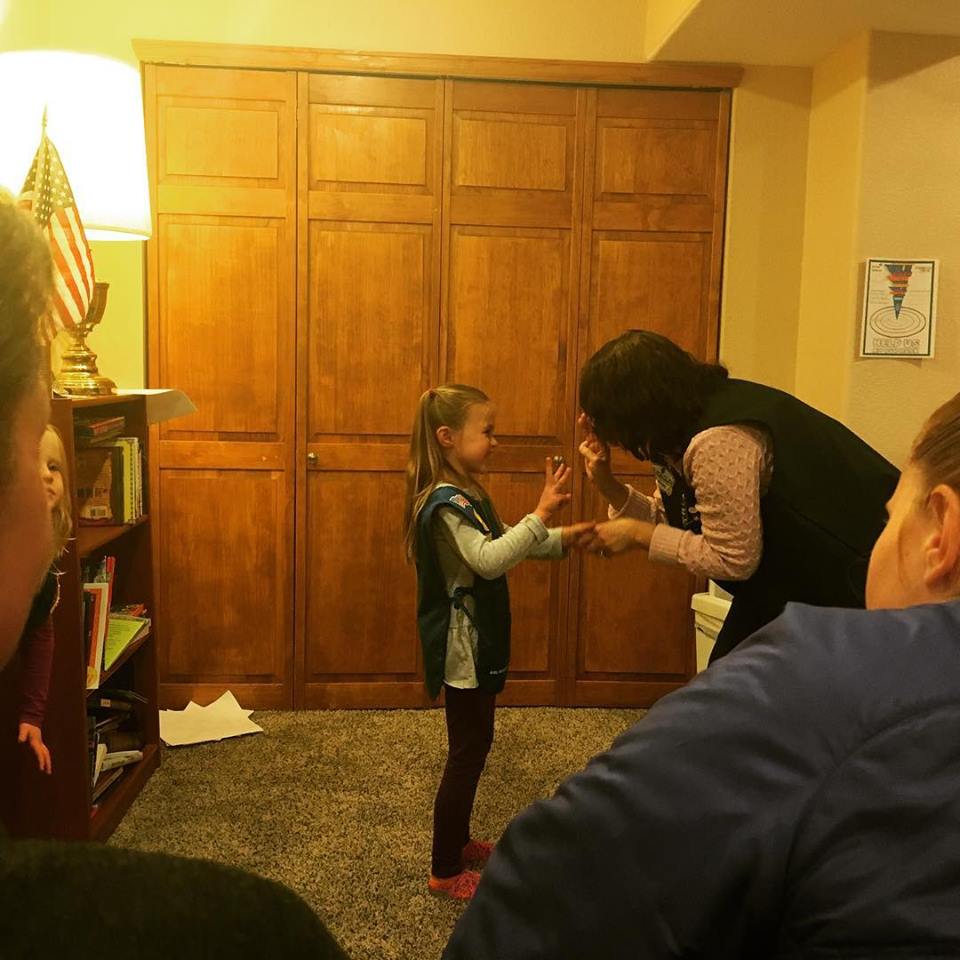
    The other night the girls had homework.  It was a picture where you had to find items hidden in the picture.  She sent home the actual picture; and then she found, on her own, a simpler picture and told me that Ashlynn just had to finish one.  In special education we call this modifying the curriculum.  This woman has never read Ashlynn’s IEP.  She does not in fact know her modifications or accommodations.  She intuitively does them.  I can’t help but think it’s because she understands.  She has walked Ashlynn’s shoes.  She totally, totally gets it.

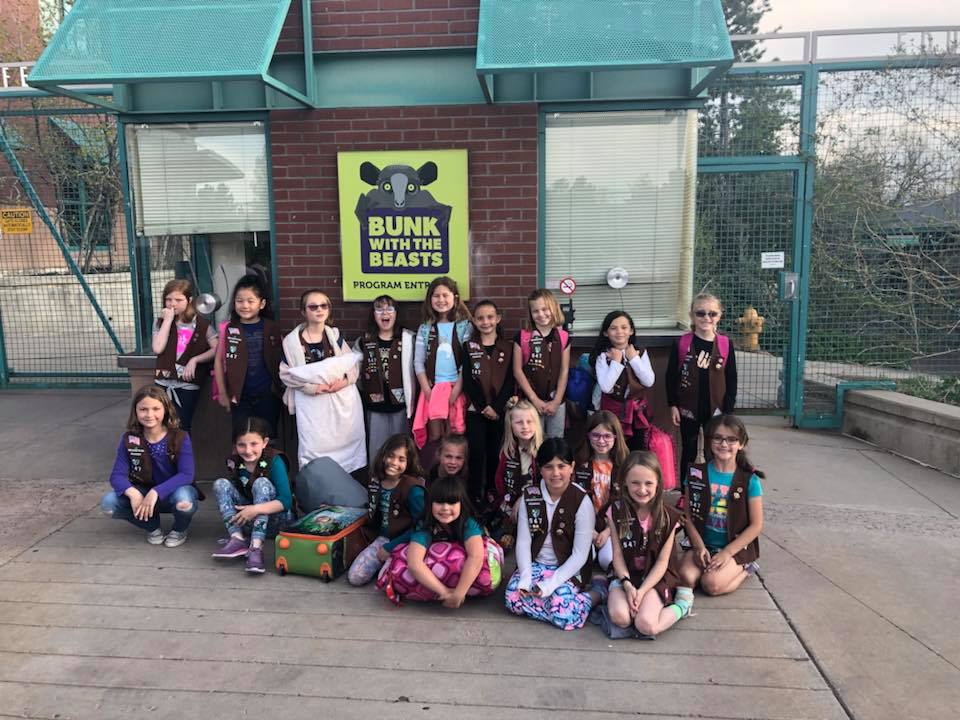
    This past weekend there was an event at the Denver Zoo called “Bunk with the Beasts.”  The girls would get to spend a night away from home and “camp” at the zoo.  Right after I received the group email about the event, her troop leader followed up with a personal email requesting that she know of any special accommodations or help that Ashlynn would need so she could do them.  She didn’t want Ashlynn to miss out.  I sent back a big list.  Ashlynn has dyspraxia.  Activities of daily living, like all the steps to get ready for bed are NOT easy. Her troop leader wrote back it wouldn’t be a problem.  A few days later a chaperone pulled out so I was asked to come.  I was thrilled!  I said yes immediately.  This way her troop leader could focus on the other 18 girls, and I could be there and help Ashlynn.
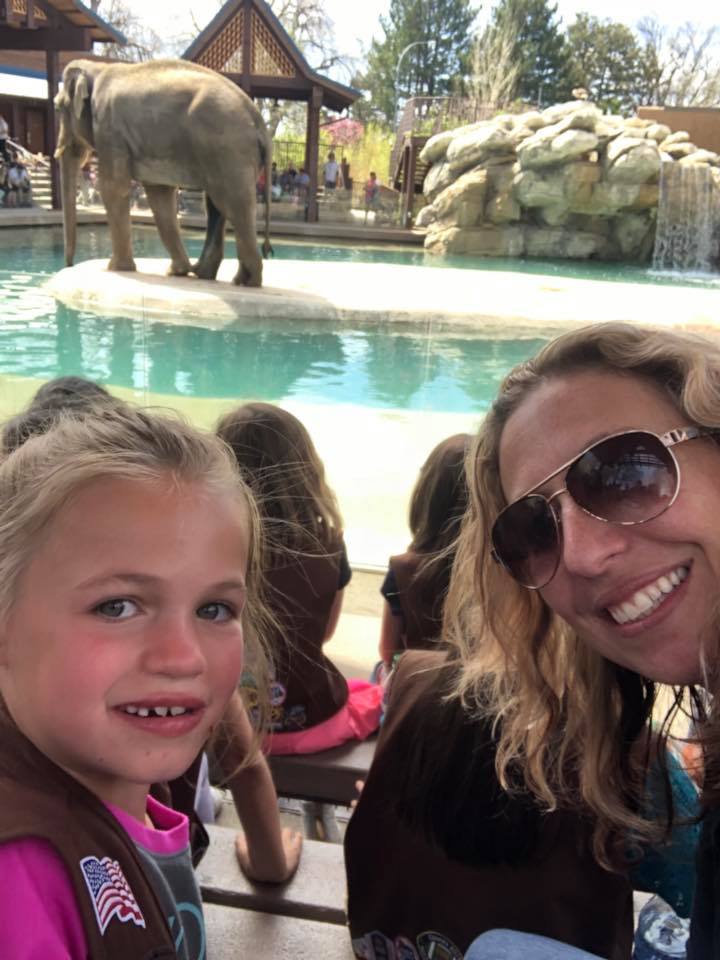
    When we arrived, there were 4 adults to 19 girls.  Her troop leader split them into groups of two.  She told me that usually a chaperone or leader is not placed with their girl, but in this case she made an exception.  So her and I were in charge of one group of girls in which Ashlynn was a part of, and the other two co scout leaders were in charge of the other group of girls for the zoo tour and excursions.  Some would find this preferential treatment; but it is in fact, an accommodation. I found a renewed sense of awe in this woman.  She went onto explain that many of the girls have developed “best friends” and she purposefully separated them for this event because a troop cannot be a troop unless they all learn how to work together.  I shrugged it off.  She looked at me more earnestly and said, “No, when I mean best friends I mean like this,” and she proceeded to hug my arm and not let go.  I still shrugged it off not realizing yet her point.

    As she gathered the girls and called out what group they were in, one of the girls was visibly shaken.  Her mom is a girl scout troop co-leader and I was standing next to her at the time.  She told me that this was a big reason her daughter wants to quit Girl Scouts next year, because Ms. E insists that the girls be separated from their best friends.  As she talked I looked on.  Most girls had a best friend in which they were sitting next too.  If not, they were still obviously part of the group.  Two girls sat in the back of the group slightly removed, but Ashlynn was basically completely removed in the back by herself.  Don’t get me wrong, she wasn’t acting upset or lonely.  Ashlynn loves girl scouts.  It just struck me in that moment that most girls had an “arm clinging” best friend, and my daughter had no one.  This mother I was standing next to felt so bad her daughter would feel alone and away from her best friend for a couple of excursions, and my daughter felt that way basically all the time.  I don’t fault this mom.  Maybe if I didn’t have a kid with a disability, I would feel the same way too.  Maybe I wouldn’t understand or even notice that another child in the group, the child with disabilities never had any of those best friend moments.  Maybe I would be sad that my child would be sad for a couple hours and never realize this girl in the same troop sitting in the back by herself doesn’t EVER have an “arm hugging” best friend. Maybe…..

    Ms. E did though.  Ms. E noticed.  That’s why she split them up.  Society needs to stop casting those who are different to the outside, but including them and accepting them too!  We are all better when we work together.  Ashlynn and I had the best time.  Ms. E paired each child with a “buddy” and Ashlynn was thrilled to have a peer’s hand to hold as she walked around the zoo.  Ashlynn’s joy is so contagious and she is an adult magnet.  I could see though in this setting, just how unlike her peers she looks.  She’s not shy.  She doesn’t get embarrassed or worried about making mistakes.  She bonks into stuff and people and laughs at herself.  She loses attention easily and starts to wander which would annoy her buddy.  She would randomly start talking or singing when you weren’t supposed to and her buddy would have to shush her. It didn’t matter though.  It made Ashlynn’s entire night to be part of her peer group.
    I came home and cried to my husband I get why girls think she’s different.  She’s not stuck up.  She’s not concerned about what other people think.  It’s amazing how society gets it’s grasp into children as young as second grade.  I noticed so many girls tugging at their shirts, checking their appearance, and censoring what they say because they want to fit in.  I couldn’t help but look at Ashlynn and think of the Dr. Seuss quote, “Why fit in when you were born to stand out?”

    What’s ironic is these kids who “stand out” end up changing the world.  I am almost obsessed with successful people.  Notice I didn’t say “famous” people, though many might be famous.  No SUCCESSFUL people.  People actually changing the world and making it a better place.  The innovators and visionaries.  Most of them were kids who were a little different.  Some may have had a “disability” like ADHD, dyslexia, or whatever.  Bill Gates said once, “Be nice to the nerds.  You might end up working for them.”

    Last month in the news the boy scouts were under fire for revoking the eagle scout badge for a teen with Down Syndrome.  The parents filed a lawsuit claiming that their son was being discriminated against because without accommodations, there would be no way he could earn the necessary requirements to get the Eagle Scout Award.    

    The argument against him earning the award was that though he tried his hardest, he did not meet the requirements set forth.  If you don’t have a person with a disability in your family, I could see how this could make sense to you.  There are requirements that have been established, and if a person can’t meet them for whatever reason, they don’t.  There are able bodied children who don’t meet the requirements either and that’s just the way it is, right?

    Let me point out this graphic.
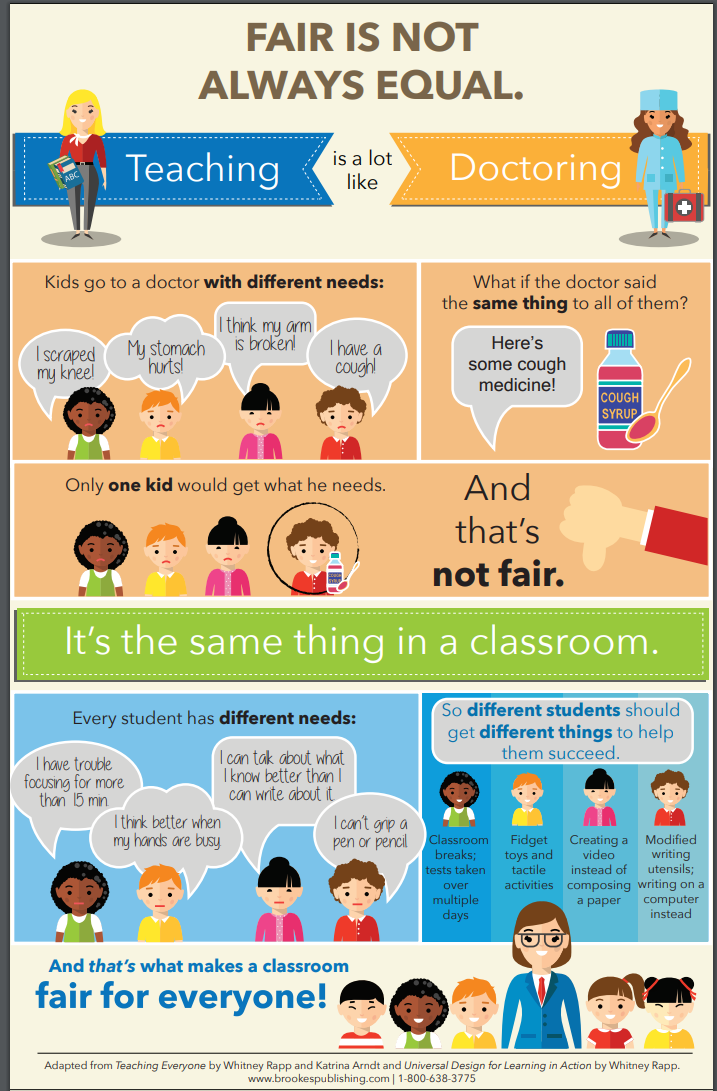
    This graphic compares teaching to going to a doctor.  Kids go to the doctor for different symptoms, and the doctor treats the symptoms.  It would be ridiculous though if you went in with a broken arm and the doctor prescribed antibiotics.  Under our current educational model that is not inherently inclusive; this is exactly what is happening.  The current educational model is based on a child without any learning, attention, or behavioral disabilities.  The lessons are made and the classrooms are set up for kids who can sit in a chair, listen and interpret information, and then attend to their work.  It is not equipped for  the child who needs sensory breaks, or the child who needs to use asisstive technology to help them write because they can’t, or the child who needs assistive technology to have something read to them because they can’t read.  It is not set up for the child who cannot learn through the auditory channel but learns best through visual and tactile channels.  Here is the most important piece though about all of this.  Children who are not “typical” CAN show their learning and skills in other ways if they are just given accommodations!!

    That’s not fair, you might say.  I would counter that it’s not fair we have a bunch of children with broken arms (learning disabilities) being forced to take antibiotics (traditional education), and then are penalized for failing. They are SET UP to fail.  A system that mandates all children must learn the same and prove they have learned the same is a broken, discriminatory system.  As Albert Einstein once said, “If you judge a fish by it’s ability to climb a tree, it will spend it’s whole life thinking it is stupid.”

    Ms. E understands this and I am so, so thankful to her.  The challenge today for apraxia awareness month was to recognize a teacher making a difference.  There are so many amazing people I could choose, but today I Thank you Ms. E, for recognizing my daughter is a fish and deserves a chance to swim.
  • Apraxia would have destroyed me

    Apraxia would have destroyed me

    I often think about what would have happened had it been me who had apraxia, dyspraxia, SPD, dysarthria, and a learning disability when I was young.  It’s pointless I know, but I was/am a perfectionist.  That’s not a good thing.  I learned early I was really good at spelling, reading and writing, but math I had to work for.  I won a math award in 3rd grade and I looked at the teacher, Mrs. Plummer,  like she was crazy.

    “I’m not good at math.  Give this to Keith or Jimmy.”  She maintained I was good at math, but I didn’t believe her and I never cared about that award.  I knew what I was good at, and it wasn’t something I had to work that hard to do well.

    I think about that because Ashlynn has to work at everything to do well.  There’s not like one thing that comes naturally to her….well actually social skills do, but she’s behind in that too only because of her other issues.  I had to work at math so it made me mad and I didn’t want to try, despite the fact I could do well.

    Her disability would have destroyed me.

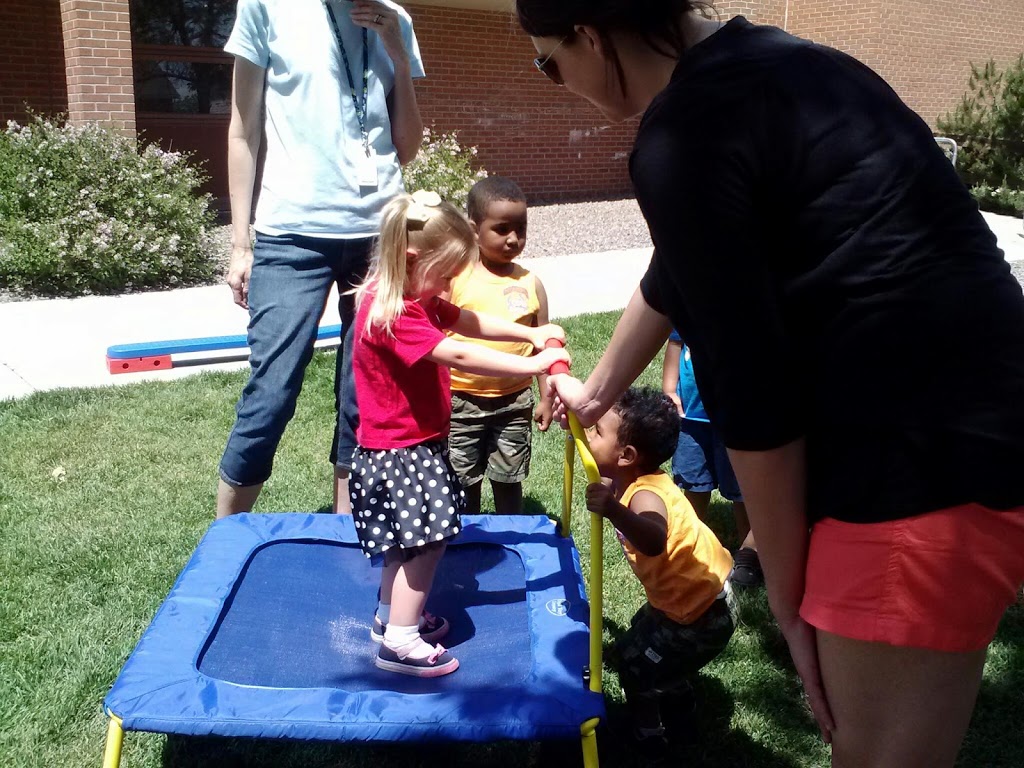
    She has the best of my husband’s personality THANK GOD.  She doesn’t get embarrassed, she attacks everything, she’ll try anything, and she’ll never give up until she conquers it.  That’s a page straight up out of her daddy’s book.  She’s in a first grade performance Tuesday, and I was watching the practice with the art teacher.  I said the songs were hard for a kid with a speech problem (bear necessities, supercalifragilisticexpialidocious) and the art teacher smiled and said she loves Ashlynn because she just goes for it.  I smiled.  It’s true…she does.  She always has.  I can still cry thinking about her preschool observation where she couldn’t jump on the trampoline so she smiled and marched instead.  All the kids were encouraging her to jump like them….

    and she couldn’t bear walk so she hung across a teacher’s arm upside down to at least get a feel for the movement….still smiling.

    When she rode her tricycle and couldn’t pedal she never stopped trying……and not only trying, but smiling. Oh, and guess what.  She learned all these skills eventually, on her own time.  She walks, she runs, she jumps, she bear walks, she skips!  She puts me to shame.  She puts that third grade girl who decided math wasn’t her thing to shame.

    Well not anymore.  I’m not sure anyone becomes a parent to be inspired by their child, but she has inspired me and made me better.  There are things I do now I would have NEVER attempted.  Every time I’m scared or nervous, I think about Ashlynn.  One year on a camping trip everyone was cliff diving.  I was terrified as I stood on the cliff, but I thought of Ashylnn and I’m on video jumping and while I’m in the air you can hear me say “for Ashlynn.”

    Tonight we were watching “Zootopia” and a song came on “Try Everything.”  Ashlynn started clapping and dancing around the kitchen.  She always dances like no one is watching.  Isn’t that phrase people have to try and follow?  Well, Ashlynn just lives it.  It’s her essence.

    So I started listening to the lyrics and I’ll be damned if this isn’t that girl’s theme song.  I downloaded it immediately.  (I’m also admittedly a Shakira fan so I was hooked anyway).  We put it on outside and her AND Jace were going crazy.  It’s a great song.

    “I messed up tonight, I lost another fight
    I still mess up but I’ll just start again
    I keep falling down, I keep on hitting the ground
    I always get up now to see what’s next

    Birds don’t just fly, they fall down and get up
    Nobody learns without getting it wrong

    I won’t give up, no I won’t give in
    ‘Til I reach the end and then I’ll start again
    No, I won’t leave, I wanna try everything
    I wanna try even though I could fail
    I won’t give up, no I won’t give in
    ‘Til I reach the end and then I’ll start again
    No, I won’t leave, I wanna try everything
    I wanna try even though I could fail

    Look how far you’ve come, you filled your heart with love
    Baby, you’ve done enough, take a deep breath
    Don’t beat yourself up, don’t need to run so fast
    Sometimes we come last, but we did our best”

    So many times she has come in last but she gets back up and tries again. As a witness to this strength I have no choice but to do the same.  Look how far you’ve come, but don’t keep looking back.  Look up and I’ll walk next to you guys through anything and I’ll pick you up when you fall.


  • The problem with school SLP’s.

    The problem with school SLP’s.

    I only realized after being a part of the special needs community that school SLP’s have a bad rap.  Like a really, REALLY, REALLY bad rap.  

    I’m preparing a talk next month for Colorado school SLP’s, and every time I prepare a talk for this demographic, I have to tell you they have a special place in my heart.  No, it’s not just because I started as one and work as one part time, but it’s because I have literally worked under, with, and around many, many, MANY of them. I have worked with so many of them, and I can tell you they are a jack of all trades.  They are the EXPERT in eclectic, and may be the ONLY person in the school who understand in depthly just how a student’s unique communication challenges actually affect them in school.

    In the schools, you don’t have the option to specialize.  Kids from every disability show up on your caseload and you are expected to be the expert.  It might be hard to understand as a parent, but there are soooo many different disabilities and speech and language disorders, and a parent (rightly so) expects the SLP to do right and best for their baby.

    Every single SLP I know and have met has a desire in their heart to help children.  Please, let that sink in.

    When I took Ashlynn to her first private SLP who had never worked in the schools she was asking me about qualification.  She asserted that she could never be a school SLP because she felt it was unethical to not qualify students who clearly had some sort of speech or language problem.  I had a hard time refuting her.  Aside from saying qualification is different in the private versus educational sector, I really had no excuse.  I know that funding is limited in the public sector so that obviously plays a part in qualification.  I also know if every SLP took her stance, than NO kids would be serviced in the public schools, and is that really what we are going for?

    Public school SLP’s have caseloads that are probably double if not more of the private SLP.

    Where the private SLP can see kids 1:1, school SLP’s rarely have that luxury.  With weekly caseload averages around 45 to 55 and some maxing out at 90 (Yes 90 people I’ve seen it), even the most skilled SLP will not be able to do what a private SLP can do 1:1 for 45 minutes (though they will kill themselves trying).

    The result?  Parents become outraged at the lack of progress or progress they feel the child should be making. They surmise the school SLP just isn’t as good as the private SLP and they become disillusioned and write them off.  They post memes about preparing for battle when going into an IEP meeting! This honestly breaks my heart.  I feel bad for the parent who feels the SLP doesn’t care, and I feel bad for the SLP who is trying to manage an unmanageable caseload, writing IEP’s at night, or staying up until 2 Am (true story from an SLP I just talked to last week) to write a lesson plan, only to be ravaged by a parent unsatisfied with the results.

    I’m not sure if everyone is aware of this, but ANY SLP in ANY setting is as qualified as the next SLP by basic certification standards.  What does that mean?  That means, as long as an SLP received their masters degree and the Certificate of Clinical Competence (CCC) through ASHA they can work anywhere.  So that means, your school SLP can apply for a job at Children’s Hospital right now and probably get hired tomorrow (because in case you didn’t know there is an SLP shortage as well).  For some reason though, there is this perception that the school SLP just isn’t as good as the private SLP.  If it’s true, it probably has MORE to do with caseload and workload size than it actually has to do with the qualification of the SLP.

    I get calls and emails all the time from concerned school SLP’s desperate to meet the needs of their kids with apraxia but not knowing how.  They want to see the kid more, or see the child 1:1, but their caseload simply does not allow for it.  They cannot add more hours to the day, yet they still call, or write and wonder if there is something they have not yet thought of.  Oh, and here’s a dirty secret.  Listen close.

    Are you listening because this is VERY important.

    If an SLP feels in their heart a child needs private, supplemental speech services, they CANNOT say it.  People, they CANNOT tell you this.  Why?  Well, their license and job is on the line.  In most cases, school SLP’s are told not to recommend any sort of outside therapy.  Why do you ask? Why?

    I’ll tell you.  If a school SLP recommends outside services, the parent can sue the district and win, and potentially disbar an SLP from ever practicing again.  Are you asking why again?  I’ll tell you.  If a school SLP recommends outside services, they are essentially saying that the child can not benefit or make progress from the therapies provided by the school, and the school is required by law to show progress.  If the SLP recommends outside service thereby saying the school is inadequate, the school gets worried or they will get sued for not providing adequate services and the SLP potentially fired.

    Would you take that risk?

    I’m not saying unilaterally every school district would do this, I’m just saying, school SLP’s are told this is a possibility, and so they would find it best not to recommend outside services.

    You need to know this as a parent of a child with any disability.  Some SLP’s will risk their professional license and recommend this to you.  Let me  tell you though what they are risking.  They are risking 4 years of a bachelor degree, 2 years of a masters degree, 1 year of a clinical fellowship, and the usually 3 years of probationary status as a teacher.  That is an entire decade of work and dedication to a profession they love and believe in.  Would you take the risk then to recommend a parent pursue outside therapy?  This is where they are at!  It is truly a catch 22.

    If you are upset about your school services, you probably have every right to be!  I was VERY unhappy with Ashlynn’s preschool, in-class only, speech/language services.  However, it is important to place the blame on the right entity and in most cases I can assure you it is NOT on the school SLP’s shoulders.  In Colorado, the Colorado Department of Education mandated an inclusion model only of special education services in preschool thus making it extremely difficult for any school SLP to pull a student out into a 1:1 session.

    My message today is this: School SLP’s are some of the most phenomenal group of people I ever have the honor to speak with or to. They do not get the option to specialize, and so they pursue advanced training and expertise in every disability that may affect communication: from Apraxia to Angelman’s Syndrome, from Developmental Delay to Down Syndrome, from Cerebral Palsy to Stuttering, from Language Impairment to Nonverbal Learning Disability, from Assistive Technology to Autism, from Auditory Processing Disorder to Articulation Disorder,  school SLP’s will see it all and be expected to rise to the challenge.  They cannot “refer out” or “discharge for lack of progress” as an can be done in private speech. No, the school SLP is expected to figure it out regardless of the lack of resources, lack of funding, or lack of time.

    They will be faced with limited or no space, they will be strapped with high caseloads, and criticized by parents; yet they will persist and pursue only becoming better for it, because of their love for the children and the profession.  I personally have witnessed it time, and time, and time again!

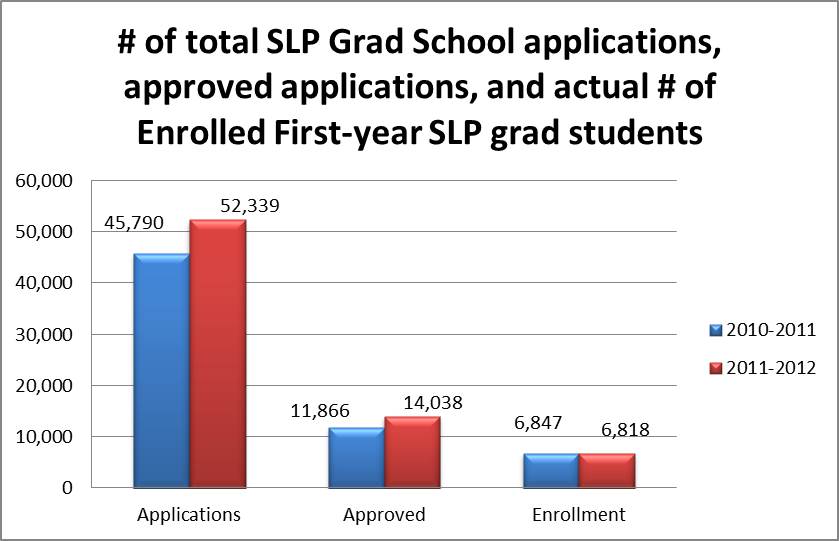
    I can tell you firsthand, getting into graduate school for speech/language pathology is VERY difficult.  It is highly competitive, and here in Colorado, the average COLLEGE GPA was a minimum of 3.87 when I applied.  I found this graphic from 2011 but I can tell you things have not changed much.  There is a HUGE gap between the number of applicants and the number of people selected. 

    The disparity should be striking, and please remember that MANY of these applicants will be YOUR school based SLP.  If you have the mentality that “C’s get degrees” and you are certain your school based SLP fits the latter, let me correct you.  NO average C students make it to graduate school in the first place for speech/language pathology.

    Truth

    For my final thoughts I wish not to be adversarial.  I hope that this article has persuaded you, a parent OR SLP, to reach out to the other side and bring about the change you wish to see.  I have the unique perspective of being on both sides, and as such, I have the utmost RESPECT and LOVE for both sides.  I truly wish for there to be a conduit of communication, and not a  ridge of animosity and distrust; and at the the forefront, I wish to impart a spirit of solidarity between my professional and special needs relationships.

    To read more from SLPMommyofApraxia follow her on facebook, pinterest, or twitter.


  • Where did THAT come from?

    Where did THAT come from?

    If you follow my facebook page, you probably already saw our HUGE news!  Ashlynn came home from school this week with a note and award that said she had successfully verbally named EVERY single letter AND letter sound.  

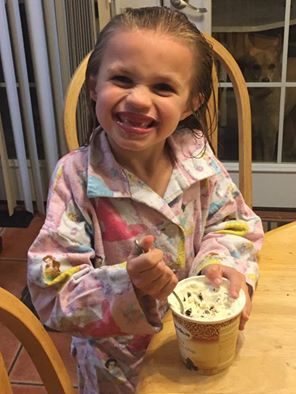
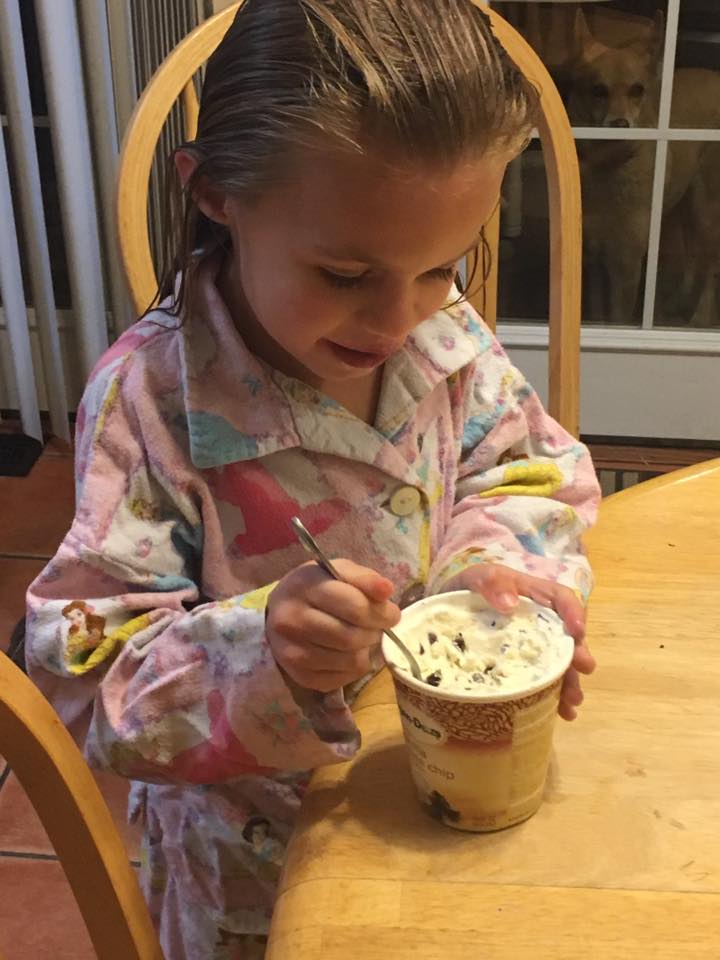
    It’s nothing short of amazing.  Ashlynn has been working soooo hard and for YEARS.  YEARS!  She deserves it soo much.  We bought ice cream for her and let her eat it straight out of the carton right before bed!

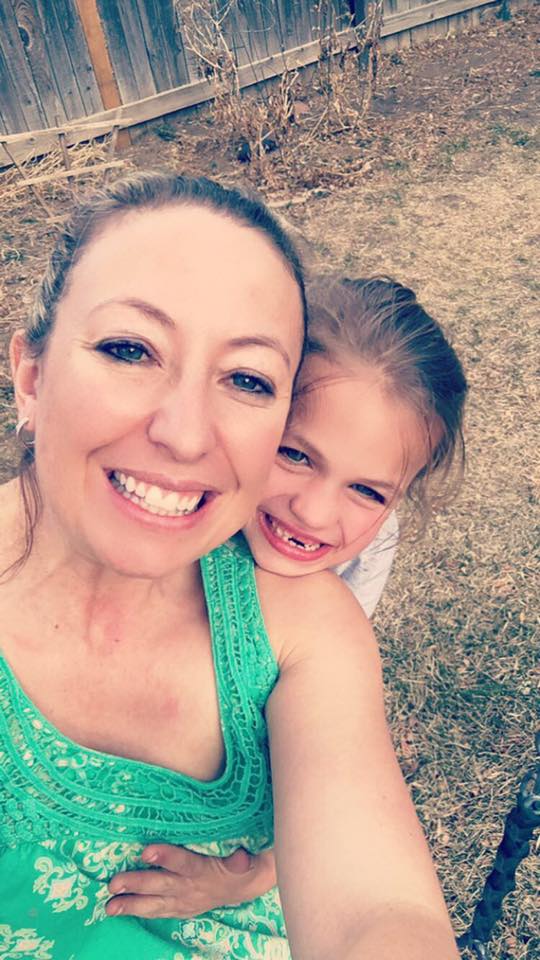
    Right after this picture was taken, my husband walked into the kitchen and told her “Ashlynn, I’m sooo proud of you for working so hard.”

    And then….something surreal happened.  Maybe it won’t feel surreal to you, but let me stress…it was.

    Cody left the room and she looked up at me….with this same smile…the smile you see here….and she said,

    “And Mommy, I’m so proud of you for working with your kids and helping them talk.”


    I included the above dead space on purpose, because dead space is what happened.  Time stopped.  I looked at her looking back at me with what I can only imagine is the most shocked look on my face.  Tears actually immediately welled in my eyes.  Where did THAT come from??

    I  am a private person.  I’m not saying we shouldn’t cry in front of others, but it’s just not my way.  I just prefer to do it behind closed doors….but right then…in that moment…that moment all about her…..it felt like someone was speaking through her and it took a moment to collect myself.

    I told her thank you but this moment was about her.  She tilted her head back in glee and then pointed at her brain and said,

    “Mom!  My brain is not messing up my letters anymore!”

    …….and she innocently took another bite of ice cream.


  • Why we’ll never stop working

    Why we’ll never stop working

    I’ve been down lately.  Really, really down.  It pretty much started at Ashlynn’s re-evaluation meeting and went downhill from there.  For all the work she’s done, for how far she has come, for what she knows in the face of so many challenges,  it was like a slap in the face.

    It’s really not anyone’s fault.  It’s just the way it is.  I’m dealing with mixed expressive/receptive language issues now.  I knew this, I did….it’s just seeing those damn numbers.  1st percentile, .5th percentile.  Phew.  Deep breath

    There were also awesome numbers.  Articulation is in the average range.  The AVERAGE range!  That’s phenomenal.  Ashlynn is intelligible to perfect strangers in and out of context.  For someone with apraxia of speech, she beat it in 2 years with a TON of therapy, but she overcame it.

    Now we’re faced with new deficits.  Word finding, expressive language, grammar, syntax, receptive language, memory, attention, writing.

    It was overwhelming.  My husband had tears, and he’s the one who always finds the positives and the “what she can do’s.”

    Even her receptive vocabulary test came back just under the average range.  Receptive vocabulary tests have been shown to correlate with IQ tests (even though I didn’t give her an IQ test), and even though I don’t think the test was totally valid since I’m sure her attention played a factor…..

    It still made me pause.  For once I started thinking, maybe we don’t have this.  Maybe I am dealing with limitations.  Maybe I am in denial.  Maybe I’m not seeing things because I don’t want to see them.

    I would read stories and updates on other blogs and get jealous someone’s child ONLY had apraxia of speech.  CAS is no joke either, but if Ashlynn only had CAS then she would almost be over speech forever!  Sigh.  You know you’re down when you’re jealous of other kids’ disabilities.  That is wrong on so many levels.

    I looked everywhere trying to get my positivity back.  I talked to family, to friends going through this journey too, co-workers…nothing helped.  I poured over pinterest looking for inspirational memes and quotes that were going to change my negativity and squash my doubts.  I found nothing.

    I scoured the internet looking for success stories for global apraxia.  One I found was on disability now but at least happy she had made it through childhood.  That wasn’t exactly lifting my spirits.

    At the same time, I finally read a new research article on Apraxia that’s been in my pile.  The article describes kids with motor planning deficits (kids with apraxia) rely heavily on auditory feedback which was proven when they demonstrated diminished speech articulation in the presence of noise.  Gee, I thought. That’s great these kids found a compensatory strategy to make up for their motor planning deficit, but what happens when you have sensory processing disorder and possibly some receptive language issues that makes that feedback unreliable.  UGH

    But then I found it.  My inspiration was sitting right under my nose.

    I know this guy who has bipolar disorder.  When I met him he was kind of a hot mess.  He hadn’t gone to college, was partying, and constantly getting fired from his jobs.  Of course, having bipolar disorder is very difficult.  There are daily struggles in his mind I will never know.  The statistics for someone with bipolar disorder are less than impressive: 90% of marriages end in divorce when one person is Bipolar.  Less than 50% of people with bipolar take their meds, and 1 in 5 commit suicide.  Many live on disability.  Many are homeless.  This guy though, he’s been married for 10 years with no sign of stopping.  He’s loyal, faithful, hardworking, finished college AFTER his diagnosis, and stays on his medication.  Who is he?

    He’s my husband.  He’s Ashlynn’s dad.  Everything he shouldn’t be doing he’s doing.  Everything he shouldn’t be, he is.  My husband, Ashlynn’s dad, defies statistics.

    Then I started thinking, I know this other guy.  He was raised under an extremely physically abusive, alcoholic father.  His parents ultimately divorced.  He was forced to go to war and and live in actual nightmares.  What are the stats on a guy like this?  Well, since he’s the product of divorce, he’s 40% more likely to end up divorced himself.  He’s four times more likely to be an alcoholic.  As a vet, he faces a higher possibility of homelessness.  What did the future hold for this guy?

    Well, he’s my dad, father of three. Married for 45 years and happily retired.  He’s healthy and has a drink maybe once a year.  My dad, Ashlynn’s grandfather, defies statistics.

    And that’s when I started to realize.  Ashlynn comes from a long line of statistic breakers.  It’s in her blood.

    I thought of me.  Had I defied statistics?  Well, neither of my parents went to college, so it would be less likely I would receive a college degree or much less an advanced degree….yet here I am. It was highly unlikely I would have ended up at Duquesne University for an elite group of SLP’s, yet there was I was last summer.  Maybe I do defy statistics.

    My dad’s nephew years ago was on the wrong track.  He was in jail, and he didn’t know how to make a life for himself after he got out.  He was lost.  He asked my dad for advice and my dad said “keep working.  All I know is to work.”  Years later that same nephew had kept a job and was raising adopted children.  He was not in jail and will never go back.  He told my dad he always remembered his words to just keep working.

    So there it was!  Right under my nose.  We are statistic breakers.  We are hard workers, and Ashlynn is no exception. She always wants to work, do homework, practice writing, ball skills, pedaling, speech, read..you name it.  She attacks it, and I realized, I may not have success stories for her EXACT same situation, but I do have success stories for many other hard or seemingly impossible situations and she will be one too…..if we just keep our head down and

    working.

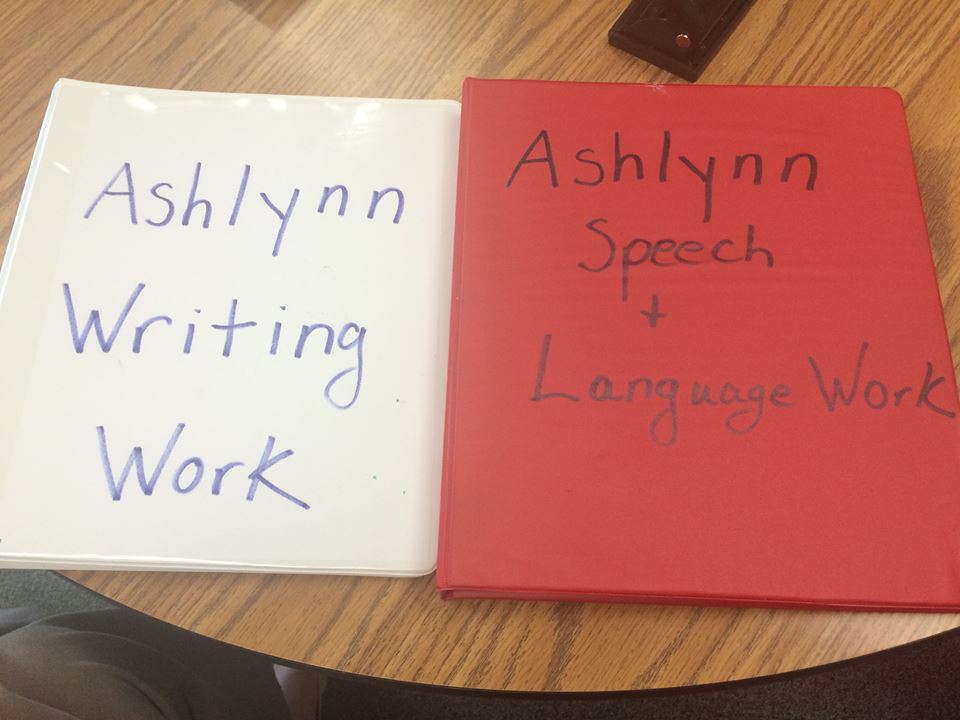
    7e94b6ca15764dd139ba2f8146844331ashlynn work


  • What if we don’t prove them wrong?

    What if we don’t prove them wrong?

    I had a client recently who told me a well-meaning friend called her five year old son with apraxia “retarded.”  Apparently he meant it in a “well-meaning way” asking about services, but understandably the term shocked, appalled, angered, and then saddened her. Isn’t it interesting what we all presume about a child based on nothing more than their speech?

    She went onto say she didn’t even correct him because at this point she’s just tired.  She’s just tired of explaining it and what did it matter anyway.  She also went on to say she was mad at apraxia all week, and she wished they were in the future when she will hunt this man down and show him her successful, happy, thriving, “retarded” son.

    I smiled.  That moment.  Yes.

    What, when, and where will that moment be?  I know it will come.  I know one day, A will have her moment in the sun.  Maybe others won’t even know it is her moment.  Maybe it will just seem completely normal and average, but to me, I will revel in her moment.  I will cry in her moment.  I will cry tears of joy.  Tears no one may understand.  Maybe she won’t even understand.

    Will she roll her eyes in typical teen fashion and scold me for embarrassing her?  Will she smile too from the pride she feels in her own self?

    Yes.  That moment.

    I talk about that moment with every mother who has a child with apraxia.  That moment when our children will prove them all wrong, even if “them all” will be long gone or distant memories.  Hurtful memories are never too distant when their pain was so raw, and they seem to leave open wounds on our hearts and in our minds, seemingly unaffected by the passage of time.

    That moment.

    When the same eyes that cried tears of fear and sadness will now drop tears of triumph, victory, and pride.

    That moment.

    The vision of that moment, whatever it may be, keeps me going.  Keeps me fighting.  Keeps me working.  Keeps me hoping.

    I know it will be there.  Just like I knew she would talk.  Just like I knew she would sing.  Just like I knew she would ride her tricycle.  That moment has and will always be there, and in that moment, nothing on this planet will be sweeter.

    In that moment, maybe I shouldn’t look at it as proving them all wrong, but rather proving US right.

    d72ced984da23e4bc651d33fcc0f1223