Tag: Childhood Apraxia of Speech

  • She is a fighter, not of guts and glory, but one of understated grace.

    She is a fighter, not of guts and glory, but one of understated grace.

    Well, Ashlynn completed Kindergarten.  It was pretty anti-climactic to be honest.  For some reason, her school doesn’t believe in Kindergarten graduations.  Okay, it’s not for “some reason,” it’s because the philosophy of the school is that graduations signify an end and Kindergarten is just a beginning.

    I get it…kind of.  Actually no, I don’t get it at all.  If that were the case, we wouldn’t celebrate any graduation because technically every end starts a beginning.  I don’t think that’s too philosophical.  Whatever though.

    It’s an odd thing.  When I was younger, people flunked.  I literally never hear that term anymore.  Now that I’m in education, kids are “held back” or kids are “retained” or kids are “not retained” because they are in “special ed” and you don’t “retain” if a child is in “special ed.”

    I received Ashlynn’s report card.  When I was little, I LOVED that little manilla envelope.  It was a little pocket that guaranteed me lots of praise from my parents….maybe even a trip to Dairy Queen.

    I looked at it now in her backpack with dread.  What would it possibly say? I know it didn’t say she flunked.  She’s in special education and she won’t be retained.  However, I know it didn’t say she was on grade level either.  If that were the case, she wouldn’t be in special education.

    Sigh

    I debated not opening it.  What does it matter?

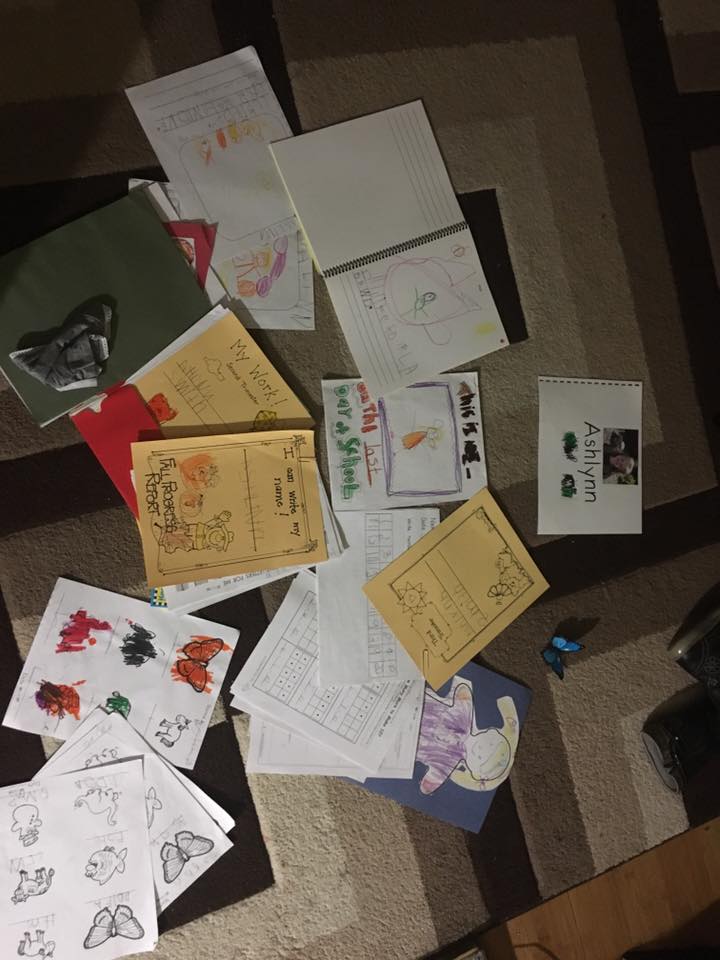
    I let it sit for awhile.  I pulled it out, but didn’t open it.  Instead I looked at the pages and pages of work sent home in her backpack that she had done from the Fall to the Spring.  Progress.  Amazing progress.  Pages and pages of hard work rested under my fingers.

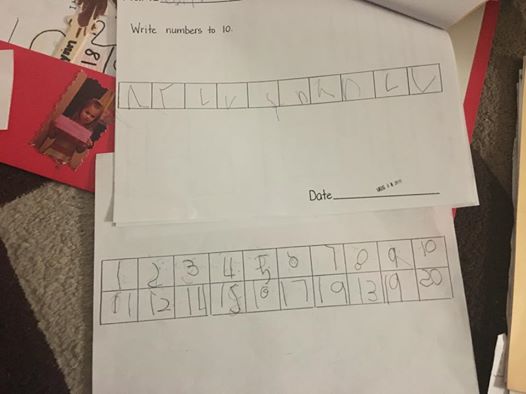
    Math:
    13256476_10207568654947057_3590974633361874637_n

    Really though, writing these numbers is not just math…it’s an occupational therapy success.  Ashlynn has just as much difficulty learning to write because of motor planning difficulties, as she did to speak.  Despite knowing how to write an S for awhile now because it’s in her name, she frequently writes a number 2.  That’s just one example of many.
    13413595_10207656395900526_6755431699833683032_n
    Everything else!


    Drawing and writing:

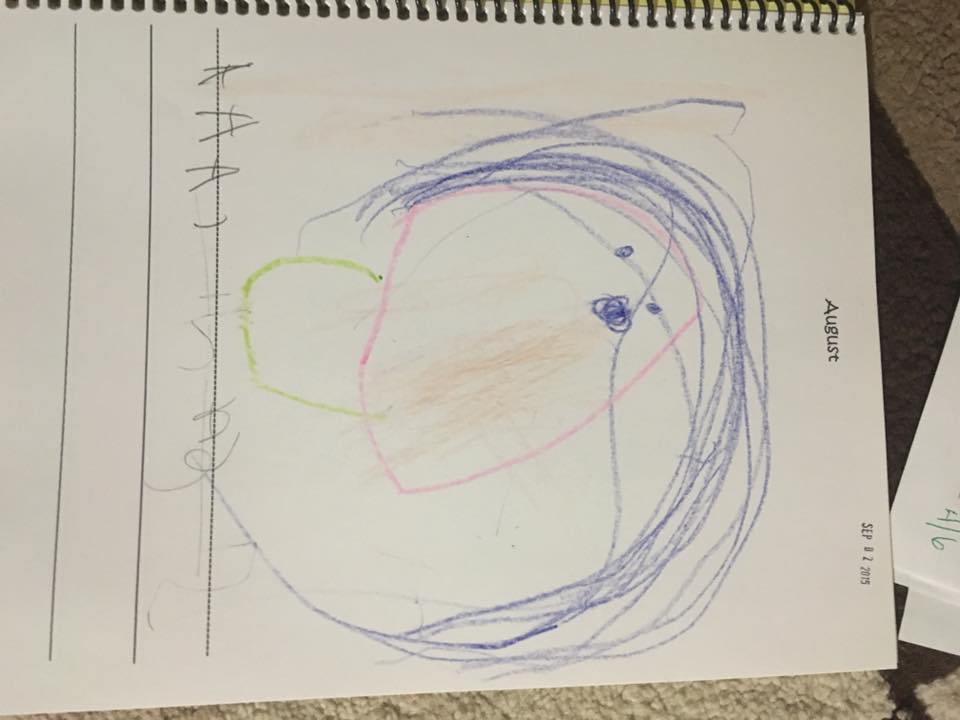
    13315720_10207656395860525_6765699865653698191_n (1)
    Fall 2015
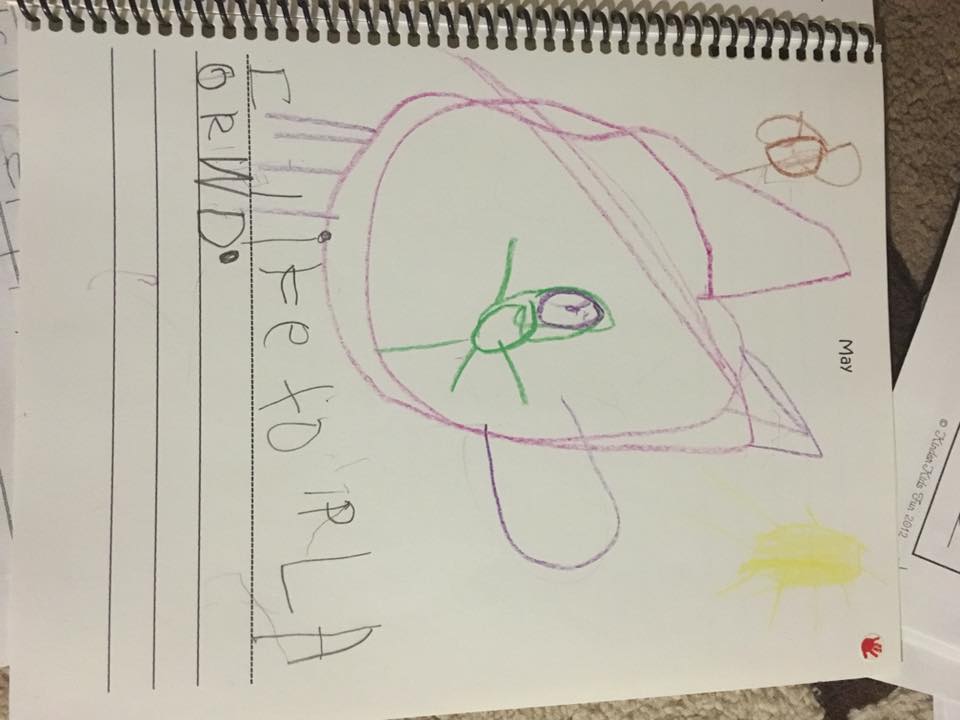
    13336000_10207656396100531_6933608185256392869_n
    Spring 2016

    As much as these pictures make me burst with pride…there is an underlining sadness….guardedness.

    When I first started as an SLPA ( Speech/Language Pathologist Assistant), one of my supervising SLP’s showed me a book.  The book described how children’s drawings correlate to IQ.

    The above pictures show Ashlynn’s progression.  Before I had Ashlynn, I didn’t realize picture drawing could be a measure of disordered motor planning  and NOT IQ…as in her case.  That last picture is after intense intervention.
    13413616_10207656230136382_4466918719341185819_n

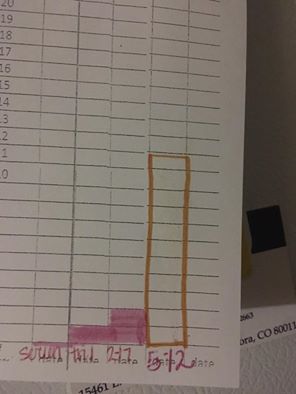
    This last graph looks impressive right?  It IS impressive.  However, it represents the “sight words” Ashlynn learned throughout the year.  When she started, we were still working on identifying uppercase letters, so she made progress on that…but yeah…sight words are going to take a back seat.   She is still abysmally behind where she should be….but if one considers where she has come, it is impressive.

    Ashlynn wasn’t even talking three years ago, so of course, everything else is going to take some time.  The point is though…the most important aspect is that….

    Ashlynn ALWAYS grows.  She ALWAYS progresses.  She was born behind the eight ball.  SIGNIFICANTLY behind the eight ball, but that girl doesn’t give a shit about analogies…or about pool for that matter.  All she does is: WORK

    She WORKS

    Her report card wasn’t terrible.  I really appreciated how throughout the report card they noted Ashlynn works hard and that she made great progress.  So, that’s where we are at.

    One day, when (if) Ashlynn ever reads all I have wrote, I hope she remembers this:

    You are a fighter, but not one of guts and glory, but one of understated grace.  Despite any challenge, you have never wavered from achieving your goals.  I watch you day after day and see how badly you want to read, write, draw, dance and skip.  I don’t know these things because you tell me with loud words and fists banging on the table.  I know these things because I watch  your tireless and humble pursuit of them.

    When you have earned prizes for behavior, you choose books, cards, sticky notes and journals.  You spend your time cutting and writing at your craft table, even though much of what you write is still not legible.  It never deters you.  It never distracts you from your goal.

    At night, you always have cards, papers, or books in your hand.  I come in before bed and place them on your nightstand so you have a place to sleep.  You “read” your stories to your stuffed animals that you call “friends” while your finger tracks words you still can’t read.

    While other children rejoice for the break that is summer, you ask daily when you will go back to school, to first grade, to be exact.  You cheer when I announced we would do homework every morning before we go out and play, and you diligently trace and write your name and letters, making numerous errors despite years of OT now.  I watch you smile and laugh away your mistakes, so forgiving of yourself as you smile and say “oops, I messed up. Let’s try that again.”

    So Ashlynn, if you remember anything in this life, remember where you have come and where you are now.  Remember that where you began, or even where you are at when you read this someday, is NO indication of where you will end up.  Remember that though you are small and sweet, your heart beats the beat of a true fighter.  You are courageous, strong, and brave in the most beautiful of ways.  Humble, kind, and forgiving, even of yourself…..something most adults have yet to master.

    e8a647537621d7096b7e64fa572729c2 (1)b0689e2beab31de00a70983fe49f72c1

    I used to care about failing before I had you.  I was a perfectionist and never wanted to take risks.  You make me realize though, that if we don’t take risks, we never succeed either.  We merely exist.  My life is more amazing now that I take risks.  I don’t fear failure because like you, I can always try again.  Watching you go to battle everyday leaves me with sorry excuses if I don’t do the same.  

    6d6c633c476a7c44f0e5a881d701bf9d

    13238905_10207532072872528_6020557741367204394_n

    Your report card means little to me.  I’m not sure if I’m finally starting to accept the numbers or I’m just having a good night, but it didn’t ruin me like it used to.  Maybe that’s because I see you and I know you will succeed, and Ashlynn, I will do everything in my power to help you.




    db5a3e11243d5a55684eb3e41909f7fcc104cd9bb7d9b9cb431665cb4b8b511d


  • Why I’m angry and even more passionate as we approach the 4th annual Apraxia Awareness Day.

    Why I’m angry and even more passionate as we approach the 4th annual Apraxia Awareness Day.

    I love Apraxia Awareness Day, ever since I celebrated my first one when Ashlynn was new to the dx.  It’s always a time of excitement, renewed hope and resolve, support, and community who comes together filling up facebook and my newsfeed with their apraxia fighters.

    I’ve been honest and open about telling my own early experience with apraxia, which wasn’t much.  I’ve been the first one to admit I barely learned anything about it in graduate school, yet earned my Clinical Certificate of Competence and was for all intents and purposes an “expert.”  Such the expert that I missed it in my own daughter.

    People, that’s a problem!  I was a good student.  I did my best to learn all the content presented to me.  I still didn’t learn about childhood apraxia like I should have, although I should be grateful my graduate school acknowledged it.  I just heard the other day that someone’s professor didn’t *believe* in it.  Didn’t *believe* in it???  Like it’s some damn mythical creature??  Don’t put me in a room with that man, seriously.   I will lose my shit.

    Anyway, I digress.  Tonight I was seeing a client, and her mom had a previous Early Intervention SLP throw out the word apraxia in a flippant way.   She tossed the word around like it was a carefree beach ball bouncing around the pool, and it was only after mom had googled it some 6 months later did she realize apraxia doesn’t carry with it the carefree connotation of summer.  In fact, it’s  a serious dx in which some will never fully overcome.  She expressed her concerns.  The SLP wrote her back to just google apraxia and she would feel better.  If you are anyone who knows anything about apraxia and your are reading this, you KNOW that googling apraxia doesn’t make one feel better.  Better???  Are you kidding me right now??  If ANYTHING, googling apraxia of speech puts a parent on an immediate road to panic!

    The mom was telling me that as much as she’s mad about the disservice done to her daughter, she was more upset about the potential disservice being done to children currently in the SLP’s care who have parents who might not look up apraxia and understand it for the serious dx that it is.  I defended the SLP saying I might not have realized how serious the dx was early on in my career either.  I stressed that THIS is the exact reason I feel awareness is so important and that we have to do our best to spread it where we can.

    I left that session and returned a call from a client I evaluated a month ago.  The mom was basically beside herself.  Her daughter is being seen at a local (renowned) hospital and has been for the past 6 months or so.  Her daughter was born pre-mature with a significant birth history.  As fate would have it, or actually, if you know me, as *concidence* would have it, the NICU SLP ended up being her daughter’s Early Intervention SLP much later.  This woman fell ill, but before she quit she told this mom that she suspected apraxia, even though the child was young.  This mom did what anyone does, googled apraxia.  What happened to her happened to many of you reading this now who googled it for the first time.

    You started reading characteristics and a pit immediately formed in your stomach.  The more you read, the more you saw your own child on those pages and the more scared you became.  Fear and uncertainty crept in.  You eventually try and look for success stories.  You many find some, but you can’t find anything to satisfy you.  You may cry.   Eventually though, you recognize  you are the expert on your child and you are going to get them help no matter what the cost.
    It was after this that this mom found me and drove 2 hours and paid out of pocket for an evaluation.  She had actually said she found my blog, and her daughter sounded very similar to mine.

    As I started the evaluation, this girl actually reminded me of MY daughter.

    Even though the girl was young at 2.5, she cooperated fully with a speech articulation test and a motor speech evaluation.  She had ever single dx marker AND sub-marker of apraxia.  I could literally transpose my awareness day article I wrote for ASHA for Apraxia Awareness Day and she fit every, single one.  Oh, and FYI, to be dx with apraxia, you DON’T need to be dx with every single one!   Forget me and my writing though.  How about the ASHA technical report.  Yeah, she fit all those too.

    Anyway, the mom almost cried and said incredulously, “so you believe me?”

    I felt so bad.  This poor mom.  She knew more than the professionals treating her kid.  She had tried to tell them what her daughter did at home, but she always felt unheard.  That is bullshit.  A mother is an expert on her own child.  Professionals need to LISTEN to the mother.  I’m not saying dx because the mother said so, but don’t dismiss a mother’s concerns or reports.

    Anyway, I wrote my report.  I didn’t even write suspected Childhood Apraxia of Speech like I normally would when I evaluate a 2 year old.  It was THAT obvious.

    Not only did she have the top three markers:
    *Inconsistent errors
    *Difficulty with co-articulatory transitions
    *Disordered prosody (in this case, equal stress patterns on the few two syllables she had)

    but ALSO
    *vowel errors
    *tendency to centralize a vowel to shwaa
    *oral apraxia
    *feeding issues
    *higher receptive than expressive language
    *groping for sounds and words
    *co-morbid fine and gross motor delays
    *no babbling
    *pop out words
    *loss of words
    *low tone

    Anyway.  My report was so thorough anyone who read it would at least be compelled to treat it as suspected CAS.  Right??  Right??

    WRONG

    That was the phone call.  This mom had given them my report hoping that even though they made her feel like SHE was crazy, they would read a report from an SLP with expertise in the area who has a DAUGHTER with it too, and help her.

    NOPE

    “I can see what’s she’s saying, but I still don’t think it’s as dire as she made it seem.  I still don’t think it’s apraxia,” said one SLP.

    Mom is defeated.  The only thing keeping her there is basically no other options, but she’s about to leave.  I was livid.

    I AM livid.

    Okay, this isn’t ego on my part.  At this point, I’m beside myself that if these TWO SLP’s can’t even recognize it’s one of the most obvious cases I’ve had lately, how is this ethical?? How do they read my report listing EVERY dx marker, and still remain firm her speech will come and it’s just because she was premature and has a language delay? Mom is going to leave, but I feel like something else needs to be done for all the other potential kids they will miss.

    Why, WHY would they at the LEAST not say they disagree but would treat it as suspected apraxia?

    How is this still happening?  How after ALL the freaking work CASANA has done, disseminating information, funding research,  awareness efforts they have headed….HOW is this STILL happening??

    I’m sure I’ll be in a better mood Saturday (or I better be since I’m announcing all my giveaway winners), but I’m mad right now.  I’m mad because for all we seem to do, I still hear stories like this.  It’s not okay.  I don’t care if it a rare disorder.  I….DON’T….CARE.  If you are an expert in speech, the experts in speech need to know what they are doing or refer on!!  Heck, I”m really good at stuttering therapy.  I have a bunch of stuttering continued education, but I would never hesitate to refer a child on to an expert who sees it EVERY DAY if a mom had concerns.  In fact, I have recently!

    I’m just shaking my head right now.  If I’m an SLP and I read a report from an outside SLP who specializes in a certain area, I would not roll my eyes.  I would make sure I knew the facts.  I would make sure I learned the facts or consulted others.  I consult others all the time!

    My mentor Deborah told me early on, if I ever hit a stage where I know it all, I need to retire.  Best advice ever.  Her point of course is that we never know it all.  There is always more to learn.

    I’m angry because a mom went through this once.
    I’m angry because a mom and child are going through this again.
    I’m angry because a mom and her child will go through this in the future.
    I’m angry because for every awareness success story I feel like I hear double the failure.
    I’m angry because it’s not just professional, it’s personal.

    You know what? For the 4th Annual Apraxia Awareness Day, I want MORE than awareness.  I WANT change.  I want SLP’s to educate themselves and if they aren’t sure, I want them to put aside their ego and consult someone.

    Is that too damn much to ask?

    26ff8d8e901263fc0635d26b91a4596a

  • Speaking in scripts with a story in her eyes

    Thanks to funding from Small Steps, I have Ashlynn back in therapy with her private SLP, who is also my mentor and now friend.  The other night she was updating me on her progress and what happened in the session.  I take my daughter to her house, so occasionally her husband or dogs may walk by and apparently distract Ashlynn.  She was remarking on Ashlynn’s ability to hold a pretty good conversation.  After she went through a communication exchange Ashlynn had with her husband, I commented that everything Ashlynn said was a script she had been taught.  To a new communication partner, she sounds very adept, but to those who know her, the script rarely changes.

    I went onto say, that though Ashlynn speaks in sentences now, her speech is still predominantly in scripts because crippling word finding deficits and motor planning continue to impede her ability to effectively offer up new and novel information.

    I wrote the other day that I wanted a professional to know Ashlynn like I do, and I know my mentor is the one.  I know because she said this,

    “Yes, it is remarkable really, and not something I think many people, including other SLP’s would understand had they not witnessed her development themselves.  To think Ashynn has been taught everything she says is almost unbelievable even to me.”

    Yes!  Yes!  She gets it!!  She sees how remarkable Ashlynn is!!  Ashlynn does put some novel things together, but they are usually already scripted phrases she has learned and then she may combine them with another scripted phrase.

    SLP’s usually talk about a “language explosion” that most kids have.  Some kids have it late, thus needing speech, but most all will usually experience it.  I remarked that Ashlynn has never had a language explosion.  Never. Everything she has said she has worked for.

    I responded that Ashlynn has always learned, from a young age, to grab onto the scripts that would get her the most bang for her buck socially.  By 1 her first word was “hi” and she could use it to grab anyone’s attention.  By 3 I taught her to say “watcha doin?” which has since been refined but to which she still uses and has actually overgeneralized now to the point that she gets stuck on it and will say it over and over just to keep up the conversation.  In her last year of preschool, the social worker really worked with her to move from parallel play into interactive play by teaching her to say “you want to play with me?” and “do you want to be my friend?”  Once Ashlynn picked this up she was off and running and uses it now frequently in a variety of settings.

    My mentor went onto say that she had asked her about a recent camping trip we had just come back from.  When she mentioned camping, she said Ashlynn’s eyes lit up and danced.  She said she wished she could have been able to get inside her head because though she could see Ashlynn’s eyes dance with stories, Ashlynn took a lot of time before settling on “I ride my bike.”

    “Another script,” I said.

    That’s when the SLP said, “Well, and doesn’t that speak to her cognitive ability?  Being able to pull out and get the scripts that get her the most bang for buck and her ability to look like an effective communicator to a new partner despite only having access to pre-existing scripts in her motor plan….that is really quite remarkable.”

    I smiled.  Yes!  Finally!  Yes it IS remarkable.  It DOES speak to her cognitive ability but also her amazing resilience, ingenuity, and motivation.

    One day I know her word finding difficulties will improve as well.  We work on naming and word recall daily.  However on days when she was with her grandma, she will still call me “grandma….mommy” and on days she has been with me she will call her grandma “mommy…grandma.” She is learning to self-monitor and that is good, though that also speaks to the cognitive ability you MUST have to do these tasks.  Can you imagine?

    First she has to conceptualize the thought, then she has to have the speech motor plan for it but also the word finding.  If she wants to speak on auto-pilot (like we all do taking it for granted), she runs the risk of saying the wrong thing, like calling me grandma even though she knows I’m mommy……or saying it incorrectly (speech sound production), so then she has to monitor her speech and then correct it, but remember, correcting mean having to plan, program, and then re-try accurate execution of what you wanted to say.

    How exhausting is that?  Is it no wonder our kids get frustrated?  Tired?  Discouraged?  It’s no wonder to me; however, what is even more of a wonder to me is Ashlynn never gets frustrated or discouraged.  She’ll laugh.  She’ll try again.  She NEVER gives up.  She is insanely motivated, and for that, I am thankful.  So thankful.  I pray she never loses that.  I pray she will be the communicator she desires to be, the friend she desires to be, and whatever person she desires to be.  I pray I’m doing enough, but for now, I’ll just say a prayer of thanks for the hope that another professional finally sees a glimmer of what I see.


    1e03a96f2d7d101f776eb239f38859a311181815_10205042296109665_1924414283570680916_n

  • Why we’ll never stop working

    Why we’ll never stop working

    I’ve been down lately.  Really, really down.  It pretty much started at Ashlynn’s re-evaluation meeting and went downhill from there.  For all the work she’s done, for how far she has come, for what she knows in the face of so many challenges,  it was like a slap in the face.

    It’s really not anyone’s fault.  It’s just the way it is.  I’m dealing with mixed expressive/receptive language issues now.  I knew this, I did….it’s just seeing those damn numbers.  1st percentile, .5th percentile.  Phew.  Deep breath

    There were also awesome numbers.  Articulation is in the average range.  The AVERAGE range!  That’s phenomenal.  Ashlynn is intelligible to perfect strangers in and out of context.  For someone with apraxia of speech, she beat it in 2 years with a TON of therapy, but she overcame it.

    Now we’re faced with new deficits.  Word finding, expressive language, grammar, syntax, receptive language, memory, attention, writing.

    It was overwhelming.  My husband had tears, and he’s the one who always finds the positives and the “what she can do’s.”

    Even her receptive vocabulary test came back just under the average range.  Receptive vocabulary tests have been shown to correlate with IQ tests (even though I didn’t give her an IQ test), and even though I don’t think the test was totally valid since I’m sure her attention played a factor…..

    It still made me pause.  For once I started thinking, maybe we don’t have this.  Maybe I am dealing with limitations.  Maybe I am in denial.  Maybe I’m not seeing things because I don’t want to see them.

    I would read stories and updates on other blogs and get jealous someone’s child ONLY had apraxia of speech.  CAS is no joke either, but if Ashlynn only had CAS then she would almost be over speech forever!  Sigh.  You know you’re down when you’re jealous of other kids’ disabilities.  That is wrong on so many levels.

    I looked everywhere trying to get my positivity back.  I talked to family, to friends going through this journey too, co-workers…nothing helped.  I poured over pinterest looking for inspirational memes and quotes that were going to change my negativity and squash my doubts.  I found nothing.

    I scoured the internet looking for success stories for global apraxia.  One I found was on disability now but at least happy she had made it through childhood.  That wasn’t exactly lifting my spirits.

    At the same time, I finally read a new research article on Apraxia that’s been in my pile.  The article describes kids with motor planning deficits (kids with apraxia) rely heavily on auditory feedback which was proven when they demonstrated diminished speech articulation in the presence of noise.  Gee, I thought. That’s great these kids found a compensatory strategy to make up for their motor planning deficit, but what happens when you have sensory processing disorder and possibly some receptive language issues that makes that feedback unreliable.  UGH

    But then I found it.  My inspiration was sitting right under my nose.

    I know this guy who has bipolar disorder.  When I met him he was kind of a hot mess.  He hadn’t gone to college, was partying, and constantly getting fired from his jobs.  Of course, having bipolar disorder is very difficult.  There are daily struggles in his mind I will never know.  The statistics for someone with bipolar disorder are less than impressive: 90% of marriages end in divorce when one person is Bipolar.  Less than 50% of people with bipolar take their meds, and 1 in 5 commit suicide.  Many live on disability.  Many are homeless.  This guy though, he’s been married for 10 years with no sign of stopping.  He’s loyal, faithful, hardworking, finished college AFTER his diagnosis, and stays on his medication.  Who is he?

    He’s my husband.  He’s Ashlynn’s dad.  Everything he shouldn’t be doing he’s doing.  Everything he shouldn’t be, he is.  My husband, Ashlynn’s dad, defies statistics.

    Then I started thinking, I know this other guy.  He was raised under an extremely physically abusive, alcoholic father.  His parents ultimately divorced.  He was forced to go to war and and live in actual nightmares.  What are the stats on a guy like this?  Well, since he’s the product of divorce, he’s 40% more likely to end up divorced himself.  He’s four times more likely to be an alcoholic.  As a vet, he faces a higher possibility of homelessness.  What did the future hold for this guy?

    Well, he’s my dad, father of three. Married for 45 years and happily retired.  He’s healthy and has a drink maybe once a year.  My dad, Ashlynn’s grandfather, defies statistics.

    And that’s when I started to realize.  Ashlynn comes from a long line of statistic breakers.  It’s in her blood.

    I thought of me.  Had I defied statistics?  Well, neither of my parents went to college, so it would be less likely I would receive a college degree or much less an advanced degree….yet here I am. It was highly unlikely I would have ended up at Duquesne University for an elite group of SLP’s, yet there was I was last summer.  Maybe I do defy statistics.

    My dad’s nephew years ago was on the wrong track.  He was in jail, and he didn’t know how to make a life for himself after he got out.  He was lost.  He asked my dad for advice and my dad said “keep working.  All I know is to work.”  Years later that same nephew had kept a job and was raising adopted children.  He was not in jail and will never go back.  He told my dad he always remembered his words to just keep working.

    So there it was!  Right under my nose.  We are statistic breakers.  We are hard workers, and Ashlynn is no exception. She always wants to work, do homework, practice writing, ball skills, pedaling, speech, read..you name it.  She attacks it, and I realized, I may not have success stories for her EXACT same situation, but I do have success stories for many other hard or seemingly impossible situations and she will be one too…..if we just keep our head down and

    working.

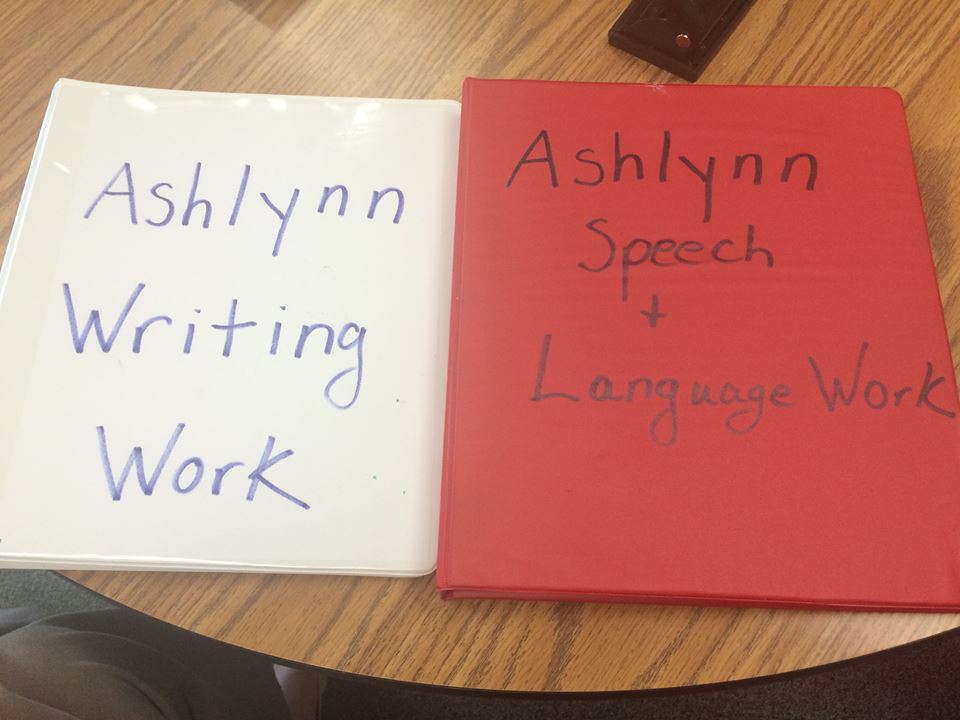
    7e94b6ca15764dd139ba2f8146844331ashlynn work


  • Kaufman DVD and Treatment Kit 1 Giveaway!

    Today is May 1st, which marks the beginning of better speech and hearing month!  More importantly though, the Third Annual Apraxia Awareness Day is May 14!

    To celebrate, I’m offering giveaways all month for apraxia related products.  First up are the immensely popular Kaufman DVD and Instructional Kit 1 COMBO.

    Kaufman_DVD_Kit_1_COMBO_pic_10242014200pm


    This kit was honestly instrumental in helping my daughter cross the bridge from being a nonverbal, ineffective imitator, to  becoming a verbal speaking child.  She did this kit for 9 months until she burned out on it.

    Though my therapy style is based more off of DTTC, I certainly use this kit as a tool for therapy with my own clients.  Many times, parents have borrowed my set and worked on it at home with their children for homework.

    This is a $228.00 value!

    I can’t thank Nancy enough for her generosity in offering this COMBO pack for the giveaway, and especially including the instructional DVD, which is so helpful to see how Nancy uses these cards herself.

    How to Enter:  Enter using the rafflecopter widget below.  Must be a U.S. resident and 18 or older.  Good luck!

    a Rafflecopter giveaway

  • Why nature weighs more heavily than nurture

    Why nature weighs more heavily than nurture

    Nature versus nurture.  It’s a phrase that comes up in my profession, even if it’s unspoken.  I’m in the business of child language development, and nothing raises more eyebrows about nurture than a child who can’t talk…. or who has poor vocabulary knowledge…… or is lacking in language skills.

    Oh it comes up in psychology too.  We’ve all heard the stories of twins separated at birth and raised in different environments.  How do they turn out?  Are they a product of their environment, or did nature play a bigger part?  I don’t really know the answers to those particular studies except what I’ve seen on talk shows like all of you.

    However, I’m here to talk about speech and language development.   I’m a professional in it, but nothing could have taught me more about nature versus nurture than having two of my own children.

    Maybe that’s why it took me until my daughter with CAS was almost three to get tested.  Was I in denial?  What the heck?  Well,  I’ve seen the eyebrows from fellow colleagues about children I’ve treated.  I’ve been privy to the comments, “well, his parents just never read to him!” or  “they just don’t talk to their children” or “those parents anticipate all of his needs that he has no NEED to talk.”  So yeah, I’m pretty sure THOSE comments were exactly why I waited so long.

    Deep breath.

    Teachers and speech/pathologists, we need to talk.  This talk is cancerous.  If only you KNEW what a parent who has a child with delays goes through on a daily basis, you would instantly take back your words.

    I am a speech/language pathologist, and had been practicing five years prior to the birth of my daughter.  I might have been unknowingly pompous once.  Let’s face it, I was.  I was convinced my first child, my daughter, would come out practically gifted.  Heck, I had a master’s degree in childhood language development and disorders.  If anyone could give their child the upper hand, it was going to be this mama.  I remember when she was very young, maybe a month, I had a red and green light rattle that I would slowly move around her visual field.  I even think I wrote on facebook I was having withdrawals from my job and was just doing some “speech therapy” with my child.

    I remember cooing at her, using “motherese,” talking to her while I went about my activities, and even using baby sign with her paired with visual models each time she went to “eat” “drink” or wanted “more.” I remember locking toys out of reach so she would have to request them, demanding some sort of verbal response before she received anything of interest, and having her use AAC on my iPad. We (I) sang nursery rhymes, sang our ABC’s, and had letters all over the house like in the bathtub and on the fridge.  I read religiously to her EVERY, SINGLE, NIGHT.  She was going to be a prodigy.  I just knew it.

    It pains me to write her whole story in this post.  I have an entire blog for that.  Suffice it to say, things didn’t quite turn out as I had envisioned.  Her SLP mama who knew the tips and tricks didn’t seem to know the key to unlocking her voice, or her other motor skills.  Despite nightly therapy sessions, it seemed I was to be the only SLP on the planet who had a child who couldn’t talk.  Who I couldn’t TEACH to talk.  Despite going to work everyday and helping my students find their voice, my daughter struggled with hers.

    Despite throwing myself in research, attending conference after conference on early intervention, or consulting with my colleagues, my daughter STILL struggled to speak.

    I’ve come a long way in this journey, but let’s just say my guilt and feelings of failure for Ashlynn were so strong that I specialized in the disorder.  I love what I do, and I love CAS, but I thought at least if I were a specialist I could finally and truly say I really did EVERYTHING I could to help her.

    “You’re an SLP” you might be saying.  “I have parents who don’t care like that.”

    Let me just tell you, that your parents are now MY parents and I have treated many kids with CAS….and I can tell you with absolute, positive, and definitive truth, that EVERY mother feels or has felt like me.  They may manifest it in different ways, but isn’t that to be expected?  We are all individuals after all.  However, every mother I have met is worried.  Every mother I have met is a praying woman.  Every mother I have met feels helpless.  I felt helpless and I’m a speech pathologist!!!

    My dear colleagues, I don’t want to get another phone call from a mother in Arizona who has a bubbly voice and seemingly carefree personality, confess that despite every night that she lays her head on her pillow pleading with God that her child gets better and praying it was nothing she did, the SLP told her if she had just read to her daughter more, she would have been in a different position.

    This is not okay.

    If you don’t believe that mother, than believe me.  I have finally come to terms with the fact that nothing I could have done would have made my daughter talk on time.  Please, please, don’t add to that mother’s guilt.  I assure you, she is full to the brim already with it….despite the fact there is nothing she could have done.

    I have another SLP mommy I have met now with a child who has CAS get a note from an SLP that stated,”still remains delayed despite excellent familial support.”

    That statement, seemingly benign, implies that that SLP believes nurture plays more than nature, and she is having a difficult time reconciling such delays that are accounted for….GASP…..an actual disorder.

    Friends, speech and language disorders are your livelihood.  Please stop assuming nurture played more of a part.  My son was born in the midst of my daughter’s diagnosis.  He never received the FRACTION of therapy my daughter did, and he said mama at 8 months old.  He went onto to say and do things that left me speechless.  Not  because I doubted him, but because based on my experience with my daughter with global apraxia, I didn’t have to TEACH him any of it!  Time after time, I shook my head asking him, “how can you say that?” or “how can you do that?  I haven’t taught you that yet!”

    If this journey has taught me anything, it’s that speech and language delays really ARE an actual disorder like we all learned in graduate school; and SLP’s, your role couldn’t be more important.  Please don’t taint it by coming in with an assumption “if only they had…..”

    Come in with the assumption that “they have….and they are spent.”  Please, please be the parent’s champion as much as you are the child’s.


    nature vs nurture