Tag: CAS

  • To tell or not to tell……..your child they have apraxia of speech?

    To tell or not to tell……..your child they have apraxia of speech?

    I see a question that gets asked a lot.  In fact, I asked it myself.  It usually goes something along the lines of,

    “Did you tell your child they had apraxia?  If you did, how did you say it? What did you say?”

    I remember thinking when I first saw this question that I wouldn’t tell Ashlynn until way later….and then…maybe if she still seemed apraxic, I would tell her.  I didn’t want her to feel different.  I wanted her to know I believed in her and I wanted her to believe in herself.  I wanted her to know that she can do anything anyone else can do.

    Yep.  That was my stance…..

    Until,

    Sharon Gretz, the executive director of CASANA answered someone’s question.  She made so much sense, I couldn’t help but immediately question my own decision.  She told this parent that it’s important kids know from an early age what their problem is, so they have a name for the difficulties they are facing. Providing a name empowers the child because they realize their struggles are due to something that is real.  In this way, they have a name for the struggles they are experiencing, and don’t develop their own schemas about it.  These schemas anyway, are usually negative and may include: I’m stupid, I’m dumb, or, I’m different.

    Aren’t we as parents the first to tell anyone who questions our child’s abilities that they are smart??  Aren’t we the first people to defend their honor?  What do we use an excuse?  Well, we explain apraxia don’t we?  We defend our children’s honor by labeling them.  Right?

    So, why wouldn’t you offer that SAME defense to your child?  You’re the first one to say your child is smart. I’m the FIRST one to say my child is capable.  If I, if you, truly believe this; can you really think your child doesn’t know they are different?  Do you really think that, or are you just hoping they don’t know?

    I have a feeling it’s the latter.  I have this feeling, because I have hoped the same thing.

    Truth is, Ashlynn has always known.  I remember when she had JUST turned three and was put in preschool as a nonverbal child, the teachers reported she would just laugh when they asked her to do something.  I could see it in their eyes:

    Low cognition
    Poor comprehension

    However, I knew….I KNEW as her mother, that Ashlynn laughed as a coping mechanism because she couldn’t do what was being asked.  It didn’t matter if it was speech or otherwise.  Ashlynn has GLOBAL APRAXIA, meaning overall motor planning difficulties. It didn’t matter what they asked her to do, she couldn’t do it…so…she laughed.

    Every heard of emotional intelligence?  My daughter has it in spades.  If you haven’t, it’s because we live in a society who only values academic intelligence, completely ignoring the fact that a genius who can’t relate to people or get along with people can’t be successful in life.

    No.

    I’m ever so thankful I read that post and the response from Sharon.  Before I was even sure my daughter knew what I was saying, I told her she had apraxia.  Whenever she even remotely paused and looked upset, I would tell her “oh dangit.  That darn apraxia!”

    If you have read my blog for awhile, I talk about apraxia being the new stuttering.  Back in the day, no one wanted to tell a child they stuttered.  Surely they didn’t notice, so you didn’t want to draw attention to it.  Years of research later, low and behold children who stuttered DID know they were different, and instead of understanding their disability, they developed shame.

    Shame is a bitch.  Shame develops when you feel as though you have done something wrong.  If we don’t talk to our kids about apraxia, we risk them feeling ashamed of it.  Apraxia is NOTHING to be ashamed of.

    That leads me to my final thought.

    The walks for apraxia taking place around the country.

    I recently learned so many people think the walk is about awareness.

    I mean, I guess.  I can see that.  Certainly a part of the walks is about awareness.  Publicity leading up to the walk and various news stories all bring awareness and awareness is very good.

    However, it may surprise you to know, especially from me, that the walk itself has very, very little to do with awareness in my eyes.

    The walk, in particular, the medal ceremony, has EVERYTHING to do with honoring our children.

    No shame.

    We HONOR them for their struggle.  We HONOR them for differences.  We HONOR them for their perseverance and hard work..

    We HONOR them.  We RECOGNIZE them.  Their family and friends HONOR them.  Their therapists HONOR them.  We all honor them, because despite the odds, they persist and achieve.  We recognize their achievement in spite of apraxia, and they can feel pride, not shame.

    Even if your child is considered “resolved,” I would urge you to rethink your stance on not telling them. People………..they KNOW.  They may not know what apraxia means, but they know they aren’t like other kids. They know they are different.

    On final thought.  A label should never be used an excuse and trust me, our sweet babes are smart enough to use a label to their advantage.  I’ve definitely heard a story or two about, “oh I can’t do that because I have _____.”

    On the contrary, it’s a teachable moment to say, “It makes it more difficult for you, but YOU are capable and I believe in you.”

    If you don’t believe me, ask my daughter some day!  We are obviously an atypical family because I specialize in apraxia so I see kids all day with apraxia and of course Ashlynn has it; however, my youngest son asked me why he DIDN’T have apraxia.  lol.

    No shame in this house.  Only knowledge…and knowledge is power.

    14067711_10208822639500870_2427710843928303952_n
    Jumping her heart out at a fundraiser for the Apraxia Walk


  • Walker Spotlight: An SLP shares her view on why she walks for her clients AND a bigger cause, by Lynn Zimmerman

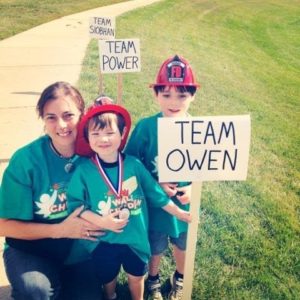
    Last fall, I attended the 2owen014 Denver Walk for Apraxia with a client and his family. In my private practice, I have the privilege of working with many children with CAS and appreciate deeply the work of the CASANA community. Walks such as this, are a beneficial experience to share as a Speech professional with the community of families connected to the cause.
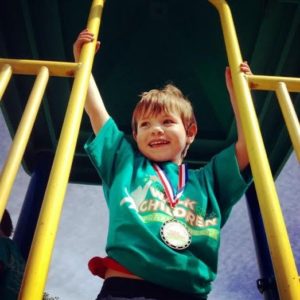
    As Speech Language Pathologists, we dedicate hours, weeks, and sometimes years to developing and nurturing a working relationship with each client — focused on maximizing the child’s communication potential. However, within such relationships, there is rarely opportunity to bond with a client without a progress-centered agenda. Participating in Denver Walk for Apraxia gave me a chance to share leisure time with a long-term client and his family. With no speech drills to practice, we instead spent the morning in the beautiful Colorado sunshine. Charity walks are occasions that, on the surface, raise money and awareness for a cause. But to a child, too young to understand the mission, the event is a celebration of their hard work.  It’s a party full of hope and excitement. As a professional, it was heart-warming to share with a client and family how much the community supports and embraces them.

    These charity walks draw in hundreds of cheerful, open-hearted people to a festive day in honor of families living owen 2with unique circumstances. To these families, who can come to feel isolated, such an event is a tangible manifestation of how supportive and optimistic the world can be. It is an opportunity for children, like those we see on our case-loads, to have fun amidst a friendly gathering in celebration of those on a common journey. Every day, parents strive to balance their child’s intense therapy schedule, frustrating social interactions, sibling relationships, and much more. But, at the event, I delighted in seeing parents bond as peers over their shared experiences and mission.


    While spending time with my client celebrating a charitable mission, I reflected on the idea that, as health professionals, the focus of our practices is on enhancing the lives of individuals. On this single-child basis, working with an SLP can be life-changing but a charity walk is an opportunity to further that statement by standing up on a larger scale for the global community of children like those we help. Donating to a charity that supports research and advocacy for people with communication challenges is a chance to help not just one child at a time, but to promote hope and long-term change in the scope of the cause.


    Lynn Zimmerman MA,CCC-SLP is the owner and primary clinician of Cobblestone Speech Language and Learning LLC, a Littleton, Colorado based pediatric Speech and Language private practice.

  • Interview with “Speaking of Apraxia”

    Interview with “Speaking of Apraxia”

    Hi Leslie!  I’m so happy to have you.  I want to start by asking, what made you decide to write this book?

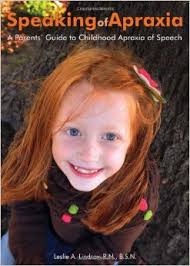
    Oh, I am happy to be here, Laura.  I won’t pretend that SPEAKING OF APRAXIA was in any way ‘easy,’ but it did sort of present itself to me…in the form of my oldest daughter!  I may have been a first-time mom, but I was also a child/adolescent psych/RN and *knew* something was a little amiss with my Kate’s verbal development.  We didn’t want to admit that our baby wasn’t anything less than perfect; still something niggled in the back of my head when she wasn’t cooing and gurgling like most little babies.  I cringed when others told me of their child’s first words.  Mine pointed and grunted.  My heart broke. When Kate was diagnosed (about 2.6 years of age), I wanted a book.  I’m very bookish – and tangible – I like to be able to hold things and refer to them time and time again.  Websites are great, but they can lead to a spiraling search.  SPEAKING OF APRAXIA is a part of a mother’s mission to help her child, but most of all – I wanted a book, I figured there had to be others out there who wanted – and needed – this resource too.

    You are quick to point out you aren’t an SLP, but did enlist the help of an advisory review board to include the latest research and technical information.  Who was on the board and how long did this take for your research?

    This was one of the more tricky aspects of writing a book about a motor neurological speech disorder for the parent community.  I wanted it to be accessible to parents, but I also wanted to get the information right.  Over the course of writing and researching SPEAKING OF APRAXIA, I had “bumped” into some extremely knowledgeable professionals at various conferences, schools, the community, and social media.

    Diane Bahr, CCC-SLP provided much of the technical assistance when it comes to speech and language development.  She practices in Las Vegas, NM and is the author of several books herself. Teri Kaminski-Peterson, CCC-SLP in in Minnesota and works so well with children and her book,  THE BIG BOOK OF EXCLAMATIONS prompted me to connect with her.  Amy, an astute mother raising girls in St. Louis, one of whom suffered from CAS chimed in with the “parent readability;” as did her child’s SLP on some of the more finer points of private practice speech therapy. A preschool-school based SLP who worked with my daughter read over the sections on school, as did Kate’s very first classroom teacher, Lisa Circelli.  I knew shew as a winner when she lowered herself to the floor and spread her arms for a big embrace from my little redheaded sprite bringing me to tears.  Kate was literally in ‘good hands.’

    How long did it take?  I don’t know…it’s like childbirth that way.  Awful and tiresome and painfully intense.  And then it’s over.  You don’t remember, but somehow you have battle scars.  And a precious reminder of your labors.  Conception to shelf: 4 years.

    You describe this in your book, but to give some background to those who might not know you, what age was your daughter Kate diagnosed?  How frequent and often were her therapy sessions, and when would you say she resolved?

    As mentioned earlier, Kate was 2.6 years old when she was finally diagnosed.  I say ‘finally’ as if it were a long wait, but it really wasn’t.  Most speech-language pathologists (SLPs) are more comfortable waiting to diagnose until the child is three years old.  But three years (even two-and-a-half) is a long time to wait and to worry and to schlep your child to appointments.  And have no answers.  Kate was evaluated by her pediatrician who was concerned at 12 months.  And again at 18 months.  We saw a speech-path for the first time around 19 months.  She told us Kate was “definitely delayed.”  A baby sister was born.  My husband was transferred out-of-state.  We moved.  We worried.  We got a definitive diagnosis once we settled in Chicagoland.  The diagnosing SLP still recalls how determined I was to get a “label,” saying I was probably the only parent who just came out and said, “So what is it?!”  She said she knew without a doubt we were dealing with apraxia.  An overwhelming sense of relief and then ‘now what’ enveloped me.  I rolled up my sleeves and dug in!  We were intense about our therapy sessions.  Twice a week for about two years.  Then we added feeding therapy (more on that below) so for awhile she was going to therapy three times a week!  Gradually, we cut it down to twice a week (speech), then once a week (speech) and once a week occupational therapy (OT).  By the time she was a first grader (6 years) we were finished with private therapy – Yahoo!

    Many kids with CAS have co-morbidities such as Sensory Processing Disorder, Autism Spectrum Disorder, and/or Attention Deficit Disorder.  These can all affect prognosis.  Did Kate have any co-morbidities, and how is she doing now?

    “You bet she does!” I say with a grin.  It’s true: CAS is often a ‘package deal;’ a combo platter of CAS and…what-have-you.  In our case, Kate had some sensory integration issues as a younger child (3-5 years old) requiring occupational therapy and feeding therapy (food textures, ‘remembering’ to chew, etc.–quite common for kids with CAS). We absolutely loved the combination of OT and Speech therapy (ST)!  It was the wining combination for our daughter.  There’s actually something to that: the vestibular system works in tandem with the speech centers in the brain – this is one reason why playgrounds are a great place to practice speech work.  When Kate was five, her SLP thought there may be “something more going on,” and that’s when she was diagnosed with AD/HD. We added medication to help control the AD/HD when Kate was a first grader and it helped immensely.  Kate’s speech became more organized as did her behavior.  These things *can* affect prognosis, but there are so many other factors that come into play: parent involvement, school support, the child’s awareness of her (dis)abilities and her ability to self-correct speech mistakes, child’s temperament/intelligence, motivation.  I may be missing some, but you get the idea.  I’m happy to report that Kate is a happy, successful 4th grader – one of her teachers call her ‘wildly creative.’  She even has the writing bug like her ol’mom!

    What do you see as the most important thing an SLP can do to help the parent in this journey?

    Wow.  This is tough.  We’re all different and we all seek different services at different stages in the apraxia journey.  I loved when our SLP listened.  It sounds simple, but having an ear to bend and some validation is huge.  As parents, we’re often at a loss of what to do – but we love our kids so much, we’d move mountains.  Let us be partners, too.  Tell us how and what we can do at home to stimulate and encourage speech.  Don’t disregard our efforts or belittle our worries or concerns, invite us on-board and let us know our efforts matter.

    How have you seen CAS awareness and information change over the years, or have you?

    It’s changed incredibly!  When I first started this journey, I didn’t know where to go for information – aside from the internet -and I felt kind of stigmatized sharing Kate’s “problem” with other parents, neighbors, even family.  Maybe that’s part of the process of coming to terms with things, or maybe there’s just greater awareness.  Over the years, walks have been added to most metropolitan areas, support groups have sprouted up, and now we even have Apraxia Awareness Day in May!

    What would be your biggest piece of advice for parents when faced with this diagnosis?

    Have faith. Partner with your child’s school and/or private SLP.  Do your own research, but don’t freak out about everything you hear or read; you’ll need to access all your critical thinking skills because it’s easy to get overwhelmed or feel as if a diagnosis is all gloom-and-doom.  It’s not, there is a light at the end of the tunnel.  Apraxia is often short-lived; there’s a reason it’s called *childhood* apraxia of speech: it’s typically resolved (or resolving) by the time a child is ten years old. Sure, there may be qualities that remain at times, but this is something your child will overcome with the proper support and therapy from a trained SLP.

    I really liked your chapter on things parents can do at home to help their child.  You have so many creative ideas!  Did you do all of these things and how often would you say your worked with Kate at home on her speech?

    Thanks!  Wow – that means a lot!  We did most *all* of those things listed in the book – either at home, or they may have been things she did with her teachers at the school or her SLP in therapy.  We took the approach of “every-moment-is-a-learning-moment” and pretty much exhausted ourselves (and Kate!) in the process.  But that’s not to say parents *should* be super-tenacious in speech work at home.  It’s not for everyone and kids need time just to be kids – exploring, getting dirty, crafting, experimenting, babbling with their toys.  Encourage and be open to that.  Instead of hovering, to be a ‘hummingbird parent,’ popping in when needed and allowing your child to take the reins/direct her own interests while you support.

    Thank you so much Leslie for your time, spreading CAS awareness, and sharing your book with us for Apraxia Awareness Day!!

    To get this book go here!

    Author Biography

    Leslie Lindsay is a former child/adolesent psychiatric RN at the Mayo Clinic and mother of a daughter with CAS. She is an award-winning author of Speaking of Apraxia: A Parent’s Guide for Childhood Apraxia of Speech (Woodbine House, 2012). Leslie and her family live in the Chicago area where she supports the apraxia community, volunteers at the elementary school, and has turned to her time to writing fiction. She hosts a blog of bestselling and debut fiction author interviews at www.leslielindsay.com.  Like her and follow her on Facebook at: https://www.facebook.com/pages/Speaking-of-Apraxia-A-Parents-Guide-to-Childhood-Apraxia-of-Speech/235772599837084?ref=hl

    Leslie A. Lindsay, R.N., B.S.N. 
    Award-Winning Author of Speaking of Apraxia www.speakingofapraxia.com, www.woodbinehouse.comLeslie Author Pic
    Author interviews, give-a-ways, excerpts, & so much more at www.leslielindsay.com
    Like my Author Facebook Page https://www.facebook.com/LeslieALindsay1?ref=hl
    Follow Me on Twitter www.twitter.com/LeslieLindsay1

     * Note, this post contains affiliate links*

  • Kaufman DVD and Treatment Kit 1 Giveaway!

    Today is May 1st, which marks the beginning of better speech and hearing month!  More importantly though, the Third Annual Apraxia Awareness Day is May 14!

    To celebrate, I’m offering giveaways all month for apraxia related products.  First up are the immensely popular Kaufman DVD and Instructional Kit 1 COMBO.

    Kaufman_DVD_Kit_1_COMBO_pic_10242014200pm


    This kit was honestly instrumental in helping my daughter cross the bridge from being a nonverbal, ineffective imitator, to  becoming a verbal speaking child.  She did this kit for 9 months until she burned out on it.

    Though my therapy style is based more off of DTTC, I certainly use this kit as a tool for therapy with my own clients.  Many times, parents have borrowed my set and worked on it at home with their children for homework.

    This is a $228.00 value!

    I can’t thank Nancy enough for her generosity in offering this COMBO pack for the giveaway, and especially including the instructional DVD, which is so helpful to see how Nancy uses these cards herself.

    How to Enter:  Enter using the rafflecopter widget below.  Must be a U.S. resident and 18 or older.  Good luck!

    a Rafflecopter giveaway

  • Still we rise

    Still we rise

    I received all of Ashlynn’s reports from her re-evaluation.  I knew it would be hard.  It’s hard to read those scores and things about your baby.  However, I was also proud.  So proud of how far she has come.  She is the hardest working child I know.  The social worker and special education teacher seem to understand her the best.  They listed her strengths, which are many.  They were thoughtful in their words, and I could tell they both believe in her success.

    Perhaps that’s why it came more as a shock to read the speech report.  It is too painful to summarize.  Maybe in another blog post, years down the road.  Not now.  Suffice it to say, there were no strengths listed.  So much of what she can’t do (which I know) without praising how far she has come and what she can do.

    I was upset to learn she tested her in the classroom.  Ashlynn’s attention severely impacts performance.   Doesn’t she know this?  Why wouldn’t you take her to a quiet room?

    Well after reading the report, it would seem apparent to me this woman doesn’t like my child and doesn’t see her potential.  Maybe that’s why she continued to only receive 30 minutes of therapy IN the classroom despite a report that says she is severely deficient in essentially every area of speech and language.  I’m not even the most upset about the numbers.  There were things Ashlynn didn’t do on the test I know she can do.  I’ve SEEN her do it. I’m an SLP, I can assure you….she can do it.  Why then didn’t this woman qualify in her report that despite not performing on the test, she can do x,y & z?

    No matter.  I have my answer.

    I guess when you don’t believe in someone, what’s the point in trying?

    I’m crying as I wrote that, but I refuse to cry anymore.  There are people who believe in my daughter, and people who aren’t just me.

    I took her this morning and told her “Ashlynn, I just want you to know you are smart.  You are kind and you’re a hard worker.  You can be anything you want to be.  You can do anything you want to do.”  and you know what that girl said?

    “I know mommy.”

    Before I enter this IEP meeting, I have Maya Angelou’s words running through my head. Ashlynn…..WE WILL RISE

    You may write me down in history
    With your bitter, twisted lies,
    You may tread me in the very dirt
    But still, like dust, I’ll rise.

    Did you want to see me broken?
    Bowed head and lowered eyes?
    Shoulders falling down like teardrops.
    Weakened by my soulful cries.

    You may shoot me with your words,
    You may cut me with your eyes,
    You may kill me with your hatefulness,
    But still, like air, I’ll rise.


    3cfa75c64816eb5cd22428d50ffe2684


  • Pot O’Gold Articulation Game for Apraxia

    Slide1 (2)

    I was finally able to make a new game for my kiddos with enough time to spare for St. Patrick’s Day! This game follows the same idea as my other repetitive games.  Kids have a game board, in this case, a black pot:

    Slide13


    The kids draw a card from the card deck.  If the card contains a shamrock with gold coins, the child collects the amount of coins shown and then practices their targeted speech sound/syllable that amount of times.

    Slide7 (2)


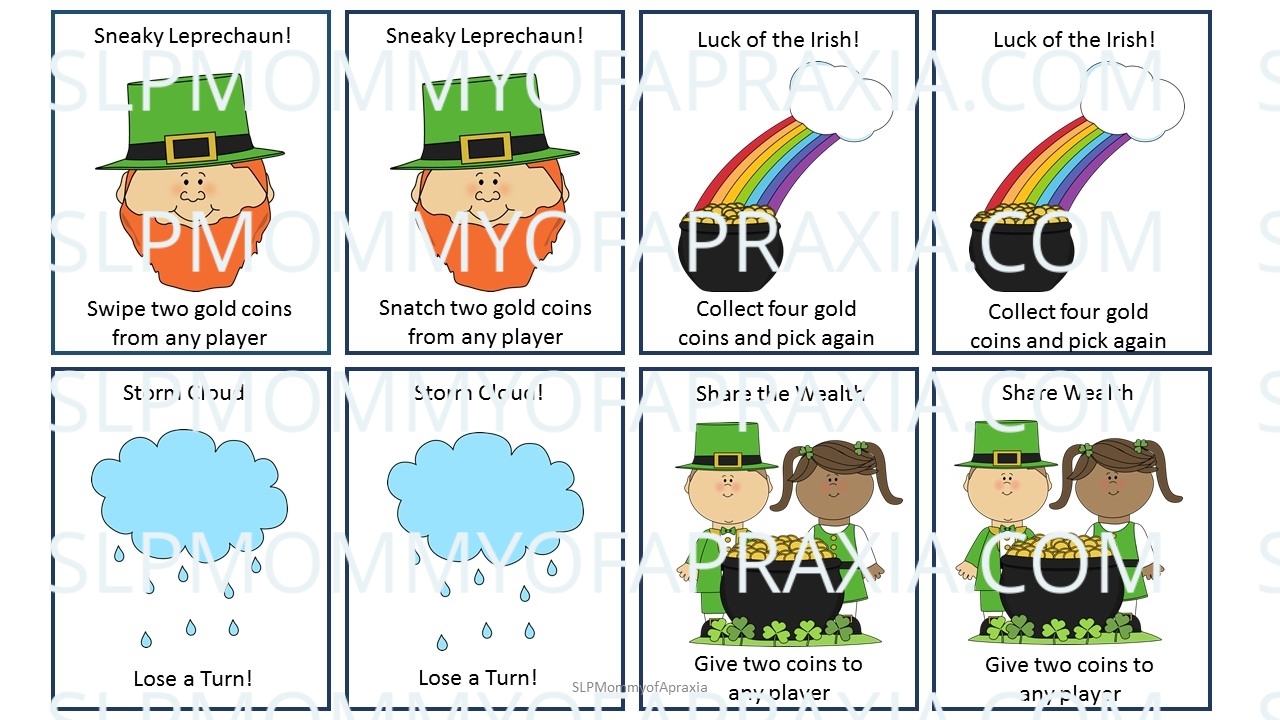
    Some cards have surprise twists that include “snatching coins from other players,” losing a turn, or giving some of their coins to other players.

    Slide11 (2)


    The player with the most coins at the end wins the game! My kids really enjoy these games and I hope kids on your caseload do too!  Enjoy!  Get it in my teachers pay teachers store for free for a short time!