Tag: Carryover for Childhood apraxia of speech

  • Growing up with CAS: Never stop dreaming

    Growing up with CAS: Never stop dreaming

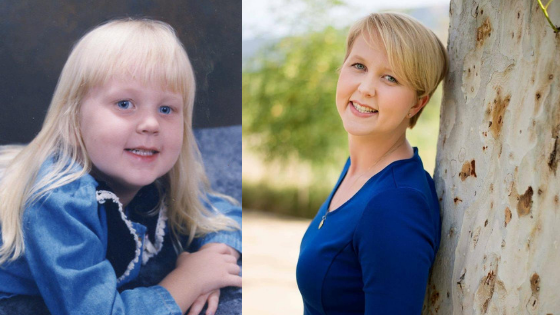
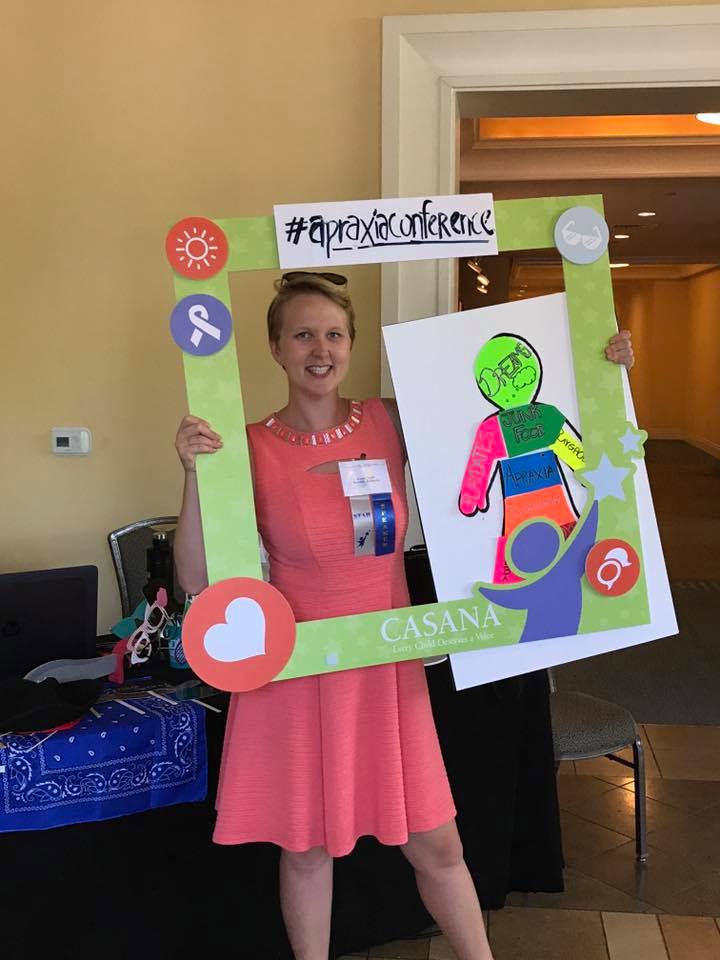
    This month I’m excited to introduce Alyson Taylor! I’ve had the pleasure of hearing Alyson and her mother speak at the Apraxia-Kids National Conference; as well as speaking to her personally on a few occasions.  Alyson is smart, witty, funny and has a great outlook on life!  Oh, and she also grew up with Childhood Apraxia of Speech!  Welcome Aly!
    Can you tell my readers a little bit more about yourself?

    Hello! My name is Alyson Taylor and I am a former child with Apraxia of Speech. It was definitely a long journey-I didn’t fully communicate until I was 7 years old, early special education courses, and 13+ years of speech therapy. Fortunately, the journey itself gave me the strength and wisdom to find success as a young adult.

    With hard work and finding comfort in my speech, today I speak with what sounds like an accent. Despite this I attended and graduated from Emory University with my BA in Political Science and Spanish. I work now as a Paralegal at Thinkwell Group, an Experience Design Company known for their Theme Parks. I also volunteer and advocate for the Apraxia Cause; I’m on the Board of Directors for Apraxia Kids and also maintain my own blog “Girl With A Funny Accent.”

    My family and I understand how difficult the Apraxia Journey was with limited resources in the nineties, so today it’s exciting to contribute these resources for the next generation.

    What do you remember as a child about CAS and speech therapy?

    As a child, I actually didn’t know about CAS. Frankly, I thought I was speaking normally and everyone else had poor hearing. It wasn’t until I was about 9 that I even became aware of Apraxia and that I spoke ‘differently’ than others.

    As far as Speech Therapy, I enjoyed it when I was younger. The time passed quickly between games and toys. Also, my Speech Therapy was rather experimental. I was a Case Study at a local university studying Apraxia and how to treat it, so some of the practices were unique. One of them being peanut butter on the roof of my mouth to direct my tongue on how to say ‘R.’

    Sadly, I grew to resent Speech Therapy around the teen years. Understandably so, I was doing well in my courses, transitioning into higher Honors classes, and playing Varsity sports. Speech Therapy took time away from my personal interests and goals as a teenager, so I quit attending at 15/16 years old. Best and scariest decision I ever made; choosing to live the rest of my life with a Speech Impairment in turn for my personal goals-college, career, and advocacy.

    Were you ever bullied?

    Um, yes!

    Some bullies were worse than others I’ll admit. I knew to ignore them, stay silent, and avoid them. However, there were some bullies that my friends and family helped me with. Thank goodness, right?

    Overall, I’m thankful I had engaged parents and friends that knew when to get involved and help me. I was definitely more patient with bullies than I should have been. Some of my most notable bullies were those following me around the playground, demanding I said ‘Rose’ or ‘Rabbit,’ then laughing when I did or calling me stupid for not responding at all. The other most notable bully was one that threw a snow cone at me during a Cheerleading Fundraiser and suggested that “The Retard to go back to speech.”

    Thankfully that bully didn’t stain the Cheerleading Uniform. Both instances, my parents and my friends were always there to have my back, call the bullies out, and life went on. [On a side note, the snow cone Bully never bothered me again, my Dad had a one-on-one chat.]

    How has apraxia affected your life, or has it?  Do you have any residual issues?

    For one, I still have an accent that I constantly need to explain. This past weekend at a Happy Hour I explained to two bartenders what Apraxia is. Anyone else after who asked, I lied and said I was from London. It tries my patience sometimes, I want to enjoy my night out like anyone else without constantly explaining why I speak the way I do. I know those asking don’t know better, but it does try my friends’ and my own patience sometimes.

    Aside from my personal life, it hasn’t affected my professional life and I’ve been fortunate enough that no one has asked about it during an interview. Additionally, Apraxia gave me the tools I need for success-being resourceful, adaptable, and always working hard to figure it out. These skills help in any field and I truly believe it helped me get to where I am at now.

    Most parents are so worried about the future when their child gets an apraxia diagnosis.  What would you tell them?

    All parents worry about their child and their future-Apraxia or not. Sadly though, Apraxia is an immediate threat to their child’s potential. With it, parents lose hope and quit dreaming for their child to achieve those grandiose goals-like becoming a doctor, a lawyer, a firefighter, etc. They begin to settle for the bare minimum-for them to talk.

    My advice would be to never quit dreaming, to never quit being hopeful for your child. If you’re not hopeful for them, then who else will be?

    What do you wish more people knew about apraxia?

    In the very beginning of the Apraxia Journey, many adults say that their child isn’t speaking. To a certain extent that’s true; however, in a child’s perspective they are in fact communicating. In their heads, they are saying the words correctly yet everyone else cannot understand them. The purpose of speech therapy isn’t only to help the child speak, it’s retraining their mind as to what is considered communication and what is actual gibberish. I wish more people knew that treating Apraxia isn’t only physical practice through therapy, but it’s also mental training. You are changing what a child’s brain determines as the ‘right’ way and the ‘wrong’ way.

    What would you tell a child who is currently struggling to speak or who lives with a dx of CAS?

    1. Find your strengths and interests; cling onto those and appreciate them. We easily know our weaknesses (everyone seems to tell us), but our strengths are what carries us.
    2. Live as if you had nothing to fear or be embarrassed about. (Yes, this means speak up in class when you know the right answer)
    3. Find your friends, stay with your friends, and thank your friends.

    What do you think professionals such as teachers and therapists need to know about CAS?

    Professionals should understand that CAS hinders a child’s execution and delivery, but it does not hinder their intent. A child wants to succeed and be rewarded for their hard work

    Professionals should never confuse lack of delivery for lack of intent. A professional should never claim that a child will never succeed or be rewarded. In either incident, the professional is contributing to a child’s downfall more so than equipping them for success.
    Growing up CAS is part of an ongoing series that aims to celebrate neurodiversity and highlight those who have grown up with Childhood Apraxia of Speech and related struggles.  If you are interested in being featured, send an email to lauraslpmommy@gmail.com


  • Overgeneralization: a caution for clients with CAS

    Overgeneralization: a caution for clients with CAS

    overgeneralization


    Before I knew my daughter Ashlynn had CAS, and before I spent countless hours researching, taking trainings, and becoming an expert in CAS; I was an elementary school SLP.  Like any new SLP, I was relatively inexperienced with CAS.  One year, I transferred schools and a 3rd grade boy with a dx of CAS popped up on my caseload.  Most people, including his mother, still found him very hard to understand.  In her defense, it didn’t help that her first language was Spanish, and this boy only spoke English (apraxic English, you can say).11wwpm

    Anyway, I could understand him most of the time, but his errors were bizarre.  He had an /l/ substitution EVERYWHERE, but mostly for sounds he had not yet acquired including /r/ and /th/.  Some examples: (blown/brown, muller/mother, bruller/brother).

    This was my first experience with “over-generalization” and it’s potential to have a negative  lasting impact on kids with CAS.

    It was not my first experience though with over-generalization.  In kids with phonological disorder, this will happen occasionally.  For example, we might be focused on a pattern, let’s say, /s/ blends.  A child with a phono disorder will usually omit the /s/ in an /s/ consonant cluster.  One of my mentors used this example:

    “I see a star in the sky” would be “I tee a tar in the tye.”  There are a few phono processes going on here, but suffice it to say, the child is still omitting the /s/ which would be considered a consonant cluster reduction.

    When we start targeting /s/ blends, the child will usually (temporarily), start adding an /s/ before every sound. Soon after they learn the pattern without any real long term consequence to existing speech patterns.  This is generally regarded a positive sign with phonological disorder, because the child is showing they are making system-wide changes that are generalizing.

    This is NOT necessarily true if a child has a dx of CAS.  Over-generalization can cause havoc on an already faulty motoric system.  There is a limited research I found regarding this phenomenon; however, there is some in the adult literature regarding acquired apraxia of speech (AOS).   Wambaugh et.al. (1999) found that in adults with apraxia,  sound production training did yield system-wide positive changes in the acquisition of a sound; however, overall maintenance effects exhibited declines in sound production accuracy (intelligibility).  The authors concluded this decline was directly attributed to over-generalization of the taught target sound.  They recommended using multiple sound targets to increase variability and stabilization during training.

    I have searched for more research articles on the subject but have come up empty.  This is NOT to say; however, that it is not a common occurrence.  Research in the field of communication disorders isn’t exactly robust like it is in the medical field.  Even the research we have on apraxia, though more than it was, rarely meets the criteria for the highest level of evidence to be proven effective.  Many times we have to go on our clinical experience, and in treating kids with CAS, I have now seen plenty of cases of over-generalization directly caused by the current therapeutic approach.  Of course, questions like these usually lead to one pursuing a doctorate and doing a research study….but……that is for another time.  lol

    I do feel though I need to write on the topic.  So here it is.

    Therapy for apraxia needs to include many target sounds, sound placements, and syllable shapes.  This is very different from many (most) treatment approaches for other speech sound disorders.  Let me give you some examples.

    In articulation approaches, therapy focuses on one sound.  They work to get accuracy and generalization for that particular sound in many different places of words: initial, medial, and final.  Therapy then progresses from word, to phrase, to sentence, to conversation.

    In phonologic approaches, therapy focuses on patterns of errors.  For example, in a popular Cycles approach, kids consistently may delete final consonants (ca/cat, do/dog) or leave off consonant clusters (tar/star, no/snow), to name a few.  Therapy would then focus on including final consonants, or consonant clusters.

    These are common approaches to most speech sound disorders.  These are what most SLP’s will have experience with.  They will have seen these in their internships.  It’s no surprise then when we fall back on these therapies.

    However, this WILL not do for apraxia.  Let me give you many personal examples I have now seen in my experience.

    For my first example, let’s go back to my 3rd grade boy with crazy /l/ substitutions.  Recall he had a history of apraxia and when I met him he was substituting /l/ for sounds he had not yet acquired (r, th).  If you are an SLP, you will know this is a pretty unusual error.  It was also an error that, at the time, before I knew motor learning principles, I had an INCREDIBLE difficult time extinguishing.  I can’t help but wonder (actually I’m really sure now), that the child had fairly good apraxia therapy, and probably was working on /l/.  At younger ages, we typically don’t work on later developing sounds such as /th/ and /r/.  However, he overgeneralized ALL of his errors to mean he needed to produce an /l/ and there I met him in 3rd grade, and what I saw was a child now saying /l/ for every sound he still had in error.

    My second example is a child who has a TON of language, but who is severely apraxic.  Unlike my daughter, he can tell stories for hours, but the sounds are completely muddled, jumbled, and in no sensible order.  At the word level he would remember to include final consonants, but at the conversational level all of his final consonants were omitted.  I am working with his school SLP who is amazing, and she noticed this pattern (phonological disorders and apraxia CAN co-exist), and decided to remediate it.  She remediated it SO well, he was adding final consonant sounds to syllables and/or words he had previously mastered that DID NOT have a final consonant.  One phone call revealed the error, and we both worked feverishly to rid him of this overgeneralization pattern.  We were able to do it, but only after using principles of motor learning.  Had she not been so open, there is not doubt in my mind he would still be adding these final consonants to every word. Much like my first example, established motor plans in a child with apraxia is VERY hard to extinguish.

    My third example includes a child I started seeing in the very early stages.  Though she was able to say many early developing sounds in isolation, she had extreme difficulty sequencing them correctly at the word level.  I was seeing her along with another private SLP and school SLP.   Early on, she made incredible progress.  The other SLP’s  were using Kaufman cards, and the first set of Kaufman cards account for all the variables I mentioned above: varying sounds, sound positions, and syllable shapes.  When you are dealing with a motor planning disorder, a “sequencing” disorder, these three things are very important. In fact, Nancy Kaufman herself describes her method on her website as:

    This is performed through using cues, fading cues, using powerful and strategic reinforcement (motor learning principles), errorless teaching (cueing before failure), gaining many responses within a session, and mixing in varying tasks to avoid over generalization.

    Only problem with example number 3 is that she progressed beyond the level 1 cards and so the SLP defaulted on what she knows.  This client wasn’t producing any fricatives (s, f, sh) so she started with the fricative (/f/) and starting hitting it hard.  The result?  My shared client is now using this taught phoneme for all other current fricatives and errored phonemes, and getting her to eliminate this now very strong motor plan is taking longer than expected.  What SHOULD have happened is that we target all fricatives now (a variety of sounds) in all word positions and stimulable syllable shapes, STILL using the principles of motor learning theory.

    Overgeneralization.  It’s a PROBLEM in CAS.  If you are an SLP and you start seeing this, you need to look at what you need to change.  It’s not a positive indicator like it is for phonological disorder.  You are literally carving incorrect motor plans. Remember, we cannot focus on a single sound.   We cannot focus on a single pattern.  We cannot focus on a single word position.  We cannot focus on a single syllable shape.  We have to choose targets that are variating ALL of the above that are including sounds within a child’s repertoire.  If we don’t, we are going to have a kid with apraxia overgeneralize what we have taught them, and it’s going to cause havoc on their motor system, and potentially make them even less intelligible.

    In addition, you will always hear me talk about wasting TIME.  Time is so, SO precious to a parent with apraxia, more specifically, getting a child to improve as quickly as possible.

    This is ALSO why it’s SO important that even after a child has resolved, a dx of CAS always be included in the case history, because principles of motor learning theory are still the most effective in driving treatment.  This is true even when you have moved on to grammar or additional language targets.  Apraxia is a different monster.  Educate yourself.  Learn more. Vist apraxia-kids.org.

    30022940f


    Resources:
    Wambaugh, J. L., Martinez, A. L., McNeil, M. R., & Rogers, M. A. (1999). Sound production treatment for apraxia of speech: Overgeneralization and maintenance effects. Aphasiology, 13(9-11), 821-837.


  • Strategies to promote speech and language in the pre-verbal or minimally verbal child with Apraxia

    Strategies to promote speech and language in the pre-verbal or minimally verbal child with Apraxia

    The great thing about speech and language, is that it a task that can be worked on in any activity.  Familiar routines in the home provide the perfect platform for encouraging speech and language, because this “routinized language” is predictable and context based.

    A fellow SLP and mommy of apraxia, Kim from Landonjourney.blogspot.com and I teamed up for Part I in my series of parent strategies to promote speech at home.  We wrote a list of some of the most effective strategies to encourage early speech in the pre-verbal child, including those with Childhood Apraxia of Speech (CAS).  Part II in the series will focus on strategies for the verbal child with CAS.

    Parents ask a lot, “How do I get my child to practice speech at home?”  Well, we are here to tell you, you don’t need worksheets and flashcards.  Basically, with kids who are minimally verbal, we look for opportunities to model and encourage functional language.  Functional language refers to language the child is more apt to use frequently throughout their day, or may be highly motivating to them.

    With kids who have apraxia, not only do we think just about functional language, but words that also contain simple syllable structures.    These are some of our favorite strategies and targets and how we incorporate them:


    Powerful motivators:

    As moms, Kim and I know that when you have a child who is nonverbal, you anticipate their needs for them.  After all, our babies can’t tell us when they hurt, or where they hurt if they are crying.  They can’t tell us they’re hungry or thirsty; and if they have global apraxia like our kids, they may even have trouble pointing to communicate to us that way.  However, as SLP’s we know that kids need to be motivated to communicate.  If we keep anticipating their needs, they never have a reason to really force themselves to try at something they know is hard for them anyway.   As the parent, you are truly the best person to encourage them to try, even when it’s hard.

    Teach and pair signs with a verbal model:

    Some worry that teaching sign will inhibit speech; however, as long as you make sure to always pair sign with verbal models and give verbal reinforcement after the child uses a sign, sign language can be a powerful bridge to helping the child say it once they begin speaking.

    • “help” “more” “go” and “bye” are good beginning signs to teach. Always provide a verbal model when you sign to your child, but encourage your child to sign, and reinforce any attempt by repeating the word and modeling the sign before giving your child what they want.

    Cloze activities:

    • Cloze activities are great for our kids with CAS because their mouth/body gets ready to respond, and the response is familiar. It reduces cognitive allocation and helps get the motor plan “set.” We do cloze for everything.
      • “Turn the music (pause) ” on, and wait for “on.”
      • “Ready, set (pause)” go!  We do “go” at every green light and I start the sentence and he tries to finish it. This has helped him feel more success at speaking “on command.”
      • “One, two _____” three!
      • Sing nursery rhymes and pause before the last word.  Ashlynn and I would sing “The Itsy Bitsy Spider” and “The Wheels on the Bus” and I would pause before some words that had simpler syllable structures.  For example “down came the rain and washed the spider (pause) out.” or “The wheels on the (pause) bus go round and round.”
      • Read repetitive story books, pausing before the predictable repetitive words.  To read more about repetitive books and to get a free download on how to use them visit my on repetitive books that are great for apraxia.

        • Keep reading for more cloze ideas. 

    Require your child to respond to your yes/no questions:

    • assessing your child’s understanding (i.e. Do you want to go outside?) can often be done with simple yes/no questions before your child is verbally able to respond more.
      • I require my child to answer yes/no questions in anyway he can. Before he could nod/shake his head (difficult for motor planning), I modeled the response based on how I knew he reacted.  Do you want help? (giggle giggle). Yes (nodding my head), I want help. I had to physically move his head before he was able to do this. Now, I will say “yes” or “no” and wait.  This has also helped my son to be able to say yes/no, and they are words we have targeted often. 

    Focus on functional words:

                (These are some of our favorites, but individualize them for your child!)

    1. Bye-bye

                * Bye bye is good because it can also signal the end to an activity if the child cannot say “more.” We say bye to each activity, place, and even to our toys at bedtime.  This works on the motor planning for waving, and then saying bye bye.

    1. In

                * Emphasize each time you put them in: bed, the bath, car-seat, highchair, stroller, park swing.

    * Model when pouring a drink in their cup etc.

    1. Out

                * Emphasize each time you take them out of: crib, bath, car-seat, highchair, stroller, park swing

    * In the kitchen, model each time you take food out of a container, the fridge, a cupboard.

    * In the bathroom, model when squeezing out: toothpaste, shampoo, tissue, diaper wipes, etc.

    1. On

    * Emphasize each time you put music on, water on, lights on.

    * In the bath, “ok let’s turn the water (pause) on.

    1. Down

    * Emphasize when going down the stairs, getting them down from highchair, putting them down,                                       when something falls down, playing “Ring Around the Rosie,” etc.

    * Use a cloze procedure here too, “uh oh! The cup fell (pause) down.” Or “We all fall (pause)                                                down.”

    Again, these are some of our favorites, but work with your SLP to determine your own that work for your child.  Other suggestions:

    Uh oh

    Hi

    Nigh-Night

    More (Mo)

    Child’s age

    Mama

    Dada

    Put

    Done

    Do

    Set activities to song:

    • Based off of research done with melodic intonation therapy, music can provide a bridge to stimulate language.
    • Have fun and make up your own silly songs set to melodies you already know, to make it easy.
      • During bath time, I would sing a body parts song to Ashlynn set to the tune of “Mary Had a Little Lamb”:
        • “Now we’re washing Ashlynn’s hands, Ashlynn’s hands, Ashlynn’s hands, Now we’re washing Ashlynn’s hands while we are taking a bath.”  You can use a cloze procedure here too: “while we are taking a (pause) bath.” 
    • To get on demand phonation, something that is hard for our kiddos,  set songs to Row, Row your Boat and change it to:
      • Row, row, row your boat, gently down the stream, if you see your feet, don’t forget to scream. For my son, this song works to assess areas that he often can’t tell me/show me on command, but in a song, he gets his body ready and is more interested/able to do so.

     Repeat and reinforce spontaneous utterances.  

    • If your child says a sound or word, try to say it back at them and encourage them to say it again.  On demand speech is hard for our kids, so getting them to imitate back to you might be easier when you first imitate something they just said.
      • Ashlynn had a “go to” sound “a dah” that she said for everything.  I would tell her, “a dah?  dah dah, dah, dah” and see if I could get her to say it again on demand.  If she did, then I would change the vowel and see if I could get that on demand, “a dee, dee, dee, dee.”  Play around with sounds and have fun with your child.  This should be a low stress activity and just seem like fun to your child.

    Praise and Encourage ALL communicative attempts           

    • Our kids know talking is hard. A little bit of praise goes a long way!

    Laura Smith M.A. CCC-SLP is a speech/language pathologist in the Denver Metro Area specializing in Childhood Apraxia of Speech.  CASANA recognized for advanced training and expertise in Childhood Apraxia of Speech, she splits her time between the public schools and the private sector.  She is dedicated to spreading CAS awareness.  Her passion is fueled by all of her clients, but especially her own daughter who was diagnosed with Childhood Apraxia of Speech.  For more information visit SLPMommyofApraxia.com  

    Kimberly Haas-McEneny M.S. CCC-SLP, mom to two boys: one with CAS and the other with suspected CAS.  Kim is a Bilingual SLP practicing in Syracuse, NY at the Syracuse City School District. She blogs about her experiences with being both a mom and SLP at landonjourney.blogspot.com

    Parent strategies


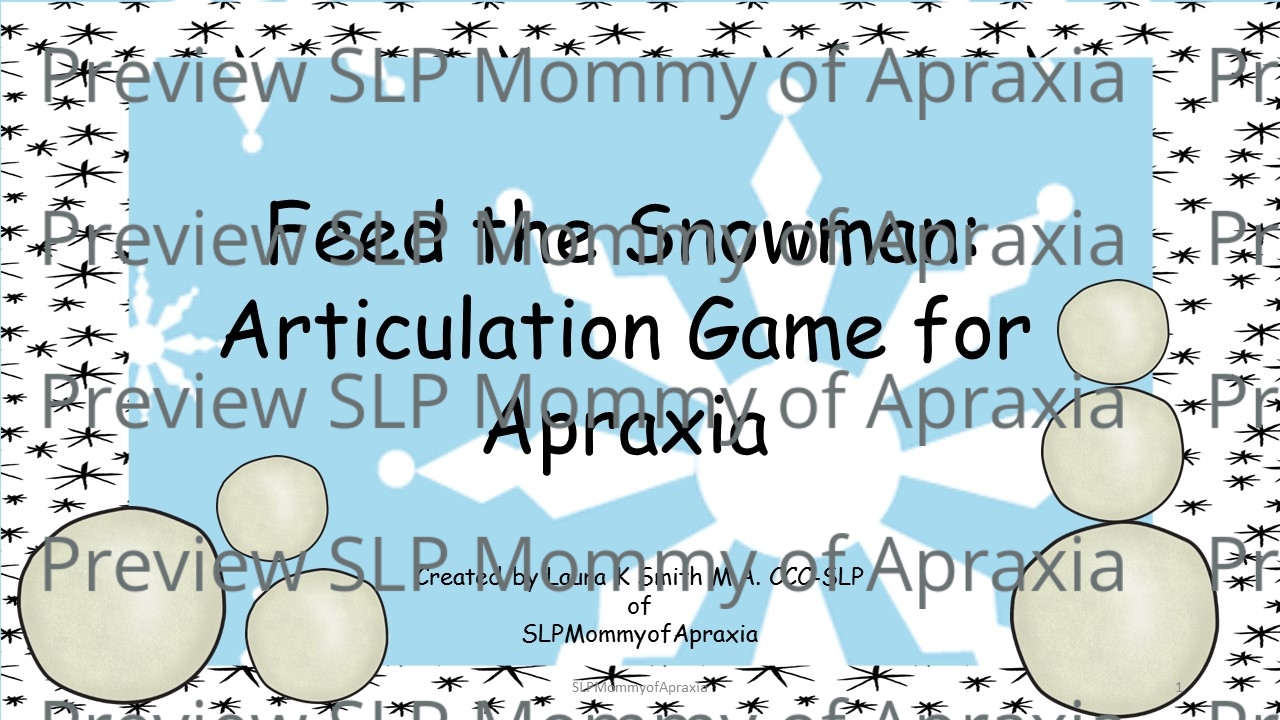
  • Feed the Snowman Articulation Game for high repetitions

    Feed the Snowman Articulation Game for high repetitions

    Slide1

    I decided since my Spooky SpiderWeb game was so popular, I’d make another one for my kids with a winter snow theme.  I go back to work tomorrow and I’m excited to play this with the kids.

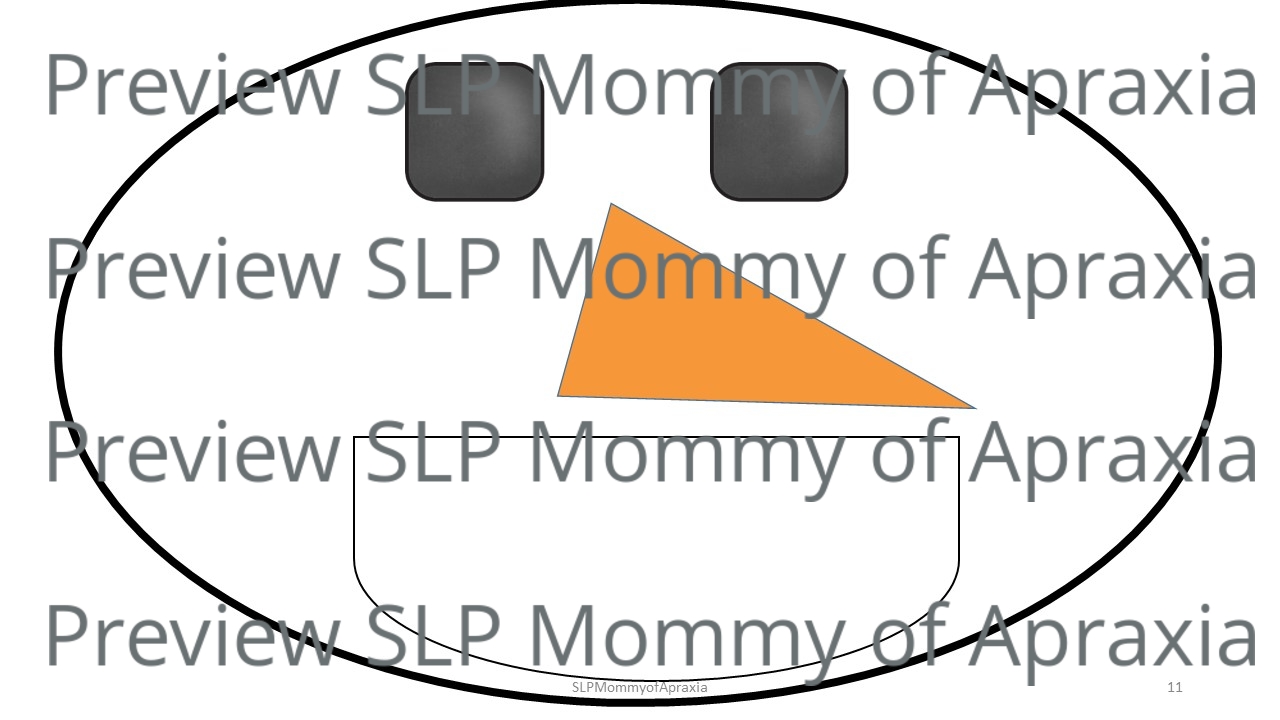
    You start with printing out the snowman boards. Glue onto a manila envelope or cereal box and cut out the mouth.


    Slide11


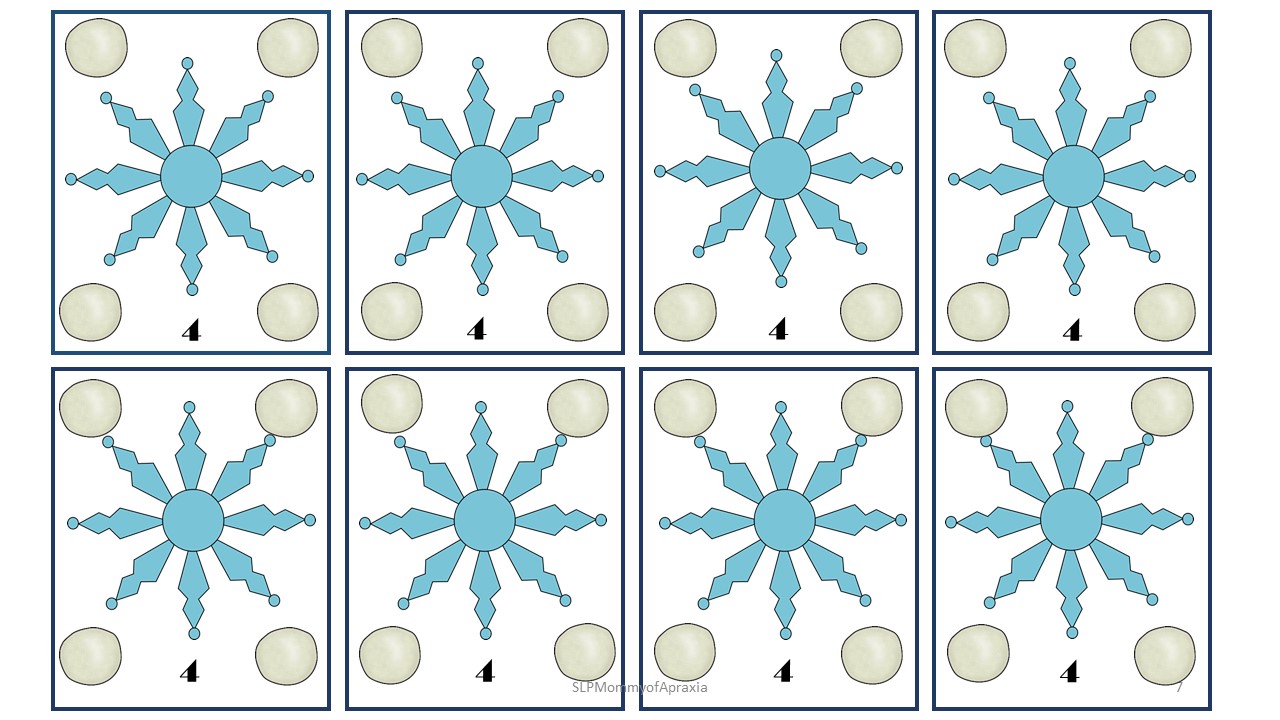
    Then cut out the game cards and snow balls.  Cutting out the snowball will be a bit tedious, but if you laminate them, then you’ll never have to do it again!

    Slide6 Slide7


    The snowflake game cards come with pages containing 1-4 snowballs.  The child picks a card, and then gets to feed his/her snowman the number of balls on the card.  Of course, the number of snowballs dictates the amount of times the child must say their target word or sound.

    The snowman with the most snowballs wins!  Get it FREE in my TpT store for a limited time.  Follow me there or here so you don’t miss out on any freebies.

  • Ashlynn summer speech therapy 3.9 years

    Ashlynn summer speech therapy 3.9 years

    Ashlynn received two grants to help with her speech and occupational therapy over the summer!  The United Health Care Foundation and the Lindsay Foundation made it possible!  I am so grateful.  Ashlynn will be back to getting intensive 1:1 speech and OT services.  

    As far as speech goes, Ashlynn communicates her wants and needs.  She has basic conversational skills and really does try to tell us what happened in her day.  Sometimes when she’s talking, I see my husband look at her with pride in his eye and I know what he’s thinking.   Even though we don’t always understand what she is saying, it is amazing to listen to her talk and try to tell us things.  She was silent for so long.  
    I love her speech therapist.  She was actually my mentor and is now one of my good friends.  She’s fun, but I also know she’ll push her.  However, I also know she’ll find the deficits and the continued deficits are hard to be faced with and make me sad.  I want to write it down though, because if I know anything about Ashlynn, I know she’ll overcome it.
    – She has significant word finding issues.  Sometimes, she needs so much wait time that eventually she even forgets what she wanted to say and moves onto something else.  
    – Her attention continues to negatively impact her progress
    – When something is hard, she changes the subject and tries to talk about something else
    – Auditory processing skills such as auditory discrimination between minimal pairs (sleep, seep) appear to be impacted.  
    – Grammar, including marking varying tenses and using s/v agreement along with pronoun usage are faulty
    – Syntax is jumbled, particularly for question forms
    – Still has a tendency to assimilate sounds she knows how to say (goggy/doggy), and continues to be inconsistent with her production of consonants in her repertoire (koys/toys). 
    – Needs continued work with /l/ and /r/
    – Continues to breakdown with novel multi-syllabic words
    – Receptive language skills continue to need monitoring
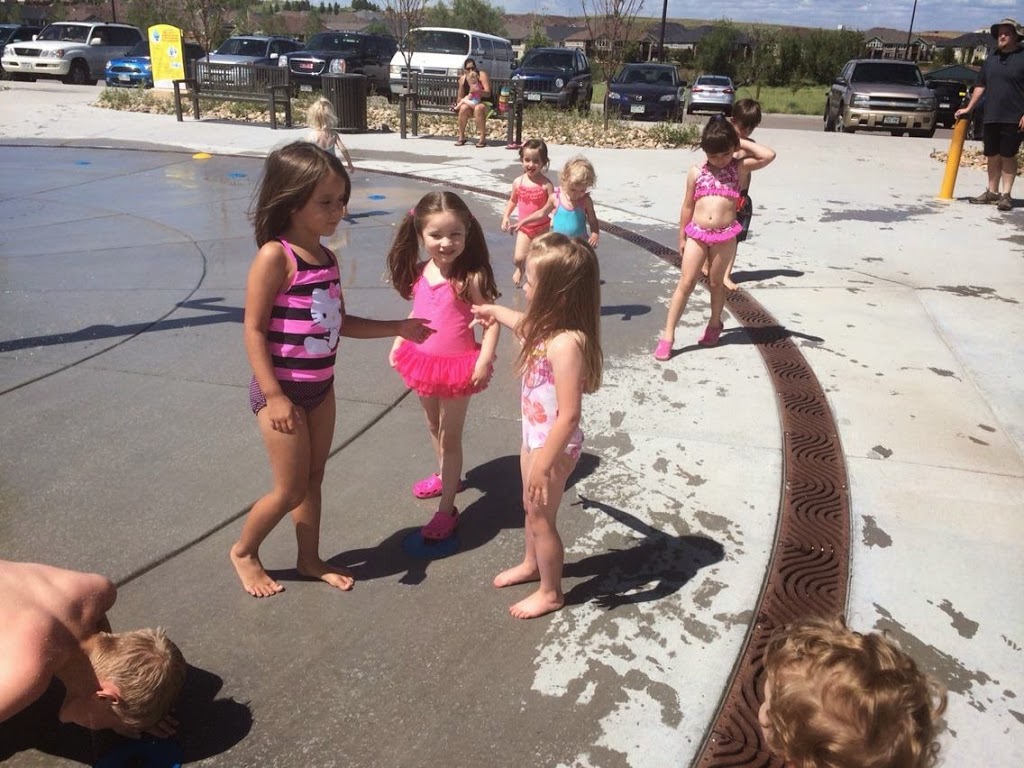
    That’s a long list, but I have to remind myself it used to be longer.  She’ll get there.  I know it.  There was a time I worried if she would ever make friends because she couldn’t talk to them.  Here she is at the splash park talking to perfect strangers and making friends.  One step at a time.
  • January book of the month: The Jacket I Wear in the Snow

    January book of the month: The Jacket I Wear in the Snow

    Winter is in full swing, and there is no shortage of books that talk about winter, snow, and winter clothing vocabulary. Also, the preschool in my district has winter clothing vocabulary on as part of the curriculum, so it’s perfect!

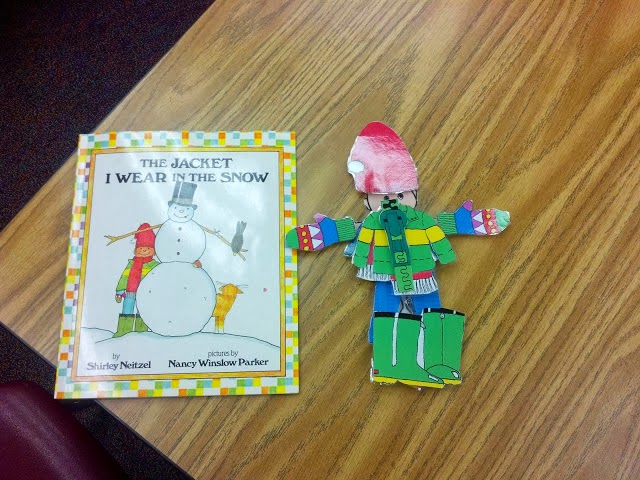
    The book is a repetitive, rebus style book that is great for practicing vocabulary, early reading skills, sequencing, and as always speech!

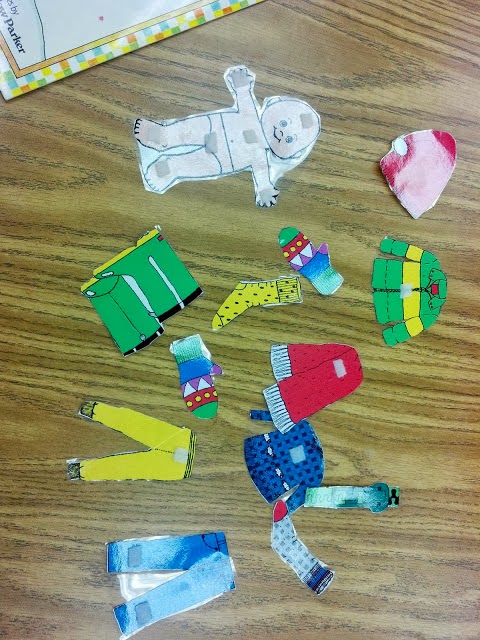
    I started with some cutouts from the story I found here:
    Winter clothes

    Then I printed them out, laminated them, and put velcro on so that the kids could dress the boy.  I used a printout doll from the website you can find here: Paper dolls

    This was the final result and it’s just so darn cute! All my kids from preschool up to even 4th grade love dressing up the boy.  For my speech kids, I strategically pick a clothing item for a sound they are working on.  There are a lot of good options including ‘s’ blend words that seem to be a constant therapy target for at least one group a year.  For a child with apraxia, there are some good basic CVC words you can use (i.e. cap, boot, sock,), or in my daughter’s case since her speech is improving so much, I gave her most of the cards and she had to practice recall while I read the book.  The use of the cutouts provide a visual and tactile aid to help kids learn and recall the vocabulary, so you will see I try to make cutouts to go with books I have whenever I can get my hands on them.  Unfortunately, I’m not very talented in the drawing department, so I have to rely on other sources as you see I did here!

     For my older kids, we did silly things to practice following directions with spatial concepts: on top, under, over, etc to work on receptive language, and then they had to do a retell.  Again, the visuals really help in being able to sequence and retell the story for those kiddos who have weaknesses with language processing.