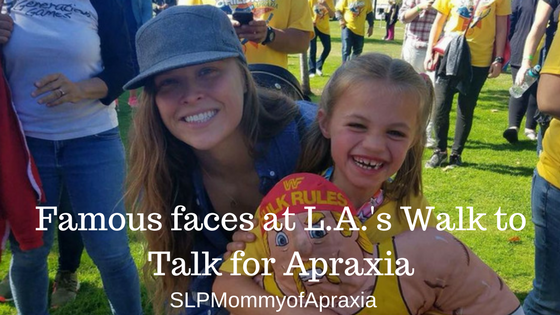
Tag: Apraxia

  • Famous Faces Walk for Apraxia in L.A’s Walk to Talk!

    Famous Faces Walk for Apraxia in L.A’s Walk to Talk!

    [wysija_form id=”1″]

    It almost seems crazy now, but just 3 years ago Apraxia didn’t have a face. There was not ONE well known person who had fought apraxia and overcome.  I was an SLP before my daughter was born and I can tell you after she was diagnosed, even though I was an SLP, the fear, worry, and guilt that gripped me hung onto me and wouldn’t let me go.

    It haunted me. It would keep me up at night.

    I would scour the internet but I could not find one famous person who had apraxia. Stuttering has faces.  Dyslexia has faces.  Down syndrome has faces.  Autism has faces of successful people living their dreams, but apraxia? Nope.

    The fear in my heart would threaten to overtake me at times.

    I remember wishing and praying with every ounce of my being that apraxia had a face.  Not even a spokesperson, but JUST a face that I could look at and say, “hey, that person had apraxia and look at them now.”  I tried to follow the advice of Ghandi who said “Be the change you wish to see in the world,” and I started my blog and my facebook page in an attempt to spread awareness.   I could have never dreamt or even prayed that awareness would come after I would read a Rolling Stone Article, an article whose first paragraph read like a case history for apraxia; and I would find myself standing in the rain that very night with my daughter waiting to ask Ronda Rousey if the speech impediment she had when she was little was in fact apraxia.  

    Since that time I have now met many, many faces of apraxia and I have found many of them in the unlikeliest of places. Mikey from Mikey’s Wish is one of them. This 16 year old boy from the UK started a Facebook page around the same time I started mine,  and he is probably one of my favorite faces who is always doing and writing amazing things and encouraging Ashlynn.

    This past weekend I once again packed my daughter up in tow on a wild adventure to go to L.A.’s Walk To Talk for Apraxia to benefit the Childhood Apraxia of Speech Association of North America.  Unlike the time I drove across town during rush hour and waited in the rain to see Ronda, this trip had more merit.  Ronda Rousey was confirmed to be a guest speaker and I knew if I didn’t go I would forever have regretted it.

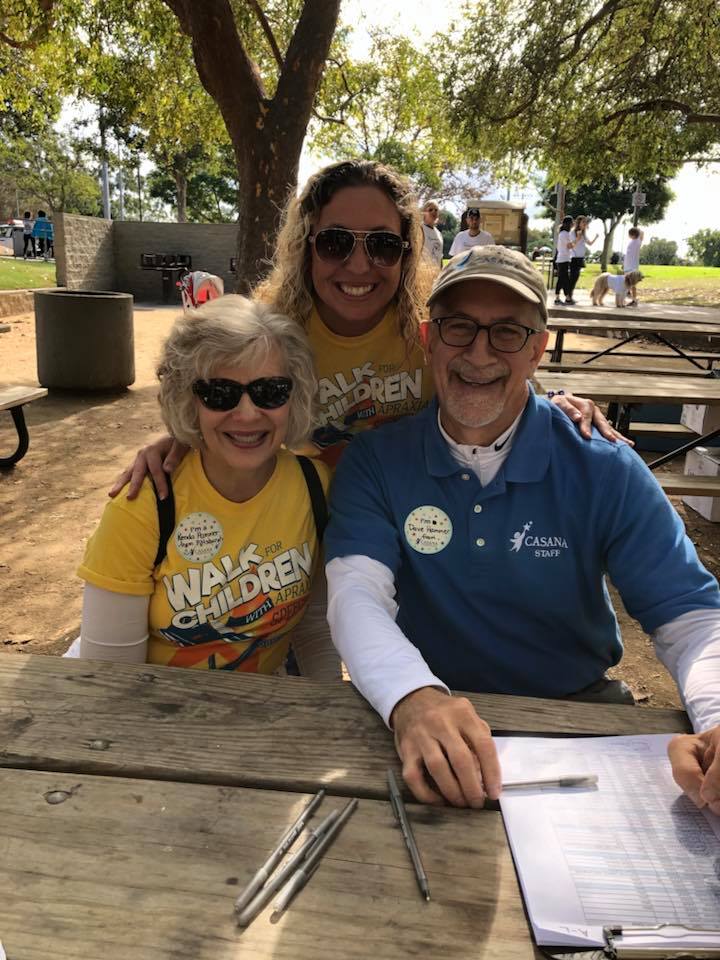
    Upon arriving at the walk, we happened to park our rental car next to my fellow apraxia mom and admin to the group Ronda Rousey: #knockoutapraxia, Bree Vanegas who drove down from Inland Empire, California.  As we walked to the registration table together, I saw one of my bootcamp apraxia mentors and apraxia SLP extraordinaire Dave Hammer.  He had come out from Pittsburgh as a rep for CASANA.  His wife Kenda was also there and I was excited to see them.  Ashlynn loved Kenda and they bonded while walking around the park petting the puppies.
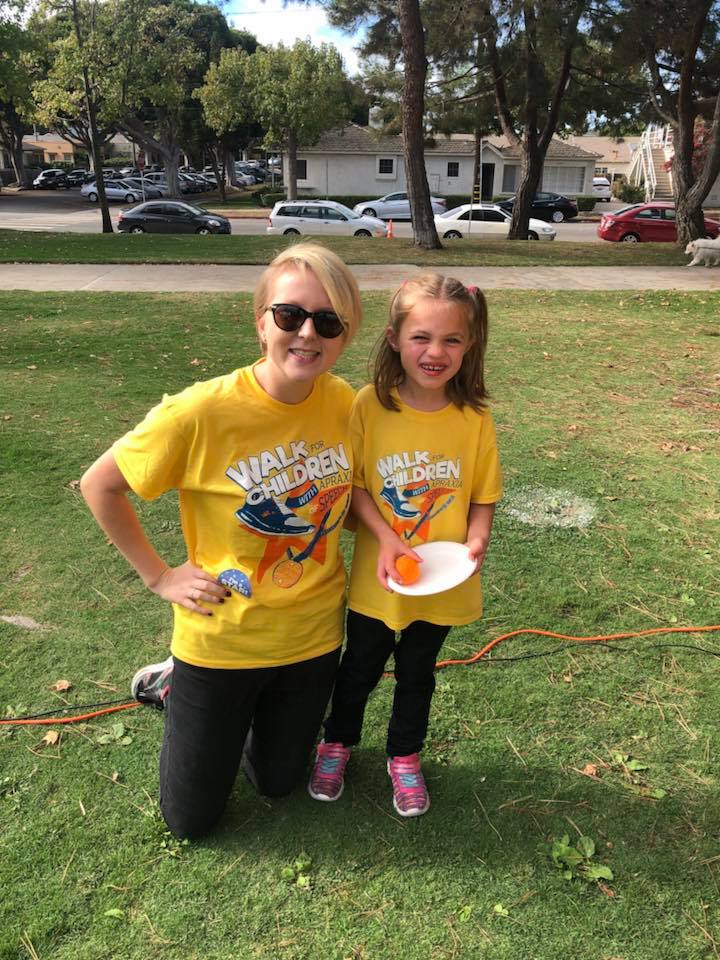
    Making my way through the park I spotted Alyson Taylor of A Girl with a Funny Accent, who I met in San Diego this past summer at the apraxia conference. I wanted so badly for Ashlynn to meet her then but we couldn’t make it work.  This time was different and was special for all of us.  Alyson immediately dropped to Ashlynn’s level and told her that she too had apraxia.   Ashlynn doesn’t always have the words when she’s put on the spot and gripped with anxiety, but I saw the spark and glimmer in her eyes.
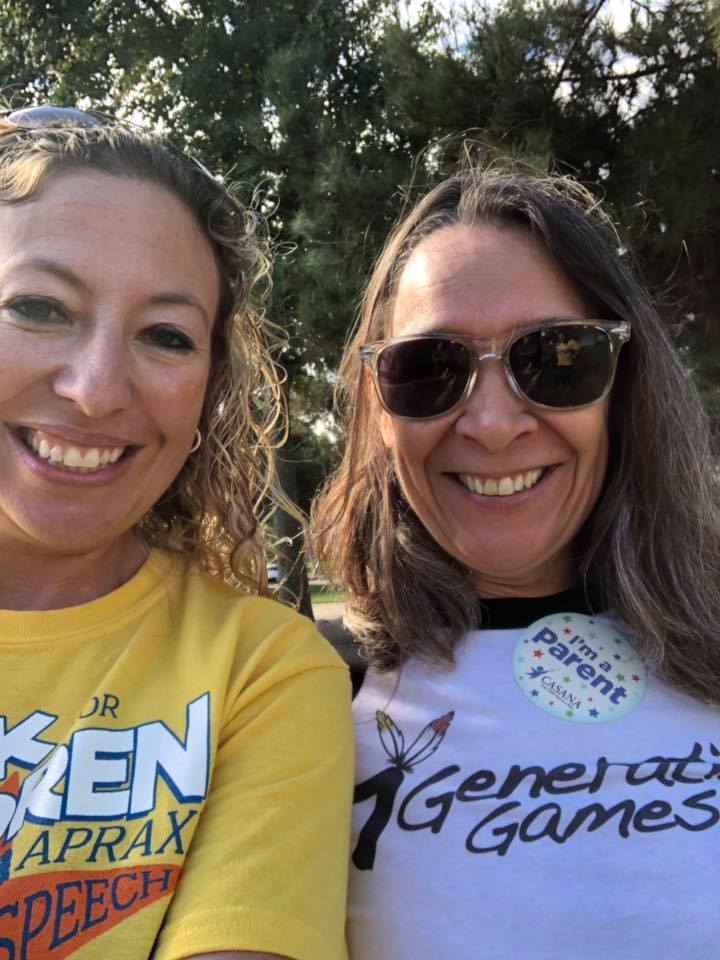
    As I meandered over to get coffee and check out the face painting station, I saw a cute fluffy white dog.  As I looked up I immediately recognized actress Gage GoLightly, who gave a revealing interview about growing up with global apraxia.  I went over to introduce myself and asked to take a picture.  Ashlynn was shy at first, but when Gage asked her to pet her dog she had Ashlynn hook, line and sinker. Gage was such a real, down to earth, and sweet person.  I was immediately struck by her genuineness and her joy at supporting a cause she felt so close to.  She laughed about still being severely dyspraxic and practically doing the splits in the shower the other day.  I smiled at her story and marveled about just how much she reminded me of Ashlynn and in that moment I knew Ashlynn was going to be okay.  How do you thank a person for giving you that moment of peace and comfort when they didn’t do anything but be themselves?  It was amazing.

    As I was talking to my friend, I ran into the L.A Walk Coordinator Jaclyn Senis who made all of this happen!  Meeting fellow walk coordinators is in may ways, like looking in the mirror.  We all spend countless (unpaid) hours devoting every second of our spare time to creating an event that is memorable and meaningful to every child with apraxia that attends.  This was her first walk, and it fell on her BIRTHDAY!  I think that should speak volumes as to the character of people who volunteer to coordinate a walk.

    Soon there was buzz Ronda has arrived with her family and supporters.  Nervously I made my way across the grass to the tent.  I immediately spotted Ronda’s mom, who I instantly recognized from social media. She apparently recognized me or Ashlynn too because she flashed a large smile and waved in our direction.  All my nerves disappeared in that moment because I recognized her not as “Ronda’s mom” but as a mom who understood me without ever even meeting me.
    As we rounded the corner of the tent, Ronda stood in the middle.  When I met her the first time I had no idea who she was, but this time I think I was not only star struck, but amazed she was actually HERE.  Ronda Rousey was HERE at an apraxia walk of just a few 100 people and was going to speak.  How did this happen?  I stared on incredulously.  Ashlynn immediately freaked out and got shy.  She basically ran away.  Haha.  Ronda said she had her “balgrin” in the car and asked if she should get it.  I immediately said yes and  if you don’t know what that is….read her book.  It’s amazing!
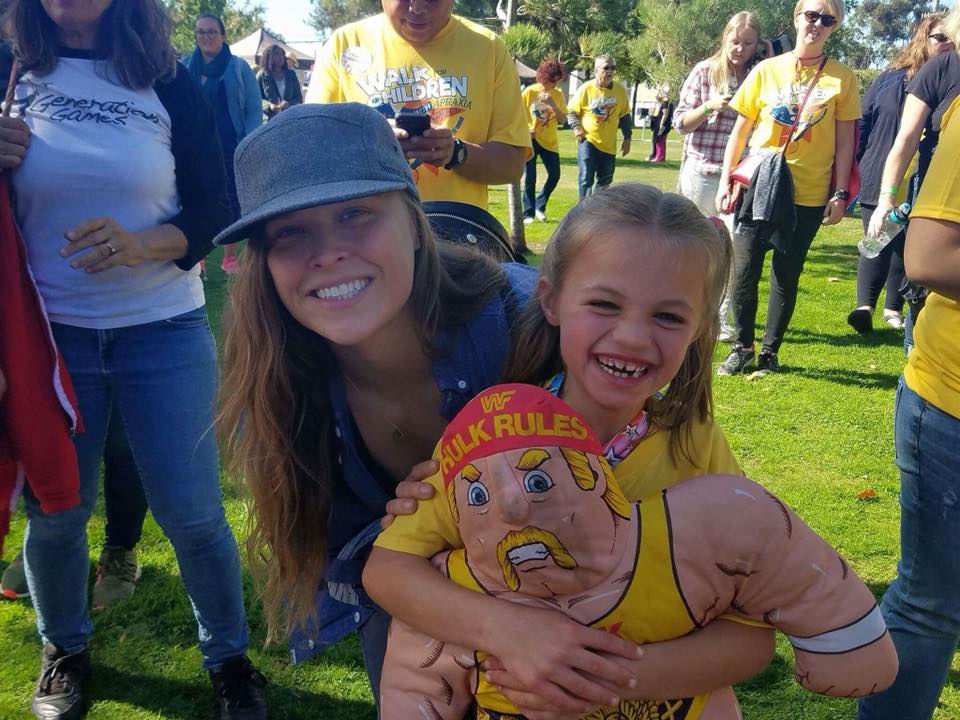
    When Ronda returned with the balgrin, the ice was broken and Ashlynn immediately came up and held it.  I marveled at the fact that ALL three adults with apraxia had managed to cut through Ashlynn’s anxiety by finding something to make her feel comfortable with first.  Alyson dropped down to her level, Gage offered her puppy, and Ronda offered her “balgrin.”  This is home people.  When I say I want to find Ashlynn’s tribe…..this is EXACTLY what I am talking about.

    The speeches by Alyson and Ronda were both incredible in VERY different but wonderful ways.  No two people with apraxia are the same, and as Alyson mused in her blog post, “There’s no right or wrong way, our fights were won in two different ways.” 

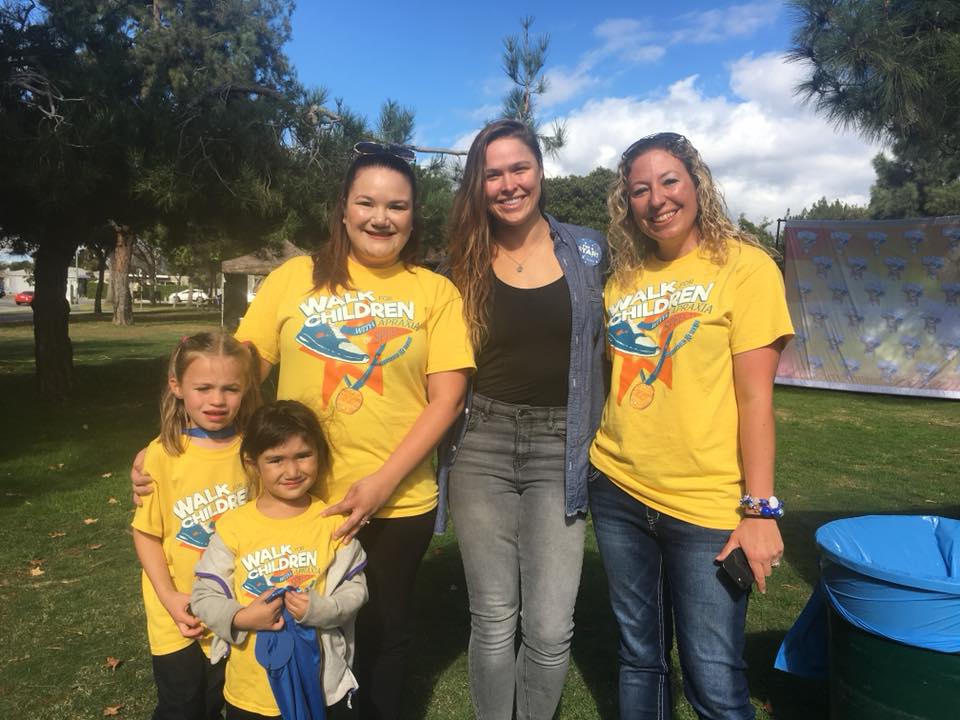
    Ronda, Gage, Alyson, EVERYONE walked the walk around the park.  In that moment in this small park in Santa Monica on this fateful day of November 5th, 2017;  there was no dumb kid or smart kid. No MMA star or actress.  No successful or not successful person.  There were just families and their children walking and raising awareness with the shared belief that EVERY CHILD DESERVES A VOICE.   On the walk Ronda took Ashlynn’s picture on her cell phone as I talked to Gage and we both remarked at the “goosebumps” we got while talking to each other.  Ronda’s mom talked to Alyson’s mom and the humanity of our shared experiences blurred out boundaries of fame, wealth, or status.

    There is the expression about pinching oneself to make sure it is real.  I literally did this during this moment in time.  It was THAT incredible and unreal.

    You know, the world is so much smaller than we think.  We are all so much more connected than we ever dare to imagine.  I’m learning every person, on every end of the country or even globe, famous or not, is walking a journey called life full of love and laughter, but also bumps and pitfalls.  The human experience is a shared experience that transcends money, wealth, power, or race.  We all have a story to tell, and we are all shaped by our story. We are all souls looking for a connection.  Olympian, Judo fighter, author, writer, actress, SLP, teacher, or any other walk of life; our lives take on meaning when we can connect with others who share a familiar story.

    What started as a mission for hope, turned into a lesson about life on one sunny day, in a beautiful park in Santa Monica, California.
     

  • Does my child have dyslexia?

    Does my child have dyslexia?

    If you have a child with a speech or language disorder, you have probably heard that they are “at risk” for future learning disabilities.  What are the prevalency rates though, and what does the actual research tell us?

    A study by Catts (1993) is a frequently cited study and found that,

    The literacy outcomes of children with SSD (speech sound disorder) have provided convincing evidence that children with SSD and concomitant LI (language impairment) (SSD+LI) have higher rates of literacy difficulties than children with isolated SSD.

    So what does this mean?  How high are the higher rates and what exactly are “literacy difficulties?”

    In 2004, Lewis et.al followed 10 children diagnosed with CAS (Childhood Apraxia of Speech) and compared literacy outcomes for them into the school aged years along side kids who were diagnosed with SSD (speech sound disorder) and another group who had SSD + LI (language impairment). At follow up, all 10 children with CAS demonstrated co-morbid disorders of reading and spelling.  This was a small sample size, but let me reiterate, ALL TEN children with CAS had future problems with reading and spelling.  Co-morbid rates though can’t be 100% right?

    A study in 2011 by Anthony et.al found that,

    Children with SSDs are at increased risk of having difficulties learning to read (Bird, Bishop, & Freeman, 1995; Bishop & Adams, 1990; Carroll & Snowling, 2004; Catts, 2001; Larivee & Catts, 1999; Raitano et al., 2004; Roberts, 2005; Snowling, Bishop, & Sothard, 2000). In fact, between 30% and 77% of children with SSDs struggle with reading (Bird et al., 1995; Larrivee & Catts, 1999; Lewis, 1996; Nathan, Stackhouse, Goulandris, & Snowling, 2004). Children with SSDs have as high a risk of developing a reading disability (RD) as children with a family history of RD (Carroll & Snowling, 2004), which is remarkable in light of heritability estimates for RD that range from 40% to 70% (e.g., Friend, Defries, & Olson, 2008; Pennington, 1989). The risk of children with SSDs having literacy problems increases with comorbid language disorders (Nathan et al., 2004; Raitano et al., 2004), severity of the SSD (Nathan et al., 2004), persistence of the SSD (Nathan et al., 2004; Raitano et al., 2004), and patterns of articulation errors that do not follow developmental trajectories (Leitão & Fletcher, 2004; Leitão, Hogben, & Fletcher, 1997; Mann & Foy, 2007; Rvachew, Chiang, & Evans, 2007).

    A study by McNeill (2009) found:

    The results indicated that the CAS group had inferior phonological awareness than the ISD and typical development groups. The CAS group had a greater proportion of participants performing below their expected age level than the comparison groups on phonological awareness, letter–sound knowledge and decoding tasks. There was no difference in the performance of the CAS and ISD groups on the phonological representation task.

    In this study, speech sound disorders are all lumped together.  Speech sound disorders include: phonological disorder, articulation disorder, and apraxia.  Depending on the study, anywhere between 30% to as high as 77% of children with a “Speech Sound Disorder” have difficulty learning to read.  That’s the quite the gap right?  There is almost a 50% discrepancy between studies.  So what gives?  Who is more at risk?

    We know every co-morbidity(which is a fancy word for additional diagnoses) increases the risk.  This especially includes children who have a language disorder.  This includes kids diagnosed with “mixed receptive/expressive language disorder,”  SLI (specific language impairment), language disorder, or language processing disorder

    I also bolded the phrase “patterns of articulation errors that do not follow developmental trajectories,” because up until 2007, apraxia was not officially recognized as a distinct childhood speech disorder by the American Speech Language Hearing Association. This is only relevant because the studies this data is taken from all are around 2007 and before; and if you know what apraxia is, it is a speech sound disorder, but also a motor planning disorder that does not present with patterns of errors and may or may not follow developmental norms for articulation.  In the above information, that EXACT description increases the risk for a reading disorder.

    The most recent research is now indicating dyslexia is a phonological processing disorder that parallels the core phonological deficit in speech sound disorders (Anthony et al., 2011). This research is groundbreaking because before we knew the risk for reading disability was higher in kids with SSD’s, but we didn’t have research telling us why.

    The bottom line though is this.

    Any childhood speech and language disorder increases the risk for a future reading disability.

    It would appear that children with CAS are at an increased risk, and those with CAS plus a language impairment or comorbid phonological disorder, are even more at risk.

    Are all reading disabilities then dyslexia?  The short answer is no, but dyslexia is by far the most common reading disability and can manifest in varying severities.  If you read research articles, reading disorder and dyslexia are almost synonymous.  For example in the 2004 article by Vellutino et al., this is the opening statement.

    We summarize some of the most important findings from research evaluating the hypothesized causes of specific reading disability (‘dyslexia’) over the past four decades.

    According to the National Institute of Child Health and Human Development, “reading and language based learning disabilities are commonly called dyslexia,” and according to the International Dyslexia Association,

    15-20% of the population has a language-based learning disability. Of the students with specific learning disabilities receiving special education services, 70-80% have deficits in reading. Dyslexia is the most common cause of reading, writing and spelling difficulties. Dyslexia affects males and females nearly equally as well as, people from different ethnic and socio-economic backgrounds nearly equally.

    The schools do not diagnose dyslexia, although they give all the same tests that learning centers give to diagnose it.  Schools are an educational entity, and thereby give “educational” diagnoses. The educational diagnosis for dyslexia is specific learning disability.  Knowing prevalency data and co-morbidities better equips special education teachers, parents, and other professionals to implement treatment strategies that can include pre-cursory and preventative measures to address potential and additional difficulties later in the child’s academic career.


  • No, not another diagnosis. Adding Dyslexia to Apraxia

    [wysija_form id=”1″]I had an epiphany the other day.  It came after reading an article someone sent me discussing how American schools are failing kids with dyslexia.   It was an excellent article and accurate in every way.  I started my career in Denver Public Schools in 2004, and at the time, an approach called “whole language” was being used to teach reading.  Just four years before this time, in 2000, my mentor (and now Ashlynn’s SLP) was telling me about the 2000 National Reading Panel Results that showed there were 5 components of reading that children needed to read, and whole language was missing many of them, particularly the two that had to do with phonological awareness and decoding.

    During my career in Denver, a special education coach named Robert Frantum Allen, came out and was training our intervention and special education staff to look at struggling readers and identify the component of reading in which they were having the most difficulty.  I remember the ones that were the most prevalent were in the areas of phonological awareness and decoding.  Many teachers weren’t even testing phonological awareness, and since the schools were using a whole language approach, it wasn’t getting taught either.

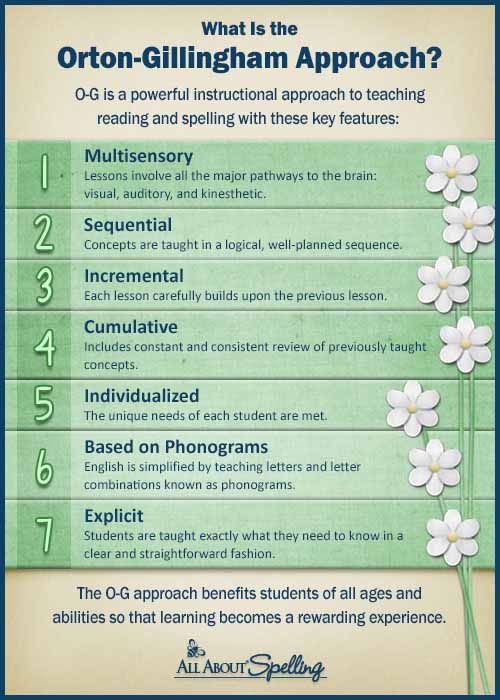
    I was in a Title 1 school, which in some ways is good because we get more funding to get more intervention teachers.  We had a great response to intervention system set up, with teachers hired to do 6 week intervention and track data on struggling readers.  The interventions included LLI (leveled literacy instruction) and Reading Recovery.  These were great programs for our ELL (English Language Learner) students, but for our kiddos who would eventually fall into special education, they weren’t helping at all.  I remember Robert stressing to us that these interventions would not remediate our kids with a reading disability (dyslexia) because they did not identify and then focus on the root cause of the issue, which in many cases was phonological awareness.  He believed 100% in an approach called Orton Gillingham or approaches based off this reading program.  In the school I was at, I had two Kindergarten kids come in with apraxia, and they THRIVED on an OG approach called Fundations.  OG has a TON of research and is in many cases considered the gold standard for reading intervention approaches.

    At the time, I didn’t have the research to back up Mr. Frantum Allen’s claims, but I had my professional experience which consistently showed our kids with a reading disability did not make growth in these reading intervention approaches; but the kids receiving an OG approach to reading did.

    I have never forgotten all the training and professional experience, but a little thing called apraxia kinda took over my life.  That is, until I read that article I mentioned above.  Everything I learned in DPS came flooding back, especially when I read the line that said one teacher said she didn’t learn how to teach kids how to read until she was trained in Orton Gillingham.  It went onto say many are now advocating for a “balanced approach” to reading as opposed to a whole language approach, but basically we are just doing a bunch of things that don’t work with some things that work really well.

    In that moment, my dear readers, I had the same gut feeling I had when that SLP told me back when Ashlynn was 2:11 “Laura this is apraxia.”

    In that moment, that article told me, “Laura, this is dyslexia.”

    I started to cry at the end of that article.  Damnit.  I missed it again.  I missed another OBVIOUS dx in my OWN daughter.  Why does this keep happening??  What good was all my training and experience when I’m not applying it to my OWN baby??

    Maybe it’s not dyslexia Laura.

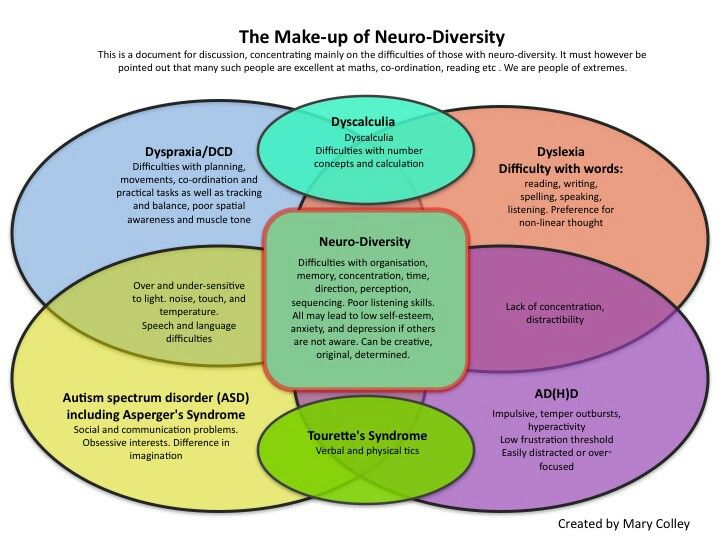
    Oh no.  It is. It IS. How do I know this?  Ashlynn participated in a balanced literacy intervention over the summer.  She did make progress in some areas, but she just took the test at school and her scores were….the exact same.  It changed by 1 point.  Didn’t I say I SAW THIS EXACT THING in DPS when I worked there?  My kids with reading disabilities didn’t make progress with those approaches. I started thinking about how she still can’t rhyme (despite me working on it constantly), still has trouble identifying how many syllables are in a word (despite clapping them out since preK), has a poor working memory….I mean everything I KNOW she is struggling with correlates with dyslexia.  Look at my graphic at the way top.  Dyspraxia and Dyslexia and all those neurological disorders overlap.  But here we are, my daughter is in 2nd grade, and I’m just NOW seeing the writing on the wall. I think for so long I wanted to explain her problems were based on apraxia.  I was totally missing the forest for trees again.

    You know what else sucks?  Kids who have poor reading skills by 3rd grade usually remain behind until 9th.  I remember that chilling statistic because when you work in an inner city, the fear is that by 9th grade if a kid is still struggling academically, they will drop out.  Someone will have to put me in a grave first before Ashlynn drops out, but I remember being worried about the 4th and 5th grade kids I had on my caseload at the time.

    Oh and this is not to mention we have older adults now who have grown up to talk about apraxia such as Gage GoLightly who says she had dyslexia too, or Daniel Radcliff who had dyspraxia and dyslexia.  I know these disorders all have crazy comorbid prevalencies.

    So, long story short, is, I have Ashlynn on the 6-8 month wait list for the learning center at Children’s Hospital.  Yes the school could test her, but schools don’t dx dyslexia. I know this.  I work in one.

    I hired a tutor who will come 2x a week trained in OG.  I should have done this two years ago, just like I should have had Ashlynn in the right speech therapy a year before I did too.  If I can take any solace in any of this, it’s that someone reading my blog will learn from my mistakes.  It wasn’t too late for Ashlynn’s speech, and hopefully it’s not too late for her reading either.


  • It’s rare, so no one cares?  Prevalence of CAS

    It’s rare, so no one cares? Prevalence of CAS

    What’s that?

    If you have a child with CAS (Childhood Apraxia of Speech), you have heard this question once, twice, many, numerous, too many times to count in the course of their life.  We all have developed our standard answer since we are prepared for the fact that no one knows what apraxia is.  This sadly does not just include the general public.  We run into this with doctors, teachers, professionals, and yes, some parents have even reported getting this question from Speech/Language Pathologists!

    I am a self-declared Apraxia Advocate and the reason I’m so passionate about awareness is because with awareness comes proper diagnosis, and only after a proper diagnosis can the child get proper treatment.  Only with proper diagnosis will we understand additional learning difficulties that may arise from this disorder; which means we will be better equipped to understand how they learn differently and tailor their educational programming better to fit their needs.

    We say that CAS is a rare and severe speech disorder.  We convince ourselves people don’t know about apraxia because it’s so rare, and sometimes, I think we all start to accept nothing will change.  Afterall, it only affects 1-2 children in every 1000.

    I certainly have my down moments where I have thought this, but it actually has never deterred me or stopped me from my efforts.  I’m preparing for a presentation in July for the CASANA conference, and something made me look up prevalence rates of other disorders.

    Have you ever heard of Down Syndrome?  Are you reading this thinking what a silly question? I’m willing to bet 99% of you have heard of it.  It’s covered well in graduate school for speech, and usually every school setting has at least one child with DS in the building.  At the very least, most teachers, educators, professionals, and most of all therapists have heard of Down Syndrome.

    Would it surprise you then if I told you the prevalence rates for Down Syndrome are 1-2 children in every 1000 births.  Sound familiar?  Maybe that’s just because I just wrote that figure for CAS.

    I actually started to get worked up.  Wait a minute.  What is wrong with this picture?  That can’t actually be right can it?  I thought to my own personal experiences.  At one school building I have two kids with DS and in a second, I have one.  At one school building I have two kids with apraxia, and at another I have two as well.

    Wait, so how is it EVERYONE it seems has heard of Down Syndrome, but no one ever seems to know what apraxia is?  Oh friends, this bit of data has now only strengthened my resolve.  At one point, somewhere, I’m sure Down Syndrome was a rare disorder too that no one had heard of.  Oh friends, we need to step up our game.  We need to stop accepting that no one will ever know or care about apraxia (oh fess up!  I know we’ve all been there at some point). The it’s rare so no one cares attitude is not acceptable anymore.

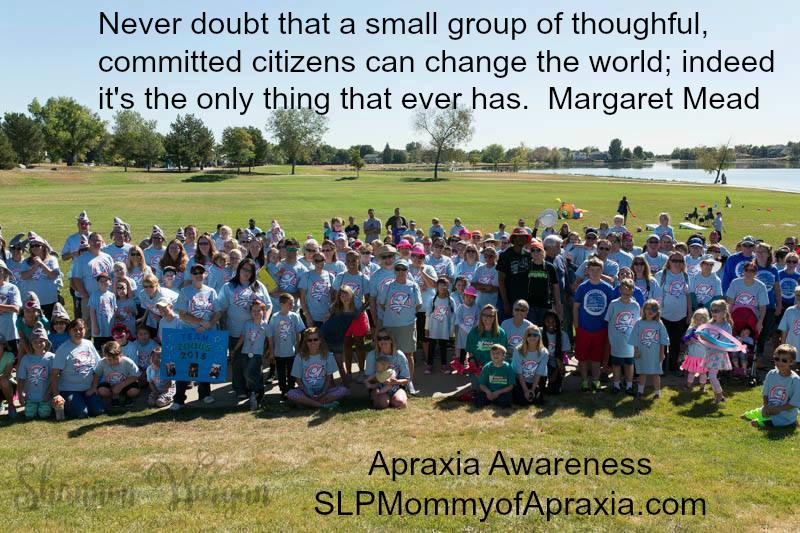
    We have to continue on!  I saw this the other day and absolutely loved it.  I can tell you I know many apraxia walk coordinators nationwide now and we all have this in common.  Every person counts.  Even one more person who knows what apraxia is, is a victory.

    Let’s stop thinking rare=unknown, because it’s not true.  We only need to look at the Down Syndrome Community to prove that point.

    It’s time to make our collective voices louder.  Join your local walk, educate the community around your child; remember, every person counts.  CAS was only accepted as a real and distinct disorder in 2007, which really wasn’t that long ago….but the point to remember is that it IS a real and distinct disorder and our children DESERVE to have professionals in their life who are as familiar with apraxia as they are with Down Syndrome, don’t you think?

  • Apraxia and the village.

    Apraxia and the village.

    I work in the schools a few days along with my private practice work.  I say I work in the schools because I like working in Ashlynn’s school, and that’s partially true.  However, I have always in my career had at least one child on my caseload with apraxia in every school in which I have worked.

    If you have a child with apraxia, you’re probably thinking, “what’s the big deal?”

    If you are an SLP, you might be thinking, “Wow!  I’ve only ever had one, or none, or….”

    Anyway, if you are in the apraxia community, you know about the “apraxia coincidences” and if you know me, you know I don’t believe in coincidences.  So part of me feels like I’m put at a school I am at because I can be of service and have a connection to a particular child, with Ashlynn’s school being no exception.

    Currently I have a 4th grader that I see and I can only say so much because of confidentiality, but I love this boy.  Actually, I wrote about him once.  You can read about it here, but it turns out, I was right.  He’s gifted.

    Ha!  As I went to link that last post, I had actually included this graphic two years ago.  How things come full circle right?

    Anyway, his nonverbal IQ is off the charts and now he’s in the gifted program.  However, he’s a fourth grader and still can’t read or write, such is the extent of his disability.  I can’t imagine being so smart, but being unable to read or write.  Such is his life.

    We have every AT tool at his fingertips.  Technology though still hasn’t totally caught up to the extent of his disability.  His grades remain sub-par, and he is unable (and many times defeated so he’s unwilling) to produce any written work.

    There are sooo many people in this boy’s life who believe in him and who want to help him.  Meeting after meeting takes place behind the scenes.  I’m serious.  If you don’t work in the schools, you have NO idea the mobilization and time occurring on behalf of our children.  I know his parents don’t.

    Anyway, after at least two major meeting of the minds with every professional expertise (OT, Speech, SPED, gen ed, ATRT specialist, TA), we finally came up with a plan we thought will help him become more independent with his school work regardless of current reading, writing, or spelling ability.

    We set a meeting date of today with ALL of these above listed professionals and the child.

    Let me take a quick digression.

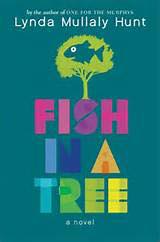
    A week ago, I posted on my SLP Mommy of Apraxia/Dyspraxia Fb page that the librarian at the school stopped me to show me this book called “Fish in a Tree.”  The book is written by a woman who had dyslexia as a child, and writes a fictional novel based on real life events about her life and the people in it.

    The librarian read this one chapter to me the other week, in which the girl’s teacher listed famous minds of our past and current generation.  They all were brilliant, but as it turned out, they were all believed to have had dyslexia.  I was so inspired.  I couldn’t WAIT to read it to my 4th grader.  The librarian was going to read it aloud to the entire class during library time, but she wanted me to read it to this child first so he knew we were all thinking of him.

    Today I got the chance.  I asked him if he knew the names of the people and what they were famous for.  He didn’t disappoint.  He can’t read, but he knew most of them as I read them to him:

    Thomas Edison? – “Invented the light bulb”

    Alexander Graham Bell?  – “Invented the telephone”

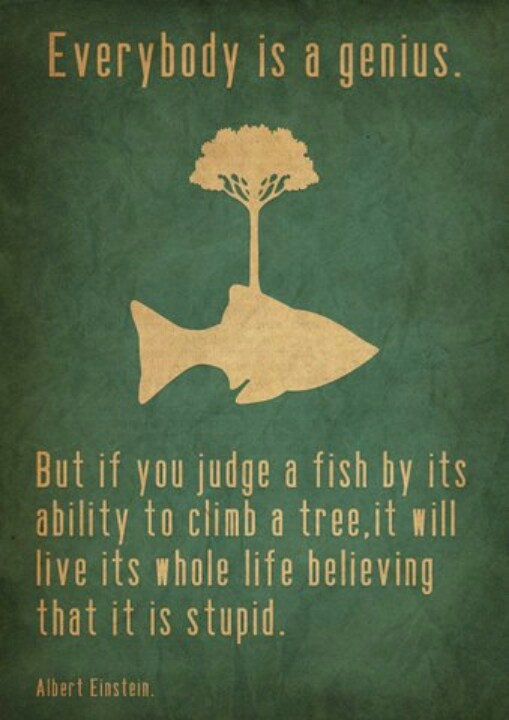
    Albert Einstein? – “Really, really, really smart.” 🙂

    Walt Disney? – “Made Pluto!”

    The list went on, and as I read the pages to him, some he knew and some he didn’t, I swear I could see a spark glow in his eyes and it was everything I could do not to cry.  People, this boy is as brilliant as all these people I was reading to him.  I honestly believe that, and it’s not just me….EVERY professional who works with him feels the same way; but if  you can’t read, and you can’t write and you’re in the fourth grade, you don’t feel that way.

    I barely got through reading the entire thing without completely breaking down.  When I finished there were stars in his eyes.  I’m telling you.  Bright, bright stars, and he smiled as he said, “Wait, all those people were like me!  They couldn’t read, but they were super smart and they invented stuff BECAUSE they weren’t typical.”

    I nodded my head.  That may not be a completely accurate assessment but I sure wasn’t going to contradict it, would you?  Oh, and I should mention, his comment came after a therapy session we had a few weeks ago in which I showed him Mikey from Mikey’s Wish who was talking about “neurotypical” and “neurodiverse.”  I knew he was alluding to this because he was inspired by the idea of being “neurodiverse.” (Thanks Mikey).

    As fate or coincidence would have it (coincidences aren’t coincidences), let me take you back to the meeting of all the professionals, the village, that helps this 4th grade student.  We scheduled another meeting, this time to include him.  It just happened to be that it was right after I read him those excerpts on these brilliant minds needing to find another way to express themselves.

    I took him to class where the meeting was about to take place, and his awesome 4th grade science and math teacher, who had already prepped him (for being in such a daunting meeting by himself with so many adults) told him we are here because we believe in him, and sometimes great minds have to find another path to greatness.

    His eyes lit up.  “Like Albert Einstein, and Disney, and the guy who invented the telephone!”

    People, the tears were in full force behind my eyes, but I still didn’t let them go.

    As the entire special education and general education team piled in, I watched this incredible strong and resilient 9 year old, listen to the plan set before him.  He was surrounded by people who loved him, but still.  He was outnumbered by 1:9 and he listened to our plan on how to help him read and write using technology, and, get this….his VOICE.   Yes, his VOICE would be a huge part in his written output via voice memo, and that’s possible, because he has one.

    We are all under no illusions.  We know this will be hard for him.  We know he will be frustrated and maybe even resist.  But literally, 8/9 people at that table believe he is capable (the 1 out-liar being him), and as one of his reading specialists said, “Maybe he doesn’t believe he can do this, but hopefully he will remember all the adults who think he can and it will keep him moving forward.”

    I was so proud to be sitting there as part of his team….his village; because we all know, these kids need a village.  I was trying pretty hard to reign in my emotions.  I thought about how lucky Ashlynn is to have this village too.  I don’t need doubters in her corner, I need believers; and I really know we have that.

    Oh, and about my 4th grader.  Believe me when I tell you he has BIG ideas.  His ideas cannot be adequately explained through his reading, his writing, or even his voice. I predict one day these BIG ideas will be turn into something even bigger.  I look forward to seeing it.


  • Neurology, delays, a dream, and a miracle.

    Neurology, delays, a dream, and a miracle.

    Most parents of kids who have a child with global apraxia will at some point visit the neurologist.  It’s usually before the age of 7, which is the age Ashlynn is today.

    I remember the referral, although the dates are a little fuzzy.  We were either at Ashlynn’s 6 or 9 month checkup and I had to fill out one of those dreaded developmental screens.  Don’t get me wrong, as a professional I’m very, VERY pleased my pediatrician had them; but as a parent each question only served as a slap in my face to everything in which Ashlynn was behind and it was hard.  Really hard.

    Well anyway, I had mentioned Ashlynn had very tight calves (or heel cords) as the professionals view it.  The pediatrician, knowing I was in the profession tread lightly.  The result though was a possible referral to the neurologist.

    I declined.

    So curious to me now.  Why did I decline?  Why wouldn’t I have at least gone to the appointment?  The pediatrician, sensing my hesitation, told me to massage her calves in in the bathtub every night and come back and we could re-evaluate at her next well baby visit.  I pounced on the cop out and religiously massaged her calves every night.  By the time of her next visit, her heel cords were looser and she could flex her foot.  I remember being praised by the pediatrician for Ashlynn having such an involved mommy and she left it up to me if I still wanted the neuro referral.  Of course I said no.  I could help her.  I could do this.  I thought for sure when Ashlynn started walking, she would be a toe walker, but she wasn’t.  We had to remind her when she learned how to stand to keep putting her heel down, but you would never detect even a hint of toe walking now.

    Anyway, that’s water on the bridge, because yesterday found me and my seven year old Ashlynn finally at the neurologist.  I actually would have went sooner, but our insurance sucks!  I knew going to a neuro would mean a recommended MRI at least, and our insurance comes with the lovely 80/20 policy and a deductible of 5K anyway before that kicks in, so I had to be willing to pay of out pocket basically for her MRI which I wasn’t willing to do.  We have her in all the right therapies, I would wait when maybe my insurance would get better.  This past year I switched the kids to my insurance plan.  It still has a high deductible, but is more manageable and at least offers 20 visits of speech and OT a year, so it’s now or never.

    Ashlynn’s “ballerina toes”

    The appointment itself was good.  She took our case history, and did an exam on Ashlynn.  She was a lovely
    person who commented how she could not detect any heel cord or tight calves now, what a great and friendly personality Ashlynn has, and when she watched Ashlynn run, commented on how good it looks considering all of her motor planning issues.  I was so proud.  I told her Ashlynn works hard and gross motor skills are the area in which Ashlynn is seeing the most progress.    I added that the school PT said she will probably meet all of her goals and be within the average range within the next year.

    She was a resident, so she went to get her supervisor for the final conclusions and recommendations.  The supervisor came in and examined everything she missed.  I felt bad because in five minutes this woman identified an under-active gag reflex, oral apraxia, and verbal apraxia (based on a measure called the diadochokinetic rate).  She didn’t say this aloud, but I knew as an SLP that was what she was examining.  They recommended a Tier 1 level of tests first which include an MRI and genetic micro-array testing.  I nodded my head.  It’s what I was expecting.  I know many, many kids now in the apraxia world and this is the next step.  We want to see if there is an actual cause we can pinpoint for all the motor planning issues.

    Then, this.

    “We would classify her at this point as a developmental delay (insert loss of breath.  Loss of breath even though I KNOW she has this, it’s just so hard to hear) and that she’s functioning right now around a 4 year old level.”

    I just stared back at them.  I was thinking, what on Earth did they do to just decide she’s functioning at a 4 year old level?  They heard her talk, ok.  They have my case history, ok.  I wouldn’t put her at a 4 year old level based on that.

    “Does that sound about right?”

    I kept staring.  Her dressing skills.  They asked me in detail about her personal care, adaptive skills we call them, and, oh yes.  Yes.  She can’t brush her teeth independently, still can’t spit, can get dressed independently but usually has things on backward or on the wrong feet……the adaptive skills is what gave them this conclusion….

    “Ms. Smith?  Does that sound about right?”

    I nodded my head.  I couldn’t get any words out.  It felt cruel.  It’s not their fault, it is just the way these appointments are.  I thought of Ashlynn’s four year old brother on the way out.  He can get dressed independently, brush his teeth independently, spit, can almost shower by himself…..punch in the gut.

    I looked over at Ashlynn holding my head walking out of the hospital.  She was smiling holding my hand, and holding a notebook and pens in the other hand.  Always working that girl.  ALWAYS.  During the appointment she “took notes” for the doctor and gave them to her at the end.  The doctor who smiled and was nice to her believes she’s functioning 3 years under her actual age level.  Similar to the day she was dx with CAS and Ashlynn smiled at me and said the one word she could, “hi,” she remains happy and with a positive attitude.  I wanted to cry, but I won’t.  That’s not to say I’m against crying.  It’s just to say it’s not how I want to process it all.  I will write it all out and when Ashlynn looks at me I will smile because that is what she deserves.

    I turned on “The Fighter” by Gym Class Heroes.

    “Just waking up in the morning
    And the be well
    Quite honest with ya,
    I ain’t really sleep well
    Ya ever feel like your train of thought’s been derailed?
    That’s when you press on Lee nails
    Half the population’s just waitin’ to see me fail
    Yeah right, you’re better off trying to freeze hell
    Some of us do it for the females
    And others do it for the retails

    But I do it for the kids, life through the tower head on
    Every time you fall it’s only making your chin strong
    And I be in the corner like mick, baby, til the end
    Or when you hear this song from that big lady”
    One last thought.  My dad has never been a dreamer and he certainly did not encourage us to dream.  He encouraged us to work, stay out of debt, and have a plan B.  He’s a practical man.  I think maybe at one time he did have dreams, but they were crushed slowly until they were snuffed out.  Between Vietnam and then coming back with no college degree and no credit, he was a blue collar worker his entire life.   That’s why it was surprising the other day when my mom called me and said,
    “Dad wants to know if you know what Ashlynn’s name means?”  Seems like something I would know.  I didn’t know though.
    “No, what?”
    “To Dream,” she responded.
    We both paused.
    “Wow” I managed.  “Dad told you to tell me that?”
    “Yes.”
    I was silent.  Honestly it was hard to process.
    “He told me the other day too, Laura, he believes Ashlynn will be a miracle.”
    Silence.
    “Wow” I managed again.
    So Ashlynn, one day when you are reading this, I want you to remember that Christ once told us in Matthew 17:20 “And he saith unto them, Because of your little faith: for verily I say unto you, If ye have faith as a grain of mustard seed, ye shall say unto this mountain, Remove hence to yonder place; and it shall remove; and nothing shall be impossible unto you.”
    So work baby girl, and I’ll work alongside you;  but most importantly DREAM and BELIEVE and your entire family will be here dreaming and believing alongside of you.
    My dad with four of his grandchildren including Ashlynn
    To read more from SLPMommyofApraxia follow her on facebook, pinterest, or twitter.