Tag: Apraxia

  • Calling all apraxia bloggers!!  Let’s link up for Apraxia Awareness Day!!

    Calling all apraxia bloggers!! Let’s link up for Apraxia Awareness Day!!


    I read your stories daily.  I feel your struggles, I rejoice in your triumphs, and I nod my head in understanding.  You are my fellow bloggers.  I read your blogs like I’m checking the morning paper.  I read your tears and your smiles about your struggle with apraxia, and I share them with you about mine with my daughter’s.  We read these stories as separate entities.  We close the blog and move onto the next, or we write our own story for that day.  What if we all wrote our story together?  What if we all weaved our experiences into an apraxia tapestry?  That is my dream in the Apraxia Awareness Link Up for Apraxia Awareness Day on May 14th.

    I ran across the quote:

    Never doubt that a small group of thoughtful, committed citizens can change the world; indeed, it’s the only thing that ever has.

    It’s up to YOU and ME to spread awareness about apraxia.  It’s only the second annual apraxia awareness day.  I am an SLP and many educators haven’t even heard of apraxia and many SLP’s don’t know how to treat it correctly.  I want to read your stories.  I want to hear how you are spreading awareness and I want to link up with you in solidarity!

    Please feel free to link up any posts related to Apraxia.  It can be anything! You fears, your successes, your diagnosis, your Apraxia Awareness Day Post, helpful tips, whatever!!  We want to see it! We want this to be a place to raise awareness for Apraxia, as well as to let others know they are not alone.  We only ask that you link back to link up at the bottom of your post!

  • nacd apraxia app review

    nacd apraxia app review

    This was one of the first speech apps for apraxia that I bought.  It was enticing because it was a good price and the description looked much like a digital version of the Word FLIPS book I was using in therapy.

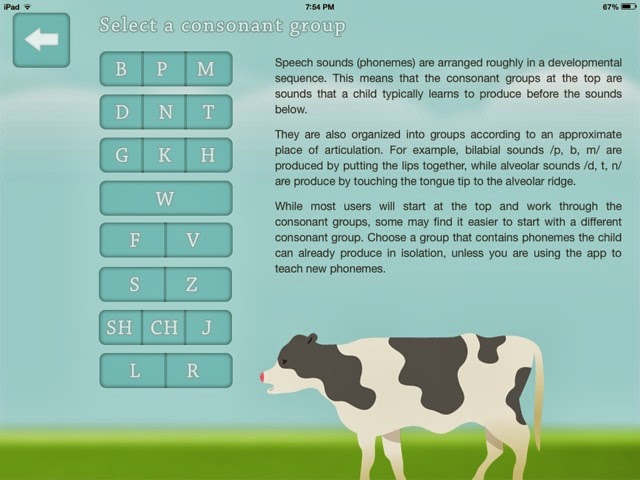
    It starts with a screen that allows you to pick a CV consonant/vowel group, seen below.

    For the purposes of this review, I chose the top group BPM.
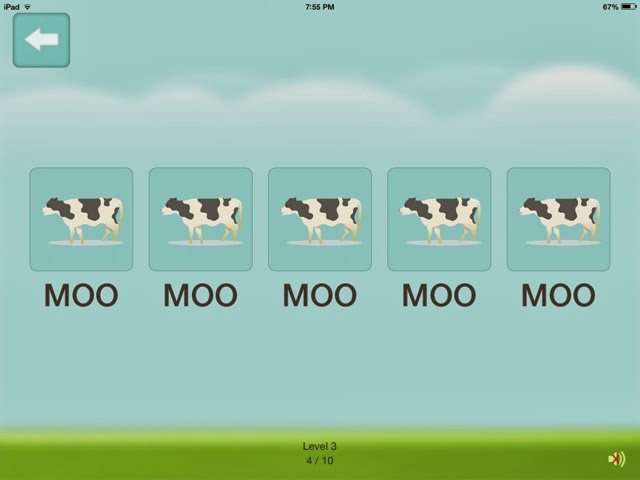
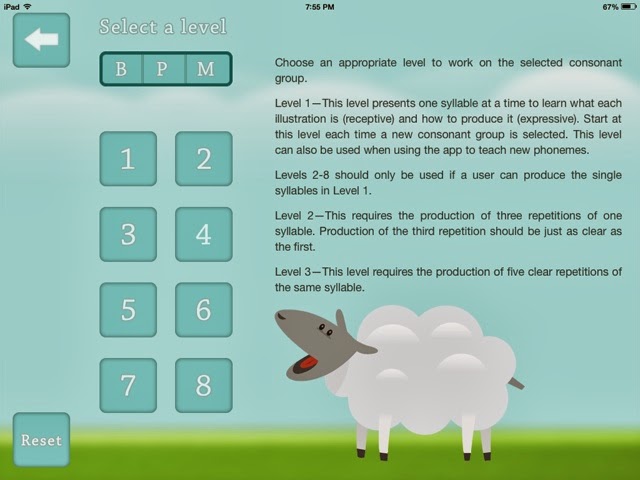
     You then have your choice of levels.  Level 1 is really just to learn the pictures, so each picture is presented one time.  In Level 2, there are three required productions of the same word.  By Level 3 (see above), there are five pictures of the same word. 
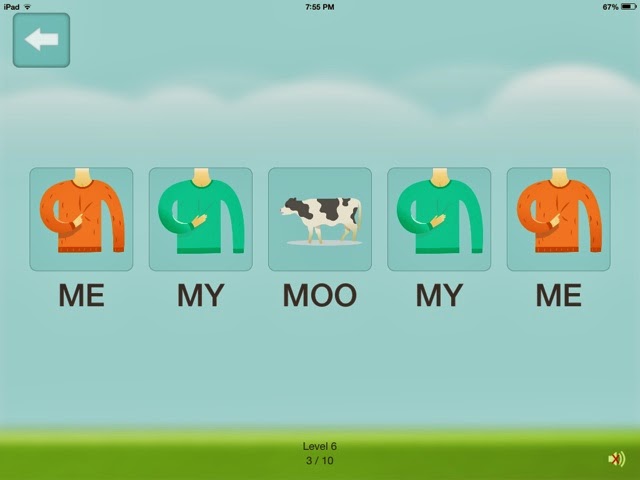
    By the time the you choose Level 8, the pictures change to have three different pictures depicting different words in alternating fashion.  (see below). 

    You can choose to have the sound on, in which a verbal model is presented when you touch the picture; or you can mute the sound so a verbal model is not given when you press the button.
    There is a also a “tracking” feature to tally correct/incorrect productions for data collecting purposes.
    What I love
    This app is great because of it’s simplicity.  It’s more fun for kids to practice these skills on the iPad then it is to use the flip book.  They are just more motivated by digital versions of everything these days!  Also, therapy for Childhood Apraxia of Speech requires A LOT of practice and repetition, and this app lends itself to multiple chances for repetitions in either blocked or randomized fashion (elements essential when treating motor based speech disorders).  
    In addition, most of the kids I treat with apraxia like it.  You can get a quick “warmup” in using this app while getting a lot of repetition right off the bat.

    What it’s missing
    I would probably use this app more, or longer during therapy sessions if it had some sort of reward or fun reinforcement.  However, since I only use it as a supplement to therapy, it’s still a nice app to have. Also, just recently my daughter was confusing her t/k and d/g, so I went back to this app and we practiced using these pictures alternating between the two sound patterns.
    The other thing that is missing is a voice record option.
    Overall impressions:
    I love this app for it’s simplicity, price, and ability to get A LOT of practice in a short amount of time.  Most of the kids I treat with apraxia, and my own daughter with apraxia, have used this app successfully and enjoy tapping, repeating, and swiping the iPad.    I would highly recommend this app to parents and SLP’s as a supplement to therapy for Childhood Apraxia of Speech.

  • Still on a sippy cup

    Still on a sippy cup

    Ashlynn is 4.5 years old.  Though as a baby she never really had a problem latching or drinking out of a bottle, she eventually showed signs very early of oral apraxia.  I remember looking at some teething biscuits and the box saying it was for 9 months and older and thinking, “are they for real??”  She’ll choke on that!!”
    I remember my sister-in-law talking about babysitting my niece when she was under a year and feeding her cheerios, and again, I thought, “Seriously??  Ashlynn would choke on that!!”

    I remember after I took her bottle away at 12 months, my mother-in-law said she had all three of her kids on a regular cup.  I know she didn’t mean any harm by it, but at the time I felt like a failure.  Ashlynn could barely handle a sippy, and a cup?? Forget about it!

    When she was eighteen months, my husband I decided to take a weekend vacation for two nights and left her with her grandma, and I remember I was still pureeing fruits and vegetables and had sent 8 jars of food. Now that I have a typical 18 month old, I can’t believe she was still on purees at that point.  She could eat the occasional cracker, but she refused any other solids.

    I can’t totally remember when she finally started eating at least pasta and breads.  I do remember though one night going to Mimi’s cafe and ordering their kids pizza.  It was more like a thin crust and she swallowed her bite whole and silently cried.  Her face turned red and she had that look on her face like when you eat a chip that isn’t totally chewed and it scratches you going down.  Another instance, my friend brought over amazing fresh bagels from Panera Bread.  I cut Ashlynn’s up into pieces.  As I was talking to my friend she started choking.  I ran over and pulled up her left arm and started patting her on the back.  The entire piece of bagel came up whole.  My friend was horrified and honestly, so was I.  I lived in fear, worried about when she would choke and I couldn’t get it up.  Another time I fed her shells and cheese pasta roni and I remember telling her she needed to chew!  She would put it in her mouth, and then immediately swallow.  Halloween when she was two was pretty disappointing.  Give her M&M’s?  Are you kidding?  What if she didn’t swallow!! Skittles?  Nope. Sprees?  No way! Anything with caramel?  Not a chance.

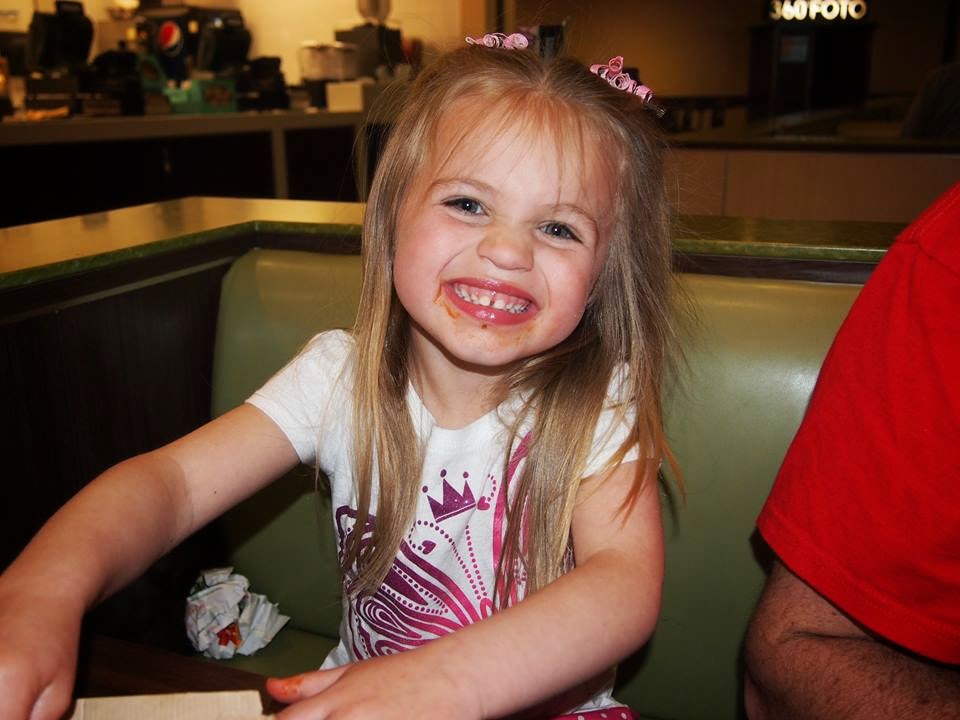
    I’m paranoid now.  I still quarter her hot dogs, grapes, blueberries.  I figured all kids have messy mouths, but now that I have my 21 month old son, his mouth is always cleaner than my daughter’s.  He licks his lips and wipes his chin.  Here is a recent “ketchup mouth” pic of her on our Spring Break.  Isn’t she a doll? She’s so perfect, apraxia and all.

    Which leads me to the title of this post.  She still violently chokes on liquids.  I’m talking about it went down the “wrong pipe,” face turns red, lips turn blue, and we have to pull up her arm and pat her back. This is with a sippy cup!  My husband and I enacted a two sip rule, which is working. We tell her, two sips and then breathe.  We’ll see how this goes, but I wish I had got her feeding therapy earlier.  This is usually done in early intervention through the SLP. She had all the symptoms: over-stuffing, choking, difficulty with chewing, and difficulty sequencing the steps for the swallow.  Hindsight 20/20.  If you read this, and this sounds like your kiddo, get them into early intervention!!  You won’t regret it.  Now I have to decide if I put her in to feeding therapy now, do a swallow study…etc etc.

    I hate apraxia.  I really, really, hate apraxia.  With apraxia, they don’t “grow out of” anything.  They have to work for EVERYTHING, but the earlier the intervention…the better.

  • The importance of touch

    The importance of touch

    “Touching helps us build relationships with one another.”
    This is a simple but profound quote from an article I read on the power of touch: Importance through touch.  It went on to say that babies first communicate through touch and crying, and that their needs are met mainly through touch. It got me thinking. Since Ashlynn took longer to talk, she could only continue to communicate with us through touch and crying.  She has pretty good functional communication now, but when she is tired she still resorts to crying or a tantrum to express her frustration. 

    Other parents who have kids with apraxia frequently report their kiddos are the sweetest and most loving children.  Generous with their hugs and kisses, they are also sensitive and highly attuned to feelings and emotions.  This describes Ashlynn as well, now.

    As a baby, she wasn’t as cuddly.  She always wanted down, and would only cuddle with me long enough to breastfeed or fall asleep.  However, she did always need to be touching hands.  Daddy’s hands, Grandma’s hands, my hands.  When she started preschool this year, the teacher reported she was very loving, which was great; but they were having to teach her to ask for hugs first because not every child shared her enthusiasm for hugs (except the little boy with Down Syndrome.  It’s a hug fest when those two get together!)  Holding hands, however,  she can usually get a way with!

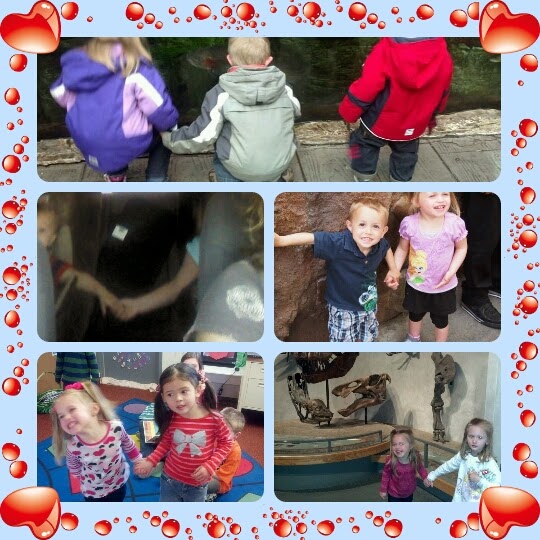
    Ashlynn holds everyone’s hand.  If they hold it back, she immediately declares them a friend. If they resist, she moves onto the next kid.  When she plays with her cousins her age, she also wants to hold their hand.  I have so many pictures of her hand in hand with her cousins and various children.  Not to mention her little brother.  They hold hands in the car on the way to Grandma’s house for daycare. 

  • “I’ve learned that people will forget what you said, people will forget what you did, but people will never forget how you made them feel.” – Maya Angelou

    “I’ve learned that people will forget what you said, people will forget what you did, but people will never forget how you made them feel.” – Maya Angelou

    I love, LOVE Maya Angelou.  I always have.  I was talking with a friend today who was concerned about her apraxic son talking so he can get a job one day.  In the midst of apraxia, in the midst of our children not speaking, us parents all get caught up in the thick, dense trees.  We all, including myself, miss the forest.  In the end, we all ultimately just want our kids to be happy.  We want them to have every opportunity to fulfill their dreams, which is why we cry, worry, and agonize over all the details.  Just recently, I’ve been kept up at night thinking about how my daughter needs to not only be able to point to letters, but she has to learn their names and sounds before Kindergarten.  Yes, she has one more year of Pre-K, but we already know her attention is an issue and she needs more repetition than most and she has apraxia which means even when she knows the letters she has word finding issues and…and…and…..

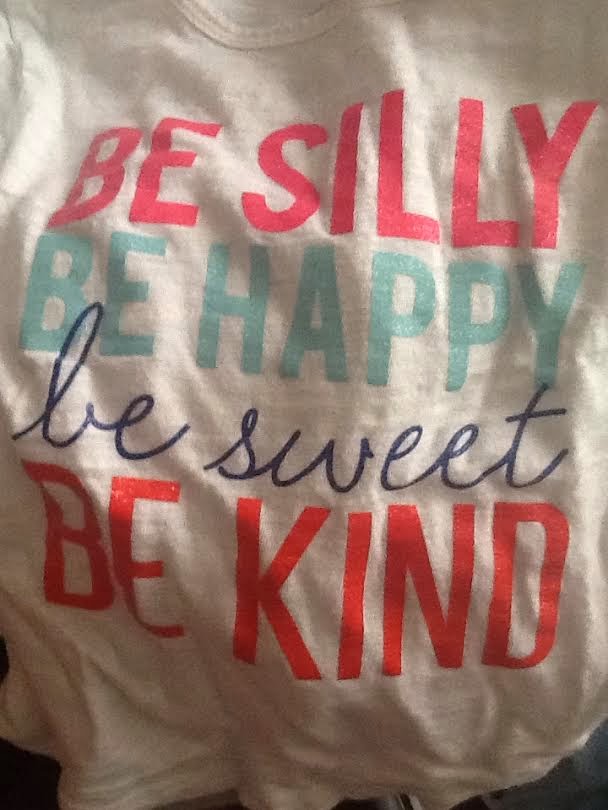
    and…I stopped myself to remember the forest.  I want above all for Ashlynn to be happy.  This picture is from a shirt she wears that her Grandma Green bought her.  It is her to a tee, pun intended.  She is silly, she is happy, she is sweet, and she is kind.  I think the world needs more children and people like this.  

    The political outlook has no time for this.  It’s all about Race to the Top, No Child Left Behind, and more recently, the Common Core.  It’s all about test scores and academic achievement.  Teachers are judged on their ability to teach by a test score.  

    The world has and will have enough big test scores.  What the world needs more of, is big, happy hearts.  As Maya Angelou says, “people will forget what you said.”  In my desire to hear her talk, I was really looking for the feeling of being told, “mommy, I love you.”  If we listen close, it’s the little hand that reaches out to us, it’s in their hug and their big sloppy kiss that they might have because they have yet to pucker, and we know in their tears when we leave.  My daughter’s heart is on her sleeve, and in her young four years she epitomizes already what Jesus said in John 3:18  

    My little children, let us not love in word, neither in tongue; but in deed and in truth.  

    and defies what Einstein mused on when he said,

    “Action speaks louder than words but not nearly as often.” 

    Our kids’ actions already speak louder than words!! They have learned a lesson in life some people fail to learn.  Though my daughter is talking in basic 4-6 word sentences now, she is still sweet, kind, and happy, and will still hug, smile, giggle, and hold someone’s hand over talking.  People don’t remember what she said or what she didn’t say.  Everyone remembers how she makes them feel. 

     If this is the woman she is destined to become, than I think I can say as her mother she is successful.  


  • “She just needs more repetition than most.”

    “She just needs more repetition than most.”

    Today was Ashlynn’s Spring parent/teacher conference.  I don’t know what I expect really.  As much as most of the time is spent focusing on her strengths, all that hits me like a ton of bricks is what she ISN’T yet doing. My husband thought I was crazy.  He couldn’t come to the meeting today, but read the paper tonight at dinner and told me he felt it was predominantly positive.  Look at all the things she’s doing that she wasn’t doing last year at this time.

    True.

    I guess I just hate listening to all the positives while holding my breath and waiting to hear the “but…..” 

    It sucks.  I just leave there feeling desperate, sad, and worried, no matter how many positives they managed to come up with.

    Hearing all the buzz words I’ve used in meetings before, “needs more repetition than other children” “learns differently” “has a great attitude which is a huge asset”

    I guess I should focus on the positive though.  Her strength was in pro-social behavior and she even gets in trouble now for talking too much!  Um, what?  Talking too much??  She didn’t even talk to her peers last year in preschool so that is AWESOME.   Her language sample during sensory table was as follows:

    I help you?
    What doing?
    I’m making a pizza to baby.
    I like pink.
    You have purple.
    I sit here?
    I play with Austin?
    Blue goes right there, see?

    As an SLP, this is awesome.  She’s four years old and is using primarily 3-4 word sentences.  Still a little behind, but her sentence length is only a little under than what is expected for her age.  This is exciting.  Also, she was SO clueless about her colors last year.  It sounds like she’s finally starting to retain them.

    The report said “she is understood by most familiar people and strangers can usually understand her if she speaks slowly.”  That is also great news!  I need to revel in all of this progress.  Can’t I just remember when  I was freaked out she wasn’t talking to anyone and all I wished for was that she would talk?  I know….I NEED to….it’s just…then there is all the academic things she needs to know now.
    She still needs more practice recognizing and naming the letters in her name. She can count to ten and count up to five objects accurately using 1:1 correspondence.

    Okay, yay, that’s awesome…..except I know by the end of preschool they need to know ALL their letter names and letter sounds, count to 20, and be able to write their name by the time they enter Kindergarten.  The teacher tried to encourage me by saying, “well, she does have one more year in preschool.”  and then ended, “but summer is a critical time because a lot of kids do show some regression.” 

    Yes, yes that’s true.  I hope next March at her Spring parent/teacher conference we will be on target.  In the meantime, I am officially off my sabbatical of only being Ashlynn’s mom.  She needs me more than that.  I went out and bought a bunch of alphabet cards, foam letter puzzles, and a dry erase board.  I sorted the letters of her name into a bag, and we’re going to practice putting them in order and naming them every day.  We’re also going to go through the foam letters and name the letter and the sound daily.

    I downloaded a kid weekly planner so that Ashlynn can learn the days of the week and each day we can talk about what she is going to do, and then at the end of the day we can talk about what she did. 

    I printed out three picture sequence cards so she can practice putting them in order as well to encourage pre-reading and narrative abilities there too. 

    I’ve been depressed today just thinking about all of our hard work ahead, but tonight when I was working with Ashlynn, she’s not depressed at all.  She was thrilled to have 1:1 attention from her mama and just attacked it all with her positive attitude. 

    So here’s to a lot of work, but most importantly, a positive attitude to go with it.