Tag: Apraxia

  • Good teachers change lives

    Good teachers change lives

    What a busy month!  Life definitely doesn’t slow down just because I’m off for summer break!  I signed both the kids up for swimming lessons.  Ashlynn would be in the Guppy class for probably her 5th time, and Jace and I would be in the parent/tot class.

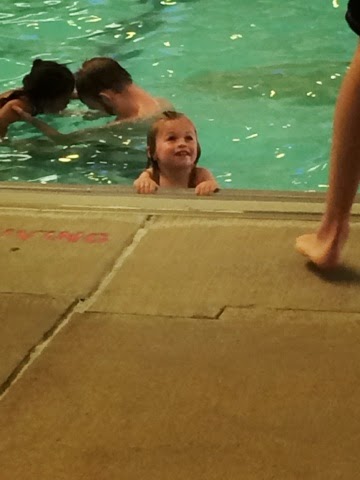
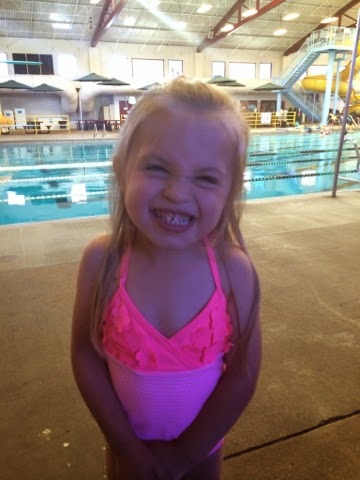
    I decided that since it was the first day, and considering Ashlynn’s aversion to water now following two traumatic pool events, here: I would stay on the side with Jace and watch to make sure she was ok. I realize now it was totally irrational, but I guess I was expecting she would have her same instructor from last year and she would be off and running.  She sure was excited at the thought of going swimming.  I snapped this photo while we were waiting for them to call off the classes.  Doesn’t she look excited?

    I have to admit, when they called off her instructor, he looked like he was 12.  Okay, not really, but he was young, new, a little hesitant himself.  Ashlynn refused to get in the water.  She cried hysterically as fear gripped her whenever they even mentioned it.  Another little boy in her class had autism, and his mom had to literally sit on the side and hold his arm or he would go swimming off under water, and another little boy had no desire to listen or follow directions.  I actually kinda felt bad for this kid as much as I did for Ashlynn.  He was in waaaaay over his head!

    Week two, Ashlynn would let him take her out to practice skills, but she either had her arms gripping his face, her neck up, or her knees pulled to her chest.  She also refused to stand in the water and would only sit on the side of the pool.  It literally broke my heart.
    There were some cute moments though.  When it was time to stand on the edge of the pool, she would hold the little boy’s hand who had autism and talk to him and repeat the directions.  He never looked at her, but he seemed to listen and his mom seemed more than grateful.  Ashlynn was the only child to talk to him and she was the only person beside his mom that he would let hold his hand. I just thought, “Well that’s Ashlynn.  Maybe she isn’t here to learn to swim.  Maybe she has a bigger purpose.”  Even though I was proud of her, my heart was still sad.  I lamented to my husband that I felt that she was actually worse than when she started swim lessons last year because now she wouldn’t even get in the water.  
    We tossed around private lessons and decided to do it.  I heard the instructor of my parent/tot class saying she and another instructor were the only two current certified staff.  I figured I’d go with her and had her write her number on the back of the card.  That was Thursday.  
    On Monday, Ashlynn started her new two week session.  I just figured she would have the same boy, and I thought, well, maybe it’s best because at least she knows him.  However, I was surprised when they put her in “Josh’s” class.  I had seen Josh since last year.  He normally taught the older kids, or so I thought.  I would marvel about his amazing teaching ability and how his kids would respond to him.  I wished he taught the younger kids, but I had never seen him do so, until today.
    Ashlynn went shyly with me holding her hand.  Instead of my usual speech of “Even though Ashlynn doesn’t look like it, she has special needs and has a motor planning disorder that affects everything from her speech to her gross motor skills, so please keep an eye on her because she has had to be rescued twice” I said, “You teach little kids?  I only thought you taught older kids?”  He seemed surprised and said that was weird because he usually only teaches the little ones.  
    I stepped back with Jace and turned around to see Ashlynn red faced, freaking out not wanting to get in the pool.  He put her in anyway and then bent his head in and said something to her ear.  I have no idea what he said, but she stopped crying.  Before I even knew it, I was in tears on the sideline watching her not only stand in the water but blow her bubbles and do her head bobs.  I sent text messages to my husband.  
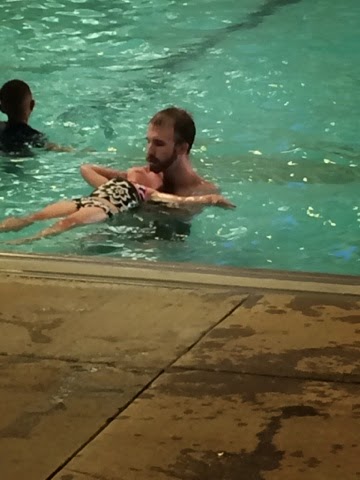
    When I looked up again, I saw this:

    Full back float, head down, arms AND legs out relaxed, and trusting Josh.  She has NEVER, EVER, done this with anyone.  I looked on stunned and snapped another picture.  When she started to tense up, he leaned his head into her ear again and told her to trust him.  He told her he had her, and when she did it he gave her the biggest hug.  

    Tears flowed.
    To see the pride on her face, the confidence in her smile, the sparkle in her eyes….he did this in ONE day!! 
    And what I realized was, I actually didn’t care about the swimming.  I mean I do, but I was more proud of her being proud of herself.  He gave her confidence, he instilled a sense of accomplishment in herself and that is what being a teacher is all about.  He made her WANT to learn to swim.  
    Good teachers change lives.
    In this journey in apraxia, I realize and learn over and over and over again, that maybe we have to know the darkness to truly appreciate the light, and the light sure shone on us today.  

  • Baking with speech and language

    Baking with speech and language

    Parents are always looking for ways to incorporate speech and language activities at home.  Whether it is to stimulate a typically developing child’s vocabulary and language, or to help a speech or language delayed child; baking is great and fun way to work on speech and language.

    The first and most important rule before you start, is you have to accept the fact that your toddler will make a mess, and that is just part of the process, or um, fun.

    When I do baking or food activities with kids in school, they absolutely love it.  That’s the key. When kids have fun they are at their best learning.  Also, baking is a multi-sensory activity, meaning many sensory systems are activated.  When children are using multiple sensory systems, acquisition and retention of skills is more likely.  Baking with your kids inherently promotes:
    Vocabulary development
    Sequencing
    Following directions and comprehension
    Pragmatic language – the social piece of language

    Let me explain a little bit further.

    Vocabulary Development:  

    For the young child, words are learned best in context.  Certain authors refer to this as “event-based knowledge.”  Many of children’s first words are usually embedded within scripts that are part of their daily lives.  Examples could be: bottle, cookie, doggie, bath, etc.  These words are said to them frequently throughout the contexts of their daily lives.  Baking provides the same event-based knowledge experience, and exposes them to new vocabulary.

    Sequencing:  

    The ability to understand sequences and to sequence is an important skill.  Sequencing most simply refers to the order of things.  When kids get into school, sequencing is very important to understanding: patterns, math, a story etc.  Following a sequence of steps is inherent in baking and makes it the perfect activity for this skill.

    Following directions and Comprehension:

    These two things fall under receptive language skills; however, they are very important to the development of overall language skills.  Kids who are good at retaining and following directions have less difficulty in school since they are not devoting a lot of their cognitive load on simply understanding and remembering what they are supposed to do.  Baking is a fun and easy way to help your child practice these skills at home.

    Pragmatic Language:

    This is usually referring to the “social” element in language.  This involves the way language is used to communicate with others.

    With a little forethought, baking can also be a way to sneak in more direct speech language targets while working with your kid at home.

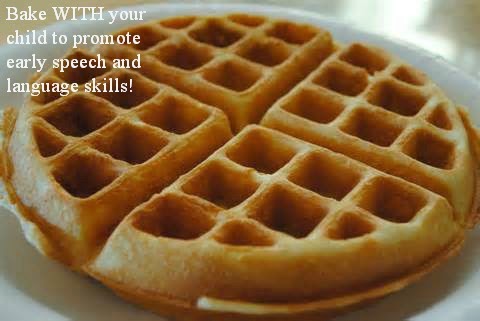
    Muffin Mondays and Waffle Wednesdays

    This summer I implemented Muffin Mondays and Waffle Wednesdays. Ashlynn is VERY interested in what day of the week it is, so I did this to also give her a framework of her week.
    Ashlynn’s current speech/language needs include: syntax (the form or structure of a sentence), and consonant blends (two consonants found together in a word: sp, st, sl, fl, bl, for example).

    It’s important to know your child’s goal, and then structure your baking around the goal.  Get creative, but it’s not as hard as it seems.  In Ashlynn’s case, I chose  the words: spoon, flour, stir.  For syntax, I had her ask me “Can I do it?” to work on her questions forms.

    Then each time we used a spoon I had her repeat “spoon.”  While she was mixing the batter, I would ask her what she was doing and cue her as needed to say the “st” blend in “stirring.”  Instead of using 1 cup of flour, I broke it up into four parts to give her more practice saying “flour” each time she poured in the flour.  For an extra bonus, she had to put “stir flour” together in a simple phrase.  I would hold the spoon until she said the desired words, and then I would give her the spoon back when she was successful!  She loved it.

    If your child isn’t yet talking as much as Ashlynn, hum the ‘m’ sound while you mix the batter or if your child isn’t great at imitating yet, just have him/her make any vocalization to request an item.  If they can’t yet imitate even a vocalization, imitate any spontaneous sounds they make to provide an opportunity for vocal play. If they aren’t really vocalizing yet, don’t get discouraged!  Practice turn taking and reciprocal play.  They pour then you pour.  You stir then they stir.

    With other clients who needed a final stop, I might have chosen the word “dump” and then every
    time we pour in an ingredient, we work on the word “dump.”

    Really, the possibilities are endless!

    In addition, you can also tell your SLP that you incorporated some great “distributed” practice throughout your child’s day.  In motor learning approaches to therapy, mass practice refers to the production of a large number of repetitions of a single target(what you should be seeing in therapy) and distributed practice refers to hitting targets with a greater amount of time between trials or sessions.  However, distributed practice is very important for stabilization and generalization!  Parents are the greatest asset when it comes to carryover, because you are in a better position to afford the child numerous opportunities for distributed practice!  In addition, you can do it in ways that are fun and multi-sensory in the child’s natural environment.


  • For once I went to school, and I heard only positives

    For once I went to school, and I heard only positives

    Let’s face it.  Being a parent is rough.  Whether you have a child with special needs or not, we all want for their happiness, that they will feel successful, that they will be confident, and that they will never hurt.  Of course we know that without trials they cannot fully appreciate the successes, without sadness they could never fully experience complete happiness, without hurt they simply wouldn’t be human. 

    School has been an absolute blessing for Ashlynn, my social butterfly.  She never let her limited speech hinder any of her relationships.  In fact, her first word was ‘hi’ and it was all she needed.  She could and still can engage anyone with that simple word and her beautiful smile, and they are hooked. 

    But

    That’s why it was so hard to go to IEP meetings, parent teacher conferences, and get reports from her teachers and therapists.  No matter how many positives were relayed, we always sit there waiting for the

    But.

    She is so happy and works so hard,

    But

    She is friendly, sociable, and loving

    But

    She is an absolute joy

    But

    I’m not gonna lie.  The “buts” hurt.  It really doesn’t matter if they are framed around 100 glowing adjectives, the “buts” can be overwhelming.  Especially when for one child she needs a

    speech therapist
    occupational therapist
    physical therapist
    special education teacher
    social worker

    They all come with their own set of “buts.” 

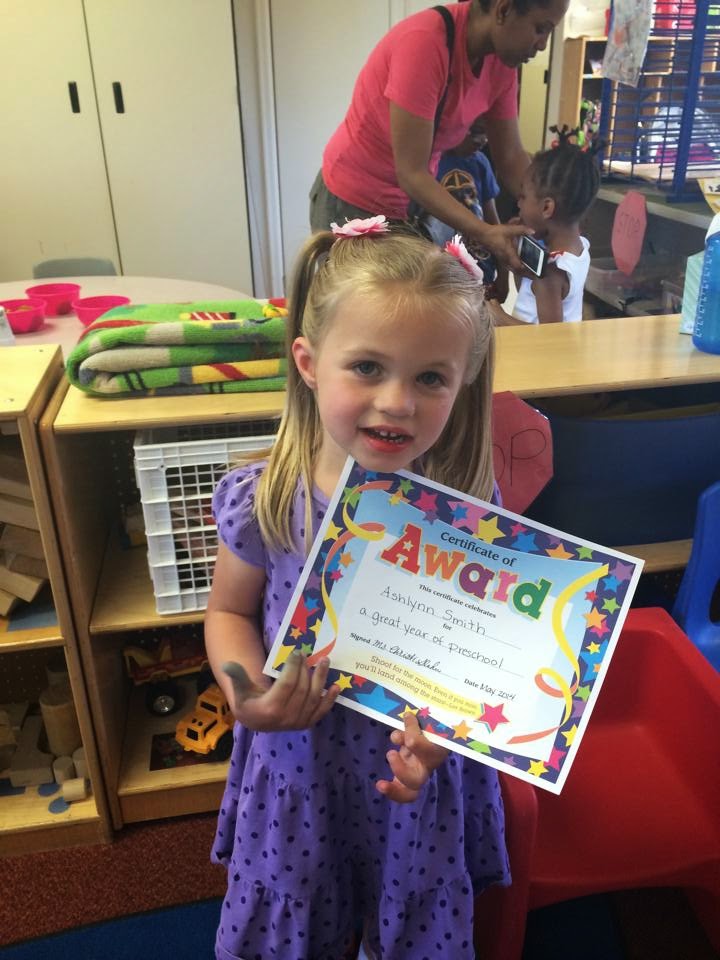
    Today though was different!!  Today, her last day of Pre-K, there were no “buts.”  Today, as I picked her up, I heard this:

    Teacher: “I have been blessed having Ashlynn is my class.”
    Social Worker: “Ashlynn is the sweetest, kindest child. She is friends with everyone, and everyone is friends with her.”
    Another parent: “My son told me this morning he was really going to miss Ashlynn. When I asked him what he would miss, he told me her laugh.”

    It just brings tears to my eyes. There’s no standard score or percentile for that….but if there were she would be way above average. 
      
    Ashlynn is my sweet, kind, loving, daughter who blesses those around her with her smile, her laugh, and her friendship.

    No buts about it.


  • Apraxia is elusive, even to professionals.

    Apraxia is elusive, even to professionals.

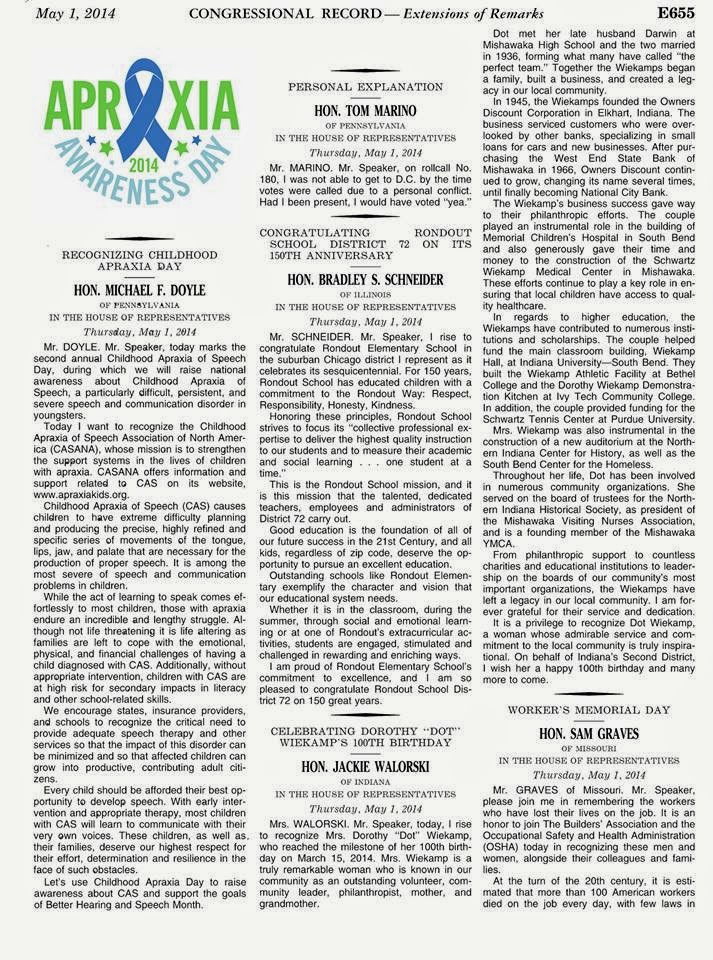
    Today is the second annual Apraxia Awareness Day, and in case you haven’t heard, this year it made its way into the United States Congressional Record!  That’s a big step in spreading awareness, but there is still a long way to go.

    I was able to blog about the very first apraxia awareness day here First annual apraxia awareness day and I’m so excited to be doing it again this year.

    Most people still haven’t even heard of apraxia.  Doctors, including my own pediatrician had only vaguely heard of it, and many SLP’s still don’t know how to treat it correctly.  I was one of them!  I had a 20 page small folder on Childhood Apraxia of Speech from graduate school, and that was it!  Luckily I had an amazing mentor who took me to an apraxia conference when I first started in the field, and I was able to treat the disorder successfully with the three kiddos I saw at the school-aged level.

    However, then my own daughter was born.  Her first year was stressful.  I hated the baby screeners at the doctor’s office.  She wasn’t cooing or really babbling, but she was so alert and had the best giggle!  Everyone assured me she would talk in her own time, but every screener put her further and further behind.  She crawled late, walked late, had poor balance and choked on her food and drinks, oh, and did I mention she wasn’t talking??  I attended conference after conference on early intervention for speech.  I then would work all day and then came home and used the techniques on her.  One problem, they didn’t work!!  I was stressed, worried, and constantly thinking about her development.  Even though I was treating it in the elementary school, it didn’t occur to me that this disorder was also behind her development delays.

    When I took her to Child Find I remember the evaluation like it was yesterday.  I knew she was behind, but seeing it with another SLP was heartbreaking.  I wanted to gather her up and leave so many times.  When the SLP came to talk to me, she said four words that I will never forget, and at the moment I instantly realized were true:  “Laura, this is apraxia.”

    My God.  How did I miss that???  However, I instantly knew she was right.  I was dealing with apraxia.
    Apraxia.
    Apraxia.
    Oh God no, not apraxia.  Why MY baby??  I cried in the car after the evaluation.  I sent a text to an SLP friend “She has apraxia.  I’m devastated.”

    My mother in law was watching my baby.  I went home and cried.  “Will she ever talk?” she asked.  “Oh yes” I responded.  She just has to face the biggest hills in order to do it.  I cried some more.

    I’m really not sure what’s worse.  Being a parent who doesn’t know what apraxia really is, or being a parent who knows exactly what the monster is, and just how hard she’ll have to work to overcome it.

    After the devastation….and to be honest I really did feel devastated, I mourned it, and then I became angry. I realized now why all the early intervention I was doing with her EVERY night wasn’t working!!  She had apraxia!!  Apraxia has to be treated differently.  You need a motor based treatment approach, not a language approach. Why didn’t I know the signs of apraxia in young children??  And you know what?  Once I put her with an SLP trained in apraxia, she made progress IMMEDIATELY.

    IMMEDIATELY!!

    I had a masters degree in this!!  It was unbelievable to me.  I reviewed all my early intervention conference notes and power points.  Not ONCE was apraxia mentioned.  It made me think, are early interventionists even looking at apraxia?  Why are we treating all speech delays the same way?

    After I got over being angry, I got determined.  This happened to me for a reason.  I had successfully treated two cases in the schools, but I needed to know the ins and outs of this disorder.  I’m an SLP and MY daughter had apraxia and I missed it.  I missed it!!  As I think of that right now I’m shaking my head.  That’s just not ok.  There needs to be more information out there.  It needs to be as well known to SLP’s as their everyday speech and language disorders are.

    That is my mission now.  I went to apraxia-kids.org and started signing up for webinars.  I went to every apraxia conference that came to Denver since that time, and was fortunate enough that the Apraxia National Conference came to Denver last summer in 2013.  I saw so many apraxia experts.  I found out about an apraxia intensive bootcamp.  I applied and I was accepted!  I go this July.   Last February, I gave my first ever professional presentation to a packed room of school based SLP’s.  I didn’t claim to be an expert, but I had come A LONG way since that mom crying in her car.  The interest was so great that people were sitting on the floor.  That’s how much SLP’s are craving this information.

    I asked my clinical director at the private practice to support me in my mission to specialize in apraxia.  She didn’t even blink.  I am so blessed to know her.

    I started this blog, and now I started a facebook page SLP Mommy of Apraxia.  I want to give simple tips on things to do at home, and also spread awareness.
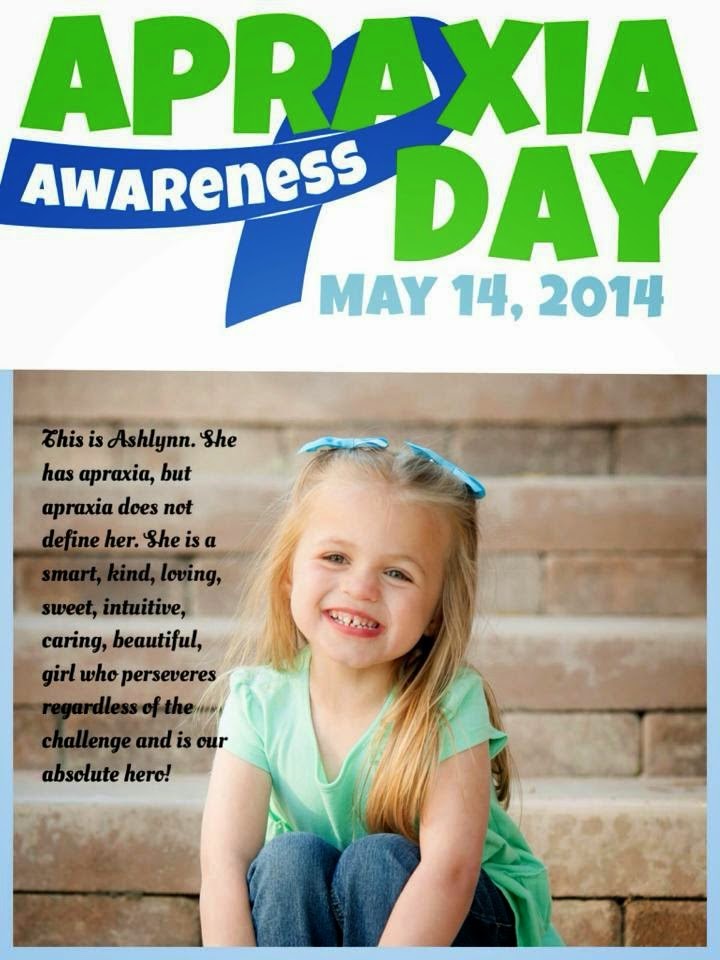
    As for Ashlynn?  Well, she’s basically just pretty amazing.  She meets every challenge head on without
    frustration.  She overcomes every obstacle in her path, no matter how many time she has to try.  She’s speaking in 4-8 word sentences, started independently doing show and share at her school, and has many friends she plays and socializes with.  She still needs speech.  We still work everyday on correcting her errors and mapping the motor plan, but I know she’s going to be fine now. She’s not only my hero, but my inspiration and why I stand up on TODAY, May 14th for EVERY child who deserves a voice on this second ever Apraxia Awareness Day.

    Signs and Symptoms:
    – Little to no babbling
    – Only a few different consonant and vowel sounds
    – Inconsistent productions of vowel and consonant sounds
    – Disrupted prosody
    – Difficulty with co-articulation of speech sounds
    – Comprehends much more than they can speak

    Diagnosis
    – Only Certified SLP’s trained in this disorder should diagnose it.  Pediatrician’s and neurologists do not go through the extensive testing an SLP will do to provide a thorough differential diagnosis.

    Treatment
    – A motor based treatment approach to therapy must be initiated.  Therapy should be focusing on the planning, coordinating, and sequencing of speech sounds, usually with some sort of verbal or visual cueing system.
    – To find professionals in your area see this link: Apraxia Experts by state

    Most of all: Spread the Word!!  Knowledge is Power.
  • The day I realized apraxia has been a blessing.

    The day I realized apraxia has been a blessing.

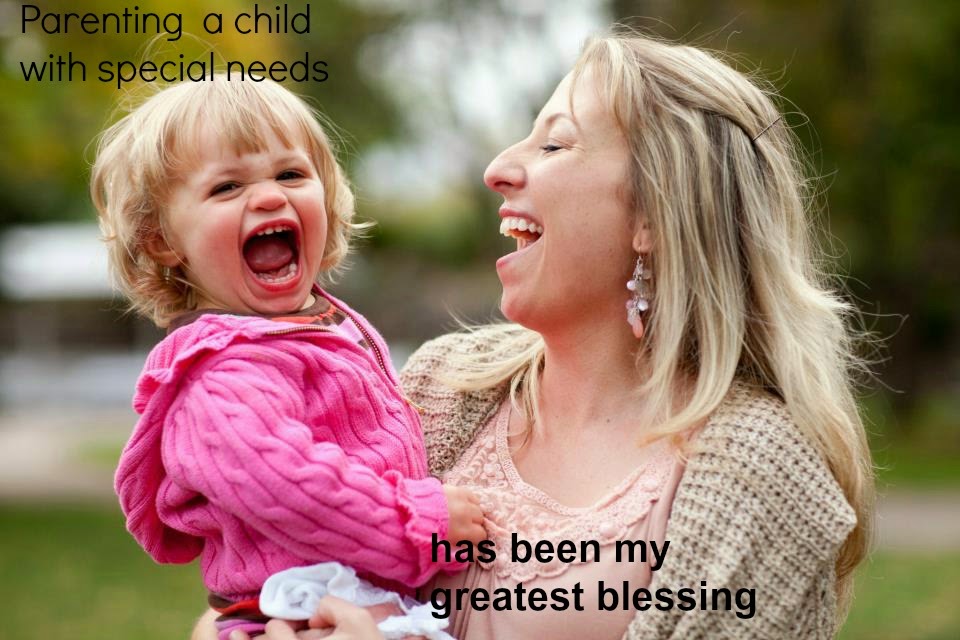
    Yes, you read the title correct.  I just called apraxia a blessing.  It took me a long time to get to this point.  I certainly didn’t feel it was a blessing here 2.5 years, or here, New worries, or here IEP on the other side of the table, or here Background and suspicions.  I remember shouting “I HATE APRAXIA” “APRAXIA SUCKS!!” everytime I watched my daughter struggle.  Slowly but surely though, the blessings started to outweigh the diagnosis; in fact, blessings started to develop out of the diagnosis.

    I was talking to a mom the other day from Georgia at Mommy Square, and she told me she has met a lot of friends because of apraxia.  It got me thinking that I have too.  I have a mom from Syracuse with whom I formed a connection because of our commonality of being mom’s who were ALSO SLP’s.  We shared our frustration at the lack of knowledge surrounding apraxia, and our mission to be educated on it.  I have a mom from Utah who has a daughter the same age as mine with apraxia.  We blog, collaborate, and fight apraxia together.  I met Sharon Gretz,  the founder of CASANA, the non-profit behind the apraxia-kids website.  Meeting her was a pivotal, inspirational moment in my life.

    All these moms have one thing in common.  They all are incredible, inspirational women, and they all go through extraordinary lengths in the names of their child.

    I am blessed to have found and to know each of them.  I am blessed to understand from an emphatic position what it is like to have a child with apraixa.

    I am blessed that I was chosen to be her mommy, because through her I have learned the true meaning of perseverance and bravery by seeing them through the eyes of my daughter.

    I am blessed because we have so many people in her corner.  Grandma’s, Grandpa’s, Uncles, Aunts, & cousins all cheering her on.

    I am blessed because out of the struggle has come joys I could never have dreamed of or experienced myself.

    I am blessed because though her dx could have brought distance between my husband and I, it only brought us closer toward the common goal of beating it.

    I am blessed because my husband confided one day that when he starts to feel bad about the hand Ashlynn was dealt, he always sees her overcome it.

    I am blessed because if not for her, I wouldn’t have set a goal to specialize in apraxia, and in turn, I may not have met all the wonderful people I have met, or been able to treat all the wonderful children I am priveleged to treat.

    I am blessed because I never take for granted one word, one sentence, or one song.

    I am blessed because I know other parents who feel the same.

    I am blessed because apraxia has taught me gratitude.

    I am blessed from simply being her mother.

  • To say your name

    To say your name

    Most people might take for granted their name. You have a name, you’ve always had a name, and basically that’s that.  Kids with Apraxia have a name too, and they know it just like you.  There is, however, one difference.  Many can’t say their name at first. Can you imagine?  How many times are little children asked their name?  It’s basically the first question strangers ask them right up there with how old they are.

    Every child deserves a voice, and every child should be able to say their own name. A name is not only your identity, it gives a symbolic representation of YOU.  A verbal representation of letters and sounds that come together and allow you to say YOU are YOU. A name carries history, geneology, and meaning to the carrier.  It’s so important, that even if one vowel in someone’s name is mispronounced, the offended will quickly correct the offender. Just recently in the news, John Travolta mispronounced Idina Menzel’s name when introducing her at the Tony Awards read here and she reported that it threw her off for like eight seconds and she had to give herself a pep talk saying “stop worrying about your name and sing this song.”

    So…needless say.  A name is important.

    I remember back to the early days of speech/therapy.  Her private SLP had a great idea.  In those days she was only working on CV and VC syllables.  We could get Ash, and we could get In.  We settled for Ashinn.  I actually was thrilled then when she said it.  After that, it took repetition after repetition to actually put the sounds together correctly and then more practice with her actually remembering and saying it on command.  I have a note from her school SLP frequently about how they would go around her preschool last year and practice saying her name when people asked her. 
    I was okay with this, because as an SLP I know that L within the realm of what we consider a later developing sound.  Basically, it’s still developmentally appropriate not to have an L at three years old, apraxia or not.  
    Now Ashlynn is 4 years 7 months.  Just a few days ago my husband and I went to the grocery store and the clerk asked her, “What’s your name?”  We waited for her to respond and she said “Ashin.”  The clerk as expected said, “Oh Ashley, what a cute name,”  and as expected without even thinking, my husband and I both followed up, “Yes, AshLYNN.”  
    Then came today.  We were looking at pictures in our photo album that I was putting away.  In it, I had some pictures of her friends from school.  I was quizzing her on their names and she could tell me most of them.  We came to a girl named “Calista.” Very deliberately, she said “Ca-Lista”  
    My head whipped around.
    “Ashlynn!  Did you hear the L sound in her name??  You said CaLista!!  Say it again, CaLista.”
    “Ca-Lista.”  
    “Ashlynn!  Do you realize that sound is in your name??  Say AshLynn.”
    “Ashhhhhhh-Lynn.”  
    And there it is.  Today, May 2nd 2014, Ashlynn finally said her name with all the sounds.  So funny how these small things bring big tears.