Tag: Apraxia Awareness Day

  • Anything but Silent book review and giveaway!

    17895894

    I’m continuing on with Day 4 of giveaways leading up to Apraxia Awareness Day on May 14th! Today I am reviewing the book ANYTHING BUT SILENT by Kathy and Kate Hennessy.  Kathy Hennessy is the mother to Kate who has pure CAS and another son Andy who has global apraxia and SPD.

    The book rotates chapters from Kathy’s point of view to Kate’s point of view.  First of all, I just have one piece of advice: if you are a parent or professional

    READ THIS BOOK.

    READ THIS BOOK!

    Yes, people.  It’s that good.  I read it in one night!  I couldn’t put it down.  I laughed, I cried, but mostly I related.

    It starts with the diagnosis:

    “I decided that day I could beat myself up about the unfairness of life or I could educate myself and help my daughter move her own mountains.”

    I could not have said it better.  This is EXACTLY how I felt.  How I feel! Kathy wasn’t kidding either.  She’s now the education director at CASANA (apraxia-kids.org).

    It captures the need for others who are going through the same thing:

    “What I needed at this point in my life, more than anything, was another parent, and that was the one thing I couldn’t find.”

    I can’t even imagine.  My fellow women I have met through facebook are my saviors.  Seriously, I don’t know what I would do without them.

    They capture the fears at simple holiday traditions:

    “When you have someone in your family with childhood apraxia of speech, things that are everyday occurrences for other families are moments for you that aren’t very normal at all.”

    She’s referring to the tradition of seeing Santa.  Kathy would fret and worry that Santa wouldn’t understand them, among other things.  Let me tell you, EVERY mommy of apraxia has been there.

    From fighting insurance companies, to therapy sessions as a lifestyle, these two amazing women tell their incredible story and as Kathy puts it, “Today both kids are doing great and I’m still standing.”

    This story was inspiring beyond my wildest imagination.  I can’t believe I waited this long to read it!  Read it people!!  That’s my review.  You won’t be disappointed!

    To win this book, enter below. Open to U.S. residents only!  Good luck.

    a Rafflecopter giveaway


  • Interview with “Speaking of Apraxia”

    Interview with “Speaking of Apraxia”

    Hi Leslie!  I’m so happy to have you.  I want to start by asking, what made you decide to write this book?

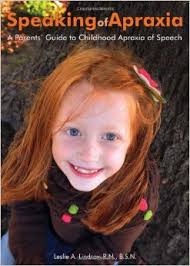
    Oh, I am happy to be here, Laura.  I won’t pretend that SPEAKING OF APRAXIA was in any way ‘easy,’ but it did sort of present itself to me…in the form of my oldest daughter!  I may have been a first-time mom, but I was also a child/adolescent psych/RN and *knew* something was a little amiss with my Kate’s verbal development.  We didn’t want to admit that our baby wasn’t anything less than perfect; still something niggled in the back of my head when she wasn’t cooing and gurgling like most little babies.  I cringed when others told me of their child’s first words.  Mine pointed and grunted.  My heart broke. When Kate was diagnosed (about 2.6 years of age), I wanted a book.  I’m very bookish – and tangible – I like to be able to hold things and refer to them time and time again.  Websites are great, but they can lead to a spiraling search.  SPEAKING OF APRAXIA is a part of a mother’s mission to help her child, but most of all – I wanted a book, I figured there had to be others out there who wanted – and needed – this resource too.

    You are quick to point out you aren’t an SLP, but did enlist the help of an advisory review board to include the latest research and technical information.  Who was on the board and how long did this take for your research?

    This was one of the more tricky aspects of writing a book about a motor neurological speech disorder for the parent community.  I wanted it to be accessible to parents, but I also wanted to get the information right.  Over the course of writing and researching SPEAKING OF APRAXIA, I had “bumped” into some extremely knowledgeable professionals at various conferences, schools, the community, and social media.

    Diane Bahr, CCC-SLP provided much of the technical assistance when it comes to speech and language development.  She practices in Las Vegas, NM and is the author of several books herself. Teri Kaminski-Peterson, CCC-SLP in in Minnesota and works so well with children and her book,  THE BIG BOOK OF EXCLAMATIONS prompted me to connect with her.  Amy, an astute mother raising girls in St. Louis, one of whom suffered from CAS chimed in with the “parent readability;” as did her child’s SLP on some of the more finer points of private practice speech therapy. A preschool-school based SLP who worked with my daughter read over the sections on school, as did Kate’s very first classroom teacher, Lisa Circelli.  I knew shew as a winner when she lowered herself to the floor and spread her arms for a big embrace from my little redheaded sprite bringing me to tears.  Kate was literally in ‘good hands.’

    How long did it take?  I don’t know…it’s like childbirth that way.  Awful and tiresome and painfully intense.  And then it’s over.  You don’t remember, but somehow you have battle scars.  And a precious reminder of your labors.  Conception to shelf: 4 years.

    You describe this in your book, but to give some background to those who might not know you, what age was your daughter Kate diagnosed?  How frequent and often were her therapy sessions, and when would you say she resolved?

    As mentioned earlier, Kate was 2.6 years old when she was finally diagnosed.  I say ‘finally’ as if it were a long wait, but it really wasn’t.  Most speech-language pathologists (SLPs) are more comfortable waiting to diagnose until the child is three years old.  But three years (even two-and-a-half) is a long time to wait and to worry and to schlep your child to appointments.  And have no answers.  Kate was evaluated by her pediatrician who was concerned at 12 months.  And again at 18 months.  We saw a speech-path for the first time around 19 months.  She told us Kate was “definitely delayed.”  A baby sister was born.  My husband was transferred out-of-state.  We moved.  We worried.  We got a definitive diagnosis once we settled in Chicagoland.  The diagnosing SLP still recalls how determined I was to get a “label,” saying I was probably the only parent who just came out and said, “So what is it?!”  She said she knew without a doubt we were dealing with apraxia.  An overwhelming sense of relief and then ‘now what’ enveloped me.  I rolled up my sleeves and dug in!  We were intense about our therapy sessions.  Twice a week for about two years.  Then we added feeding therapy (more on that below) so for awhile she was going to therapy three times a week!  Gradually, we cut it down to twice a week (speech), then once a week (speech) and once a week occupational therapy (OT).  By the time she was a first grader (6 years) we were finished with private therapy – Yahoo!

    Many kids with CAS have co-morbidities such as Sensory Processing Disorder, Autism Spectrum Disorder, and/or Attention Deficit Disorder.  These can all affect prognosis.  Did Kate have any co-morbidities, and how is she doing now?

    “You bet she does!” I say with a grin.  It’s true: CAS is often a ‘package deal;’ a combo platter of CAS and…what-have-you.  In our case, Kate had some sensory integration issues as a younger child (3-5 years old) requiring occupational therapy and feeding therapy (food textures, ‘remembering’ to chew, etc.–quite common for kids with CAS). We absolutely loved the combination of OT and Speech therapy (ST)!  It was the wining combination for our daughter.  There’s actually something to that: the vestibular system works in tandem with the speech centers in the brain – this is one reason why playgrounds are a great place to practice speech work.  When Kate was five, her SLP thought there may be “something more going on,” and that’s when she was diagnosed with AD/HD. We added medication to help control the AD/HD when Kate was a first grader and it helped immensely.  Kate’s speech became more organized as did her behavior.  These things *can* affect prognosis, but there are so many other factors that come into play: parent involvement, school support, the child’s awareness of her (dis)abilities and her ability to self-correct speech mistakes, child’s temperament/intelligence, motivation.  I may be missing some, but you get the idea.  I’m happy to report that Kate is a happy, successful 4th grader – one of her teachers call her ‘wildly creative.’  She even has the writing bug like her ol’mom!

    What do you see as the most important thing an SLP can do to help the parent in this journey?

    Wow.  This is tough.  We’re all different and we all seek different services at different stages in the apraxia journey.  I loved when our SLP listened.  It sounds simple, but having an ear to bend and some validation is huge.  As parents, we’re often at a loss of what to do – but we love our kids so much, we’d move mountains.  Let us be partners, too.  Tell us how and what we can do at home to stimulate and encourage speech.  Don’t disregard our efforts or belittle our worries or concerns, invite us on-board and let us know our efforts matter.

    How have you seen CAS awareness and information change over the years, or have you?

    It’s changed incredibly!  When I first started this journey, I didn’t know where to go for information – aside from the internet -and I felt kind of stigmatized sharing Kate’s “problem” with other parents, neighbors, even family.  Maybe that’s part of the process of coming to terms with things, or maybe there’s just greater awareness.  Over the years, walks have been added to most metropolitan areas, support groups have sprouted up, and now we even have Apraxia Awareness Day in May!

    What would be your biggest piece of advice for parents when faced with this diagnosis?

    Have faith. Partner with your child’s school and/or private SLP.  Do your own research, but don’t freak out about everything you hear or read; you’ll need to access all your critical thinking skills because it’s easy to get overwhelmed or feel as if a diagnosis is all gloom-and-doom.  It’s not, there is a light at the end of the tunnel.  Apraxia is often short-lived; there’s a reason it’s called *childhood* apraxia of speech: it’s typically resolved (or resolving) by the time a child is ten years old. Sure, there may be qualities that remain at times, but this is something your child will overcome with the proper support and therapy from a trained SLP.

    I really liked your chapter on things parents can do at home to help their child.  You have so many creative ideas!  Did you do all of these things and how often would you say your worked with Kate at home on her speech?

    Thanks!  Wow – that means a lot!  We did most *all* of those things listed in the book – either at home, or they may have been things she did with her teachers at the school or her SLP in therapy.  We took the approach of “every-moment-is-a-learning-moment” and pretty much exhausted ourselves (and Kate!) in the process.  But that’s not to say parents *should* be super-tenacious in speech work at home.  It’s not for everyone and kids need time just to be kids – exploring, getting dirty, crafting, experimenting, babbling with their toys.  Encourage and be open to that.  Instead of hovering, to be a ‘hummingbird parent,’ popping in when needed and allowing your child to take the reins/direct her own interests while you support.

    Thank you so much Leslie for your time, spreading CAS awareness, and sharing your book with us for Apraxia Awareness Day!!

    To get this book go here!

    Author Biography

    Leslie Lindsay is a former child/adolesent psychiatric RN at the Mayo Clinic and mother of a daughter with CAS. She is an award-winning author of Speaking of Apraxia: A Parent’s Guide for Childhood Apraxia of Speech (Woodbine House, 2012). Leslie and her family live in the Chicago area where she supports the apraxia community, volunteers at the elementary school, and has turned to her time to writing fiction. She hosts a blog of bestselling and debut fiction author interviews at www.leslielindsay.com.  Like her and follow her on Facebook at: https://www.facebook.com/pages/Speaking-of-Apraxia-A-Parents-Guide-to-Childhood-Apraxia-of-Speech/235772599837084?ref=hl

    Leslie A. Lindsay, R.N., B.S.N. 
    Award-Winning Author of Speaking of Apraxia www.speakingofapraxia.com, www.woodbinehouse.comLeslie Author Pic
    Author interviews, give-a-ways, excerpts, & so much more at www.leslielindsay.com
    Like my Author Facebook Page https://www.facebook.com/LeslieALindsay1?ref=hl
    Follow Me on Twitter www.twitter.com/LeslieLindsay1

     * Note, this post contains affiliate links*

  • Speech Stickers App for Apraxia Giveaway!

    Speech Stickers App for Apraxia Giveaway!

    I’m keeping up the momentum now until May 14th, offering giveaways and prizes in honor of Apraxia Awareness Day!

    Next up is the app Speech Stickers.

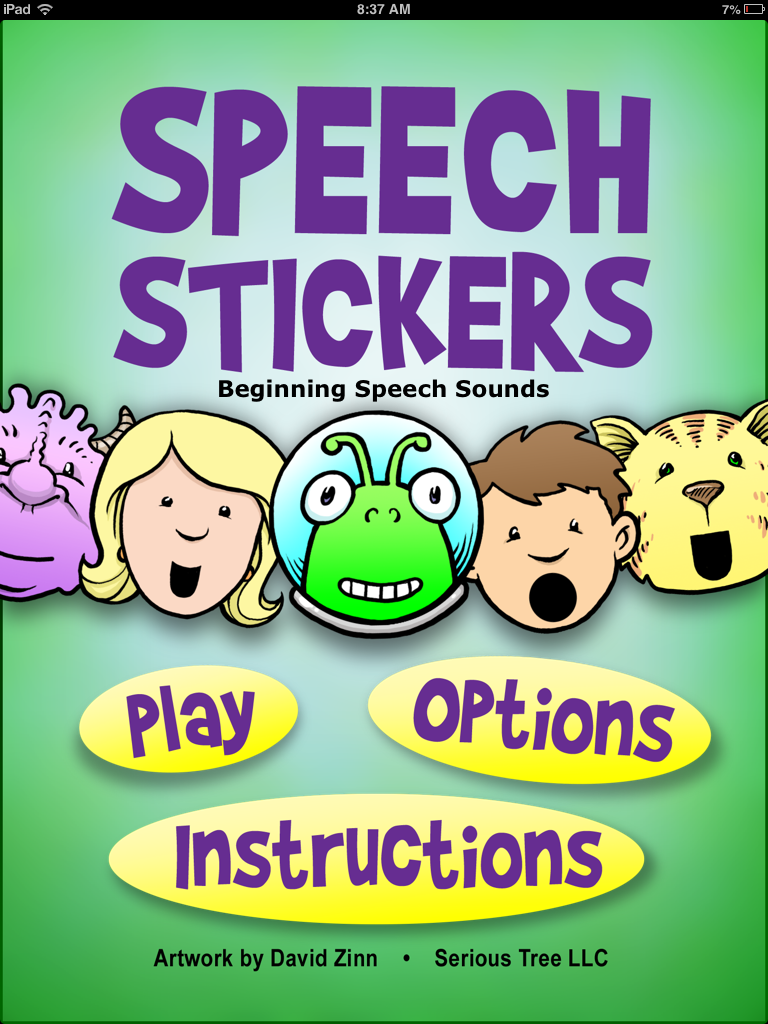
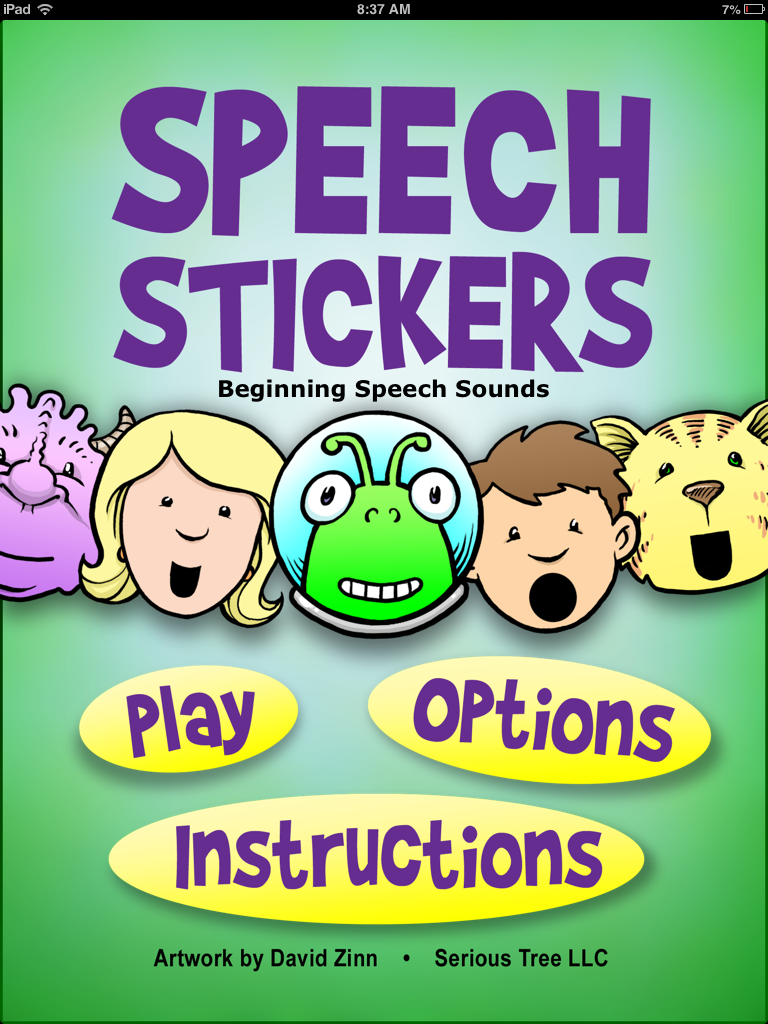
    Speech Stickers is the first app that I downloaded for Ashlynn (my daughter with apraxia) when she had first turned three.  I chose it because it was cheap, and said it was developed for children with apraxia.  The app is simple in design with not a lot of bells and whistles; however, my daughter loved practicing her speech with this app.

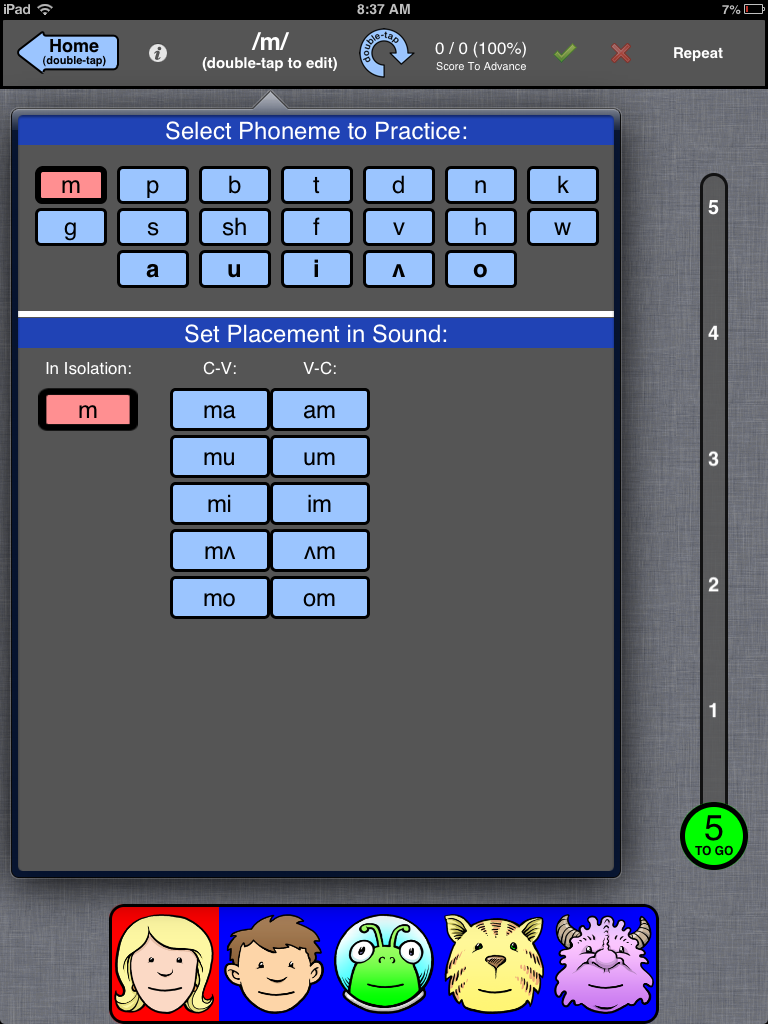
    The app is set up for kids in the very early stage of apraxia therapy.  The child can practice sounds in isolation and in CV(consonant-vowel) and VC(vowel-consonant) combos. The app is based around blocked practice with a lot of repetition that is necessary for apraxia therapy.

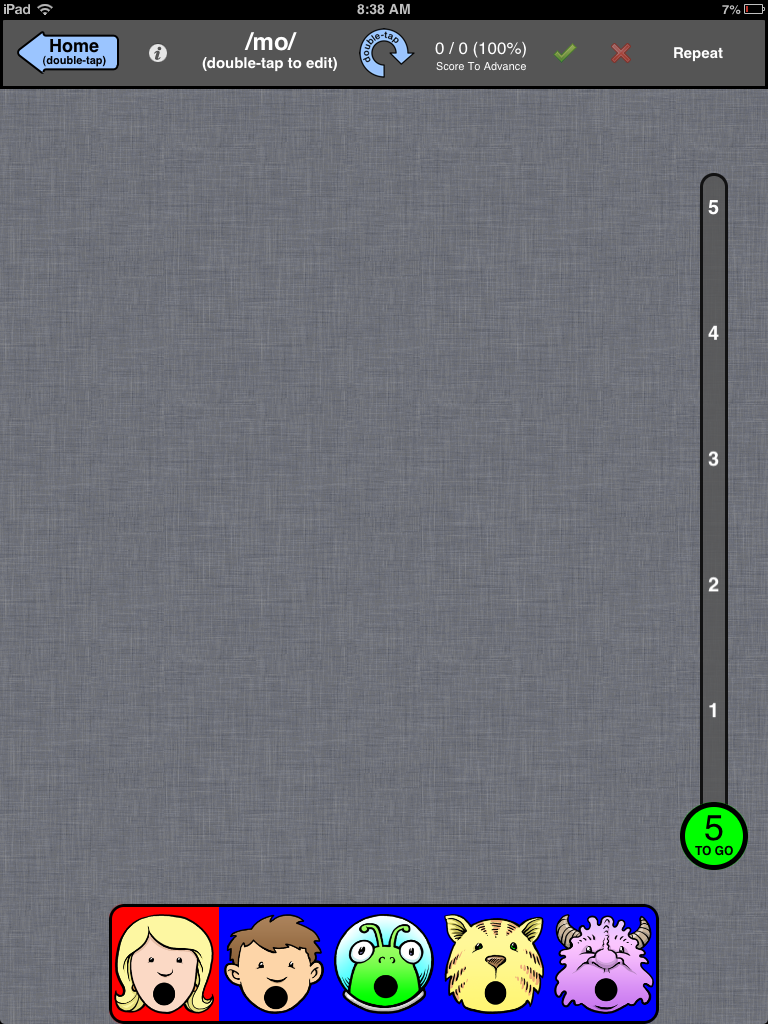
    After you pick your sound or sound combo, you can then decide how many times times the child has to say it before they get a “sticker” or a little animation as a reward.  Then, the child chooses between five characters on the bottom, all of which have a different pitch to their voice.  This is a bonus too, because children with apraxia have difficulty with “prosody” or the melody of speech.  The characters’ mouths model the correct placement.  The above picture is showing ‘m.’  Below the characters are modeling ‘mo.’ This is also great because it gives the kids a visual cue for the correct mouth posture.

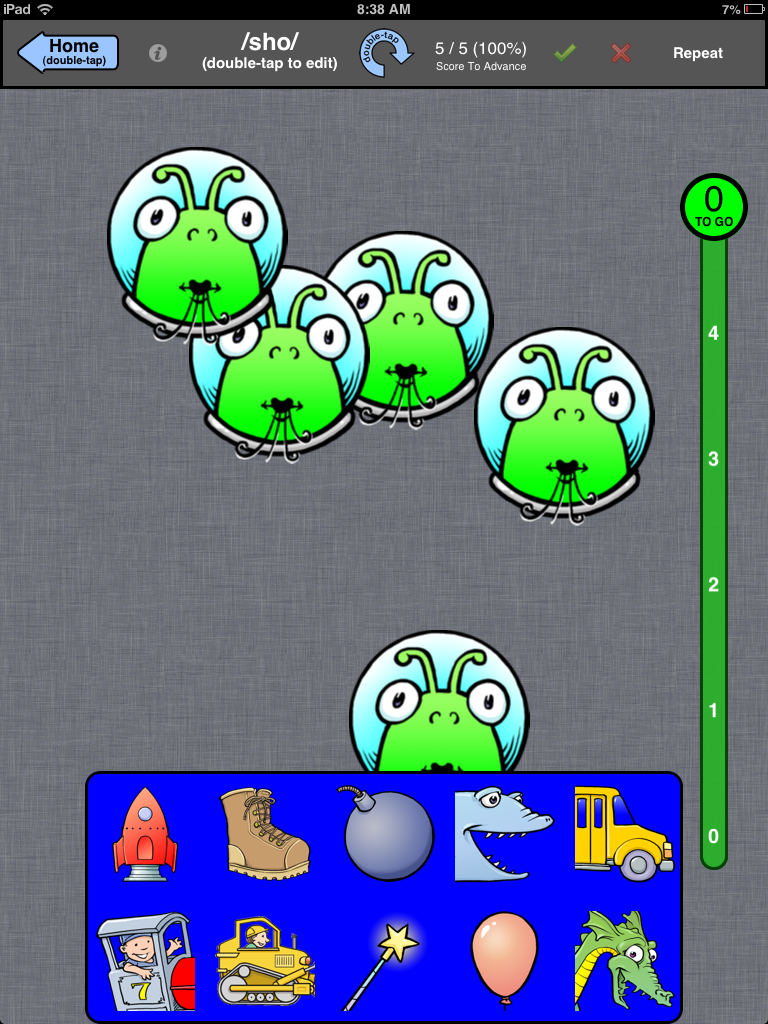
    A scoring bar at the top help score and keep track of data. You must press the green check or the red x to move onto the next practice sound.  The app is designed so that the bar can also turn upside down so that the therapist can discreetly score; however, my daughter picked up on this in a heartbeat and would push the buttons haphazardly just so she could move on!    Once you reach the set number you earn a “sticker” or reward.  You can choose from eight stickers seen below:

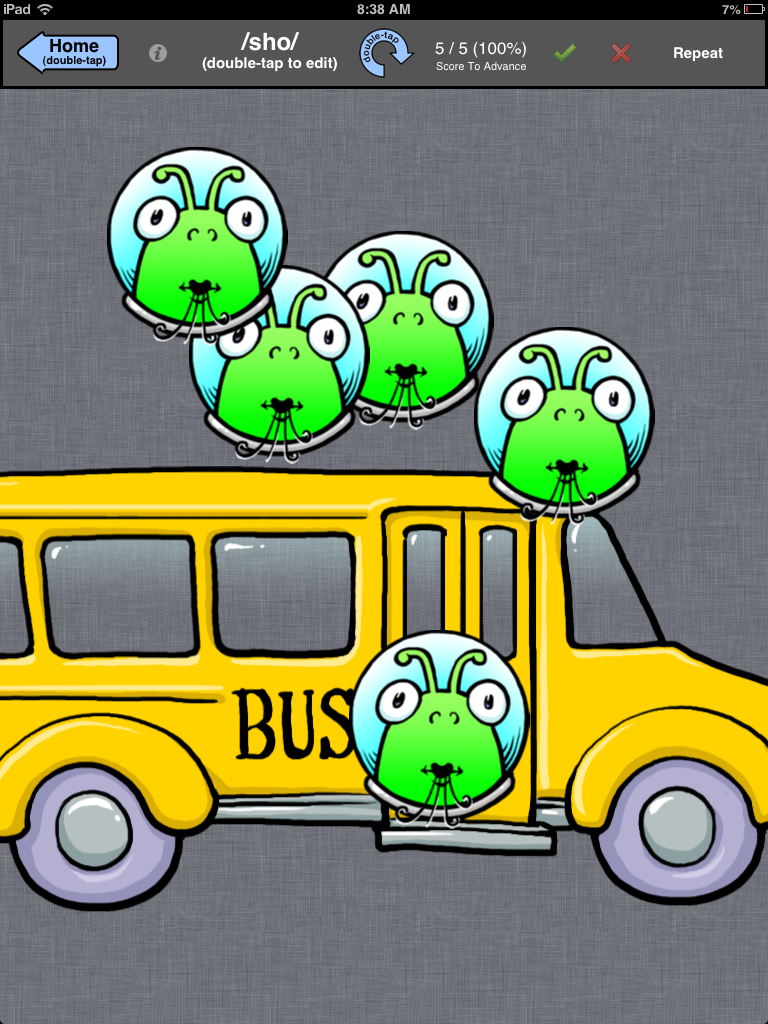
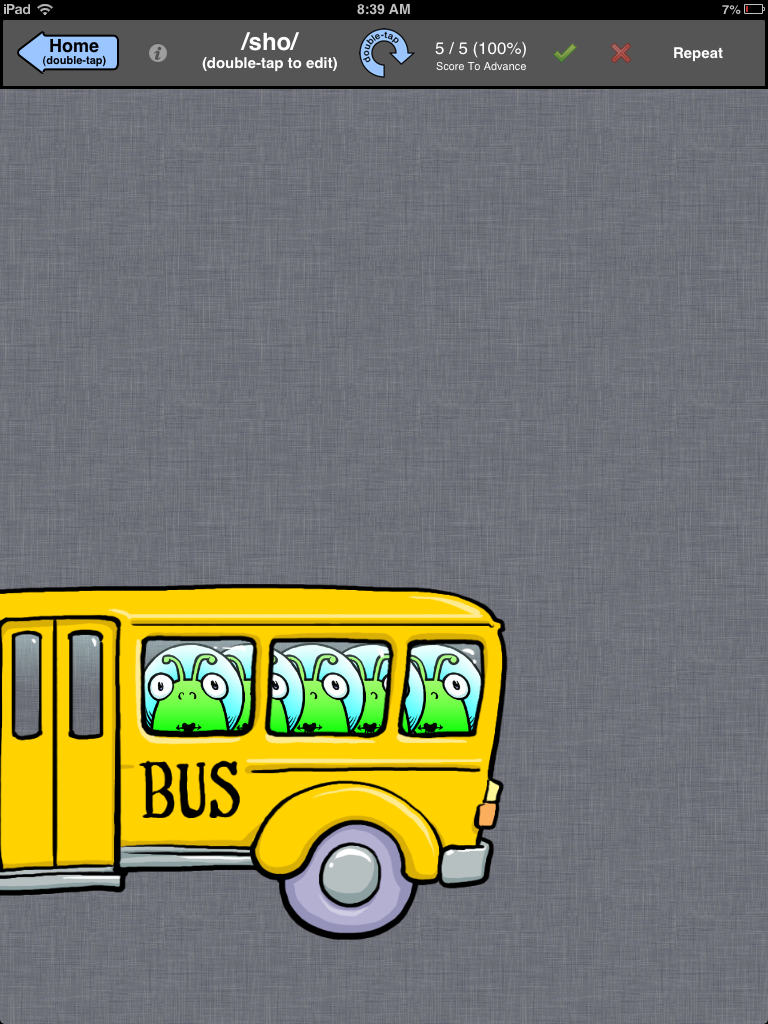
    They are so simple, but my daughter loved them.  I chose the bus just so you can get an idea of the animation.

    It has been almost three years since I have used this app for Ashlynn, but the app lives on with all of my clients!  Kids of all ages and disabilities LOVE this app.

    I have a 5th grade boy with Down Syndrome who laughs every time he earns a sticker and watches the animation.

    I have a 3 year old who loves picking the alien because it reminds him of a popular TV show right now “The Octonauts!”

    I could go on!  Really, I can’t say enough about this app, and when I reached out to the creator Carol Fast MSPA, CCC-SLP I realized why this app is soo good.  Here are some comments from her:

    “It’s truly been a labor of love for me and I’m always gratified to find that other SLPs appreciate what we do. I’m glad that you found Speech Stickers to be helpful for your daughter and other students.  I work mostly with preschoolers and have found a special interest and passion in my little nonverbal CAS kids. I really love helping find their true voice. This is probably the most rewarding work I’ve done in over 30 years as an SLP.”

    Thank you Carol!  Thank you for your passion for working with kids who have CAS and for a great app that allows us to get a lot of repetitions of targeted syllable shapes in a fun and engaging way for the kids.

    To Enter: Use the rafflecopter widget below to enter.  Good luck!

    a Rafflecopter giveaway


  • Apraxia is elusive, even to professionals.

    Apraxia is elusive, even to professionals.

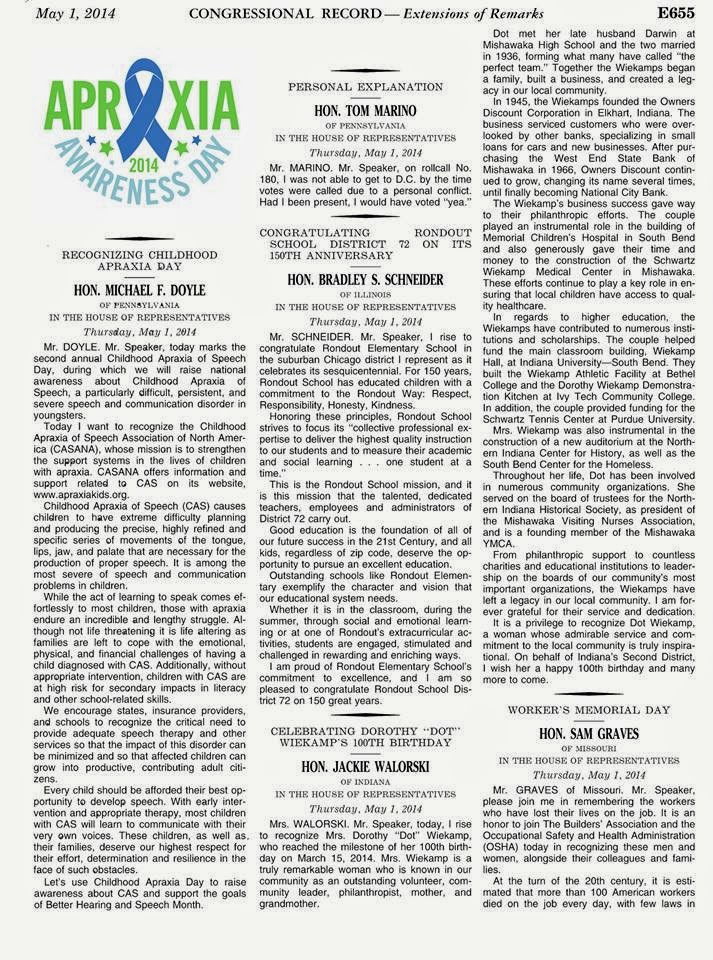
    Today is the second annual Apraxia Awareness Day, and in case you haven’t heard, this year it made its way into the United States Congressional Record!  That’s a big step in spreading awareness, but there is still a long way to go.

    I was able to blog about the very first apraxia awareness day here First annual apraxia awareness day and I’m so excited to be doing it again this year.

    Most people still haven’t even heard of apraxia.  Doctors, including my own pediatrician had only vaguely heard of it, and many SLP’s still don’t know how to treat it correctly.  I was one of them!  I had a 20 page small folder on Childhood Apraxia of Speech from graduate school, and that was it!  Luckily I had an amazing mentor who took me to an apraxia conference when I first started in the field, and I was able to treat the disorder successfully with the three kiddos I saw at the school-aged level.

    However, then my own daughter was born.  Her first year was stressful.  I hated the baby screeners at the doctor’s office.  She wasn’t cooing or really babbling, but she was so alert and had the best giggle!  Everyone assured me she would talk in her own time, but every screener put her further and further behind.  She crawled late, walked late, had poor balance and choked on her food and drinks, oh, and did I mention she wasn’t talking??  I attended conference after conference on early intervention for speech.  I then would work all day and then came home and used the techniques on her.  One problem, they didn’t work!!  I was stressed, worried, and constantly thinking about her development.  Even though I was treating it in the elementary school, it didn’t occur to me that this disorder was also behind her development delays.

    When I took her to Child Find I remember the evaluation like it was yesterday.  I knew she was behind, but seeing it with another SLP was heartbreaking.  I wanted to gather her up and leave so many times.  When the SLP came to talk to me, she said four words that I will never forget, and at the moment I instantly realized were true:  “Laura, this is apraxia.”

    My God.  How did I miss that???  However, I instantly knew she was right.  I was dealing with apraxia.
    Apraxia.
    Apraxia.
    Oh God no, not apraxia.  Why MY baby??  I cried in the car after the evaluation.  I sent a text to an SLP friend “She has apraxia.  I’m devastated.”

    My mother in law was watching my baby.  I went home and cried.  “Will she ever talk?” she asked.  “Oh yes” I responded.  She just has to face the biggest hills in order to do it.  I cried some more.

    I’m really not sure what’s worse.  Being a parent who doesn’t know what apraxia really is, or being a parent who knows exactly what the monster is, and just how hard she’ll have to work to overcome it.

    After the devastation….and to be honest I really did feel devastated, I mourned it, and then I became angry. I realized now why all the early intervention I was doing with her EVERY night wasn’t working!!  She had apraxia!!  Apraxia has to be treated differently.  You need a motor based treatment approach, not a language approach. Why didn’t I know the signs of apraxia in young children??  And you know what?  Once I put her with an SLP trained in apraxia, she made progress IMMEDIATELY.

    IMMEDIATELY!!

    I had a masters degree in this!!  It was unbelievable to me.  I reviewed all my early intervention conference notes and power points.  Not ONCE was apraxia mentioned.  It made me think, are early interventionists even looking at apraxia?  Why are we treating all speech delays the same way?

    After I got over being angry, I got determined.  This happened to me for a reason.  I had successfully treated two cases in the schools, but I needed to know the ins and outs of this disorder.  I’m an SLP and MY daughter had apraxia and I missed it.  I missed it!!  As I think of that right now I’m shaking my head.  That’s just not ok.  There needs to be more information out there.  It needs to be as well known to SLP’s as their everyday speech and language disorders are.

    That is my mission now.  I went to apraxia-kids.org and started signing up for webinars.  I went to every apraxia conference that came to Denver since that time, and was fortunate enough that the Apraxia National Conference came to Denver last summer in 2013.  I saw so many apraxia experts.  I found out about an apraxia intensive bootcamp.  I applied and I was accepted!  I go this July.   Last February, I gave my first ever professional presentation to a packed room of school based SLP’s.  I didn’t claim to be an expert, but I had come A LONG way since that mom crying in her car.  The interest was so great that people were sitting on the floor.  That’s how much SLP’s are craving this information.

    I asked my clinical director at the private practice to support me in my mission to specialize in apraxia.  She didn’t even blink.  I am so blessed to know her.

    I started this blog, and now I started a facebook page SLP Mommy of Apraxia.  I want to give simple tips on things to do at home, and also spread awareness.
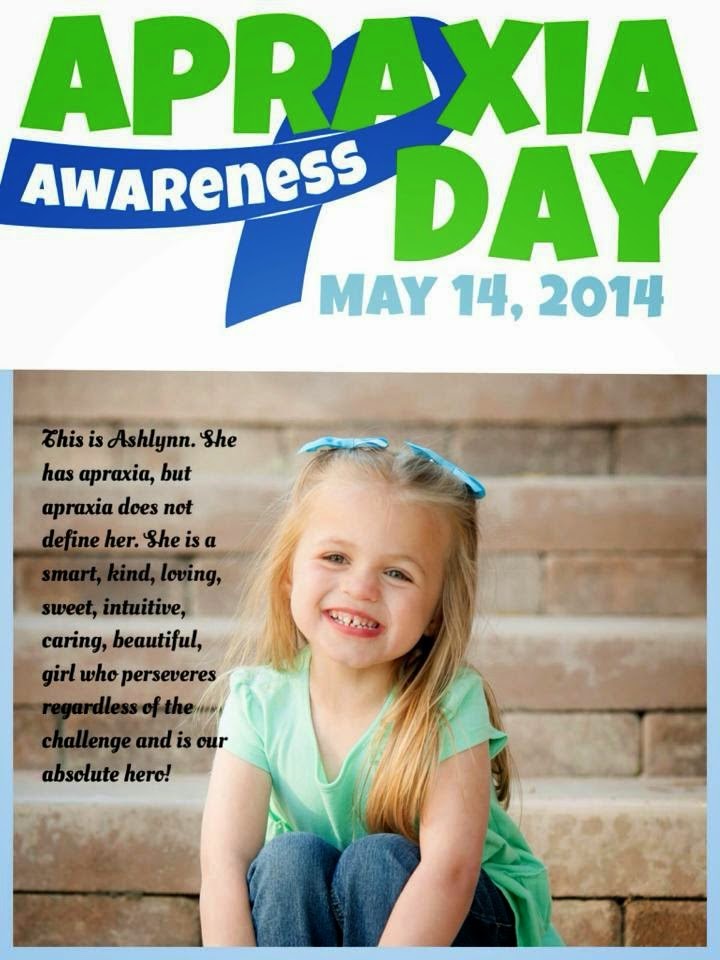
    As for Ashlynn?  Well, she’s basically just pretty amazing.  She meets every challenge head on without
    frustration.  She overcomes every obstacle in her path, no matter how many time she has to try.  She’s speaking in 4-8 word sentences, started independently doing show and share at her school, and has many friends she plays and socializes with.  She still needs speech.  We still work everyday on correcting her errors and mapping the motor plan, but I know she’s going to be fine now. She’s not only my hero, but my inspiration and why I stand up on TODAY, May 14th for EVERY child who deserves a voice on this second ever Apraxia Awareness Day.

    Signs and Symptoms:
    – Little to no babbling
    – Only a few different consonant and vowel sounds
    – Inconsistent productions of vowel and consonant sounds
    – Disrupted prosody
    – Difficulty with co-articulation of speech sounds
    – Comprehends much more than they can speak

    Diagnosis
    – Only Certified SLP’s trained in this disorder should diagnose it.  Pediatrician’s and neurologists do not go through the extensive testing an SLP will do to provide a thorough differential diagnosis.

    Treatment
    – A motor based treatment approach to therapy must be initiated.  Therapy should be focusing on the planning, coordinating, and sequencing of speech sounds, usually with some sort of verbal or visual cueing system.
    – To find professionals in your area see this link: Apraxia Experts by state

    Most of all: Spread the Word!!  Knowledge is Power.

  • Calling all apraxia bloggers!!  Let’s link up for Apraxia Awareness Day!!

    Calling all apraxia bloggers!! Let’s link up for Apraxia Awareness Day!!


    I read your stories daily.  I feel your struggles, I rejoice in your triumphs, and I nod my head in understanding.  You are my fellow bloggers.  I read your blogs like I’m checking the morning paper.  I read your tears and your smiles about your struggle with apraxia, and I share them with you about mine with my daughter’s.  We read these stories as separate entities.  We close the blog and move onto the next, or we write our own story for that day.  What if we all wrote our story together?  What if we all weaved our experiences into an apraxia tapestry?  That is my dream in the Apraxia Awareness Link Up for Apraxia Awareness Day on May 14th.

    I ran across the quote:

    Never doubt that a small group of thoughtful, committed citizens can change the world; indeed, it’s the only thing that ever has.

    It’s up to YOU and ME to spread awareness about apraxia.  It’s only the second annual apraxia awareness day.  I am an SLP and many educators haven’t even heard of apraxia and many SLP’s don’t know how to treat it correctly.  I want to read your stories.  I want to hear how you are spreading awareness and I want to link up with you in solidarity!

    Please feel free to link up any posts related to Apraxia.  It can be anything! You fears, your successes, your diagnosis, your Apraxia Awareness Day Post, helpful tips, whatever!!  We want to see it! We want this to be a place to raise awareness for Apraxia, as well as to let others know they are not alone.  We only ask that you link back to link up at the bottom of your post!

  • What are you doing May 14th, for Apraxia Awareness Day?

    What are you doing May 14th, for Apraxia Awareness Day?

    It’s the month of May, and in my world, that means starting to think about what to do for the second annual Apraxia Awareness Day.  Leading the movement is CASANA, a non-profit dedicated to Childhood Apraxia of Speech.  If you are interested, they have a bunch of great ideas on how to celebrate here, at their website Apraxia Kids.

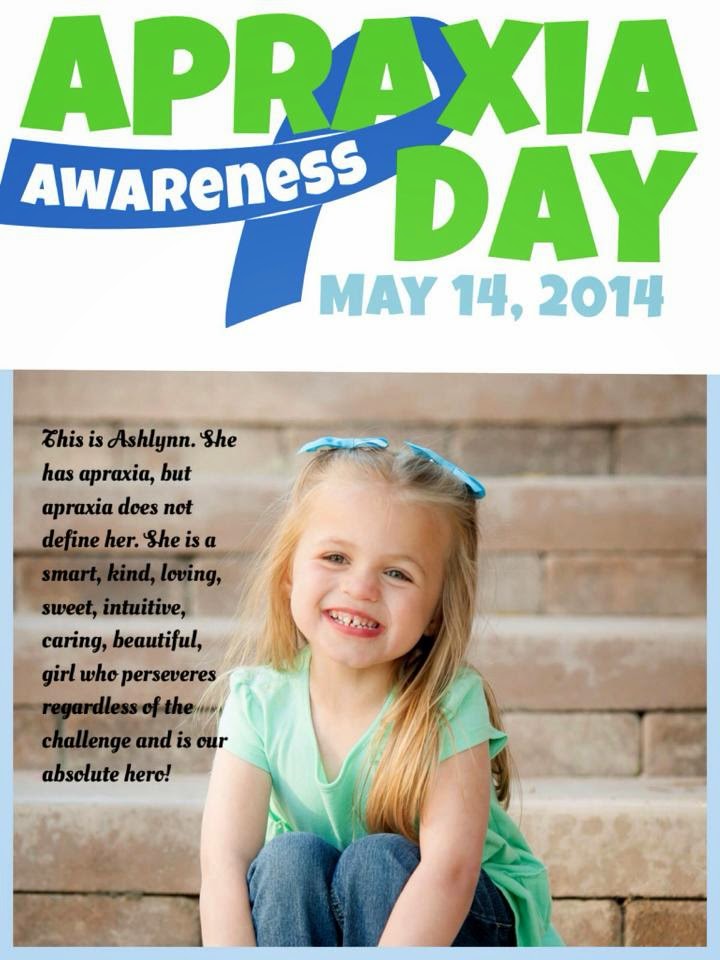
    I did write to my local papers, but my favorite of all was making and seeing collages of our kids’ sweet faces and what really defines them.  In addition, everyone blogging and lighting up social media was really powerful.  You can read about my first ever one last year here: First annual apraxia awareness day!

    It was a powerful and empowering day.  I NEEDED that day.  My daughter was 3 1/2, and though she was doing great, she still struggled to talk and wasn’t talking at all in school unless she was with her SLP (speech/language pathologist).  Though we made a lot of gains that year, it was easy to get bogged down with what she “couldn’t” do, and what she still needed to work on. I was navigating this brave new world of social media, and one of the positives to come out of it was seeing all the apraxia superstars on the facebook support group APRAXIA-KIDS – Every Child Deserves a Voice.  If you are not a member and your child has apraxia, you absolutely MUST get on this page.

    The month of May I was able to see the “faces” of apraxia.  Parents could share what their child could do, and not just want they couldn’t.  Posts brought tears to my eyes frequently, and on the awareness day, I felt honored to be part of such a great group.  A slideshow of all the pictures was made and set to music. I don’t know the song, but the lyrics were “Living in the Hall of Fame, Everyone will know your name.”

    I watched it over and over, and every time I saw Ashlynn I teared up.  She wasn’t living in any other hall of fame in her own part of the Earth, but here she was a hero with all the other kids.

    So…I encourage all you moms of apraxia.  All you warrior moms.  All you worriers, sleepless nighters, criers, advocaters, non-stop tireless fighters, create a collage like this and post it to every social media at your disposal.  I guarantee, you won’t be alone, and you won’t be disappointed.  Bloggers from far and wide will be linking up!  Find and add your link here: Apraxia Link Up Let’s see the faces of our apraxia heroes!!