Tag: apraxia and academics

  • The biggest apraxia challenge: Graduation 2032

    The biggest apraxia challenge: Graduation 2032

    Day 21 of Apraxia Awareness Month is to discuss your biggest challenge.

    I read the various posts and related to all of them.  ALL of them.  Unfortunately when your daughter has a laundry list of disabilities with apraxia being just one of them, yes,  I could relate to everything.

    My son struggles with word finding.” Check

    “My son struggles with anxiety.” Check

    “My daughter struggles with attention.” Check

    “My child has difficulty navigating social situations.” Check

    “My child struggles with handwriting.” Check

    “My child struggles in school.” Check

    Literally the list goes on and I could check off almost everything else.  I’m farther in this journey now though and though we continue to have new challenges, I had an epiphany about them.

    The biggest challenge was realizing the very definition of challenge does not mean struggle.

    No.  The very definition means a contest, competition, or objection.  And guess what?  One can argue and overcome ALL of those things.  If you follow my social media pages, then you know Ashlynn is having a stellar last couple of months.  The girl with dyslexia who was more than two years behind in reading is testing on grade level.  She just graduated occupational therapy after being in private OT for SIX years. At field day, the girl with dyspraxia and cerebral palsy wowed her classmates by killing it on the hippity hop ball station, and the girl with a language processing disorder and apraxia is just “one of the gang” according to her general education classroom teacher.

    The biggest challenge was not just hoping, but holding firm my belief that Ashlynn could overcome them all.

    Ashlynn just ended her third grade year and she is 9 1/2 years old. I have been through AT LEAST 8 IEP meetings.  I have been brought to the edge of despair.  I have watched my husband shed tears in front of strangers.  I have looked around a room of literally EVERY discipline (speech, OT, PT, Special Education, general education, psychology, social work) and listen as they ALL described deficits in my daughter.  I have sat, stone faced and quiet for fear that talking would reveal my anguish and diminish me to a weeping pile of sadness on the floor.  I refused to be that person. I was probably rude at times, but I promise it was for self-preservation and to ensure my daughter never ONCE thought I didn’t believe in her.

    As one who has been on this journey with Ashlynn, my biggest obstacle was in discovering no obstacle was ever too big.

    Armed with this knowledge now (at least in this current space of happy that I’m in), I truly look at current and future obstacles and say, “Bring it.  You have never met an opponent like us.  You can try to break us, but you won’t.  You can knock us down, but we’ll get up stronger.”

    An SLP Mommy friend I know posted a video and said “Apraxia created one gritty little girl” referring to her resilient daughter. I couldn’t agree more.  Apraxia was never our greatest obstacle.  Believing we could overcome anything was, and we did it.  I know there are more struggles, more obstacles, bigger mountains to climb but they don’t intimidate me anymore.  Ashlynn has proven time, and time, and time again that no matter what life throws at her, if you have a positive attitude, perseverance, and HEART…no one and nothing can beat you.

    Starting with one of my most popular posts “Lessons of a Tricycle” to “Lessons from a Bicycle” years later, success has always been waiting for us as along as we just keep pedaling.  Just kept trying and never, ever, EVER give up.

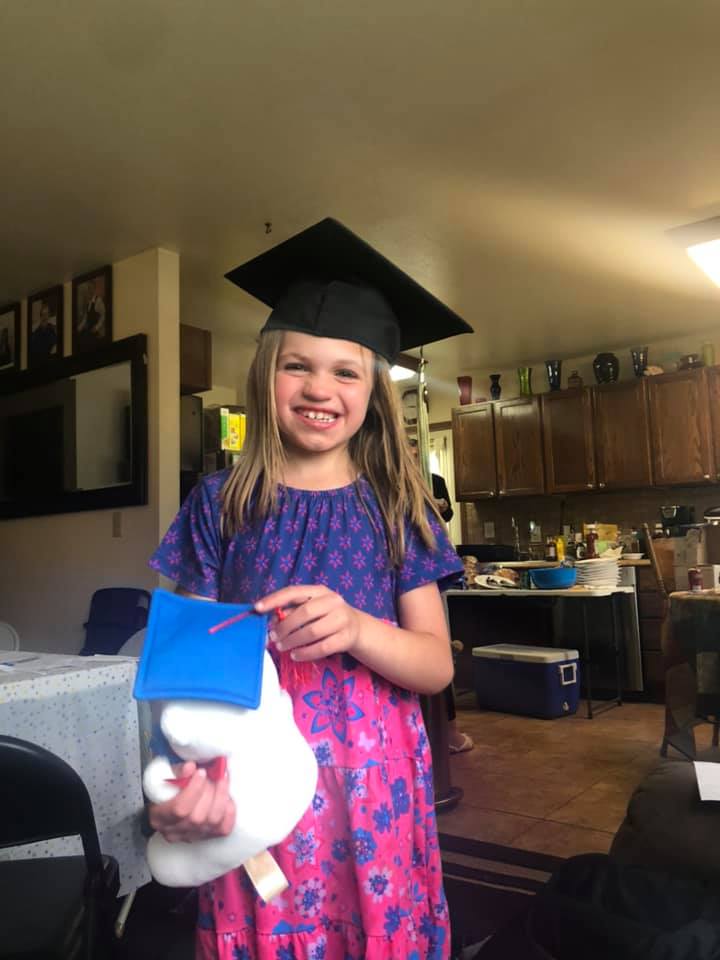
    This past weekend my niece graduated from college and Ashlynn wanted to try on her cap.  We snapped a picture and all commented, “how cute!” But inside, I was silently smiling and thinking, “Another challenge?  BRING IT 2032!”

    Love,
    Laura and Ashlynn


  • Executive functioning home intervention

    Executive functioning home intervention

    Let’s talk executive functioning.  If you follow my facebook page SLPMommyofApraxia (click here), you already know we are making our house an executive functioning friendly zone and you might have read a prior post I wrote a  “What is Executive Functioning, and Why Do You Need to Know?”

    What does an executive functioning friendly zone mean exactly?  I decided to put all of it into a post so you can see and hopefully help others who may have children with similar issues.

    Before I begin, I just want to say this:
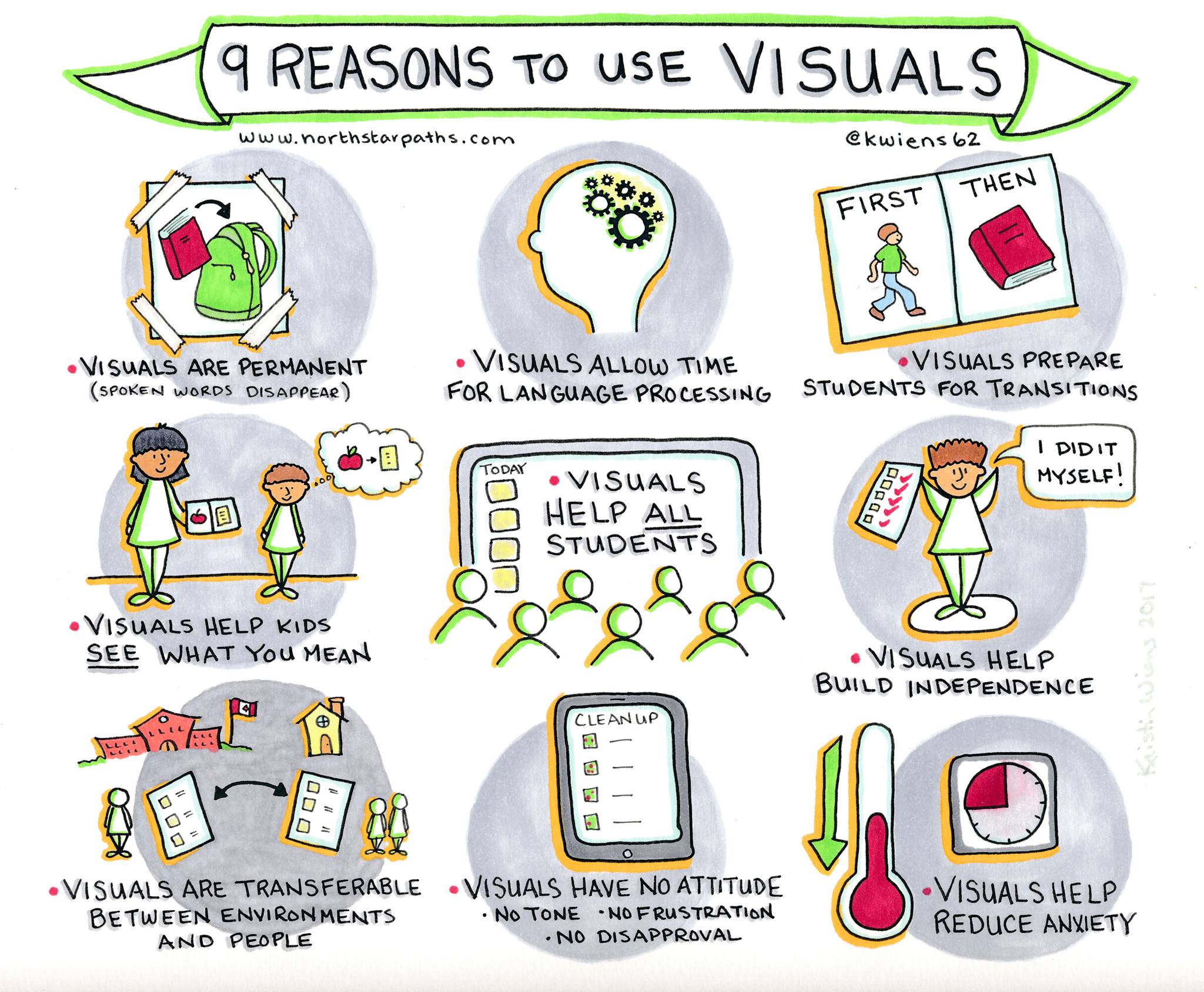
    Children with learning differences, many, many, MANY times benefit from the use of visuals.  There have a been a handful of cases in my career where visual aids actually confused the student more; but for the most part, visual aids benefit everyone.  This visual from northstarpaths really explains why:
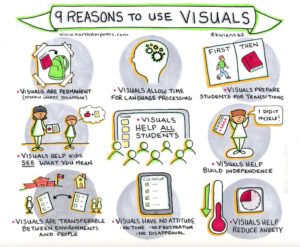
    Executive functioning (EF) deficits are a common comorbidity with a variety of conditions including: ADHD, OCD, ID and others just to name a few.

    Visuals are AMAZINGLY helpful for children with EF dysfunction.   The problem is, most teaching involves auditory input.  The teacher (or parent) talks, children listen, and learning takes place.  For kids like my daughter, who have a language processing impairment, the teacher (or parent)  talking is basically the equivalent to the teacher in the Peanuts comic series.  All the children hear are “wah wah, wah wah wah wah.”

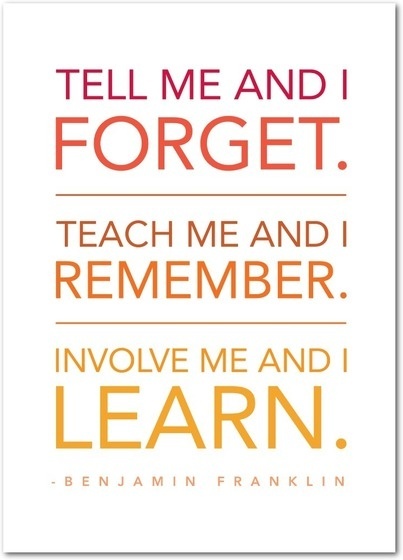
    Visuals bridge the gap.  I couldn’t say it better than Benjamin Franklin, who himself had a learning disability when he said,
    Aside from just visuals though, kids with EF dysfunction benefit from organization and time management strategies.  The following is what we currently have implemented in my home.

    Morning Routine

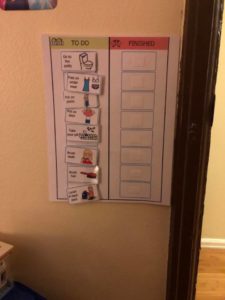
    The most recent example from my personal experience involved the steps to getting ready for school.  If I told Ashlynn what to do, she immediately forgot or I had to go through step by step and tell her, which is not promoting independence.  With the help of her SPED teacher, we made this visual schedule and she was successfully completing all of her steps without our help in about two weeks.
    Restroom steps

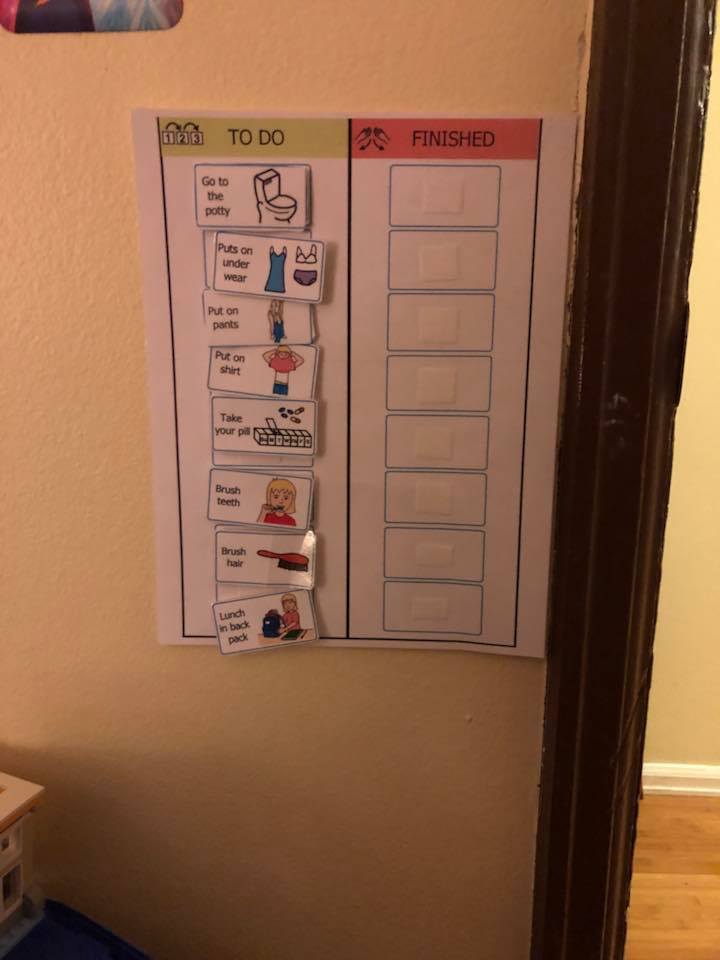
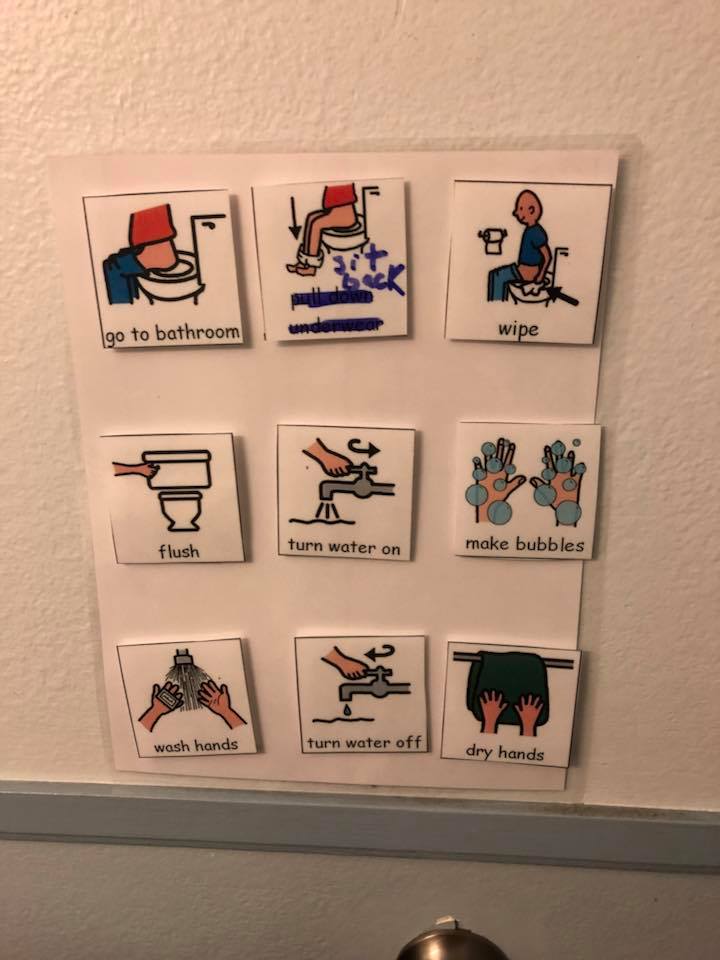
    We decided to make a visual schedule for completing bathroom steps.  Let me tell you that we have been working on remembering these for AT LEAST a year.  Last year in 2017, I sent her to Adam’s Camp and remember telling the therapists she can say all the steps but still is not consistent.  After Adam’s Camp she came home being able to sing them as well, and still, we could not get consistency.   So we made a visual schedule a little different than her morning schedule and it looked like this.
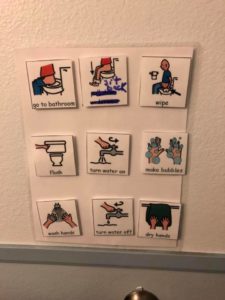
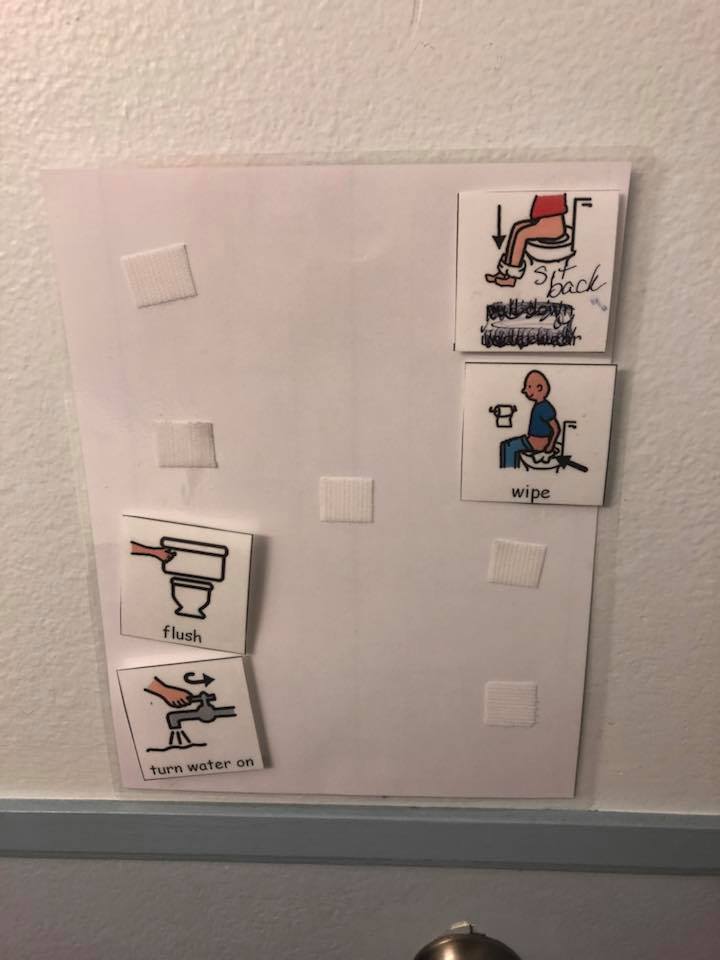
    This was NOT successful.  It probably has too many steps and it doesn’t have the nice left to right motion the morning schedule this, so I modified and made this.
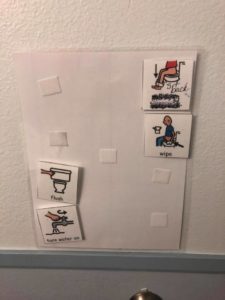
     

    I’d be lying if I said this was a complete success right off the bat, but it has worked better than any other strategy to date and now that the summer has hit, we have made sure she has to go back and complete her steps every single time.

    Cleaning her room

    The next step was to tackle completing a basic chore like cleaning her room.  I can’t even begin to explain the difficulty with this.  What I do know, is that many adults with ADHD continue to struggle with disorganization into adulthood.  It behooves us now to help our kids develop strategies that are going to serve them well throughout their lives.

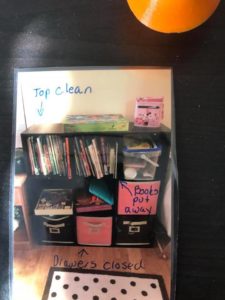
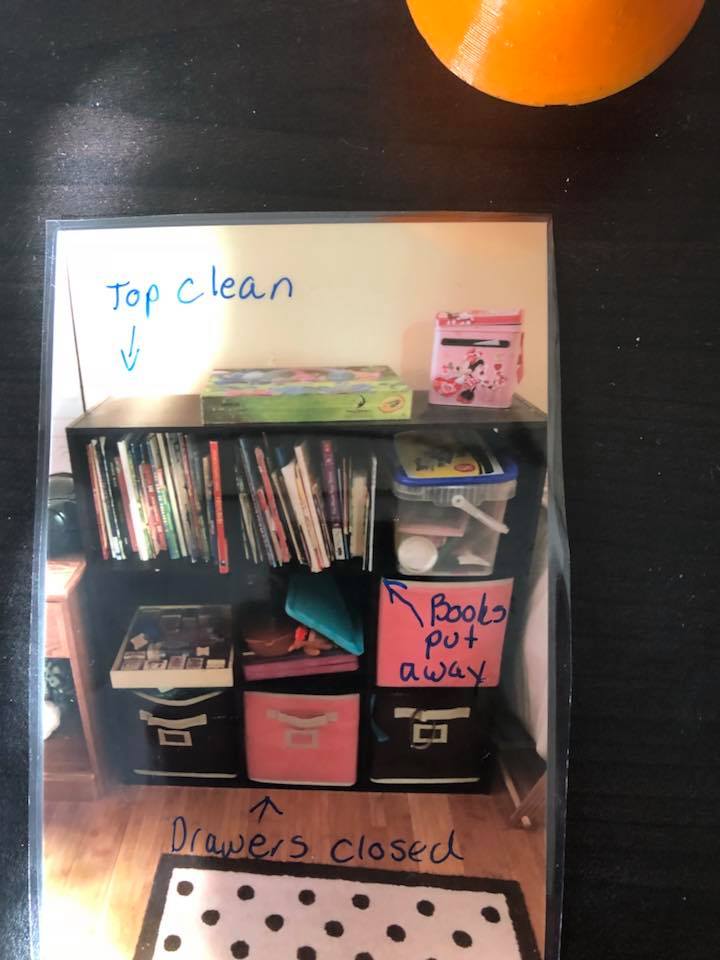
    The first step is to make sure everything has a place.  Classrooms are set up this way for a reason.  There is a specific space for each and every item that is used or played with in a classroom.  If not, things will inevitibely end up in a pile of clutter.  Ashlynn and I went through her room and designated certain drawers and bins for different things.  Everything has a spot.  There is a bookshelf, a lego bin, a writing utencil drawer, a baby clothes bin, you get the idea.

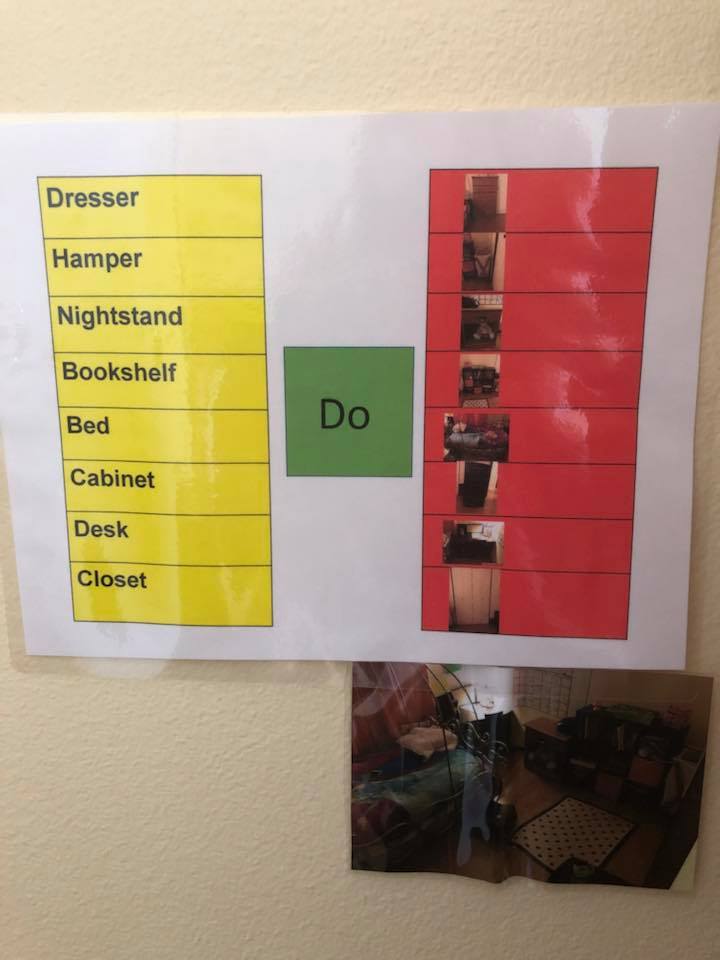
    I then created a visual schedule of each piece of furniture that she could check off as she went about her cleaning routine.
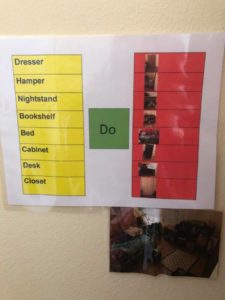
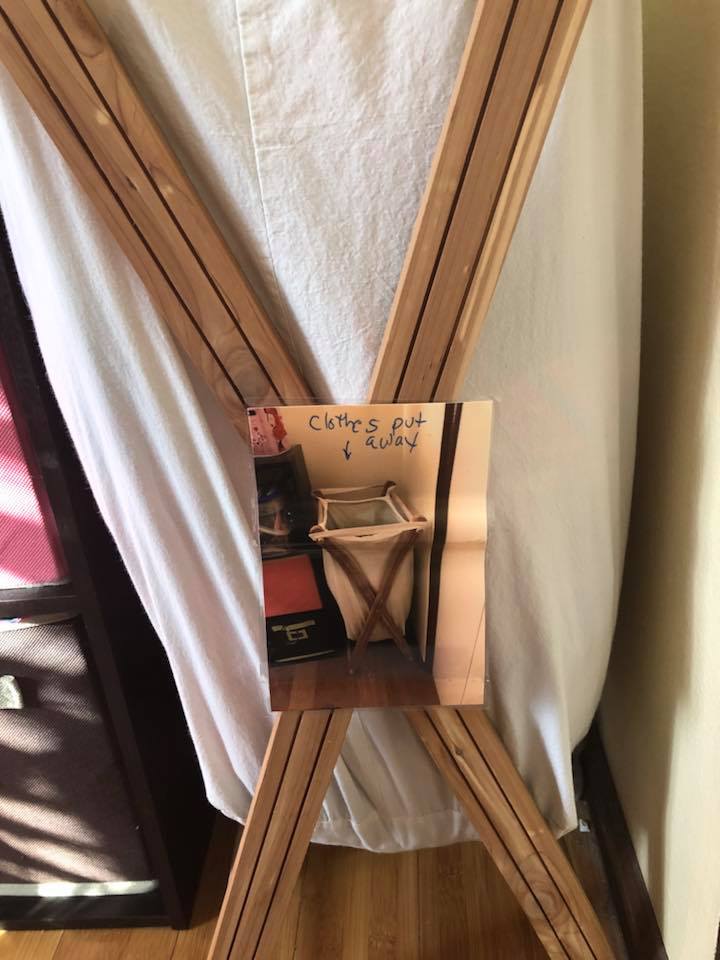
    I know it’s hard to read, but basically each furniture item is listed on the left, with a picture representation on the right of what it looks like done.  The picture on the bottom is a grand finale picture of what the entire room should look like clean after completing all of the steps for one last check.

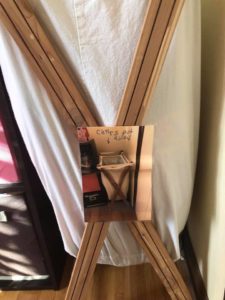
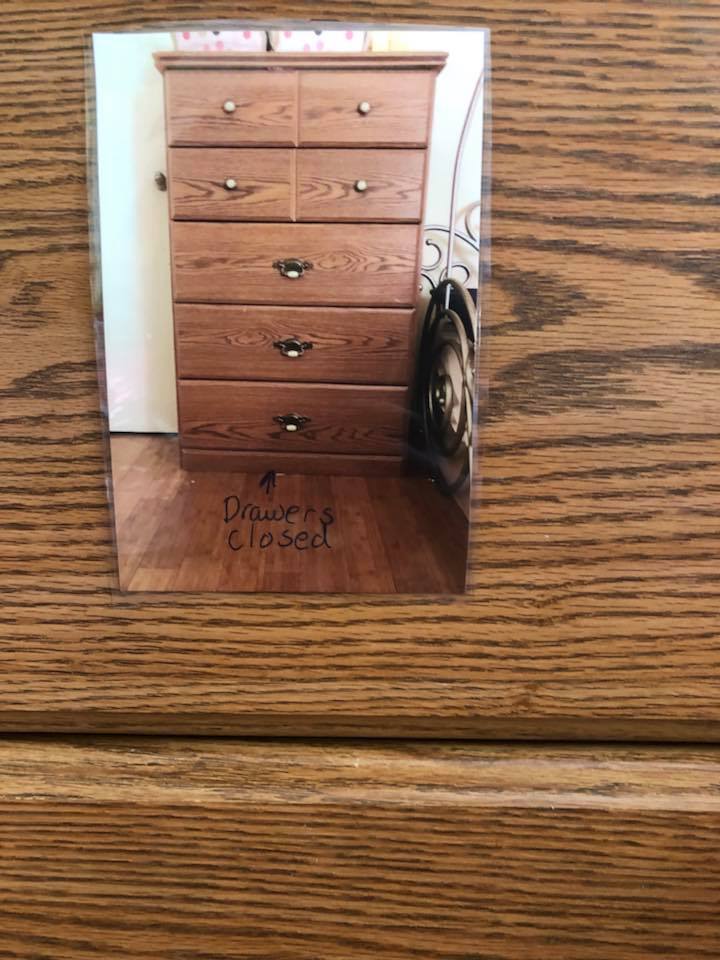
    Next up was to have bigger picture velcroed to all of the furniture items so she could see as she was cleaning them what they are supposed to look like.  I know it seems redundant, but seriously if you have a child who struggles this, then you will relate when I say that a dresser with closed drawers looks fine with clothes hanging out of it to her.  Same with a picked up hamper.  I even have a picture showing what the closet should like closed and no that doesn’t mean it is closed until it hits the piles of crap.  It means actually closed and looking neat.
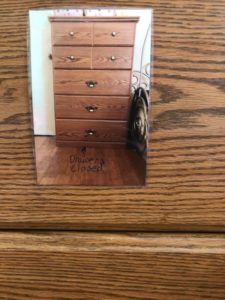


    I have to add that these helped, but still had to be taught.  In fact, it’s still a work in progress.  Some nights, I am so frustrated and just want to pull my hair my out.  I’m only human after all.  I do though, in those times, try and decompress and remind myself this is not a *fix* but a lesson.  Ashlynn doesn’t learn like other kids and that’s okay.  I have to realize though that all of this will pay off in the long run, and when we start early kids have the best outcomes.

    Homework

    Oh man don’t we hear horror stories about homework from parents of kids with varying learning differences.  Teachers make homework sound so easy.  Ten minutes for every grade you are in, so a first grader shouldn’t be more than 10 minutes a night.

    Say….what???  That assignment just took my kid an hour….and then when we went to second grade, that so called 20 minute assignment just took upwards off and on of two HOURS?  Minutes?  What?

    Know that homework can always be modified, but there are strategies that can be put in place to help with this too. Number one is to just start with a place that is going to make them successful for learning.  If you are like me, my first baby is the one with learning differences so instead of preparing for the ultimate learning environment, we were more focused on transitioning my son from a crib to a toddler bed and spent our money on that.  Needless to say, our kitchen table became her homework place.  Yes, the place that she eats and the chair in which she sits that her feet don’t touch on the ground yet is what we thought would be the perfect location for her to sit down and do that quick assignment in 10 minutes.  I should mention too it’s a thoroughfare in my house, so my kid with ADHD was also constantly distracted by the events taking place all around her.  Can we talk about set up to fail???

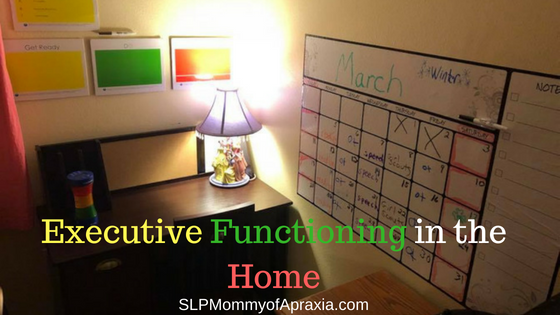
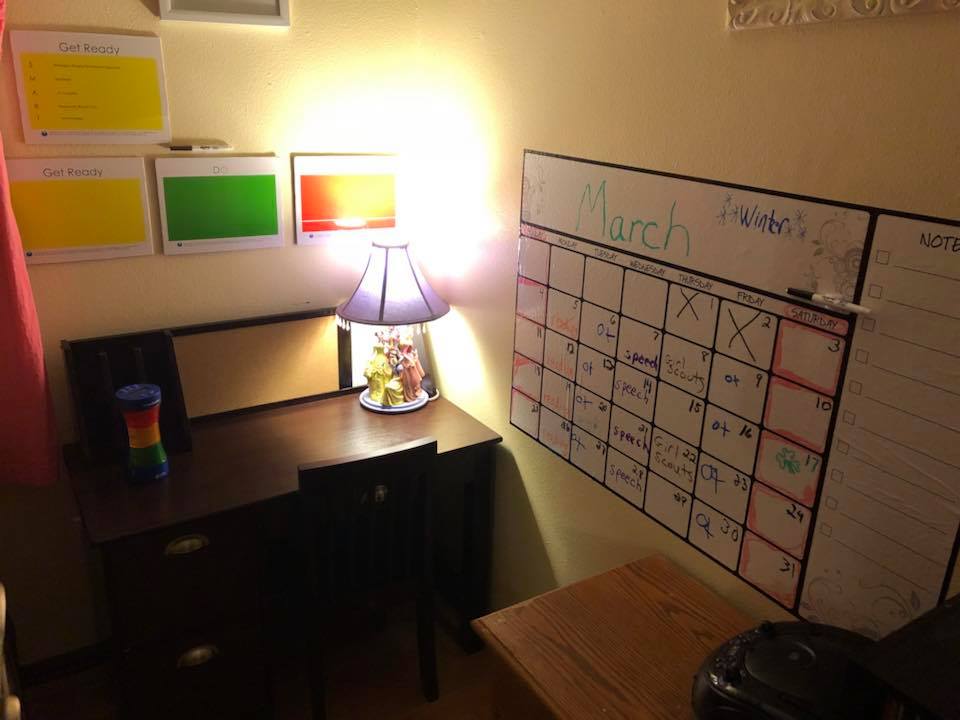
    I redid her room and created a homework corner.  I bought her a new desk in which she sat at a 90 degree angle, perpendicular to the floor, and decked it out with strategies from executive functioning queen Sarah Ward from the website Cognitive Connections.
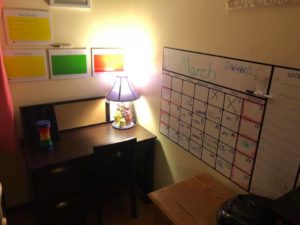
    New desk with feet on the floor

    As you can see, I have her own desk, in a corner of her own room, that is quiet and in which her feet touch the floor!

    Get ready, do, done boards

    The colored board above the desk are suggestions from the cognitive connections website.  In the yellow, we write everything we need to get ready.  It might be as simple as a pencil and it might be more complicated if doing a project.  (To modify for non-readers, you can tape or velcro pictures that you need.).

    The green stands for “doing.” These are the steps you need to do to reach the finished project.  The finished project then is the red board and reflects what the assignment looks like when it is finished.  For lower level, you can put a picture of what a completed assignment looks like, or for readers you can simply write it.  Sarah Ward also recommends to “start with the end in mind,” meaning kid with EF deficits benefit from knowing what the end is supposed to look like and then working backwards. For a more elaborate description, go see Sarah Ward talk.  She’s amazing.

    Calendar

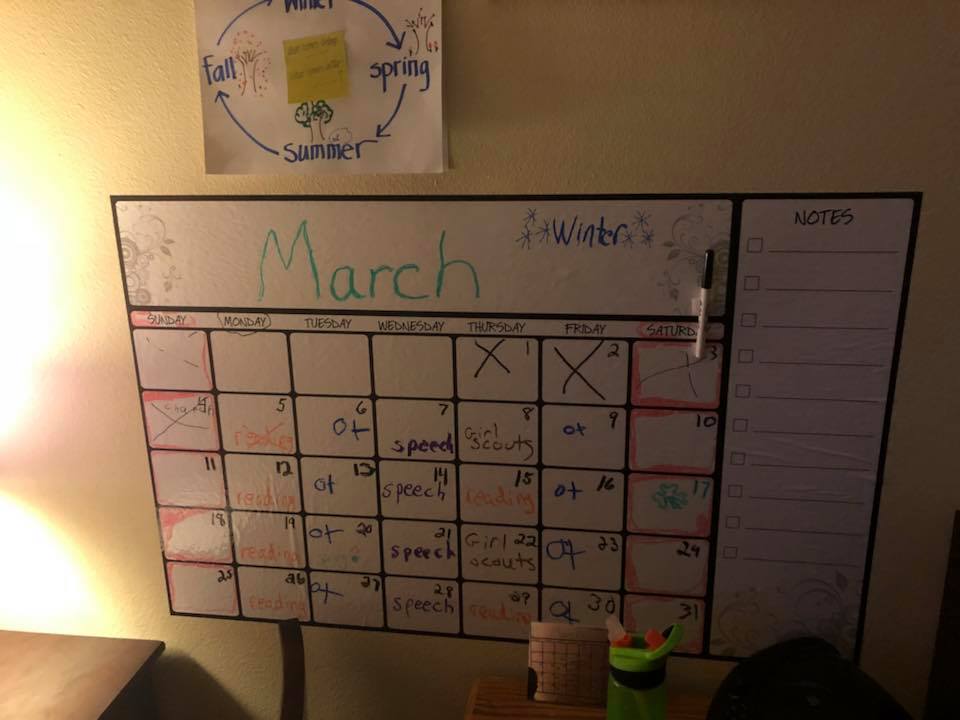
    We have tried a few different things to help Ashlynn learn time, and I’m not just talking time management.  Ashlynn has had a lot of difficulty learning the seasons, days of the weeks, the months, and understanding the difference between yesterday, today, tomorrow, last week, next week etc.
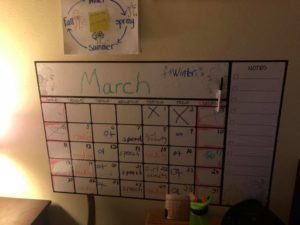
    I decided to buy this peeling dry erase calendar at target.  It’s huge and sits right by her desk.  Every month, she helps me write the month and the days.  We then go through and write her therapy/activity schedule and color code them.  Each activity is written in a different color.  The weekends are shaded on red since she has a difficult time understanding that Saturday and Sunday are one unit (the weekend) when they are split up on a normal calendar.  We then marked an X for each day that had passed and talked about yesterday and tomorrow.  This calendar has been AMAZING.  I might be so bold as to say it almost helped her understand days of the week right away.

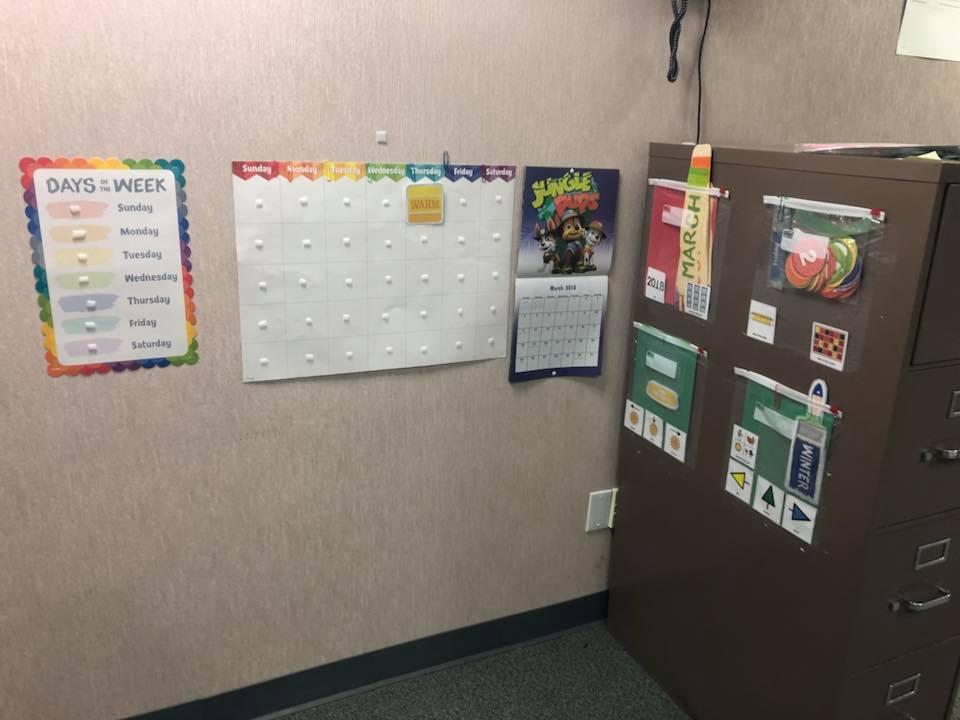
    Her school though also hit this hard visually and created the following corner in the SPED room just for her.
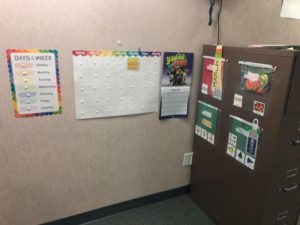
    This picture is also hard to see, but basically you see the basic calendar color coded by day in the middle.  To the left, each day of the week is color coded.  On the file cabinet on the right, the months are placed and she has to pick out the right month each day for added repetition.  The days are in the second bag, and there are tiles for the season and then arrows to talk about the concepts yesterday and tomorrow.  A normal calendar was provided as a reference to keep track of how her modified calendar related to a typical calendar.

    Timer

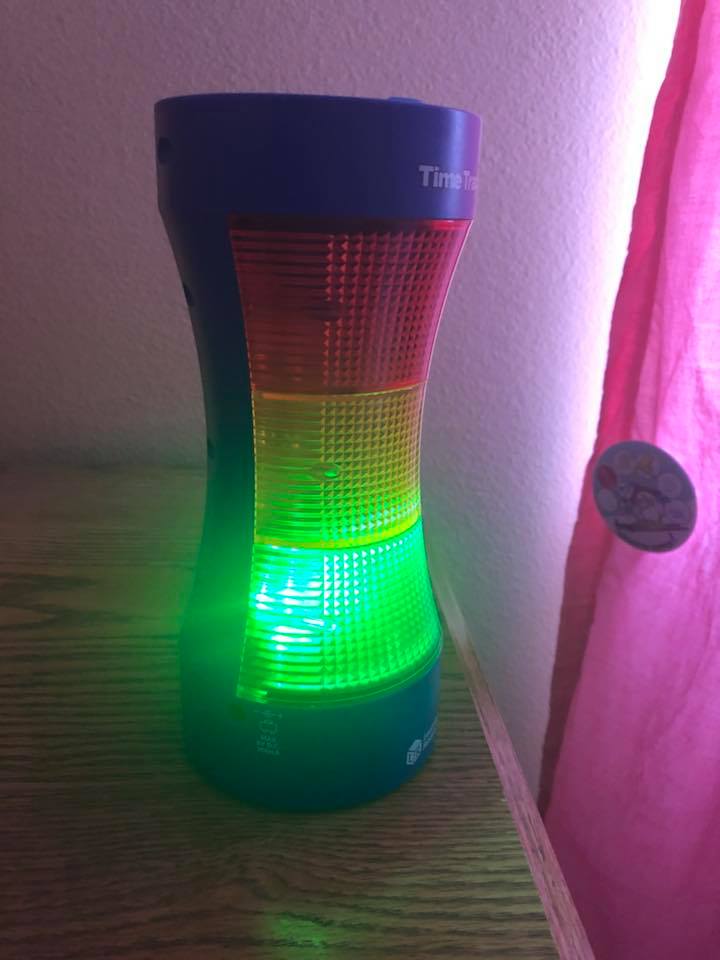
    Last to come is the timer I used for all of these tasks!  Time management is another HUGE skill that is difficult for those with EF deficits.

    The timer is from the autism community store here in Denver, but I’m sure you can find them on Amazon or other places.  This timer is amazing!!  The colors stand for different things similar to a stoplight.  Green means go, yellow means caution you are nearing the end, and red means you need to be done or stop NOW. What is best, is that each color is completely customizable by time.  For her morning routine, we usually set it for 3-3-3.  For homework, it might be  2-20-2.  Did I mention it also comes with sound?  So that means every color it changes to also has a sound to go with it, aka, an auditory cue.
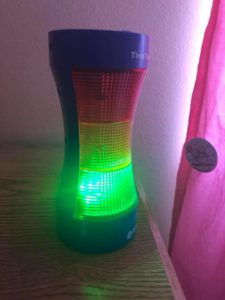
    The impact

    I have to admit, there were times that as even I were making all of these materials and buying all these things that I wondered will this really make a difference?  Was all this work really worth it?? My answer came from Ashlynn.  As I was making these visuals, she probably thanked me more than 10 times.  She knows how she learns.  She was just waiting on me to help her.

    Laura Smith is a mom to two children, one of which who has multiple learning differences.  She is also an SLP (speech/language pathologist) specializing in CAS (Childhood Apraxia of Speech), a passion that was fueled by her daughter’s dx in 2012.  To learn more, visit slpmommyofapraxia.


  • Apraxia and the village.

    Apraxia and the village.

    I work in the schools a few days along with my private practice work.  I say I work in the schools because I like working in Ashlynn’s school, and that’s partially true.  However, I have always in my career had at least one child on my caseload with apraxia in every school in which I have worked.

    If you have a child with apraxia, you’re probably thinking, “what’s the big deal?”

    If you are an SLP, you might be thinking, “Wow!  I’ve only ever had one, or none, or….”

    Anyway, if you are in the apraxia community, you know about the “apraxia coincidences” and if you know me, you know I don’t believe in coincidences.  So part of me feels like I’m put at a school I am at because I can be of service and have a connection to a particular child, with Ashlynn’s school being no exception.

    Currently I have a 4th grader that I see and I can only say so much because of confidentiality, but I love this boy.  Actually, I wrote about him once.  You can read about it here, but it turns out, I was right.  He’s gifted.

    Ha!  As I went to link that last post, I had actually included this graphic two years ago.  How things come full circle right?

    Anyway, his nonverbal IQ is off the charts and now he’s in the gifted program.  However, he’s a fourth grader and still can’t read or write, such is the extent of his disability.  I can’t imagine being so smart, but being unable to read or write.  Such is his life.

    We have every AT tool at his fingertips.  Technology though still hasn’t totally caught up to the extent of his disability.  His grades remain sub-par, and he is unable (and many times defeated so he’s unwilling) to produce any written work.

    There are sooo many people in this boy’s life who believe in him and who want to help him.  Meeting after meeting takes place behind the scenes.  I’m serious.  If you don’t work in the schools, you have NO idea the mobilization and time occurring on behalf of our children.  I know his parents don’t.

    Anyway, after at least two major meeting of the minds with every professional expertise (OT, Speech, SPED, gen ed, ATRT specialist, TA), we finally came up with a plan we thought will help him become more independent with his school work regardless of current reading, writing, or spelling ability.

    We set a meeting date of today with ALL of these above listed professionals and the child.

    Let me take a quick digression.

    A week ago, I posted on my SLP Mommy of Apraxia/Dyspraxia Fb page that the librarian at the school stopped me to show me this book called “Fish in a Tree.”  The book is written by a woman who had dyslexia as a child, and writes a fictional novel based on real life events about her life and the people in it.

    The librarian read this one chapter to me the other week, in which the girl’s teacher listed famous minds of our past and current generation.  They all were brilliant, but as it turned out, they were all believed to have had dyslexia.  I was so inspired.  I couldn’t WAIT to read it to my 4th grader.  The librarian was going to read it aloud to the entire class during library time, but she wanted me to read it to this child first so he knew we were all thinking of him.

    Today I got the chance.  I asked him if he knew the names of the people and what they were famous for.  He didn’t disappoint.  He can’t read, but he knew most of them as I read them to him:

    Thomas Edison? – “Invented the light bulb”

    Alexander Graham Bell?  – “Invented the telephone”

    Albert Einstein? – “Really, really, really smart.” 🙂

    Walt Disney? – “Made Pluto!”

    The list went on, and as I read the pages to him, some he knew and some he didn’t, I swear I could see a spark glow in his eyes and it was everything I could do not to cry.  People, this boy is as brilliant as all these people I was reading to him.  I honestly believe that, and it’s not just me….EVERY professional who works with him feels the same way; but if  you can’t read, and you can’t write and you’re in the fourth grade, you don’t feel that way.

    I barely got through reading the entire thing without completely breaking down.  When I finished there were stars in his eyes.  I’m telling you.  Bright, bright stars, and he smiled as he said, “Wait, all those people were like me!  They couldn’t read, but they were super smart and they invented stuff BECAUSE they weren’t typical.”

    I nodded my head.  That may not be a completely accurate assessment but I sure wasn’t going to contradict it, would you?  Oh, and I should mention, his comment came after a therapy session we had a few weeks ago in which I showed him Mikey from Mikey’s Wish who was talking about “neurotypical” and “neurodiverse.”  I knew he was alluding to this because he was inspired by the idea of being “neurodiverse.” (Thanks Mikey).

    As fate or coincidence would have it (coincidences aren’t coincidences), let me take you back to the meeting of all the professionals, the village, that helps this 4th grade student.  We scheduled another meeting, this time to include him.  It just happened to be that it was right after I read him those excerpts on these brilliant minds needing to find another way to express themselves.

    I took him to class where the meeting was about to take place, and his awesome 4th grade science and math teacher, who had already prepped him (for being in such a daunting meeting by himself with so many adults) told him we are here because we believe in him, and sometimes great minds have to find another path to greatness.

    His eyes lit up.  “Like Albert Einstein, and Disney, and the guy who invented the telephone!”

    People, the tears were in full force behind my eyes, but I still didn’t let them go.

    As the entire special education and general education team piled in, I watched this incredible strong and resilient 9 year old, listen to the plan set before him.  He was surrounded by people who loved him, but still.  He was outnumbered by 1:9 and he listened to our plan on how to help him read and write using technology, and, get this….his VOICE.   Yes, his VOICE would be a huge part in his written output via voice memo, and that’s possible, because he has one.

    We are all under no illusions.  We know this will be hard for him.  We know he will be frustrated and maybe even resist.  But literally, 8/9 people at that table believe he is capable (the 1 out-liar being him), and as one of his reading specialists said, “Maybe he doesn’t believe he can do this, but hopefully he will remember all the adults who think he can and it will keep him moving forward.”

    I was so proud to be sitting there as part of his team….his village; because we all know, these kids need a village.  I was trying pretty hard to reign in my emotions.  I thought about how lucky Ashlynn is to have this village too.  I don’t need doubters in her corner, I need believers; and I really know we have that.

    Oh, and about my 4th grader.  Believe me when I tell you he has BIG ideas.  His ideas cannot be adequately explained through his reading, his writing, or even his voice. I predict one day these BIG ideas will be turn into something even bigger.  I look forward to seeing it.


  • The problem with school SLP’s.

    The problem with school SLP’s.

    I only realized after being a part of the special needs community that school SLP’s have a bad rap.  Like a really, REALLY, REALLY bad rap.  

    I’m preparing a talk next month for Colorado school SLP’s, and every time I prepare a talk for this demographic, I have to tell you they have a special place in my heart.  No, it’s not just because I started as one and work as one part time, but it’s because I have literally worked under, with, and around many, many, MANY of them. I have worked with so many of them, and I can tell you they are a jack of all trades.  They are the EXPERT in eclectic, and may be the ONLY person in the school who understand in depthly just how a student’s unique communication challenges actually affect them in school.

    In the schools, you don’t have the option to specialize.  Kids from every disability show up on your caseload and you are expected to be the expert.  It might be hard to understand as a parent, but there are soooo many different disabilities and speech and language disorders, and a parent (rightly so) expects the SLP to do right and best for their baby.

    Every single SLP I know and have met has a desire in their heart to help children.  Please, let that sink in.

    When I took Ashlynn to her first private SLP who had never worked in the schools she was asking me about qualification.  She asserted that she could never be a school SLP because she felt it was unethical to not qualify students who clearly had some sort of speech or language problem.  I had a hard time refuting her.  Aside from saying qualification is different in the private versus educational sector, I really had no excuse.  I know that funding is limited in the public sector so that obviously plays a part in qualification.  I also know if every SLP took her stance, than NO kids would be serviced in the public schools, and is that really what we are going for?

    Public school SLP’s have caseloads that are probably double if not more of the private SLP.

    Where the private SLP can see kids 1:1, school SLP’s rarely have that luxury.  With weekly caseload averages around 45 to 55 and some maxing out at 90 (Yes 90 people I’ve seen it), even the most skilled SLP will not be able to do what a private SLP can do 1:1 for 45 minutes (though they will kill themselves trying).

    The result?  Parents become outraged at the lack of progress or progress they feel the child should be making. They surmise the school SLP just isn’t as good as the private SLP and they become disillusioned and write them off.  They post memes about preparing for battle when going into an IEP meeting! This honestly breaks my heart.  I feel bad for the parent who feels the SLP doesn’t care, and I feel bad for the SLP who is trying to manage an unmanageable caseload, writing IEP’s at night, or staying up until 2 Am (true story from an SLP I just talked to last week) to write a lesson plan, only to be ravaged by a parent unsatisfied with the results.

    I’m not sure if everyone is aware of this, but ANY SLP in ANY setting is as qualified as the next SLP by basic certification standards.  What does that mean?  That means, as long as an SLP received their masters degree and the Certificate of Clinical Competence (CCC) through ASHA they can work anywhere.  So that means, your school SLP can apply for a job at Children’s Hospital right now and probably get hired tomorrow (because in case you didn’t know there is an SLP shortage as well).  For some reason though, there is this perception that the school SLP just isn’t as good as the private SLP.  If it’s true, it probably has MORE to do with caseload and workload size than it actually has to do with the qualification of the SLP.

    I get calls and emails all the time from concerned school SLP’s desperate to meet the needs of their kids with apraxia but not knowing how.  They want to see the kid more, or see the child 1:1, but their caseload simply does not allow for it.  They cannot add more hours to the day, yet they still call, or write and wonder if there is something they have not yet thought of.  Oh, and here’s a dirty secret.  Listen close.

    Are you listening because this is VERY important.

    If an SLP feels in their heart a child needs private, supplemental speech services, they CANNOT say it.  People, they CANNOT tell you this.  Why?  Well, their license and job is on the line.  In most cases, school SLP’s are told not to recommend any sort of outside therapy.  Why do you ask? Why?

    I’ll tell you.  If a school SLP recommends outside services, the parent can sue the district and win, and potentially disbar an SLP from ever practicing again.  Are you asking why again?  I’ll tell you.  If a school SLP recommends outside services, they are essentially saying that the child can not benefit or make progress from the therapies provided by the school, and the school is required by law to show progress.  If the SLP recommends outside service thereby saying the school is inadequate, the school gets worried or they will get sued for not providing adequate services and the SLP potentially fired.

    Would you take that risk?

    I’m not saying unilaterally every school district would do this, I’m just saying, school SLP’s are told this is a possibility, and so they would find it best not to recommend outside services.

    You need to know this as a parent of a child with any disability.  Some SLP’s will risk their professional license and recommend this to you.  Let me  tell you though what they are risking.  They are risking 4 years of a bachelor degree, 2 years of a masters degree, 1 year of a clinical fellowship, and the usually 3 years of probationary status as a teacher.  That is an entire decade of work and dedication to a profession they love and believe in.  Would you take the risk then to recommend a parent pursue outside therapy?  This is where they are at!  It is truly a catch 22.

    If you are upset about your school services, you probably have every right to be!  I was VERY unhappy with Ashlynn’s preschool, in-class only, speech/language services.  However, it is important to place the blame on the right entity and in most cases I can assure you it is NOT on the school SLP’s shoulders.  In Colorado, the Colorado Department of Education mandated an inclusion model only of special education services in preschool thus making it extremely difficult for any school SLP to pull a student out into a 1:1 session.

    My message today is this: School SLP’s are some of the most phenomenal group of people I ever have the honor to speak with or to. They do not get the option to specialize, and so they pursue advanced training and expertise in every disability that may affect communication: from Apraxia to Angelman’s Syndrome, from Developmental Delay to Down Syndrome, from Cerebral Palsy to Stuttering, from Language Impairment to Nonverbal Learning Disability, from Assistive Technology to Autism, from Auditory Processing Disorder to Articulation Disorder,  school SLP’s will see it all and be expected to rise to the challenge.  They cannot “refer out” or “discharge for lack of progress” as an can be done in private speech. No, the school SLP is expected to figure it out regardless of the lack of resources, lack of funding, or lack of time.

    They will be faced with limited or no space, they will be strapped with high caseloads, and criticized by parents; yet they will persist and pursue only becoming better for it, because of their love for the children and the profession.  I personally have witnessed it time, and time, and time again!

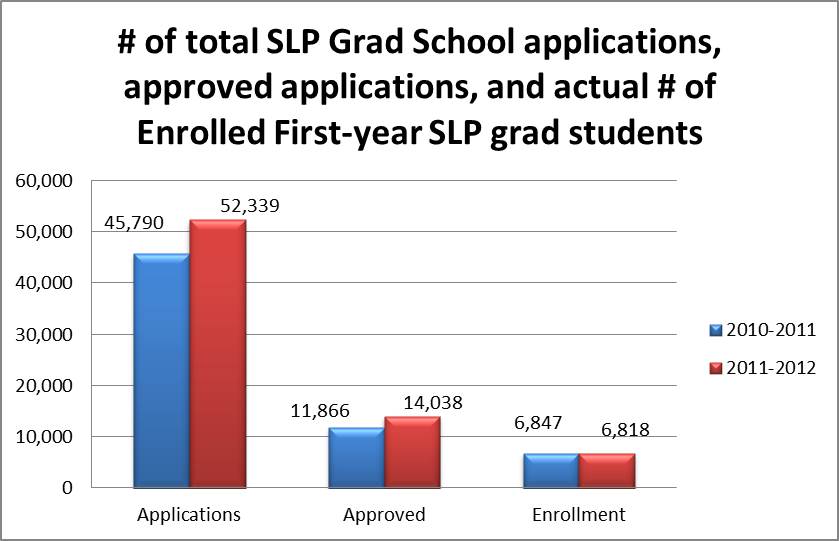
    I can tell you firsthand, getting into graduate school for speech/language pathology is VERY difficult.  It is highly competitive, and here in Colorado, the average COLLEGE GPA was a minimum of 3.87 when I applied.  I found this graphic from 2011 but I can tell you things have not changed much.  There is a HUGE gap between the number of applicants and the number of people selected. 

    The disparity should be striking, and please remember that MANY of these applicants will be YOUR school based SLP.  If you have the mentality that “C’s get degrees” and you are certain your school based SLP fits the latter, let me correct you.  NO average C students make it to graduate school in the first place for speech/language pathology.

    Truth

    For my final thoughts I wish not to be adversarial.  I hope that this article has persuaded you, a parent OR SLP, to reach out to the other side and bring about the change you wish to see.  I have the unique perspective of being on both sides, and as such, I have the utmost RESPECT and LOVE for both sides.  I truly wish for there to be a conduit of communication, and not a  ridge of animosity and distrust; and at the the forefront, I wish to impart a spirit of solidarity between my professional and special needs relationships.

    To read more from SLPMommyofApraxia follow her on facebook, pinterest, or twitter.


  • Where did THAT come from?

    Where did THAT come from?

    If you follow my facebook page, you probably already saw our HUGE news!  Ashlynn came home from school this week with a note and award that said she had successfully verbally named EVERY single letter AND letter sound.  

    It’s nothing short of amazing.  Ashlynn has been working soooo hard and for YEARS.  YEARS!  She deserves it soo much.  We bought ice cream for her and let her eat it straight out of the carton right before bed!

    Right after this picture was taken, my husband walked into the kitchen and told her “Ashlynn, I’m sooo proud of you for working so hard.”

    And then….something surreal happened.  Maybe it won’t feel surreal to you, but let me stress…it was.

    Cody left the room and she looked up at me….with this same smile…the smile you see here….and she said,

    “And Mommy, I’m so proud of you for working with your kids and helping them talk.”


    I included the above dead space on purpose, because dead space is what happened.  Time stopped.  I looked at her looking back at me with what I can only imagine is the most shocked look on my face.  Tears actually immediately welled in my eyes.  Where did THAT come from??

    I  am a private person.  I’m not saying we shouldn’t cry in front of others, but it’s just not my way.  I just prefer to do it behind closed doors….but right then…in that moment…that moment all about her…..it felt like someone was speaking through her and it took a moment to collect myself.

    I told her thank you but this moment was about her.  She tilted her head back in glee and then pointed at her brain and said,

    “Mom!  My brain is not messing up my letters anymore!”

    …….and she innocently took another bite of ice cream.


  • Finding hope again is like finding a diamond in the rough

    Finding hope again is like finding a diamond in the rough

    We always hear about mama bears.  Okay, maybe it’s just me, but I guess I am one.  Daddy bears don’t have quite a good a reputation.  Daddy wolves though.  Watch out.  Read about them.  You do NOT want to cross a daddy wolf.

    My dad is a daddy wolf.   I found a definition online that read,

    “Male wolves are attentive, monogamous and fiercely protective dads that live with their she-wolves for life. A wolf pack is essentially a classic nuclear family consisting of a mom, dad and kids.”

    If I had written that definition, I would extend the kids to “grandkids” as well.

    That’s because my dad is a daddy wolf.  My dad loves being a grandpa, and he likes being called grandpa.  Grandpa is a name of respect…just like dad.  A child says “dad” out of respect, and similarly says “grandpa” for the same reason.

    He had 5 grandchildren before Ashlynn.  They ALL respectfully refer to him as “Grandpa Baskall.”  It is a title he has certainly earned.

    Then came Ashlynn.  Then came apraxia.  Yeah, Grandpa is going to be pronounced “papa” and that’s just the way it is. I saw my dad soften in these years.  We always think about the pain parents feel that their child cannot say their name…….but when do we talk about the grandparents?  My dad, though words were not spoken, I think had also yearned to hear his grandchild say “Grandpa.”
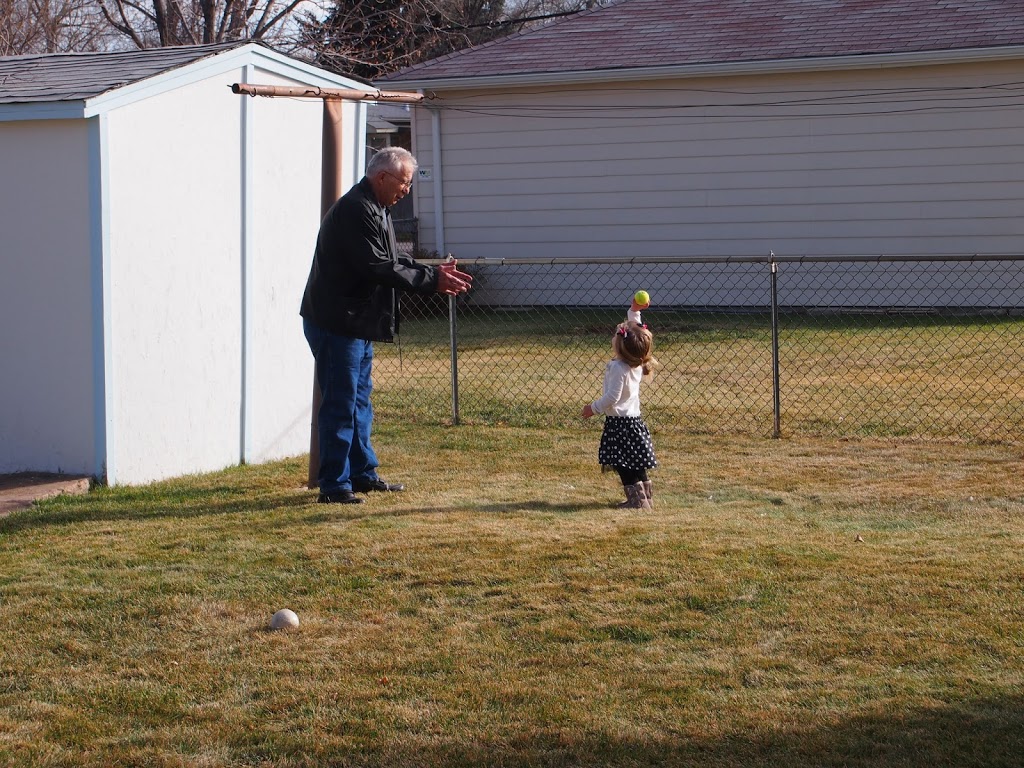
    She clearly loved him.  She gravitated toward him as a nonverbal two year old.  He would play with her and make her laugh.  He would practice writing with her, playing ball, and pulling toy boats in the grass outside. She giggled in his presence.  She clearly loved him…..but she couldn’t even say his name “grandpa” much less “I love you.”

    15380456_10209136973594043_7341643425335965372_n
    Ashlynn dancing on my dad’s feet at his 45th wedding anniversary.

    One day….when she was three….she was able to say the words “papa.”  I can’t recall the exact moment in time, but I can recall that my dad never even blinked from that day forward to being called “papa.”

    pb220626
    My dad working on “ball skills” with my daughter who has dyspraxia

    One day, on our way to my parent’s house, Ashlynn told me she was happy for the first time.  She was 4 1/2.  It was so monumental, I wrote an entire post about it.  I think it’s a great read, and if you want to read about it, it was entitled: Ashlynn Happy….Papa’s House.

    She is now 7.  She is verbal, intelligible, and says so many more things now.  She would be able to say “Grandpa Baskall” now, but he is not her Grandpa Baskall, he is and always has been…her Papa.  The same is true on my husband’s side.  Where they both went by Grandpa, they both now are Papa…because of Ashlynn.

    Though Ashlynn can speak, she is still a girl of few words. If you know her, you know there is way more in her head than what we hear out of her mouth.  Thank you to her additional language processing disorder that has been heaped on top of the apraxia.
    Anyway, on Thanksgiving, my dad, my daddy wolf, was talking to Ashlynn before he turned to me and resolutely commented on how he couldn’t wait for the day she would “break out.”  The day when we would truly hear all the thoughts in her head.  He laughed that we would all have to “watch out” because boy would she have a lot to say.

    I could only smile wistfully.  I have to be honest and say I’m not sure that will ever be her reality.  As I mentioned, Ashlynn’s language processing is also impacted….aside from apraxia.  I hoped my dad was right.  As I looked at him, at his resolve, and his absolute certainty Ashlynn would one day break out, I started to remember how he believed in me that same way.  That daddy wolf way.  That papa wolf way.  My dad ALWAYS believed in me.  It wasn’t a belief born out of encouragement either.  It’s not like he was always telling me I could be anything I wanted.  On the contrary, he’s very practical and encouraged me to do practical things like don’t take out student loans and have a plan B (some of which I listened to, a lot of which I didn’t…. love ya dad!)

    No, it was deeper than that.  It was a visceral belief that I felt…..and though I am still scared for Ashlynn, I took comfort in that moment that the same daddy wolf who  believed in me, had that same firm belief and resolve in MY child.

    It gave me hope again, and boy, aren’t we always looking for renewed hope.

    Speaking of hope, today the internet affords us many opportunities that wouldn’t have been possible…one big one being knowing others with the disorder.

    In my search for others like Ashlynn, I came across a page called “Mikey’s Wish – Verbal Dyspraxia Awareness.” That is the term for Childhood Apraxia of Speech as we know it here in the U.S.  Finding his page, was like finding home.  Ashlynn’s disorder is sooooo misunderstood.  Many peg her as having a cognitive impairment, and on a test of cognition, I am certain she would perform poorly too.  However, motor planning is a bitch.  It impacts EVERY area.   My daughter’s cognition is in tact.  IQ tests will never be able to adequately describe her because inherent in any IQ test is language processing and motor planning.

    15192518_1815855478682645_8304031844544030308_n
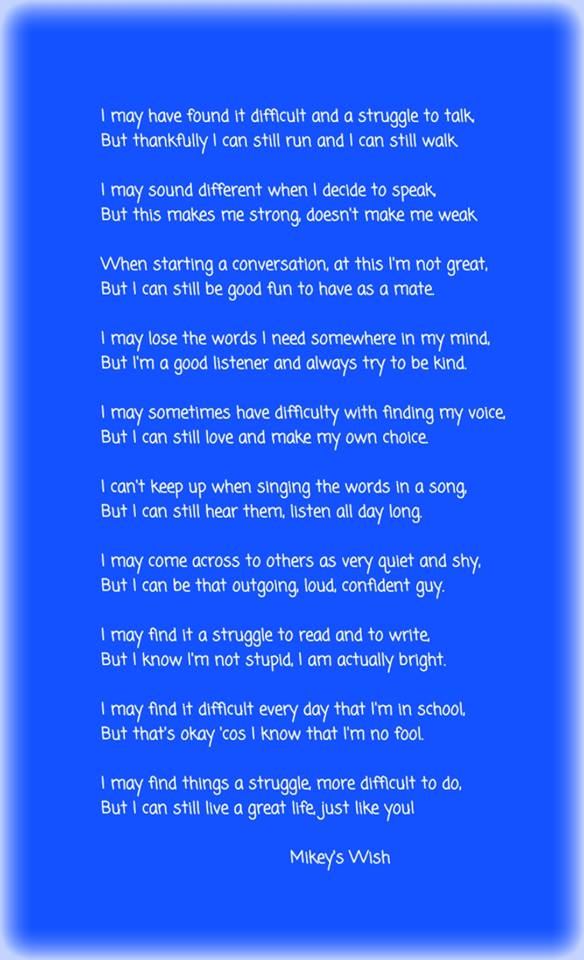
    One of Mikey’s poems

    Anyway, back to Mikey.  I have been soooo impressed by Mikey’s writing. He writes poems and other genres to spread awareness and to encourage expression and understanding of those who have apraxia.
    When I was in AP English, I remember our teacher saying writing should make people “feel.”  Good writing touches on “universal experiences” that touch a large portion of the population regardless of culture, background, or creed.

    I can tell you, that the few things I’ve read now that are written by people with apraxia “speak to me.”  I start to have hope that maybe Ashlynn will have an outlet in writing.

    The two I’m following right now are “Mikey’s  Wish” and “The Girl with the Funny Accent.”

    Their writing frequently makes me tear up.   Ashlynn may never “break out” as my dad described.  Or…one day…maybe she will.  We certainly have success stories now in Ronda Rousey and Gage Golightly.

    I’ve been enjoying Mikey’s poems so much that recently I asked him if he ever thought of compiling them and selling them.  I would love to buy them to have Ashlynn read when she’s older.  He said he had not, but it apparently got him thinking.   He recently wrote this

    I have been reading up about getting poems published and it is very hard to do. Then I got thinking about something that I would have liked to have access to when I was younger. I don’t know if I will be able to do it but I would definitely like to give it a go. I would have really liked to have a book that would either make myself feel better about having verbal dyspraxia or that could be read to (or read by) other children to help them understand a bit about verbal dyspraxia. Aimed at primary age children, so maybe written in rhyme with nice pictures. I would really like to be able to make this a reality. Can you imagine a child who has always struggled with literacy managing to get a book in print. Now that would be a huge achievement. I know I can write it so I will, it’s just getting it noticed by the right people that I might find difficult. But I am used to facing difficulties so hopefully that won’t stop me and if I don’t try I will never know, so watch this space. ?
    Well, I for one am watching, and cheering.  He’s absolutely right.  How amazing would that be that a child who struggled with literacy would get a book in print.  It really speaks to his intelligence and how even though he had struggles talking, then reading, then writing, he’s in there and it now comes through IN his writing.

    When my dad said he can’t wait until Ashlynn “breaks out” it may never be verbally, but perhaps it will be in a different way.  Actually, it could be in a way of which I am rather quite fond of…writing.

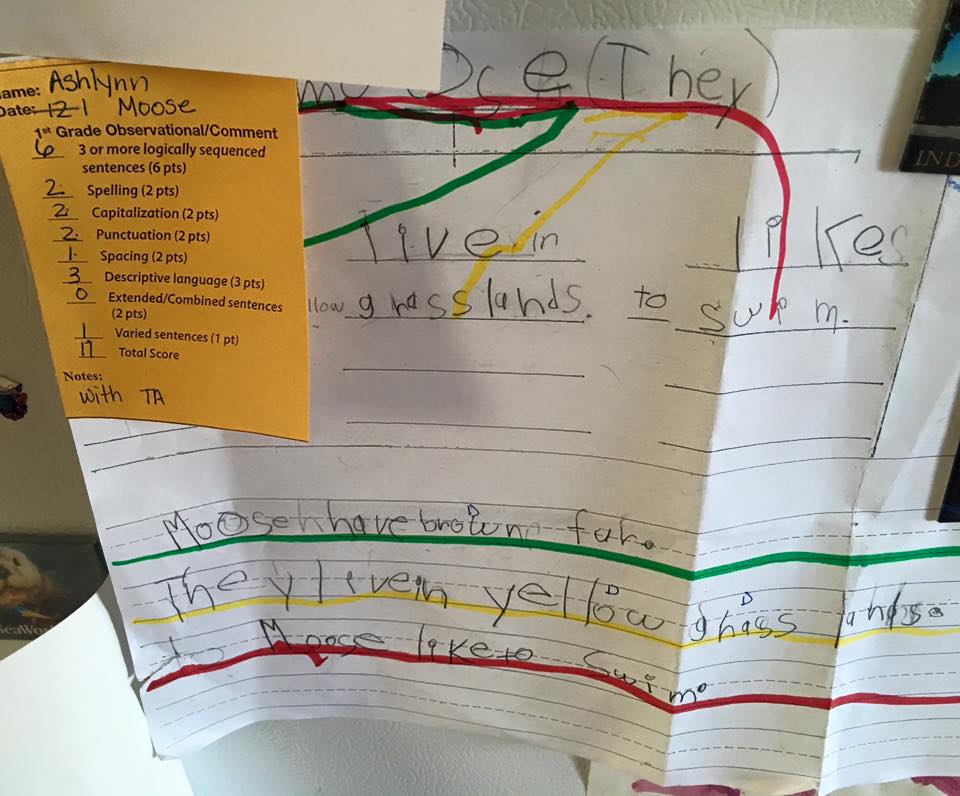
    This weeken15284868_10209136846470865_6471383872322827586_nd she brought home this.  I pulled out the paper, saw the rubric and winced.  Like, I seriously physically winced because rubrics lately have been…well…depressing.

    I took a deep breath and opened my eyes.  Ashlynn rushed over and said, “Look mommy, I got a 6 and a 2 and another 2..”

    I braced myself for it being out of like 10 points or something.  Instead, I saw 6/6.  2/2.  The note said “with TA” which means she had TA support, but look at what she accomplished!  This girl with apraxia, a language processing disorder and dyspraxia.  I’ll be damned.  Nothing has come easy, and I finally feel we have a therapeutic dose now of her meds, she’s in private OT again, her reading plan was changed after conferences to put her back in the classroom while continuing to get pulled for those foundational skills, and I started her on a home reading program called “ALL” recommended in the apraxia groups for kids who are nonverbal; so maybe it’s all pulling together now.

    I’m so proud of her. She was so proud of her. When Ashlynn struggled for years to just write her name, I couldn’t imagine getting to this point.  All these words and sentences on a paper written by HER hands, and suddenly I find hope again.  Hope on this one rubric out of so many that have come back poor, this one rubric is like a diamond in the rough...so it’s now hanging on my fridge, to honor her, but to also remind me we may roll down a lot hills, but it’s never about the fall.  It’s how you get back up and try again….

    and again

    and again in our case. In her case.

    So we will.

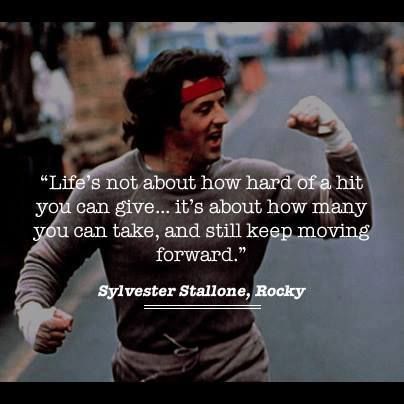
    When we fall we might have a good cry, okay I might have a good cry because Ashlynn doesn’t seem to get sad over all the hard work she is doing.  Then we will stand up, more determined than before.  I’ll brush myself off, take her hand, and start climbing up again, and again, and again, until we’re at the freakin top because I know if we do this, it may be slow, and it may be hard, but we will always keep moving forward.

    8e4387daf1e1fdabbe3bb377c6ff87c1