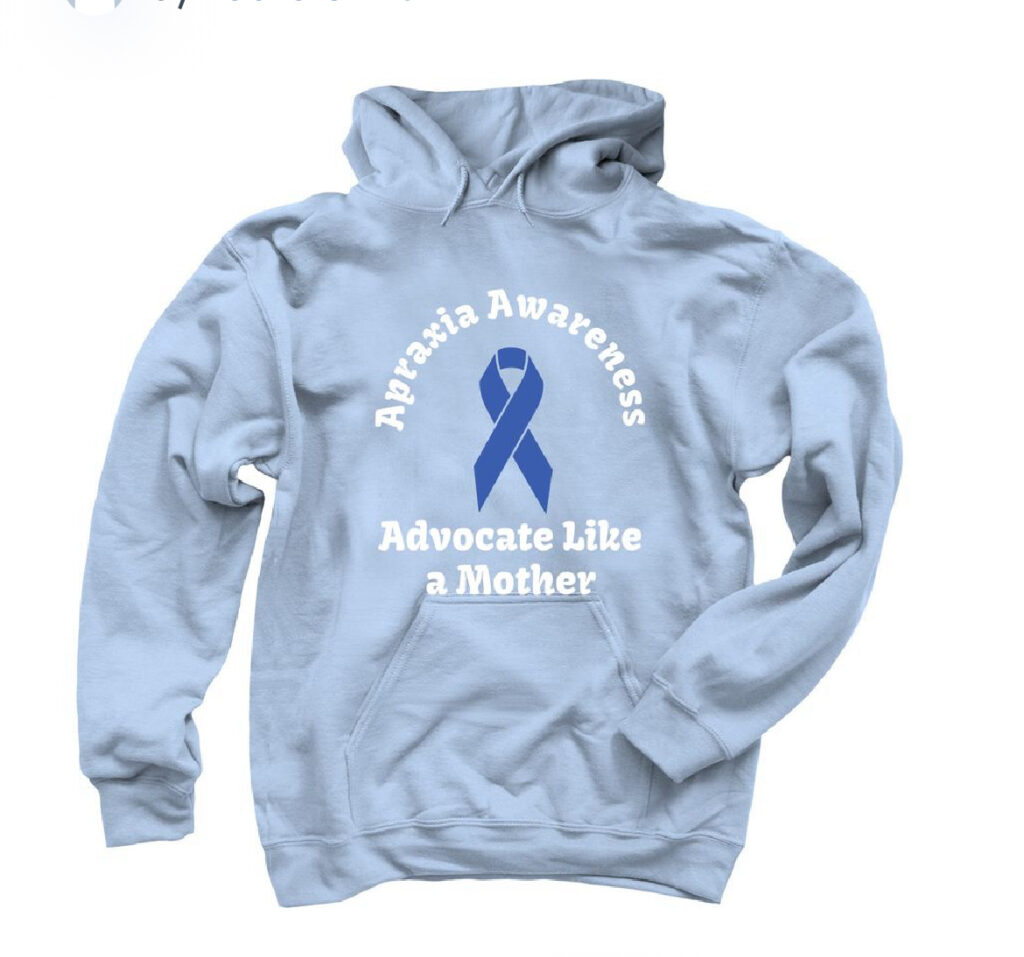
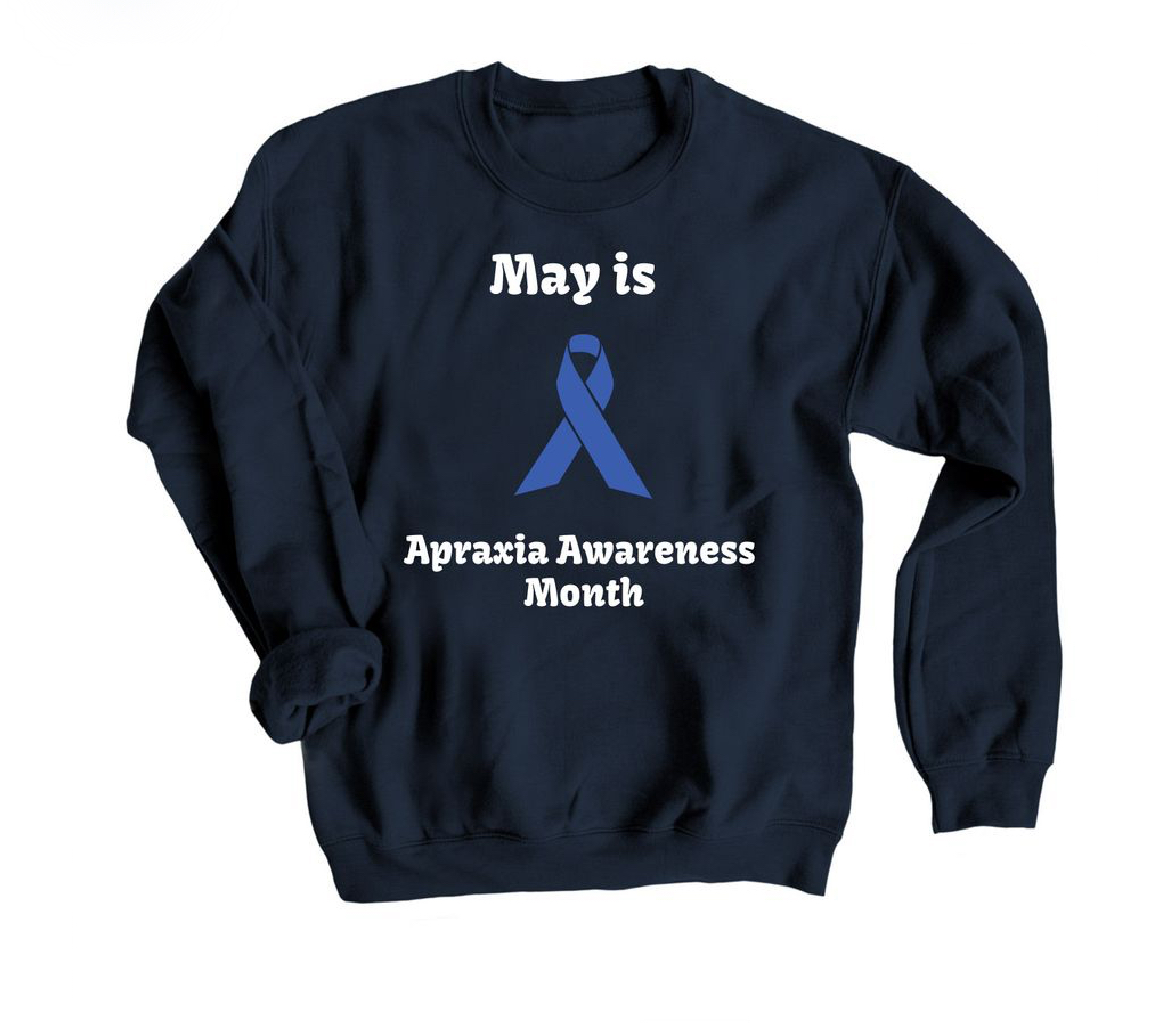
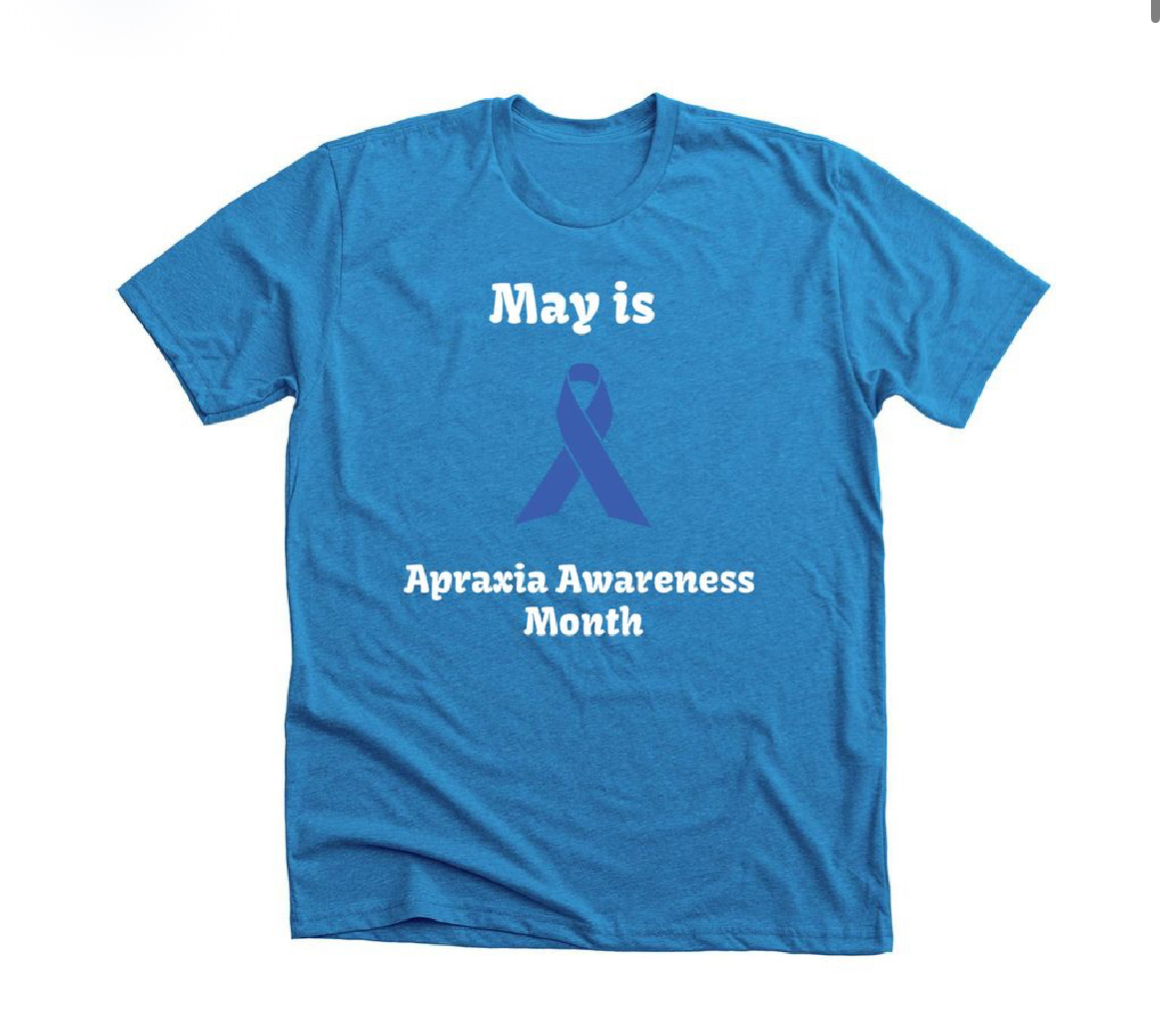
Apraxia Awareness Month is May of 2024! The first EVER Apraxia Awareness Day was recognized only 11 years ago on May 14th, 2013. Right on the heals of Ashlynn’s diagnosis in 2012, this day filled my cup!
Each year since it has grown bigger and bigger! One thing that’s a MUST is to wear your apraxia awareness gear! For a short time, my store is offering shirt sales through April 11th 2024. That’s the last day to ensure you will get yours in time for Apraxia Awareness month, which is just month away! Look for more posts on other ideas to help spread awareness leading into next month!
Tag me, SLP Mommy of Apraxia on social media in May during Apraxia Awareness Month 2024 with the hashtag #slpmomyofapraxia2024 and #apraxiaawarenessmonth2024 so I can reshare you wearing your gear!
You can now go about your day. If you are interested in reading more, I will summarize the research below.
What is NDT?
NDT stands for neurodevelopmental treatment. It was created by a physical therapist named Berta Bobath and her husband as a treatment for cerebral pasly (NDTA, 2005). According to (Paris, B. Theoretical Base of NDT), the Bobath’s believed that movement is not learned. Rather sensations of movement are what help children learn effectively.
What does the research say?
Since that time, it’s been researched since it’s conception primarily in the physical and occupational therapy realms. More specifically, with cerebral palsy and gross motor skills. I found no information related to NDT for childhood apraxia of speech. There was one paper that did a relational study looking at the effectiveness of NDT on gross motor function with children who had cerebral palsy and a general developmental delay. The criteria for developmental delay though was loose and it’s not clear if these children had a diagnosed motor planning disorder as in developmental coordination disorder (Lee K.H. et al, 2017)
This does not even address children with dyspraxia, developmental coordination disorder or CAS.
Do children with CAS need PT and OT?
Research does show that many children with CAS can be at risk for motor impairments (Iuzzini-Seigel, 2019). However, it is out of the scope of a PT or OT to be treating childhood apraxia of speech.
What does the research show is the best way to treat CAS?
Findings of six systematic reviews, two of which were conducted with relative rigor, suggest that motor programming treatments have the best evidence base for treatment decisions pertaining to CAS. Clinicians are referred to online resources to implement these treatments according to published protocols.
In short, NDT is not a recognized treatment in childhood apraxia of speech. CAS is a lifelong neurological disorder affecting the planning and programming of the movements needed for speech. As such, the best approach according to available research is treatment incorporating the principles of motor learning.
Laura Smith, M.A. CCC-SLP is a 2014 graduate of Apraxia Kids Boot Camp, has completed the PROMPT Level 1 training, and the Kaufman Speech to Language Protocol (K-SLP). She is the author of Overcoming Apraxia and has lectured throughout the United States on CAS and related issues. Currently, Laura is a practicing SLP specializing in apraxia at her clinic A Mile High Speech Therapy in Aurora, Colorado.
Hi readers! Not only another year, but another decade is coming to a close! My daughter Ashlynn was born in 2009, and it’s astounding all of the changes that set off in my life throughout the past ten years! This past decade was one of joy as a I built my family, but also sorrow facing numerous challenges with Ashlynn.
I have faith though that this next decade will be one of overcoming! I know ten years from now I’m going to be writing another success and triumph story, much like I did in the book I published this year called “Overcoming Apraxia.” I also want this next decade to be one of exponential growth in apraxia awareness and information so all children have the access to the best therapy.
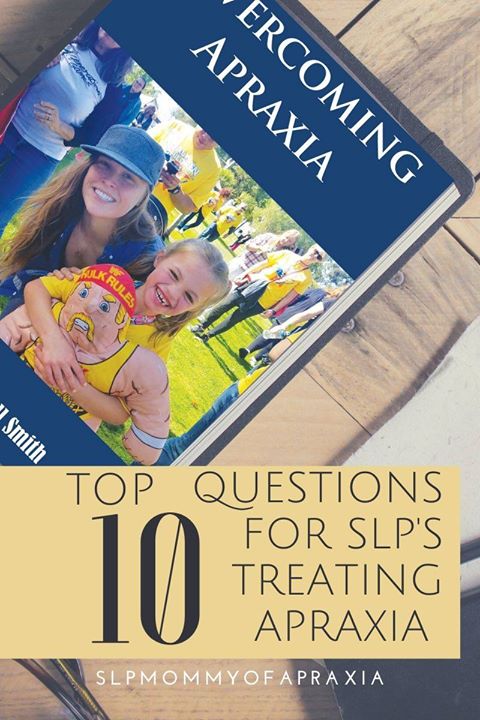
I recently posted a quote from my book Overcoming Apraxia that was met with a lot of questions. The first question was from SLP’s asking about the additional trainings and resources I would recommend. You can read about that here. The second question came from parents wondering what questions to ask? I’ve created a (not exhaustive) list of questions to ask a potential SLP about their knowledge and experience treating childhood apraxia of speech.
As I was writing them, I thought, though this list is a great starting list for parents, this is ALSO a great list for SLP’s to ask themselves when evaluating whether they are actually an expert in it! Self reflection is always good, right?”
Okay so here we go! My top ten questions for speech-language pathologists!
How comfortable do you feel treating childhood apraxia of speech?
What other questions would you ask? Find me on social media under the handle SLP Mommy of Apraxia and let me know!
Laura Smith, M.A. CCC-SLP is a 2014 graduate of Apraxia Kids Boot Camp, has completed the PROMPT Level 1 training, and the Kaufman Speech to Language Protocol (K-SLP). She is the author of Overcoming Apraxia and has lectured throughout the United States on CAS and related issues. Currently, Laura is a practicing SLP specializing in apraxia at her clinic A Mile High Speech Therapy in Aurora, Colorado.
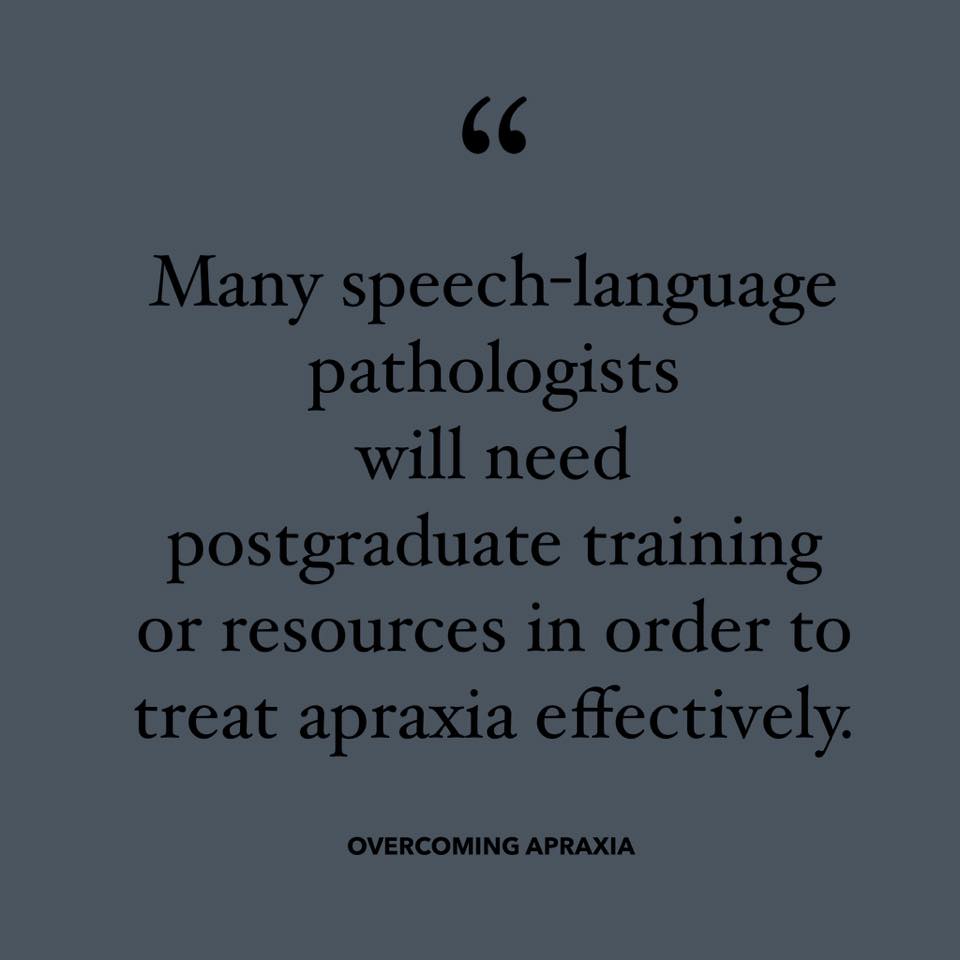
I recently posted a quote from my book Overcoming Apraxia on social media that garnered quite a bit of attention. It wasn’t to criticize or disparage SLP’s. It’s just a fact many of us speech-language pathologists, (myself included) didn’t get adequate training in graduate school on how to treat apraxia. I had maybe 15 loose leaf pages on it, and that wasn’t about treatment.
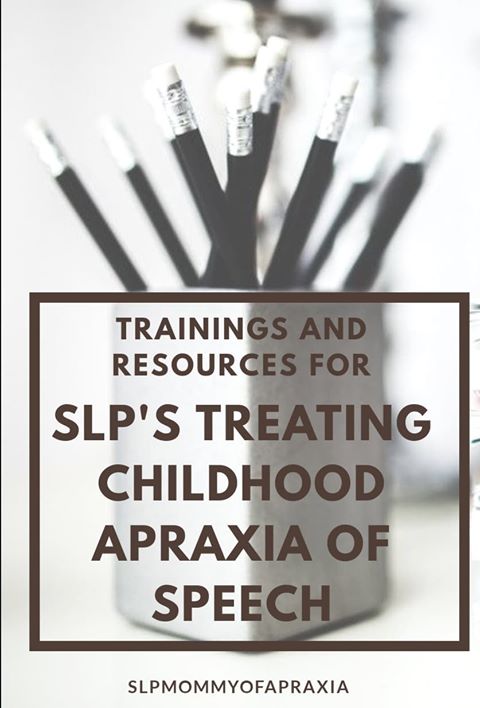
Many SLP’s asked what trainings I would recommend and many parents asked what questions they should ask. I’ve compiled a list of trainings and resources on childhood apraxia of speech for speech-language pathologists.
SLP training and resources
There are numerous online free trainings for apraxia, believe it or not.
Currently Edythe Strand has a free course on DTTC (dynamic temporal tactile cueing) that gives you CEU’s through the University of Texas at Dallas found at Child Apraxia Treatment.
Apraxia-Kids.org offers on demand videos that can be accessed through a yearly subscription fee that is relatively cheap (around $90 for the entire year).
ASHA.org has a recently updated practice portal on CAS.
A newer and AWESOME book targeted for parents and early intervention professionals is “Let’s Get Talking,” by Mehreen Kakwan. It explains direct therapy tips to use when a child has suspected motor planning difficulties including visual and verbal cueing ideas.
*Both DTTC and ReST have the current highest evidence base in the research on apraxia*
Fellow speechies, here’s the deal. Yes we come out of graduate school with a wealth of knowledge, and yes, the Certificate of Clinical Competence behind our name makes us qualified to treat speech/language disorders; however, the field is VAST. We should not apologize or feel bad about not being an “expert” in every speech and language disorder from birth to geriatrics.
However we DO have a responsiblity to be honest with parents, clients, and families about our level of expertise in a given area, and whenever possible, try to gain additional training and expertise in that area if we are lacking.
Laura Smith, M.A. CCC-SLP is a 2014 graduate of Apraxia Kids Boot Camp, has completed the PROMPT Level 1 training, and the Kaufman Speech to Language Protocol (K-SLP). She is the author of Overcoming Apraxia and has lectured throughout the United States on CAS and related issues. Currently, Laura is a practicing SLP specializing in apraxia at her clinic A Mile High Speech Therapy in Aurora, Colorado.
A new study finds that 65% of children with a history of suspected
Childhood Apraxia of Speech (sCAS) are low proficiency readers, suggesting that
early literacy intervention is justified for this group of children.
August 17, 2019
Research recently published in the American Journal of Speech
Language Pathology (AJSLP) suggests children with sCAS are at increased risk
for reading disorders and should receive early intervention targeting early
literacy and language skills, along with the speech motor planning component in
their speech therapy program.
” The
current conceptualization of CAS as primarily a motor speech disorder may
encourage interventions that rely largely on habituating accurate motor speech
plans with little attention paid to the development of literacy skills. Viewing
CAS as a motor speech disorder that commonly includes reading impairment may be
more useful to clinicians given the high percentage of children with CAS who
exhibit decoding difficulties. “
The study by Miller, Lewis and colleagues had several
aims. First, the researchers wanted to
identify the frequency of reading disorders in children with sCAS and Speech
Sound Disorder (SSD). Also, researchers
wanted to learn how children with sCAS differed from one another and also how
they differed from children with SSD in various levels of reading proficiency
and performance.
Participants were a group of 40 children ranging in age from
7-18 with sCAS and 119 participants ranging in age from 7-18 with SSD. All the
study participants were tested and then compared on various measures for
speech, language, reading, and cognitive-linguistic skills.
Several findings are of interest:
Sixty-five percent of children with sCAS were
low proficiency readers, which is substantially more than the percentage of low
proficiency readers in the general population.
Specific risk factors for literacy difficulties
in children with sCAS were oral language and phonological skills.
While speech motor skill deficits were
identified in all children with sCAS, the participants’ speech difficulties did
not predict their reading proficiency.
Overall, the findings indicate that viewing CAS solely as a
motor speech disorder may be a disservice as SLP’s might miss out on the
opportunity to address the intertwining of speech, language and literacy
deficits as early as preschool. The current study provides justification for
providing early literacy intervention coupled with appropriate speech and
language therapy for children with sCAS to strengthen weak phonological
processing skills found in the population and which negatively impact later reading
proficiency.
Future research needs to explore the differences or
similarities in the trajectory of reading achievement between groups considered
resolved or with persistent CAS as well to explore what specific interventions
are particularly helpful for kids with CAS and reading impairment.
Laura Smith, M.A. CCC-SLP is a 2014 graduate of Apraxia Kids Boot Camp, has completed the PROMPT Level 1 training, and the Kaufman Speech to Language Protocol (K-SLP). She has lectured throughout the United States on CAS and related issues. Laura is committed to raising and spreading CAS awareness following her own daughter’s diagnosis of CAS and dyspraxia. She is the apraxia walk coordinator for Denver, and writes for various publications including the ASHA wire blog, The Mighty, and on a website she manages slpmommyofapraxia.com. In 2016, Laura was awarded ASHA’s media award for garnering national media attention around apraxia detailing her encounter with UFC fighter Ronda Rousey, and also received ASHA’s ACE award for her continuing education, specifically in the area of childhood motor speech disorders. Currently, Laura is a practicing SLP specializing in apraxia at her clinic A Mile High Speech Therapy in Aurora, Colorado.