Blog

  • So many things require motor planning, including a computer mouse.

    I’m so frustrated today!  To make it worse, I’m frustrated with myself for being frustrated.  I went to put Ashlynn on abcmouse.com, and early learning site for kids as young as two.  Since she’s 3.7, I figured this should be great.  Wrong.  Turns out using a mouse requires a high degree of motor planning and coordination.  God.  It sucks.  She can’t even do things two year olds can do.  I mean, she can, but it’s going to take a high degree of practice.  It’s not fair!!  I just want to cry. I mean, forget using the site for educational purposes, we’ve been stuck on the tutorial just trying to help her get the hang of the mouse. 

    It’s not that she’s not trying either.  She’s so excited like she always is, smiling, happy to be learning something new.  It’s just where most kids get to actually use the other programs on the site, we are using it to learn how to use a mouse.  This is something two year olds can do! 

    Why does everything have to be so hard for her?  Anything she’s ever done has required so much more practice.  Everything she’s accomplished has not come easy, yet she perseveres with a smile on her face.  I have so much to learn from her.

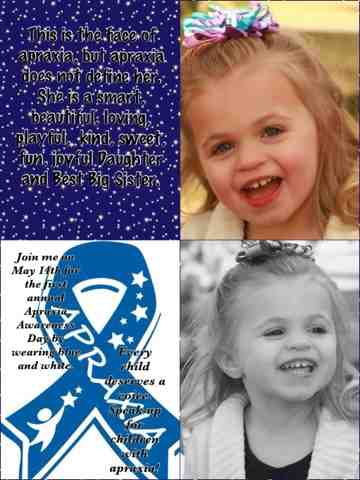
  • First annual Apraxia Awareness Day! What it means to me as a mom and SLP

    First annual Apraxia Awareness Day! What it means to me as a mom and SLP

    I never thought when I was going through school to be a speech/language pathologist, or when I became a speech/language pathologist, that I would one day have a child who would have apraxia. It’s funny, because before I had Ashlynn, I was still drawn to the disorder. I was highly disappointed about the information that was available on it in graduate school. I think I have a packet of maybe 20 papers that discusses Childhood Apraxia of Speech (CAS), and that’s it. Luckily, I had an amazing mentor who was able to take me to a conference given by Ruth Stoeckel from the Mayo Clinic in 2005. I still have her packet today, and have shared the knowledge I gained there with many colleagues.
    In 2008, I had a child enter my school and on my caseload when he was in Kindergarten.  He did have an IEP from Early Intervention; however, therapy had been primarily unsuccessful.  One day, he pulled out an alphabet BINGO game I had on my shelf.  He proceeded to say every letter sound in isolation.  I quickly realized he must have Childhood Apraxia of Speech (CAS)!  Apraxia is a motor planning disorder that affects a child’s ability to accurately plan, sequence, and execute the sounds needed for intelligible speech. Since he could say all the sounds in isolation, it was clear to me the breakdown must have been in the sequencing.  I pulled out my packet from Ruth, and searched for resources.
    Fortunately by the end of the school year, he was talking in sentences!  That’s the power of information.  That’s the power of awareness.  That’s the power I hope other SLP’s who may only have a 20 page packet from grad school get when they are called attention to Apraxia Awareness Day.
    I am so grateful that there is now an Apraxia Awareness Day, not only for the children affected by CAS and their families, but also for the professionals who treat it.  We all know that early identification is key, but many kids can be identified much sooner than they are!  I currently am in another school building, in almost the exact same situation.  I have a child from a bilingual home come into Kindergarten nonverbal.  Now that I have more experience, now that I’m armed with more information and more tools, we started making progress the first week.  Though I’m happy for his progress, I am sorry for it’s tardiness.   Especially, for his sake.  He is so smart.  He can point to any sight word in English AND Spanish, but just can’t put those sounds together coherently.  He’s frustrated and embarrassed.  This shouldn’t have to happen to any more kids, and this is what Apraxia Awareness I hope, will accomplish.
    As for my daughter?  I could never have fully appreciated the disorder outside the disorder, if it wasn’t for her.  In her I see it’s humanity and complexity,  it’s heartbreak and hope,  it’s tenacity and victory!  My 3 year old daughter has taught me more about CAS then graduate school, then professional developments, or my professional experience.  I can only believe that God chose me to be an SLP for a reason, and that my daughter has CAS for a reason.  I don’t want to disappoint Him, and I don’t want to disappoint her;  so I stand up for all the kids who DESERVE  a voice to raise awareness on this first ever Apraxia Awareness Day!
     
     
  • “I Will Wait” Struggles have made victory that much sweeter.

    Ashlynn’s progress continues to grow by leaps and bounds.  So many times I catch myself smiling and my eyes well up with tears to see her knock down all of her obstacles.

    Last month she learned to jump for the first time at 3 1/2.  At the beginning of the year, it broke my heart to watch her try on a classroom trampoline.  On their turn, all the other kids exuberantly bounced away.  When it was Ashlynn’s turn, all she could do was march.  Now, she is not only exuberantly bouncing, but she is catching air in my kitchen, on my patio, and even on her bed.  I was scolded for jumping on the bed, but I don’t care if she busts every spring and I have to buy  her a new one.  It’s worth it.  It’s all worth it.  Every penny spent, every happy and sad tear shed, every minute in therapy; it’s all worth it!  
    She also sang to a song that she had never heard before in the car last week.  Mumford and Son’s “I Will Wait” song was on the radio.  I was singing to it, and all of a sudden I heard her.  Her little voice filling the car with the chorus.  There are no words to describe the feeling.  I will buy the CD and put the album cover in her baby book. 
    These little triumphs, so sweet when  you have a child with a developmental delay.  She has taught me so much.  We may have had challenges, but we experience something so much sweeter when there are victories.  We appreciate all the little things so much more.  We never take for granted, not even for a second, her talking, her jumping, her SINGING.  

  • Ashlynn’s at four words! Update

    Ashlynn is literally making leaps and bounds in her speech.  Sometimes, I feel like we are actually having a mini conversation.  I think the greatest aspect is her being able to tell me where she’s hurting, or even tell me what she wants to eat.  She tries to repeat everything now, and even has some sponteaneous four word utterances! 

    The past week, her new thing was “too” as in, “Ashlynn go ni night too?”  or “Ashlynn eat dinner, too?”  That counts as four words!  Yeee haw!!  She’s also said, “I want more ketchup.”

    This past month, after hard work from both her SLP’s and myself, she marks every final ‘t’ ‘p’ and ‘n’ consonant.  Getting to that point though, wasn’t easy.  Practicing CVC words, you could see her brain thinking as she groped for the correct sound.  She needed a visual and verbal cue every time.  For example, when saying “hat” she would say,
    ha       t.  The pause time could be up to 3 seconds, which doesn’t sound like a lot, but is when you are talking about speech.  Now she has it down though!  Such a small step, but so big at the same time!  Having a child with apraxia makes one wonder how we ever learn to talk at all?? 

    She puts chapstick on her “yip”, and has Jace sit in her “yap.”  She puts a “hat” on her head, and drinks with a “sup.”  She can tell me perfectly “I want down” and that she wants “out” or to put something “in.” 

    She also gets tickled by everything and laughs “Silly_____.”  My favorite is of course, “Silly Momma” but “Silly baby”  and  “Silly Daddy” are pretty popular around here too.

  • Instant connection with “Ben”

    So, I went back to work this past month.  As I was going through my new caseload and reviewing files, I came across a boy I’ll call Ben.  Ben was a nonverbal Kindergarten student in the Spanish classroom with above average intelligence.  Ben had suspected Childhood Apraxia of Speech.  The SLP who was substituting for me, wrote me an email saying, “he has no motivation or desire to communicate right now. I think he doesn’t really understand how powerful it can be for him. He can also be very sensitive and shut down at the slightest moment.”  Various assisstive technology devices had been trialed, but he showed no interest in using them beyond a therapy session.  The substitute SLP also told me the teacher hadn’t been really helpful.  I consulted with the special education teacher who also reported that Ben seems smart, but doesn’t talk in her class either, but that she keeps trying.

    Of course, I had to see Ben right away.

    I walked into the classroom and interrupted a reading group to pull him out.  The teacher, I guess not wanting to interrupt her group, snapped her finger at him toward me.  He immediately came over and hugged me.  Ben had never met me, or seen me.  Sometimes though, I think there is just an indescribable connection that occurs between two people, and this was one of them.  I instantly loved him.  We made are way down to my room and he avoided eye contact and as promised, didn’t talk.  Once we got to my room, I brought out a beach ball.  I wanted to see if he would try and imitate at least a sound, and I picked ‘b’ since that is what his name started with.  We tossed the ball back and forth for a few minutes, until I stopped and told him I wanted him to try and say ‘b.’  He whispered it, but I took it.  As we played more, we were laughing, and I kept saying “ball” and telling him to turn his voice on.  He finally did!! I high – fived him, and praised him.  He just beamed.

    I got out some simple CV Kaufman cards.  For those of you not familiar with these, these are cards designed by Nancy Kaufman, who is considered an expert in apraxia.  We started with some simple bilabials (p, b, m).  He just imitated the mouth postures at first, but I praised him and told him that was exactly how you make them.  Now he just needed to add sound.  He did shortly after.

    After I took him back to class, I decided to change up his IEP.  This kid was getting 30 minutes in the classroom and 30 minutes pullout.  I called the parents to arrange a meeting so I could see him for a short time everyday I was there.

    Ben is my little buddy.  I love picking him up.  I look forward to seeing him everyday I go to work.  I’m pretty sure he feels the same way, because when I enter his classroom his eyes shine and he waits in anticipation until I call his name and then comes running.  I promised him I’m going to help him, and I will.

    The following week, the special education teacher came running in my office after school.  She asked me what I had done to Ben.  Concerned, I hastily ask her what was wrong?  She smiled and replied, “look at this probe.”  It was a paper with upper and lower case letters arranged in varying order.  More than half of the letters had checks over them.  She informed me that a month ago, Ben didn’t attempt to say any letters or sounds, but today, he said, or at least attempted over half!!

    The next week she came in my office and told me Ben is now doing choral reading with her during group.  This means that he will attempt to read along with her simultaneously.  My heart smiled so big.  “Thatta boy Ben,” I thought, “I knew you could do it.”

    Since then, we are immersed in full on motor based therapy.  He is so motivated and I am so proud of him.  During therapy, he sometimes holds my hand and looks up at me with these shining brown eyes.  I can’t wait until he can say what he is thinking.
  • December book of the month

    December book of the month

    Product Details

    December book of the month is The Gingerbread Man.  This classic book has so many repetitive opportunites jam packed in the pages, and the kids absolutely love it!

    Tonight, Ashlynn’s word was “man” which combines a bilabial sound ‘m’ with a final consonant ‘n.’  On almost every other page the Gingerbread man shouts,

    “Run, run, fast as you can.  You can’t catch me I’m the Gingerbread man!”  Then, various characters procede to try and catch him while calling “come back, come back!”  It didn’t take long before Ashlynn was shouting “come back” along with me.

    As usual, depending on your child and their needs, you can have them repeat the word, a phrase, or an entire sentence with the target sounds embedded in it.  For older kids, it’s another great sequencing/retell activity to do after you read the book.  My school aged kids really like cutting out felt characters and placing them on a felt board while retelling the story. 

    Happy reading!!