Blog

  • How to teach toddlers their colors, interesting article I found on pinterest.

    How to teach toddlers their colors, interesting article I found on pinterest.

    http://www.scientificamerican.com/article.cfm?id=why-johnny-name-colors

    On pinterest, I ran across this interesting article.  It basically says that children learn their colors faster by saying “the balloon is read” instead of “the red balloon.”  In English, we usually put the adjective before the noun, so our kiddos don’t get a lot of practice with learning it this way.

    I thought it was interesting from an SLP standpoint too though, because many language processing kiddos struggle with describing activities anyway.  In therapy, we do exactly this.  We sort items and then say “the puppy is little, the elephant is big etc.  Only after they get the concept, can they start practicing putting the adjective in front of the noun.  Makes sense for learning colors too.

  • Speech Stickers App for Apraxia Review

    Speech Stickers App for Apraxia Review

    Speech Stickers is the first app that I downloaded for Ashlynn (my daughter with apraxia) when she had first turned three.  I chose it because it was cheap, and said it was developed for children with apraxia.  The app is simple in design with not a lot of bells and whistles; however, my daughter loved practicing her speech with this app.

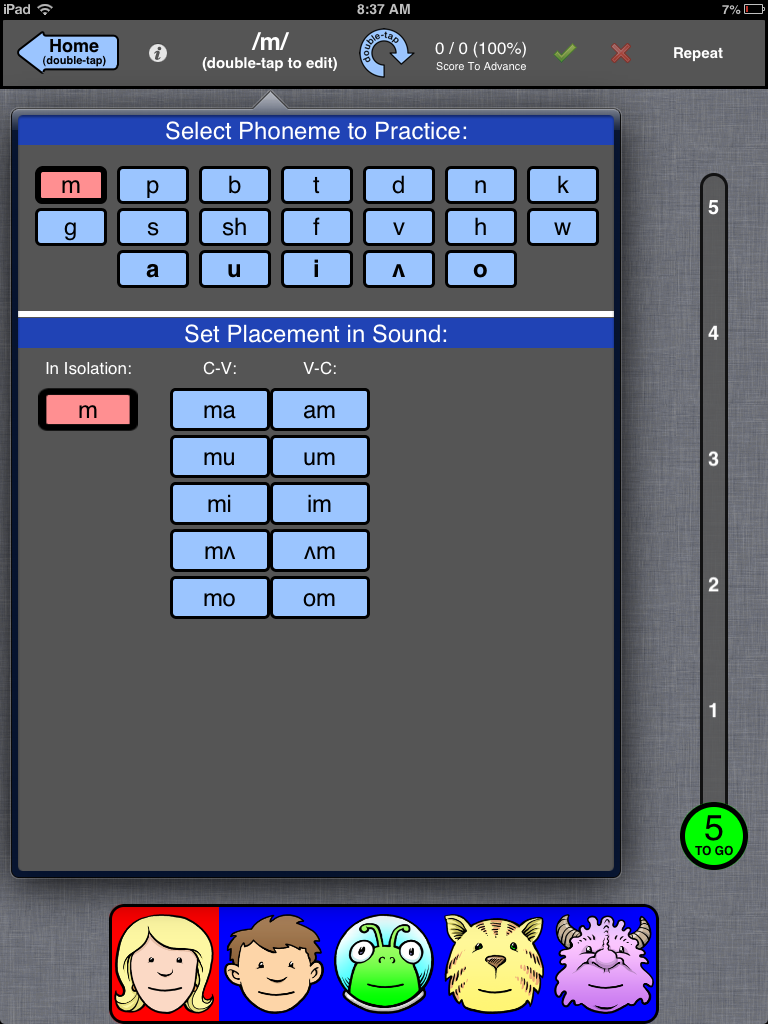
    The app is set up for kids in the very early stage of apraxia therapy.  The child can practice sounds in isolation and in CV(consonant-vowel) and VC(vowel-consonant) combos. The app is based around blocked practice with a lot of repetition that is necessary for apraxia therapy.

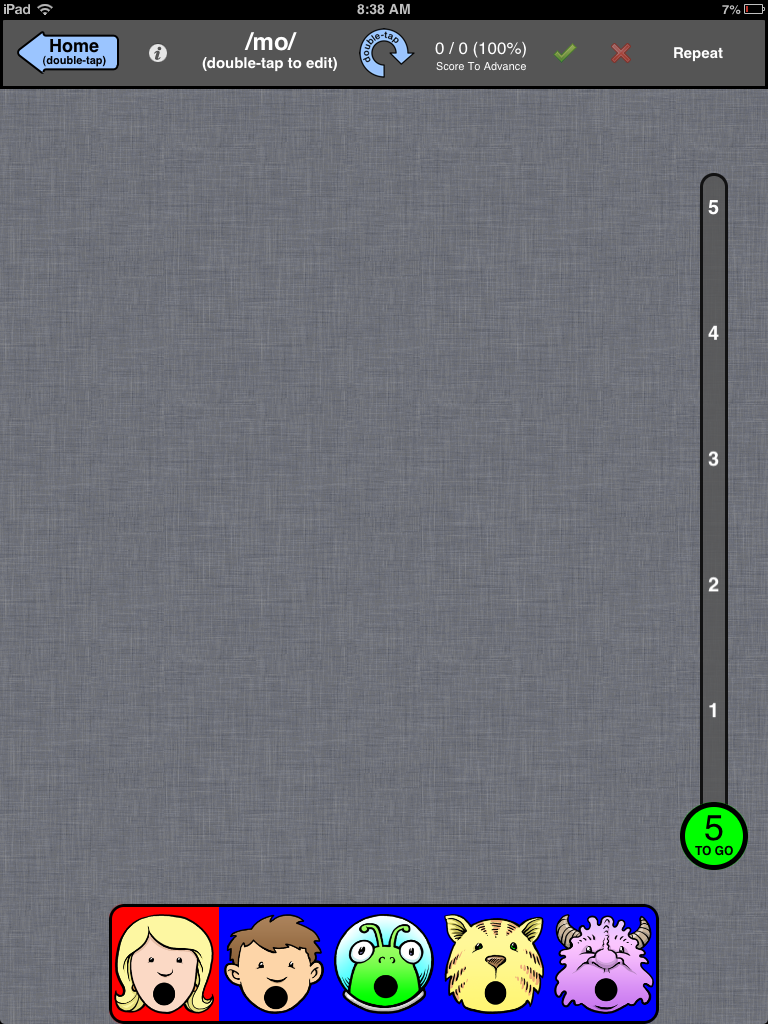
    After you pick your sound or sound combo, you can then decide how many times times the child has to say it before they get a “sticker” or a little animation as a reward.  Then, the child chooses between five characters on the bottom, all of which have a different pitch to their voice.  This is a bonus too, because children with apraxia have difficulty with “prosody” or the melody of speech.  The characters’ mouths model the correct placement.  The above picture is showing ‘m.’  Below the characters are modeling ‘mo.’ This is also great because it gives the kids a visual cue for the correct mouth posture.
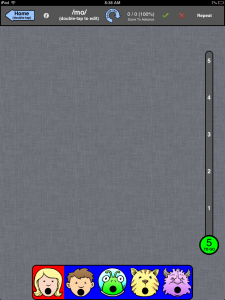
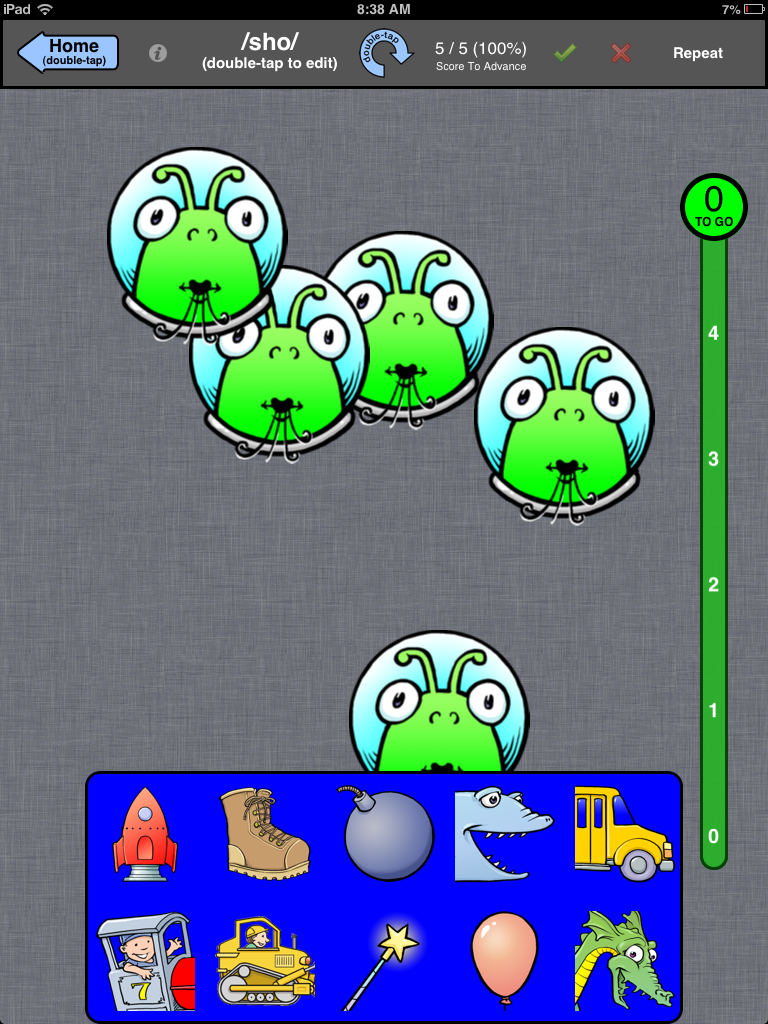
    A scoring bar at the top help score and keep track of data. You must press the green check or the red x to move onto the next practice sound.  The app is designed so that the bar can also turn upside down so that the therapist can discreetly score; however, my daughter picked up on this in a heartbeat and would push the buttons haphazardly just so she could move on!    Once you reach the set number you earn a “sticker” or reward.  You can choose from eight stickers seen below:

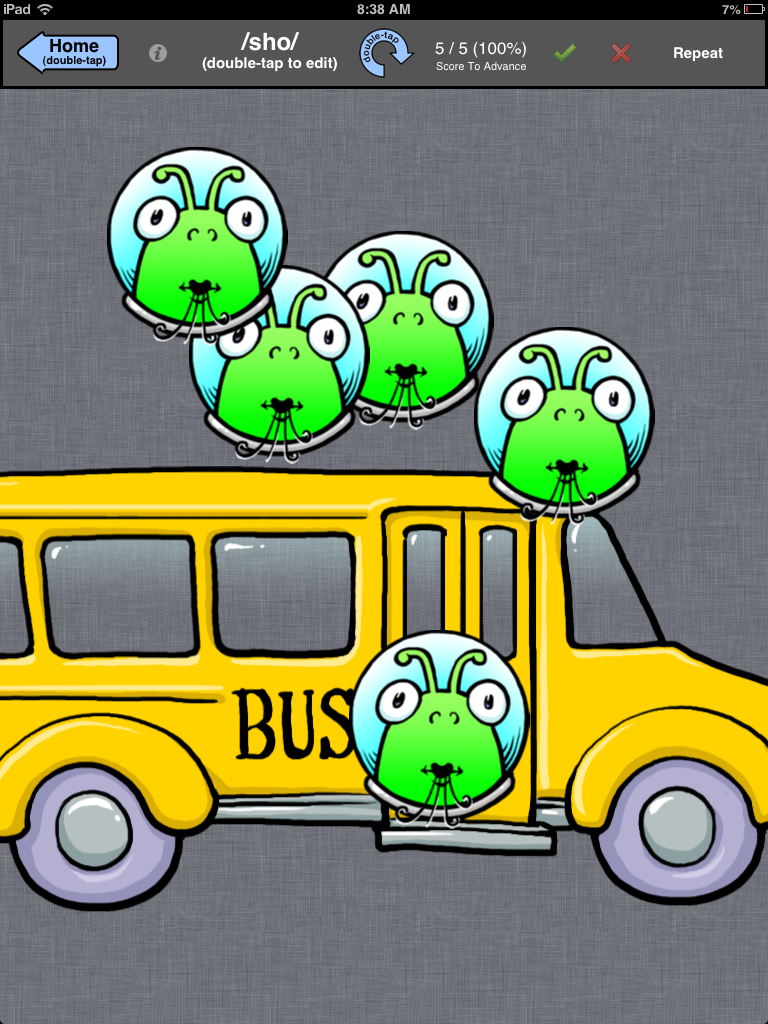
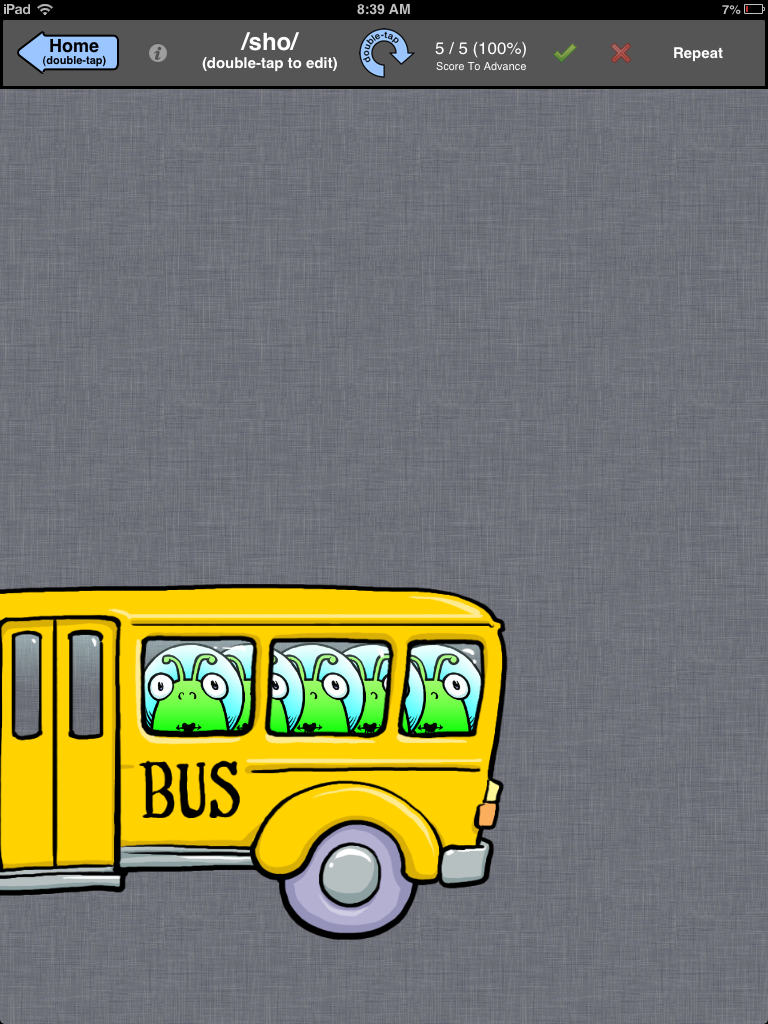
    They are so simple, but my daughter loved them.  I chose the bus just so you can get an idea of the animation.

    It has been almost three years since I have used this app for Ashlynn, but the app lives on with all of my clients!  Kids of all ages and disabilities LOVE this app.

    I have a 5th grade boy with Down Syndrome who laughs every time he earns a sticker and watches the animation.

    I have a 3 year old who loves picking the alien because it reminds him of a popular TV show right now “The Octonauts!”

    I could go on!  Really, I can’t say enough about this app, and when I reached out to the creator Carol Fast MSPA, CCC-SLP I realized why this app is soo good.  Here are some comments from her:

    “It’s truly been a labor of love for me and I’m always gratified to find that other SLPs appreciate what we do. I’m glad that you found Speech Stickers to be helpful for your daughter and other students.  I work mostly with preschoolers and have found a special interest and passion in my little nonverbal CAS kids. I really love helping find their true voice. This is probably the most rewarding work I’ve done in over 30 years as an SLP.”

    Thank you Carol!  Thank you for your passion for working with kids who have CAS and for a great app that allows us to get a lot of repetitions of targeted syllable shapes in a fun and engaging way for the kids.

    What I Love: 
    – Works on early developing syllable structures
    – It really helped us work on final consonants when my daughter wasn’t adding them.  Helped us get the final ‘n’ and final ‘t’
    – Gives a reward in the form of a short animation that is interesting to kids
    – Models different pitches and inflections, which is difficult for kids with apraxia

    What it’s Missing
    I would like the option for the child to record their voice
    – As an SLP, I would appreciate the option to email the data
    – It doesn’t include more complex syllable structures such as CVC and CVCV, so it’s only applicable for the early stages of therapy

    Impressions:
    This app was helpful during the early stages of therapy, when Ashlynn was struggling to sequence basic syllable structures.  She had just turned three, and was motivated to practice speech.  In addition, she loved the sticker rewards.  It did help us get those final consonants that she was struggling with too.
    As an SLP, I have also used this app with a five year old, and he enjoyed it too.  For the price, I would recommend this app if you have a kiddo in the early stages of therapy.
  • ApraxiaVille app review

    ApraxiaVille app review


    ApraxiaVille is an app from Smarty Ears, and is the newest speech app that I have downloaded to use at work and with Ashlynn my daughter with CAS.
    To get started, you create your players.  You can make an avatar, or import your own picture.  The application allows up to four players, which is nice from an SLP perspective, since you can use it during group therapy.
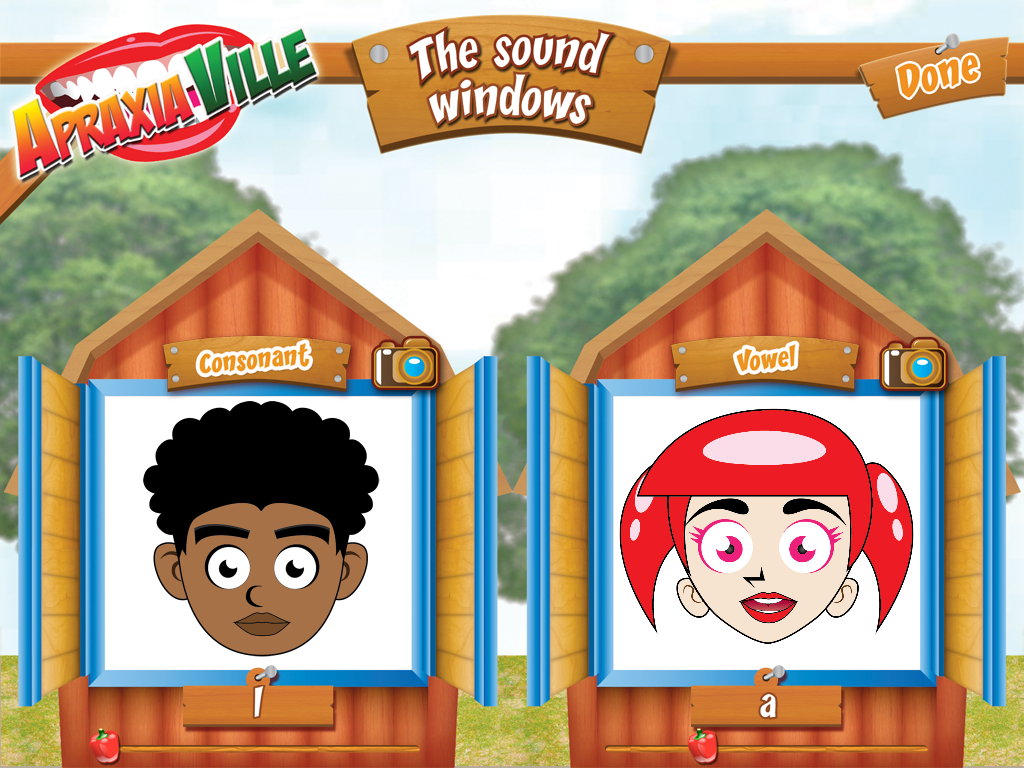
    Next, you choose your activity from a list of three.  The first activity is the sound windows, which allows the child to practice a sound.

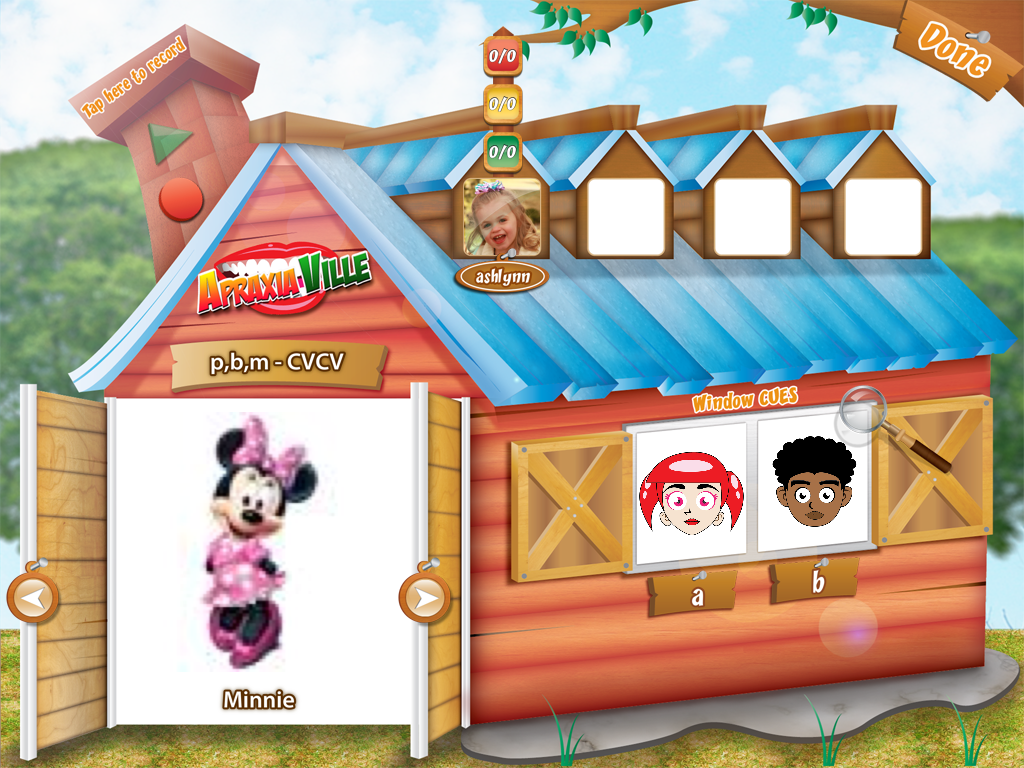
    The avatar gives the child a visual and audio cue on how to say the sound.  In the upper right corner is a camera, and if you press it, the child can see themselves in the window as they try to mimic how to say the sound.  I was a little skeptical about this, but I tried it with Ashlynn (my daughter who is 3 and 1/2) on a sound she hasn’t been able to say.  /f/  I have cued her and showed her the current production many times, but she loved seeing it on the avatar and then looking at herself in the camera.  Guess what?  We have /f/ in isolation!  Wahoo!

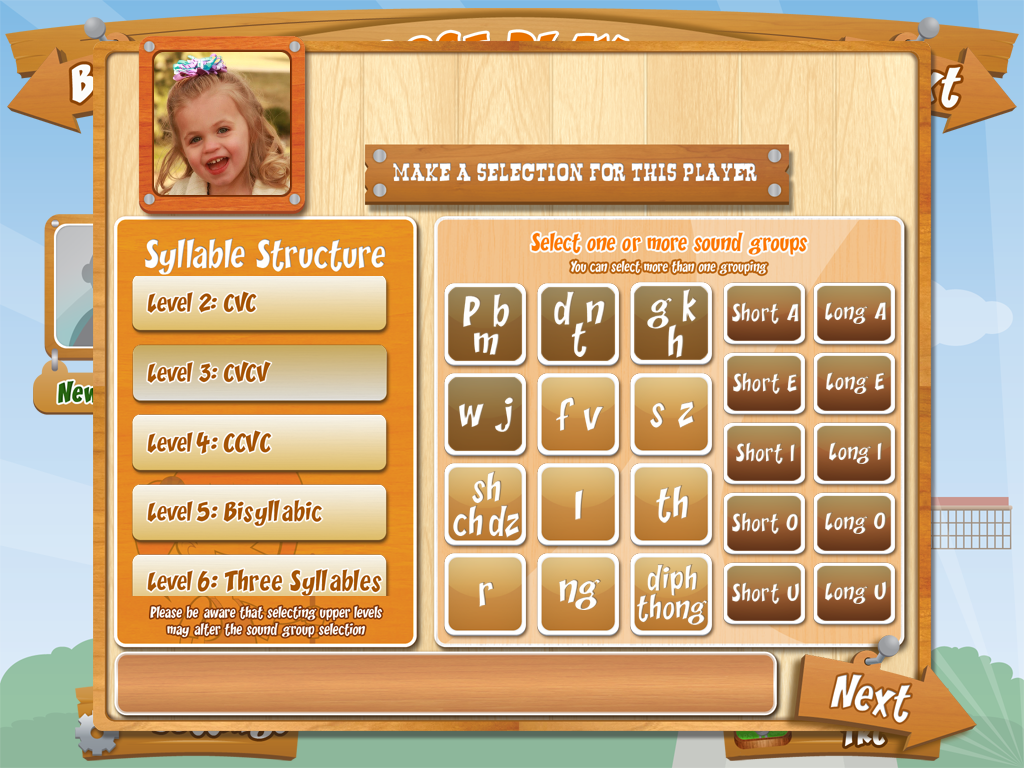
    The next activity is the Farm house.  In this activity, you can choose from a variety of syllable structures and sound groups.  This is exactly how apraxia therapy is usually structured, from easier consonant vowel combinations all the way to four syllable words.

    What I really like, is that you can customize it for the child.  For example, they have consonant groups, but if your child can’t produce one of them, you can go to settings and just choose the words you want your child to work on.  You can also add your own words and pictures to the rotation, which is also awesome.  My daughter has a tendency to drop medial ‘n’ and ‘d.’  She really likes Mickey Mouse Clubhouse, so I added pictures of Minnie and Toodles. Then you can record the name to correspond with the picture.  I also think this would be great if you wanted your child to practice family member names, pet names, etc.

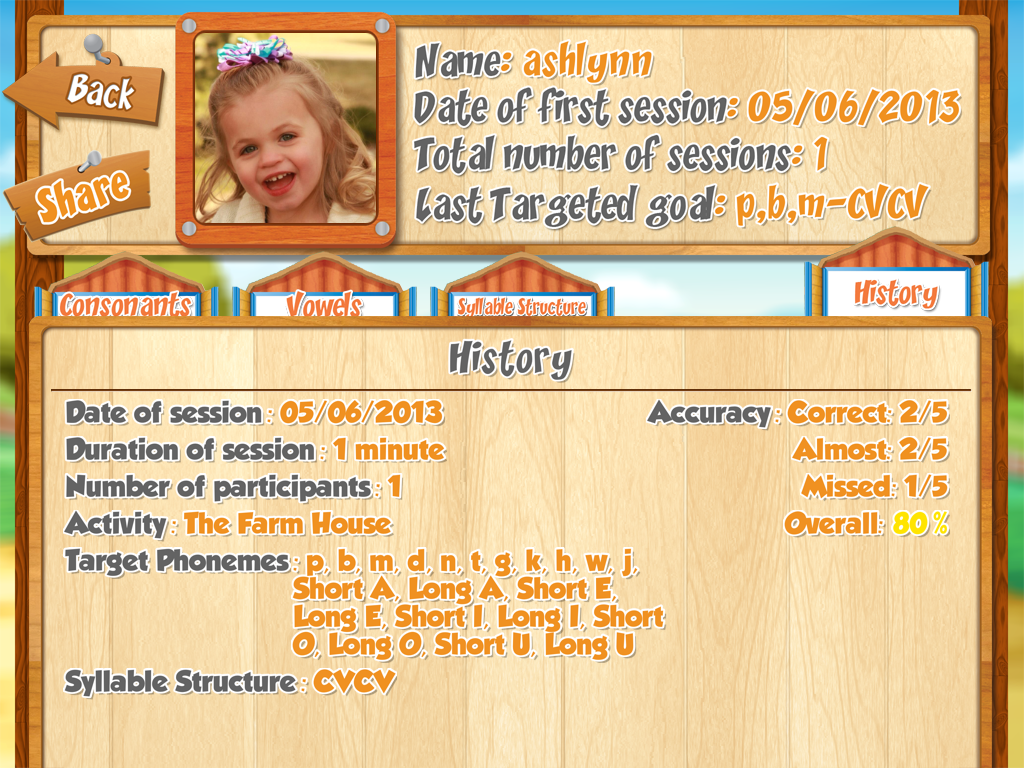
    Once in the farm house, you can practice the words.  A scoring system is set up above each child’s picture to record data.  There is a record feature in the chimney to record and playback the child’s production, and there are the avatars on the body of the barn to model appropriate production for a sound if needed.  After the activity, you can obtain a spreadsheet that collects the data with the option to email it.  I love this option as an SLP.

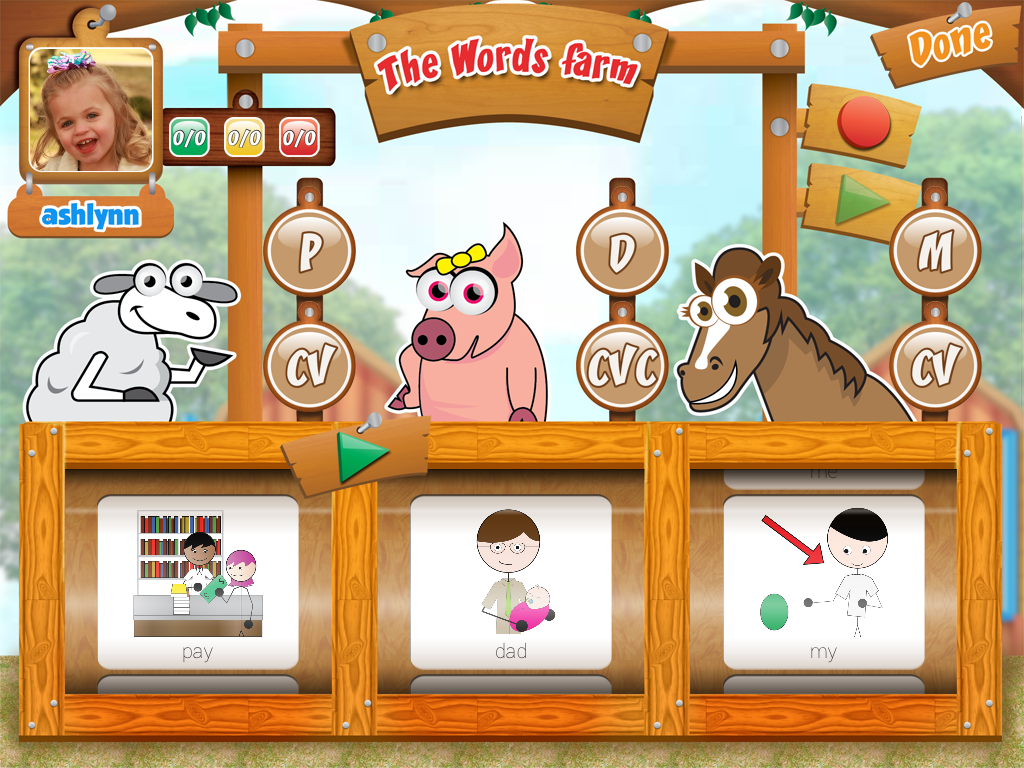
    Finally, the last activity is the Words Farm, where you can choose 2-3 words to practice.  This is great for doing targeted blocked and/or randomized practice necessary when using a motor based approach to therapy.  This activity only allows one child, but again there is a record/play function, and you can take data that will be generated into a spreadsheet at the end of the activity.

    What I Love:
    – Has practice items on a syllable structure hierarchy used with apraxia therapy
    – Can customize sound and syllable combinations to only include those in the child’s repertoire
    – Allows for adding your own additional pictures from your child’s own life with ability to record
    – Avatar’s give visual and auditory cues with a camera feature so the child can immediately practice
    – The second activity allows up to four players, which is helpful in group therapy
    – Data collection feature that is automatically generated into a spreadsheet and can be emailed and/or shared electronically

    What it’s Missing
    Though the app is colorful and visually appealing to kids, there really isn’t any game or reward to it.  It would be nice to have some fun reinforcement for practicing the words.

    Overall impressions
    Overall, I think this is a great app for young kids with Childhood Apraxia of Speech.  I would recommend this application to parents and SLP’s.

  • Switching private SLP’s

    There is no easy way to “break-up” with an SLP, but  I made the decision to discontinue private services through the SLP that was seeing Ashlynn.  A lot of parents wonder what is the best way, and I don’t think there is a right or wrong way.  I personally just wrote an email and said I was switching her to my mentor.

    I am very appreciative of all that she did; however, I feel like we had hit a wall with her therapy style.  Her style was to have my 3 1/2 year old daughter sit in a chair across from her for the entire 30 minutes.  The first 15 minutes she would do Kaufman cards, and the last 15 minutes she would play with a fun toy and have my daughter request and comment on it.  However, it was very controlled and my daughter couldn’t hold the toy or play with at all.  It had to be done all her way.  If Ashlynn threw a temper tantrum, she would look at me and tell me that when she has kids they are going to hate her because she won’t put up with that.

    Ya, well, good luck lady.  Kids throw them whether you “put up with them” or not.  It’s called being a toddler.

    After a couple months of this, my daughter was pretty over it.  The first 15 minutes turned into more like 20-25 just trying to get her to say the cards.  Apraxia therapy can be boring, but my goodness, I needed her to get creative!  I did bring up that maybe we could put it in a more naturalistic setting, having them play etc.  In her defense, she did try; but she still had Ashlynn sitting in a chair.  If she didn’t get something accomplished, she just told me to do it at home.  I remember thinking to myself that Ashlynn is one of the most compliant toddlers I have seen.  I wondered how “typical” toddlers who need to MOVE do in therapy with her?

    I tried to be polite, but I informed her that as a school based SLP, I don’t have the luxury of having my carryover plan include parents doing homework.  I have to get creative!  Kids need to be having fun, and besides, that’s how they learn the best!

    I had a great mentor whose therapy plans usually included 3-4 different activities in one thirty minute session. They were multi-sensory in nature, which are methods that involve using any sensory and motor input available to enhance verbal skills.  This usually involves some type of play activity that might have them throwing a bean bag, walking like a crab, or even using felt and velcro boards just to do something different with those same old picture cards.

    David Hammer, a well known CAS expert out of Pittsburgh does this as well.  I’ve been to a couple of his presentations now and he shows a lot of video.  I rarely see a child required to sit in a chair across from him. He has them doing puppet shows, hitting the cards with a nerf gun after they say their sound, or tossing bean bags in and out of a huge dinosaur’s mouth aiming at the artic cards.  He has them banging on drums to represent each sound or syllable etc.  This is the way to promote carryover, and I could see this SLP wasn’t going to do that.  She may have known the Kaufman method, but her therapy style wasn’t what I was looking for.

    That’s the thing.  There are always going to be reading programs, math programs, and speech programs out there, but teaching style or therapy style plays a big if not bigger part in facilitating change.

    When I was an SLPA (assistant SLP), I worked under a lot of supervisors and was able to see a lot of different styles.  All therapists are qualified and trained professionals that will most likely get the job done, it’s just some got the job done a lot faster.  That’s the kind of SLP I strive to be, and that’s who my mentor is.

    Since it’s summer and my mentor is off, I”m switching Ashlynn to her.  I know Ashlynn would have progressed, but I need her to progress faster, which means I need someone more multi-sensory. This is where I have seen my mentor shine and I’m excited for Ashlynn to start with her.


  • Jumping on her bed?  Break every spring girl!

    Jumping on her bed? Break every spring girl!

    At the beginning of her preschool school year after she had just turned three, I went to observe her classroom.  I went for a lot of reasons, mostly to make sure I liked the classroom and to make sure her needs were going to be met.
    I left the observation in tears.  Not because I was disappointed in the classroom.  Not because I was disappointed in the teacher or the therapists.  No, I left crying with a broken heart.  You see there was an obstacle course in class that included Ashlynn jumping on a trampoline with a bar, and then crawling like a bear around a table.  She couldn’t do any of it. I watched all the other kids jump enthusiastically and then do their best bear crawl.  When it was Ashlynn’s turn, she needed help to get up on the tramp.  Then, instead of jumping, she just marched her little legs up and down.  Big smile and beautiful energy, but no jumping.  Not even close to jumping really.  She needed help getting down and in fact she almost fell.  Then, as she went to do her bear crawl, the teacher had to hold her core for her to even get up on her legs.
    It makes me tear up even now.  It just wasn’t fair.  Why couldn’t she jump like the other kids?
    Well, today, just 6 short months later, we went to her preschool picnic to celebrate the last day of school.  There was that trampoline that just a half a year earlier she could only march on.  Well, she stood in line with that same big smile, that same beautiful energy; and when it was her turn she got up on that tramp WITHOUT anyone’s help, and she jumped, and she jumped, and she jumped some more.  And….when it was time to get off, she got down without anyone’s help.
    As I sat on the side watching, I realized that I’m the one that has it all wrong.  The only thing that changed was that my daughter could now jump, but that wasn’t the real story.  The real story was that despite being different or not, or needing help or not, or being able to even do it or not, she always DID it.  She did it with a smile, a giggle, and that beautiful aura she carries around with her teaching me life is what you make it; and when it’s what you make it, you WILL MAKE IT.
    She amazes me everyday.  I still hate that she has it.  I still hate that it seems like she has to scratch and crawl for every achievement she makes, but I’m beginning to realize she WILL always do anything she sets her heart to doing and I am so proud of her.
    Oh, and one more thing.  As she went down for her nap today I heard noise coming from her room.  When I went to check on her, she was holding her bed rail jumping up and down like she was on that trampoline.  I told her to lay down like any sensible mother would, but inside I was thinking, “Keep jumping Ashlynn!  Break every spring!”

  • She is the definition of perseverence (a poem)

    She is the definition of perseverence (a poem)

    You went to speak, but the words wouldn’t come,
    Stuck in your brain,  so easy for some.

    You went to crawl with the best of intents,
    Yet your body didn’t know what your brain meant.

    You went to walk, big smiles and all,
    yet every time you tried, it ended with a fall.

    You went to drink from a big girl cup
    You would sputter and spit till it came up.

    A new car for Christmas kids want to ride
    Spins in circles, hard to learn how to drive.

    But

    You are a living example to persevere
    and with it you conquer all our fears.

    One day you said mommy, and I love you
    One day you crawled to daddy’s shoe.

    You don’t just walk but now you run
    You drink from any cup till it’s done.

    and I know in time you will do it all,
    with  more patience and practice
    you will conquer it all.