Blog

  • Lessons from a tricycle

    Lessons from a tricycle

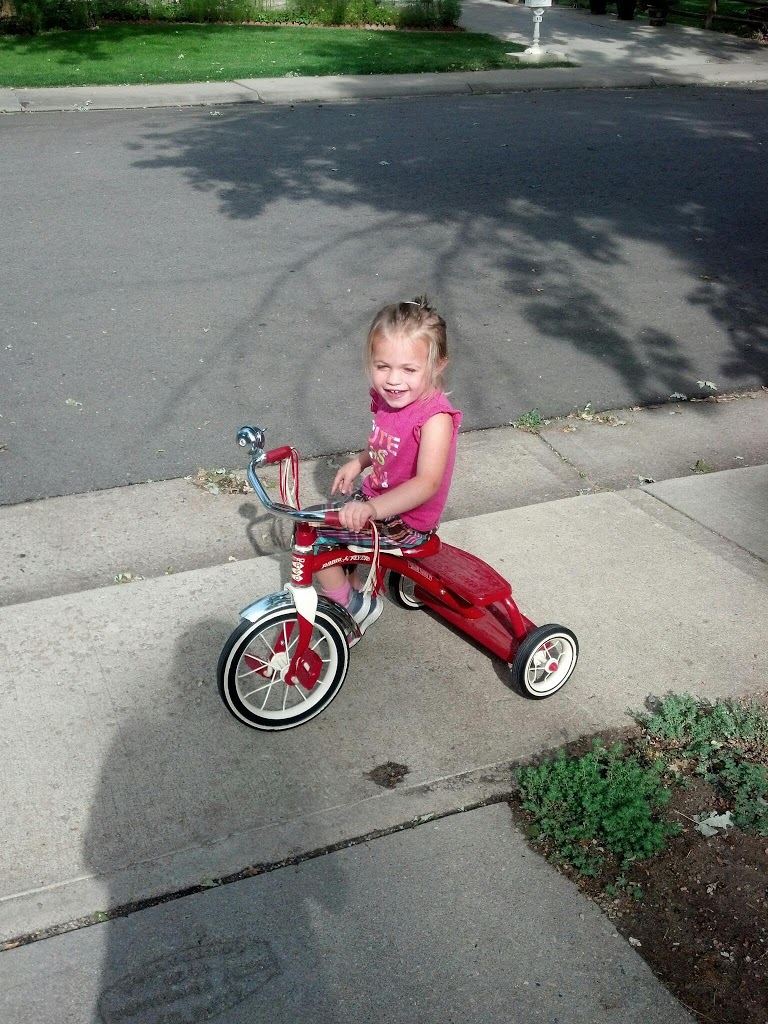
    We bought a tricycle for Ashlynn three months before her third birthday. My husband and I took her to Toys R Us, excited, full of hope and expectation. I had seen two-year old children on Facebook gleefully riding their trikes with big goofy smiles on their faces, and I couldn’t WAIT to snap that happy gleeful face on my little girl.
    Pregnant with my son, we all left the store and I had visions in my head of me walking to the park, with her riding her trike in front. I would occasionally have to call for her to stop so she wouldn’t get too far ahead………….
    ….but it was me getting too far ahead that night. One year later, with aching backs and frazzled patience, my Ashlynn still can’t ride a trike.  She has made progress though and can now not only keep her feet on the pedals, but can also keep them “straight” on the pedals where her heel isn’t constantly coming into contact with one of the bars.  As for the actual alternating pushing motion, that is still to come.  
    You’d think she would be frustrated, but the opposite is true.  As kids whiz by on their bikes, she happily laughs, giggles, and asks me, “See bicycle mama?”  and then with determination in her face she gets up on her tricycle again, ready to practice. Like most other motor tasks, this one too will take time.  It will be a journey to success, but success will surely be there; waiting more patiently than me.
    However, I’ve learned success is never really about the outcome, just as riding a bike is never really about the destination.  Every bike rider will tell you the fun and the meaning are found in the journey.  The sights seen, the hills climbed, and even possibly the falls taken.  The lesson learned from the tricycle is more than just learning to ride.  It’s a metaphor for life, and of one thing I”m certain.  Ashlynn will always be a success because she has already learned: the fun is in the journey.
  • Nine year old Katie with apraxia sings “Brave” and dedicates it to Ashlynn :)

    Nine year old Katie with apraxia sings “Brave” and dedicates it to Ashlynn 🙂


    CASANA has a parent support group on facebook called APRAXIA-KIDS – Every Child Deserves a Voice.  If you have a child with apraxia, I highly recommend joining this group. Sharon Gretz, the founder of CASANA, is an active member, but there are also other SLP’s, advocates, educators, and of course parents who care about these little ones.

    I recently vented to the group about my sadness over the park incident, but then shared my blog post about hearing the song “Brave” and how it made me feel better.  A parent to a nine year old girl sent me the following note:


    when Katie was diagnosed at 2 1/2 with CAS she was 

    considered severe and significantly delayed. She just turned 

    9. She told me to tell you this song is dedicated to Ashlynn. 


     http://www.youtube.com/watch?v=P5q907Ojdfc

    The video is her daughter singing “Brave!”  How awesome is that?  So inspiring for all of us with little ones who are struggling to talk.  

    Katie sings beautifully.  All the therapy, all the tears, all the sadness her mother felt are a distant memory when you hear her sing.  Katie found her voice and then some!  Ashlynn loved the video and told me, “sing dood.”  Yes, Ashlynn, Katie sure sings good and YOU will too some day 🙂


  • Ashlynn update 3.10 years

    Ashlynn is in a regular preschool this year with about 15 other kids.  Most are typical with about six on IEP’s.  I asked the SLP if she was talking at all in the classroom, and she looked at me like I was crazy and then answered “yes?”  I presumed it meant she was surprised that I didn’t think Ashlynn was!  In the Spring, Ashlynn was still gesturing and pointing in the the classroom to express her wants/needs, even though she was speaking at home in 2-4 word phrases; so this is major progress!

    Ashlynn for all intents and purposes can be considered verbal at this point.  She no longer gestures to comment or request; rather, she relies on her speech to communicate.  Her sentences are approximately 2-4 word in length, usually including a subject and verb.  Since she started school, I’m getting a lot more of, “momma wook(look)!!” or “momma! watch!”

    Her Grandma and Grandpa both had surgery recently, and a cute thing she said was,

    “Dama (Grandma) ha (have) an owie, Papa ha an owie…..daddy ha an owie too?”  Haha  She says a lot of stuff now that makes me laugh.  I remember waiting for the day I would hear her say cute things, and actually being sad thinking we were missing out on all the funny things kids say as they are learning language….but we are experiencing it…just a little later than some.


  • “Say what you want to say, and let the words fall out.  I want to see, I want to see you be brave.”

    “Say what you want to say, and let the words fall out. I want to see, I want to see you be brave.”

    I heard a new Sara Bareilles song the other day.  I love music, but I really felt like this song was written for A.  It’s been a struggle to get her words out.  Even now, the other day at the park she was talking to a little girl appropriately saying ‘come on” and “let’s go again!”  It sounded more like, “tum on!” and “yet do adain” but she was DOING it.  She was putting herself out there, and REALLY talking.

    After a short time, the little girl asked her, “Are you a baby?”  A, looking confused, just covered her eyes and laughed at her.  On the sidelines, my heart broke.  How DARE this child say that!!!  Didn’t she know how much it took for my daughter to put herself out there and talk??!!

    Of course the rational side of me realizes this girl is just a kid who didn’t mean to be malicious or mean.  But the mommy in me wanted to teach her a lesson.  Instead, as usual, the person doing the teaching was A.  As she laughed at this little girl, it was really A who had the last laugh.  It was my daughter who is so wise despite her challenges.  Much wiser than me.

    Shortly after I heard this new song.

    “Say what you want to say, and let the words fall out.  Honestly, I want to see you be brave.”

    A is braver in one hour than I ever have been in my entire life.  I love you little girl, and I love seeing you be “BRAVE.”

    http://www.youtube.com/watch?v=QUQsqBqxoR4


  • “I see” with DIY binoculars

    “I see” with DIY binoculars

    If you have a child in speech, or a speech language pathologist yourself, you are probably familiar with the term “carrier phrase.” A carrier phrase refers to the initial component of a sentence that stays constant (usually a subject and verb, allowing for a fill in the blank at the end (the predicate). Common examples include:
    “I want ______.”
    “I have ______.”
    “I see _______.”
    “I like________.” 
    This list is not exhaustive, but does give you an idea. In the educational arena, these are frequently referred to as sentence stems. 
    Carrier phrases are used in a variety of therapy strategies for a variety of disorders. The predictability allows the child to practice learned skills beyond the word level, moving into the phrase and sentence level.  It decreases the cognitive load needed to form a sentence AND remember the learned skills, because the sentence stem, or initial phrase remains constant. In this way, the child can practice their skills at a higher level of complexity (phrase or sentence level) but doesn’t have the increased demand to also generate a new and novel sentence.
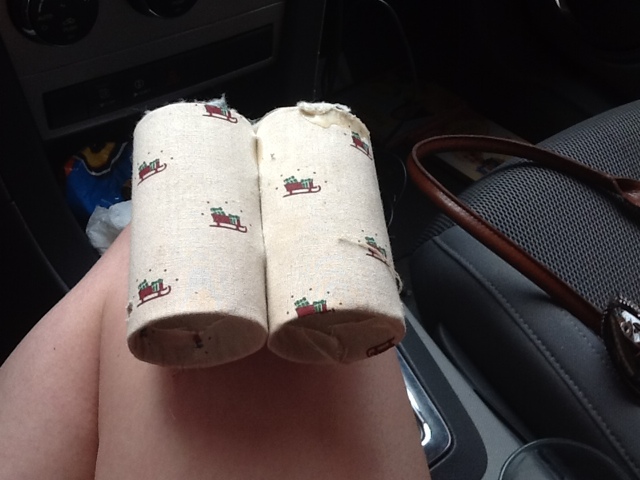
    To practice her words in a sentence I have a great idea that comes from my fabulous and creative mentor Deborah Comfort, who is currently the private practitioner seeing my daughter. She had Ashlynn pick out some fabric swatches from a book she had at the end of the session last week.  For the next session, she had hot glued the fabric onto two toilet paper rolls and then hot glued the toilet paper rolls together side by side. She poked some holes in the top and threaded some yarn, and Presto, they gave a set of DIY binoculars. Using the carrier phrase “I see_____” they practiced a variety of words with targeted sounds at the sentence level. 
    Ashlynn loved it of course! It’s also more fun than sitting at a table practicing flash cards. As you’ll frequently read in my posts, I am a big proponent of multi-sensory learning and this fits the bill. Maybe tomorrow we will take it to the zoo! Great carryover practice and lots of fun!
  • Conference take aways 2013

    Conference take aways 2013

    The Apraxia conference was incredible to say the least.  On one hand it was information overload, but on the other hand I learned so much.
    I was beyond thrilled to meet Sharon Gretz, the founder of CASANA.  What an incredible women and inspiration she is to me, and when I met her she was so down to earth and humble.  We swapped stories and I immediately felt a kinship with her.  It was also amazing to meet her son who was nonverbal at 5 talking and taking pictures of the conference.  She reported he was in college maintaining a 3.25 GPA.  Incredible.
    The breakout sessions were awesome.  I was never bored, though by the end I was tired.  I just want to soak up as much as possible.

    Some things that really struck me at this conference

    – Apraxia could have a sensory feedback component as well as a motor component.  One study showed that kids with CAS had a greater number of vegetative utterances in the first year.  These include things like coughing, hicupping, and burping.  The theory is that perhaps sensory feedback is to blame.

    – Kaufman recommends taking sounds in the child’s repertoire, and then creating words from it.  She didn’t just advocate her picture cards.  She also said she chose items in her picture cards that were of high interest to the child.  However, she also uses pictures on the iPad and in other materials.  She’s also not concerned if the child doesn’t “remember” or “learn” some of the words since the goal is just to map the motor plan.  For example, she said a child could go their whole life not knowing “oboe” and would probably be fine.

    – Kaufman uses a lot of approaches for ABA verbal techniques.  One was called errorless learning, in which you anticipate the child’s mistake before they say it and give them a cue to increase success.

    – Brain imaging studies show that kids with apraxia have more brain centers lit up during talking tasks then do the neuro-typical peers.  It shows just how hard they are working to talk.

    – Children with apraxia are at increased risk for reading difficulties.  Some reading programs that have shown success with children who have apraxia are the LIPS program, which allows a child to learn sound correspondence and sound segmentation receptively, as well as Phonic Faces.

    I look forward to attending more conferences in the future!  I also learned about an “Apraxia Bootcamp.”  It’s a four day intensive training, but some of the top apraxia experts in the country.  It’s apparently highly competitive, but I’m up for the challenge.  I’m going to start gaining more experience with apraxia, and already started networking with other colleagues.  I’m excited for what the future brings!