Blog

  • January book of the month: The Jacket I Wear in the Snow

    January book of the month: The Jacket I Wear in the Snow

    Winter is in full swing, and there is no shortage of books that talk about winter, snow, and winter clothing vocabulary. Also, the preschool in my district has winter clothing vocabulary on as part of the curriculum, so it’s perfect!

    The book is a repetitive, rebus style book that is great for practicing vocabulary, early reading skills, sequencing, and as always speech!

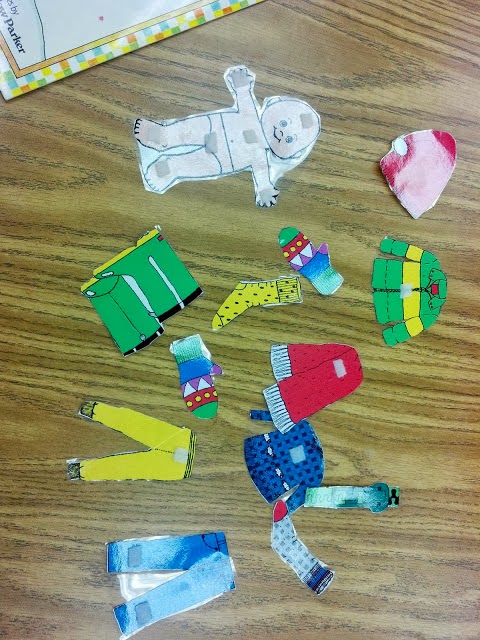
    I started with some cutouts from the story I found here:
    Winter clothes

    Then I printed them out, laminated them, and put velcro on so that the kids could dress the boy.  I used a printout doll from the website you can find here: Paper dolls

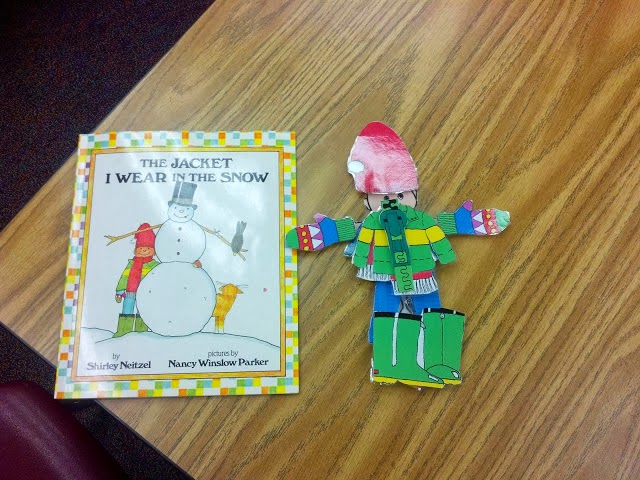
    This was the final result and it’s just so darn cute! All my kids from preschool up to even 4th grade love dressing up the boy.  For my speech kids, I strategically pick a clothing item for a sound they are working on.  There are a lot of good options including ‘s’ blend words that seem to be a constant therapy target for at least one group a year.  For a child with apraxia, there are some good basic CVC words you can use (i.e. cap, boot, sock,), or in my daughter’s case since her speech is improving so much, I gave her most of the cards and she had to practice recall while I read the book.  The use of the cutouts provide a visual and tactile aid to help kids learn and recall the vocabulary, so you will see I try to make cutouts to go with books I have whenever I can get my hands on them.  Unfortunately, I’m not very talented in the drawing department, so I have to rely on other sources as you see I did here!

     For my older kids, we did silly things to practice following directions with spatial concepts: on top, under, over, etc to work on receptive language, and then they had to do a retell.  Again, the visuals really help in being able to sequence and retell the story for those kiddos who have weaknesses with language processing.

  • She really does have “special needs.”

    She really does have “special needs.”

    So, I obviously am well aware my daughter has apraxia.  I’m well aware of her challenges, but for some reason, I didn’t want to admit she’s “special needs.”  I don’t know why.  I work with special needs kids all day long.  It’s what I do.  I don’t see them as special needs.  I just see them as maybe learning differently, or needing different supports than other kids to be successful.  I guess that’s why it has taken me until now to admit that yes, my daughter does in fact have special needs.

    When she was first diagnosed I was drowning in a sea of sorrow and desperation.  Sorrow because I knew how much more work it would really take her to talk, and desperation because I so desperately wanted to help her and hear her voice, her thoughts, her say, “I love you.”  After that though, I picked myself up and took her to endless therapy appointments spending thousands of dollars on her therapy and little by little, her speech improved.  I’ve been riding a pretty good high for awhile.  She’s talking at school, she’s speaking in sentences, and for all intents and purposes, she has found her voice! Oh, and now with a neat trick from OT she is putting on her coat BY HERSELF and is able to get her shoes and socks on without help.  I see the light at the end of the tunnel!

    Until about a month ago.  It’s one thing to be told you’re daughter will be sitting in a cube chair and has a weighted lap blanket to help keep her focused.  It’s another to see her with those accommodations in the classroom.  She was happy though and if it was helping her, well ok.  Then at teacher conference, the teacher told me she needed us to work on Ashlynn’s name, or at least get her recognizing the first three letters and being able to put them in order.  Sounds easy right?

    Wrong.

    She doesn’t consistently identify the right letter, even when I only have three in front of her; and I have to keep cueing her to start at the left and put them in order in a linear fashion to the right.  I created a grid with three boxes so she could visually see where the letters fit, and she started to get it a little.  In the bathtub, I would take the foam letters and have her put one on each tile of the wall.  Then the OT started sending home packets.  Ashlynn isn’t crossing midline.  She switches hands instead of reaching across her body, and she needs to cross midline to eventually develop hand dominance, and oh yea, to write!  Hmm…I realized she wasn’t starting with the left box for the first letter of her name because she wasn’t crossing midline.

    I know this doesn’t seem like a big deal, but now I have to work on getting her to cross midline with various activities, and also work on her name.

    Ok, that’s cool.  I got this. I’ll keep cueing her with the letters and I’ll add practicing in the bathtub making sure she crosses midline washing herself, and when I’m working on her brushing her own teeth (which she still can’t do well yet)  I’ll also remind her to cross midline.  When she’s eating dinner, instead of just cueing her EACH time to use her fork (which is hard to use because of her apraxia), I’ll also make sure she is crossing midline instead of switching hands.  That while practicing drinking out of a big girl cup and not managing to spill her drink, plate, or drop her fork.  Oh, and when I read her a book at night, while I’m busy reading and then asking questions and making her answer using complete sentences and correcting her articulation, I’ll make sure she flips the pages by crossing midline with her right hand and turning the page. Phew.  Yes, I can fit this in though.  I got this.

    Then on Monday I get caught by the OT in person.  Ashlynn has very weak upper body strength and she needed me to also do exercises with her to improve it.  I was left with another packet.  My shoulders started feeling a little bit heavier.  It’s okay though, I got this.  No problem.  When I work out, I can just have Ashlynn “work out” with me.

    Wrong.

    She needs max assist to do the exercises. I see the need though as she really is weak and can’t even lay on her tummy for more than 30 seconds without fatiguing. Her upper core just isn’t there.  Hmm, I wonder if that’s why it’s hard for her to ride a tricycle, oh crap, I haven’t practiced pedaling with her in awhile.  What kid can’t ride a bike!  I need to get out there with her.  Oops, I digress.

    Oh no!  I just remembered the teacher sent out a newsletter that the kids will be having show and tell every week and Ashlynn’s turn is tomorrow.  Crap, how is she going to do show and tell?  Yes, she can talk, but on demand she clams up.  Better email the SLP.  Okay, that’s done.  I wrote three questions and practiced them with Ashlynn after dinner.  I sent it with Grandma who drops her off, and then I emailed the SLP who promised to practice with her before it was her turn.  Success!

    The next morning I get her ready for school.  She comes out with her coat on upside down and her shoes on the wrong feet.  Sigh.  I haven’t worked on her jacket or shoes in awhile….
    ….and I finally realize.

    My daughter has special needs.

    5/17/17 Edit – I am editing this to reflect my education around special needs, and though she has special needs, the term that is being universally more accepted now is neuro-divergent.

     

  • Just love

    Just love

    It’s really not ok to develop a severe disliking for a child.  They are, after all, just a child.  However, there is a little girl at Ashlynn’s school who is very hard to like.  She’s rude, rolls her eyes, and bosses Ashlynn around.  She has mocked my son (who’s a baby) when he was talking, refused to say “hello” to Ashlynn even as Ashlynn greets her with a cheerful “hello,” and demanded Ashlynn stop hugging a little boy in her class among other things.  All of this has happened in the first five minutes before school started, so I can’t help what wonder how this girl is to Ashlynn the rest of the day; and my anger stemming from somewhere in the depths of me, begins to rise giving way to some not so nice feelings toward this little girl!

    The other day for the class holiday party, I couldn’t go so it was just my husband and Ashlynn.  Feeling like I was missing out, I text messaged him begging for a picture.  He took the most adorable picture of Ashlynn.  I smiled as I saw it, and then I saw she was sitting next to……that girl.  Why?  “Why is she sitting next to this little girl who has an attitude problem and is ALWAYS rude to her?” I huffed in my mind.

    Well today, as I dropped her off for school, we were once again graced by the little girl’s rudeness.  She refused to say hello, and only spoke to tell Ashlynn to get away from the door, declaring SHE was first.  Ashlynn backed away and the girl with an air of haughtiness gestured, “YOU can get behind me.”

    Okay really??  She’s four!  What the heck!  Ashlynn sweetly nodded her head and answered “yes?”  Of course since she was in fact there first, there wasn’t much I could say, as the rules of preschool are very black and white.  However, the rules of preschool don’t dictate my feelings, which were only growing into more of a cancer now.

    As I left the school, I called my mom asking her how she dealt with these problems?  My kid’s only four and I’m already mad at her “friends” and developing hate for a mere child.  I need to get it together.  My mom had great advice, including “let go and let God.”  She also reminded me that in life we all have to deal with these people at different times, and unfortunately, our kids have to learn that too even though it may hurt us.  She made me feel better, and I thought I had put it to rest.

    I started thinking though. Ashlynn has only love in her heart.  She’s the target, not me; and yet she still tells her hello everyday with a big smile.  She still hugs kids when they want hugs (or maybe even if they don’t), and she still sits with her at a party, possibly because no one else will.  I know it wasn’t because she doesn’t have any friends, because all the teachers assure me frequently how well liked Ashlynn is and how she is friends with everyone.  I realized I needed to take a tip from Ashlynn.  There is no room for hatred in our heart.  Love is not only easier, but it’s kinder and makes us feel better.  This little girl is unhappy, but Ashlynn always has a smile.  She has a smile because she dismisses the eye rolling, the lack of manners or social etiquette, and just wants to love.  If Ashlynn can love so simply, than so can I.

    She’s a real class act that Ashlynn.

  • Christmas 2013 updates

    Christmas 2013 updates

    It’s Christmas 2013, and my daughter is 4years, 2 months.  It was a magical time this year with her talking more and being able to jump.  So much is conveyed through jumping and talking.  We did the Elf on the Shelf this year, and each day she would get out of bed and ask, “where’s elf?”  When she found him, she would point (something that took until she was more than two to do) and jump (another motor milestone that took until 3 to do).  Add the speech, “There he is!!” and her excitement was communicated fully for the first time this Christmas!  As a parent, that is literally all you want to see.  You want to see the excitement in your child, and then their wonder as they play with their new presents. 

    Apraxia affects ALL of that.  If you’re not a parent of a child who has it, you just cannot understand.  She smiles in the pictures (though it has to be genuine because she still has difficulty smiling on command), and she is holding her toys (though a picture doesn’t show how she can’t operate AND steer her car, or pedal her big wheel, or put the baby clothes on her dolls), and she looks completely normal; but if you are there with her, you not only see her struggles, but as a parent, you FEEL them as well.

    This Christmas was a mix of feelings.  At seeing her jump and point, we FEEL her excitement.  At forgetting how to pedal and not being able to ride the big wheel, we FEEL her frustration and disappointment.  At opening baby clothes that she actually asked Santa for (“I want clothes….for my baby…baby clothes”) we FEEL her success at telling Santa for the FIRST time what she wanted and not what someone else had suggested, and when she opened the clothes, we FELT her elation.  As she tried to put it on and finally gave up and had to ask us to “play babies with me” we FELT her resignation to her apraxia. 

    There are not words to convey the roller coaster that is apraxia.  There are no words to convey how you literally feel everything your child feels; which is why every parent says they would wish hard things on them if only they’re child didn’t have to experience it. 

    However, this is not a story of sadness or defeat.  This is an update of triumphs and successes, and how this year is better than the last.  In years to come, these years will be faded memories as she will have struggled and defeated all of her difficulties. We will literally be the proudest parents when she achieves every success, and we will love her through them all.

  • Speech/language with simple Christmas chains

    Speech/language with simple Christmas chains

    We’re in the Christmas spirit around here and we started with a classic Christmas chain.

    * I first had Ashlynn sort the strips into their respective color piles. Great for developing early sorting and categorizing skills.

    * I then instructed her to put glue on the “end” of the strip.  Many kids with language delays have difficulty with positional words and she is no exception.  She kept wanting to glue in the middle, so I had to keep reminding her “no, not the middle, put the glue on the end. (Also great for O/T practice)

    * We then put the strip “through” the other strip.  During this, I made sure to emphasize “through” because again, this is another word that kids have difficulty with.

    * Once the chain had three links, we repeated, “white, green, red”  and then each time, I would stop and ask her what comes “next” or “after” emphasizing those two concepts.

    *Also, having her identify what comes next is the beginning of early patterning and sequencing skills.

    * Finally, at the end of the activity, we counted the links!

    * For a bonus, write words or tape pictures of target words to practice!

    Easy and fun!

    Skills addressed:
    Colors
    Sorting
    Sequencing/Patterns
    Concept vocabulary (next to, after, through, end, middle)
    Following directions
    Counting
    Speech goals

  • Don’t dare to compare

    Don’t dare to compare

    Ashlynn was my first child.  In a way, it was fortunate I had nothing to compare her to, and in a way, it was unfortunate I had nothing to compare her to.

    My son Jace is my second child and is currently 16 months.  He not only walks…he RUNS.  He not only babbles and says words, he puts two and three words together!!  Every time he hits a milestone, my heart bursts with pride; and every time he hits a milestone a tinge of sadness seeps in when I think of just how long it took Ashlynn to do anything he does. 

    I hate that.  I hate comparing.  I wish that when someone told me how they know they heard Jace say “what’s over there” in his baby jargon that they could understand, I could smile longer than a fleeting moment until I wondered when Ashlynn finally put those three words together.  I wish when someone told me how they swear they heard him singing the ABC’s, I could beam with pride longer than a second before my mind swirled to countless days singing ABC’s with Ashlynn on the iPad, the fridge toy, the vacuum toy, in the car, while reading a book and still not hearing her be able to say “A.”  I wish that when he drank out of a real cup, a straw, a water bottle and looked at me with pride, I could be there only in that moment with him, and not start to think about how Ashlynn still chokes drinking her sippy cup.

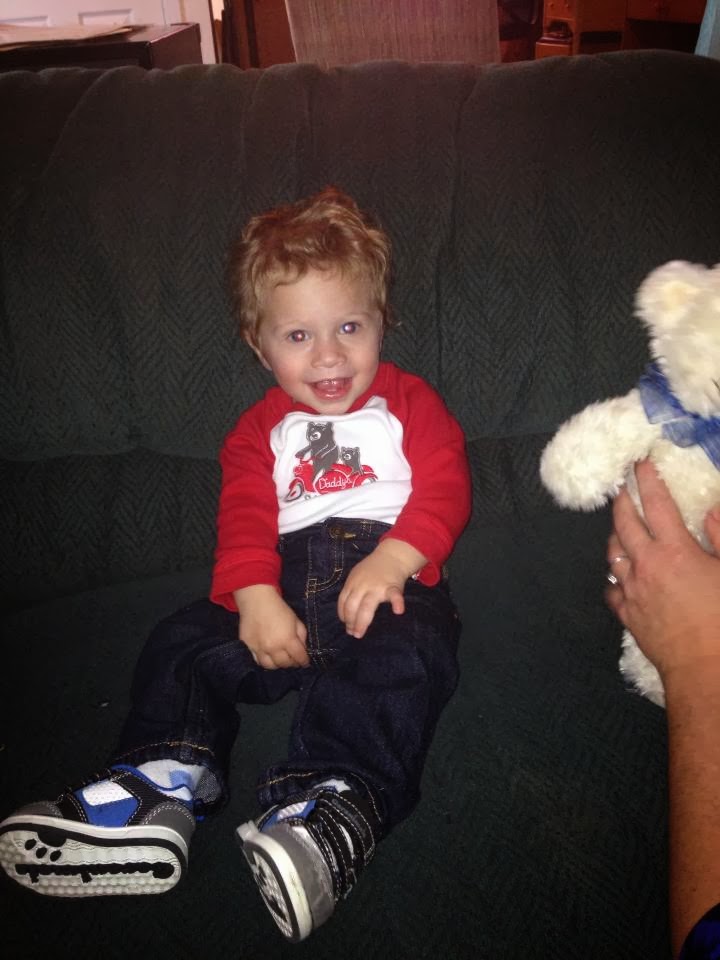
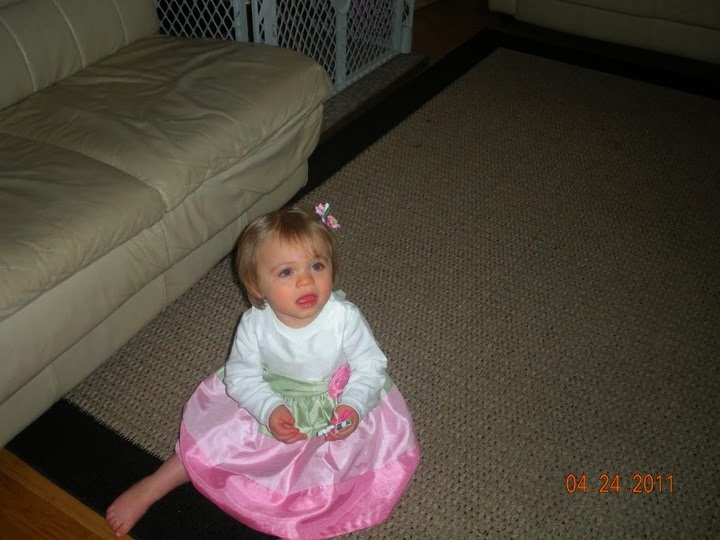
    These pictures show Jace age 16 months, and Ashlynn age 18 months.  In her picture you can see her open mouth posture (low tone) and also see the flexion in her feet.  She was just barely walking and walked on her toes.  I stretched out her calves everyday in the bathtub. 

    It makes me think about a quote from Temple Grandin, “There needs to be a lot more emphasis on what a kid can do, instead of what he cannot do.” 

    So let me say, even though Ashlynn didn’t talk, or sing her ABC’s, her sweet smile and bright eyes lit up a room.  Her soft and gentle touch melted hearts, and her giggle was and is still contagious.  She may not have drank from a real cup or a straw, but she would hold out a goldfish to a friend to “share” and she would pat the seat next to her forcing whomever to sit down and enjoy her company. She may not have ran when we went outside, but she would lay down next to me staring at the clouds and sharing a perfect moment in the summer sun.  She may not have told me when she was hurt, but she was the first to look concerned if she thought her dad or I was. 

    Yes, there does need to be a lot more emphasis on what a child CAN do, and from now on, I hope to not compare, but to focus on what each child does well!  I’m so proud of them BOTH and I want to be proud of each of them and revel in those moments.