Blog

  • Spooky Spider Web Game For Apraxia

    Spooky Spider Web Game For Apraxia

    Since Childhood Apraxia of Speech requires a different approach to treatment, principles of motor learning theory need to be driving therapy.   You can read more about this in my two interviews: Sharon Gretz interview and Ruth Stoeckel Interview

    Since getting 100-200 reps per session can be tedious and difficult to keep new and fresh, I came up with this fun Halloween game to play while you work on the child’s target sounds.
    Download it at my TpT store: Spooky Spiderweb game
    Happy Halloween!
  • Kids say the darndest things….unless of course they don’t because they have apraxia.

    Kids say the darndest things….unless of course they don’t because they have apraxia.

    What was it that Bill Cosby always said?  Kids say the darndest things or something like that.  Unless of course, you know, they don’t because they have apraxia of speech and can’t even say the most basic things.  Or this that I just ran across:

    Unless of course, they don’t because they have Apraxia 

    When Ashlynn was born, I wondered what her personality would be, the funny things she would do and say.  I just expected it to happen.  She would be so witty.  She has two smart parents, and one in particular who is quite funny (I won’t name names but it’s not the SLP).

    As time marched on, I did see her personality, and she did do funny things, but it was all so limited. It’s pretty hard to say or do basic things, much less funny things when you have motor planning issues affect your entire body.

    Seeing other kids her age or younger on social media or worse in person, usually broke my heart.  It got to the point I didn’t want to take her around other kids her age and I had to hide friends on social media because I couldn’t bear another kids say the darndest things” moment, or really any moment that a typical developing child would have:

    Scenario:
    My crazy kid is doing back flips off our couch
    What I saw:
    Ashlynn can’t even jump yet

    Scenario:
    Look at our precious baby wearing her mom’s high heels.  We’re in trouble!
    What I saw:
    My precious baby still falls wearing her own sturdy tennis shoes

    Scenario:
    My son just imagined this carrot looked like an alien
    What I saw:
    Can my daughter even say carrot, and does she even know what an alien is?

    Scenario:
    Look at our big boy riding his two wheeler!
    What I saw:
    My big girl still can’t pedal a big wheel.

    Scenario:
    Little girl just said she wants to be a princess for Halloween.  She sure is daddy’s little princess!
    What I saw:
    My little princess has yet to say her name.

    The list goes on. Not that I wasn’t proud of all of these other kids, I was.  I was also happy for the parents, and maybe a little jealous.  How easy everything came.  All these cute little milestones taken for granted.

    Worse yet, the posts about their child’s annoying incessant talking.  If only there was some peace and quiet.

    Really?

    The quiet is our own little hell.  You can’t even to begin to understand how painful that is to hear as a mother who has a nonverbal child, when every quiet moment is spent praying that they will talk.

    That’s why my last post was so special I guess about Ashlynn confusing “coworkers” with “construction workers.”  She always comes along, just in her own time,

    and your kids will too.

  • The Little Old Lady Who Was Not Afraid of Anything: SLP activity pack

    The Little Old Lady Who Was Not Afraid of Anything: SLP activity pack

    I made my first companion pack today to go along with the book, The Little Old Lady Who Was Not Afraid of Anything, by Linda Williams.  This book is awesome for speech.  I use it for elementary school children, but also read it to my young kids and they are spellbound.  The pack includes a sequencing, describing and following directions activity related to the book.

    The book is a repetitive book that builds on the page before.  This little old lady goes for a walk in the forest and runs into various articles of clothing and each item makes a certain sound: shoes (clomp), pants (wiggle), shirt (shake), gloves (clap), hat (nod), and a big pumpkin head (boo) at the end.  As you will learn from me, repetitive books are excellent books to use to promote language and practice speech since the children can catch on after a few repetitions.  You can read more about how to use repetitive books for apraxia in my free handout .

    I always make sure to get out props as it engages the children to pay attention and participate in the book even more.  If you have my companion pack though, there are printable pictures you can also use.  For my verbal students, they have to say the sound that goes with their item each time it comes up in the book.  For my nonverbal students, I might record the sound on an assistive technology device of some sort that they must press when it is their turn.
    I usually choose which items to give the kids depending on their level of speech or language development.  Since Ashlynn has apraxia, I gave her the pumpkin head that said, “boo” when she was younger, since she was working on bilabials (b,p,m) in CV combos.  As she got older, I have her saying the more complex syllable CCVC ‘l’ blend shapes (i.e. clomp, clap).

    Once the kids catch on to their word or phrase, as I read the book I stop at their part to have them say it.  Lots of participation and lots of fun!

    To get my activity pack that includes a sequencing and following directions activity: go to my teachers pay teachers store.

    Happy Halloween!

  • Working our way out of the apraxia tunnel

    Working our way out of the apraxia tunnel

    Ashlynn has been saying things lately that are really showing higher level thinking. You’d think this would be glaringly apparent to me, but it really IS crazy how much language gives us an idea of what is going on in their brain.
    She’s been VERY interested in her schedule, and where she is going the next day.  I still haven’t made our visual schedule, but it’s on my to do list.  She usually asks me though while she’s laying in bed to go to sleep,
    “Mama, what are we doing today?”
    “you mean tomorrow?
    “yes”
    “Tell me that.  What are we doing tomorrow?”
    What are we doing, tomahyo?”
    And then we talk about it.  She loves it when her grandma drops her off at school and I get to take her to her class.  This happens on Tuesday and Wednesdays.  She used to just keep asking 
    “you takin me to school?”
    I would reply, “Grandma will take you to school and I’ll take you to class.”

    I’ve been telling her that since she started school.  This week she finally said, 
    “What are we doing today mama?”
    “you mean tomorrow?”
    “yes”
    “Say that, What are we doing tomorrow?”
    Instead of repeating it back to me, she asked, “Grandma take me to school and you take me to class?”  
    This may seem small, but I was sooo proud!
    She also asks me who I work with almost everyday and I usually tell her my coworkers or colleagues.
    Well the other night, she said, “who you go to work with, mama?  Construction workers?” 
    LOL  
    I love it.  It makes my heart smile, and in those moments, I know everything is going to be okay.
    My last update has to do with school.  This is her third year of preschool.
    The first year she came home singing (with 1-2 sounds) the melody to the baby bumblebee song.  By the end of that year, she was also telling me who her friends were in school.
    The second year, she would tell me who she played with for that day, but that was usually the extent of her school reporting.
    This year, her third year, she’s identifying the letters of her name all over the place.  She also told me the other day when we were talking about arctic animals and that polar bears live there, 
    “I live in Colorado.”  
    Me: “Did you just say you live in Colorado?”
    Ashlynn: “Yes, my teacher tell me that.”  
    I sat their in awe.  This is the first time she’s ever told me something she’s learned at the school.  Heck, this was the first time she said something that she hadn’t learned from me or that I hadn’t heard her say before. 
    I see the light at the end of this tunnel that is apraxia.  To be honest, I’ve seen it for some time now, but I feel we’re getting closer to making it completely out.
  • Back and forth book for nonverbal students

    Back and forth book for nonverbal students

    When a child starts school, a range of emotions can be present in BOTH the parent and the child. When Ashlynn started preschool at three years old, she had only ever been watched by family.  This was fortunate for us because since she was essentially nonverbal for her first three years of life, my husband and I knew we wouldn’t know if someone hurt her or abused her.

    Conversely, we also wouldn’t know anything about her day if we relied on her to tell us.  I wouldn’t know what songs she sang, what friends she made, what activity she enjoyed, what she learned, or even what she ate for snack.  Basically, it can be heartbreaking and a little terrifying.

    Currently I’m working in a program in the schools for many kids with severe communication needs. Just because they are elementary level, it doesn’t mean the parents still don’t have those range of emotions, worries, and desire to hear about their child’s day.

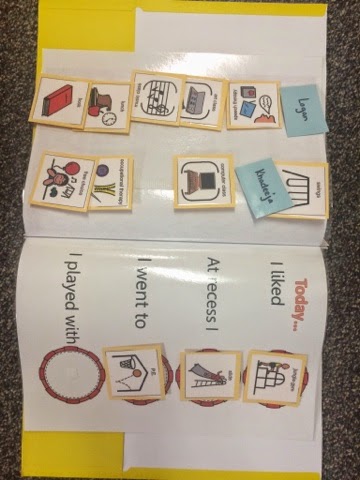
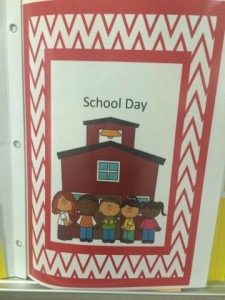
    I came up with this cute back and forth book we’ve been using with some of the kids.  We printed the sheets out and laminated them.  We then put velcro on and the kids can pick the pictures and put them in the circles for that day.

    For example, in the picture below, our little friend said today  he liked the jungle gym, played on the slide at recess, and went to PE.

    You can also get pictures or have names of the child’s classmates that can be put on with velcro or written in with dry erase marker on the bottom circle, “I played with ____.”


  • What to do when you can’t say “Trick or Treat”

    What to do when you can’t say “Trick or Treat”

    Ashlynn said her first “trick or treat” on command at the age of four.  At three…she had an approximation, but then she froze when we went trick or treating.

    Many people were polite and kind, not demanding she say something for her candy.  Others though, sat indignantly at the door waiting for “the magic words.”  Because Ashlynn’s strengths lie in social skills, she was always able to charmingly muster up the word “hi” instead, and most of them would give her the candy.

    However, many of my clients report anxiety around this time of year for them and for their child with apraxia.  I’ve heard of some creative ways around this.

    One client I had said she took her daughter with older cousins who all went in a group and spoke for her, if you will.

    Another client had a sign that said “Trick or Treat”

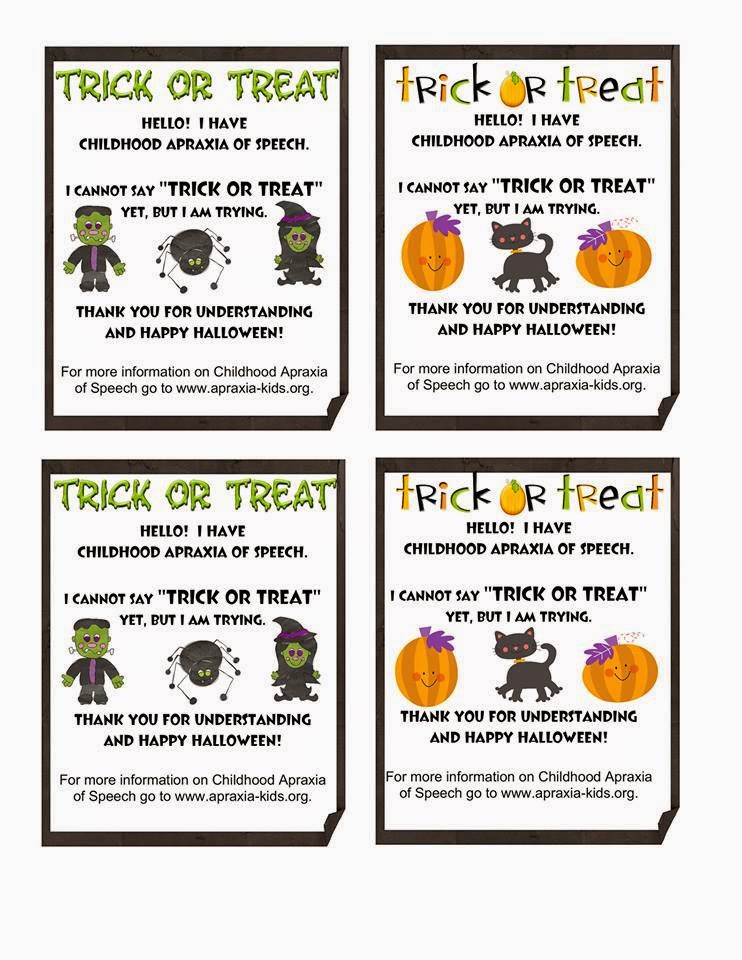
    A mom I’ve met through the fb group, made these cute and wonderful cards that not only say “trick or treat” for the child, but also spread awareness!!  I asked if I could share and she was happy to pass them along.

    So here they are!!  Thanks Shelley for your generosity!

    If you are finding these hard to print, feel free to email me at lauraslpmommy@gmail.com and I will be happy to send you along the PDF.