Category: Therapy for apraxia

  • Overgeneralization: a caution for clients with CAS

    Overgeneralization: a caution for clients with CAS

    overgeneralization


    Before I knew my daughter Ashlynn had CAS, and before I spent countless hours researching, taking trainings, and becoming an expert in CAS; I was an elementary school SLP.  Like any new SLP, I was relatively inexperienced with CAS.  One year, I transferred schools and a 3rd grade boy with a dx of CAS popped up on my caseload.  Most people, including his mother, still found him very hard to understand.  In her defense, it didn’t help that her first language was Spanish, and this boy only spoke English (apraxic English, you can say).11wwpm

    Anyway, I could understand him most of the time, but his errors were bizarre.  He had an /l/ substitution EVERYWHERE, but mostly for sounds he had not yet acquired including /r/ and /th/.  Some examples: (blown/brown, muller/mother, bruller/brother).

    This was my first experience with “over-generalization” and it’s potential to have a negative  lasting impact on kids with CAS.

    It was not my first experience though with over-generalization.  In kids with phonological disorder, this will happen occasionally.  For example, we might be focused on a pattern, let’s say, /s/ blends.  A child with a phono disorder will usually omit the /s/ in an /s/ consonant cluster.  One of my mentors used this example:

    “I see a star in the sky” would be “I tee a tar in the tye.”  There are a few phono processes going on here, but suffice it to say, the child is still omitting the /s/ which would be considered a consonant cluster reduction.

    When we start targeting /s/ blends, the child will usually (temporarily), start adding an /s/ before every sound. Soon after they learn the pattern without any real long term consequence to existing speech patterns.  This is generally regarded a positive sign with phonological disorder, because the child is showing they are making system-wide changes that are generalizing.

    This is NOT necessarily true if a child has a dx of CAS.  Over-generalization can cause havoc on an already faulty motoric system.  There is a limited research I found regarding this phenomenon; however, there is some in the adult literature regarding acquired apraxia of speech (AOS).   Wambaugh et.al. (1999) found that in adults with apraxia,  sound production training did yield system-wide positive changes in the acquisition of a sound; however, overall maintenance effects exhibited declines in sound production accuracy (intelligibility).  The authors concluded this decline was directly attributed to over-generalization of the taught target sound.  They recommended using multiple sound targets to increase variability and stabilization during training.

    I have searched for more research articles on the subject but have come up empty.  This is NOT to say; however, that it is not a common occurrence.  Research in the field of communication disorders isn’t exactly robust like it is in the medical field.  Even the research we have on apraxia, though more than it was, rarely meets the criteria for the highest level of evidence to be proven effective.  Many times we have to go on our clinical experience, and in treating kids with CAS, I have now seen plenty of cases of over-generalization directly caused by the current therapeutic approach.  Of course, questions like these usually lead to one pursuing a doctorate and doing a research study….but……that is for another time.  lol

    I do feel though I need to write on the topic.  So here it is.

    Therapy for apraxia needs to include many target sounds, sound placements, and syllable shapes.  This is very different from many (most) treatment approaches for other speech sound disorders.  Let me give you some examples.

    In articulation approaches, therapy focuses on one sound.  They work to get accuracy and generalization for that particular sound in many different places of words: initial, medial, and final.  Therapy then progresses from word, to phrase, to sentence, to conversation.

    In phonologic approaches, therapy focuses on patterns of errors.  For example, in a popular Cycles approach, kids consistently may delete final consonants (ca/cat, do/dog) or leave off consonant clusters (tar/star, no/snow), to name a few.  Therapy would then focus on including final consonants, or consonant clusters.

    These are common approaches to most speech sound disorders.  These are what most SLP’s will have experience with.  They will have seen these in their internships.  It’s no surprise then when we fall back on these therapies.

    However, this WILL not do for apraxia.  Let me give you many personal examples I have now seen in my experience.

    For my first example, let’s go back to my 3rd grade boy with crazy /l/ substitutions.  Recall he had a history of apraxia and when I met him he was substituting /l/ for sounds he had not yet acquired (r, th).  If you are an SLP, you will know this is a pretty unusual error.  It was also an error that, at the time, before I knew motor learning principles, I had an INCREDIBLE difficult time extinguishing.  I can’t help but wonder (actually I’m really sure now), that the child had fairly good apraxia therapy, and probably was working on /l/.  At younger ages, we typically don’t work on later developing sounds such as /th/ and /r/.  However, he overgeneralized ALL of his errors to mean he needed to produce an /l/ and there I met him in 3rd grade, and what I saw was a child now saying /l/ for every sound he still had in error.

    My second example is a child who has a TON of language, but who is severely apraxic.  Unlike my daughter, he can tell stories for hours, but the sounds are completely muddled, jumbled, and in no sensible order.  At the word level he would remember to include final consonants, but at the conversational level all of his final consonants were omitted.  I am working with his school SLP who is amazing, and she noticed this pattern (phonological disorders and apraxia CAN co-exist), and decided to remediate it.  She remediated it SO well, he was adding final consonant sounds to syllables and/or words he had previously mastered that DID NOT have a final consonant.  One phone call revealed the error, and we both worked feverishly to rid him of this overgeneralization pattern.  We were able to do it, but only after using principles of motor learning.  Had she not been so open, there is not doubt in my mind he would still be adding these final consonants to every word. Much like my first example, established motor plans in a child with apraxia is VERY hard to extinguish.

    My third example includes a child I started seeing in the very early stages.  Though she was able to say many early developing sounds in isolation, she had extreme difficulty sequencing them correctly at the word level.  I was seeing her along with another private SLP and school SLP.   Early on, she made incredible progress.  The other SLP’s  were using Kaufman cards, and the first set of Kaufman cards account for all the variables I mentioned above: varying sounds, sound positions, and syllable shapes.  When you are dealing with a motor planning disorder, a “sequencing” disorder, these three things are very important. In fact, Nancy Kaufman herself describes her method on her website as:

    This is performed through using cues, fading cues, using powerful and strategic reinforcement (motor learning principles), errorless teaching (cueing before failure), gaining many responses within a session, and mixing in varying tasks to avoid over generalization.

    Only problem with example number 3 is that she progressed beyond the level 1 cards and so the SLP defaulted on what she knows.  This client wasn’t producing any fricatives (s, f, sh) so she started with the fricative (/f/) and starting hitting it hard.  The result?  My shared client is now using this taught phoneme for all other current fricatives and errored phonemes, and getting her to eliminate this now very strong motor plan is taking longer than expected.  What SHOULD have happened is that we target all fricatives now (a variety of sounds) in all word positions and stimulable syllable shapes, STILL using the principles of motor learning theory.

    Overgeneralization.  It’s a PROBLEM in CAS.  If you are an SLP and you start seeing this, you need to look at what you need to change.  It’s not a positive indicator like it is for phonological disorder.  You are literally carving incorrect motor plans. Remember, we cannot focus on a single sound.   We cannot focus on a single pattern.  We cannot focus on a single word position.  We cannot focus on a single syllable shape.  We have to choose targets that are variating ALL of the above that are including sounds within a child’s repertoire.  If we don’t, we are going to have a kid with apraxia overgeneralize what we have taught them, and it’s going to cause havoc on their motor system, and potentially make them even less intelligible.

    In addition, you will always hear me talk about wasting TIME.  Time is so, SO precious to a parent with apraxia, more specifically, getting a child to improve as quickly as possible.

    This is ALSO why it’s SO important that even after a child has resolved, a dx of CAS always be included in the case history, because principles of motor learning theory are still the most effective in driving treatment.  This is true even when you have moved on to grammar or additional language targets.  Apraxia is a different monster.  Educate yourself.  Learn more. Vist apraxia-kids.org.

    30022940f


    Resources:
    Wambaugh, J. L., Martinez, A. L., McNeil, M. R., & Rogers, M. A. (1999). Sound production treatment for apraxia of speech: Overgeneralization and maintenance effects. Aphasiology, 13(9-11), 821-837.


  • Dot Articulation book GIVEAWAY

    Dot Articulation book GIVEAWAY

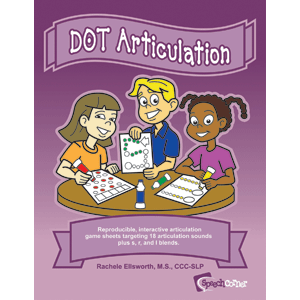
    Keeping up with our giveaways, next up is Dot Articulation from Speech Corner.  I use this book all the time with a variety of  different speech disorders.

    It’s a great way to get multiple productions in a fun and motivating format.  It has reproducible worksheets targeting 19 frequently articulated sounds, including blends.  For my kids with apraxia,  there are blank sheets in the book for you write in your own and then play with dot markers.

    Enter to win below and the winners will be notified on Apraxia Awareness Day on May 14th!

    a Rafflecopter giveaway

  • The Do’s and Don’ts of in-home speech therapy

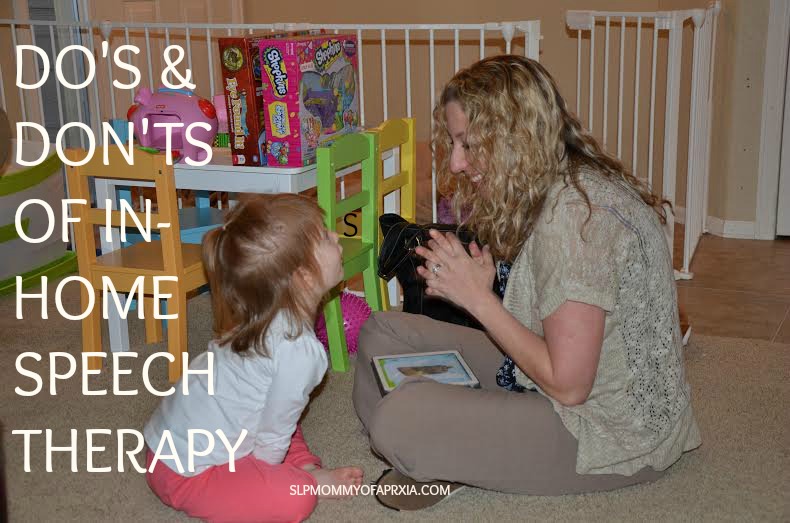
    The Do’s and Don’ts of in-home speech therapy

    Being both an SLP AND a mother to a child with a severe speech disorder, I have this unique and sometimes bizarre perspective; that perspective, of course, being that I now intimately understand both sides.  That being said, I think parents/my clients, typically feel more comfortable telling me things parent to parent vs. parent to SLP.

    As a mother now to a child with apraxia, I have a new appreciation for the “other” side.  This post is targeted for all the amazing and well-meaning SLP’s out there, who may not understand some things because they haven’t been on the parent side.  Here are my top five Do’s and Dont’s for in-home therapy.

    Don’t spend therapy time talking about your wedding, the death of your dog, or your friend’s miscarriage. Do spend the therapy session focusing on the child and reserve personal conversations for a time outside the therapy session.

    Many times, our client’s mothers may have a lot in common with us.  However, literally every minute of therapy is as important to a parent as it is to the child.  I remember watching the digital clock in the first speech room Ashlynn was in.  If the SLP had to use the bathroom before seeing Ashlynn, I would of course understand; but honestly, I was staring at the clock hoping she didn’t waste too much of Ashlynn’s time.  I currently have a client who put those minutes into dollars.  For a 30 minute session at $50,  a person is paying almost $2.00 per minute!  We pay because we know they are valuable, but please, make sure all the minutes count.

    Many parents have told me that at times, they have been at fault for wasting minutes talking because they were with kids all day and craving another adult interaction; however, regardless of whose fault it is, always try to stay professional and keep the focus on the child.

    Don’t blurt out suspicions, concerns, or think out loud.  However, do make sure you make referrals and not withhold information if you feel there are additional concerns that need to be addressed.

    Parents have reported that therapists have flippantly mentioned apraxia and turned their world upside-down unnecessarily, only to find out later it was in fact, NOT apraxia.  In a different scenario,  I have had parents upset that an SLP never even mentioned apraxia, and now they were just finding out years later, distraught, worried, and feeling guilty they had not done something sooner; and in yet another scenario, a parent has told me her SLP casually mentioned a serious diagnosis like apraxia frequently without ever moving forward with a different treatment plan.

    As an SLP, you have a responsibility to relay a suspected dx in a responsible manner; and if you don’t know what to do, it’s your job to figure it out or make a referral.  There are so many more resources available now including apraxia-kids.org or ASHA’s practice portal.  We are counting on you!!

    Don’t start planning your lesson when you enter the house. Do have a plan heading into therapy.

    Look, as an SLP I get it. Planning time isn’t exactly built into our pay.  Also, it can get overwhelming to carry a bunch of materials from house to house.  Shouldn’t we be teaching the parent how to use toys in their house?  Yes, that’s great, but you should STILL have a plan whether it’s using a child’s toys or your own.  Nothing looks more unprofessional than spending five minutes letting the child decide what toy or game to play. Remember my previous comment?  The parent just paid you almost $10.00 now just to plan the lesson and get started.

    If you are in early intervention, some of your time might be for planning and writing notes.  If so, please explain that to a parent before-hand so they aren’t thinking you are deliberately short-changing a session.

    Don’t continually cancel or run late.  Do respect people’s time and schedule, and refer out if you are unable to be a consistent provider.

    Okay, first of all, if you are consistently late or cancel a lot, you make the profession look bad.  However, even more important is that you are not helping the child the way you should when you do this.  Be conscientious, and if you are frequently late and/or cancelling, refer out.

    A parent also told me that a quick apology is nice, but an entire explanation is not necessary.  Parents do understand if you are late sometimes.

    Don’t assume parents aren’t worried, involved, invested, or not working with their child. Do provide resources, assume the parents are doing the best they can with the knowledge and tools they have, and that they are worried and just want the best for their child.

    I had a post last year entitled Nature Versus Nurture.  In it, I beg SLP’s not to assume nurture played more of a piece in a child’s language delay.  This is especially true for apraxia of speech.  I’m an SLP.  A pediatric SLP.  My daughter has a great language rich environment, and not only that, I DID work with her almost every night on speech.  Guess what?  She STILL had apraxia and continues to have a persistent receptive/expressive language delay.

    Parents are human too, and might not have the background we have in child language development. Please do not assume though, that they don’t care.  Even parents who seem like they don’t care, care….trust me.  If you are there, it’s because they care.  They had to make the phone call after all.

    The best thing you can do is not only to provide therapy, but provide them with resources.  Some parents may not use the resources, but I think it’s our job to provide them.  Give them articles, handouts, point them to online resources, support groups, walks, conferences, etc.


    Most of all, DO realize you are appreciated and valued more than you may ever realize.  Helping a child get their voice is one of the most amazing things I think we do as SLP’s.

    06a8417b-9bbf-4414-8e54-d5e557b66394

    Thank you to all the parents who added their feedback to this article.  

    LAURA SMITH M.A. CCC-SLP IS A SPEECH/LANGUAGE PATHOLOGIST IN THE DENVER METRO AREA SPECIALIZING IN CHILDHOOD APRAXIA OF SPEECH.  CASANA RECOGNIZED FOR ADVANCED TRAINING AND EXPERTISE IN CHILDHOOD APRAXIA OF SPEECH, SHE SPLITS HER TIME BETWEEN THE PUBLIC SCHOOLS AND THE PRIVATE SECTOR.  SHE IS DEDICATED TO SPREADING CAS AWARENESS. HER PASSION IS FUELED BY ALL OF HER CLIENTS, BUT ESPECIALLY HER OWN DAUGHTER WHO WAS DIAGNOSED WITH CHILDHOOD APRAXIA OF SPEECH.  FOR MORE INFORMATION VISIT SLPMOMMYOFAPRAXIA.COM


  • Why are SLP’s still using “mouth exercises” for CAS??

    Why are SLP’s still using “mouth exercises” for CAS??

    I realized in the entirety of my blog, I have never even once addressed oral motor exercises, aka mouth exercises, or now being touted as oral placement therapy; in the treatment of Childhood Apraxia of Speech.  The “why” is actually very simple.  Massive amounts of research consistently demonstrate they are ineffective in the treatment of speech sound disorders.  In graduate school I had to do a paper on their ineffectiveness and I have an entire binder of research papers showing they are not supported; so yeah, I literally never even considered it.

    At one point, Ashlynn’s school therapist felt it was very important she round her lips to make the /w/ sound and had her using horns, but this was squashed pretty quickly.

    Ashlynn is now 6 1/2, and is intelligible at least 90% of the time in unknown contexts with unfamiliar communication partners.  The apraxic component to her speech is resolved and has been for at least a year.

    “She must have been mild,” you might say.  Wrong.  Though she wasn’t profound, she was severe.  She has additional co-morbidities of: oral apraxia, dyspraxia (limb apraxia), SPD (sensory processing disorder), and suspected dysarthria that make prognosis more guarded.  Even with all of those additional factors, I STILL never had her do oral motor exercises.

    What could it hurt?

    Technically, nothing, except wasting precious time; and let me tell you what was the most important thing to me after getting a CAS dx:

    TIME.

    I instantly started thinking about Kindergarten and she wasn’t yet 3.  Will she have an extra year?  Will she be talking by then?  Will she be intelligible by then?  If she’s not intelligible, how is that going to negatively impact her phonemic awareness skills?  If she has poor phonemic awareness skills, how will that impact her reading? Will I need to hold her back?

    I’m not alone.  Every parent I meet frets about this….so TIME.  Yes TIME is of the essence.  I needed Ashlynn to get remediated as quickly as possible, and quite frankly, though NSOME’s wouldn’t hurt her, the research is very clear they don’t help either.  To me,

    NSOME’s = a waste of time.

    Dr. Ruth Stoeckel, an apraxia expert out of the Mayo Clinic, created a user friendly handout for parents based on information gathered and collected by Dr. Gregory Lof.   It includes the most common questions parents may have, and then research based responses for why NSOME’S should not be used.  You can access that here:

    NSOME parent adaptation

    Some SLP’s swear by them. Some SLP’s do genuinely and honestly feel NSOME’s help children with motor planning disorders.  My response to them is that they are probably not giving themselves enough credit on their clinical speech therapy skills, because the research is very clear that to improve speech, one needs to work on speech.  Not use tools that mimic speech movements either, but actually work on speech.

    I’m not going to go through the handout line for line.  I really encourage you if you are a parent or SLP to read it yourself though.

    If the research can’t persuade you, please let my personal experience with Ashlynn be of some influence.  She had excessive drooling, jaw instability, slurring, and inaccurate target placement…all ASIDE from the motor planning. She entered into therapy based on motor learning principles right before age 3, and a little after her 5th birthday I wrote the post:

    Wait….is she the….R word? 

    I’m not saying every kid’s apraxic component is going to be resolved that quickly.  Many, many, MANY factors play a part including a child’s personality.  Ashlynn always tries and never gets frustrated.  How, I have no idea, but I can only assume that has contributed to her quicker progress, especially in the face of so many negative indicators. Hopefully, me being an SLP as her mom also helped. However, we never once used any NSOME’s.  What is the harm?  The harm is you are wasting time, and that’s not just an opinion, it’s based on research.

    You will not find apraxia experts using them.  Edythe Strand, Ruth Stoeckel, Tom Cambell, David Hammer, Gregory Lof…NONE of these people use NSOME’s.  The Childhood Apraxia of Speech Association of North America (CASANA) will not endorse them.  In fact, I did a search on apraxia-kids.org and came up with this page full of articles refuting their use.  Keep in mind, the executive director and director of education at CASANA both have young adult children with resolved CAS, and THEIR children NEVER had NSOME’S either, and they are resolved.

    Finally, the organization that certifies SLP’s, ASHA, has also refuted the use of oral motor exercises in the technical report on CAS.

    That’s why I never even wrote a blog post about it.  It should seriously not even be an issue. I have been shocked now to discover how many SLP’s are still using them!  They are a complete waste of time in the treatment of CAS, and as I said before, TIME was the most important thing to me when Ashlynn was dx.  Is it to you?

    no-sign-1872071


  • Tips for carryover in Childhood Apraxia of Speech: Part 2 of 2

    Tips for carryover in Childhood Apraxia of Speech: Part 2 of 2

    We all know Childhood Apraxia of Speech is rare!  The odds then of having a mother who is an SLP?  Probably substantially rarer right?  When I first started on this journey, I knew of none.  Now I know at least 30!  We have a unique perspective for sure, and I wanted to team up with two other moms to tell you what we do in our own homes with our own children with CAS.  This is Part 2 of a 2 part series.  Our first one can be found here:

    Tips for Carryover in the Verbal Child with CAS: Part 1 of 2

    So, if you haven’t read that already, please do!  If you have, let’s continue!

    Powerful Motivators

    Sound familiar?  This was first and foremost in my last post on home strategies too.  Speech is hard!  Our kids have to not only think about what they want to say but how to say it, and that’s where we come in to help.  I can remember when Ashlynn started saying the final /k/ in the word “book” instead of substituting a /t/.  She loves books and even still looks forward to me reading a book to her before bed.  It’s a powerful motivator, and after I knew she could say “book” and not “boot,” I had her say it correctly before I read her the book.

    A huge motivator for my son too is really as simple as just saying “wow, I loved how you said your lifty sound (our reminder word for the L sound) in the middle of that word!” he gets so excited when I notice the work he puts into speaking. His face just lights up and it is so cute.  I try to do this as much as I can so that he can feel noticed for doing right instead of just maybe feeling corrected all the time.

    Motivation is an essential element for making progress and one to always keep in mind for home practice as well as during therapy with his regular SLP.  In fact, this is one of the top characteristics that I look for in an SLP for my son. He is a pretty easy-going, compliant client for any SLP, so he’ll do a lot of “work” in a therapy session without a lot of reinforcement.  While this may sound like a wonderful “problem” to have, I know that he needs motivation and reinforcement to keep his forward momentum going in his speech therapy, since we all know this is a marathon and not a sprint for kids with CAS.  We actually switched SLPs at one point because he wasn’t having fun and staying motivated during his therapy sessions with a former SLP.  I need an SLP who recognizes this critical component of therapy and want to stress its importance to all parents of kids with CAS.  For my little guy, the best reinforcement is when I get down on his level and play with him.  Having fun and playing games of his choosing is a way to keep our relationship strong, which carries over into the rest of our daily activities/practice opportunities.

    I completely agree! Therapy with an SLP needs to be meaningful, motivating, functional, and encouraging in order to work. It’s the same at home. Use the moments when your child is engaged with something they love and use that as an opportunity to get the best results.

    Praise!  Lots and Lots of Praise!

    I currently have a new young client, and she thrives on getting stickers.  When we first started, she would get a sticker for even just looking at my mouth when I asked!  As I was talking to her mom one day, her mom said something so simple but profound, “what person doesn’t like praise?”  She was right!  Aren’t you motivated to work harder at your job or help your spouse more when you get praise and you feel appreciated?  Make sure to acknowledge your child’s hard work!

    EVERYONE likes to feel successful. Children are no different. Praise becomes motivation as well so these two things really go hand in hand in my opinion. Once you start focusing on praising and positivity you will see willingness to participate increase. There was a time when I was so frustrated at my son’s eating, or lack thereof, that at the end of the day I realized that all I had been doing all day was talking negatively to him about not eating. It made the situation worse. In the morning, I started making sure I found things that he was good at in regards to eating and said things like “You are really good at using your tongue to taste food. You are my expert taste tester” I can’t say it helped him eat anymore, but it certainly made both of us in a better mood and he was willing to “taste test” more and smile at the thought of trying food instead of crying. It is no different with speech. Sometimes you just have to find the words that work best for your child. We’ve all said this a million times…it’s a marathon, not a sprint. It takes time to find what works best for you and your child. It is also important to remember that what works best for you and your child may not work best for your spouse and your child. Encourage your spouse, partner, family, whoever to find something that works for them, but don’t make them do everything the way you do it (oh and don’t forget praise for them either).We all have such different relationships and communication styles with our children.

    You two have already covered most of this topic, though I’d like to add the reminder to remember how hard our kids are working every single day, every single time they open their mouths to speak.  We witness it everyday and know how hard they are working.  We must be our children’s biggest cheerleaders.  Smile, laugh, and remember to have fun.  We’re in this for the long haul and want to enjoy our journey together as much as possible.  

    Know your cues!

    Since we are SLP’s, we already know tips and tricks to cueing speech sounds.  However, parents might not.  That’s why it’s so important parents are able to see therapy in action, whether that be in the room, or videotaped.  Most kids with apraxia respond well to cues.  Cues can be touch cues, visual cues, verbal cues, or even sign cues.  If you don’t know the cues your SLP is using, you’re probably going to be less successful at helping your child carryover his/her targets at home.  

    If the child cannot say the sound or is getting frustrated, it’s not a good target.

    If you have your powerful motivators, are using your cues, and your child is still not producing the word correctly, move on.  Ask your SLP for different targets.  Therapy for apraxia is hard enough.  Home practice should be easy, not miserable.

    If this was a post on facebook, I would try to like this comment a thousand times! Remember that old saying “pick your battles”? It applies to home practice too. They need to stay confident in order to want to keep working because let’s face it, they have to work really hard. If they stop wanting to work because something is physically unachievable at that time, you might as well throw in the towel. I sit in on every session and watch very closely to what they are doing. I make sure I am using the same verbal and visual cues that our SLP uses. This is extremely important for me in order to stay consistent, but it is also important to see how he reacts to cues in therapy so I can use that information to troubleshoot at home. Being in the room or behind a two way mirror also helps me to be able to ask questions based on what I have seen and tried at home and what I see in therapy. If something isn’t working at home, I tell our SLP. Sometimes I have suggestions on what could help based on his personality and sometimes we really have to work together to figure it out. It is a collaboration for sure.

    When there is a word or phrase that you know your child will have difficulty with, try to set them up for success to produce it correctly by giving the cues they need to say it accurately – it may be visual or verbal cues or a direct model.  If I can intercept an incorrect production, I try to do so.  The more he practices it correctly, the better off for everyone.  This applies best to emerging skills or those currently being targeted in therapy.  When your child reaches a higher level of proficiency for a skill, I will often let him try it on his own and only cue if there is an error. 

    It’s impossible to correct/cue for every speech and language error every time it happens during your daily interactions with your child.  I don’t want to present the idea that I catch and correct every error that my son produces every day because I’m an SLP.  That’s not realistic or accurate.  Early on in his therapy, and even now, when we have so many goals that need addressed, I have often felt overwhelmed when trying to work on them.  I feel the need to work on everything all the time.  It’s been helpful to me to choose one goal or one goal area to target at a time.  Right now, we’re working most on language goals and using helping verbs, prepositions, and articles (the “little” words in sentences), and those are what I cue for 75% of the time.  The other 25% are mostly speech errors on sounds that he can produce (consonant blends) or the occasional newer speech target (long vowels).  Soon, I’ll probably switch my focus back to cueing/working on speech goals (especially those vowels!) a majority of the time, and put the language goals on the “back burner.”

    It’s a marathon, not a sprint!  

    There’s that phrase again! Once our kids have finally passed the hurdle from being non-verbal to verbal, many times they rely on practiced or known “motor plans” to communicate…..which is AWESOME!  Our kids go so long not being able to say a single word despite having what they want to say in their head, I can only imagine how nice it must be to go on auto-pilot every once in awhile.  Unfortunately, sometimes their motor plans contain poor grammar.  

    The most common one I see is the child referring to themselves in third person, instead of saying “I.” Ashlynn definitely did this!  It makes sense though right?  We always teach them their name, and then when they finally get it, we are so proud.  Also, it has all the elements I just talked about right?  It’s a powerful motivator to say your name, they get lots of praise and reinforcement when they say their name, and parents probably practice this target throughout their day (distributed practice). I have many, many blog posts where I outline her sayings such as: Ashlynn happy, Ashlynn play boats, Ashlynn want muffin etc.  It took months, MONTHS, and that was with me correcting her EVERY TIME to break that and say “I” instead.  That is apraxia.  You can then only imagine how much longer that would have taken without that home element!

    Yes, once G moved into using short 3-4 phrases, this was a big milestone and so exciting!  However, those phrases were often learned as big chunks.  For example, he learned the phrase, “I like it!” but did not actually have functional use of the pronouns “I” and “it.”  He used the phrase as one unit and didn’t grasp independent use of those pronouns in other contexts or with other verbs.  However, once he did start using it, I made sure to model their use in other situations to get him to practice similar sentence structures.  I think of it as him having the motor plan for that sentence structure (subject-verb-object) and then we have to work on it growing and maturing to be strong enough to support more combinations of that sentence structure.  This “auto-pilot” scenario still occurs right now too, especially with new-to-him phrases.  For example, when watching the weather forecast one day, they predicted snow showers on Friday.  G said a new sentence, “Snow on Friday!” which was fantastic to hear!  However, now any other time we watch the weather report and talk about the rain or snow forecasted, he defaults back to saying, “Snow on Friday!” whether it’s correct or not.  Now that I know this about him, I try to intercept that automated response and repeat the correct words (“Rain on Monday!”) before he has a chance to say the inaccurate one.

    Don’t forget about Prosody!

    Prosody is sometimes referred to as the “melody” of speech.  It can include things like inflections, syllable stress, and volume.  To have an apraxia dx, children have to have difficulty with this.  When we are trying to get them to say a word correctly, we can exacerbate disordered prosody, which we don’t want to do.  Always be mindful of using varying inflections, and stressing the correct syllable when speaking to your child or having them say a word.

    Ashlynn had a habit of omitting medial consonants in CVCV words.  For example, daddy was da–ee and doggy was dah-eee.  When I would try to correct her, my first inclination is to of course tell her to say daDEE.  That is the wrong stress though for the word.  We don’t say daDDY.  We say DAddy.  Sometimes we can’t help but stress the wrong syllable, especially in the teaching phase; but it’s good to be mindful we want to move them to the correct stress as quickly as possible.

    I feel prosody is often an overlooked, but important aspect to remember with CAS. If you question if you are encouraging or modeling something correctly, try saying it in a sentence naturally to your spouse and see what kind of inflection you naturally put on the syllables in that word, then you can model it better for your child if you understand how it sounds in a natural way. I tend to say a word a little sing-songy when I’m trying to model good prosody in a word or sentence that is hard for him. For some reason, it really works for him by emphasizing the left out stress in the syllable without taking away the naturalness of it. He can hear it and model it a bit better when I do it like this, but if you have concerns on how to address it, ask your speech therapist. It can feel tricky at times. Also, my son would say things too high pitched and he still does occasionally, but we were able to come up with a system that worked for him. We color coded his high and low pitches so if he was getting too high, I would say “I heard your purple voice, let’s try saying that with your green voice instead of your purple voice.” Colors clicked with my son, but you may find using animals or something more meaningful as a voice reference is easier for your child.

    This is one of the trickiest aspects of CAS for me.  I was guilty of using unnatural prosody and stress A LOT with G, especially early on.  I wanted him to speak so badly and I was doing everything I possibly could to help.  Now that I know better, I do better. When working on a specific target, I do sometimes still stress sounds or syllables to help draw G’s attention to that sound and to help him produce it.  However, as soon as he produces the word or phrase accurately, I immediately return to normal prosody and try to elicit that immediately after.  We also use a sing-songy voice sometimes to help bridge the gap between an over-stressed isolated production and one with natural prosody.  I would say that I strategically use extra stress for omitted sounds, syllables, or words, but I try to use normal prosody first before doing this.  

    Listen and give them time!

    One of the biggest keys to success in our home is to listen. Ian needs extra time to speak, he needs to feel heard and this helps his confidence to continue to try even if he doesn’t always do it perfectly. Although it sometimes takes a painfully long time we let him finish what he is trying to say, and pause a moment before we answer, just in case he wants to fix something he missed on his own. I try to give opportunities for him to figure out and fix his mistakes on his own, and I’m not afraid to tell him if I didn’t understand something. We have always had a gesture or a word associated with a sound thanks to guidance from CAS specialists we have worked with, so if Ian forgets a sound in a word I try to first just do the gesture of the sound he missed or I do the word he may have left off of a sentence in sign language to help him remember without telling him first. Everything he has learned (from signs/visual cues to help with speech, to sounds, to words, to the prosody within those words and sentences) is still modeled heavily in our house whenever he doesn’t say it like I know he can. This is basically our everyday distributed practice. I do try to create moments to help him work on combining his new sounds with everyday speech, but for the most part I just go with the flow and most importantly I don’t give up. I guess I’m still afraid he will lose something and we might not see it again for months, or that he will get used to saying something that he already can say correctly the wrong way and have to start all over again, but whatever it is we never stop using everyday situations as practice. I’ve had to learn the hard way that thinking he has something mastered doesn’t mean I can give up correcting it. There have been times when his ability to speak correctly and efficiently waxes and wanes. I’m hoping it changes where one day he won’t need my help at all, but for now I can never let myself get lazy with helping him progress to the best speaker he can be and that’s why we use everyday moments to practice speech and not just ten minutes at a time.

    I couldn’t agree with this more!  Ashlynn needs a TON of processing time.  As much as we work on speech, I also make sure to step back and just wait for her to finish a sentence or a thought.  She also has crippling word finding difficulties and though it’s tempting to want to fill in the blank or give her a word, I wait for her to try and come up with it herself.  If she can’t, I also use sign cues like Nicole, or I give her the first sound and see if she can access it on her own.  

    While it’s true that all kids need time to accomplish something new on their own in order to feel independence and pride, this is especially poignant for our kids with CAS.  They often need extra time to formulate their replies and get their mouth to cooperate with what their brain wants to say.  I try to give G this extra time at home, in his safest environment, so he can build his confidence and skills to use his speech in the more hectic “real” world outside our home.  When listening to G, I too let him know when I do not understand what he’s saying and give him as many opportunities as possible to repair that communication breakdown (e.g. repeat, re-phrase, gestures, answer questions).  

    When thinking about G and his speech therapy goals, it’s so important for me to remember to “give them time.”  Some days, I feel discouraged about G’s speech and language skills and that I should be able to do more for him.  When this happens, I try to think about what he can do now compared with 6, 9, or 12 months ago.  Of course, those gains don’t come without a whole lot of work from him and us, but the progress is there, and he will keep making it, because we won’t give up.  

    I can’t thank Nicole and Kimberly enough for joining me on this journey and for guest blogging today.  When I had this vision for this blog post, it could not have been nearly as in depth or insightful as it is without their input!  Our children continue to make progress.  YOUR child will continue to make progress with the right elements and correct therapy approach.  
    mommy-2Band-2BashlynnLaura Smith M.A. CCC-SLP is a speech/language pathologist in the Denver Metro Area specializing in Childhood Apraxia of Speech.  CASANA recognized for advanced training and expertise in Childhood Apraxia of Speech, she splits her time between the public schools and the private sector.  She is dedicated to spreading CAS awareness.  Her passion is fueled by all of her clients, but especially her own daughter who was diagnosed with Childhood Apraxia of Speech.  For more information visit SLPMommyofApraxia.com

    12483712_10102672217441924_1074570947_nNicole Quaka M.A. CCC-SLP is a licensed speech and language pathologist in the Pittsburgh area who is currently a stay at home mom to her two boys. Her background is in adult swallowing and cognitive communication disorders related to TBI and degenerative neurological disorders. However, because of her eldest son’s diagnosis with CAS she has spent the last three years dedicated to continuing education on augmentative and alternative communication, childhood apraxia of speech, and related developmental disorders.
    12476212_10153908135074903_1729160114_nKimberly Peterman M.A. CCC-SLP is a speech language pathologist in the Columbus, Ohio area who is currently a stay-at-home mother to her two sweet, active sons.  She has experience with clients from preschool age through mature adults, and particularly enjoys working with clients in the areas of articulation, stuttering, hearing impairment, and language impairment.  Since her oldest son’s diagnosis of CAS one year ago, she has devoted all of her SLP continuing education, time, and resources to his ongoing speech therapy and is grateful to be able to do so.
     

  • Word FLIPS giveaway!

    Day 5 leading up to Apraxia Awareness Day on May 14th has me offering a giveaway for Word FLIPS by Super Duper Publications.

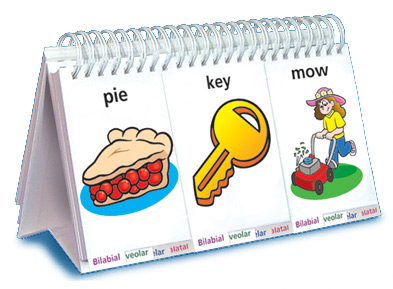
    wordflipsWord FLIPS can be a useful and handy tool to use with kids who have apraxia.  It allows practice for simple CV syllable shapes for up to 3 repetitions.  It also allows for combining combos to form other bisyllabic words i.e. tie+knee = tiny.  I usually give my kids one of those finger pointers and we take turns pointing at and saying the words.

    Taken from their website:

    Word FLIPS includes three sections of identical picture words with four tabs in each section that divide the words according to articulatory placement: Bilabial, Alveolar, Velar, and Palatal. Begin teaching severely unintelligible children by having them repeat identical earlier developing sounds, such as “boo-boo-boo.” Older or more verbal children can practice a variety of sequences, such as “tie-tea-shoe” as a warm-up to practicing sentences.

    Must be a U.S. resident.  Good luck!
    a Rafflecopter giveaway