Category: specific language impairment

  • The IEP meeting I wanted to attend.

    The IEP meeting I wanted to attend.

    I never knew before I had a child with an IEP (individualized education plan), how awful these meetings can be for parents.

    Before I had my daughter, IEP meetings were part of my job and I attended them weekly with a room full of colleagues and the parent or parents. I had no idea how it felt being on the parent side. I do now and it feels scary, nerve wracking, and very intimidating.

    I haven’t gone back and added it up, but today was at least the 9th and probably 10th IEP meeting (individualized education plan) we’ve had for my daughter Ashlynn. I don’t think I’ve ever had a meeting where I wanted to go to it. I can particularly remember the meetings that gutted me. Looking back it probably wasn’t any one educator’s fault. It was my position in the process of it all. It was like additional problems kept adding up. Just when I thought I had apraxia down, she would get ADHD, dyspraxia, issues with memory, issues with language comprehension……and the meetings were full of her can’ts. I could talk about how to write a strengths based report or run a strengths based meeting, but in the end even that wouldn’t have been enough to fill or patch the holes from the stab wounds from all of her can’ts.

    This time though was different.

    Starting last year, Ashlynn started to turn a corner. She was no longer speaking in as many “scripts” but was formulating her own novel sentences. She grew exponentially on her reading. The special education team got to know her and they saw what I saw and believed what I believed Ashlynn was capable of. Instead of the words “she requires more repetition than most,” hurting my soul, I was encouraged because they said it with the conviction behind it that they would get her those extra reps because she is capable.

    This entire past year I’ve felt the momentum and seen her IEP goals in action in Ashlynn’s everyday life.

    From SPED, I’ve seen Ashlynn finally understand money, time, and her math facts. She has RETAINED these facts. Did it take one hell of a lot of repetition? You betcha, but they did it and when Ashlynn has learned something, it’s like riding a bike; she doesn’t lose it. Ashlynn’s reading has continued to improve and we are working toward closing that gap. We aren’t there yet, but I SEE it. I SEE it and I feel the momentum. I’ve seen it within her book choices and through her reading out loud. In addition, many skills she needed accommodations for she is now independent with. She has mastered the classroom routine, she doesn’t need direct line of sight supervision for safety, and she is independent with basically all of her ADL’s (Activities of Daily Living). The one that made me smile was teaching Ashlynn to stop and think and give her time to process and understand what was being said so that she could give a thoughtful answer instead of just blurting out anything. We all laughed because she will frequently now tap her brain and say “hmmmm” to give herself time to think. Again, seeing IEP goals materialize in my child is not something I can quite explain. It’s phenomenal.

    From her SLP I saw the direct result from her working on formulating more complex sentences with “so” and “because” come to life at home. In addition, all the vocabulary work done in speech has seemed to literally lift Ashlynn out of her language disorder fog. Where before language was literally just flying over her head, she is comprehending and making connections like she was never able to before, and again I’m seeing that in her everyday conversations with me as well.

    From PT we remarked at how she can perform tasks like standing on one leg for 6-9 seconds and doing jumps etc, something that once seemed like a pipe dream with her hypotonia, cerebral palsy, and major motor planning problems. I told her how she could now ride a bike with no training wheels and that Ashlynn chooses to do workout videos and could follow along.

    From OT we marveled at her mastery of her ADL’s around school, how she can tie her shoes now, and her ability to follow up to 3 step directions that involve motor planning tasks. With adapted graph paper, Ashlynn’s can complete writing assignments and really is just working on putting it all together: getting thoughts on paper, letter formation, spacing, punctuation and legibility. She can do all of those tasks adequately if given separately. I’ll take that. There was a time she couldn’t write her name. That took “more repetition than most, ” but I smiled this time. I had it all wrong before when that phrase would burn me. No one said she can’t do it, and that’s what’s important. More repetition than most? Deal. Bring it on. THAT we can do.

    From mental health she is doing great with whole body listening and finding more peers to play with and inserting herself into play on the playground. Next step is learning how to engage socially with peers in conversation.

    The whole meeting was amazing. I was on cloud nine. The takeaway? Ashlynn’s going to make it.

    I sat there and thought back to Ashlynn’s early days. Was this really the same girl? The girl who would get too distracted she couldn’t even hang up her coat and backpack and get to class without assistance? Was this the girl who spent all of preschool, kinder, and preschool just learning the letters of the alphabet, much less learning how to read? Was this the girl who spent Kinder, 1st, and 2nd grade trying to master addition and subtraction and now was rocking that but also money and time? Was this the girl who was so clumsy and uncoordinated that she couldn’t ride a tricycle or put her shoes on the right feet much less tie them?

    It was and she was freaking killing it.

    Though there were many, many, many times I felt defeated, I NEVER was defeated. I always held the vision for Ashlynn. I held it steadfastly in my mind and promised her that even if I was the only person who ever saw her potential, I would never give up on her and I would fight to the end. I was prepared for war. I listened to inspirational songs and videos to keep the faith. I also worried and fought and lost sleep and prayed. Oh did I pray, but it wasn’t that she would overcome. I always knew that you see. I always knew she had a divine purpose. I prayed for a team that would see Ashlynn like I do and help her fly.

    A couple of months ago, filled with gratitude, I nominated her SPED teacher for a district award.

    It’s called the Golden Heart Award and is bestowed to any educator in special education who has gone above and beyond for a student in the program. Because coincidences are the Universe or God’s way of talking to us, Colleen received notice she was awarded this honor TODAY – the day of Ashlynn’s IEP.

    I thought to myself,

    “Sounds about right.”
    Laura Smith, M.A. CCC-SLP is a 2014 graduate of Apraxia Kids Boot Camp, has completed the PROMPT Level 1 training, and the Kaufman Speech to Language Protocol (K-SLP). She is the author of Overcoming Apraxia and has lectured throughout the United States on CAS and related issues. Currently, Laura is a practicing SLP specializing in apraxia at her clinic A Mile High Speech Therapy in Aurora, Colorado. 

    Purchase Overcoming Apraxia on Amazon.

  • Did I cause her apraxia?

    Did I cause her apraxia?


    When Ashlynn was first diagnosed with Childhood Apraxia of Speech, I think most parents will relate when I say I spent (pointless) hours wondering what had caused it.

    Back in 2012 when Ashlynn was diagnosed, the most current information we had at the time was that it could have three main causes:

    1. Brain Trauma such as a stroke in utero
    2. Genetic causes
    3. Idiopathic – meaning of no known cause

    Though I knew this, I couldn’t help but cycle back to questions.  Questions that kept me up at night.  Any parent of a child with special needs has probably done this endlessly.  It is probably one of the main causes of sleep deprivation in special needs parents right behind “am I doing enough? and goes something like this.

    Was it that time when I was 6 months pregnant and I had the stomach flu?  Did I wear the painting mask long enough when I painted her baby room?  Was it because I had to have a C-Section?  What about the vaccines, giving her Tylenol, or that time she bumped her head?  Maybe it was……..

    And before I know it, I’m deep into the weeds unable to find my way out.

    It doesn’t help I had been privy to professional “inside” comments with colleagues who blamed parents for lack of reading, lack of talking, lack of stimulation etc.  You can read about my snub to those “opinions” in my article where I snub the 30 million word gap theory.

    It also didn’t help I would hear stories from other apraxia mamas who would share their personal experiences of being blamed and shamed.  

    So, I sought answers. It was a revolving door of specialists, waiting lists, and additional diagnoses, but still no answers as to the cause.  I would cycle through periods of acceptance and guilt, such as in this post I wrote when she was a little over 4 about a year after her CAS dx.

    Earlier this year, I thought we had found our answers when we went to rehabilitation specialist at Children’s Hospital who diagnosed her with dystonic cerebral palsy. Though I had more answers to her disability profile, I still didn’t have any answers as to what caused all the issues.

    No answers that is, until we found ourselves in the office of a genetic doctor and genetic counselor.  This is not to be confused with general genetic testing that a pediatrician can order either.  It was there that we would learn the cause of everything.  It was there, I would finally know why Ashlynn had apraxia, dyspraxia, hyptonia, ADHD, dysarthria, SPD, CP, and learning disabilities.  The answer was housed in a small set of letter and number combinations called:

    BCL11A

    A quick pub med article revealed that of the few case studies we have, children shared commonalities with:

    1. Non-verbal or low verbal status
    2. Abnormal muscle tone
    3. Gross motor delays
    4. Childhood Apraxia of Speech
    5. Dysarthria
    6. Hypotonia
    7. Dyslexia susceptibility

    The doctor explained the genetic mutation was “de novo” meaning it was not inherited and happened at conception.  It was a complete fluke when the sperm and egg came together that this mutation happened on the 2nd chromosome.

    Is it possible to be completely stunned and then not surprised at all at the same time?  Is there a word for that?  If there is, that is how I felt.  I knew as a professional researching this endlessly it wasn’t my fault.  Mom guilt though.  Mom guilt is a real thing.  It is strong, irrational, and overwhelming. So, in that sense, I wasn’t surprised.

    Knowing though that a genetic mutation was the single cause for all of her disabilities was shocking, but then quickly reaffirming. So many things went through my mind with the biggest one being,

    “This really wasn’t my fault, and furthermore, there is nothing more I could have done to change this.”

    The genetic landscape regarding apraxia is a new and quickly changing field.  We are going to see more research and information coming out now recommending that genetic testing be pursued.  Look for a follow up post with me talking about this new and changing frontier.

    For now though, I need time to process and learn.  A mother does better research than the FBI after all, when searching for answers about their child.


    Laura is a speech/language pathologist specializing in Childhood Apraxia of Speech and mom to two amazing children, one neurotypical and one neurodiverse. Laura is a speaker, writer, Denver Walk Coordinator for Apraxia, and is the voice behind the website SLPMommyofApraxia where she is passionate about Apraxia Awareness. 


  • A language disorder and my snub to the 30 million word gap

    A language disorder and my snub to the 30 million word gap

    There is a famous study done by Hart & Risley that is infamously named the “30 million word gap.”  SLP’s and educators are all taught about this study because the conclusions were that children in poverty who lacked experiences, access to books, and parents who talked to them using a rich vocabulary were at a significant disadvantage in terms of vocabulary than their peers.

    Never mind the study was culturally and racially biased, it completely undermines the fact that children with a true language disorder, regardless of race, religion, socioeconomic status, access to books, or whatever, will STILL struggle with language and vocabulary acquisition because they have an actual disability.

    It is commonly understood that children’s language is largely influenced by their background experiences. Being a mom to a child that has a language disorder is extremely isolating. I should be more specific.  Being a mother who has her masters degree in speech/language pathology and having a child with a true language disorder has been extremely eye opening and heart breaking.  The amount of judgement I feel from teachers and professionals is so tangible it can bring me to tears.

    In education, and particularly with reading there is this term called “background knowledge.”  Background knowledge refers to the knowledge a child has picked up either explicitly but usually implicitly through real life experiences.  For example, a child living in the arctic reading a book about Caribbean reptiles might have a more difficult time with comprehension on the topic not because they have a comprehension issue, but because they have never been exposed to warm climate reptiles.  Children with less exposure to experiences may lack background knowledge which may contribute to reading comprehension issues.  For example, I have never worked on cars, so if I’m reading a book about mechanics and fixing an engine, I am more likely to struggle with understanding the topic. However, if my dad was a mechanic and I was around cars all day listening to and observing car mechanic terms, a passage on cars will be significantly easier for me to understand because of my inherent “background knowledge” on the topic.

    I tell you all this to explain a “true” language disorder.  My daughter Ashlynn has a true and legit language disorder.  She has been exposed to books, been taught vocabulary both explicitly and implicitly by me, a speech/language pathologist, and she has had more experiences than many, many, MANY kids her age.

    Despite this, she recently took a receptive vocabulary test given by her private SLP and scored well below the average range.  When I expressed my disappointment, her SLP said the concepts are becoming more abstract.  Abstract refers to concepts that aren’t tangible.  In other words, it refers to concepts like “freedom” or “poverty.”  You can’t touch these things like you can a “lamp” “bed” or even a “microscope.”  I reluctantly agreed.  Yes, she’s older.  I can see how the words are becoming more abstract now.

    That is, until I looked at the testing protocol.  Words she missed?  I couldn’t stop shaking my head.

    River

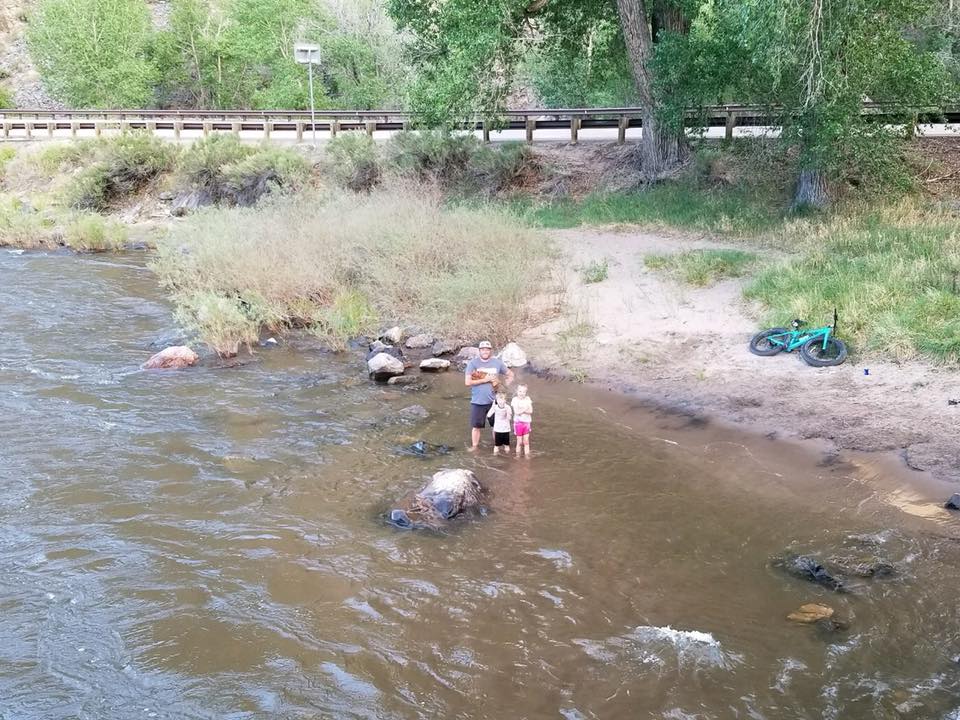
    Ok, that might be a hard word.  She’s a city girl after all and how many times is she by a river?  Unless you count that time two months ago where she went camping by a river bed and went white water rafting in a river.   River?? She missed River?  How was that possible??  We laughed just two months ago about how her puppy Pretzel ran head first into the river.  We walked to the river at LEAST a half dozen times on our camping trip and she missed…. river???

    Okay, maybe that was a fluke,  What’s next.  What else did miss?

    Vase

    Vase? As in the vase her dad just pulled out a week ago to put the flowers he bought me in?  The same vase she was looking at while remarking how beautiful my flowers were in it?  The same vase she helped fill with water so the flowers wouldn’t die? That?? That vase?  She missed VASE???

    Naw, it has to be fluke,  What’s next?

    Heart

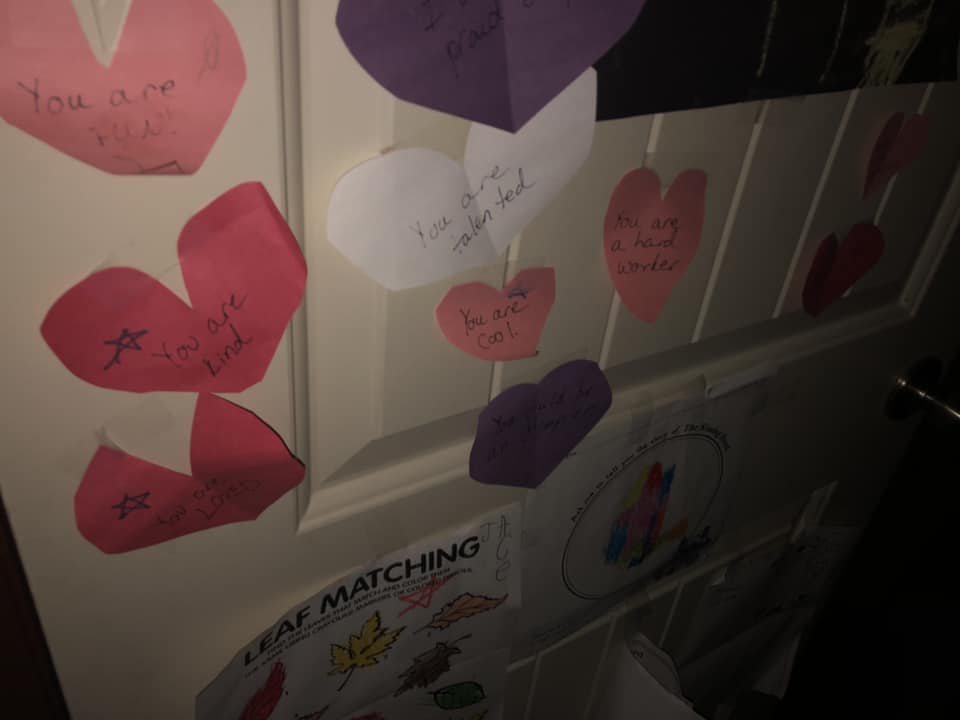
    She missed heart???  Heart?? Like the hearts that were placed on her door each day last Valentine’s day with a positive characteristic about who she is and what she does?  Heart, as in the candy hearts she loves to eat and read out of her Valentine bags? Heart, as in the shape that her younger brother Jace learned to draw before her and she lamented over saying she didn’t know how to draw a heart yet?  That same heart right??

    Let’s move on.

    Aquarium

    Aquarium??  As in the Denver Aquarium she’s been to twice and pet the sting rays and taken pictures with the mermaids?  That aquarium?  Or, the multiple aquariums in Vegas where she watched the fish and awed at their majesty?

    Okay next?

    Flaming

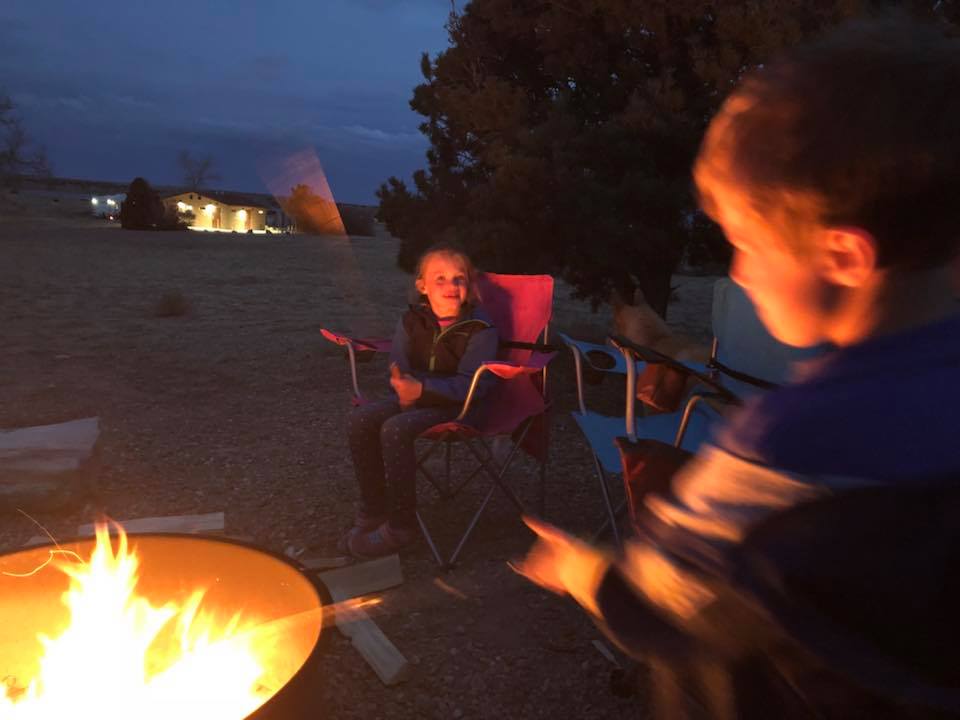
    Flaming?  Flaming as in the flames from the fire she has watched at least over 30 times on all the various camping trips she has been on in her nine years? Or maybe the flames the entertainer was spitting from the fire and ice show we attended a year ago?

    Canoe

    Canoe?  As in the canoeing activity she has done now twice at a special needs camp called Adam’s Camp and reported it was one of her favorite activities?  Or the canoe her aunt has that she rode in and watched her Aunt and Uncle ride in on an annual camping trip we take every year?

    She missed…….canoe?

    THAT my friends, is a language disorder. She has not only been exposed to and experienced many of the concept vocabulary she missed, but she has also been taught explicitly this vocabulary by me, a Speech/Language Pathologist.  She has been read a book (at least) every single day of her life.

    Enough with the 30 million word gap.  It doesn’t mean crap when your kid has an actual language disorder.

    Enough with the judgement.

    Enough with the blame.

    Enough with the shame.

    My kid has an actual language disorder.  If my English speaking kid with an SLP as a mom has a language disorder, so can children from other monolingual or bilingual families. Stop the blaming.  Stop the assumptions.

    Let’s get more awareness and compassion and let’s recognize a developmental language disability, aka specific language disability aka mixed expressive/receptive language disability aka specific language impairment as an actual childhood developmental disability and not an environmental disability.


  • SLP’s integral role in the five components of reading

    SLP’s integral role in the five components of reading

    When I was younger and learned to read, I remember I was taught phonics.  I remember the phonics workbooks I had, and would read the rules at the bottom of the page for spelling.  It was all very systematic. Little did I know at the time, phonics was just one part of the five components of reading that can contribute to reading disorders.

    Today, a concept called whole language dominates our public education systems.  Not every school district or school uses this approach, but very many of them do and it is at a detriment to our children who have reading disorders.  Some critics go so far as to say whole language is “anti-phonics.”  I don’t believe it’s quite that extreme.  However, for kids who have reading disorders, the vast majority struggle with phonemic awareness and decoding, which a whole language curriculum is not even close to adequately addressing.

    I’m fortunate that when I started my career, Ashlynn’s SLP was very knowledgeable on the topic.  I had no idea that learning about the five components of reading before my child was even conceptualized would come back and benefit her some day.

    So, what are the five components of reading?

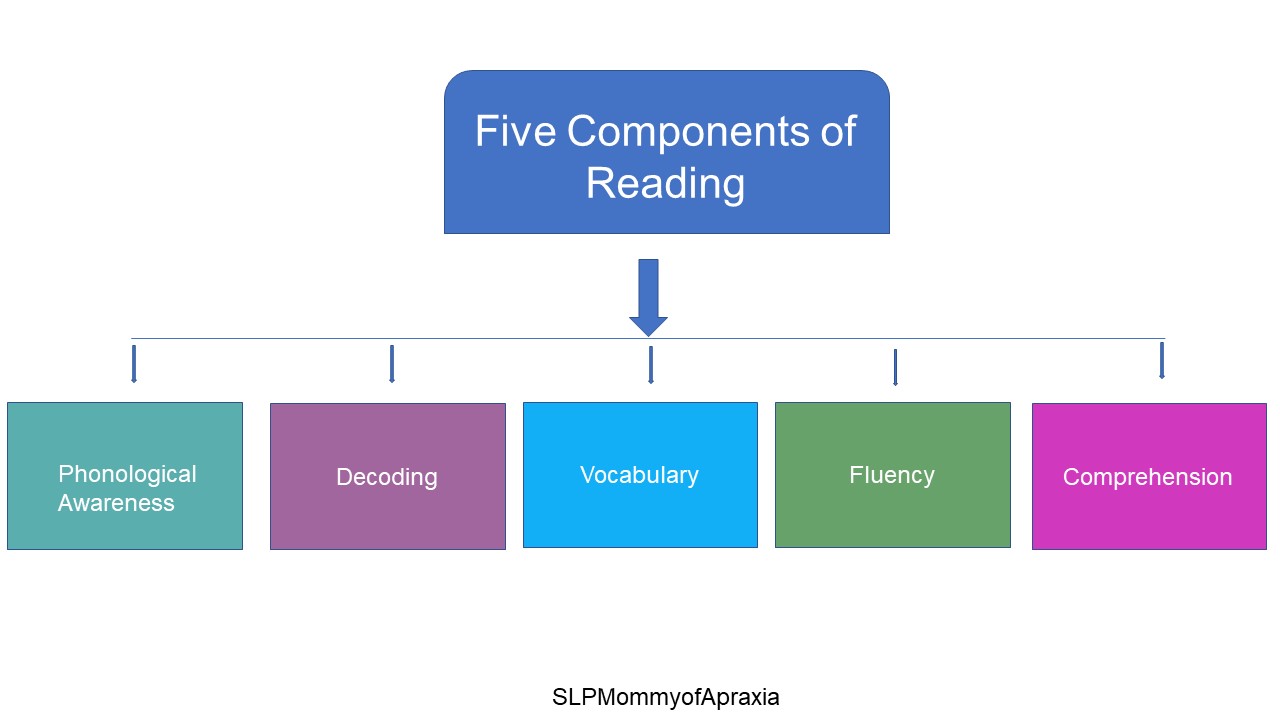
    They are: Phonemic Awareness, Decoding, Fluency, Vocabulary, and Comprehension. These areas were identified by the National Reading Panel that was convened by Congress in 1999. It’s very important that parents and educators are aware of these five components, because weaknesses in any one component can cause a child to struggle to read.

    Speech/Language Pathologists can play a big role in reading.  They are trained and certified to treat children with three of the five components.  A Speech/Language Pathologist can work on phonemic awareness, vocabulary, and comprehension.  This is why they are frequently on IEP’s when children have reading disorders.  It is very infrequent that the older school-aged child with dyslexia is seeing the SLP to work on their “sounds.”

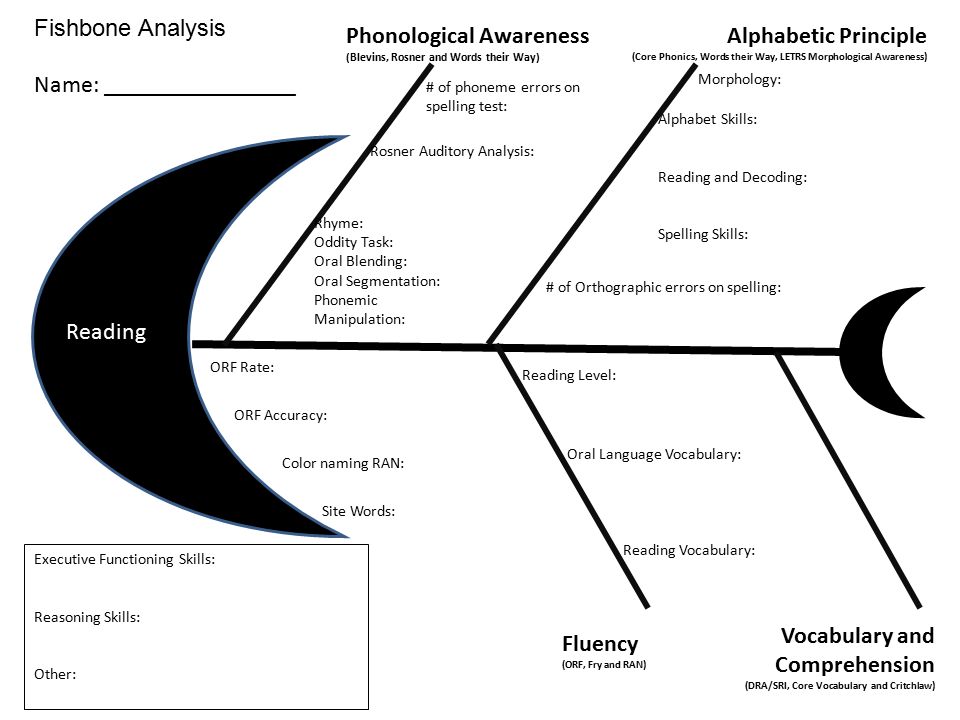
    Parents and educators all need to be aware and familiar with these five components if they want to help children effectively who are struggling to read.  During my time in Denver Public Schools, an excellent teacher advocated the use of a “fishbone” analysis when testing kids who were struggling to read.


    As you can see, it contains the five components of reading, and spaces to document a child’s performance in all five areas.  It could be possible to have a child who has difficulties in all of these areas.  However, more frequently a couple of areas usually stand out.  One area that is frequently a problem is with phonological awareness skills.  This can be tricky because elementary school children many times get identified with a reading disorder past the time that instruction with phonological awareness is taught.  Teachers jump right into reading instruction without realizing the child is lacking the basic building blocks for reading in the first place.

    So what is phonological awareness?

    Phonological awareness refers to a child’s ability to manipulate sounds out loud.  Tasks included in this umbrella might be to identify the initial sound in a word, blend sounds, segment sounds, identify the last sound in a word, or be able to identify and formulate rhyming words.  Logically it would make sense why this is a building block skill.  If a child can’t do these things out loud, it’s going to be very difficult to transfer these skills when looking at graphemes (letters).

    Phonics/Decoding

    Phonics refers to the actual act of sounding out words.  To do this skill, children need to have mastered knowing letters and letter sounds, and then be able to use this knowledge of letter sounds to “decode” a word.

    Vocabulary

    A child’s vocabulary many times affects background knowledge, which is important in reading.  If the words they are trying to read hold no meaning due to low vocabulary skills, it is going to be harder for them to understand what they are reading.  In addition, a child with weak vocabulary skills will have a harder time monitoring their comprehension when reading sentences.  I see this all the time as an SLP. An example of this would be if a child were to read the sentence “He saw the dog.”  Instead of “saw” he/she read “sam” and they would continue reading.  Many children without a language disorder would realize “He sam the dog” didn’t make sense and go back and try and fix the sentence so that it makes sense. Kids with language disorders have a very difficult time with this skill.

    Fluency

    Fluency refers to a child’s ability to read text accurately and quickly while maintaining good expression.  The ability for a child to read fluently helps with comprehension.  If a child’s fluency is slow and choppy, they may be allocating so much brain power to decoding that they are not monitoring comprehension. If a child lacks expression in their reading, this too can affect comprehension.

    Comprehension

    Comprehension is simple terms, means understanding what we read.  Kids with a mixed receptive/expressive language disorder or an auditory processing disorder frequently experience difficulties with text comprehension.

    What does this mean for parents?

    The bottom line for parents is that reading is a complicated process that has many components.  A deficit in one or more of the above listed components can cause a child to struggle when learning how to read.  Children with speech and language disorders are at high risk for reading disabilities. Being aware of all five components helps parents be more informed regarding treatment approaches and options their child may need to catch up in reading.

    This article contains information from the National Reading Panel’s Findings


    Laura Smith is a first and foremost a mom to two amazing children, one of which who carries a constellation of invisible labels including: Childhood Apraxia of Speech, dysarthria, SPD, ADHD, MERLD, dyspraxia, dyslexia, and cerebral palsy. She is a speech/language pathologist specializing in Childhood Apraxia of Speech following her daughter’s diagnosis.  SLPMommyofApraxia is her space to share her professional and personal experiences related to the complex but beautiful world of neuro-diversity and to spread a message of hope, positivity, acceptance, and kindness.

  • 1st Day of 3rd Grade

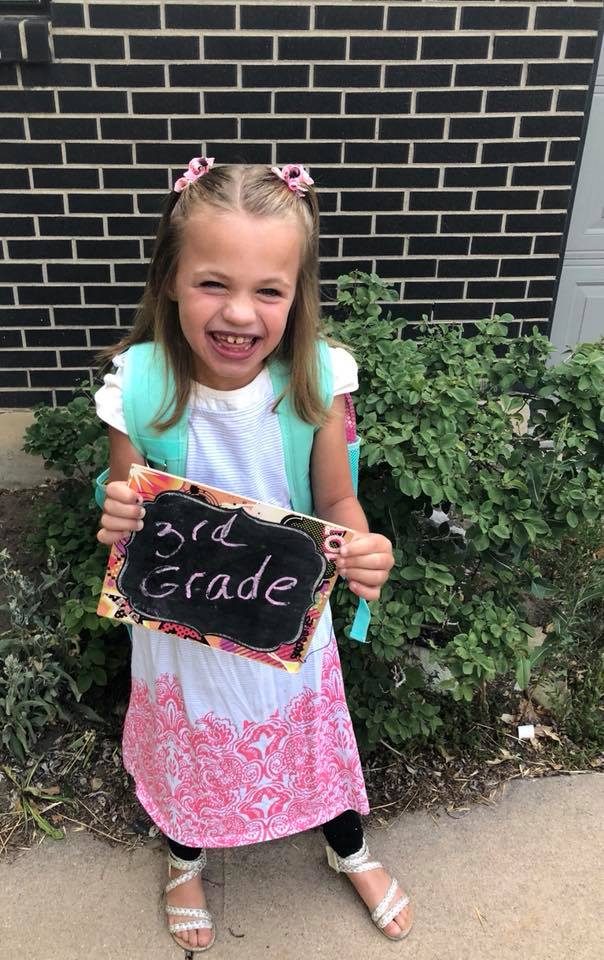
    1st Day of 3rd Grade

    My dearest Ashlynn,

    Your courage amazes me daily.  It inspires me and pushes me beyond any limit real or imagined.  Today was your first day of 3rd grade.  You have been waiting for this day since the last day of 2nd grade.  Actually, quite possibly since the first day of 2nd grade when you told me,“After 2nd grade you I will be in 3rd grade!”

    I emphatically responded,

    “We need to make it through 2nd grade first!”

    We bought you a new backpack, new outfit, new shoes, and you got a new haircut.  Two out of the four items went as planned.  The backpack and new shoes went off without a hitch.  The other two? Well Ashlynn, it’s just not our style to have a few hiccups is it?

    Getting a new haircut is always an adventure.  Your dyspraxia, ADHD, SPD, and receptive language issues make following specific commands somewhat challenging don’t they?  I stepped in to help guide your head where it needed to go so the stylist would stop reminding you of how hard it was for you to follow those simple commands.

    Then came the new outfit.  We picked it out together!  I didn’t think we needed to try it on because I know what size you are and I was sure it would fit.  Last night we hung it up on your dresser anticipating the first day of school! However, this morning when you went to put it on you were more confused than ever.  I came into help and realized I had bought you a romper! That flowey material fooled both of us didn’t it!!  I could have sworn it was a dress.  A romper though?  Yeah, not a friend to the girl who has dyspraxia.  I apologized and offered other options in your closet.  We chose a pretty sun dress you hadn’t worn much, but I still felt bad.

    You took it in stride though!

    All morning you were jumping up an down and excited to go to school and I marveled at you.  School is so hard for you.  Last year you came home with bloodied shirts or completely different shirts because you had so thoroughly stained yours from picking your finger nails.  Almost every assignment you completed you struggled in, and many times you ate and played alone.  How on Earth were you excited to go back to that?

    Three days before we saw an ex client of mine who is your age.  Her apraxia is resolved and she has residual learning disabilities.  She told us how she didn’t want to go back to school because she was bullied and you sat there un-phased.   I thought to myself if I were in either of your shoes I would feel like my client; yet I was so grateful you are you.

    You have a strength and internal resolve I am working towards.  You have courage and resiliency I have yet to conquer.  Where my instinct is to run back your instinct is to jump forward.

    I am inspired by you.  I am always going to be here by your side.  I’m going to love you, but I’m going to push you.  I’m going to do everything in my power to help you obtain the tools you need in order to live life on your terms.

    It took me many years to believe and even more to practice this simple advice:

    Heck it takes grown men and women to follow this advice, and let’s face it.  Some die before they ever follow this advice at all. YOU embody this.  YOU are a living testament to this.

    Pursue it all Ashlynn!  I’ve always got your back and I’m your biggest fan!

    Love,

    Mommy

  • This school year, teach your children to be kind.

    This school year, teach your children to be kind.

    Fresh backpack, lunchbox, shoes and school outfit are waiting tomorrow for my child’s first day of school.  There is an excitement in the air as we bought school supplies and met her teacher last week.  She picked out her name tag like the other kids and picked her seat.  She flashed a big smile to her new teacher and chattered endlessly about school starting again and how she was excited to go back and to learn.  We went and got a new haircut and she told the stylist how she was starting third grade.

    Tomorrow I will take the historic first day of school picture. I will probably proudly post it on all of my social media accounts.  I will most likely scroll back and look at it a couple of times and wonder where my baby has gone.  I will marvel at how this school aged girl with long legs is standing on my front porch.

    That is where the similarities will end.

    As many parents cheer and are relieved to get back to a routine, I’m left with only nerves and trepidation.  The summers in my house are happy.  My daughter is a child who can explore the outdoors and experience life as a carefree and curious kid.  She plays with neighbor children until bedtime and explores campgrounds on the weekend.  She makes mud pies and collects dirt under her fingernails that need to be clipped and scrubbed frequently.

    Unfortunately school brings other stories.  The child who played carefree until bedtime with neighbors is the same child who is frequently seen sitting with her teacher’s aid (TA) at lunch and playing by herself on the playground.  The fingernails that grew long and collected dirt over the summer are replaced with widdled down nubs during school that are bit, picked and chewed so much that her shirts frequently come home bloodied or on some really bad days, have to be changed completely.

    The girl who chatted endlessly to family and friends is the same girl who is quiet and reserved at school, frequently clamming up when put on the spot or asked a direct question.

    The child who could explore during the summer and jump from varying activities is the same child who frequently loses focus and can’t concentrate on subjects at school.

    My child has invisible learning disabilities.

    Many of them.

    However underneath them, she is still just a kid like your son or your daughter.  She is curious.  She is friendly.  She wants friends.  She craves connections.  She’s excited to learn.

    This year as you talk to you children about their new teacher, new classroom, and new adventures, I beg you to talk to your kids about being kind.  I beg you to explain to your child that children with disabilities are just like them, but it might take a little longer to understand or get to know them.  If nothing else though, please just teach your children to be kind.  Maybe ask about something they did that was kind alongside your questions of who they played with or what they learned.

    Our kids will thank you for it!

    Sincerely,

    A proud mama to a child with hidden disabilities