Category: special needs

  • The problem with school SLP’s.

    The problem with school SLP’s.

    I only realized after being a part of the special needs community that school SLP’s have a bad rap.  Like a really, REALLY, REALLY bad rap.  

    I’m preparing a talk next month for Colorado school SLP’s, and every time I prepare a talk for this demographic, I have to tell you they have a special place in my heart.  No, it’s not just because I started as one and work as one part time, but it’s because I have literally worked under, with, and around many, many, MANY of them. I have worked with so many of them, and I can tell you they are a jack of all trades.  They are the EXPERT in eclectic, and may be the ONLY person in the school who understand in depthly just how a student’s unique communication challenges actually affect them in school.

    In the schools, you don’t have the option to specialize.  Kids from every disability show up on your caseload and you are expected to be the expert.  It might be hard to understand as a parent, but there are soooo many different disabilities and speech and language disorders, and a parent (rightly so) expects the SLP to do right and best for their baby.

    Every single SLP I know and have met has a desire in their heart to help children.  Please, let that sink in.

    When I took Ashlynn to her first private SLP who had never worked in the schools she was asking me about qualification.  She asserted that she could never be a school SLP because she felt it was unethical to not qualify students who clearly had some sort of speech or language problem.  I had a hard time refuting her.  Aside from saying qualification is different in the private versus educational sector, I really had no excuse.  I know that funding is limited in the public sector so that obviously plays a part in qualification.  I also know if every SLP took her stance, than NO kids would be serviced in the public schools, and is that really what we are going for?

    Public school SLP’s have caseloads that are probably double if not more of the private SLP.

    Where the private SLP can see kids 1:1, school SLP’s rarely have that luxury.  With weekly caseload averages around 45 to 55 and some maxing out at 90 (Yes 90 people I’ve seen it), even the most skilled SLP will not be able to do what a private SLP can do 1:1 for 45 minutes (though they will kill themselves trying).

    The result?  Parents become outraged at the lack of progress or progress they feel the child should be making. They surmise the school SLP just isn’t as good as the private SLP and they become disillusioned and write them off.  They post memes about preparing for battle when going into an IEP meeting! This honestly breaks my heart.  I feel bad for the parent who feels the SLP doesn’t care, and I feel bad for the SLP who is trying to manage an unmanageable caseload, writing IEP’s at night, or staying up until 2 Am (true story from an SLP I just talked to last week) to write a lesson plan, only to be ravaged by a parent unsatisfied with the results.


    I’m not sure if everyone is aware of this, but ANY SLP in ANY setting is as qualified as the next SLP by basic certification standards.  What does that mean?  That means, as long as an SLP received their masters degree and the Certificate of Clinical Competence (CCC) through ASHA they can work anywhere.  So that means, your school SLP can apply for a job at Children’s Hospital right now and probably get hired tomorrow (because in case you didn’t know there is an SLP shortage as well).  For some reason though, there is this perception that the school SLP just isn’t as good as the private SLP.  If it’s true, it probably has MORE to do with caseload and workload size than it actually has to do with the qualification of the SLP.

    I get calls and emails all the time from concerned school SLP’s desperate to meet the needs of their kids with apraxia but not knowing how.  They want to see the kid more, or see the child 1:1, but their caseload simply does not allow for it.  They cannot add more hours to the day, yet they still call, or write and wonder if there is something they have not yet thought of.  Oh, and here’s a dirty secret.  Listen close.

    Are you listening because this is VERY important.

    If an SLP feels in their heart a child needs private, supplemental speech services, they CANNOT say it.  People, they CANNOT tell you this.  Why?  Well, their license and job is on the line.  In most cases, school SLP’s are told not to recommend any sort of outside therapy.  Why do you ask? Why?

    I’ll tell you.  If a school SLP recommends outside services, the parent can sue the district and win, and potentially disbar an SLP from ever practicing again.  Are you asking why again?  I’ll tell you.  If a school SLP recommends outside services, they are essentially saying that the child can not benefit or make progress from the therapies provided by the school, and the school is required by law to show progress.  If the SLP recommends outside service thereby saying the school is inadequate, the school gets worried or they will get sued for not providing adequate services and the SLP potentially fired.

    Would you take that risk?

    I’m not saying unilaterally every school district would do this, I’m just saying, school SLP’s are told this is a possibility, and so they would find it best not to recommend outside services.

    You need to know this as a parent of a child with any disability.  Some SLP’s will risk their professional license and recommend this to you.  Let me  tell you though what they are risking.  They are risking 4 years of a bachelor degree, 2 years of a masters degree, 1 year of a clinical fellowship, and the usually 3 years of probationary status as a teacher.  That is an entire decade of work and dedication to a profession they love and believe in.  Would you take the risk then to recommend a parent pursue outside therapy?  This is where they are at!  It is truly a catch 22.

    If you are upset about your school services, you probably have every right to be!  I was VERY unhappy with Ashlynn’s preschool, in-class only, speech/language services.  However, it is important to place the blame on the right entity and in most cases I can assure you it is NOT on the school SLP’s shoulders.  In Colorado, the Colorado Department of Education mandated an inclusion model only of special education services in preschool thus making it extremely difficult for any school SLP to pull a student out into a 1:1 session.

    My message today is this: School SLP’s are some of the most phenomenal group of people I ever have the honor to speak with or to. They do not get the option to specialize, and so they pursue advanced training and expertise in every disability that may affect communication: from Apraxia to Angelman’s Syndrome, from Developmental Delay to Down Syndrome, from Cerebral Palsy to Stuttering, from Language Impairment to Nonverbal Learning Disability, from Assistive Technology to Autism, from Auditory Processing Disorder to Articulation Disorder,  school SLP’s will see it all and be expected to rise to the challenge.  They cannot “refer out” or “discharge for lack of progress” as an can be done in private speech. No, the school SLP is expected to figure it out regardless of the lack of resources, lack of funding, or lack of time.
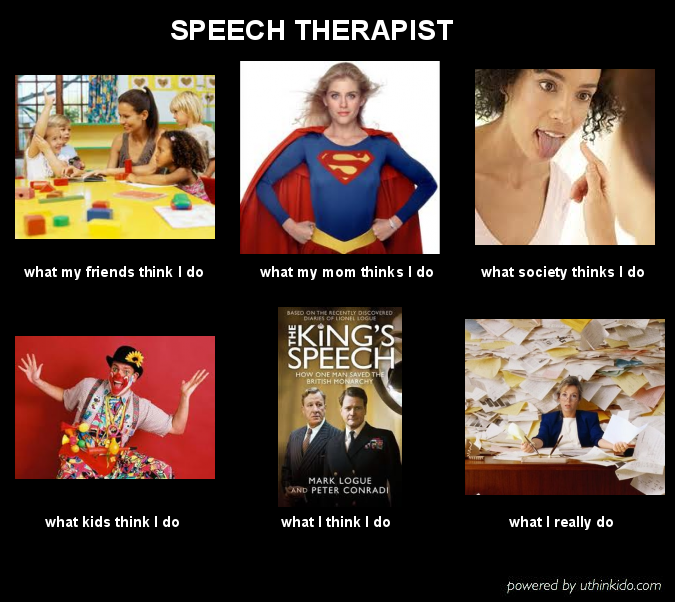
    They will be faced with limited or no space, they will be strapped with high caseloads, and criticized by parents; yet they will persist and pursue only becoming better for it, because of their love for the children and the profession.  I personally have witnessed it time, and time, and time again!

    I can tell you firsthand, getting into graduate school for speech/language pathology is VERY difficult.  It is highly competitive, and here in Colorado, the average COLLEGE GPA was a minimum of 3.87 when I applied.  I found this graphic from 2011 but I can tell you things have not changed much.  There is a HUGE gap between the number of applicants and the number of people selected. 
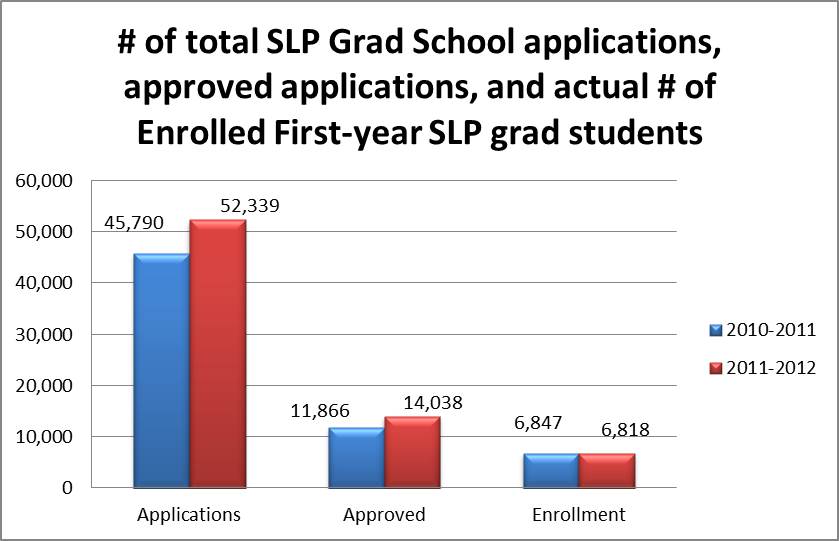
    The disparity should be striking, and please remember that MANY of these applicants will be YOUR school based SLP.  If you have the mentality that “C’s get degrees” and you are certain your school based SLP fits the latter, let me correct you.  NO average C students make it to graduate school in the first place for speech/language pathology.

    Truth

    For my final thoughts I wish not to be adversarial.  I hope that this article has persuaded you, a parent OR SLP, to reach out to the other side and bring about the change you wish to see.  I have the unique perspective of being on both sides, and as such, I have the utmost RESPECT and LOVE for both sides.  I truly wish for there to be a conduit of communication, and not a  ridge of animosity and distrust; and at the the forefront, I wish to impart a spirit of solidarity between my professional and special needs relationships.

    To read more from SLPMommyofApraxia follow her on facebook, pinterest, or twitter.


  • There is either fear or hope.  Pick one

    There is either fear or hope. Pick one

    Life would be so much less complicated if we lived on breaks.  haha.  Yes, that is my opener and I realize it’s not only a statement captain obvious would make, but it’s completely devoid of reality.

    Seriously though, breaks are awesome.  Family comments how far Ashlynn has come.  We are all stress free (well at least from school and work stress).  We can spend time as a family doing things together we wouldn’t normally have time to do.  We’re not in “go” mode all week trying to get to school, to therapy, get the homework done, and all the other million appointments we have.

    I don’t have a daily reminder of how hard things are for Ashlynn, like tonight, doing homework with her again.  Don’t get me wrong, she’s improving…so, so SO much.  It’s just, when we’re doing homework,  I realize we’re improving, but nowhere near the pace the class is going.  I feel like Ashlynn is more keenly aware of it too now, or maybe she always has been and now she can just verbalize it.  Tonight we did her reading, her math, and then practiced her spelling test.  I think she said at LEAST 8 times something like, “it’s just my brain!  ugh.”

    We are not punitive.  We are patient.  We tell her EACH time, something to the effect of, “Ashlynn, it’s okay sweetie.” and I might add, “you have apraxia and also have a hard time getting the words out, it’s okay.  The more you practice the better you’ll get,” but then she’ll stumble on a word again, or say the wrong number when we are counting by tens and hit her head and again announce “Ohhh my brain!’

    Hearing it once is hard.  Hearing her say it twice is hard.  Hearing her say it repeatedly despite our words of reassurance and patience is excruciating.

    Damnit.  Damnit.  I had to walk away and have my husband help her.  This isn’t fair!!!

    I got on my phone and checked fb.  In the apraxia group a woman posted a picture of her son crying while looking at a reading passage.  My heart broke all over again.  Stupid apraxia.  Stupid apraxia.  Ashlynn isn’t crying….yet.  Will she be? Will she get to that level of frustration?

    I was feeling down again.  Two weeks back at school and I feel sad again.  All that joy and happiness of the vacation gone.

    Then I read this.  A blog post by an adult who had grown up having apraxia.  She outlines the day she went back to her old reports and progress reports and how she discovered that in early elementary school she spent 80% of her time in special education. She says the reports all started with how teachers would comment she was a hard worker and tried hard. I immediately thought of Ashlynn.  Every report says that about her.

    She talks about how she just wanted to feel normal.  She says you could see her “subtle progress” through the years as she started spending more and more time in general education.  By highschool she still had report cards that said she was a hard worker and tried hard, but now she had a GPA of 4.5. She muses that she doesn’t even know when that transition from “special education” to “straight-A honors geek” even happened.

    She concluded that apraxia fueled her strong work ethic, and though she is sad she never achieved “normalcy” she decides maybe it was all for the best.

    I needed to read that right now.    I needed to read that because I needed hope.

    You know what drives parents of special needs kids?  You may think it is the love for them, and yes of course that is true.  However, at the core, even on the darkest days, what drives us to face a new day with strength while we hold their hand is….hope.

    Hope is the belief that despite any challenges we may face and how many times life will knock us down, we will wake up tomorrow still standing, still growing, and still achieving.  Sometimes hope may be a flicker, and other times a fire, but as long as it is still there, we will continue to rise

    again

    and again

    and again.

    Thank you Alyson for sharing your story AND re-igniting HOPE.


  • When you can talk but have no words

    When you can talk but have no words

    If you are familiar at all with apraxia of speech, then this meme makes perfect sense to you. Most kids with apraxia, especially in the early stages cannot communicate what they are thinking because they cannot talk or make the sounds make sense.

    (Not) fun fact: Some kids (I don’t know the percentage offhand), will also have an additional language processing disorder with the apraxia.  This adds another layer of complexity and makes it more difficult for kids to express themselves with language even if they can actually articulate all the sounds correctly.

    Such is the case with Ashlynn.   Now, to be clear, Ashlynn can  talk my ear off.  She talks so much sometimes I have to tell her to stop talking, like when she has food in her mouth or when we are brushing her teeth!  She speaks in sentences, has long sentences, has question forms, and is gaining new vocabulary words daily.

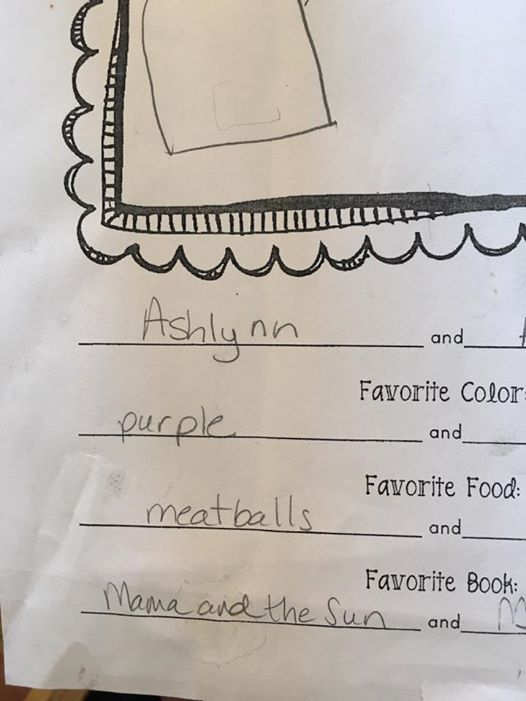
    The other day, she comes home with this paper:

    Seems normal, except, the only thing correct is her name.  She has never declared a favorite color, she doesn’t eat meatballs, and I’ve never heard of this alleged “favorite book.”

    “Ashlynn,” I asked.  “Why did you say your favorite food was meatballs?”

    “Ugh my brain!” she said as she slapped her forehead.

    “Honey, why would you say meatballs though?”

    She points to a cookie tupperware sitting on the counter.  Over break we had made Christmas cookies called Pecan Drops that are round little balls.  She says, “What are those called?”

    “Pecan drops?” I offer.

    “Yes! Pecan Drops!  Ugh my brain!” she exclaims.  Sigh.  Poor thing.  Can you imagine?  What must that be like?  She knew EXACTLY what she wanted to say, but couldn’t access the word pecan drop and settled on meatball instead.  Someone even wrote it down for her and she just had to go along with it.  This is what always amazes me about Ashlynn.  She like NEVER gets frustrated.  How is that?  Wouldn’t that be frustrating?  She was just happy she could spit out a word and complete the activity.  She didn’t care they didn’t know she was trying to say pecan drops.

    I look down the list.  What book is this?  We’ve never read this book?  Is this really your favorite book?

    “No,” she laughed.

    I looked at my husband and told him maybe one day one of these about me papers will be accurate.

    Later that day, I saw a fun game on facebook where parents were asking their kids to answer questions they asked them.  It was to show how much your kids pay attention and really know you.  Questions were things like, what is my favorite food, what makes me happy, etc.

    I asked my four year old and he was funny.  I told my husband to do it with Ashlynn and handed him the questions.  This girl who talks with her mouth full and while she brushes her teeth was reduced to a pantomiming nervous wreck.  I could have cried watching it.  She knows all those answers.  She pays more attention to us than anyone.  She will be the first one to notice a haircut, a new shirt, or change in the decor.

    My husband asks the first question:

    “What is something I say a lot?”

    I KNEW she would get this one.  She tells me what he says all the time.  She tells me “Daddy says he loves me forever.”

    She stood there and looked visibly anxious shuffling her feet from side to side.  We gave her processing time, we didn’t rush her, we were patient, we both asked again phrasing it differently, still nothing.

    “Ask the next one,” I said sure it would be easier.

    “What is something that makes me happy?” Cody questioned. I knew she would have this easy.  She waited a time and then just pointed at herself.  She didn’t even say her name.  It’s true she makes Cody happy, but I couldn’t believe she wasn’t saying the jetski, or his snowboard, or his video games.  Hmm.

    “What makes me sad?” Cody asked as the next question.  She pointed to herself again.  My husband gave a half smile.  “You don’t make me sad Ashlynn,” he said as I sat there feeling that exact feeling.  Sad.  This was so sad.  Where were her words?  When I say and write about crippling word finding, this is what I’m talking about.

    He skipped down.  Ashlynn has been to his work now twice with him for take your kid to work day.  She knows he works on computers.  He asked her if she knew what his job was.  She sat there and started shuffling her feet again.

    He asked the last question, “How much do you love me?” and she put her arms out wide, again with no words. 🙁 🙁 🙁

    Sometimes it’s such a cruel, cruel, cruel disorder.

    Seriously.

  • The irony of the Chicago Hate Crime

    The irony of the Chicago Hate Crime

    By now, you have probably seen or read about the special needs man who was kidnapped and tortured by 4 other individuals.  Some reports say it was racially motivated, yet others said they targeted a person for being special needs.

    I made myself watch the video.  I got through a fair amount.  I saw this man cower in a corner while he was beat, kicked and punched.  I saw the fear in his eyes.  Oh God his eyes.  I saw them bully him into getting up and going to the bathroom and I saw him get on his knees and drink the water out of the toilet while they laughed.  That’s when I stopped and turned it off.

    Some call it evil.

    To me, it was simply the worst of humanity.  It was a display of everything bad that humans can be, and what’s worse, they had no ounce of shame. Not one drop of shame as they proudly and mockingly recorded it on video.

    I have a special needs child, and I work with special needs children every day and I can resolutely tell you this:

    They represent the BEST of humanity, what is GOOD in humanity.  Their innocence and joy are a display of everything good that humans can be, which is what makes this hate crime so utterly despicable.

    This isn’t the first time this has been on the news.  It made me remember a story I heard of a young man who had autism and his peers dumped human urine and feces on his head, also capturing it on video for presumably bragging rights or some sick form of entertainment.

    I’m sad.  I’m sad and then I get angry, and then I get scared because I’m not sure if Ashlynn would know if she was being bullied yet, and I worry she could fall into some mean trap, and all she’s ever done is “spread her sunshine” as my sister puts it.

    I don’t like seeing the worst of humanity.  Maybe that’s why I surround myself with people whom I feel are the best.  They make me remember the good that’s in people because when you read stories like this you can’t get enough reminders that there IS still good in this world.  It’s easy to get cynical.

    If you are reading this, I ask you to do one thing, make one promise each day when you wake up that today you will choose to be KIND, and if you have children, you will teach them too to just be KIND.

    At the start of each day,  I’m going to start asking my kids to do something kind for someone, and then at night I’m going to ask them what they did that day that was kind.  #choosekindness  and teach your kids to do the same…..because PLEASE remember:

    Kindness is an active endeavor, not a passive one.


  • One kickass family, finding your tribe, and other lessons from Finding Dory

    One kickass family, finding your tribe, and other lessons from Finding Dory

    I finally watched “Finding Dory” last night.  I had already wanted to see that movie because I’m sorry, Ellen Degeneres is awesome, and her Dory character in Finding Nemo is the best!

    However, when the movie came out, my clients started asking me if I had seen it.  “No…” was my reply as I sighed in disappointment.

    “You HAVE to see it!” was the resounding response.  Yeah, yeah, I know.  I want to.  In good time.  I will.  One day.  Then I started to read about it on the disability pages and websites I’m part of.  Finding Dory had struck a cord with a variety of disabilities including: depression, autism,  sensory processing disorder…the list goes on.  I purposely didn’t read them so the movie wouldn’t be spoiled.

    Ashlynn is seven and to this has never been interested or captivated by movies.  She completely checks out and gets distracted and then I’m annoyed and movie time is over.  Whatever.

    Jace is better at watching shows, but he has about a 30 minute attention span for a story.  Now he can watch 3 successive 30 minute shows, but watching an entire movie is not really his forte either.  I obtained a copy of Finding Dory, and since I’m on break, I was finally able to fire up the DVD player and put in a movie.  It was seriously below zero outside and I was excited to get cozy and watch a movie with the kids. Ashlynn was interested for about 3 minutes before she announced she was going downstairs to play with her dad.  Jace snuggled with me for about 30 minutes, his max, before dragging out toys and playing with them.  So much for that fantasy.  Oh well…

    I was HOOKED.

    If you know me, you know I talk about emotional intelligence.  I talk about it so much because I wish it was valued as much as intellectual intelligence.  I have met brilliant people who literally cannot function in society or hold a job because they have zero ability to relate to other people.  I would argue they have a disability in emotional intelligence, but  no one cares about emotional intelligence so those people don’t get the proper help they need either.

    This may be me because I think too much, and please don’t quote me because I am only stating an observation, not a research article; but isn’t it curious that many people who are gifted in intellectual intelligence seem to have a deficit in emotional intelligence, and those considered to have an intellectual deficit seem to have a heightened emotional intelligence?

    Let me give you an example.  I have a young 5th grade friend in the schools who has Down Syndrome.  This kid is some sort of angel.  I mean, everyone loves him!  Even my toughest, most challenging fifth graders will smile and tell me, oh yea…he’s cool.  Sure they know he’s different, but he just has this special charisma you can’t NOT love.  I mean I know I’m biased, but I LOVE this kid.  If I’m having a bad day, or even if I’m not, this kid makes it instantly better with his smile, his incredible memory for names despite his memory difficulties for other tasks, and his social competence.

    I was talking to the main school SLP before break, and she was telling me a friend we have with autism in the 1st grade started school and his mom was terrified no one would like him.  One day when she was picking him up, this fifth grade friend was passing by, and stopped and asked if this woman was the 1st grade friend’s mom.  She replied yes and he smiled his big perfect smile and announced how happy he was to have this boy at his school, and he said the boy’s name.  When he walked away, the mom was crying because she was so happy that someone had noticed her son and not shunned him, and someone had actually even known him by name.

    THAT’S emotional intelligence.  To have THAT effect on a mother of a special needs child takes an incredible person, and that person is my 5th grade friend who just happens to have Down Syndrome.

    Oh but I digress.  Back to Dory.

    Where do I even start with this movie??  I guess since I’m on the topic, let’s start with emotional intelligence.

    Dory suffers from short term memory loss.  Consequently, she is not the person, ahem fish, who is good at math, reading, writing,  or following directions.

    She WAS, however,  the fish to whom young Nemo looked up to the most.  He felt loved by her.  At the end of the day, do you want to be with someone who is smart, or who makes you feel loved?  I’m pretty sure most people would say the latter.

    Let’s go to her parents.  She does finally find them, and as she gets closer to home, she starts remembering more and more.  Maya Angelou said, “people will forget what you said, people will forget what you did, but they will never forget the way you made them feel.”

    Dory started to feel loved again, and through this she started to remember more and more.  She starts to remember the encouragement of her parents,

    “It means you can do whatever you put your mind to.”

    “When life gets you down…just keep swimming.”

    I smiled watching those moments and thought of a phrase someone told me once when talking about prognostic indicators, “Don’t underestimate the power of one kick ass family.”  Dory found her way back IN SPITE of her disability because of her belief in herself that was fostered and ingrained by her family.

    Finally, the parents.  Watching the opening scenes and seeing their realization as to the extent of her disability, but then the resolve to put things in place to help her overcome it speaks to EVERY family I have met.  The anxiety that is 10x magnified when you have a child with special needs, the strategies you try and teach to help them compensate, and the undying hope they exhibited at the end of the movie as Dory realized they spent the entire time she was missing laying out shells for her to find her way home……it speaks to the painful yet infinite hope we parents have in our children.

    Finally, when Dory was reunited with her biological parents, she was separated from the surrogate family, Marlin and Nemo, she had known now for years.  Her parents understandably didn’t want her to risk her life again to get them, but she was not deterred.  They were her family too, if not by blood…they had been loyal, they understood her and accepted her, and appreciated her for all of her talents.  So much so, that Nemo frequently used the phrase, “What would Dory do?” to problem solve.

    So no.  Dory went back and rescued Marlin and Nemo, because if you are in the special needs community, you know what it feels like to have found your tribe, even if they aren’t blood; and so you will go back because your tribe understands you, they love you just for who you are, and when you have found your people, it is unacceptable, no UNIMAGINABLE  to lose them too.

    Finally, at the end, Dory’s memory has improved and she is living with her biological parents and surrogate family..her tribe.  She declares she is going to swim to the drop off..a known danger zone if the fish ventures further.  Marlin, her surrogate friend freaks out, reigns it in, and then supports her.  Fearing for her safety though, he cautiously follows her to make sure nothing happens.

    Without looking back she remarks,

    “Hello Marlin,”

    to which he tries to casually play off.  She of course though has a heightened emotional intelligence and tells him, “You look worried.”

    He replies something to the effect that he’s pretty sure that’s just his face now and I cracked up!  My God that will be Ashlynn some day.  She will be spreading her wings, and I will want her to so I will support it, but then I will stalk her and she will know it and tell me I look worried and I will answer her with words that could never be more true,

    “It’s fine. It’s how I always look.”

    So yeah…..one fish movie left me with all that!  If you haven’t seen it, I’ll channel my clients and tell you,

    “You HAVE to see that movie!”


  • Why we’ll never stop working

    Why we’ll never stop working

    I’ve been down lately.  Really, really down.  It pretty much started at Ashlynn’s re-evaluation meeting and went downhill from there.  For all the work she’s done, for how far she has come, for what she knows in the face of so many challenges,  it was like a slap in the face.

    It’s really not anyone’s fault.  It’s just the way it is.  I’m dealing with mixed expressive/receptive language issues now.  I knew this, I did….it’s just seeing those damn numbers.  1st percentile, .5th percentile.  Phew.  Deep breath

    There were also awesome numbers.  Articulation is in the average range.  The AVERAGE range!  That’s phenomenal.  Ashlynn is intelligible to perfect strangers in and out of context.  For someone with apraxia of speech, she beat it in 2 years with a TON of therapy, but she overcame it.

    Now we’re faced with new deficits.  Word finding, expressive language, grammar, syntax, receptive language, memory, attention, writing.

    It was overwhelming.  My husband had tears, and he’s the one who always finds the positives and the “what she can do’s.”

    Even her receptive vocabulary test came back just under the average range.  Receptive vocabulary tests have been shown to correlate with IQ tests (even though I didn’t give her an IQ test), and even though I don’t think the test was totally valid since I’m sure her attention played a factor…..

    It still made me pause.  For once I started thinking, maybe we don’t have this.  Maybe I am dealing with limitations.  Maybe I am in denial.  Maybe I’m not seeing things because I don’t want to see them.

    I would read stories and updates on other blogs and get jealous someone’s child ONLY had apraxia of speech.  CAS is no joke either, but if Ashlynn only had CAS then she would almost be over speech forever!  Sigh.  You know you’re down when you’re jealous of other kids’ disabilities.  That is wrong on so many levels.

    I looked everywhere trying to get my positivity back.  I talked to family, to friends going through this journey too, co-workers…nothing helped.  I poured over pinterest looking for inspirational memes and quotes that were going to change my negativity and squash my doubts.  I found nothing.

    I scoured the internet looking for success stories for global apraxia.  One I found was on disability now but at least happy she had made it through childhood.  That wasn’t exactly lifting my spirits.

    At the same time, I finally read a new research article on Apraxia that’s been in my pile.  The article describes kids with motor planning deficits (kids with apraxia) rely heavily on auditory feedback which was proven when they demonstrated diminished speech articulation in the presence of noise.  Gee, I thought. That’s great these kids found a compensatory strategy to make up for their motor planning deficit, but what happens when you have sensory processing disorder and possibly some receptive language issues that makes that feedback unreliable.  UGH

    But then I found it.  My inspiration was sitting right under my nose.

    I know this guy who has bipolar disorder.  When I met him he was kind of a hot mess.  He hadn’t gone to college, was partying, and constantly getting fired from his jobs.  Of course, having bipolar disorder is very difficult.  There are daily struggles in his mind I will never know.  The statistics for someone with bipolar disorder are less than impressive: 90% of marriages end in divorce when one person is Bipolar.  Less than 50% of people with bipolar take their meds, and 1 in 5 commit suicide.  Many live on disability.  Many are homeless.  This guy though, he’s been married for 10 years with no sign of stopping.  He’s loyal, faithful, hardworking, finished college AFTER his diagnosis, and stays on his medication.  Who is he?

    He’s my husband.  He’s Ashlynn’s dad.  Everything he shouldn’t be doing he’s doing.  Everything he shouldn’t be, he is.  My husband, Ashlynn’s dad, defies statistics.

    Then I started thinking, I know this other guy.  He was raised under an extremely physically abusive, alcoholic father.  His parents ultimately divorced.  He was forced to go to war and and live in actual nightmares.  What are the stats on a guy like this?  Well, since he’s the product of divorce, he’s 40% more likely to end up divorced himself.  He’s four times more likely to be an alcoholic.  As a vet, he faces a higher possibility of homelessness.  What did the future hold for this guy?

    Well, he’s my dad, father of three. Married for 45 years and happily retired.  He’s healthy and has a drink maybe once a year.  My dad, Ashlynn’s grandfather, defies statistics.

    And that’s when I started to realize.  Ashlynn comes from a long line of statistic breakers.  It’s in her blood.

    I thought of me.  Had I defied statistics?  Well, neither of my parents went to college, so it would be less likely I would receive a college degree or much less an advanced degree….yet here I am. It was highly unlikely I would have ended up at Duquesne University for an elite group of SLP’s, yet there was I was last summer.  Maybe I do defy statistics.

    My dad’s nephew years ago was on the wrong track.  He was in jail, and he didn’t know how to make a life for himself after he got out.  He was lost.  He asked my dad for advice and my dad said “keep working.  All I know is to work.”  Years later that same nephew had kept a job and was raising adopted children.  He was not in jail and will never go back.  He told my dad he always remembered his words to just keep working.

    So there it was!  Right under my nose.  We are statistic breakers.  We are hard workers, and Ashlynn is no exception. She always wants to work, do homework, practice writing, ball skills, pedaling, speech, read..you name it.  She attacks it, and I realized, I may not have success stories for her EXACT same situation, but I do have success stories for many other hard or seemingly impossible situations and she will be one too…..if we just keep our head down and

    working.

    7e94b6ca15764dd139ba2f8146844331ashlynn work