Category: special needs parenting

  • SLP Mommy Top 10 posts of 2017

    SLP Mommy Top 10 posts of 2017

    I started this blog in 2012, shortly after my daughter’s diagnosis of apraxia when she was just under three. Since that time, she has made tremendous growth.  She speaks, she speaks clearly, and she can tell me about her day. She can tell me when people are mean to her, what her teacher said that was funny, and what she had for lunch.  These were all things she couldn’t do and I worried she would never be able to do when she was first diagnosed.

    We’ve added more diagnoses through the years including a language disorder, dyspraxia, ADHD, dysarthria, and this year….dyslexia.

    In spite of all of these challenges, watching my now 8 year old daughter wake up each morning and attack the day with happiness, kindness, bravery, and a resilience that is unmatched inspired me to do the same.  I always think, I have NONE of her issues….what’s my excuse?

    This blog/website has grown with an average of 300 visitors daily.  Whether you are a professional, parent, or just someone who cares, thank you so much for following along and being part of my desire to spread apraxia awareness in the hopes of helping every child with apraxia to achieve intelligible speech.

    Here is the Top Ten Countdown to my most read posts of 2017.  Cheers to 2018!

    10. As children walk to find their voice, local news outlets stay silent.

    “I have to say I want to give up sometimes.  It seems like no one is going to care and sometimes the fight just doesn’t seem worth it anymore.  But then I look at these smiling faces who never give up, and like the song says, I need to get up again to see what’s next.”

    9. It feels like home this year: Apraxia Conference 2017

    “Have you ever stopped to think, and then believe, that one person, ONE, could change the life of hundreds; if not thousands, if not millions of others?”

    8. Whatever it takes: A day on the brink.

    “She’s finally in bed. I have the song “Whatever it takes” on again.  Tomorrow is a new day.”

    7. It’s like juggling 8 balls and desperately hoping one doesn’t roll away. 

    “Sometimes I wonder what it would be like to just worry about the speech, or just worry about the motor skills, or just worry about homework or just worry about executive functioning, or just worry about language processing.”

    6. It’s rare so no one cares? Prevalence of CAS.

    “Would it surprise you then if I told you the prevalence rates for Down Syndrome are 1-2 children in every 1000 births.  Sound familiar?  Maybe that’s just because I just wrote that figure for CAS.”

    5. “She’s a puzzle” or…she has dyspraxia.

    “I don’t want professionals to tell me she’s a puzzle.  I don’t want to know that she’s so unusual that her very being challenged your knowledge, or that you are confused by her.”

    4. No, not another diagnosis.  Adding dyslexia to apraxia. 

    “In that moment, my dear readers, I had the same gut feeling I had when that SLP told me back when Ashlynn was 2:11 “Laura this is apraxia.”

    3. The Hulk and Rousey on struggling to speak.

    “Everyone is handicapped either physically, mentally, or emotionally.  It’s all about maximizing what you have.  As a kid I had trouble speaking.  It’s all about overcoming adversity.”

    2. Apraxia, special ed, and grad school.  One woman’s remarkable tale.

    “Whatever you accomplish in life will be perfect, as long as you keep loving yourself for who you are.”

    1. The Problem with School SLP’s

    “They cannot “refer out” or “discharge for lack of progress” as an can be done in private speech. No, the school SLP is expected to figure it out regardless of the lack of resources, lack of funding, or lack of time.”

    Sign up for my newsletter to get all the info related to apraxia, dyspraxia, and dylexia for 2018.

    [wysija_form id=”1″]

    Follow me on facebook: SLP Mommy of Apraxia/dyspraxia/dyslexia

    Follow me on Pinterest: SLP Mommy of Apraxia

    Follow me on Instagram: Laura SLP Mommy

    Follow me on Teachers Pay Teachers: SLP Mommy of Apraxia

  • Whatever it takes: A day on the brink

    Whatever it takes: A day on the brink

    Ashlynn had oral surgery today to fix a ridiculously thick upper labial frenulum that was impacting her front teeth.  I have anxiety.  That’s no secret.  I was pretty nervous.  I had like every prayer warrior I could think of praying for her.

    It’s not that serious of a surgery in the grand scheme of things; but she was going to have to take a valium the night before, and then one and hour before and one right before surgery.

    I gave her the valium pill  (meaning I watched wringing my hands while my husband gave her the pill) and waited.  The surgeon said the pharmacist may fuss at the prescription, especially since she is tiny, but not to worry.  Um……telling a worrier not to worry is like telling the sun not to come up.  Actually it might be worse.  It made me freak out more than had he said nothing and just prescribed the pill.

    I immediately decided she would sleep with me, because if I woke up I needed to hear her breathing. That was basically a joke because the valium made her hyper and crazy emotional.  She would laugh hysterically and then just start balling uncontrollably.  Every emotion was magnified and out of her control.  She talked incessantly and didn’t get to bed until 10!!  Despite this, I kept her home from school because I figured she would feel pretty tired.

    Wrong

    She woke up on the right side of the bed happy and ready.  In hindsight, I should have just sent her to school and then taken her out when it was time for the procedure.  She was also (and she told me multiple times) very MAD I was not letting her go to school. It’s amazing right?  She has no close friends, struggles in every subject, and was just bullied recently…..but she’s mad I didn’t send her.  Her internal resolve and determination is incredible.

    Anyway, I digress.  I let her graze on food all day since she would only be able to eat soft foods after the surgery.  I gave her the second valium an hour before and it made her hyper again.  She was talking incessantly, and at the doctor’s office she was literally jumping and running in the lobby.  If you know my child, she is pretty much the opposite of a sensory seeker, so seeing her do this on a drug that’s supposed to make you sleepy was crazy town.

    The doctor made the decision in light of her behavior not to give her the third valium. The procedure went amazing.  The surgeon and his team were amazing and awesome with kids.  Ashlynn though was awesome too.  High tolerance for pain means she didn’t even flinch when the needle went in for the anesthetic.  He asked her to close her eyes, but I explained she wasn’t going to be able to do that on demand because of her motor planning issues, but seeing a needle wasn’t going to freak her out.  She gave blood for her genetic testing last summer staring at the needle and joking with the flabotomist that she was “taking a lot of blood wasn’t she?”  The flabotomist remarked in her whole career Ashlynn was the only person who smiled giving blood. LOL

    So that’s the good part.  Everything else was pretty much a shit show.  I’m sorry to cuss, but sometimes it’s the only words that cut it. The doctor’s orders were clear.  Relax, take it easy, eat soft foods, do medicated mouthwash rinses (which turned into salt water rinses since Ashlynn can’t spit), alternate ibuprofen and tylenol, and keep lips closed and ice the outside. Sounds basic.  I got in my car and turned on Imagine Dragons “Whatever it Takes.”  I told Ashlynn it was our song.  We do whatever it takes to help her.  We never give up. We do what it takes.  I was feeling pretty good.

    However, Ashlynn apparently thought it was opposite day.  She immediately and incessantly kept talking.  I kept telling her to keep her lips closed and then she would burst into tears that I was being mean to her and not letting her talk.  I calmed her down with the promise of a present.  That was short lived because she kept biting the ice pack (hello SPD).  If I corrected her to not bite it, she became hysterical.  Hysterical = bad because she could rip out the sutures.

    “Fine just give me the ice pack and talk.  Throwing a tantrum will rip out the sutures.”

    We picked up her brother, and he was trying to be helpful and told her (nicely) to stop talking so she doesn’t bleed.  That was code for “Let’s go to War” in Ashlynn’s world and they started fighting on the way home.  My stress was at a 10.

    Once home, she decides she’s famished.  Not hungry…FAMISHED.  She can only eat soft foods.  I feed her two bowls of noodles, 5 yes FIVE pieces of bread, countless squares of cheese, a banana, and then an ensure calorie drink I had my husband pick up on the way home.  After dishes I go downstairs and find her eating gummies she got out of the storage room!!

    “What the hell are you doing??”  You can’t eat gummies!!!”

    Not my finest moment I know.  She burst into tears I was yelling at her.  Told me again how mean I was being.  Again, she is supposed to be resting.  Most kids who took valium would be asleep.  Nope.  Not my kid.  I go downstairs again to find her bouncing on our big yoga ball.

    “Ashlynn….you’re supposed to be taking it EASY!!  Get up upstairs and watch a movie!!”

    Ashlynn hates movies.  She is 8 years old and due to a visual processing motor problem and language processing issues, she cannot follow the story line of an entire movie and therefore has never watched one completely through.  She bursts into tears again, throws a tantrum and guess what?  Her suture finally decided it had enough stress and started bleeding.

    I got a washrag and applied pressure just like the doctor said to do.  She seemed to realize it was somewhat serious now.  My son was majorly freaking out trying to help me out.  Ashlynn was still mad I had been mean to her.

    Bedtime came and I had to try and do a salt water rinse.  She still can’t spit.  She has one motor plan.  Swallow.  She can’t chew gum either for this reason.  First sip.  She swallows.  Second sip.  She swallows.  Third sip, she somewhat spits all over my mirror but I praise her.  Fourth sip, she swallows.  Fifth sip, spits all over my mirrors.  I have NO idea if any reached her suture, but we tried.

    She’s finally in bed. I have the song “Whatever it takes” on again.  Tomorrow is a new day.  Dang parenting his hard, but I can’t give up.

    Whatever it takes.

    Playing on snapchat trying to get her to be quiet and keep her lips closed!
  • To the mama who feels she is never enough: Be present

    To the mama who feels she is never enough: Be present

    When my kids were both under the age of 5, it would be a gross understatement to say I was “tired.”  With one kid at least you could nap with them; but with two kids, naps became a thing of the past and lack of sleep reigned as the new order of the day.

    My oldest child has special needs, and though that shouldn’t technically matter; it amplified stress, lack of sleep, and anxiety.

    I remember many people telling me various versions of the following sentiment:

    “Enjoy it while they’re little.”

    In fact, I was told this as early as my first born daughter being 2 weeks old when we took her out to dinner for the first time.  I remember being annoyed at the woman who didn’t understand what a chore it was to even get out of the house and that of course I was enjoying it!!

    “Enjoy it while they’re little.”

    I would take it to heart and admonish myself for being angry, stressed, or upset that day because one day they wouldn’t be little anymore and all I would have was regret.

    I remember stumbling upon this great meme and adopting it as my mantra.

    “The days are long, but the years are short.”

    I would repeat this mantra in my head when any difficulty arose.

    Need to rush my daughter to school on time.  Everything is packed and ready to go. Shoes on, coats on, hats on….and, somebody pooed their pants and needed a diaper change.

    Ugh

    “The days are long but the years are short.  The days are long but the years are short.”

    Youngest son is old enough to start fighting with oldest sister while I’m trying to listen to my daughter’s speech therapist give me homework for the week.  Youngest runs out of the room, out of the building, and with my anxiety, probably into oncoming traffic.

    “Excuse me, I’m sorry.  I just need to grab him.”

    “The days are long but the years are short.  The days are long but the years are short.”

    Church on Sunday and youngest son is running in and out of aisles while I do my best to use my stern yet whispered breath to bring him back.  Oldest daughter, jealous of the attention starts to act up and run out too.  After wrangling them both out of church full to the brim with embarrassment, I would silently curse in my head,

    “The days are long, but the years are short.  The days are long, but the years are short.”

    Park on a weeknight finds my oldest daughter making friends, and my son who felt left out.  Oldest daughter has special needs and motor skill issues so I’m hovering make sure there is not some horrific accident where she falls and leaves her with a broken limb.  Youngest son feels sad from the lack of attention and pushes down a baby trying to play with playground equipment he wanted.  Mortified and angry I leave the park with both kids in a football hold screaming, and in my head I was repeating,

    “The days are long, but the years are short.  The days are long, but the years are short.”

    Can I tell you a secret though? I still feel like I have these days and my kids are growing older now.  They are out of the toddler stage.  I will no longer take a kid to their first day of preschool or Kindergarten.  That season is over.  However, some days still feel extremely long.  I don’t think I quite realized a season was over until I was watching a young mother wrangle her two kids under 5 the other day.  Her hair was disheveled and she breathed deep breaths as she tried to manage these two beautiful humans she loves more than life itself.

    I found myself smiling at the chaos.  Her chaos, and thinking,

    “Oh wow.  Enjoy it while it lasts.”

    I stared at her stress and wistfully thought in my head how I will never have that again. I decided to empathize with her and told her I understood her stress and to just remember,

    “The days are long, but the years are short.”

    “That’s what they tell me,” was her reply, as she scooped up her children and told me goodbye.

    Motherhood, parenthood, is HARD.  It is this crazy paradox of loving another human being more than yourself, more than ANYTHING; but then being stressed and crazy, and wishing for something else, anything else, in that moment.

    The mother with a newborn, exhausted from the ordeal of childbirth and lack of sleep is envied by the woman who doesn’t have kids, while she herself envies the mother of toddlers who is able to take a moment and sip a latte.  The mother with a toddler envies the simplicity of having a newborn while being stressed by chasing a busy toddler.  The woman with a teenager, seeing the mom with a toddler, remembers that smaller kids have smaller problems and finds herself missing the days when her worst fear was that her child would fall off the jungle gym instead of making a poor choice like drunk driving that could end with some very big and serious consequences.

    I think we as mothers need to give ourselves more grace.  We need to allow and accept our humanity.  We need not feel guilty and just know that EVERY stage of motherhood is hard, but also wonderful at the same time.  Every stage, every season, has this push-pull of enjoying it and feeling happiness you have never known, and yet surviving it all at once.

    I don’t think the message should be “enjoy it while it lasts,” even though that is what I myself even thought when watching a mother and her two young kids a week ago. I think the message all mothers need to know simply this:

    Be present.

    If you are present, you WILL enjoy and not miss all those little moments with your children that bring tears to your eyes.  If you are present, you will also understand that we are all human, and some days are more difficult than others; but that doesn’t mean we love our children any less or would change our life.

    Be present.

    Be present and live every moment with you children, good and bad.  In this way, we don’t need to feel pressured to “enjoy every moment,” because the human experience itself is not enjoying every moment.  That’s ridiculous.  The human experience includes happiness, but also sadness, pain, anxiety, and uncertainty.  Our children don’t need us to be happy or perfect all the time, just that we were there,  by their side,[wysija_form id=”1″] through it all.

    Be present.

    That’s my new message.  Yes the days may still be long and the years may still be short….and yes you may look back on this time in your life now and urge yourself to “enjoy it.”  However, life is to be LIVED.  To be EXPERIENCED, and not every experience is joy.  My message this short journey through motherhood has taught me  is to just simply,

    Be present.

    No guilt.  No shame. No apology of emotion. Maya Angelou once famously said,

    “I’ve learned that people will forget what you said, people will forget what you did, but people will never forget how you made them feel.”

    Kids will not remember everything, but they will remember whether or not you were there.  Did you show up?  Were you there to talk to when they needed you?  Were you plugged in?  Did you love them through all of their actions and emotions, good and bad?  I no longer believe we need to “enjoy” each moment; but I do feel strongly, we need to be present in it.

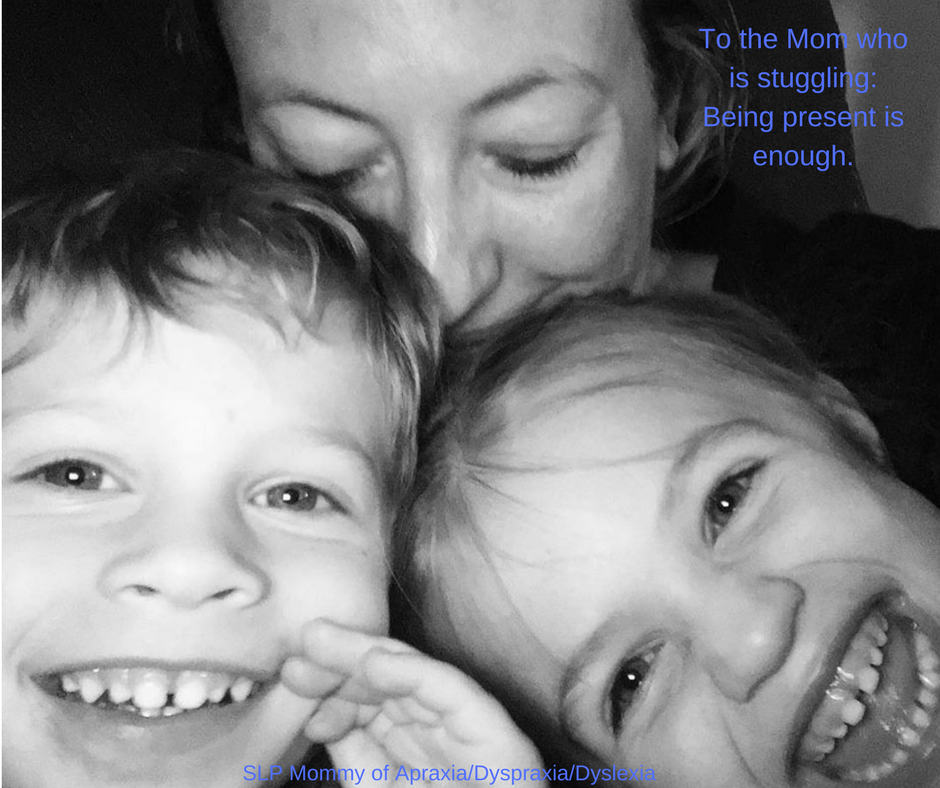
    Be present Mama.  Be present. And know by being present, you are enough.


    https://www.facebook.com/SLP-mommy-of-ApraxiaDyspraxiaDyslexia-275144516000550/

  • Why you are the CEO and CFO in special needs parenting

    Why you are the CEO and CFO in special needs parenting

    A discussion in one of my groups the other day centered around the fact that parents of kids with special needs have to be the CEO on their child.  This extends beyond the idea that we are experts on our child.  The CEO, by definition, is in charge of making all management decisions.

    Parents of children with special needs have to be the CEO, and there is LOT to manage.

    Some days, it can feel unmanageable.  A CEO is typically responsible for the success of a company, which is no doubt stressful; but a parent feels they are responsible for the success of something even greater than a company……

    Parents feel they are responsible for the success of their child’s future.

    I know all parents feel this way about all of their children of course, including those with special needs.  However, the stakes are higher when you have a child with some sort of delay or disability.  A child with special needs is already starting life behind the eight ball.  A parent of a child with special needs feels intense responsibility to give them the best chance at a normal life, which is hard enough in this world without a disability!

    Parenting a child with special needs is a juggling act.

    When a parent has a kid with special needs, they spend their time not only at the pediatrician, but are bounced from specialist to specialist in many cases, just in an effort to get an actual diagnosis.  Kids with special needs in many cases have visited developmental pediatricians (different from regular pediatrician), neurologists, and psychologists. They have had blood taken, scans done, and more doctor visits to discuss results.  They have been poked, prodded, and examined more than the neuro-typical peer.  Their tiny bodies might have been subjected to sleep studies, sedation, and sometimes surgery.

    Therapy is always in the mix.  They may see occupational therapists, physical therapists, speech therapists, play therapists, behavior therapists, early interventionists, vision therapists and the list goes on.  Seeing a therapist always means another new evaluation, where this child who struggles anyway is subjected to tests and judgement calls as to their performance compared to typical peers.

    Obviously, there are only so many hours in a day and so a parent; the CEO if you will, has to choose  and prioritize many of the above listed appointments and even others not on this list.

    Unless you have been in this position, you have no idea how excrutiatingly difficult it is to decide which doctor or therapy your child needs most or more.

    Remember what I said before.  As a person making these decisions, the weight of your child’s future feels like it lay squarely on your shoulders.  Hopefully, you can get an appreciation of how big that weight becomes.

    Let’s not forget though, money.  All of these things cost money.  Insurance in many cases does not cover the brain scans, the MRI’s, the evaluations and the therapies.

    It causes a parent to become the CFO for their child as well.

    A CFO is responsible for the financial affairs.  Oh, and in the case of a parent with special needs, one doesn’t count on paying thousands of dollars out of their budget when they are starting a life with their partner, buying their home, and preparing for a new baby.  I had a supervisor tell me once at a private practice, no one can afford therapy, because no one counted on the huge hit to the budget these therapies, doctor appointments, and evaluations will cost your family.

    If you are lucky to get some sort of disability, Medicaid, or scholarship to help fund the cost; it’s not without another price.

    Time.

    All of these applications take an enormous amount of time.

    Parents need to gather required documentation, letters from insurance companies, doctors, evaluations, tax returns, and medical records to name a few.  A parent will spend hours filling out paperwork, spending time on the phone, and listening to hold music.  This time is well spent if a parent can get insurance to cover or get money to help with expenses; however, prioritizing time and finding time is not easy when we are shuffling our kids to doctor appointments and therapy appointments (see above).  This on top of finding time to put them in “typical” kid stuff like soccer or gymnastics and letting them go to birthdays like other kids do; in hopes that they can feel “normal” at least some of their childhood.

    If we are lucky, there are times we CEO parents find the perfect team.  We’ve got the diagnosis, the plan and team of therapists to treat it, and we see our child do the most amazing thing in the entire world……

    Make PROGRESS

    It’s probably the most beautiful gift in the entire world and in that moment; all the guilt, all the stress, all the worry, all the money, and all the time was 100% worth it.


  • You know you need awareness when you know more than the “experts.”

    You know you need awareness when you know more than the “experts.”

    About a year ago I switched insurance from my husband’s to mine, in order to leave no stone left unturned.  I know that kids with apraxia can have some sort of positive indicator on a brain MRI, or genetic marker.  I had yet to do any of that testing, and so I decided this was the year to do it.

    My husband questioned why.  Is there a reason to know? Will it change anything?  Well, in some very small cases, people have discovered things that have been helped, but most likely the results would not yield anything.  My husband again questioned why.  Would it change the treatment plan?  Therapy plan?  Long term prognosis?

    “Probably not,” was my reply, but honestly, I just had to make sure.  I have to look in her eyes every morning and every night as she struggles through every daily living task and educational task. I have to pray most days to check my patience because many things she does is not her fault.  So yeah, I also have to be able to look at myself  reflected in her adult eyes someday and tell her with complete honesty,

    “Ashlynn, I did everything I knew in my power to do, to help you.”

    I have to be able to say that.  Yes it cost thousands of dollars and I’m on a payment plan for those medical bills now, but it’s worth it.  Everything came back negative and it’s STILL worth it.

    I’m not here to cry and moan though.  If you have a child with apraxia you are just as much in the hole as me.  No martyrdom here.  What I DO want to talk about though, is neurology.

    I went to the Children’s Hospital of Denver.  Well respected, popular hospital.  I took her to neurology and the first appointment went exactly as expected.  Exam and then orders for an MRI and genetic testing.  Pretty standard with Ashlynn’s presentation.  We only found out our neurologist was a resident when the supervising doc came in for a review.  Nice.  I guess it’s no big deal, but it would have been nice to know our appointment was with a resident. Maybe that’s not common, I don’t know.

    The second visit was a follow up visit.  I already knew the MRI and genetic testing didn’t yield anything remarkable.  I was there to see what their dx would be.  Our resident neurologist did her exam and then a different supervisor came in. She did a few things with Ashlynn, and then, as though I wasn’t even in the room she proceeded to tell the resident that “she doesn’t have apraxia” among other things.

    I think I sat in my chair in the twilight zone for a minute.  My head shifted back and forth between the two as I struggled to process what had actually been said.  Did that woman just say Ashlynn doesn’t have APRAXIA???

    “Um…wait.  Yeah, I’m sorry.  Did you just say she doesn’t have apraxia or oral apraxia?  Ask her to close her eyes on command.  She can’t.  Ask her to spit out some water…she can’t. Ask her to smile on demand, she can’t.  Oh, and if you don’t hear her speech apraxia, I am more than able to take you through a motor speech exam quickly.”

    The supervisor did many of the non-speech things I recommended.  She saw, as I said, Ashlynn couldn’t do them.  She then looked at her resident, again as though I wasn’t in the room and commented, “Oh, is this the SLP?”

    “Yes, I’m an SLP that specializes in her disorder,” I responded for the resident.  “Would you like me to take you through a motor speech exam?” I reiterated.

    She told me that wasn’t necessary and changed the subject to the next course of action.

    People.  WTF?

    You ALL know just as well as I know that if I WASN’T an SLP, that neurologist would have told the parent ASHLYNN doesn’t have apraxia.

    Ashlynn has been in therapy since before 3 and has a mom as an SLP!  She is now almost 8!  My God, I would HOPE she has improved.  WTH is wrong with people??  This is a DOCTOR for CHILDREN’S HOSPITAL NEUROLOGY.

    Sigh

    This is why I say and will ALWAYS say, you the parent are the expert on your child.  It sucks right now because parents seem to know more about apraxia and dyspraxia than experts.

    I have a client who has a son with apraxia and dyspraxia.  Apraxia was officially dx by me, so she asked where she should got to get the dyspraxia dx.  I recommended a neurologist.  She found herself at Children’s Hospital too.  Different neurologist.  She point blank asked if her son had dyspraxia and his answer was,

    Do I look like a therapist?

    My dear readers, therapists don’t diagnose dyspraxia or developmental coordination disorder!!!  It’s a DOCTOR who does this.

    I absolutely hate that we as parents know more than the professionals, but you guys, we do.  I say that AS a professional too. That is why awareness is so important to me, but right now we have to be the experts on our children!

    Don’t stop.  Don’t accept any “expert” opinion just because they are an “expert.”   Don’t be afraid to ask questions.  Dig for answers.  Listen to your gut, because you DO know your child better than anyone.

    Advocate.

    Don’t blindly accept “expert” opinion.  Value your own.  You are a parent and that makes your an expert on your child.

    Remember that.

  • What is executive functioning and why do you need to know?

    What is executive functioning and why do you need to know?

    Does your child struggle with impulse control? Do they run out or touch things they know they shouldn’t but seem unable to help themselves despite consequences?  Do they struggle to get dressed?  Does it take you 30 minutes longer to get out the door in the morning than you think it should?  Do they frequently lose things like important papers from teachers? Is their desk, backpack, and folders completely disorganized and in disarray?  Do they have difficulties with attention?  Do they have emotional outbursts that seem atypical from other children?

    If any of these sound familiar to you, your child may be struggling with a deficit in executive functioning skills.  Executive functioning skills are regulated by the pre-frontal cortex in the brain. Many kids with developmental delays and disabilities such as: apraxia, dyspraxia, autism,  ADHD, sensory processing disorder, and others are at risk for deficits with executive function skills.  These skills include the following:

    • Impulse Control
    • Emotional Control
    • Flexible thinking
    • Working memory
    • Self monitoring
    • Planning and prioritizing
    • Task initiation
    • Organization

    My daughter has apraxia and developmental coordination disorder, but I think difficulties with executive functioning skills have the most impact on us and our life as a family.  Any task that involves planning, sequencing, organizing and then execution brings her a massive amount of anxiety and manifests itself as her looking defiant and oppositional.  Even a task like “brush your teeth” which she can and has done numerous times independently still stresses her out at times depending on how tired she is, or any other factors.  The same is true for getting dressed in the morning or at night, cleaning her room (not gonna happen), or doing her homework from start to finish without direction from us.

    How do I know it’s a deficit as opposed to her truly being defiant?  I just said she has done most of these things independently at some point. I know though, because when she becomes physically distressed at the thought of performing a task, when I offer to help her she immediately calms down and is willing to do anything that is requested of her; including cleaning her room.  An OT at Adam’s Camp this summer gave me this analogy.

    Have you ever changed oil on a car?  No?  Great.  It’s exactly like setting your in front of a car and telling you to change the oil.  You have no directions and you have no manual (think visuals), and you have no one there to direct you?  How would you act?

    This was such an “aha” moment for me.  Let’s look at our list above.  In this scenario, I’m going to struggle with: task initiation, planning and programming and organization at the very least.  If I can’t do it and feel I am messing up, it’s probably going to escalate into my emotional control which will potentially affect my flexible thinking and so on.

    All of these processes are independent, but they can also be tied together.

    So what do we do?  Can executive functioning skills be taught?

    The good news is YES.  There is so much more great research too coming out now, and I’ve seen educational institutions grabbing onto this idea and implementing strategies into their classrooms.  If you are a parent, accommodations to help executive functioning skills can be easily placed in the IEP under the accommodations sections; or if you want more targeted instruction, can be written as it’s own goal. Psychologist’s can administer a test to look at executive functioning skills. One such test we use at my school is called the BRIEF (Behavior Rating Inventory of Executive Functioning). Don’t be afraid to ask for testing if you think your child struggles with this.

    That’s great for school, but what can frustrated parents like you and me do at home? I wrote Part 2 to this series in which I outline strategies to do at home for various skills. (click here).

    In the meantime though, Sarah Ward is quickly becoming nationally recognized as a top expert in this area.  She gives talks nationwide and if you can see her I have one word of advice: GO.  She’s fantastic, fresh and has current ideas that incorporate technology and apps that I have never seen presented before.  Most talks on executive functioning that I go to now will almost always include a suggestion they got from Sarah Ward.  Her website is Cognitive Connections.

    You can also find books on the topic that have good reviews with practical suggestions for parents:


    These books are geared more for parents and what you can do at home.  I also found some kid books that I think are helpful when we are talking to our kids about their difficulties.