Category: Sensory Processing Disorder

  • Apraxia, special ed, and grad school.  One woman’s remarkable tale.

    Apraxia, special ed, and grad school. One woman’s remarkable tale.

    One day I was perusing The Mighty to see if any new apraxia articles had been posted, and I ran across an article by Kelsey Belk, a graduate student studying to be an SLP.  I was so inspired by her article I just had to reach out and thank her.  I found her on facebook and saw that she was currently attending the University of Northern Colorado! I live in Colorado! Can anyone say coincidence, and as a reminder, you all know I believe they are signs and so I took it as a green light to contact her.

    Kelsey, thank you so much for writing that article!  I plan to save it and have Ashlynn read it one day.

    Let’s start with what you remember about speech therapy? When did you know you had apraxia?  Do/did you have any co-morbid disorders aside from apraxia?

    I was diagnosed at age 2 with apraxia. I also was diagnosed with SPD and dyspraxia in my early toddler-hood age as well. In late elementary school I was diagnosed with ADHD and Oppositional Defiant Disorder.  As I am getting older I keep getting diagnosed with more psychiatric and learning disorders. I really want to do research on the possible relationship between childhood apraxia and a later diagnosis of psychological conditions!

    What was your school experience like?  Could you tell us how you did academically and if it affected you socially?

    I have always been a very highly motivated student and am a huge social butterfly – I actually cannot stand the idea of being alone. In elementary school I did rather well with the accommodations the school provided. It wasn’t until later that I realized how big the gap was between my peers and I, especially in reading and writing for me. In high school I started to receive worse grades and this really negatively affected my self-esteem because I didn’t understand why. I felt like I was putting in double the effort than my friends, but always got worse grades. This is when I went back to get more accommodations and was re-evaluated and was told I had all of the same results as a severe dyslexia case, only was able to read rather fast therefore my poor decoding/reading/spelling/phonological awareness was tied to my apraxia. Ever since then I have been receiving extra help such as a note-taker in class and all my books on an audio file. It is not perfect, especially in college. Most of my peers will skim read, but I cannot do this and have to sit and listen to the entire 100 page textbook chapter – but it still makes it much easier than without the accommodations. Overall I have been very successful in school, but it has definitely been a huge struggle.

    My social life is more difficult to describe due to some of my co-morbid diagnoses that affect social relationships. In elementary school through high school I had amazing friends, although seemed to change friend groups frequently to find these friends. However, I also had really negative relationships. I was terrified to talk to adults because they could never understand me – which affects me to this day. Kids were always carefree and often did not even notice a difference. I did have some bullies though – I remember particularly having kids make me repeat things I could not say (like rabbit and railroad). I did really well to not let this get to me though! When I got to college I met all these new people from all over the world. This led to more issues with people not being able to understand me, and I often got asked “where is your accent from?”. I never had an issue making friends growing up or now, but I do have issues with some of the less accepting people. But, it showed me who the good people were and has allowed me to make amazing genuine friends that I may not have found otherwise!

    How has apraxia affected your life?  Do you still have residual struggles?

    Apraxia has definitely shaped me to be who I am.  When you have to put in so much effort just to play “catch-up” at school, it will definitely change you. I had one speech therapist that I loved, but many I did not like which made me not like school on speech days. It has affected me academically and socially, as described above. I am lucky to have had great support systems growing up that allowed me to succeed academically and made me want to go to college. I know that this is not the case with many special ed kids, because you just get so burnt out. It is exhausting to act “normal”. Even to this day I don’t think my professors understand that half of my cognitive energy goes to my talking clearly, focusing, and reading – so in class when I have to take breaks I really need them. I get home completely exhausted everyday, and then have to focus on homework. People forget that disabilities don’t disappear, and it is a constant struggle. I definitely have residual struggles, like mentioned I get asked where my accent is from or I am asked to repeat myself often. Most noticeably, it is in my reading or SLP tasks, because that is what I am studying. Apraxia has greatly affected my self-esteem – I refuse to talk on the phone, get defensive quickly about my speech, and still get scared to make presentations/talks. Last year I decided to go back to speech therapy to try to fix these speech errors, and made some progress on the ‘ai’ vowel however I am to the point I am just going to accept these speech errors as part of me.

    What made you want to become a speech/language pathologist?

    I always wanted to work with kids, but did not really want to be a teacher. I became very interested in this field and just stuck with it! I particularly love the Deaf/hard-of-hearing population. I think it is great to help someone communicate – as social connections are so important. I also have felt that the current model is not often what is best for the child – and I hope to change that. I feel like this field overlooks mental health way too often, even though it is so hard being a child who is different. I hope to work to combine the two fields more to help children succeed in every part of their life – most importantly making them feel valued and happy. I also think we often assume that children need to be like ‘us’ – look like us, talk like us, walk like us, etc. I don’t think this is always the case. I think it is important to see the child as an individual and help them succeed in the modality best for them. For me, I need accommodations such as audio books – no amount of therapy would fix my problems. For some kids this may be ASL or an AAC even, so I hope to change the view so speech therapy is actually centered around the kid.

    My daughter is 7 and currently struggles with what seems like every motor task.   What advice would you give her and all the other kids who struggle with apraxia and related learning disorders?

    I think it is important to not compare yourself to others. The school system is set up to where everyone is pressured to be at this perfect level – but that is not real life. In real life everyone has strengths and weaknesses. I know that I will always have weaknesses in these areas – and it will always come back (such as driving – it is so hard!). But, I also have learned to find my strengths – which are ones you probably share. I learn to persevere – when someone tells me I can’t so something I work as hard as possible to show him or her I can. I am creative – having disabilities makes you find new and creative ways to complete tasks. And most importantly, I gained strength in having empathy. This one seems so simple, but is one so many people lack.  Just remember to never give up – I did. I dropped out of speech in 6th grade because I wanted to be normal and I regret it. In the words of Taylor Swift, “haters are gonna hate hate hate”. Don’t let other people get you down, do it for yourself! Whatever you accomplish in life will be perfect, as long as you keep loving yourself for who you are.

    What advice do you have for parents?

    Accept your child for who they are. Yes it is good to practice correct motor tasks and speech at home, but also remember they are kids! They need a break and need to be able to talk to you without being corrected. Find a balance between the two. Let your child make decisions too – explain the IEP to them and let them give their important in what they want to learn and work on. And do not be ashamed to seek out mental health help (if needed)! There is absolutely nothing wrong with therapy; it can help your child grow in self-esteem and self-confidence. Also remember to not put all the pressure on yourself, you child goes to an SLP/OT/PT/specialist for a reason, just enjoy being a parent!

    There is so much good advice in here Kelsey! Thank you so much for your candor and honesty.  You sound so much like my daughter.  She’s a huge social butterfly too, and works harder than everyone else around her.  You give me so much hope for her!


  • Apraxia would have destroyed me

    Apraxia would have destroyed me

    I often think about what would have happened had it been me who had apraxia, dyspraxia, SPD, dysarthria, and a learning disability when I was young.  It’s pointless I know, but I was/am a perfectionist.  That’s not a good thing.  I learned early I was really good at spelling, reading and writing, but math I had to work for.  I won a math award in 3rd grade and I looked at the teacher, Mrs. Plummer,  like she was crazy.

    “I’m not good at math.  Give this to Keith or Jimmy.”  She maintained I was good at math, but I didn’t believe her and I never cared about that award.  I knew what I was good at, and it wasn’t something I had to work that hard to do well.

    I think about that because Ashlynn has to work at everything to do well.  There’s not like one thing that comes naturally to her….well actually social skills do, but she’s behind in that too only because of her other issues.  I had to work at math so it made me mad and I didn’t want to try, despite the fact I could do well.

    Her disability would have destroyed me.

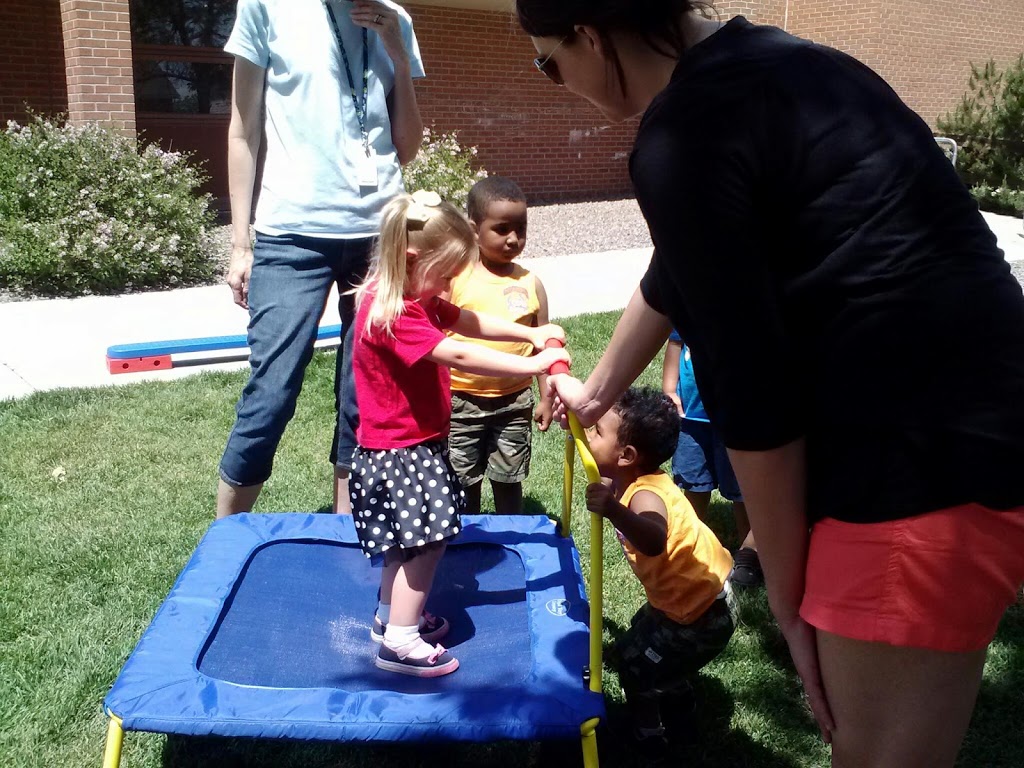
    She has the best of my husband’s personality THANK GOD.  She doesn’t get embarrassed, she attacks everything, she’ll try anything, and she’ll never give up until she conquers it.  That’s a page straight up out of her daddy’s book.  She’s in a first grade performance Tuesday, and I was watching the practice with the art teacher.  I said the songs were hard for a kid with a speech problem (bear necessities, supercalifragilisticexpialidocious) and the art teacher smiled and said she loves Ashlynn because she just goes for it.  I smiled.  It’s true…she does.  She always has.  I can still cry thinking about her preschool observation where she couldn’t jump on the trampoline so she smiled and marched instead.  All the kids were encouraging her to jump like them….

    and she couldn’t bear walk so she hung across a teacher’s arm upside down to at least get a feel for the movement….still smiling.

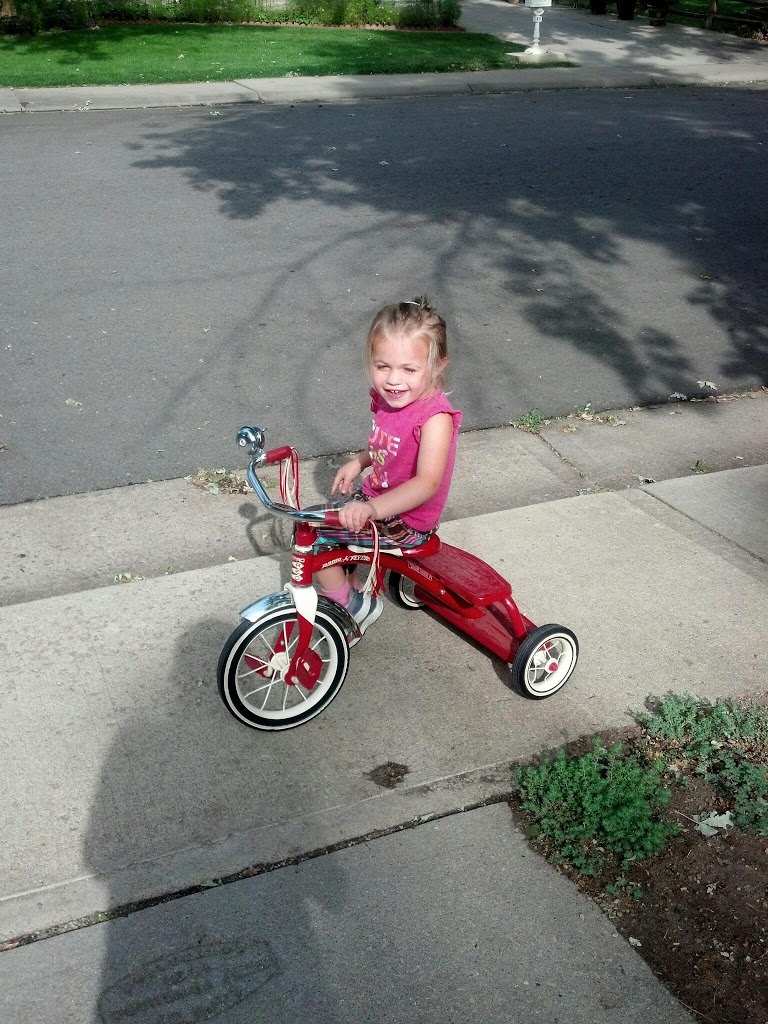
    When she rode her tricycle and couldn’t pedal she never stopped trying……and not only trying, but smiling. Oh, and guess what.  She learned all these skills eventually, on her own time.  She walks, she runs, she jumps, she bear walks, she skips!  She puts me to shame.  She puts that third grade girl who decided math wasn’t her thing to shame.

    Well not anymore.  I’m not sure anyone becomes a parent to be inspired by their child, but she has inspired me and made me better.  There are things I do now I would have NEVER attempted.  Every time I’m scared or nervous, I think about Ashlynn.  One year on a camping trip everyone was cliff diving.  I was terrified as I stood on the cliff, but I thought of Ashylnn and I’m on video jumping and while I’m in the air you can hear me say “for Ashlynn.”

    Tonight we were watching “Zootopia” and a song came on “Try Everything.”  Ashlynn started clapping and dancing around the kitchen.  She always dances like no one is watching.  Isn’t that phrase people have to try and follow?  Well, Ashlynn just lives it.  It’s her essence.

    So I started listening to the lyrics and I’ll be damned if this isn’t that girl’s theme song.  I downloaded it immediately.  (I’m also admittedly a Shakira fan so I was hooked anyway).  We put it on outside and her AND Jace were going crazy.  It’s a great song.

    “I messed up tonight, I lost another fight
    I still mess up but I’ll just start again
    I keep falling down, I keep on hitting the ground
    I always get up now to see what’s next

    Birds don’t just fly, they fall down and get up
    Nobody learns without getting it wrong

    I won’t give up, no I won’t give in
    ‘Til I reach the end and then I’ll start again
    No, I won’t leave, I wanna try everything
    I wanna try even though I could fail
    I won’t give up, no I won’t give in
    ‘Til I reach the end and then I’ll start again
    No, I won’t leave, I wanna try everything
    I wanna try even though I could fail

    Look how far you’ve come, you filled your heart with love
    Baby, you’ve done enough, take a deep breath
    Don’t beat yourself up, don’t need to run so fast
    Sometimes we come last, but we did our best”

    So many times she has come in last but she gets back up and tries again. As a witness to this strength I have no choice but to do the same.  Look how far you’ve come, but don’t keep looking back.  Look up and I’ll walk next to you guys through anything and I’ll pick you up when you fall.


  • It’s like juggling 8 balls at one time desperately hoping one doesn’t roll away

    It’s like juggling 8 balls at one time desperately hoping one doesn’t roll away

    There is not one day that goes by I don’t think of Ashlynn’s disability (ies).  As a basis of comparison, I have my four year old son.  He has some concerning behavior issues, and I do think (worry) about them often; however, I do not think of it EVERY SINGLE DAY.

    Apraxia and dyspraxia make that impossible.  There is always something else to worry about.  Something else in which I don’t feel like I’m doing enough.  Let’s take speech.  Her speech is intelligible (hallelujah praise Jesus my baby has her voice); however she also has dysarthria, which makes her overall speech slower, and she has a language processing problem heaped on top of that, which makes it extremely difficult to express herself, even though when she does you can understand her now.  She also has a lisp, which is pointless to work on right now because she doesn’t have her two front teeth.  That will wait, but it’s still on the  “to do” list.

    Oh, but then there is dyspraxia and it involves motor planning issues with gross and fine motor skills, which in turn, affect ALL of her ADL’s (Activities of Daily Living). This includes: dressing, toileting, feeding, hygiene, getting her shoes on the right freaking feet, putting on her pants that aren’t backward, brushing her teeth without it ending up all over the counter, or showering and actually coming out of the shower cleaner than you went in.

    I make her do all these things first independently, despite it taking 3x longer than her brother who is almost 3 years younger.  It would be so much easier to just get her dressed or brush her teeth for her, or shower her;  but I know with motor planning, EVERYTHING is going to take about 1000x more repetitions and because of that, I can’t let her slack.  I can’t do it for her.  I have to watch her struggle and sometimes cry for me to help her, and force her to do it because I know she can.  There are nights it breaks my heart when she begs me to just help her put on her shirt and I tell her no.  I tell her no for her own good.  I know it’s hard, but the brain has more plasticity now and she has to learn how to do these things, and the only way to get better is to do it herself over and over and over.

    I think about stuff down the road.  How the heck is she going to ever be able to do her hair?  She can brush it, but how do I teach her how to get it in a hair tie?  These things will never come easy for her.  She can’t even put a headband on straight. Should I buy a bra for her now and have her start practicing?  The list goes on and honestly, at times, it seems endless.

    I attended an executive functioning training recently, and many kids with global apraxia are going to have issues with executive functioning.  They just are.  Ashlynn is one of them.  There are things to do to help. A lot of things actually, but they need to be put in place.  A lot includes visuals, visual aids, etc.  I sat through the entire training thinking about application to Ashlynn (I was there to apply it to my students in the classroom).  I started stressing that I’m not teaching her these skills and if I don’t, there is only so much the school can do and she will be a mess as an adult.  I need to start working on that.

    Oh..but she has homework, and we need to work on that too because like with everything else, she needs about 1000x more repetitions than a peer and we are the only ones to help her get those reps in.

    Seriously, I just don’t know if there are enough hours in the day. I texted another apraxia mom and I knew she would get it and wouldn’t judge me.  I was right.  She responded,
    “There isn’t a moment that passes.  I hate how consuming it is.  I sometimes feel paralyzed by it.”

    She reminded me that our kids our capable, but they require the BEST of us constantly to be successful.

    She’s right.  All of it.  So here we are.  It’s all consuming. I said not a day, but she’s right, it’s not a moment passes without being reminded Ashlynn has global apraxia.  It’s not one area that’s affected.  Sometimes I wonder what it would be like to just worry about the speech, or just worry about the motor skills, or just worry about homework or just worry about executive functioning, or just worry about language processing.

    That’s not to downplay all the kids who have one or a couple of these problems, but it is to say that each problem adds an additional weight to my shoulders and sometimes it feels like I’m juggling 8 balls in the air and working desperately not to have any fall and roll away.  How do I keep them all in the air?  There is no answer….there is only what Michelle said…this disorder requires the best of us and not just sometimes, but CONSTANTLY so that we can be sure our children our successful.

    Taking pictures for a visual schedule to remind Ashlynn of the steps to going to the restroom.
  • Anxiety and PTSD. What you don’t know about special needs parenting.

    Anxiety and PTSD. What you don’t know about special needs parenting.

    Can everyone agree parenting is stressful? I’m sure we all can.  I read something the other day though that perfectly described my life.

    “If parenting can feel like a roller coaster of anxiety, than special needs parenting is a whole carnival.”  I’ve also read that PTSD is common among parents of kids with special needs.

    I’ve also read and seen quoted a very popular article: Autism moms have stress similar to combat soldiers.
    N
    ow, I’m not pretending to know THAT stress or try and compare, but seriously people, if you have a kid with special needs it’s really not that hard to believe.  If you don’t, it may be hard to understand, but let me assure you it’s INCREDIBLY stressful.

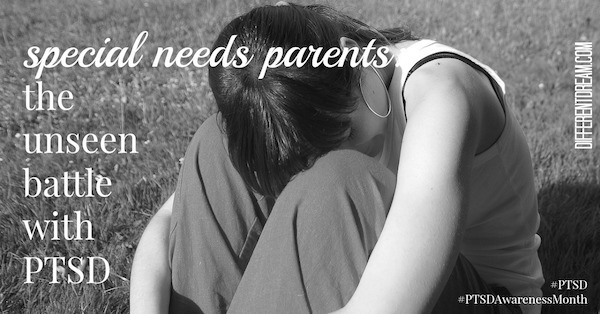
    PTSD-battle-fb

    Two years ago, I wrote a very scary blog post that I still can’t re-read.  I’m not even going to link it here because that would require me going back and potentially reading some of it. It detailed a near drowning incident with my daughter when she was in a group swim lesson.  I still haven’t really ever recovered from it.  We are around water all the time too, and everytime I’m stricken with an anxiety I can’t quite put into words.

    I really don’t know if it’s the global apraxia or her disordered sensory system, but Ashlynn does not have normal reflexes, for lack of a better word.  Instead of her body responding appropriately to survive, hers does the exact opposite.  Add to it an under-responsive sensory system in which she rarely feels pain, and it’s a recipe for disaster.

    An under-responsive tactile system is rare, but I find it is very common among kids with “global” apraxia, and that “global” word is important.  It’s scary though.  Let me give you some examples.

    When Ashlynn was a baby, probably around 4 months or so, I was getting her ready for bed.  That’s when I noticed her baby toe had a hair wrapped around it and was swollen.  It was so swollen I couldn’t even see the hair as it had created a turniquette.  My baby was never fussy.  She never cried unusually more than any other time.  I had absolutely no indication this had happened.  We had to go to the ER and get it removed it was that bad.

    In another instance when she was probably three, we were at the playground and she had a full speed head on collision with another boy.  Both kids had immediate goose eggs swelling on their forehead; the only difference?  The other boy burst into tears and went running to his mother while Ashlynn followed, not crying, wondering if he was ok.

    Another one happened recently right as school ended.  Ashlynn woke up with a horrific stomach ache.  Knowing she NEVER complains of pain I start panicking (it’s that anxiety I’m talking about) and immediately call the doctor and take her in.  The result?  She had a burst ear drum from an ear infection!!  She wasn’t sick or sniffling, she never complained of her ear, pulled at her ear…..NOTHING.  The pain in her stomach was described as “referred pain.”  I’d never heard of it before.  Apparently it’s a thing.

    When she was a baby, she didn’t chew her food.  Literally if something went into her mouth she swallowed it and this lasted well into her toddler years.  I remember a friend came over one day and brought bagels.  As we were chatting, Ashlynn started choking.  I swooped in, turned her upside down and started violently patting her back.  An entire piece of barely chewed bagel appeared on the floor.  My friend was horrified.  So was I, but sadly it wasn’t the first time that had happened.  She’s going to be seven and I still cut up her grapes and hot dogs.  If she chokes, it literally is her life on the line.  How can I NOT helicopter??

    Has your child ever been choking and looks at you with wide, terrified eyes?  I’ve never had that experience even once with my son, but with Ashlynn I can’t even count the number of times it’s been so many.  Each time brought a flood of overwhelming panic and anxiety.

    These are just four of MANY, MANY, MANY instances.  Hopefully you have some idea now why I helicopter.  I used to think if she could just talk she would be able to tell me what was wrong.  Hah! If you still aren’t convinced these examples are enough reason for me to have the anxiety I do, let me outline ONE day in her life that happened this weekend.

    We went to a ski town called Breckenridge to visit my husband’s family.  We were walking along the side of the street when we heard a car coming.  Ashlynn wasn’t in the middle of the street, but like any reasonable parent we both beckoned her to move closer to us.  For reasons I probably will never know, she freaks out and goes darting into the center of the road! I went running after and ended up dragging her back to the side.  I mean, what is that??  Tell me.  What IS that??  I don’t know what that is, but I DO know my stress level went through the roof.  I DO know that next time we are in that situation I will now be helicoptering because her natural instinct for whatever reason was to dart into the CENTER of the street.

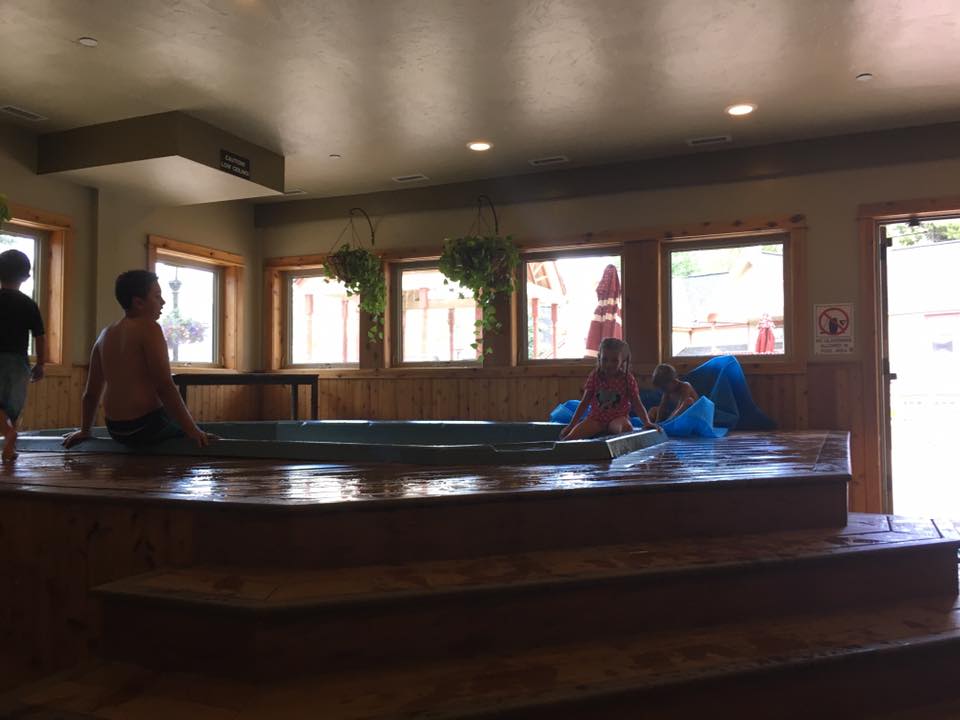
    Next was a trip to the hotel hot tub.  As much as I am at lakes and around water, you would think my anxiety over her near drowning incident would have subsided.  Nope.  I immediately started panicking thinking about it.  I had remembered their swim suits but not the floaties.  Their cousins assured me it was shallow and even the shortest kid amongst us could touch the bottom.  I still with every being of my body want to tell them no, but that’s MY issue and I don’t want to punish my kids for my anxiety. I guess it’s fine if I’m right there.  A hot tub is small.  I can save them if something happens.  They both wanted “privacy” and change in the bathroom with closed doors.  Unbeknownst to me, they went out a different door and made it to the hot tub without me.  When I realized they were gone , my stress goes through the roof again and I take off into a sprint toward the hot tub.

    They were there with their cousins having fun and splashing around.  I wish I could say I breathed a sigh of relief, but my stress and anxiety levels could not recover that quickly. I scolded them for leaving without me.

    I took a seat on the bench.  I watched Jace (my four year old son) jump in  (he doesn’t know how to swim) and his head goes under.  I stand up and immediately I see him dart out of the water.  A human’s natural instinct is to stiffen their body and shoot toward the top, which he did.

    Dear God, am I going to get through this?  Ashlynn was being more cautious.  Okay that’s good. My sister-in-law came in to keep an eye on her kids.  My anxiety started to come down.  I started to relax (a little).  Suddenly and silently, as I’m watching Ashlynn, one second she’s walking, and the next second her head falls under the water.  She NEVER voluntarily puts her entire head under the water.  In fact, we’re working on that in private swim lessons.  I tell you this so you can understand that if her entire head was underwater it was NOT of her own volition.  My heart starts pounding, my ears start ringing, I’m seriously panicking.  I’m taken back to that day two years ago in swimming lessons and I have to jump in again and save her.  Luckily my older nephew was in the water and no sooner did I say grab Ashlynn, he had her in his arms.

    She looked scared.  Spooked.  My nephew looked scared.  I’m not sure if it was because of Ashlynn or my reaction.  My hands were shaking.  In fact, they are shaking now as I type this.

    Unlike my son, who went under water and then came shooting out of it, my daughter’s natural instinct is to pull up her legs into a fetal position.  I know this, because I saw her do it in the pool that day two years ago, sitting underwater, and I also know this because she is much taller than that hot tub was deep.  The only way she could have gone under was she pulled up her legs.

    She stayed along the side of the hot tub after that as I sat there wanting to just pull my kids out and go home.  The stress is just too much.  I need to keep her in my house in bubble wrap and then at least I know she’ll stay alive.  I’m being sarcastic of course because the rational side of me realizes I can’t do it, but there is an irrational side that very, very much wants to do that.  I’m not gonna lie.

    My husband walks past at that moment.  He mouths a question “are you ok?”

    I shake my head no.

    He back up and walks in the pool area.  He asks me what’s wrong.  Just talking about it has me panicking all over again.  He tells me to leave.  I can’t stop talking.  I’m so scared.  He says he will stay, but he’s not even looking at her.  Doesn’t he realize he needs to look at her every second?  He tells me to leave again more firmly.  I hesitate, and then he says my anxiety is making everything else worse and giving everyone else anxiety.  I’m upset, but not at him.  I’m upset because I know he’s right, but what can I do?

    He managed to get her back in the water he told me later, and hopefully she doesn’t have PTSD over it like I do.

    So yeah.  It’s not hard at all to believe mothers of special needs children have stress levels similar to that of combat soldiers, because our stress never goes away.  It’s a daily fight for your child’s survival.

    13728973_10207953930258699_5847861193958388927_n
    Ashlynn staying alongside the hot tub after the incident
    13680505_10207953930338701_291093249682823046_n
    Playing around and being silly. Love her duck face here.

    13406745_10100653496539656_1976337265973063999_n d

  • Blue Man Group’s reputation for kids with special needs

    Blue Man Group’s reputation for kids with special needs

    We went to Vegas for Spring Break, and we took the the kids to see the Blue Man Group.  I had heard great things about the show in my parent support groups, so I thought it would be the perfect show for my kids.

    Ashlynn has a formal dx of SPD, and my son, well, he definitely has sensory issues.  Not sure if they fit a formal dx or not, but they’re there.

    Many kids with SPD become overstimulated to the point of total meltdown.  Stimuli, whether it be visual, auditory, tactile, or any combination of the above can completely overwhelm a child with SPD.  To make it all the more complicated, each child is unique in their sensory profile. For example, many kids ( like Jace), are extremely sensitive to tactile (touch) stimuli.  They are the kids who complain about a tag, or rip off clothing because it hurts.  I’m not an occupational therapist, but from my understanding, this is considered over-responsive. Ashlynn is actually the opposite in the tactile department, and I’ve found many kids with global apraxia tend to have her presentation.  She is actually “under-responsive.”  Ashlynn is THE toughest chick I know.  She looks sweet right?  She is, but I have seen this kid get goose eggs, have blood literally running down her leg, or even get a turniquet accidentally from a hair wrapped around her toe, and she has NEVER cried.  Heck, she didn’t even whimper..  This has gotten better as she has matured, but let’s just say if Ashlynn is in pain, I come RUNNING, because it must be bad.

    The opposite though, is true regarding visual and auditory stimuli.  She is definitely over-responsive.  Any visual or auditory stimuli completely distracts her.  This is ESPECIALLY true if it’s stimuli with which she has not yet experienced.  Two of her SLP’s have told me “she needs to take everything in.”  Unfortunately, this severely impacts her attention, so that is why I have her on a low dose of attention medication. I hate it because it’s not ADD…but sensory or ADD…it’s all neurological and meds have really, REALLY helped her.

    Despite this, she’s never been so overwhelmed to the point of total meltdown.  SPD is a common co-moribidity with autism,  and children with autism tend to get so overwhelmed they have complete behavioral meltdowns.  Ashlynn has meltdowns, but they aren’t to the extreme.

    So what does all this have to do with The Blue Man Group?  Well, I had just seen literally this week that they were going to create a show that was autism friendly.  When I did a google search, I read this:

    “We’ve heard from many families affected by autism that their children responded to the Blue Man character in a very moving way.  We don’t know the exact reason. We can only speculate that it has to do with the Blue Men communicating in their own unique way — non-verbally, through visuals, touch and sound. Their message often resonates on a deeper, more sincere level,” says Phil Stanton, Blue Man Group Co-Founder, “Once we knew that we could be helpful or provide an outlet for those affected by autism, we  felt it was important to do more. With our sensory-friendly shows, we want to create a safe and welcoming environment for individuals and families affected by this disorder, in the hopes that they can have an entertaining and joyful experience together.”

    So, long story short, I figured this show was a win-win.  I was surprised though when Ashlynn started asking me if it was time to go back to the hotel.  She looked distressed each time she asked. The show switches activities a lot.  She would acclimate to one activity and be okay, but when it switched she would be back to distressed mode.  I did something I nor she have ever done.  I covered her ears with my hands.  She instantly relaxed in my arms, so I held them there.  It had only been about 5 minutes and Cody was handing me a pack of ear plugs looking  confused.  He said he was told to just pass them down.

    I smiled and put them in Ashlynn’s ears. They were perfect.  She went on to enjoy the rest of the show without incident. I literally wanted to kiss whoever gave those to her.  However, I did not know if it was a parent who had noticed, or the staff until after the show.  I asked Cody and he verified it was a staff member who asked everyone to pass them down our way.  I almost teared up on the spot.  Who noticed that??  Who took action??  Are they always prepared for that?  Is this why that have a great reputation for special needs kids?  I had so many unanswered questions.

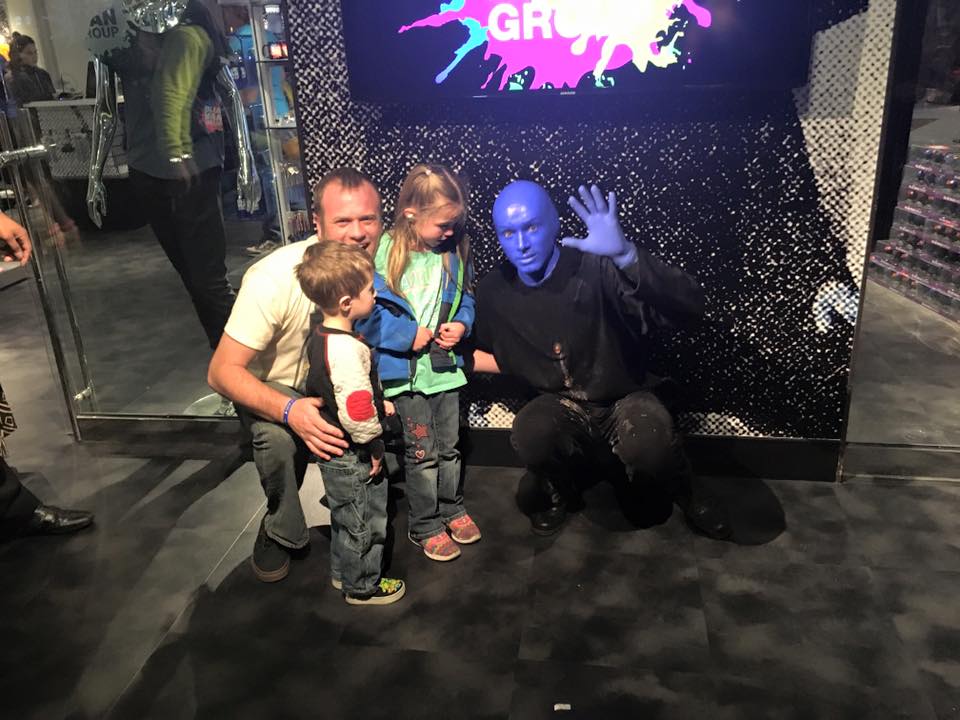
    At the end of the show, we had a chance to take pictures.  The Blue Men don’t talk, even after the show.  12932862_10207164753569775_5369643655843644488_nThere is something extremely relatable to a child with Apraxia as there is to a child with Autism.  I’m sure he saw the earplugs in her ears, and even though he had been standing with all the other kids, he immediately knelt down when he saw Ashlynn, and he stayed there.  I was trying to get a good picture…but as her SLP’s would say, “she was taking it all in.” She kept staring at him and never looked at me or my camera.  He let her.  He was kind and patient.  Others wanted their photo op, but he never hurried us along.  He wanted her to feel safe.  He wanted her to understand.  He wanted her to take it all in and not feel pressured.  He seemed to know how important it was for me to get a good picture, and no one else seemed to matter during the time he was with her.  Because of his kindness, I didn’t even care anymore that she didn’t look at the camera.  It was just a beautiful moment, and that’s what I wanted to capture.

    My son on the other hand was ALL about the over-stimulation.  In fact, after my daughter told me those “ear things” made me feel better, because it was too loud”  my son announced he likes it LOUD.  He is  a VERY loud kid, so we kinda knew that.   Either way….two kids with completely different sensory issues left that show happy and excited.  They are my new favorite.  I truly can’t say enough.