Category: phonological disorder

  • SLP’s integral role in the five components of reading

    SLP’s integral role in the five components of reading

    When I was younger and learned to read, I remember I was taught phonics.  I remember the phonics workbooks I had, and would read the rules at the bottom of the page for spelling.  It was all very systematic. Little did I know at the time, phonics was just one part of the five components of reading that can contribute to reading disorders.

    Today, a concept called whole language dominates our public education systems.  Not every school district or school uses this approach, but very many of them do and it is at a detriment to our children who have reading disorders.  Some critics go so far as to say whole language is “anti-phonics.”  I don’t believe it’s quite that extreme.  However, for kids who have reading disorders, the vast majority struggle with phonemic awareness and decoding, which a whole language curriculum is not even close to adequately addressing.

    I’m fortunate that when I started my career, Ashlynn’s SLP was very knowledgeable on the topic.  I had no idea that learning about the five components of reading before my child was even conceptualized would come back and benefit her some day.

    So, what are the five components of reading?
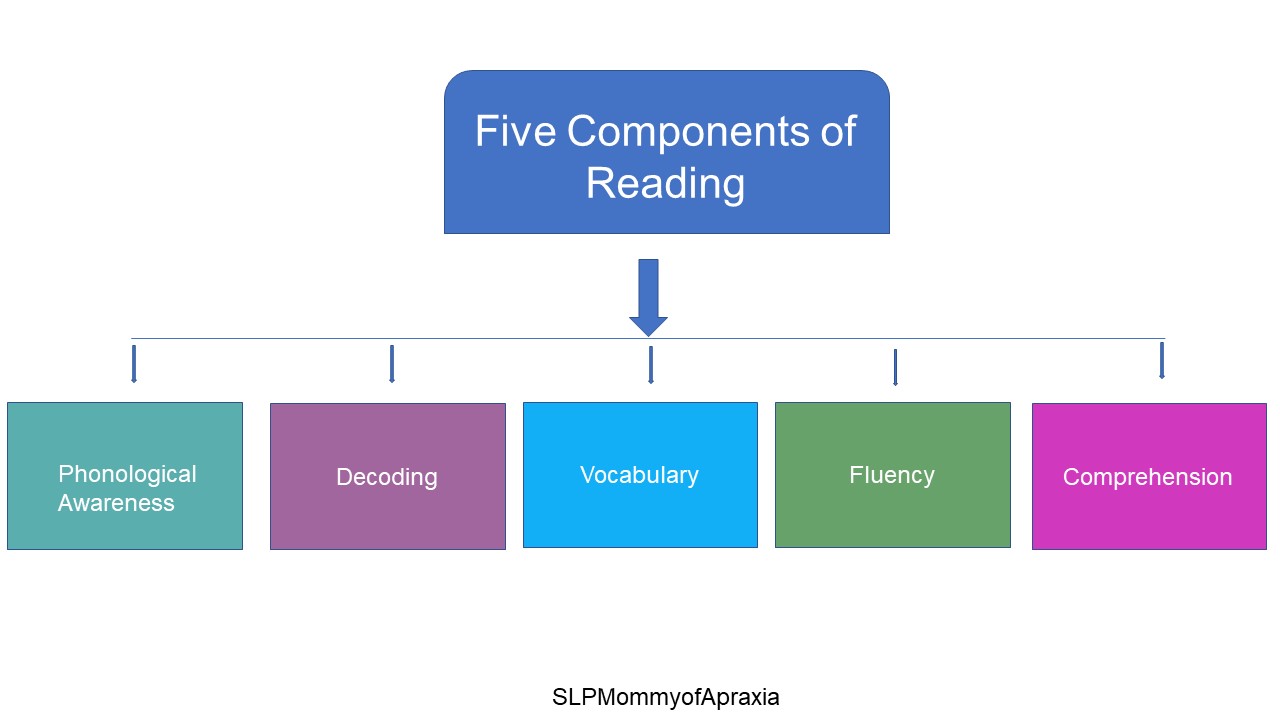
    They are: Phonemic Awareness, Decoding, Fluency, Vocabulary, and Comprehension. These areas were identified by the National Reading Panel that was convened by Congress in 1999. It’s very important that parents and educators are aware of these five components, because weaknesses in any one component can cause a child to struggle to read.

    Speech/Language Pathologists can play a big role in reading.  They are trained and certified to treat children with three of the five components.  A Speech/Language Pathologist can work on phonemic awareness, vocabulary, and comprehension.  This is why they are frequently on IEP’s when children have reading disorders.  It is very infrequent that the older school-aged child with dyslexia is seeing the SLP to work on their “sounds.”

    Parents and educators all need to be aware and familiar with these five components if they want to help children effectively who are struggling to read.  During my time in Denver Public Schools, an excellent teacher advocated the use of a “fishbone” analysis when testing kids who were struggling to read.
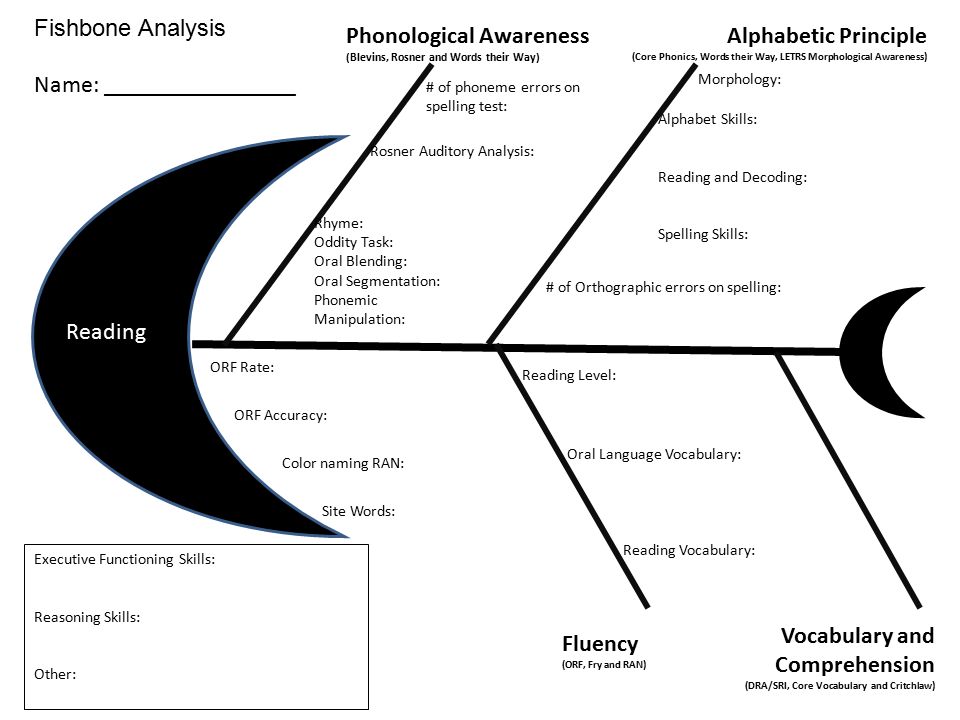
     

    As you can see, it contains the five components of reading, and spaces to document a child’s performance in all five areas.  It could be possible to have a child who has difficulties in all of these areas.  However, more frequently a couple of areas usually stand out.  One area that is frequently a problem is with phonological awareness skills.  This can be tricky because elementary school children many times get identified with a reading disorder past the time that instruction with phonological awareness is taught.  Teachers jump right into reading instruction without realizing the child is lacking the basic building blocks for reading in the first place.

    So what is phonological awareness?

    Phonological awareness refers to a child’s ability to manipulate sounds out loud.  Tasks included in this umbrella might be to identify the initial sound in a word, blend sounds, segment sounds, identify the last sound in a word, or be able to identify and formulate rhyming words.  Logically it would make sense why this is a building block skill.  If a child can’t do these things out loud, it’s going to be very difficult to transfer these skills when looking at graphemes (letters).

    Phonics/Decoding

    Phonics refers to the actual act of sounding out words.  To do this skill, children need to have mastered knowing letters and letter sounds, and then be able to use this knowledge of letter sounds to “decode” a word.

    Vocabulary

    A child’s vocabulary many times affects background knowledge, which is important in reading.  If the words they are trying to read hold no meaning due to low vocabulary skills, it is going to be harder for them to understand what they are reading.  In addition, a child with weak vocabulary skills will have a harder time monitoring their comprehension when reading sentences.  I see this all the time as an SLP. An example of this would be if a child were to read the sentence “He saw the dog.”  Instead of “saw” he/she read “sam” and they would continue reading.  Many children without a language disorder would realize “He sam the dog” didn’t make sense and go back and try and fix the sentence so that it makes sense. Kids with language disorders have a very difficult time with this skill.

    Fluency

    Fluency refers to a child’s ability to read text accurately and quickly while maintaining good expression.  The ability for a child to read fluently helps with comprehension.  If a child’s fluency is slow and choppy, they may be allocating so much brain power to decoding that they are not monitoring comprehension. If a child lacks expression in their reading, this too can affect comprehension.

    Comprehension

    Comprehension is simple terms, means understanding what we read.  Kids with a mixed receptive/expressive language disorder or an auditory processing disorder frequently experience difficulties with text comprehension.

    What does this mean for parents?

    The bottom line for parents is that reading is a complicated process that has many components.  A deficit in one or more of the above listed components can cause a child to struggle when learning how to read.  Children with speech and language disorders are at high risk for reading disabilities. Being aware of all five components helps parents be more informed regarding treatment approaches and options their child may need to catch up in reading.

    This article contains information from the National Reading Panel’s Findings


    Laura Smith is a first and foremost a mom to two amazing children, one of which who carries a constellation of invisible labels including: Childhood Apraxia of Speech, dysarthria, SPD, ADHD, MERLD, dyspraxia, dyslexia, and cerebral palsy. She is a speech/language pathologist specializing in Childhood Apraxia of Speech following her daughter’s diagnosis.  SLPMommyofApraxia is her space to share her professional and personal experiences related to the complex but beautiful world of neuro-diversity and to spread a message of hope, positivity, acceptance, and kindness.
  • Apraxia? Phonological Disorder?  Language Disorder?  What’s the difference?

    Apraxia? Phonological Disorder? Language Disorder? What’s the difference?

    So many times I see parents post a video of their child speaking, or attempting to speak, and they ask, “Is this apraxia?”

    The follow up question is usually something like, “If it’s not apraxia, then what ELSE could it be?

    The answer is that childhood speech and language delays can be caused by a variety of factors.  It’s important to keep in mind too, the difference between “speech” and “language” disorders when we are discussing speech and language delays.

    On the surface, speech and language seem like different sides of the same coin.  This is particularly true when people or even professionals may seem to use the terms interchangeably.  If a child isn’t speaking, they must have a “speech” problem right?

    Not necessarily.

    A child with a “speech disorder” has a problem in the way or how they say sounds. Most of you who read this blog know my daughter has apraxia, and apraxia, in its truest sense, is a “speech” disorder.  It’s not a language disorder (although my dear daughter and many other kids have both).  Other common factors that can cause speech disorders, or the way kids say their sounds are:

    1.) A hearing loss, or even a history of chronic ear infections – If a child has a hearing loss, or is suffering from a hearing loss due to chronic ear infections; their typical speech development *may* be negatively impacted. Without going into a technical explanation, it makes sense that a child with ear infections who is hearing like they’re “under water” during the time they are supposed to be learning how to talk, may have speech and/or language development that is delayed.

    2.) Stuttering – a disruption to the flow of speech, is also considered a “speech” disorder because it is characterized by disruptions in the production of “speech sounds.”

    3.) Phonological Disorder – Phonological disorder is one of the most common speech disorders that SLP’s treat, so I was shocked to go to the ASHA website and find this definition:

    Speech sound disorders that impact the way speech sounds (phonemes) function within a language are traditionally referred to as phonological disorders; they result from impairments in the phonological representation of speech sounds and speech segments—the system that generates and uses phonemes and phoneme rules and patterns within the context of spoken language.

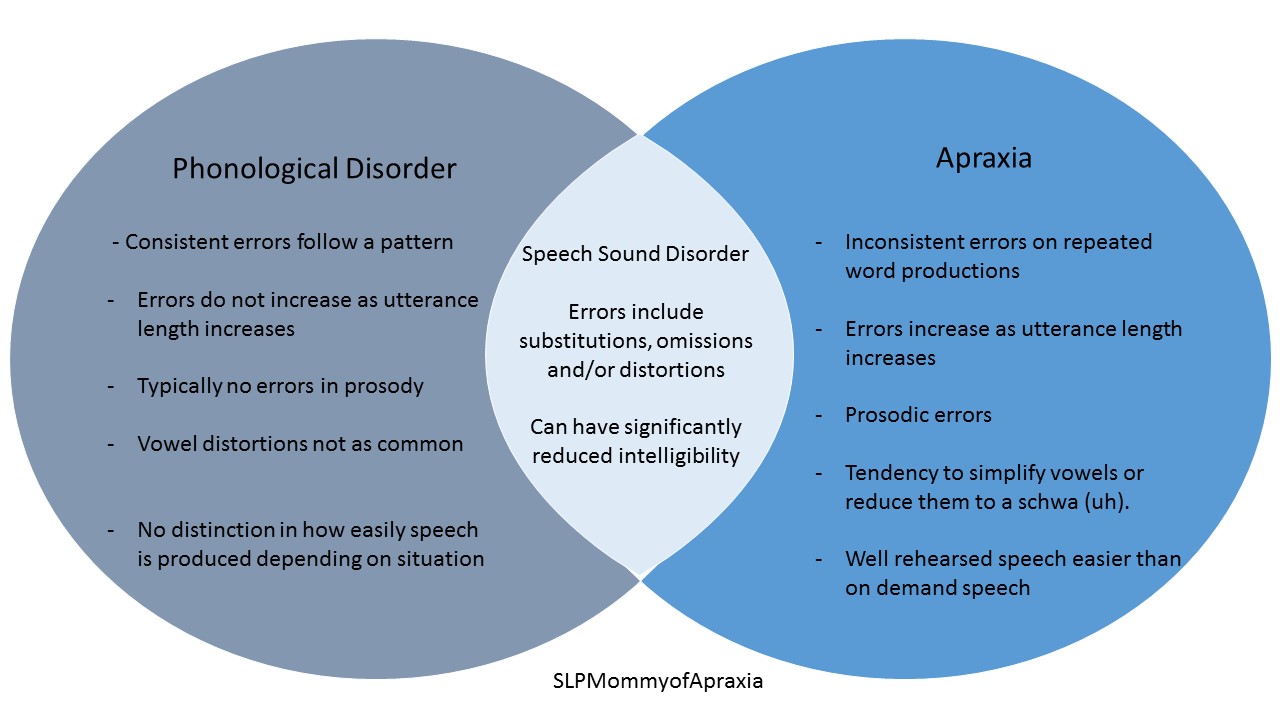
    It is NOT that complicated.  To put it simply, phonological disorder is a speech sound disorder in which the child typically makes consistent patterns of errors.  For example, one common phonological process is called fronting.  In this process, the child will consistently produce the /k/ sound as a /t/ sound, and the /g/ sound as a /d/ sound.  It is a predictable, patterned error.  This child, regardless of the word will usually always make these substitutions.  However, a child with a phonological disorder can have several phonological processes they are employing and be quite severe and have significantly reduced intelligibility.  A child with phonological disorder may have numerous substitutions, omissions, or distortions.

    4.) A motor speech disorder such as apraxia or dysathria –  Apraxia of speech refers to a child’s difficulty with the planning and programming of speech production that results in inconsistent errors, deficits with prosody, and significantly reduced intelligibility.  Unlike kids with phonological disorder, children with apraxia do not always have predictable and consistent error patterns.  This could be on repeated productions of the same word, or the ability to produce one sound in different words.

    For example, a child with apraxia may be able to say an /m/ in the word “momma,” but be unable to say or inconsistently say an /m/ in the word “more.”  Another child with apraxia may say “baby” for baby once, but when asked to say it multiple times may produce it different ways such as saying: baby, bay-ee, daby, or day-ee.  A child with apraxia may have numerous substitutions, omissions, or distortions.

    In addition, children with apraxia have some sort of prosodic disturbance to their speech.  This can manifest in ways such as: stressing each syllable in a word resulting in more “staccato” sounding speech, or errors with pitch, intonation, rate or volume.

    Graphic depicting the differences and overlap between phonological disorder and apraxia.

    Language delays do not involve the actual production of speech sounds (although the two can overlap). Language delays can be caused by many factors as well, and include:

    1.) A late talker – A late talker is just a typical child who talks late and has no additional speech or language issues from it.  The ASHA website offers this explanation “At onset, it is difficult to distinguish late talkers from late bloomers, as this distinction can be made only after the fact,” which as a parent and professional of children with apraxia, this is a pretty DANGEROUS and potentially hazardous distinction if you are just waiting around to see if it’s late blooming or something else.

    2.) A language impairment – There are many components of language. Language is comprised of five major components including: phonology, morphology, semantics, syntax, and pragmatics.  In addition, children can have difficulties expressively or receptively with these components.  Some children can have both, getting a diagnosis of MERLD or mixed expressive/receptive language disorder.

    3.) A hearing loss –  This is repeated on this list, because a hearing loss can also cause delays in language development as well. ASHA describes its effects in the following:

    There are four major ways in which hearing loss affects children:

    1. It causes delay in the development of receptive and expressive communication skills (speech and language).
    2. The language deficit causes learning problems that result in reduced academic achievement.
    3. Communication difficulties often lead to social isolation and poor self-concept.
    4. It may have an impact on vocational choices.


    3.) A medical or genetic condition – Other causes of language delay or impairment could be but aren’t limited to:

    Autism
    Fragile X
    Down Syndrome
    Cerebral Palsy
    Cleft lip/palate

    To complicate things even more, a child with a medical disorder could also have a co-morbid speech or language impairment as well!  It’s important to always know the etiology because an accurate diagnosis ensures and informs therapy.

    What I hoped to clarify in this post is that the question “Does this look like apraxia?” is just a little (okay a lot) more complicated than it seems.  Obviously the best place to start is to get a comprehensive evaluation!  If apraxia is suspected, it is best to get a differential diagnosis from an SLP who has received additional training past their post graduate degree in apraxia of speech.

    To find an apraxia expert near you, or to get listed as an apraxia expert,  go to apraxia-kids.org and click “find a speech therapist” at the top.