Category: #knockoutapraxia

  • Apraxia and the Mamba Mentality

    Apraxia and the Mamba Mentality

    At the beginning of 2020, the world received word that world famous basketball player Kobe Bryant died in a helicopter crash with his daughter Gianna.

    After his death, people were chanting and hashtagging #mambamentality. Though I had heard of the “Black Mamba” and the “mamba mentality,” in relationship to Kobe, I have never followed professional basketball that closely, and didn’t really know the origin of the phrases or what they meant.

    After searching the “mamba mentality” I found this interview article in which Kobe describes it in his own words. While I was reading it, I realized that apraxia taught our kids the Mamba Mentality early on in their life. Here are a few quotes straight from the mouth of Kobe Bryant.

    The Mamba Mentality is:

    ” Doing more than the next guy and then trusting in the work you’ve put in when it’s time to perform.”

    ” If you have a goal or a dream, you need to apply the Mamba Mentality to achieve it. Everything worth achieving needs total focus and dedication.”

    ” Hard work outweighs talent – every time.” (this one is my favorite).

    Apraxia and the Mamba Mentality

    In the throws of an initial diagnosis, the apraxia diagnosis broke me. I was in despair for my daughter and determined to do anything in my power to help her speak. I gave it everything I had and getting her the help she needed took my total focus and dedication – Mamba Mentality

    Throughout the process of therapy and learning to talk, Ashlynn gave it everything she had, every session. My clients do the same. Ashlynn and children with apraxia put in WAY more work than other children just learning how to talk. When it was time to perform they many times may have fallen short, but always got up again. Speech for apraxia is intense and direct and talking didn’t come easy, but hard work outweighs talent every time. – Mamba Mentality

    I posted a video from Neil deGrasse Tyson the other day about a parent’s job not being so much to instill curiosity in children as to be being sure not to squash it. I might venture the same is true about the resiliency that apraxia taught our children early on. I think it’s easy for us to want to take away their pain and make life easy for them after watching them struggle to do a basic human right: Speak.

    However, that “struggle” built a natural “mamba mentality” and if they can keep that mentality throughout their entire life they are already ahead of game.

    I’ve had the privilege of meeting many older individuals who grew up with apraxia now, and by and large their work ethic, drive, determination, and resiliency continues to help them achieve great things. – Mamba Mentality

    Watching my daughter fight to overcome apraxia and then all of her other learning disabilities put this “mamba mentality” inside of me. I was not ever going to give up. I was going to keep my drive and determination no matter how many times I failed. I was going to keep working and striving not only for her but toward a greater vision of apraxia awareness and I was going to remember what Babe Ruth when he said, “You just can’t beat the person who never gives up.”

    It would seem Babe Ruth too had the mamba mentality.

    As the world said goodbye to Kobe Bryant at his celebration of life today, I thought about how a true legacy is not just achieving some amazing feat. A true legacy is an amazing feat paired with how many others were inspired to be better and be something greater because you existed.

    Who will you or your child inspire with their mamba mentality?

    Laura Smith, M.A. CCC-SLP is a 2014 graduate of Apraxia Kids Boot Camp, has completed the PROMPT Level 1 training, and the Kaufman Speech to Language Protocol (K-SLP). She is the author of Overcoming Apraxia and has lectured throughout the United States on CAS and related issues. Currently, Laura is a practicing SLP specializing in apraxia at her clinic A Mile High Speech Therapy in Aurora, Colorado. 

  • The IEP meeting I wanted to attend.

    The IEP meeting I wanted to attend.

    I never knew before I had a child with an IEP (individualized education plan), how awful these meetings can be for parents.

    Before I had my daughter, IEP meetings were part of my job and I attended them weekly with a room full of colleagues and the parent or parents. I had no idea how it felt being on the parent side. I do now and it feels scary, nerve wracking, and very intimidating.

    I haven’t gone back and added it up, but today was at least the 9th and probably 10th IEP meeting (individualized education plan) we’ve had for my daughter Ashlynn. I don’t think I’ve ever had a meeting where I wanted to go to it. I can particularly remember the meetings that gutted me. Looking back it probably wasn’t any one educator’s fault. It was my position in the process of it all. It was like additional problems kept adding up. Just when I thought I had apraxia down, she would get ADHD, dyspraxia, issues with memory, issues with language comprehension……and the meetings were full of her can’ts. I could talk about how to write a strengths based report or run a strengths based meeting, but in the end even that wouldn’t have been enough to fill or patch the holes from the stab wounds from all of her can’ts.

    This time though was different.

    Starting last year, Ashlynn started to turn a corner. She was no longer speaking in as many “scripts” but was formulating her own novel sentences. She grew exponentially on her reading. The special education team got to know her and they saw what I saw and believed what I believed Ashlynn was capable of. Instead of the words “she requires more repetition than most,” hurting my soul, I was encouraged because they said it with the conviction behind it that they would get her those extra reps because she is capable.

    This entire past year I’ve felt the momentum and seen her IEP goals in action in Ashlynn’s everyday life.

    From SPED, I’ve seen Ashlynn finally understand money, time, and her math facts. She has RETAINED these facts. Did it take one hell of a lot of repetition? You betcha, but they did it and when Ashlynn has learned something, it’s like riding a bike; she doesn’t lose it. Ashlynn’s reading has continued to improve and we are working toward closing that gap. We aren’t there yet, but I SEE it. I SEE it and I feel the momentum. I’ve seen it within her book choices and through her reading out loud. In addition, many skills she needed accommodations for she is now independent with. She has mastered the classroom routine, she doesn’t need direct line of sight supervision for safety, and she is independent with basically all of her ADL’s (Activities of Daily Living). The one that made me smile was teaching Ashlynn to stop and think and give her time to process and understand what was being said so that she could give a thoughtful answer instead of just blurting out anything. We all laughed because she will frequently now tap her brain and say “hmmmm” to give herself time to think. Again, seeing IEP goals materialize in my child is not something I can quite explain. It’s phenomenal.

    From her SLP I saw the direct result from her working on formulating more complex sentences with “so” and “because” come to life at home. In addition, all the vocabulary work done in speech has seemed to literally lift Ashlynn out of her language disorder fog. Where before language was literally just flying over her head, she is comprehending and making connections like she was never able to before, and again I’m seeing that in her everyday conversations with me as well.

    From PT we remarked at how she can perform tasks like standing on one leg for 6-9 seconds and doing jumps etc, something that once seemed like a pipe dream with her hypotonia, cerebral palsy, and major motor planning problems. I told her how she could now ride a bike with no training wheels and that Ashlynn chooses to do workout videos and could follow along.

    From OT we marveled at her mastery of her ADL’s around school, how she can tie her shoes now, and her ability to follow up to 3 step directions that involve motor planning tasks. With adapted graph paper, Ashlynn’s can complete writing assignments and really is just working on putting it all together: getting thoughts on paper, letter formation, spacing, punctuation and legibility. She can do all of those tasks adequately if given separately. I’ll take that. There was a time she couldn’t write her name. That took “more repetition than most, ” but I smiled this time. I had it all wrong before when that phrase would burn me. No one said she can’t do it, and that’s what’s important. More repetition than most? Deal. Bring it on. THAT we can do.

    From mental health she is doing great with whole body listening and finding more peers to play with and inserting herself into play on the playground. Next step is learning how to engage socially with peers in conversation.

    The whole meeting was amazing. I was on cloud nine. The takeaway? Ashlynn’s going to make it.

    I sat there and thought back to Ashlynn’s early days. Was this really the same girl? The girl who would get too distracted she couldn’t even hang up her coat and backpack and get to class without assistance? Was this the girl who spent all of preschool, kinder, and preschool just learning the letters of the alphabet, much less learning how to read? Was this the girl who spent Kinder, 1st, and 2nd grade trying to master addition and subtraction and now was rocking that but also money and time? Was this the girl who was so clumsy and uncoordinated that she couldn’t ride a tricycle or put her shoes on the right feet much less tie them?

    It was and she was freaking killing it.

    Though there were many, many, many times I felt defeated, I NEVER was defeated. I always held the vision for Ashlynn. I held it steadfastly in my mind and promised her that even if I was the only person who ever saw her potential, I would never give up on her and I would fight to the end. I was prepared for war. I listened to inspirational songs and videos to keep the faith. I also worried and fought and lost sleep and prayed. Oh did I pray, but it wasn’t that she would overcome. I always knew that you see. I always knew she had a divine purpose. I prayed for a team that would see Ashlynn like I do and help her fly.

    A couple of months ago, filled with gratitude, I nominated her SPED teacher for a district award.

    It’s called the Golden Heart Award and is bestowed to any educator in special education who has gone above and beyond for a student in the program. Because coincidences are the Universe or God’s way of talking to us, Colleen received notice she was awarded this honor TODAY – the day of Ashlynn’s IEP.

    I thought to myself,

    “Sounds about right.”

    Laura Smith, M.A. CCC-SLP is a 2014 graduate of Apraxia Kids Boot Camp, has completed the PROMPT Level 1 training, and the Kaufman Speech to Language Protocol (K-SLP). She is the author of Overcoming Apraxia and has lectured throughout the United States on CAS and related issues. Currently, Laura is a practicing SLP specializing in apraxia at her clinic A Mile High Speech Therapy in Aurora, Colorado. 

    Purchase Overcoming Apraxia on Amazon.

  • Executive functioning home intervention

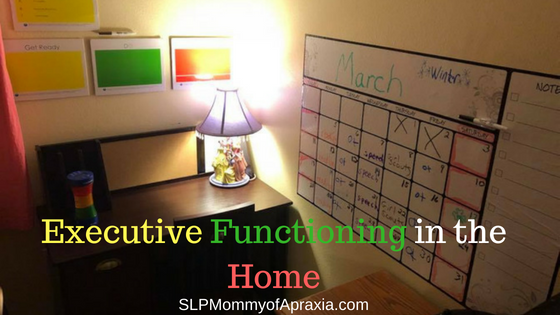
    Executive functioning home intervention

    Let’s talk executive functioning.  If you follow my facebook page SLPMommyofApraxia (click here), you already know we are making our house an executive functioning friendly zone and you might have read a prior post I wrote a  “What is Executive Functioning, and Why Do You Need to Know?”

    What does an executive functioning friendly zone mean exactly?  I decided to put all of it into a post so you can see and hopefully help others who may have children with similar issues.

    Before I begin, I just want to say this:
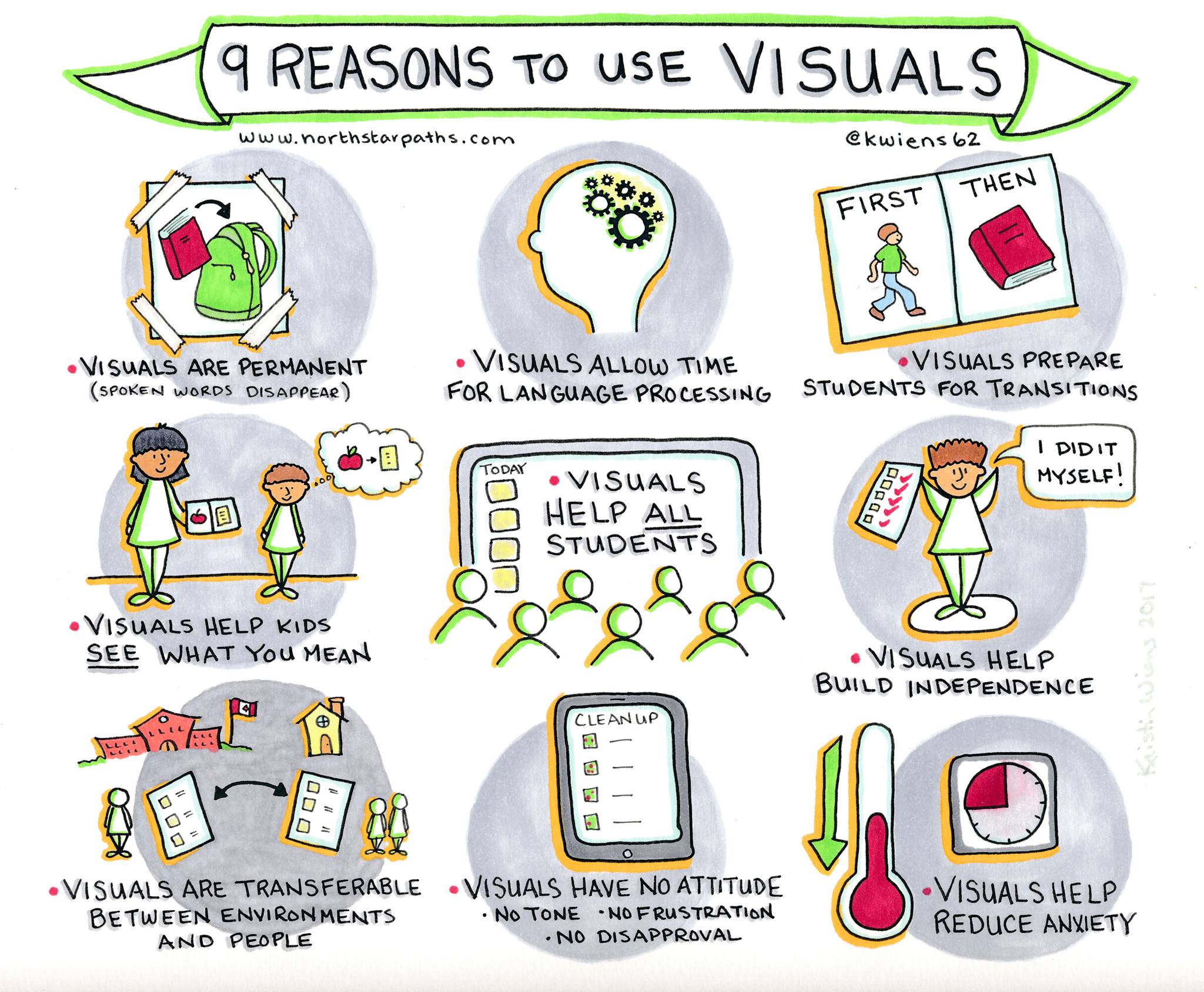
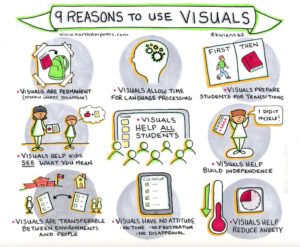
    Children with learning differences, many, many, MANY times benefit from the use of visuals.  There have a been a handful of cases in my career where visual aids actually confused the student more; but for the most part, visual aids benefit everyone.  This visual from northstarpaths really explains why:
    Executive functioning (EF) deficits are a common comorbidity with a variety of conditions including: ADHD, OCD, ID and others just to name a few.

    Visuals are AMAZINGLY helpful for children with EF dysfunction.   The problem is, most teaching involves auditory input.  The teacher (or parent) talks, children listen, and learning takes place.  For kids like my daughter, who have a language processing impairment, the teacher (or parent)  talking is basically the equivalent to the teacher in the Peanuts comic series.  All the children hear are “wah wah, wah wah wah wah.”

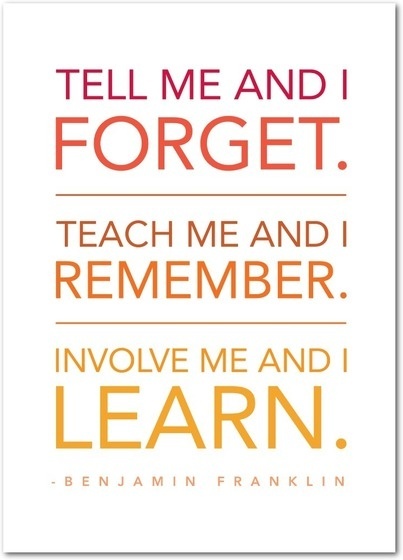
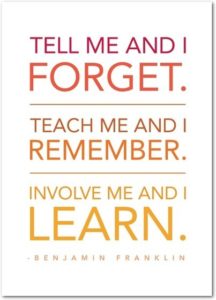
    Visuals bridge the gap.  I couldn’t say it better than Benjamin Franklin, who himself had a learning disability when he said,
    Aside from just visuals though, kids with EF dysfunction benefit from organization and time management strategies.  The following is what we currently have implemented in my home.

    Morning Routine

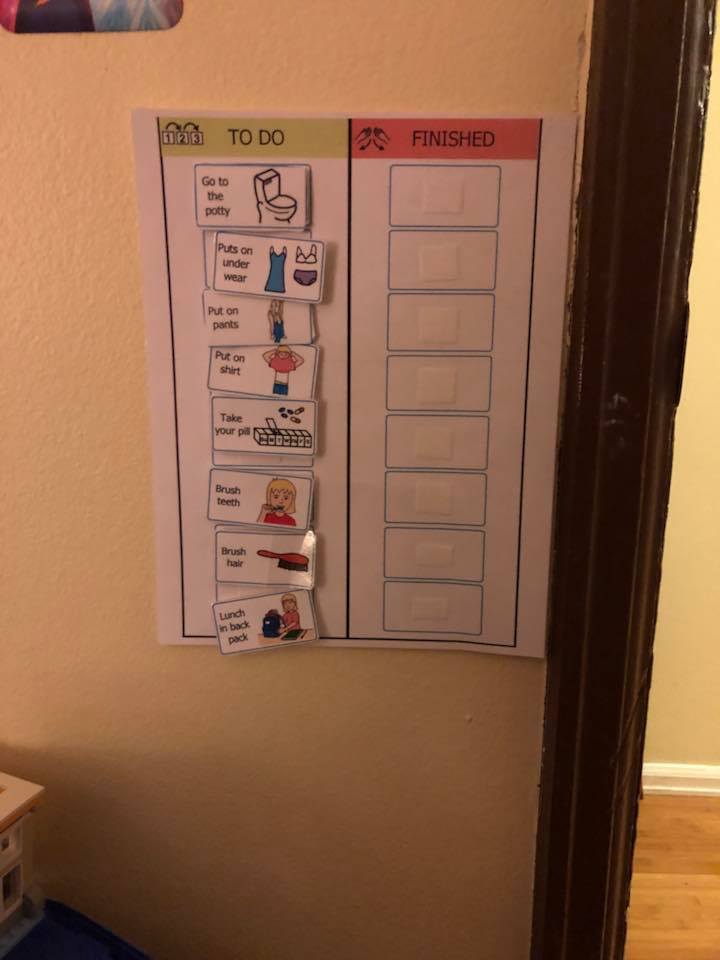
    The most recent example from my personal experience involved the steps to getting ready for school.  If I told Ashlynn what to do, she immediately forgot or I had to go through step by step and tell her, which is not promoting independence.  With the help of her SPED teacher, we made this visual schedule and she was successfully completing all of her steps without our help in about two weeks.
    Restroom steps

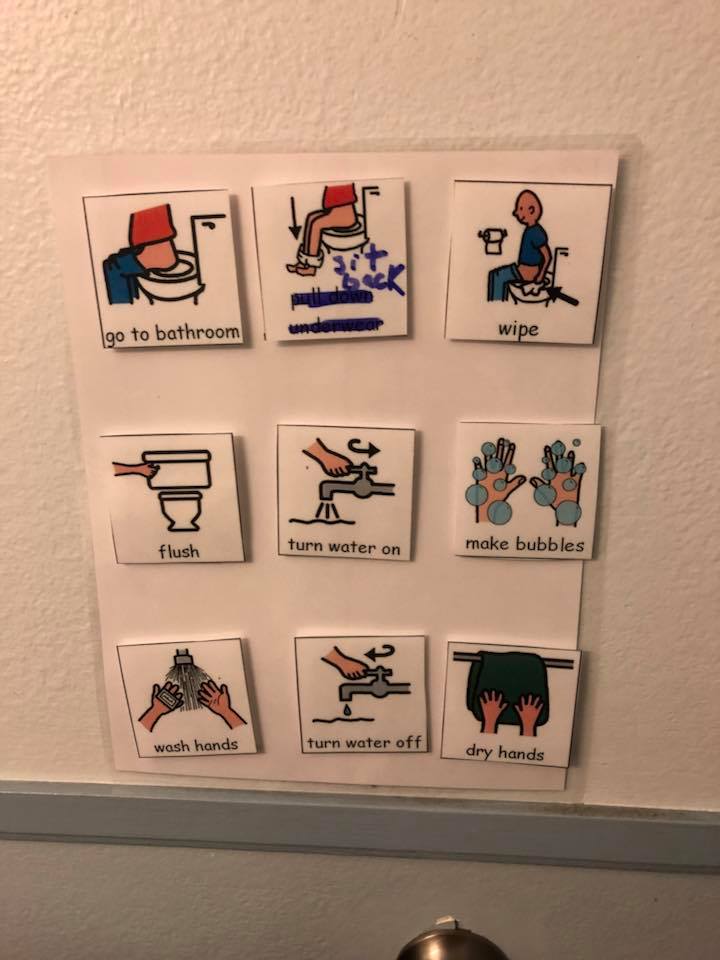
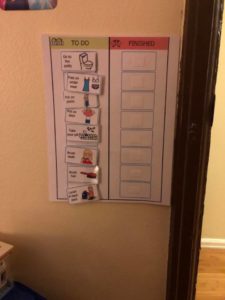
    We decided to make a visual schedule for completing bathroom steps.  Let me tell you that we have been working on remembering these for AT LEAST a year.  Last year in 2017, I sent her to Adam’s Camp and remember telling the therapists she can say all the steps but still is not consistent.  After Adam’s Camp she came home being able to sing them as well, and still, we could not get consistency.   So we made a visual schedule a little different than her morning schedule and it looked like this.
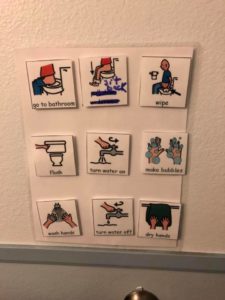
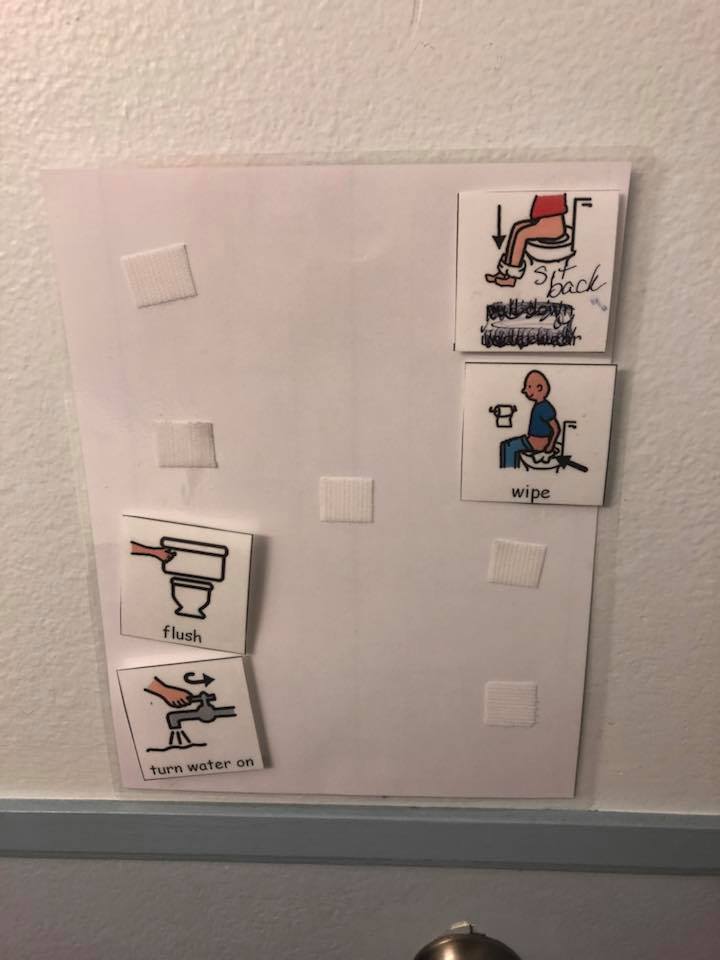
    This was NOT successful.  It probably has too many steps and it doesn’t have the nice left to right motion the morning schedule this, so I modified and made this.
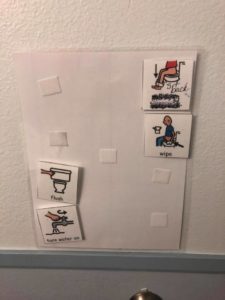
     

    I’d be lying if I said this was a complete success right off the bat, but it has worked better than any other strategy to date and now that the summer has hit, we have made sure she has to go back and complete her steps every single time.

    Cleaning her room

    The next step was to tackle completing a basic chore like cleaning her room.  I can’t even begin to explain the difficulty with this.  What I do know, is that many adults with ADHD continue to struggle with disorganization into adulthood.  It behooves us now to help our kids develop strategies that are going to serve them well throughout their lives.

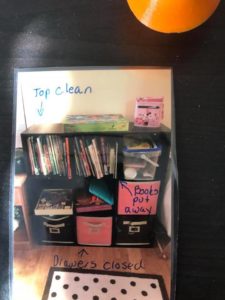
    The first step is to make sure everything has a place.  Classrooms are set up this way for a reason.  There is a specific space for each and every item that is used or played with in a classroom.  If not, things will inevitibely end up in a pile of clutter.  Ashlynn and I went through her room and designated certain drawers and bins for different things.  Everything has a spot.  There is a bookshelf, a lego bin, a writing utencil drawer, a baby clothes bin, you get the idea.

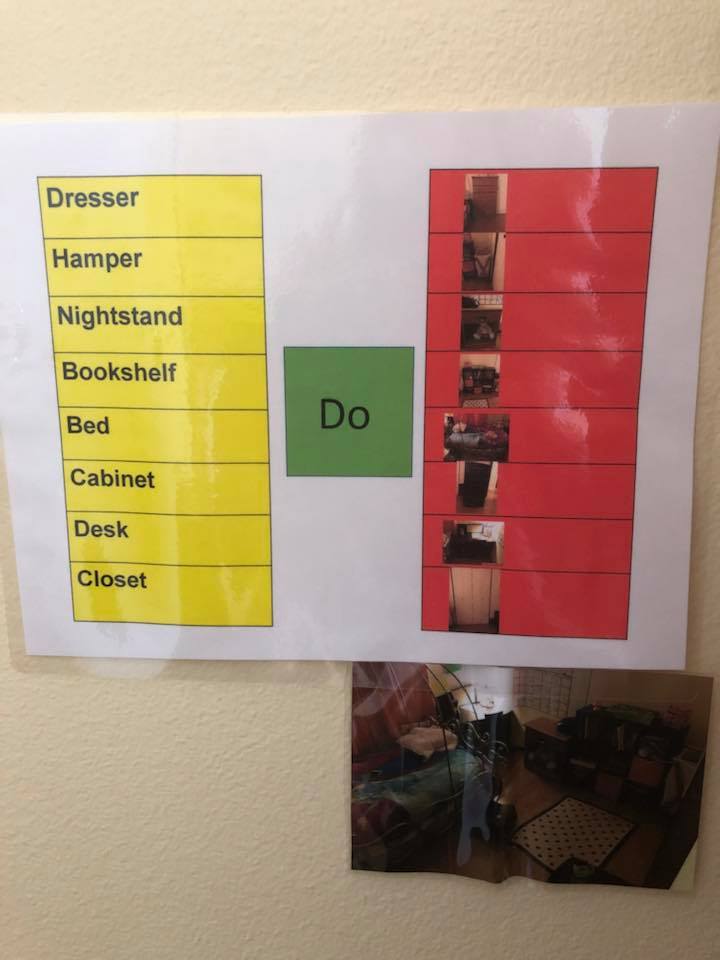
    I then created a visual schedule of each piece of furniture that she could check off as she went about her cleaning routine.
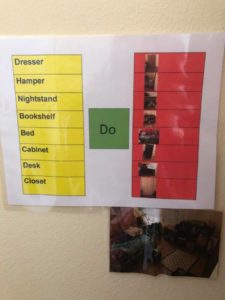
    I know it’s hard to read, but basically each furniture item is listed on the left, with a picture representation on the right of what it looks like done.  The picture on the bottom is a grand finale picture of what the entire room should look like clean after completing all of the steps for one last check.

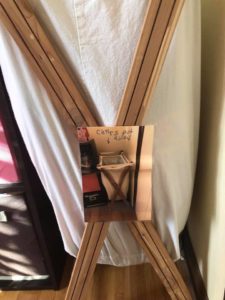
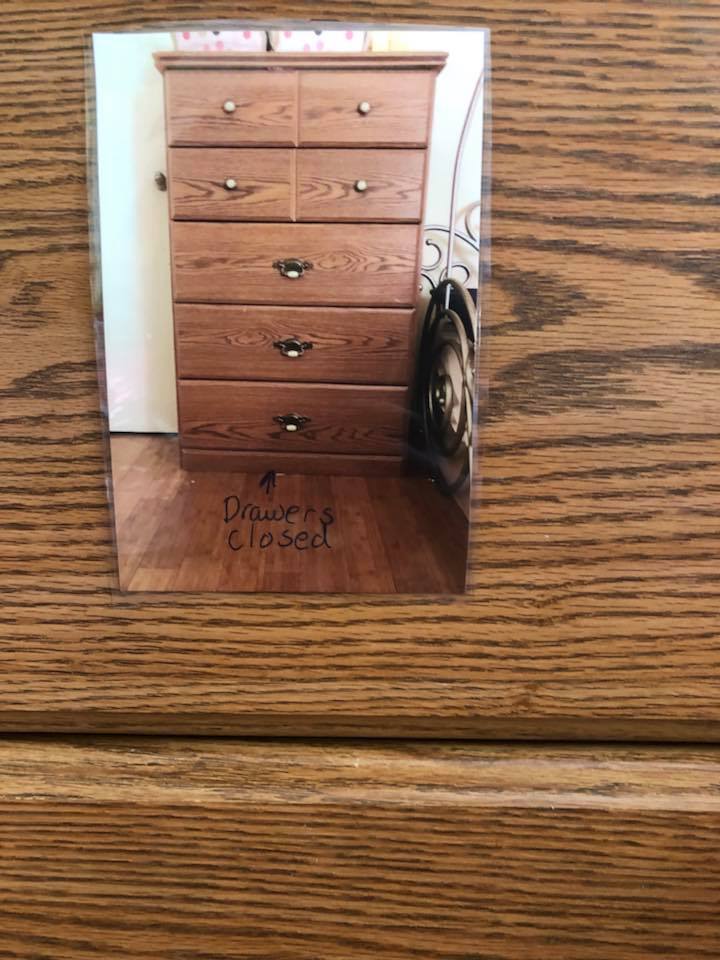
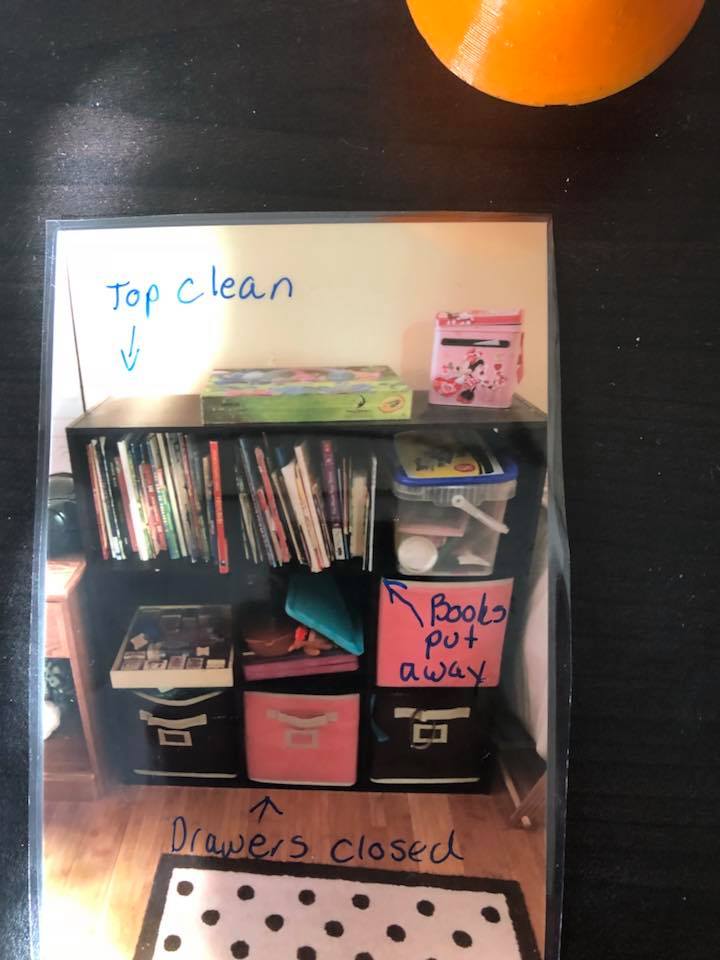
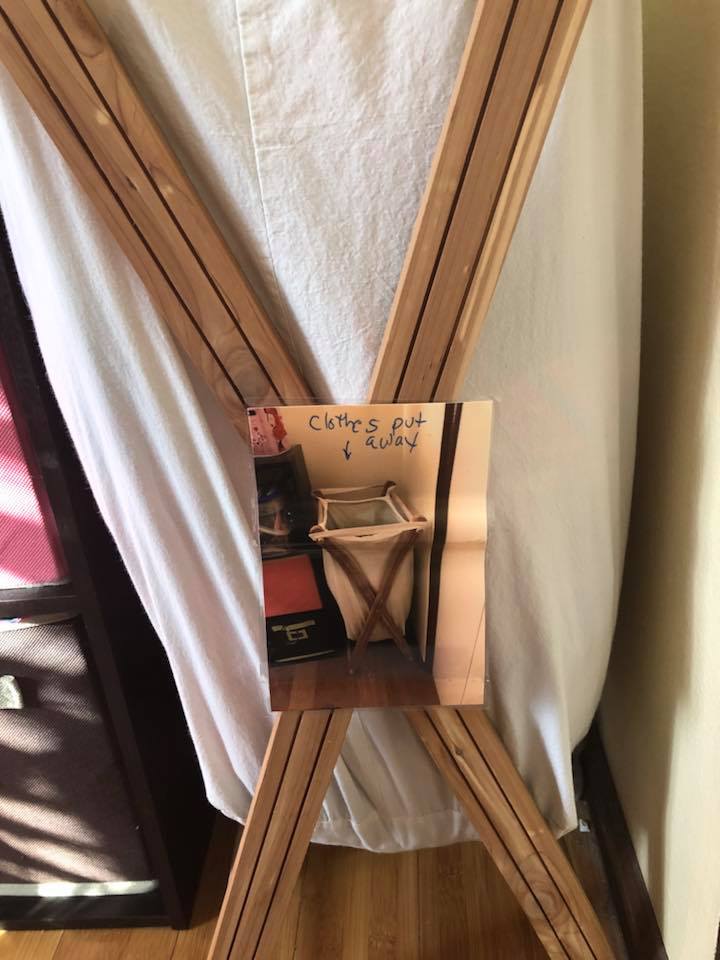
    Next up was to have bigger picture velcroed to all of the furniture items so she could see as she was cleaning them what they are supposed to look like.  I know it seems redundant, but seriously if you have a child who struggles this, then you will relate when I say that a dresser with closed drawers looks fine with clothes hanging out of it to her.  Same with a picked up hamper.  I even have a picture showing what the closet should like closed and no that doesn’t mean it is closed until it hits the piles of crap.  It means actually closed and looking neat.
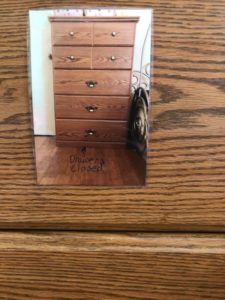


    I have to add that these helped, but still had to be taught.  In fact, it’s still a work in progress.  Some nights, I am so frustrated and just want to pull my hair my out.  I’m only human after all.  I do though, in those times, try and decompress and remind myself this is not a *fix* but a lesson.  Ashlynn doesn’t learn like other kids and that’s okay.  I have to realize though that all of this will pay off in the long run, and when we start early kids have the best outcomes.

    Homework

    Oh man don’t we hear horror stories about homework from parents of kids with varying learning differences.  Teachers make homework sound so easy.  Ten minutes for every grade you are in, so a first grader shouldn’t be more than 10 minutes a night.

    Say….what???  That assignment just took my kid an hour….and then when we went to second grade, that so called 20 minute assignment just took upwards off and on of two HOURS?  Minutes?  What?

    Know that homework can always be modified, but there are strategies that can be put in place to help with this too. Number one is to just start with a place that is going to make them successful for learning.  If you are like me, my first baby is the one with learning differences so instead of preparing for the ultimate learning environment, we were more focused on transitioning my son from a crib to a toddler bed and spent our money on that.  Needless to say, our kitchen table became her homework place.  Yes, the place that she eats and the chair in which she sits that her feet don’t touch on the ground yet is what we thought would be the perfect location for her to sit down and do that quick assignment in 10 minutes.  I should mention too it’s a thoroughfare in my house, so my kid with ADHD was also constantly distracted by the events taking place all around her.  Can we talk about set up to fail???

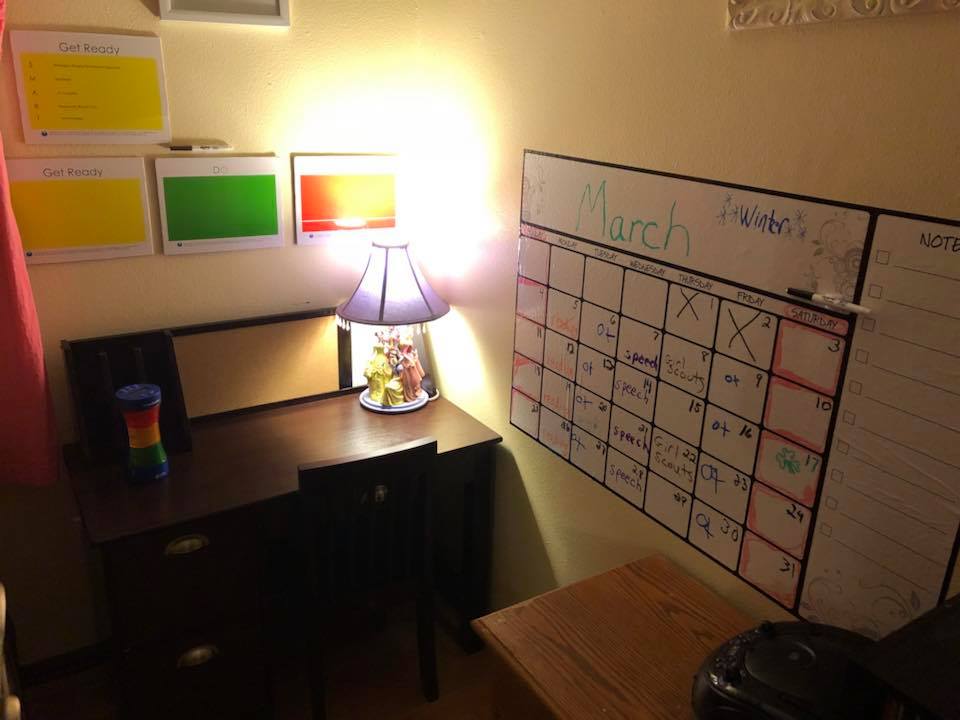
    I redid her room and created a homework corner.  I bought her a new desk in which she sat at a 90 degree angle, perpendicular to the floor, and decked it out with strategies from executive functioning queen Sarah Ward from the website Cognitive Connections.
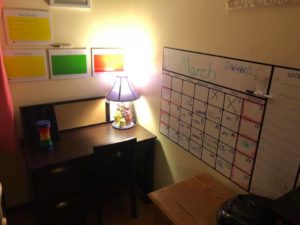
    New desk with feet on the floor

    As you can see, I have her own desk, in a corner of her own room, that is quiet and in which her feet touch the floor!

    Get ready, do, done boards

    The colored board above the desk are suggestions from the cognitive connections website.  In the yellow, we write everything we need to get ready.  It might be as simple as a pencil and it might be more complicated if doing a project.  (To modify for non-readers, you can tape or velcro pictures that you need.).

    The green stands for “doing.” These are the steps you need to do to reach the finished project.  The finished project then is the red board and reflects what the assignment looks like when it is finished.  For lower level, you can put a picture of what a completed assignment looks like, or for readers you can simply write it.  Sarah Ward also recommends to “start with the end in mind,” meaning kid with EF deficits benefit from knowing what the end is supposed to look like and then working backwards. For a more elaborate description, go see Sarah Ward talk.  She’s amazing.

    Calendar

    We have tried a few different things to help Ashlynn learn time, and I’m not just talking time management.  Ashlynn has had a lot of difficulty learning the seasons, days of the weeks, the months, and understanding the difference between yesterday, today, tomorrow, last week, next week etc.
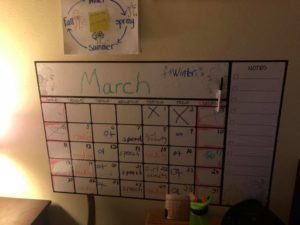
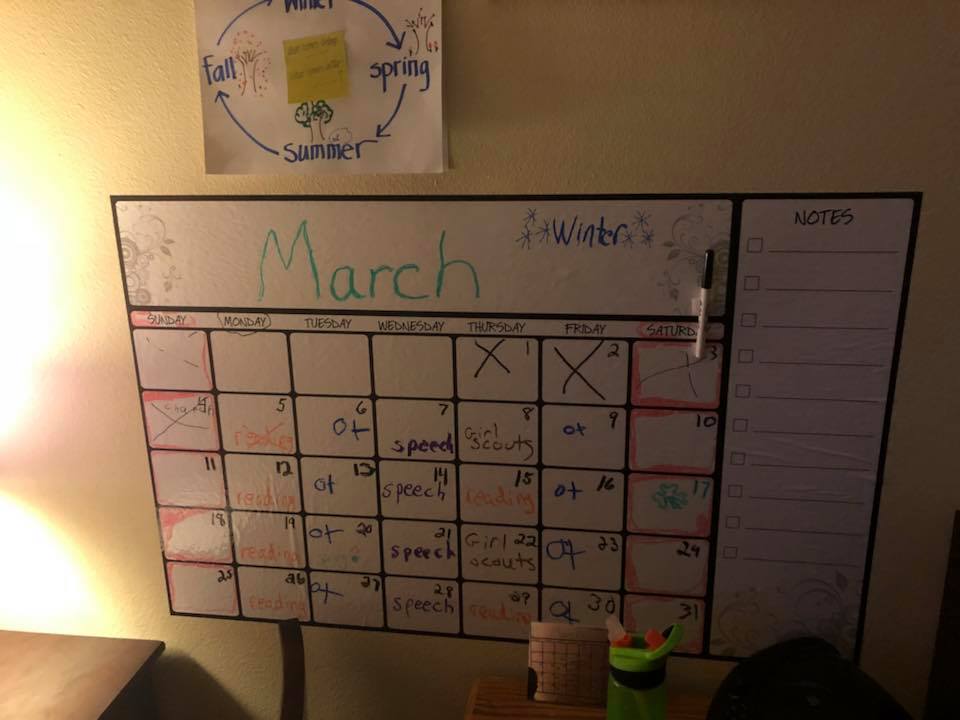
    I decided to buy this peeling dry erase calendar at target.  It’s huge and sits right by her desk.  Every month, she helps me write the month and the days.  We then go through and write her therapy/activity schedule and color code them.  Each activity is written in a different color.  The weekends are shaded on red since she has a difficult time understanding that Saturday and Sunday are one unit (the weekend) when they are split up on a normal calendar.  We then marked an X for each day that had passed and talked about yesterday and tomorrow.  This calendar has been AMAZING.  I might be so bold as to say it almost helped her understand days of the week right away.

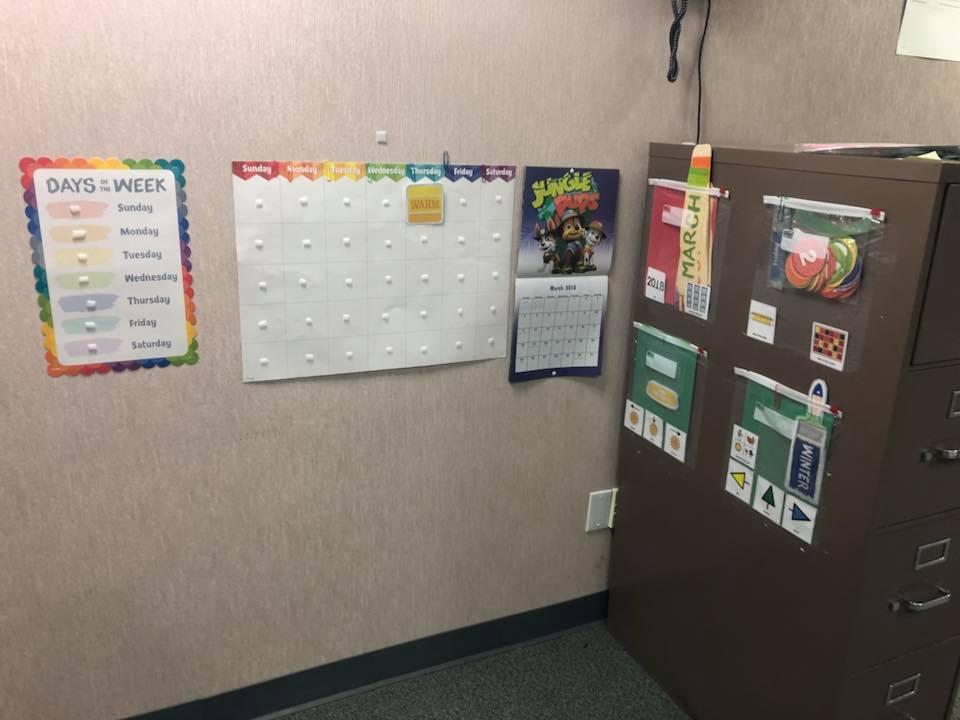
    Her school though also hit this hard visually and created the following corner in the SPED room just for her.
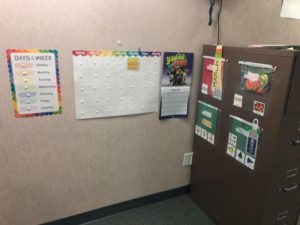
    This picture is also hard to see, but basically you see the basic calendar color coded by day in the middle.  To the left, each day of the week is color coded.  On the file cabinet on the right, the months are placed and she has to pick out the right month each day for added repetition.  The days are in the second bag, and there are tiles for the season and then arrows to talk about the concepts yesterday and tomorrow.  A normal calendar was provided as a reference to keep track of how her modified calendar related to a typical calendar.

    Timer

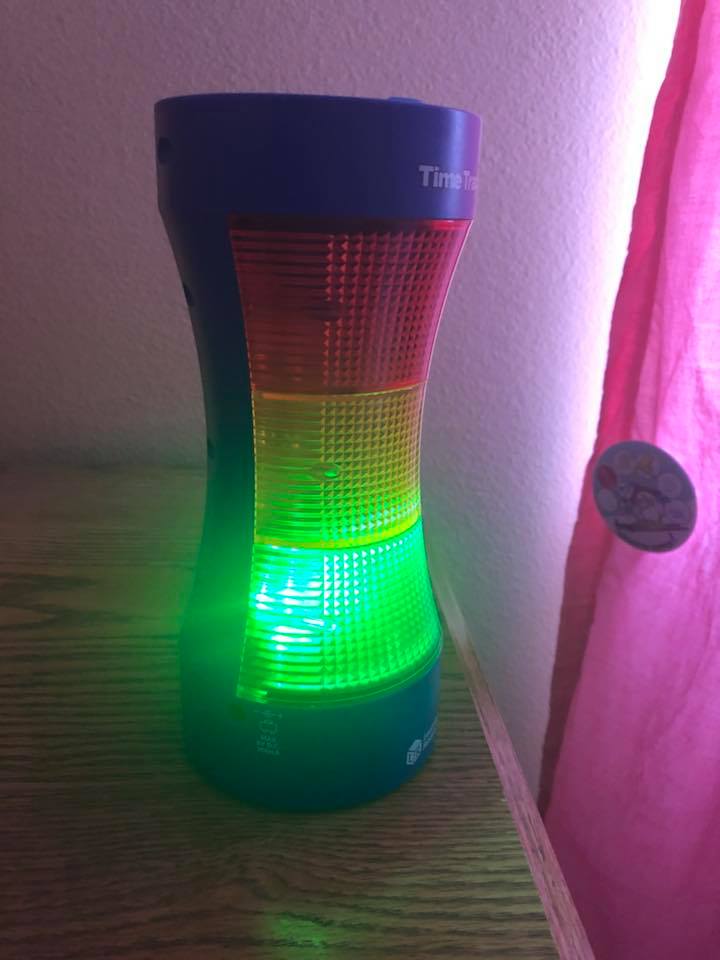
    Last to come is the timer I used for all of these tasks!  Time management is another HUGE skill that is difficult for those with EF deficits.

    The timer is from the autism community store here in Denver, but I’m sure you can find them on Amazon or other places.  This timer is amazing!!  The colors stand for different things similar to a stoplight.  Green means go, yellow means caution you are nearing the end, and red means you need to be done or stop NOW. What is best, is that each color is completely customizable by time.  For her morning routine, we usually set it for 3-3-3.  For homework, it might be  2-20-2.  Did I mention it also comes with sound?  So that means every color it changes to also has a sound to go with it, aka, an auditory cue.
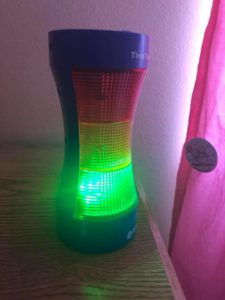
    The impact

    I have to admit, there were times that as even I were making all of these materials and buying all these things that I wondered will this really make a difference?  Was all this work really worth it?? My answer came from Ashlynn.  As I was making these visuals, she probably thanked me more than 10 times.  She knows how she learns.  She was just waiting on me to help her.

    Laura Smith is a mom to two children, one of which who has multiple learning differences.  She is also an SLP (speech/language pathologist) specializing in CAS (Childhood Apraxia of Speech), a passion that was fueled by her daughter’s dx in 2012.  To learn more, visit slpmommyofapraxia.


  • She’s starting to feel different.

    She’s starting to feel different.

    Ashlynn just started her second grade year.  At the end of first she basically made a full year’s worth of growth going from beginning Kinder reader to end of Kinder reader, but still couldn’t pass the last level. I put her in tutoring again, just like I had done the summer after her Kinder year; but this time it was 3x a week for 30-45 minutes.  I saw so much growth and confidence.

    Thanks to her awesome teachers, Ashlynn has had solid reading instruction that includes explicit phonics instruction paired with an evidence based sight word program called Edmark.  Ashlynn has sooo many amazing skills.  She has sight words, she has all of her letter sounds, she can blend words.  For all intents and purposes, she should be passing this last Kinder level.  For some reason though, when we go to put it together, it just isn’t coming together.

    Ashynn found a “hooked on phonics” box I had forgotten about in her closet.  It’s a mostly phonetics based approach home program that includes computer disks and leveled books. She has carried

    these books, a stack of probably 12, EVERYWHERE.

    Today alone we read one waiting at the dentist, she read one in speech therapy since she refused to leave them in the car, and she picked one as her bedtime story.  When we were done reading, she sat at the edge of her doorway and read more to her stuffed animals.  It was very late and I told her she had to go to bed.  I heard her say pleadingly,

    “But Mommy.  I HAVE to learn how to read.”

    That KILLS me.  It literally breaks my heart into tiny pieces.  Why does it have to be so hard??  If I had worked that hard as a child I can’t even imagine where I’d be.  Maybe I would be an author like I’ve always wanted making millions.

    She’s so much more aware this year.  I can tell.  One of her friends from last year was retained and the other was grade skipped.  She’s happy everyday she comes home.  She still wakes up excited to go to school; but it’s been hard to make friends for her this year.  Her T.A’s are AWESOME.  They are always trying to facilitate friendships and get her playing with kids…….

    It’s just….

    Ashlynn has always known she has apraxia, but this year, I think she understands what it means to feel different.


  • The Hulk and Rousey on struggling to speak.

    The Hulk and Rousey on struggling to speak.

    During an episode of “Battle of the Network Stars” Lou Ferrigno and Ronda Rousey shared a touching exchange about their childhood disorders and how it made them stronger.

    Ferrigno, best known as the Incredible Hulk, inquired into famed MMA star Ronda Rousey’s life.  He questioned about the fire she had inside of her and wanted to know where the first flame was stoked. In an incredibly honest moment, Ronda tells him that she grew up with apraxia, a childhood speech disorder in which she would talk;  but the message in her head was different than what came out of her mouth and would sound like jibberish.

    She continues to reveal she was made fun of for having trouble speaking and eventually venting that frustration physically.

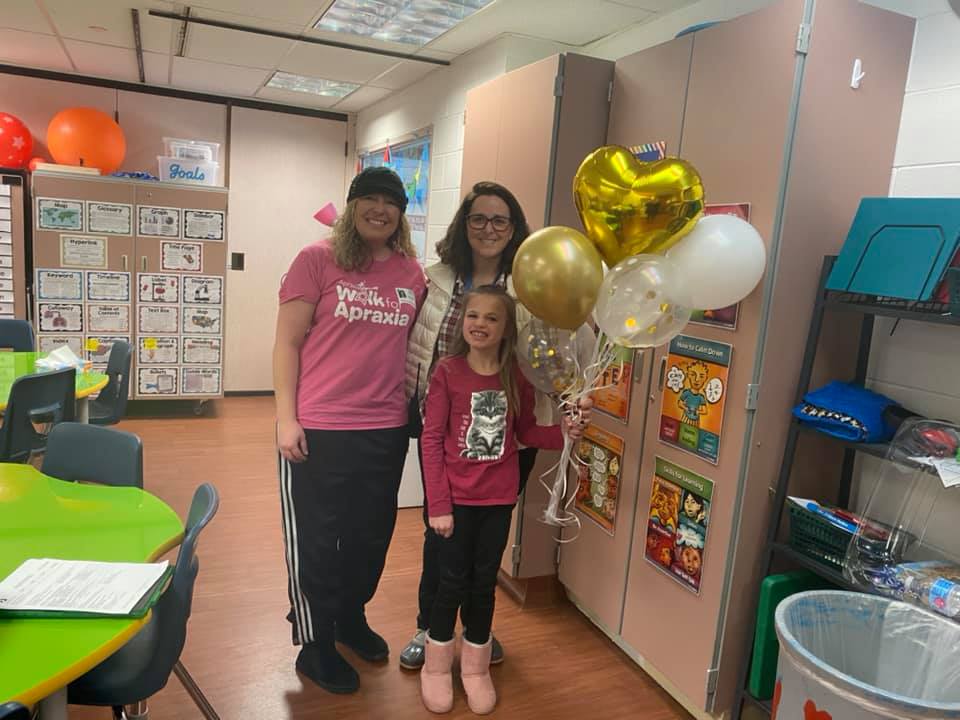
    Speaking as a parent of a child with apraxia, my heart stood still.  Hearing the word “apraxia” on national television brought instant tears to my eyes.  No one knows the struggle it is unless you have it or live it.  There is so little awareness that even many professionals don’t know it or its presentation. I’m a walk coordinator for the disorder in a large metropolitan city and the local news informed us it wasn’t newsworthy.

    In that one moment, that one SECOND in time, the apraxia community blew up with excitement.  A video was posted that has been viewed 5K times in one day! That is the power of having a celebrity speak out about a cause.

    Lou Ferrigno again brought tears to my eyes when he said,

    “Everyone is handicapped either physically, mentally, or emotionally.  It’s all about maximizing what you have.  As a kid I had trouble speaking.  It’s all about overcoming adversity.”

    I watch my child do this very thing every day.  I watch her struggle to do a basic human right that comes so easily to everyone else.  Something that’s so important it’s our first amendment in the United States.

    Speak.

    Watching Lou and Ronda in that moment, I realized that overcoming adversity will put that fire in her belly just like it did Lou and Ronda and we can show our children their story to inspire them and inspire us to become our best selves.

    As Ferrigno pointed out,

    “We’re only here for a short time.”

    Make each moment count.

  • Apraxia would have destroyed me

    Apraxia would have destroyed me

    I often think about what would have happened had it been me who had apraxia, dyspraxia, SPD, dysarthria, and a learning disability when I was young.  It’s pointless I know, but I was/am a perfectionist.  That’s not a good thing.  I learned early I was really good at spelling, reading and writing, but math I had to work for.  I won a math award in 3rd grade and I looked at the teacher, Mrs. Plummer,  like she was crazy.

    “I’m not good at math.  Give this to Keith or Jimmy.”  She maintained I was good at math, but I didn’t believe her and I never cared about that award.  I knew what I was good at, and it wasn’t something I had to work that hard to do well.

    I think about that because Ashlynn has to work at everything to do well.  There’s not like one thing that comes naturally to her….well actually social skills do, but she’s behind in that too only because of her other issues.  I had to work at math so it made me mad and I didn’t want to try, despite the fact I could do well.

    Her disability would have destroyed me.

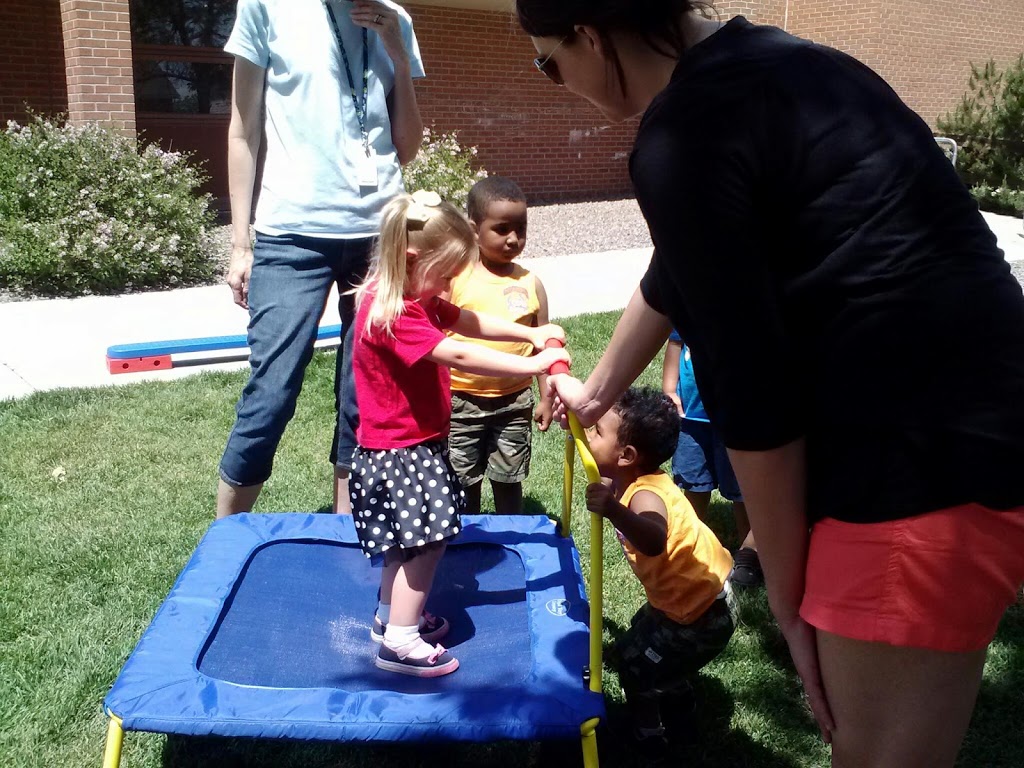
    She has the best of my husband’s personality THANK GOD.  She doesn’t get embarrassed, she attacks everything, she’ll try anything, and she’ll never give up until she conquers it.  That’s a page straight up out of her daddy’s book.  She’s in a first grade performance Tuesday, and I was watching the practice with the art teacher.  I said the songs were hard for a kid with a speech problem (bear necessities, supercalifragilisticexpialidocious) and the art teacher smiled and said she loves Ashlynn because she just goes for it.  I smiled.  It’s true…she does.  She always has.  I can still cry thinking about her preschool observation where she couldn’t jump on the trampoline so she smiled and marched instead.  All the kids were encouraging her to jump like them….

    and she couldn’t bear walk so she hung across a teacher’s arm upside down to at least get a feel for the movement….still smiling.

    When she rode her tricycle and couldn’t pedal she never stopped trying……and not only trying, but smiling. Oh, and guess what.  She learned all these skills eventually, on her own time.  She walks, she runs, she jumps, she bear walks, she skips!  She puts me to shame.  She puts that third grade girl who decided math wasn’t her thing to shame.

    Well not anymore.  I’m not sure anyone becomes a parent to be inspired by their child, but she has inspired me and made me better.  There are things I do now I would have NEVER attempted.  Every time I’m scared or nervous, I think about Ashlynn.  One year on a camping trip everyone was cliff diving.  I was terrified as I stood on the cliff, but I thought of Ashylnn and I’m on video jumping and while I’m in the air you can hear me say “for Ashlynn.”

    Tonight we were watching “Zootopia” and a song came on “Try Everything.”  Ashlynn started clapping and dancing around the kitchen.  She always dances like no one is watching.  Isn’t that phrase people have to try and follow?  Well, Ashlynn just lives it.  It’s her essence.

    So I started listening to the lyrics and I’ll be damned if this isn’t that girl’s theme song.  I downloaded it immediately.  (I’m also admittedly a Shakira fan so I was hooked anyway).  We put it on outside and her AND Jace were going crazy.  It’s a great song.

    “I messed up tonight, I lost another fight
    I still mess up but I’ll just start again
    I keep falling down, I keep on hitting the ground
    I always get up now to see what’s next

    Birds don’t just fly, they fall down and get up
    Nobody learns without getting it wrong

    I won’t give up, no I won’t give in
    ‘Til I reach the end and then I’ll start again
    No, I won’t leave, I wanna try everything
    I wanna try even though I could fail
    I won’t give up, no I won’t give in
    ‘Til I reach the end and then I’ll start again
    No, I won’t leave, I wanna try everything
    I wanna try even though I could fail

    Look how far you’ve come, you filled your heart with love
    Baby, you’ve done enough, take a deep breath
    Don’t beat yourself up, don’t need to run so fast
    Sometimes we come last, but we did our best”

    So many times she has come in last but she gets back up and tries again. As a witness to this strength I have no choice but to do the same.  Look how far you’ve come, but don’t keep looking back.  Look up and I’ll walk next to you guys through anything and I’ll pick you up when you fall.