Category: Executive Functioning Skills

  • Diagnosis, Disability, and Finding your Tribe

    Diagnosis, Disability, and Finding your Tribe

    ​Parenting children is hard.  That isn’t a secret.  Parenting a child with a disability has even extra challenges that shake us to our core.

    I have a daughter with special needs and numerous learning challenges.  When she was almost three, she received her first diagnosis of Childhood Apraxia of Speech, a rare and severe speech disorder in children.  That was the beginning of many a “dark day” in my parenting journey with her.  I remember putting her in her car seat, tears in my eyes as her bright blue eyes smiled back at me and seemed to ask, “why are you crying?”  I sobbed that day.  I cried for so many reasons.  Fear, uncertainty, guilt and confusion.  I texted a friend I was devastated, and I truly felt like I had the wind knocked out of me.

    Slowly I found a community of parents who had children with apraxia as well; and I started to feel hope again.  I started to believe what was possible for their children was possible for mine as well.  I found my tribe, as I like to say.  All these parents understood me, my daughter, our challenges and the significance of our small successes!  I discovered there was a walk to honor kids like mine and spread awareness.  I connected with others in my community and no longer felt alone.  I no longer felt devastated but instead felt blessed by the friendships I had formed.

    My daughter has went on to receive multiple and additional disabilities since that first one of apraxia.  I can’t lie.  Each new diagnosis, report, or low test score feels like a punch in the gut all over again.  However, we have our people now.  We have our tribe.  We have others who understand.  They understand that sometimes you are in such a state of deep grief you can do nothing else but cry and cannot face the world that day.  We also know that stage doesn’t last, and when a member of our tribe is down, we will rally around them and be ready to pick they back up when they are ready to face the day again.

    I learned that some of my darkest nights were followed by the most glorious sunrise; and I found that sunshine in the community around us.  No one should suffer alone.  No matter the struggle, we should all find others who understand our unique situation in the world.  For us, community was the light that found its way into the dark tunnel of grief and showed us the way out.

  • Why you are the CEO and CFO in special needs parenting

    Why you are the CEO and CFO in special needs parenting

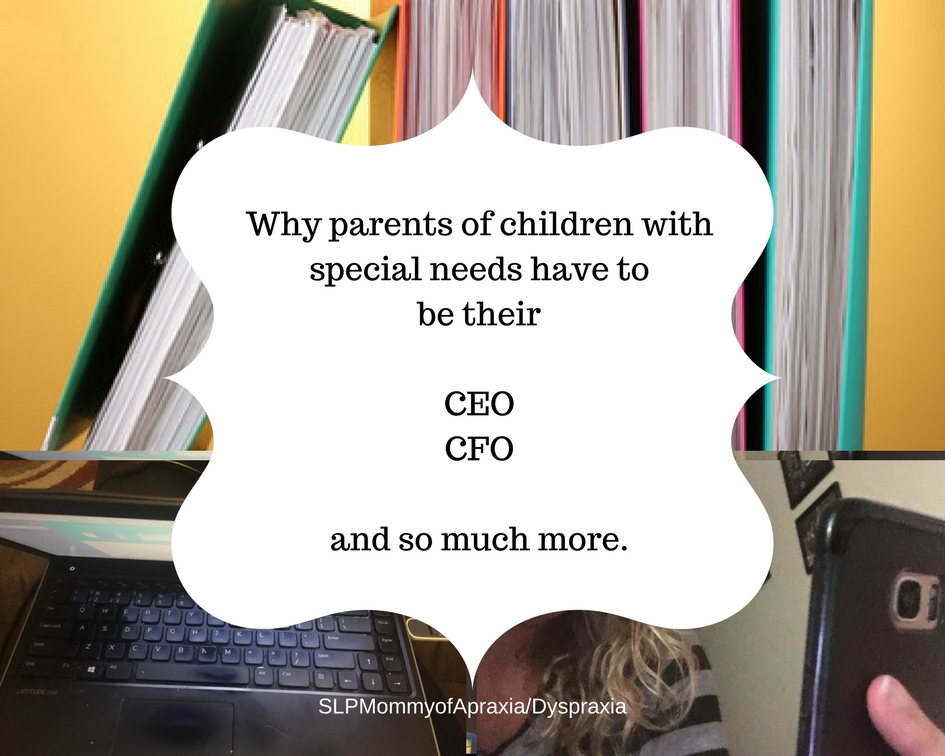
    A discussion in one of my groups the other day centered around the fact that parents of kids with special needs have to be the CEO on their child.  This extends beyond the idea that we are experts on our child.  The CEO, by definition, is in charge of making all management decisions.

    Parents of children with special needs have to be the CEO, and there is LOT to manage.

    Some days, it can feel unmanageable.  A CEO is typically responsible for the success of a company, which is no doubt stressful; but a parent feels they are responsible for the success of something even greater than a company……

    Parents feel they are responsible for the success of their child’s future.

    I know all parents feel this way about all of their children of course, including those with special needs.  However, the stakes are higher when you have a child with some sort of delay or disability.  A child with special needs is already starting life behind the eight ball.  A parent of a child with special needs feels intense responsibility to give them the best chance at a normal life, which is hard enough in this world without a disability!

    Parenting a child with special needs is a juggling act.

    When a parent has a kid with special needs, they spend their time not only at the pediatrician, but are bounced from specialist to specialist in many cases, just in an effort to get an actual diagnosis.  Kids with special needs in many cases have visited developmental pediatricians (different from regular pediatrician), neurologists, and psychologists. They have had blood taken, scans done, and more doctor visits to discuss results.  They have been poked, prodded, and examined more than the neuro-typical peer.  Their tiny bodies might have been subjected to sleep studies, sedation, and sometimes surgery.

    Therapy is always in the mix.  They may see occupational therapists, physical therapists, speech therapists, play therapists, behavior therapists, early interventionists, vision therapists and the list goes on.  Seeing a therapist always means another new evaluation, where this child who struggles anyway is subjected to tests and judgement calls as to their performance compared to typical peers.

    Obviously, there are only so many hours in a day and so a parent; the CEO if you will, has to choose  and prioritize many of the above listed appointments and even others not on this list.

    Unless you have been in this position, you have no idea how excrutiatingly difficult it is to decide which doctor or therapy your child needs most or more.

    Remember what I said before.  As a person making these decisions, the weight of your child’s future feels like it lay squarely on your shoulders.  Hopefully, you can get an appreciation of how big that weight becomes.

    Let’s not forget though, money.  All of these things cost money.  Insurance in many cases does not cover the brain scans, the MRI’s, the evaluations and the therapies.

    It causes a parent to become the CFO for their child as well.

    A CFO is responsible for the financial affairs.  Oh, and in the case of a parent with special needs, one doesn’t count on paying thousands of dollars out of their budget when they are starting a life with their partner, buying their home, and preparing for a new baby.  I had a supervisor tell me once at a private practice, no one can afford therapy, because no one counted on the huge hit to the budget these therapies, doctor appointments, and evaluations will cost your family.

    If you are lucky to get some sort of disability, Medicaid, or scholarship to help fund the cost; it’s not without another price.

    Time.

    All of these applications take an enormous amount of time.

    Parents need to gather required documentation, letters from insurance companies, doctors, evaluations, tax returns, and medical records to name a few.  A parent will spend hours filling out paperwork, spending time on the phone, and listening to hold music.  This time is well spent if a parent can get insurance to cover or get money to help with expenses; however, prioritizing time and finding time is not easy when we are shuffling our kids to doctor appointments and therapy appointments (see above).  This on top of finding time to put them in “typical” kid stuff like soccer or gymnastics and letting them go to birthdays like other kids do; in hopes that they can feel “normal” at least some of their childhood.

    If we are lucky, there are times we CEO parents find the perfect team.  We’ve got the diagnosis, the plan and team of therapists to treat it, and we see our child do the most amazing thing in the entire world……

    Make PROGRESS

    It’s probably the most beautiful gift in the entire world and in that moment; all the guilt, all the stress, all the worry, all the money, and all the time was 100% worth it.


  • You know you need awareness when you know more than the “experts.”

    You know you need awareness when you know more than the “experts.”

    About a year ago I switched insurance from my husband’s to mine, in order to leave no stone left unturned.  I know that kids with apraxia can have some sort of positive indicator on a brain MRI, or genetic marker.  I had yet to do any of that testing, and so I decided this was the year to do it.

    My husband questioned why.  Is there a reason to know? Will it change anything?  Well, in some very small cases, people have discovered things that have been helped, but most likely the results would not yield anything.  My husband again questioned why.  Would it change the treatment plan?  Therapy plan?  Long term prognosis?

    “Probably not,” was my reply, but honestly, I just had to make sure.  I have to look in her eyes every morning and every night as she struggles through every daily living task and educational task. I have to pray most days to check my patience because many things she does is not her fault.  So yeah, I also have to be able to look at myself  reflected in her adult eyes someday and tell her with complete honesty,

    “Ashlynn, I did everything I knew in my power to do, to help you.”

    I have to be able to say that.  Yes it cost thousands of dollars and I’m on a payment plan for those medical bills now, but it’s worth it.  Everything came back negative and it’s STILL worth it.

    I’m not here to cry and moan though.  If you have a child with apraxia you are just as much in the hole as me.  No martyrdom here.  What I DO want to talk about though, is neurology.

    I went to the Children’s Hospital of Denver.  Well respected, popular hospital.  I took her to neurology and the first appointment went exactly as expected.  Exam and then orders for an MRI and genetic testing.  Pretty standard with Ashlynn’s presentation.  We only found out our neurologist was a resident when the supervising doc came in for a review.  Nice.  I guess it’s no big deal, but it would have been nice to know our appointment was with a resident. Maybe that’s not common, I don’t know.

    The second visit was a follow up visit.  I already knew the MRI and genetic testing didn’t yield anything remarkable.  I was there to see what their dx would be.  Our resident neurologist did her exam and then a different supervisor came in. She did a few things with Ashlynn, and then, as though I wasn’t even in the room she proceeded to tell the resident that “she doesn’t have apraxia” among other things.

    I think I sat in my chair in the twilight zone for a minute.  My head shifted back and forth between the two as I struggled to process what had actually been said.  Did that woman just say Ashlynn doesn’t have APRAXIA???

    “Um…wait.  Yeah, I’m sorry.  Did you just say she doesn’t have apraxia or oral apraxia?  Ask her to close her eyes on command.  She can’t.  Ask her to spit out some water…she can’t. Ask her to smile on demand, she can’t.  Oh, and if you don’t hear her speech apraxia, I am more than able to take you through a motor speech exam quickly.”

    The supervisor did many of the non-speech things I recommended.  She saw, as I said, Ashlynn couldn’t do them.  She then looked at her resident, again as though I wasn’t in the room and commented, “Oh, is this the SLP?”

    “Yes, I’m an SLP that specializes in her disorder,” I responded for the resident.  “Would you like me to take you through a motor speech exam?” I reiterated.

    She told me that wasn’t necessary and changed the subject to the next course of action.

    People.  WTF?

    You ALL know just as well as I know that if I WASN’T an SLP, that neurologist would have told the parent ASHLYNN doesn’t have apraxia.

    Ashlynn has been in therapy since before 3 and has a mom as an SLP!  She is now almost 8!  My God, I would HOPE she has improved.  WTH is wrong with people??  This is a DOCTOR for CHILDREN’S HOSPITAL NEUROLOGY.

    Sigh

    This is why I say and will ALWAYS say, you the parent are the expert on your child.  It sucks right now because parents seem to know more about apraxia and dyspraxia than experts.

    I have a client who has a son with apraxia and dyspraxia.  Apraxia was officially dx by me, so she asked where she should got to get the dyspraxia dx.  I recommended a neurologist.  She found herself at Children’s Hospital too.  Different neurologist.  She point blank asked if her son had dyspraxia and his answer was,

    Do I look like a therapist?

    My dear readers, therapists don’t diagnose dyspraxia or developmental coordination disorder!!!  It’s a DOCTOR who does this.

    I absolutely hate that we as parents know more than the professionals, but you guys, we do.  I say that AS a professional too. That is why awareness is so important to me, but right now we have to be the experts on our children!

    Don’t stop.  Don’t accept any “expert” opinion just because they are an “expert.”   Don’t be afraid to ask questions.  Dig for answers.  Listen to your gut, because you DO know your child better than anyone.

    Advocate.

    Don’t blindly accept “expert” opinion.  Value your own.  You are a parent and that makes your an expert on your child.

    Remember that.

  • What is executive functioning and why do you need to know?

    What is executive functioning and why do you need to know?

    Does your child struggle with impulse control? Do they run out or touch things they know they shouldn’t but seem unable to help themselves despite consequences?  Do they struggle to get dressed?  Does it take you 30 minutes longer to get out the door in the morning than you think it should?  Do they frequently lose things like important papers from teachers? Is their desk, backpack, and folders completely disorganized and in disarray?  Do they have difficulties with attention?  Do they have emotional outbursts that seem atypical from other children?

    If any of these sound familiar to you, your child may be struggling with a deficit in executive functioning skills.  Executive functioning skills are regulated by the pre-frontal cortex in the brain. Many kids with developmental delays and disabilities such as: apraxia, dyspraxia, autism,  ADHD, sensory processing disorder, and others are at risk for deficits with executive function skills.  These skills include the following:

    • Impulse Control
    • Emotional Control
    • Flexible thinking
    • Working memory
    • Self monitoring
    • Planning and prioritizing
    • Task initiation
    • Organization

    My daughter has apraxia and developmental coordination disorder, but I think difficulties with executive functioning skills have the most impact on us and our life as a family.  Any task that involves planning, sequencing, organizing and then execution brings her a massive amount of anxiety and manifests itself as her looking defiant and oppositional.  Even a task like “brush your teeth” which she can and has done numerous times independently still stresses her out at times depending on how tired she is, or any other factors.  The same is true for getting dressed in the morning or at night, cleaning her room (not gonna happen), or doing her homework from start to finish without direction from us.

    How do I know it’s a deficit as opposed to her truly being defiant?  I just said she has done most of these things independently at some point. I know though, because when she becomes physically distressed at the thought of performing a task, when I offer to help her she immediately calms down and is willing to do anything that is requested of her; including cleaning her room.  An OT at Adam’s Camp this summer gave me this analogy.

    Have you ever changed oil on a car?  No?  Great.  It’s exactly like setting your in front of a car and telling you to change the oil.  You have no directions and you have no manual (think visuals), and you have no one there to direct you?  How would you act?

    This was such an “aha” moment for me.  Let’s look at our list above.  In this scenario, I’m going to struggle with: task initiation, planning and programming and organization at the very least.  If I can’t do it and feel I am messing up, it’s probably going to escalate into my emotional control which will potentially affect my flexible thinking and so on.

    All of these processes are independent, but they can also be tied together.

    So what do we do?  Can executive functioning skills be taught?

    The good news is YES.  There is so much more great research too coming out now, and I’ve seen educational institutions grabbing onto this idea and implementing strategies into their classrooms.  If you are a parent, accommodations to help executive functioning skills can be easily placed in the IEP under the accommodations sections; or if you want more targeted instruction, can be written as it’s own goal. Psychologist’s can administer a test to look at executive functioning skills. One such test we use at my school is called the BRIEF (Behavior Rating Inventory of Executive Functioning). Don’t be afraid to ask for testing if you think your child struggles with this.

    That’s great for school, but what can frustrated parents like you and me do at home? I wrote Part 2 to this series in which I outline strategies to do at home for various skills. (click here).

    In the meantime though, Sarah Ward is quickly becoming nationally recognized as a top expert in this area.  She gives talks nationwide and if you can see her I have one word of advice: GO.  She’s fantastic, fresh and has current ideas that incorporate technology and apps that I have never seen presented before.  Most talks on executive functioning that I go to now will almost always include a suggestion they got from Sarah Ward.  Her website is Cognitive Connections.

    You can also find books on the topic that have good reviews with practical suggestions for parents:


    These books are geared more for parents and what you can do at home.  I also found some kid books that I think are helpful when we are talking to our kids about their difficulties.