Category: Childhood Apraxia of Speech

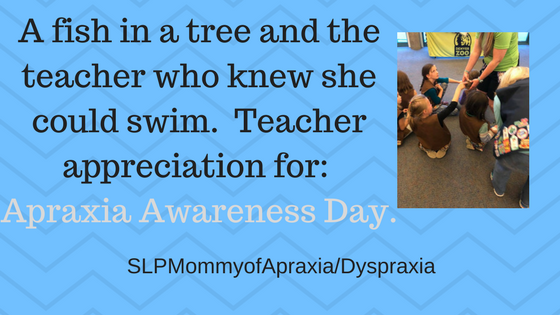
  • A fish in a tree and the teacher who helped her swim

    A fish in a tree and the teacher who helped her swim

    Ashlynn is in 2nd grade and is in Girl Scouts.  She has been in Girls Scouts since Kindergarten.  She loves it; but honestly, Ashlynn loves most activities and new adventures.  Yes she has apraxia, dyspraxia, SPD, ADHD, learning disabilities and a language processing disorder; but despite all of those disabilities she is a true extrovert that one.

    Ashlynn’s Girl Scout troop leader is seriously amazing.  If there were an award, I would nominate her to be the best girl scout troop leader in the state, because she is.    A girl scout troop leader is a volunteer who donates their time.  This woman though I think must be a real life saint who deserves a salary.  When Ashlynn first started Girl Scouts I wrote a post about how she became misty eyed and told me that she knew what Ashlynn was going through.

    When I first met her, I noticed something a little off with her speech.  Later I found out she has a hearing disability, and has had one since birth.  From the beginning she was very concerned about Ashlynn’s needs.  I was also surprised to learn that she had never had anyone with a disability before.  She told me she just wanted to make sure this experience was the best possible experience for her, and that she was willing to make accommodations or help her however she could.  We ended up having to make a few accommodations, especially with requirements. For example, in Kindergarten the girls needed to have memorized their name AND address to earn a special pin.  It took everything we could do for Ashlynn to learn the address, but we could just not get the phone number at that time.  Ms. E made an accommodation like a trained special education teacher would; and said as long as she can memorize one of the two, she would earn her pin.

    The other night the girls had homework.  It was a picture where you had to find items hidden in the picture.  She sent home the actual picture; and then she found, on her own, a simpler picture and told me that Ashlynn just had to finish one.  In special education we call this modifying the curriculum.  This woman has never read Ashlynn’s IEP.  She does not in fact know her modifications or accommodations.  She intuitively does them.  I can’t help but think it’s because she understands.  She has walked Ashlynn’s shoes.  She totally, totally gets it.

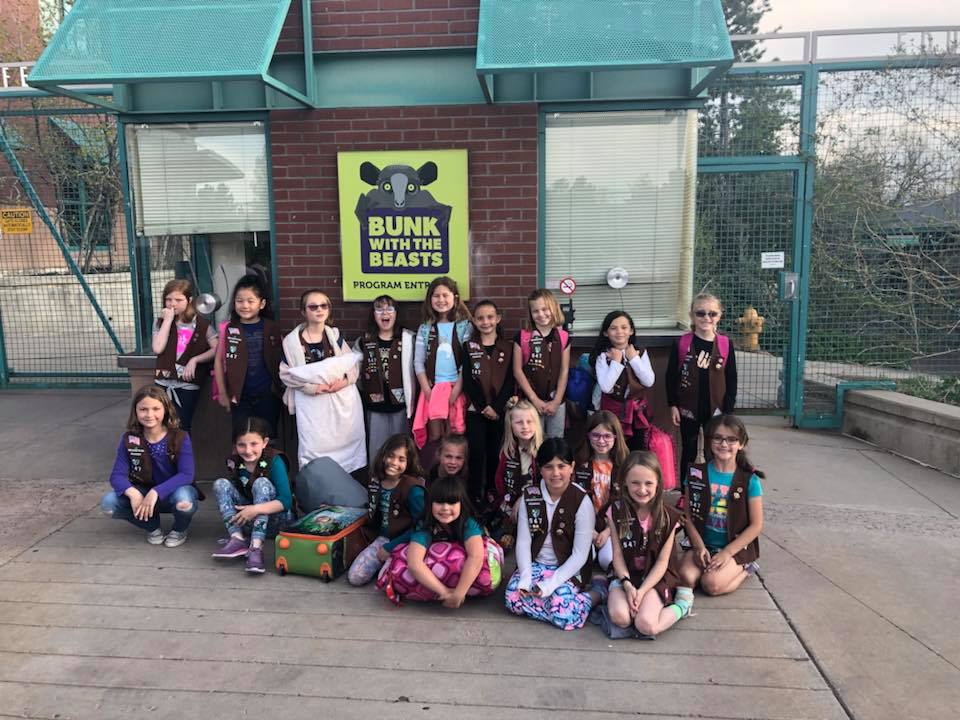
    This past weekend there was an event at the Denver Zoo called “Bunk with the Beasts.”  The girls would get to spend a night away from home and “camp” at the zoo.  Right after I received the group email about the event, her troop leader followed up with a personal email requesting that she know of any special accommodations or help that Ashlynn would need so she could do them.  She didn’t want Ashlynn to miss out.  I sent back a big list.  Ashlynn has dyspraxia.  Activities of daily living, like all the steps to get ready for bed are NOT easy. Her troop leader wrote back it wouldn’t be a problem.  A few days later a chaperone pulled out so I was asked to come.  I was thrilled!  I said yes immediately.  This way her troop leader could focus on the other 18 girls, and I could be there and help Ashlynn.
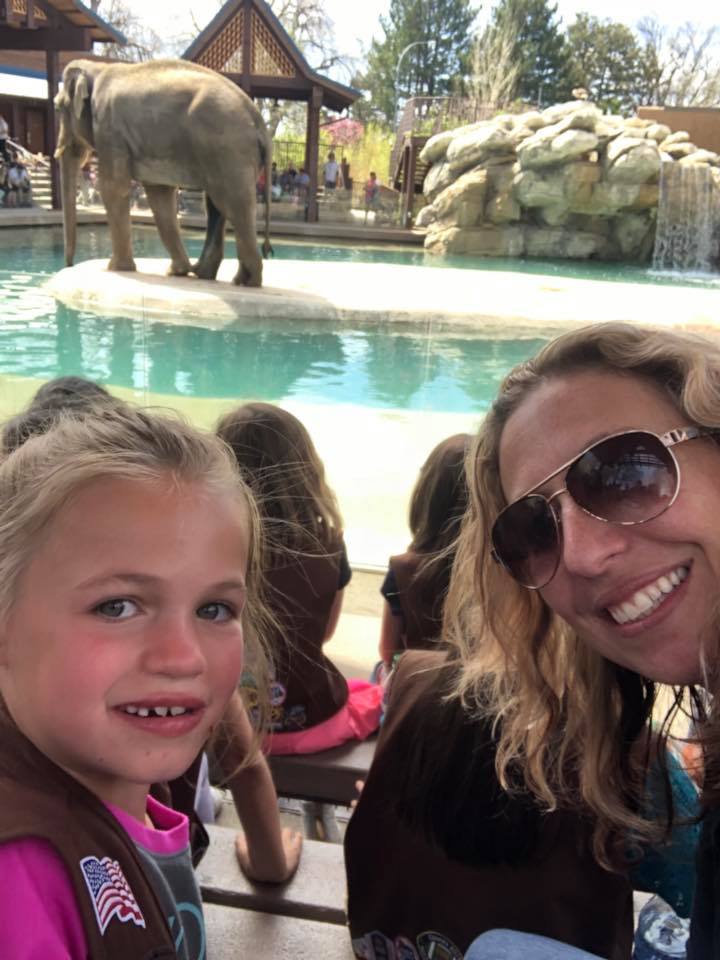
    When we arrived, there were 4 adults to 19 girls.  Her troop leader split them into groups of two.  She told me that usually a chaperone or leader is not placed with their girl, but in this case she made an exception.  So her and I were in charge of one group of girls in which Ashlynn was a part of, and the other two co scout leaders were in charge of the other group of girls for the zoo tour and excursions.  Some would find this preferential treatment; but it is in fact, an accommodation. I found a renewed sense of awe in this woman.  She went onto explain that many of the girls have developed “best friends” and she purposefully separated them for this event because a troop cannot be a troop unless they all learn how to work together.  I shrugged it off.  She looked at me more earnestly and said, “No, when I mean best friends I mean like this,” and she proceeded to hug my arm and not let go.  I still shrugged it off not realizing yet her point.

    As she gathered the girls and called out what group they were in, one of the girls was visibly shaken.  Her mom is a girl scout troop co-leader and I was standing next to her at the time.  She told me that this was a big reason her daughter wants to quit Girl Scouts next year, because Ms. E insists that the girls be separated from their best friends.  As she talked I looked on.  Most girls had a best friend in which they were sitting next too.  If not, they were still obviously part of the group.  Two girls sat in the back of the group slightly removed, but Ashlynn was basically completely removed in the back by herself.  Don’t get me wrong, she wasn’t acting upset or lonely.  Ashlynn loves girl scouts.  It just struck me in that moment that most girls had an “arm clinging” best friend, and my daughter had no one.  This mother I was standing next to felt so bad her daughter would feel alone and away from her best friend for a couple of excursions, and my daughter felt that way basically all the time.  I don’t fault this mom.  Maybe if I didn’t have a kid with a disability, I would feel the same way too.  Maybe I wouldn’t understand or even notice that another child in the group, the child with disabilities never had any of those best friend moments.  Maybe I would be sad that my child would be sad for a couple hours and never realize this girl in the same troop sitting in the back by herself doesn’t EVER have an “arm hugging” best friend. Maybe…..

    Ms. E did though.  Ms. E noticed.  That’s why she split them up.  Society needs to stop casting those who are different to the outside, but including them and accepting them too!  We are all better when we work together.  Ashlynn and I had the best time.  Ms. E paired each child with a “buddy” and Ashlynn was thrilled to have a peer’s hand to hold as she walked around the zoo.  Ashlynn’s joy is so contagious and she is an adult magnet.  I could see though in this setting, just how unlike her peers she looks.  She’s not shy.  She doesn’t get embarrassed or worried about making mistakes.  She bonks into stuff and people and laughs at herself.  She loses attention easily and starts to wander which would annoy her buddy.  She would randomly start talking or singing when you weren’t supposed to and her buddy would have to shush her. It didn’t matter though.  It made Ashlynn’s entire night to be part of her peer group.
    I came home and cried to my husband I get why girls think she’s different.  She’s not stuck up.  She’s not concerned about what other people think.  It’s amazing how society gets it’s grasp into children as young as second grade.  I noticed so many girls tugging at their shirts, checking their appearance, and censoring what they say because they want to fit in.  I couldn’t help but look at Ashlynn and think of the Dr. Seuss quote, “Why fit in when you were born to stand out?”

    What’s ironic is these kids who “stand out” end up changing the world.  I am almost obsessed with successful people.  Notice I didn’t say “famous” people, though many might be famous.  No SUCCESSFUL people.  People actually changing the world and making it a better place.  The innovators and visionaries.  Most of them were kids who were a little different.  Some may have had a “disability” like ADHD, dyslexia, or whatever.  Bill Gates said once, “Be nice to the nerds.  You might end up working for them.”

    Last month in the news the boy scouts were under fire for revoking the eagle scout badge for a teen with Down Syndrome.  The parents filed a lawsuit claiming that their son was being discriminated against because without accommodations, there would be no way he could earn the necessary requirements to get the Eagle Scout Award.    

    The argument against him earning the award was that though he tried his hardest, he did not meet the requirements set forth.  If you don’t have a person with a disability in your family, I could see how this could make sense to you.  There are requirements that have been established, and if a person can’t meet them for whatever reason, they don’t.  There are able bodied children who don’t meet the requirements either and that’s just the way it is, right?

    Let me point out this graphic.
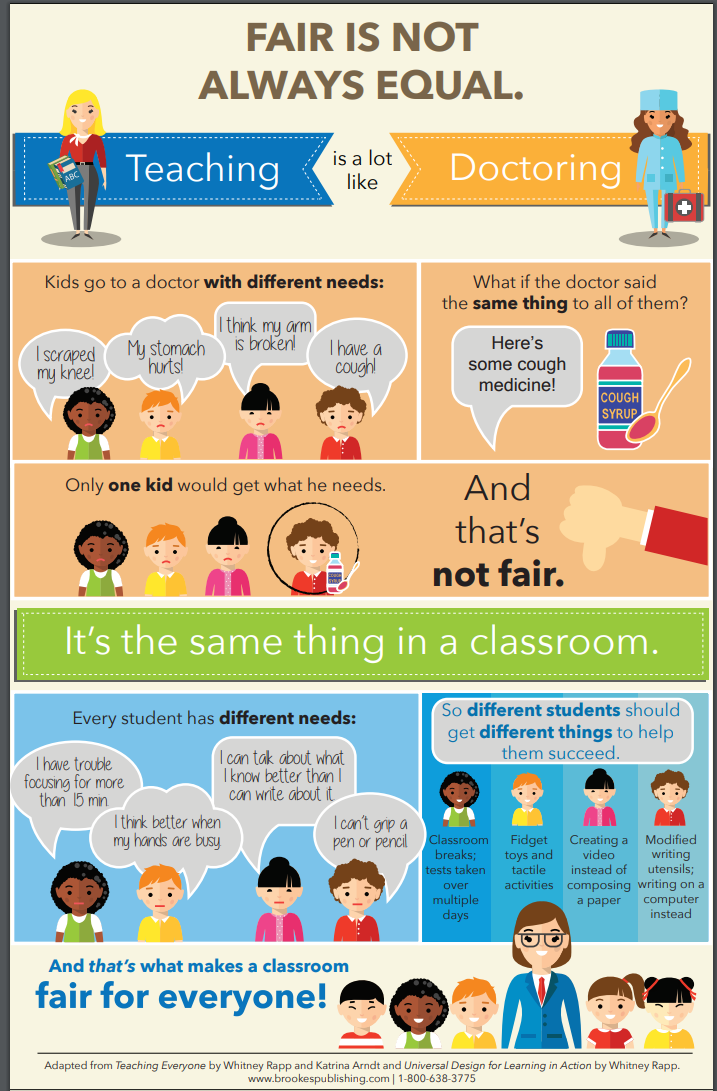
    This graphic compares teaching to going to a doctor.  Kids go to the doctor for different symptoms, and the doctor treats the symptoms.  It would be ridiculous though if you went in with a broken arm and the doctor prescribed antibiotics.  Under our current educational model that is not inherently inclusive; this is exactly what is happening.  The current educational model is based on a child without any learning, attention, or behavioral disabilities.  The lessons are made and the classrooms are set up for kids who can sit in a chair, listen and interpret information, and then attend to their work.  It is not equipped for  the child who needs sensory breaks, or the child who needs to use asisstive technology to help them write because they can’t, or the child who needs assistive technology to have something read to them because they can’t read.  It is not set up for the child who cannot learn through the auditory channel but learns best through visual and tactile channels.  Here is the most important piece though about all of this.  Children who are not “typical” CAN show their learning and skills in other ways if they are just given accommodations!!

    That’s not fair, you might say.  I would counter that it’s not fair we have a bunch of children with broken arms (learning disabilities) being forced to take antibiotics (traditional education), and then are penalized for failing. They are SET UP to fail.  A system that mandates all children must learn the same and prove they have learned the same is a broken, discriminatory system.  As Albert Einstein once said, “If you judge a fish by it’s ability to climb a tree, it will spend it’s whole life thinking it is stupid.”

    Ms. E understands this and I am so, so thankful to her.  The challenge today for apraxia awareness month was to recognize a teacher making a difference.  There are so many amazing people I could choose, but today I Thank you Ms. E, for recognizing my daughter is a fish and deserves a chance to swim.
  • Good SLP’s for apraxia are addressing the head in the hands

    Good SLP’s for apraxia are addressing the head in the hands


    Therapy for apraxia is direct and intense.  Any task that involves motor planning is this way.  Motor planning any skill, whether it be learning to shoot hoops, hit a tennis ball, or learning to speak when your etiology is motor planning (apraxia), instruction needs to be intense and involve a lot of repetitive practice.

    I remember when I attended an intensive 4 day training, Dr. Ruth Stoeckel from Mayo clinic was asked how many repetitions SLP’s should be looking to get in therapy.  She hesitated and expressed concern about giving a number.  I didn’t understand her hesitation at the time.  It was a simple question, how many repetitions should we be trying to get in therapy?  We were all professionals.  We all understood that this number would be in the ideal circumstance, and that many factors would decrease the number.  Still, she was hesitant to give a number.  She did finally say in the ideal circumstance, we are looking to get around 200 reps per session.

    I now realize why Dr. Stoeckel was hesitant to throw out that number.  It’s not only because it can only happen in the most ideal circumstances and we might frequently fall short.   The main concern is that a number doesn’t take into account a child’s emotional health.

    Let me say it again.  Yes our goal is to get a lot of reps, but it doesn’t take into account a child’s emotional health!

    I was talking to a student who is Ashlynn’s para right now and he is looking to earn his special education degree.  He expressed concern that others seemed so much smarter than him and he was worried he wouldn’t be as good a teacher.  He was the only person in Ashlynn’s life thus far who recognized her anxiety and nail picking and fixed it by buying her a rubber band ball.  His professor actually admonished him for it.  It just went to show his professor sitting at the university was completely out of touch with what was going on the field, and that was my point to this young man.

    I have met brilliant SLP’s.  Seriously brilliant.  “C’s get degrees” does not apply in my field.  I’m not trying to boast either, it just doesn’t happen.  Graduate school for speech/language pathology is extremely competitive, and average GPA’s, AVERAGE, were 3.88 to 3.97 at the time I was trying to get into graduate school.  That means a fair amount of current SLP’s held college level GPA’s that were 4.0.

    It’s important to have the best of the best teaching our children to talk; however, a GPA can never account for what I would consider to be one of the most important qualities in an SLP.  It’s a quality I can’t even succinctly put into one word, but it is by and far the most important.  It is a therapist’s ability to read and then respond to the emotional health of their student or client.  If we, in our quest to get 200 reps completely disregard any signs of emotional anxiety, distress, or defeat in the child; we have lost everything we had hoped to gain.

    Let me say that again.  If we sacrifice a child’s emotional health for the sake of getting in so many reps, we have lost EVERYTHING.

    Speech therapy is predominately speech and language therapy, but the counseling aspect I believe is significantly underscored. My graduate program did include a class on counseling in speech therapy, but it was geared primarily to the adult population or for those who stutter.  Our pediatric field recognizes now the importance of counseling in stuttering therapy, but there is very little information out there on counseling and our kids with not just apraxia, but also a phonological disorder, articulation disorder, or a language impairment.

    What Dr. Stoeckel was trying to tell us in her hesitation of throwing out a number of reps we should be targeting, is that if we sacrifice their emotional health and our trust relationship with them for the sake of getting in a certain amount of reps, we have sacrificed everything.

    I get sent videos from time to time asking for advice, and usually what I find striking is NOT the speech therapy that is being done, but the absolute blind eye turned to a child’s nonverbal signs of emotional distress.  I remember watching one video and the child was enrolled in PROMPT therapy.  The SLP was kind, competent, and skilled at what she was doing.  What she never even once acknowledged though was that the child would constantly put his head in his hands when she asked him to repeat anything.  Nothing was said.  Nothing at all!  Not, “It’s okay, I know this is hard, but you got this!” or “I know it’s so hard and I can see you are frustrated so let’s take a break.”

    Nothing. Just, “Say it again, try again.”

    It was all about reps and speech and reps and speech and reps and speech and reps and speech.

    I’m here to tell you, if we aren’t addressing the head in the hands, the best and the smartest SLP in the world isn’t going to make progress.  I told this student, if we aren’t addressing the nail picking that causes bleeding, the best and smartest SPED teacher in the world isn’t going to make progress.

    Let’s go back to motor planning though, since the research is telling us that is the most effective form of treatment for apraxia.  If we liken it to another motor skill like basketball, is the job of a coach JUST to teach the kid the right technique and the right form to shoot a basket?  Or, is the job a coach to also encourage, foster, and nourish their confidence as well?  In that analogy, it seems obvious; yet with speech therapy we still don’t seem to be there yet.

    A final example comes from a newer client of mine.  Completely nonverbal at the age of 7, her school SLP, who is amazing, risked her job to recommend private therapy.  After three months, she was making progress, but much, much slower then I wanted.  She had major avoidance behaviors and if she were asked to repeat anything again she would point to something else, pretend her finger hurt, or try to get off topic.  The avoidance behaviors decreased the more she developed trust and had success, but I still felt like I was missing something.

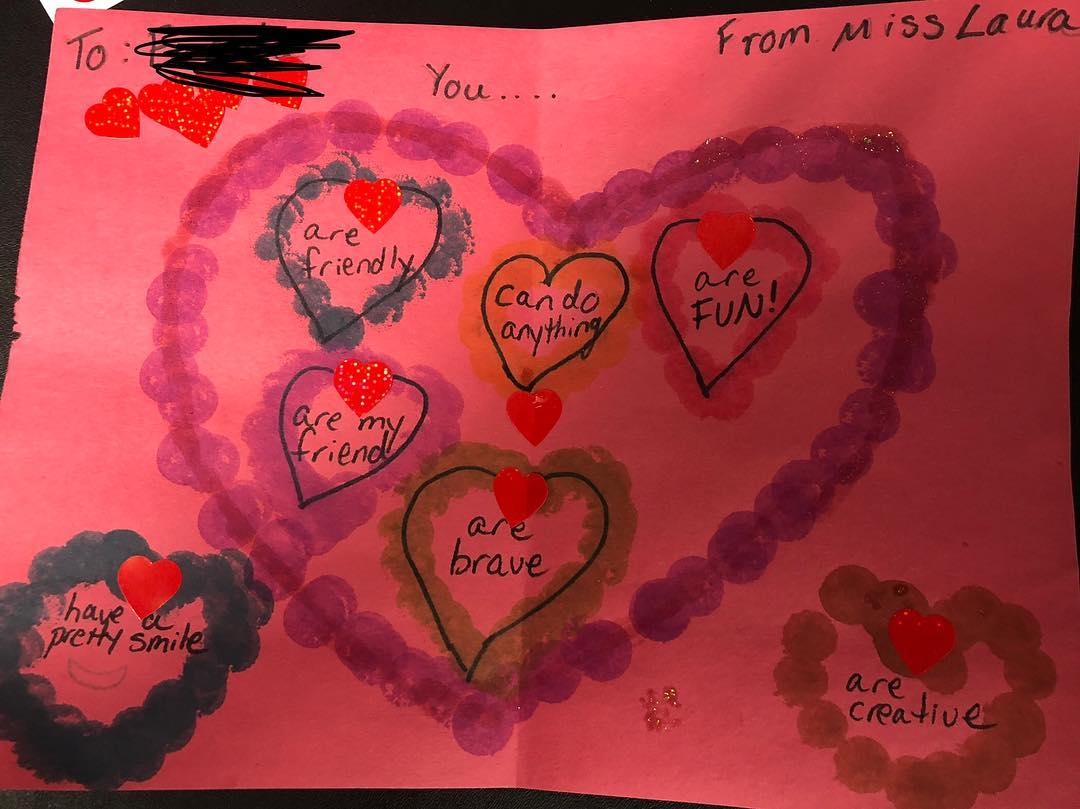
    Since Valentine’s day was coming up, I decided we would take a break from speech and do something fun.  Make Valentine’s.  I still embedded a few target words in the activity, but for the most part, the focus was on the Valentine.  She made one and I made one.  When I showed her mine, I read all the things I wrote about to her.  I stressed that she was brave and could do hard things.  Her brown eyes searched my face, wanting to believe me.  When I read she was creative, she proudly pointed to the Valentine she had made, and I nodded in affirmation.  After the session, I had her mom come in and read it.  She beamed as her mom read the words on the page.  Before she left I looked her in the eye again and told her she was brave and could do hard things.  This time, though her eyes still searched my face, she nodded her head.

    The next day her school SLP sent me a video.  She had a breakthrough and said two new words and her confidence was through the roof.  We both decided taking time to address her emotional health was going to be just as critical to her speech progress as were the principles of motor learning.


    My message today is this.  You can have the smartest, most competent, adept and amazing SLP in the world;  but if they aren’t addressing the head in the hands, the avoidance behaviors, or a child’s emotional heath; they are sacrificing EVERYTHING. In our quest to provide good therapy for apraxia, we keep in mind the principles of motor learning, but ALSO what it means to be a child’s coach and champion.  That might mean some sessions we elicit 0 reps, but what we gain in trust is immeasurable.

    Be the therapist who is looking to give good therapy, but who first and foremost is always looking for and then addresses the head in the hands.  Your kids will thank you.


  • Interview with Mikey.  The wish that turned into a passion.

    Interview with Mikey. The wish that turned into a passion.

    I am so excited to have probably my favorite person I know on social media I know with us today. His name is Mikey and he is admin to the page Mikey’s Wish – Verbal Dyspraxia Awareness. Mikey’s famous tagline is that himself and others with verbal dyspraxia/apraxia are “too cool to follow the neurotypical rule.”

    Mikey thank you so much for being here! For my readers who don’t know, can you start by telling us about yourself?

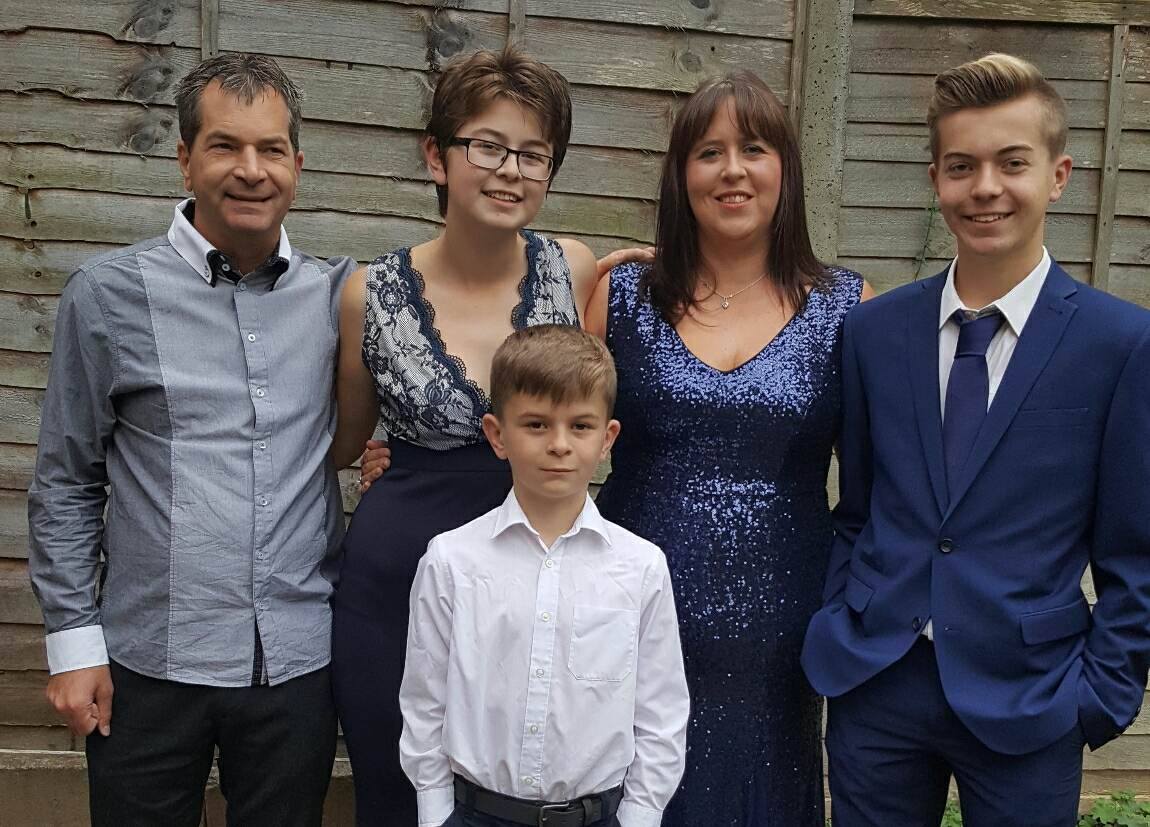
    My name is Mikey and I am 16 years old. I was diagnosed with verbal dyspraxia/apraxia when I was 2 and ½ years old. I live in a village just outside Birmingham in the UK. I finished school last year and I am now doing a level 3 photography course in college. I live with my mum, dad, older sister Becki and younger brother Ben. My family have been a huge support throughout my journey with verbal dyspraxia.

    1. What made you decide to start your facebook page of now 6000 worldwide followers and how have you seen it grow and evolve?

    I started my facebook page 3 years ago after writing a poem called ‘I am the Boy’ about living with verbal dyspraxia/apraxia and wanting more awareness. This prompted a conversation with my mum where she said that the loneliness and not knowing anyone else who shared my diagnosis was the hardest thing to live with. This made me think that if my mum felt this way there must be others feeling the same. I had seen many facebook pages about verbal dyspraxia but they were more about parents asking questions and looking for answers. I hadn’t actually seen one from the point of view of the person living with it. That is when, with support from my mum, I set up my Mikey’s Wish Facebook page. It started off with the aim to raise awareness but the more I shared my story of growing up and living with verbal dyspraxia/apraxia the more I realised that it was actually helping others who shared my diagnosis and their families. I began receiving messages from people thanking me for helping them to understand what their child might be going through and also helping their child realise that they were not the only ones living with verbal dyspraxia/apraxia. I was actually giving them hope for the future. Supporting others, knowing that I am helping others understand their child’s diagnosis and helping them realise that there are others sharing their diagnosis is the most rewarding part about sharing my story on my Facebook page.

    1. How has verbal dyspraxia/apraxia affected or changed you in more ways than just speech?

    When I was younger living with verbal dyspraxia was difficult. Struggling to talk in a world where so much importance is put on speech, watching all those around you find speech so easy wondering what is wrong with you is soul destroying. Then going to school, already feeling different, to then find out that you also struggle with reading and writing even at a young age knocks your confidence. My family and school had to fight to get a Statement of Educational Needs so that the school received the funding needed to give me the 1:1 support and speech therapy that I needed to have any chance of achieving. Even with all this support in place I still started senior school 4 years behind my peers, still feeling different and not good enough. My self esteem and confidence were really low. I was determined to improve. My speech was becoming intelligible and I had great support in school. I had access to 1:1 support in most lessons. Dyslexia was also mentioned throughout my schooling but because I already had great support in place it was decided that we didn’t need to push for a diagnosis. After 4 years in senior school I managed to all but catch up with my peers and I managed to gain 3B’s and 3 C’s in my GCSE’s and managed to secure a place at college doing a level 3 photography course. Even now, at 16 years old, having had amazing support from everyone around me I have huge anxiety surrounding my speech. I can’t bring myself to talk in front of people I don’t know and social situations can be difficult. Having said that I am surrounding by a large group of amazing friends. Verbal dyspraxia/apraxia, I believe, has moulded me into the person I am today. It has made me compassionate, quietly confident and determined.

    1. What would you want people to know about you and others living with verbal dyspraxia/apraxia?

    I would like people to know that those of us that happen to live with verbal dyspraxia/apraxia are just ‘normal’ people. We can understand everything that is said to us. We know in our heads exactly what we want to say but the messages from our brain to our mouth get mixed up causing our speech to become unintelligible. Once our speech becomes intelligible we can then also be left with word finding issues. If you are lucky enough to come across someone with verbal dyspraxia/apraxia just give us time to process what is said and find the words we need to answer you. Take the time to understand us. Not being able to talk does not mean that we are unintelligent. We are intelligent, amazing, hardworking and determined. Just take the time to get to know us and we could end up being the coolest person you know.

    1. What advice do you have for those growing up with and/or living with verbal dyspraxia/apraxia?

    The advice I would give to others growing up with verbal dyspraxia/apraxia is to work hard on their speech but don’t let it get them down. It will be a long, slow road but it will be so worth it. I know that it is hard growing up feeling different but as you get older you will realise that it is the difference that makes you, you. Fighting for a voice, facing adversity and overcoming everything that verbal dyspraxia/apraxia throws at you is what will mould you into the person that you will become. I would not be me or had all the amazing opportunities that I have had if I didn’t have verbal dyspraxia/apraxia and I am proud of who I have become and what I have achieved so far. You are amazing and don’t let anyone tell you any different. Embrace your uniqueness.

    1. What advice do you have for parents of kids with verbal dyspraxia/apraxia?

    The advice I would give to parents is be supportive but not too pushy. Fight to get your child the support they need but don’t make them feel any different from their siblings. My family have always been really supportive but they have never treated me any differently from my siblings. I have been given the same opportunities as them and never been stopped from doing or trying anything. Don’t push too hard with speech therapy. Obviously it needs to be done but try and do it in a way that the child doesn’t know they are doing it. Play family games and make it fun. It’s hard for a child spending all day in school and then come home and be sat down to do even more work, especially when it is so difficult and frustrating for them. Finally, it’s a long, hard road with no quick fixes so celebrate every tiny milestone.

    1. Why is awareness so important to you? What is your ultimate goal?

    Awareness is so important to me because it is the lack of awareness and understanding that is so difficult to live with. Having to explain to everyone you meet why you struggle to communicate or why your speech sounds ‘funny’. Everyone deserves understanding. Young children being called lazy because their speech is delayed when they live with a neurological speech condition is wrong! Parents being told that it is their fault because they didn’t talk or read to their child enough is wrong! Professionals having never heard of verbal dyspraxia/apraxia is wrong! Schools not having any strategies or understanding of how to teach those with verbal dyspraxia/apraxia is wrong! Discrimination in the work place because of some ones speech is wrong! Awareness and understanding of verbal dyspraxia/apraxia is the only thing that will help change all those wrongs. My ultimate goal would be for verbal dyspraxia to be known and understood in every school, college and work place so that those who share my diagnosis will get the understanding and inclusion that they deserve.

    Mikey I can’t thank you enough for this interview but also just for ALL that you are doing to for verbal dyspraxia/apraxia worldwide!  You are an amazing young man who gives me so much hope for Ashlynn and also comfort in knowing she has a worldwide community who has her back.  Thank you for encouraging her and all others!  You have already accomplished so much at 16 and I have confidence that in the future you will see all that you wish to see come true.  Maybe me and my daughter Ashlynn with apraxia will meet you one day!

    To follow Mikey and his story follow him on:

    Facebook: Mikey’s Wish – Living with Verbal Dyspraxia

    Twitter: Mikey’s Wish

    Instagram: Mikey’s Wish


  • SLP Mommy Top 10 posts of 2017

    SLP Mommy Top 10 posts of 2017

    I started this blog in 2012, shortly after my daughter’s diagnosis of apraxia when she was just under three. Since that time, she has made tremendous growth.  She speaks, she speaks clearly, and she can tell me about her day. She can tell me when people are mean to her, what her teacher said that was funny, and what she had for lunch.  These were all things she couldn’t do and I worried she would never be able to do when she was first diagnosed.

    We’ve added more diagnoses through the years including a language disorder, dyspraxia, ADHD, dysarthria, and this year….dyslexia.

    In spite of all of these challenges, watching my now 8 year old daughter wake up each morning and attack the day with happiness, kindness, bravery, and a resilience that is unmatched inspired me to do the same.  I always think, I have NONE of her issues….what’s my excuse?

    This blog/website has grown with an average of 300 visitors daily.  Whether you are a professional, parent, or just someone who cares, thank you so much for following along and being part of my desire to spread apraxia awareness in the hopes of helping every child with apraxia to achieve intelligible speech.

    Here is the Top Ten Countdown to my most read posts of 2017.  Cheers to 2018!

    10. As children walk to find their voice, local news outlets stay silent.

    “I have to say I want to give up sometimes.  It seems like no one is going to care and sometimes the fight just doesn’t seem worth it anymore.  But then I look at these smiling faces who never give up, and like the song says, I need to get up again to see what’s next.”

    9. It feels like home this year: Apraxia Conference 2017

    “Have you ever stopped to think, and then believe, that one person, ONE, could change the life of hundreds; if not thousands, if not millions of others?”

    8. Whatever it takes: A day on the brink.

    “She’s finally in bed. I have the song “Whatever it takes” on again.  Tomorrow is a new day.”

    7. It’s like juggling 8 balls and desperately hoping one doesn’t roll away. 

    “Sometimes I wonder what it would be like to just worry about the speech, or just worry about the motor skills, or just worry about homework or just worry about executive functioning, or just worry about language processing.”

    6. It’s rare so no one cares? Prevalence of CAS.

    “Would it surprise you then if I told you the prevalence rates for Down Syndrome are 1-2 children in every 1000 births.  Sound familiar?  Maybe that’s just because I just wrote that figure for CAS.”

    5. “She’s a puzzle” or…she has dyspraxia.

    “I don’t want professionals to tell me she’s a puzzle.  I don’t want to know that she’s so unusual that her very being challenged your knowledge, or that you are confused by her.”

    4. No, not another diagnosis.  Adding dyslexia to apraxia. 

    “In that moment, my dear readers, I had the same gut feeling I had when that SLP told me back when Ashlynn was 2:11 “Laura this is apraxia.”

    3. The Hulk and Rousey on struggling to speak.

    “Everyone is handicapped either physically, mentally, or emotionally.  It’s all about maximizing what you have.  As a kid I had trouble speaking.  It’s all about overcoming adversity.”

    2. Apraxia, special ed, and grad school.  One woman’s remarkable tale.

    “Whatever you accomplish in life will be perfect, as long as you keep loving yourself for who you are.”

    1. The Problem with School SLP’s

    “They cannot “refer out” or “discharge for lack of progress” as an can be done in private speech. No, the school SLP is expected to figure it out regardless of the lack of resources, lack of funding, or lack of time.”

    Sign up for my newsletter to get all the info related to apraxia, dyspraxia, and dylexia for 2018.

    [wysija_form id=”1″]

    Follow me on facebook: SLP Mommy of Apraxia/dyspraxia/dyslexia

    Follow me on Pinterest: SLP Mommy of Apraxia

    Follow me on Instagram: Laura SLP Mommy

    Follow me on Teachers Pay Teachers: SLP Mommy of Apraxia

  • Apraxia? Phonological Disorder?  Language Disorder?  What’s the difference?

    Apraxia? Phonological Disorder? Language Disorder? What’s the difference?

    So many times I see parents post a video of their child speaking, or attempting to speak, and they ask, “Is this apraxia?”

    The follow up question is usually something like, “If it’s not apraxia, then what ELSE could it be?

    The answer is that childhood speech and language delays can be caused by a variety of factors.  It’s important to keep in mind too, the difference between “speech” and “language” disorders when we are discussing speech and language delays.

    On the surface, speech and language seem like different sides of the same coin.  This is particularly true when people or even professionals may seem to use the terms interchangeably.  If a child isn’t speaking, they must have a “speech” problem right?

    Not necessarily.

    A child with a “speech disorder” has a problem in the way or how they say sounds. Most of you who read this blog know my daughter has apraxia, and apraxia, in its truest sense, is a “speech” disorder.  It’s not a language disorder (although my dear daughter and many other kids have both).  Other common factors that can cause speech disorders, or the way kids say their sounds are:

    1.) A hearing loss, or even a history of chronic ear infections – If a child has a hearing loss, or is suffering from a hearing loss due to chronic ear infections; their typical speech development *may* be negatively impacted. Without going into a technical explanation, it makes sense that a child with ear infections who is hearing like they’re “under water” during the time they are supposed to be learning how to talk, may have speech and/or language development that is delayed.

    2.) Stuttering – a disruption to the flow of speech, is also considered a “speech” disorder because it is characterized by disruptions in the production of “speech sounds.”

    3.) Phonological Disorder – Phonological disorder is one of the most common speech disorders that SLP’s treat, so I was shocked to go to the ASHA website and find this definition:

    Speech sound disorders that impact the way speech sounds (phonemes) function within a language are traditionally referred to as phonological disorders; they result from impairments in the phonological representation of speech sounds and speech segments—the system that generates and uses phonemes and phoneme rules and patterns within the context of spoken language.

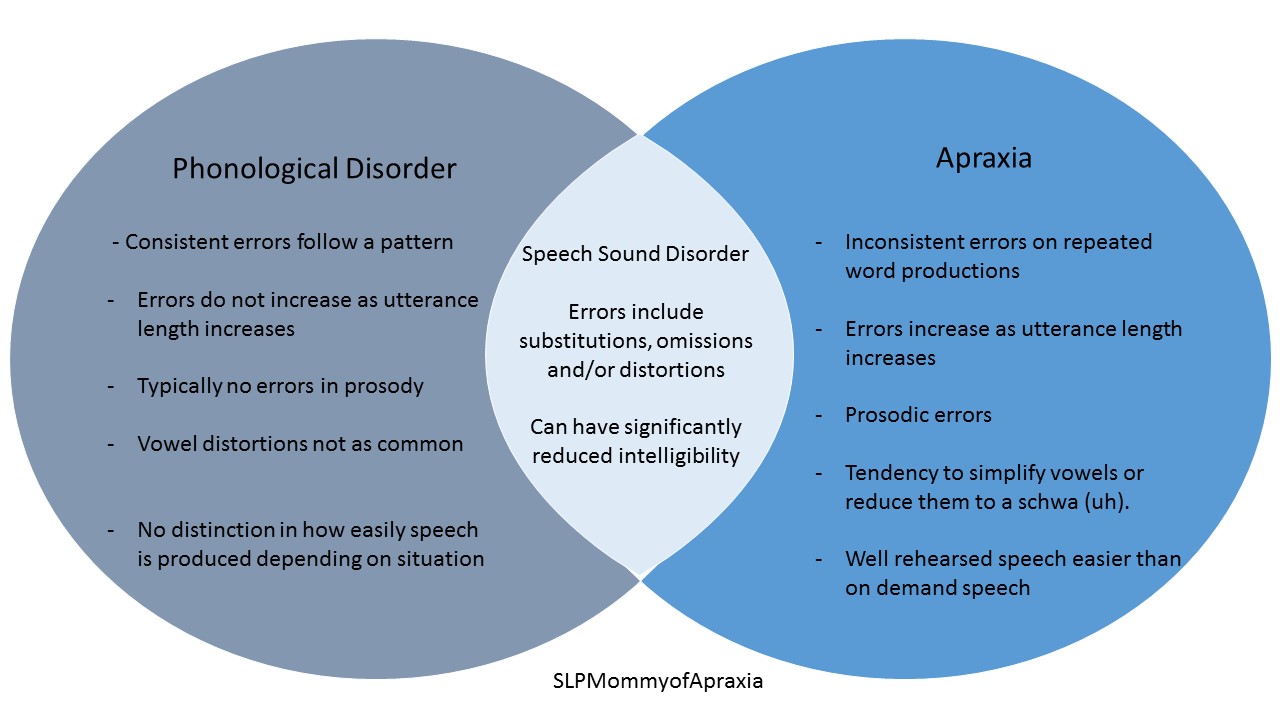
    It is NOT that complicated.  To put it simply, phonological disorder is a speech sound disorder in which the child typically makes consistent patterns of errors.  For example, one common phonological process is called fronting.  In this process, the child will consistently produce the /k/ sound as a /t/ sound, and the /g/ sound as a /d/ sound.  It is a predictable, patterned error.  This child, regardless of the word will usually always make these substitutions.  However, a child with a phonological disorder can have several phonological processes they are employing and be quite severe and have significantly reduced intelligibility.  A child with phonological disorder may have numerous substitutions, omissions, or distortions.

    4.) A motor speech disorder such as apraxia or dysathria –  Apraxia of speech refers to a child’s difficulty with the planning and programming of speech production that results in inconsistent errors, deficits with prosody, and significantly reduced intelligibility.  Unlike kids with phonological disorder, children with apraxia do not always have predictable and consistent error patterns.  This could be on repeated productions of the same word, or the ability to produce one sound in different words.

    For example, a child with apraxia may be able to say an /m/ in the word “momma,” but be unable to say or inconsistently say an /m/ in the word “more.”  Another child with apraxia may say “baby” for baby once, but when asked to say it multiple times may produce it different ways such as saying: baby, bay-ee, daby, or day-ee.  A child with apraxia may have numerous substitutions, omissions, or distortions.

    In addition, children with apraxia have some sort of prosodic disturbance to their speech.  This can manifest in ways such as: stressing each syllable in a word resulting in more “staccato” sounding speech, or errors with pitch, intonation, rate or volume.

    Graphic depicting the differences and overlap between phonological disorder and apraxia.

    Language delays do not involve the actual production of speech sounds (although the two can overlap). Language delays can be caused by many factors as well, and include:

    1.) A late talker – A late talker is just a typical child who talks late and has no additional speech or language issues from it.  The ASHA website offers this explanation “At onset, it is difficult to distinguish late talkers from late bloomers, as this distinction can be made only after the fact,” which as a parent and professional of children with apraxia, this is a pretty DANGEROUS and potentially hazardous distinction if you are just waiting around to see if it’s late blooming or something else.

    2.) A language impairment – There are many components of language. Language is comprised of five major components including: phonology, morphology, semantics, syntax, and pragmatics.  In addition, children can have difficulties expressively or receptively with these components.  Some children can have both, getting a diagnosis of MERLD or mixed expressive/receptive language disorder.

    3.) A hearing loss –  This is repeated on this list, because a hearing loss can also cause delays in language development as well. ASHA describes its effects in the following:

    There are four major ways in which hearing loss affects children:

    1. It causes delay in the development of receptive and expressive communication skills (speech and language).
    2. The language deficit causes learning problems that result in reduced academic achievement.
    3. Communication difficulties often lead to social isolation and poor self-concept.
    4. It may have an impact on vocational choices.


    3.) A medical or genetic condition – Other causes of language delay or impairment could be but aren’t limited to:

    Autism
    Fragile X
    Down Syndrome
    Cerebral Palsy
    Cleft lip/palate

    To complicate things even more, a child with a medical disorder could also have a co-morbid speech or language impairment as well!  It’s important to always know the etiology because an accurate diagnosis ensures and informs therapy.

    What I hoped to clarify in this post is that the question “Does this look like apraxia?” is just a little (okay a lot) more complicated than it seems.  Obviously the best place to start is to get a comprehensive evaluation!  If apraxia is suspected, it is best to get a differential diagnosis from an SLP who has received additional training past their post graduate degree in apraxia of speech.

    To find an apraxia expert near you, or to get listed as an apraxia expert,  go to apraxia-kids.org and click “find a speech therapist” at the top.

  • Whatever it takes: A day on the brink

    Whatever it takes: A day on the brink

    Ashlynn had oral surgery today to fix a ridiculously thick upper labial frenulum that was impacting her front teeth.  I have anxiety.  That’s no secret.  I was pretty nervous.  I had like every prayer warrior I could think of praying for her.

    It’s not that serious of a surgery in the grand scheme of things; but she was going to have to take a valium the night before, and then one and hour before and one right before surgery.

    I gave her the valium pill  (meaning I watched wringing my hands while my husband gave her the pill) and waited.  The surgeon said the pharmacist may fuss at the prescription, especially since she is tiny, but not to worry.  Um……telling a worrier not to worry is like telling the sun not to come up.  Actually it might be worse.  It made me freak out more than had he said nothing and just prescribed the pill.

    I immediately decided she would sleep with me, because if I woke up I needed to hear her breathing. That was basically a joke because the valium made her hyper and crazy emotional.  She would laugh hysterically and then just start balling uncontrollably.  Every emotion was magnified and out of her control.  She talked incessantly and didn’t get to bed until 10!!  Despite this, I kept her home from school because I figured she would feel pretty tired.

    Wrong

    She woke up on the right side of the bed happy and ready.  In hindsight, I should have just sent her to school and then taken her out when it was time for the procedure.  She was also (and she told me multiple times) very MAD I was not letting her go to school. It’s amazing right?  She has no close friends, struggles in every subject, and was just bullied recently…..but she’s mad I didn’t send her.  Her internal resolve and determination is incredible.

    Anyway, I digress.  I let her graze on food all day since she would only be able to eat soft foods after the surgery.  I gave her the second valium an hour before and it made her hyper again.  She was talking incessantly, and at the doctor’s office she was literally jumping and running in the lobby.  If you know my child, she is pretty much the opposite of a sensory seeker, so seeing her do this on a drug that’s supposed to make you sleepy was crazy town.

    The doctor made the decision in light of her behavior not to give her the third valium. The procedure went amazing.  The surgeon and his team were amazing and awesome with kids.  Ashlynn though was awesome too.  High tolerance for pain means she didn’t even flinch when the needle went in for the anesthetic.  He asked her to close her eyes, but I explained she wasn’t going to be able to do that on demand because of her motor planning issues, but seeing a needle wasn’t going to freak her out.  She gave blood for her genetic testing last summer staring at the needle and joking with the flabotomist that she was “taking a lot of blood wasn’t she?”  The flabotomist remarked in her whole career Ashlynn was the only person who smiled giving blood. LOL

    So that’s the good part.  Everything else was pretty much a shit show.  I’m sorry to cuss, but sometimes it’s the only words that cut it. The doctor’s orders were clear.  Relax, take it easy, eat soft foods, do medicated mouthwash rinses (which turned into salt water rinses since Ashlynn can’t spit), alternate ibuprofen and tylenol, and keep lips closed and ice the outside. Sounds basic.  I got in my car and turned on Imagine Dragons “Whatever it Takes.”  I told Ashlynn it was our song.  We do whatever it takes to help her.  We never give up. We do what it takes.  I was feeling pretty good.

    However, Ashlynn apparently thought it was opposite day.  She immediately and incessantly kept talking.  I kept telling her to keep her lips closed and then she would burst into tears that I was being mean to her and not letting her talk.  I calmed her down with the promise of a present.  That was short lived because she kept biting the ice pack (hello SPD).  If I corrected her to not bite it, she became hysterical.  Hysterical = bad because she could rip out the sutures.

    “Fine just give me the ice pack and talk.  Throwing a tantrum will rip out the sutures.”

    We picked up her brother, and he was trying to be helpful and told her (nicely) to stop talking so she doesn’t bleed.  That was code for “Let’s go to War” in Ashlynn’s world and they started fighting on the way home.  My stress was at a 10.

    Once home, she decides she’s famished.  Not hungry…FAMISHED.  She can only eat soft foods.  I feed her two bowls of noodles, 5 yes FIVE pieces of bread, countless squares of cheese, a banana, and then an ensure calorie drink I had my husband pick up on the way home.  After dishes I go downstairs and find her eating gummies she got out of the storage room!!

    “What the hell are you doing??”  You can’t eat gummies!!!”

    Not my finest moment I know.  She burst into tears I was yelling at her.  Told me again how mean I was being.  Again, she is supposed to be resting.  Most kids who took valium would be asleep.  Nope.  Not my kid.  I go downstairs again to find her bouncing on our big yoga ball.

    “Ashlynn….you’re supposed to be taking it EASY!!  Get up upstairs and watch a movie!!”

    Ashlynn hates movies.  She is 8 years old and due to a visual processing motor problem and language processing issues, she cannot follow the story line of an entire movie and therefore has never watched one completely through.  She bursts into tears again, throws a tantrum and guess what?  Her suture finally decided it had enough stress and started bleeding.

    I got a washrag and applied pressure just like the doctor said to do.  She seemed to realize it was somewhat serious now.  My son was majorly freaking out trying to help me out.  Ashlynn was still mad I had been mean to her.

    Bedtime came and I had to try and do a salt water rinse.  She still can’t spit.  She has one motor plan.  Swallow.  She can’t chew gum either for this reason.  First sip.  She swallows.  Second sip.  She swallows.  Third sip, she somewhat spits all over my mirror but I praise her.  Fourth sip, she swallows.  Fifth sip, spits all over my mirrors.  I have NO idea if any reached her suture, but we tried.

    She’s finally in bed. I have the song “Whatever it takes” on again.  Tomorrow is a new day.  Dang parenting his hard, but I can’t give up.

    Whatever it takes.

    Playing on snapchat trying to get her to be quiet and keep her lips closed!