I am absolutely thrilled to introduce Sharon Gretz as my first guest in my September Specialty series! Sharon Gretz is the founder and executive director behind CASANA (apraxia-kids.org), the largest non-profit dedicated exclusively to Childhood Apraxia of Speech.
Sharon’s dedication to CAS (Childhood Apraxia of Speech) awareness, support, research, and funding started with her experiences of being a mother to a child diagnosed with CAS. When I first met her, I instantly felt that she “got me.” She understood what it was like to walk in my shoes. She had been there, and I took incredible comfort in hearing the words “me too.”
Hi Sharon! I hope you know what an inspiration and comfort you are/were to me, especially around the time of my daughter’s dx. What I love about CASANA is that many of the board of directors have a personal connection to CAS. For those who don’t know you, will you tell us a little about you and your personal connection to CAS?
Laura, it has been wonderful meeting you and getting to know you a bit this last year! Thank you for the complement about CASANA’s Board of Directors. Yes, each person has someone with apraxia of speech that they love in their family! Of course, this all started for me when my son Luke was diagnosed with severe apraxia of speech at age 3. I can’t believe it, but in just a few weeks it has been 2 decades since his diagnosis. He had been in speech therapy for a full year with no verbal progress prior to me taking him to the evaluation where he received the apraxia diagnosis. Once my son began to receive intensive, frequent, and appropriate speech therapy for apraxia, his progress finally began! We were blessed to be connected to apraxia expert David Hammer who was simply amazing with my son. It was all so fascinating, watching this “dance” of therapy between David and Luke, the sheer effort and determination they both had. I don’t think I’ll ever forget it.
So, I guess the bottom line is I have traveled this road. I’ve been a lot of places, seen and heard an awful lot, and most of all, in these years I have tried to do my best to learn and share about all things concerning childhood apraxia of speech. My son speaks very well now and is approaching his final semester of college. He is a young adult and I continue to be very, very proud of him.
You mentioned that your son had been receiving services for a year before you found David Hammer. For other parents who currently have children in those early stages of therapy, what advice would you give them? How can they know if their SLP is knowledgeable or has experience with apraxia, and what kind of progress should they expect to see?
Well, Laura, I know that you are aware that despite the fact that our children with apraxia all share a speech diagnosis and all that it means, they are also very different than one another. That said, the advice that I would give parents of children in the early phases of therapy is to watch, learn and question.
When I think back about what I saw in speech therapy for my son with his first therapist, I noted that she played with him. She played quite nicely and he enjoyed it. She talked a lot. She described things – the toys, their colors and shapes. She asked him questions (though he did not respond back). She did reinforce some of the growing sign language that we were teaching him at home and attempted to get him to sign back. The first therapist that my son had was a very lovely person. My son liked her and so did I. The hard lesson is that just because someone is nice and fun and a child likes them does not mean that therapy is appropriate or that progress is going to come. I distinctly remember watching their sessions – start to finish- and not being able to really understand what the goal was. What was she truly working on that was about learning to speak? My son was bright and attentive and it appeared, best I could tell, that she was reinforcing language and play routines, something that I always did myself. Therapy started one time a week, then bumped up to two times a week, and over the course of the year he still said almost nothing.
So, while speech therapy for young children is necessarily embedded in play, I think parents need to know that unproductive therapy cannot go on indefinitely. There should be noticeable progress in a child’s speech attempts and the refinement of their speech. It was after my son’s diagnosis with very severe apraxia of speech that I came to understand that the therapy he had been getting was appropriate for a child with a “simple” speech/language delay. It was a language stimulation approach – not a horrible thing, just not appropriate if the child’s main issue is speech motor planning and programming, which is the primary problem of apraxia. I remember the evaluator, Dr. Tom Campbell told me that I could continue on with the therapy my son had been receiving, but it was likely I would also continue to see the same results. Or – OR – we could try something different. Speech therapy should match the child’s particular speech, language, and communication issues. If it is true that a child’s main problem (relative to any other language or communication problems) is apraxia of speech then the therapy must be tailored to a direct focus on speech production if we want to see meaningful, noticeable progress.
I learned how to ask questions and I made learning about childhood apraxia of speech a priority. I imagine that I was a bit annoying to David Hammer, my son’s SLP, because the questions just started on day one and kept on coming! “I noticed you did x, why did you do that?” But I will tell you Laura, even from Luke’s first day with David Hammer, I never had to guess what the goal was again and I never, in my son’s whole life to that point, had heard him make so many attempts to speak. By observing their therapy sessions, which included a ton of play, it was very, very clear what the goal was.
So, another tip for parents is to observe therapy. Observe as much as possible! Obviously the best scenario is if there is an observation room with a one way mirror. I know that everyone doesn’t have that feature but there are many ingenious ways parents have found to observe and watch the therapy sessions. It was through the watching that I learned what I must do at home to elicit good speech practice from my son. I just don’t think I could have been a great therapy partner had I not actually seen the therapy in action with my own eyes. I’m not sure I would have understood my son’s progress either, without the direct observation.
Learn, observe, and ask questions!
As for progress – if therapy is appropriate to the problem of apraxia… if the therapy method is appropriate, the frequency is appropriate, and the intensity is appropriate (child is saying and practicing lots and lots of speech targets each and every session) – then progress should be notable. If it is not noticeable or progress is slow to nonexistent, I think that more investigation needs to occur. An impossibly slow rate of progress is hopefully questioned by the professional first! While progress in children with CAS may be slower than progress in children with other types of speech sound disorders, you should still see noticeable progress!
There may be reasons for progress that is slower than expected. For example, each competing diagnosis added alongside of CAS is going to challenge the rate of progress. But unproductive therapy should not go on indefinitely without being questioned, the techniques changed up, or referral made for more assessment or evaluation. Over the last two decades I my personal observation has been that with the right therapy, hopefully early, and enough of it, most kids with apraxia will make amazing progress in their speech, some to the extent you would never know they once had a severe speech disorder. Other kids will have good progress but there may be some noticeable residual errors in their speech. And yet others, despite best efforts, may not be fully intelligible speakers.
Many parents are told by a neurologist, doctor, or other professional that their child must have a certain therapy approach. Examples include: Kaufman, PROMPT, SpeechEZ, and DTTC. I’ve noticed that the creators behind many of those programs are on CASANA’s professional advisory board. Is there an approach you would recommend over another?
This is a good question Laura. No. CASANA does not “recommend” specific methods. What we try to do is, first of all, share what many of these methods have in common that make them appropriate for a child who has apraxia – ie: speech motor planning issues. All of the methods you have mentioned share common features, and some have uniqueness as well. Research into effective treatment has really just begun a few years ago because of CASANA’s push and funding for pilot treatment research studies. Many of those studies are being published now and have added to the body of research and what we know. CASANA does have an emphasis on sharing facts as we know them at this time. So, we definitely do share information about research and various methods and which ones have more research than others, as well as which have no published research at this time.
I can say that there is not any onemethod to date that has been proven to be effective with all ages of kids with CAS, all levels of severity, etc. etc. We are learning more, though, through all of the published treatment research and appreciate that this type of research is incredibly difficult to do and to get funded! CASANA wants families and professionals to not just know about a particular method, but to have some understanding about WHY it may be effective. That understanding, we hope, leads to better decision-making for the child’s therapy program.
What then should parents be looking for to discern if their child is getting good apraxia therapy?
Those therapies that appear to be most effective focus on a process called speech motor learning. There is a lot of data published about how humans learn skilled movements. Those “principles” of motor learning applied to the speech learning process are woven into effective methods of treatment for CAS. Some of the principles have to do with aspects of practice and feedback to the child.
So, in regard to practice, the SLP is paying attention to getting frequent and intensive repetition of speech targets. A child is encouraged to produce words many, many, many times each therapy session. If a child is basically silent or says little or attempts to speak rarely in a speech therapy session, that would be a BIG concern. We know our kids will need many, many, MANY repetitions of speech targets in order for the motor plans to become automatic and not so effortful.
The speech targets need to be carefully considered and planned by the SLP so that the child is able to have some success & their speech attempts can then be shaped into closer and closer correct adult forms. Pulling out random word lists and expecting children to practice them without any consideration of the child’s current inventory of sounds and syllable shapes would be unproductive. Also, an SLP who understands apraxia will give consideration to how many speech targets the child is working on each session and how they are presented. For example, should the child practice the word “mom” 10 x in a row or should those 10 repetitions of “mom” be woven among the child’s other speech targets?
Ok, so is having a child say words many, many times going to do it? Nope, it won’t because the child must also receive feedback about how they are forming the words and/or about the accuracy of their attempts. I have seen many videos of therapy sessions in which the child is making a lot of attempts, saying target words, but the SLP is not providing any feedback to them or says “good job!!!” after every attempt, whether or not the child’s attempt was accurate or even close! There are times that feedback should be frequent and specific, and times it should be less frequent and more general, but there must be good feedback and an SLP who has good apraxia experience is always giving thought to and considering the amount and type of feedback provided to the child.
All of the methods most noted as being appropriate for children with apraxia of speech incorporate what we call “cues”. Cues are like reminders to the child about what to do with their mouth and/or how to position their oral structures during speech production. Some cues are visual in that the child “sees” something that reminds them of what to do. Some cues are verbal. And some cues are even physical or touch cues (tactile) in which a touch creates a tactile sensation which reminds the child of what to do. Our kids have difficulty moving from sound to sound, syllable to syllable. Appropriate therapy for CAS is going to emphasize MOVEMENT – how to MOVE sound to sound and syllable to syllable – think speech in motion. Some children will need to be taught individual sounds too, but that is not the emphasis of therapy for CAS.
Another thing that I would remind parents about and that involves the principles of speech motor learning which I mention above is that the child needs to actually directly work on the skill they are trying to acquire. It seems like common sense, but yet we do hear from families in which the bulk of a child’s therapy program is working on other skills and not on speech directly. For our kids to learn to speak, they must be working on speech most of their therapy time! That does not mean, for example, that the child will not ALSO need to work on language, pragmatic skills, etc., but if we want to improve speech intelligibility, we need to work on speech.
Finally, all the while we are hoping for and working on speech intelligibility, children still need a way to communicate. I would encourage parents to not be afraid of alternative or augmentative forms of communication. These forms can serve as a real functional bridge for the kids so that they can keep expanding their language even if their speech production skills are not capable of keeping up quite yet.
On the apraxia-kids.org website, there are five goals CASANA tries to achieve, with the top goal being: “To provide high quality information on CAS to families, professionals, policy-makers and other members of the public.” Why is this a top priority and what are some things you are doing to meet that goal?
Well, it is unfortunate, but there is a lot of poor and shallow information out there on CAS. When we started the organization, we felt that it was urgently important to assure that the information that we shared was as up to date and accurate as possible and free from, what I can only call, sensationalism. Having access to high quality information makes families much better advocates for their children and it makes for way more informed professionals who spend their lives dedicated to helping our kids. Resources are sometimes quite slim and that situation isn’t changing anytime soon. High quality information hopefully helps parents ask good questions, scrutinize things closely and make good decisions about the use of their personal resources and helps decision-makers do better by kids with apraxia. We continue to strive for this each and every day. Our information is always under review and being updated and shared. We read every piece of research that is published on CAS or related to motor speech production and related topics. We have a Professional Advisory Board that includes most of the top experts and researchers in CAS who help us in that way as well.
Anyone who speaks to you will usually discover your interest in, and pursuit of research. Can you explain why this is important to you?
I believe that research is important to objectively verify what we observe or believe and to know the best way forward. Today, especially on the internet and even as reported by mainstream media in magazines and books, the objective “facts” are often misconstrued, misunderstood, and/or minimized. Researchers, the good ones, are scientists that are seeking to test and explain phenomena. They may have a hypothesis of what they think, but at their best they are truth seekers. I have an interest in GOOD research. Believe me, I have seen individuals report results that they CALL research, but that I sure would not call high quality research. I also quite frequently read online about claims regarding research, for example “X product or method is known to help apraxia”, when in fact there is no research at all or “sketchy” research to substantiate the claim. I think that parents are trying so hard to help their children that sometimes these claims and assertions are not easy to detect for what they are. I want to teach parents to be the skeptic and to detect and investigate these sorts of false or misleading claims, to uncover the truth and then to weigh it all and make the best, most fruitful decisions for their child.
For our children, children with apraxia of speech, high quality research is enabling us to better understand the disorder, how to best treat it, and hopefully one day how to possibly even prevent it (at least in some cases). The needs of our children in speech and communication are so extensive that we need to really be sure that both public and private resources are being used as wisely as possible because these kids use a lot of resources. When we continue to have high rates of misdiagnosis and/or unproductive treatments, resources are not being used well.
Research is not easy to do and it needs a lot of funding to get it done, most often. But we have to try! Because it is difficult is no reason to not do it or to not try to move the science forward.
Since we’re on the topic, what are the current trends in research related to CAS?
There are some really interesting papers sitting in my reading pile! One of the latest that I am excited to dive into is by one of our CASANA grantees, Dr. Jonathan Preston who has just recently relocated to Syracuse University. He and colleagues have just published a paper looking at neurophysiological differences in speech production for children with CAS. Through measuring aspects of EEG signals they were able to gather evidence of key differences in neural processing of children with CAS during speech planning and programming tasks, especially for more complex words. So, why is this and other neurobiological evidence important? Because now, through this study and others using neuroimaging, for example, we are beginning to have physical evidence of the speech behaviors that we think we see. While still early, these sorts of studies eventually could lead to faster ways to determine who has CAS or is at risk of having it as well as biological evidence of treatment effectiveness.
The whole area of genetics research is really fascinating as well. For example, a recent paper by Shriberg and colleagues used whole exome sequencing (WES) for children with what might be called “idiopathic” CAS (no known cause). These subjects were tested extensively to be sure they truly did have speech behaviors fitting the definition of CAS. Eight of the ten subjects – 80% – had genetic variations in one or two of six genes of high interest and which were picked up with WES. Will most cases of idiopathic CAS turn out to actually be genetic? Maybe, but it’s too early to tell.
There has been more treatment research publications published in the last several years, including the first clinical treatment trial from our wonderful friends in Australia, which is truly exciting. Just in 2007 the ASHA AdHOC committee on CAS could only identify 4 treatment studies in the previous 20+ years. Many of CASANA funded research grants have focused on pilot studies of speech therapy treatments and nearly all of them have made it through peer-review and are in publication in the professional literature. There are many exciting things in CAS research world!
I heard you say once that finding support is one of the most powerful things you can do as a parent in this situation. I couldn’t agree more from a personal perspective, and have literally been saved through the facebook group. Not only can I get questions answered immediately, I have others who can cheer my daughter’s success, and can also find experts willing to give their advice. I’ve also met “friends” around the country who I’ve connected with based on our shared experiences. I said it in the opening, but there is something so comforting in hearing the words “me too.”
Maya Angelou once said, “I’ve learned that you can’t go through life with two catcher’s mitts. You need to be able to throw something back once in a while.” This quote reminds me of you. I’ve now met many people who have moved on after their child had resolved apraxia.
Please tell me in your own words why it was so important to you to literally found a non-profit after your son’s diagnosis, and why it is that you remain so active on the facebook group supporting parents and offering your advice?
Well, it is a long story I suppose. The core of it started with observing, literally observing, through what I call my “looking glass” (ie: the one way speech therapy room window). It truly stunned me to watch my son, over the course of the years he had speech therapy with David Hammer, and how deep the struggle was and how much he very much wanted to learn to speak. It was equally stunning to see the depth at which Dave worked with my son, how challenging the work was for both of them, and how much Dave really wanted to be that person who could change Luke’s life. Well, together they did it. And at some point in that process I realized that my son was going to be ok. He was going to be a talker, no doubt. What a gift to be able to give a child a voice! Truly, in those years I felt I had learned so much and had already started communicating online about what I was learning. At the time there was nothing online and yet the need was still great back then. So.. what does one do? Do you walk away and say, “my child is going to be just fine”? I guess I felt a calling. I don’t know what else to say. Creating CASANA and working with my wonderful and dedicated colleagues on our staff and board is my passion because I know in a deeply personal way that what we do matters and can help to transform the lives of the children. It is especially rewarding, now, to see quite a few of the older children and youth with wonderful futures unfolding. What a warm feeling to know that our organization helped to play a role in it all.
Are there any closing comments, suggestions, or recommendations you would like to make?
I like the Angelou quote a lot! I hope that families and professionals out there who have benefited from CASANA can, in turn, find a way to reach back, whether that be to us as an organization or to another parent or colleague.
The other thing I want to say has to do with our tagline: Every child deserves a voice. It’s important to me that parents remember that having a voice is a much larger enterprise than just learning to speak clearly. Amidst it all, we want our children to develop into every bit of who they were meant to be. We want them to grow in confidence so that they can, indeed, share their inner worlds, their thoughts, hopes, convictions and dreams as they go out into the world. We want them to take pride in themselves and their efforts and accomplishments, whether or not they learn to speak perfectly. As parents we can’t lose sight of the whole child.
Thank you so much Sharon! Again, on behalf of not only myself and my family; but also all the professionals, researchers, and more importantly the children and their families whose lives have been changed for the better due to your hard work and dedication, thank you. Truly, THANK YOU. I am honored you were willing to guest blog today.
To find more information on apraxia and CASANA, visit apraxia-kids.org.
Sharon Gretz is the founder and Executive Director of the Childhood Apraxia of Speech Association of North America (CASANA). Officially incorporated in 2000, CASANA emanated from an online education effort that Sharon led called “Apraxia-KIDS”. In addition to being the mother of a now young adult son who grew up with CAS, Sharon has her Master’s Degree in Counselor Education and has completed all coursework for requirements of a Ph.D. in Communication Sciences and Disorders (completed after her son’s diagnosis). Sharon was also a recipient of the National Distinguished Service Award at the Kennedy Center in Washington, DC, presented to her by the National Council on Communicative Disorders for her advocacy and work on behalf of children with apraxia and has been named a “Community Hero” for her work with apraxia in her home location of Pittsburgh.
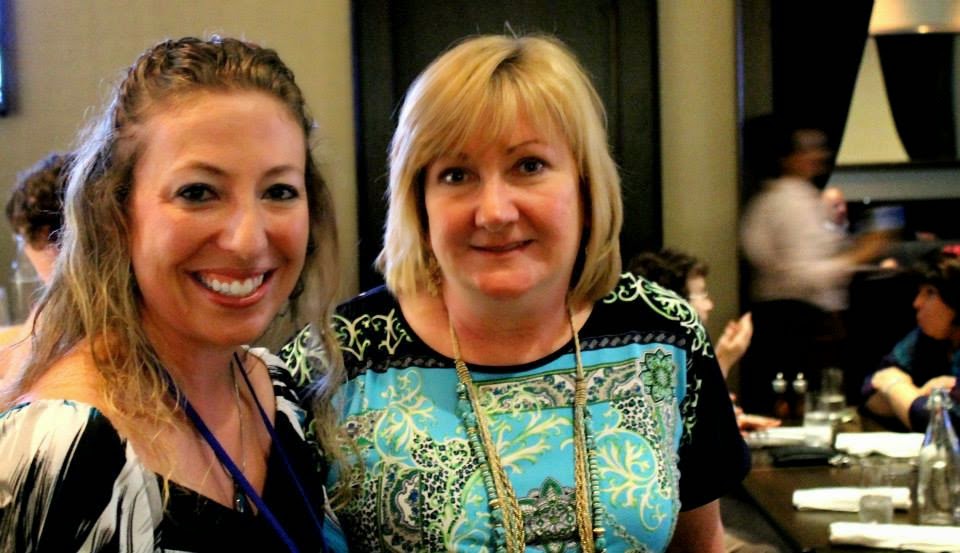 |
| With Sharon at the Apraxia of Speech National Conference |