Category: Childhood Apraxia of Speech

  • Her fight, our fight: The day we met Ronda Rousey

    Her fight, our fight: The day we met Ronda Rousey

    It started with an intriguing title: Ronda Rousey: The World’s Most Dangerous Woman, and then a picture of a James Bond beauty type.

    1035x703-R1236_FEA_Rousey_lay_D (1)


    Now, I normally wouldn’t click on stuff like this, but today I had a day off, the kids weren’t fighting, and I thought, okay…sure.  Let’s see.  A beautiful James Bond girl is the most dangerous woman in the world?  Sure.  Let’s read about this.

    And then I read this

    “In her first six years, nobody knew whether she’d ever speak an intelligent sentence, such were the after effects of being born with an umbilical cord wrapped around her neck. It could be that her gibberish and mumblings were signs of brain damage. No one knew, and her parents — Ron, an aerospace-industry executive, and De Mars, an educational psychologist and statistician — moved when she was three from Riverside, California, to Jamestown, North Dakota, in part to be near the Minot State University speech therapists, who set about bringing her vocal cords to their senses. It wasn’t easy, and it took time. And it was especially frustrating for Ronda given how advanced her sisters were. “I’m dumb, Mom,” she once said. “Maria and Jennifer have the words. I don’t have the words.” “No, you’re not, you’re very smart,” her mother told her. ”

    And then I was hooked.  I started googling her name.  I read every interview.  In almost every interview she made mention of her “speech impediment.”  Each time she talked about it, the more my mind thought, “this is apraxia.”

    I threw up the question to the apraxia kids facebook group.  Yes, people had heard of her, but no, they never heard she had a speech impediment and they sure didn’t think she had apraxia.  Hmm.

    Did I mention I had the day off and my kids were being good?

    So, I started to research some more.  In one interview she said her dad called her “sleeper.”  She was just waiting to bloom.  He told her things like she was going to be an Olympic gold champion, or the president of the United States. He died tragically when she was young and he never lived to see her accomplishments.  My heart ached for them.

    In another interview they said one time she said a word that was unintelligible, but it was what she wanted for her birthday.  Her dad took her to the toy store and made the store clerk take them to every item until they discovered her jumbled words were trying to say Incredible Hulk.  Man, how many of us have been there?  Damn birthdays.  When your kid can finally tell you what they want, you would sell your house to get it and you say a prayer of thanks they could at least try and say something and tell us what they want.  She HAS to have apraxia.  I have to at least ask.

    One problem.  Ronda Rousey is incredibly famous.  What could I even write that her PR people would read and then pass on to her?  Could I try her fb page?  Twitter?  I settled on the “contact me” form on her website.  I started writing to her PR people, but it emphatically turned into me writing to her.  I didn’t hold out much hope, but hey, might as well put it out there.  Apraxia needs a face….and what better face then this badass female!  She’s smart, talented, driven, resilient…man.  Doesn’t she sound like our kids with APRAXIA?

    Before I closed my computer one last thing on her website caught my eye.  She wrote a book.  Hmm.  Maybe she writes more about her speech impediment in her book?

    I saw that she was going to have a Colorado book signing.


    Interesting.  I clicked on it.

    May 29th 2015

    Wait….that’s…..today!?  Oh my gosh.  She is in Colorado!!  She is in Denver tonight!

    Insert internal struggle.

    I have to go!  This is amazing.  I have to ask her.  I can ask her in person!  Laura, are you crazy?  A has speech therapy and swimming tonight.  You can’t go down there.  Plus, are there even any tickets left?  It’s the day of.  Well, I could check.  I could check….and then if there aren’t any tickets left I can wipe my hands of it and know it wasn’t meant to be.

    So I called Tattered Cover.  There are tickets left, but they are almost gone.  I have to buy the book to get a ticket.  Do I have to come in and buy the book?  Oh, I can order it over the phone and pick it up at the book signing with my ticket?  Do I want one?  Um…um….this is crazy right?  I’m crazy.  Oh what the hell.  Yes.  I’ll buy one.  Yes thank you. I’m number 422 out of an allotted 500.

    What did I just do?  I don’t watch MMA.  Just this morning I didn’t even know who Ronda Rousey was and now I have bought her book and a ticket to go to her book signing on a night we are slammed with appointments.  My husband is going to think I lost my mind.

    Okay, I won’t tell anyone.  It’s only crazy if she doesn’t have apraxia right?

    I feed my kids lunch.

    Who am I kidding?  I can’t keep a secret.  I text two of my apraxia mommy friends.

    “Do you believe that coincidences are not really coincidences?” and I tell them the story.  The consensus?

    “Go”

    I tell my daughter’s SLP…her response?

    “You have to go!” and “You should bring your walk flyer!”

    Yep.  Definitely going.  I packed a CASANA apraxia brochure and inserted my walk poster and off we went.

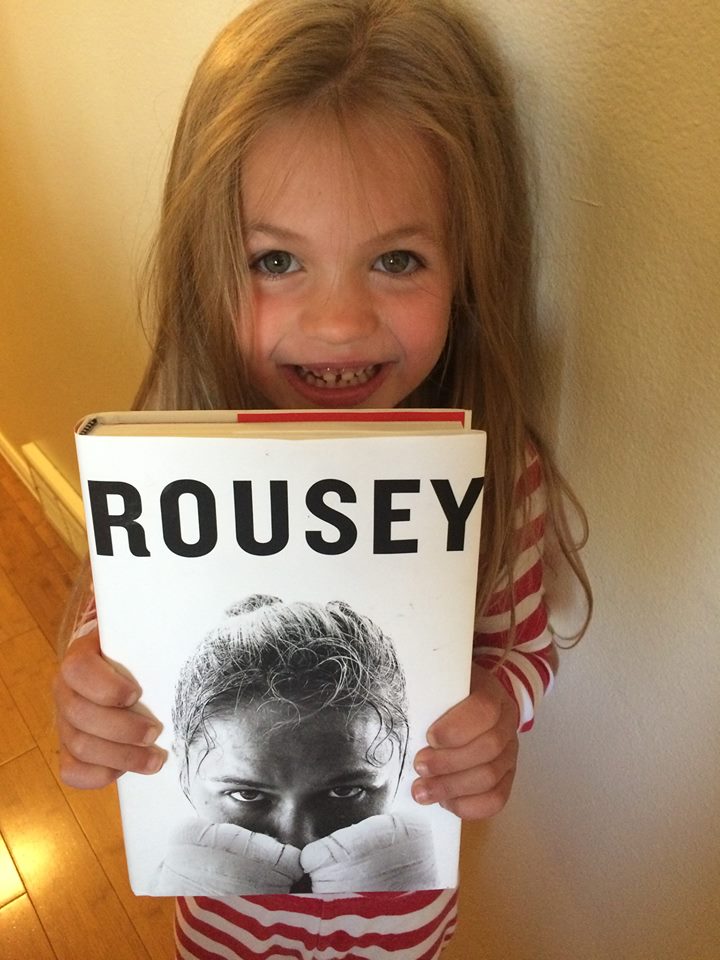
    A was STOKED.  She LOVES books.  She could not believe this big book was for her.  She held it like a prize and she would NOT let me hold it.

    We stood in line and people thought she was adorable.  Ronda’s youngest fan.  Well…maybe….if Ronda has apraxia this moment is epic.  I started to get nervous.  What am I doing here?  I dragged my 5 year old baby to a book signing on a mother’s intuition.  Oh well.  If nothing else, this woman is pretty kick ass.  She’s not famous for her good looks (even though she’s beautiful), she’s not famous for being a reality star, she’s famous for being freaking talented and smart.  I started liking her in spite of anything.

    Finally it was our turn.  As we got closer, her bodyguards were crabby and everyone on her team seemed tired.  They were literally pushing people after their book was signed so they wouldn’t take up more time for selfies or whatever. She wasn’t personalizing books.  In fact, you couldn’t even hand her your book.  They handed it to her for you.  Sigh.  I took out my hidden apraxia brochure.

    Damn.

    Oh well, maybe we’ll still be able to talk.  Those body guards though.  Gulp

    “Okay sweetie, your turn.”

    I sent A up to the counter by herself because I read in one interview that Ronda has a soft spot for kids who seem to have the same speech disorder she did, so she really tries to take time for them.  This was no exception.

    A walks shyly up to the counter.

    “What’s your name?” Ronda asked.

    A answered but she couldn’t understand so she leaned over and asked again.  I only got this one picture 11393018_10205134887824400_1278270075692218729_n


    before I went over to clarify.

    Ronda started signing her book.  I said quickly, “A has a neurological speech disorder like you did and we are inspired by you because you overcame that and so much more.”

    Almost on auto-pilot Ronda responded, “Yep, I had to overcome a lot to get here.”

    I’m crazy nervous now.  I have to ask her like ASAP.  Luckily she’s taking a long time to sign the book.  Laura say it!!

    “Did you have apraxia?”

    Ronda stops signing dead in her tracks and looks me in the eye and says, “What did you just say?”

    “uh uh apraxia?  dyspraxia?  Was that your speech impediment?”

    She looks incredulous and repeats “apraxia, yes, this is what they think I had.”

    I smiled.  I knew it.  Un-freaking believable.  I look over at the body guards.  What the heck.  I throw the CASANA brochure on the counter.  They move in, but she motions them to stop.  I say,

    “This is information on apraxia.  If you really did have it, will you say that in your interviews instead of speech impediment.  It would mean so much to our kids who are struggling with it.”

    She again looked at the brochure before looking back up at me and said, “I will.  I really will.”

    She seemed sincere.  I instantly believed she would.  I have A give her a hug and try to push her along (bodyguards are watching) and she says,

    “You know, my mom is a PhD psychologist, and SHE had never heard of it.  She took me to the Universities and many of them had never heard of it.”

    “Yes!” I replied.  “Yes!  It’s still not well known or understood.”

    She starts to get really worked up now.  Emotions start spilling out of her.  I read in an interview people think she’s so tough, but really she wears her heart on her sleeve and she was, right then, in that moment.

    “They wanted to put me in a special classroom away from my friends.  They thought I was stupid!!  But by 4th grade I was top of my class in algebra, and by highschool I tested gifted.”

    “Yes!” I again replied.  “Yes, these are our kids.”

    She looked back down at the brochure before looking up again and said, “I will.  I really will.”

    A and I ran out of there.  Before we left I pointed at Ronda and said “Look!!  She has apraxia,” and then I pointed to a line of almost 100 people who were still waiting and said, “and all these people want her autograph!!”

    My daughter smiled.  We ran out into the rain laughing.

    “You’re going to be famous!” I said, and we laughed.

    It was very late by this point and we still had a 30 minute drive home.  I stopped by my parents house to tell them the story.  They couldn’t believe it!

    I finally got home and ate dinner while my husband put A to bed.  I fired up my computer to start writing this blog post, but checked fb.  Just for the heck of it I went to Ronda’s fb page to like it, and that’s when I saw this:
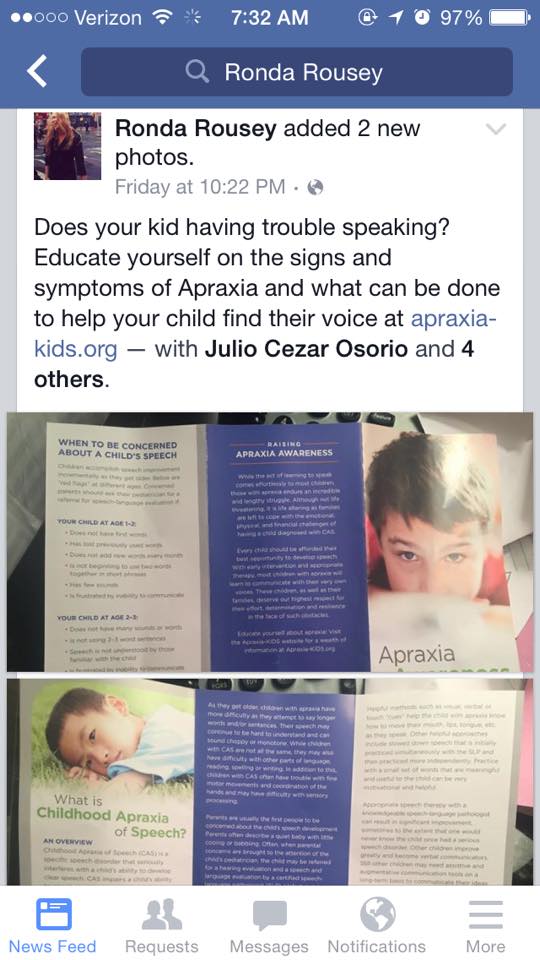
    11351185_10205152491424479_6279279109440234371_n

    She reposted the brochure I gave her!!  She must have done that first thing upon completing the book signing!!  She IS one of our kids!  So freaking awesome!!

    Even if she doesn’t do anything else, even if she doesn’t say she has apraxia (but I think she will), A and I will always have that moment…..that moment when we met a true fighter who beat apraxia and so much more, just like A will.

    We will always have that book confirming what I have hoped all along:

    “I never would have been able to do any of those things without hope.  The kind of hope I’m talking about is the belief that something good will come.  That everything you’re going through and everything you’ve gone through will be worth the struggles and frustrations.  The kind of hope I’m talking about is a deep belief that the world can be changed, that the impossible is possible.” – Ronda Rousey
    11351169_10205152550145947_2841047692327843802_n

    *Note: This post contains affiliate links*

  • Anything but Silent book review and giveaway!

    17895894

    I’m continuing on with Day 4 of giveaways leading up to Apraxia Awareness Day on May 14th! Today I am reviewing the book ANYTHING BUT SILENT by Kathy and Kate Hennessy.  Kathy Hennessy is the mother to Kate who has pure CAS and another son Andy who has global apraxia and SPD.

    The book rotates chapters from Kathy’s point of view to Kate’s point of view.  First of all, I just have one piece of advice: if you are a parent or professional

    READ THIS BOOK.

    READ THIS BOOK!

    Yes, people.  It’s that good.  I read it in one night!  I couldn’t put it down.  I laughed, I cried, but mostly I related.

    It starts with the diagnosis:

    “I decided that day I could beat myself up about the unfairness of life or I could educate myself and help my daughter move her own mountains.”

    I could not have said it better.  This is EXACTLY how I felt.  How I feel! Kathy wasn’t kidding either.  She’s now the education director at CASANA (apraxia-kids.org).

    It captures the need for others who are going through the same thing:

    “What I needed at this point in my life, more than anything, was another parent, and that was the one thing I couldn’t find.”

    I can’t even imagine.  My fellow women I have met through facebook are my saviors.  Seriously, I don’t know what I would do without them.

    They capture the fears at simple holiday traditions:

    “When you have someone in your family with childhood apraxia of speech, things that are everyday occurrences for other families are moments for you that aren’t very normal at all.”

    She’s referring to the tradition of seeing Santa.  Kathy would fret and worry that Santa wouldn’t understand them, among other things.  Let me tell you, EVERY mommy of apraxia has been there.

    From fighting insurance companies, to therapy sessions as a lifestyle, these two amazing women tell their incredible story and as Kathy puts it, “Today both kids are doing great and I’m still standing.”

    This story was inspiring beyond my wildest imagination.  I can’t believe I waited this long to read it!  Read it people!!  That’s my review.  You won’t be disappointed!

    To win this book, enter below. Open to U.S. residents only!  Good luck.

    a Rafflecopter giveaway


  • Why we’ll never stop working

    Why we’ll never stop working

    I’ve been down lately.  Really, really down.  It pretty much started at Ashlynn’s re-evaluation meeting and went downhill from there.  For all the work she’s done, for how far she has come, for what she knows in the face of so many challenges,  it was like a slap in the face.

    It’s really not anyone’s fault.  It’s just the way it is.  I’m dealing with mixed expressive/receptive language issues now.  I knew this, I did….it’s just seeing those damn numbers.  1st percentile, .5th percentile.  Phew.  Deep breath

    There were also awesome numbers.  Articulation is in the average range.  The AVERAGE range!  That’s phenomenal.  Ashlynn is intelligible to perfect strangers in and out of context.  For someone with apraxia of speech, she beat it in 2 years with a TON of therapy, but she overcame it.

    Now we’re faced with new deficits.  Word finding, expressive language, grammar, syntax, receptive language, memory, attention, writing.

    It was overwhelming.  My husband had tears, and he’s the one who always finds the positives and the “what she can do’s.”

    Even her receptive vocabulary test came back just under the average range.  Receptive vocabulary tests have been shown to correlate with IQ tests (even though I didn’t give her an IQ test), and even though I don’t think the test was totally valid since I’m sure her attention played a factor…..

    It still made me pause.  For once I started thinking, maybe we don’t have this.  Maybe I am dealing with limitations.  Maybe I am in denial.  Maybe I’m not seeing things because I don’t want to see them.

    I would read stories and updates on other blogs and get jealous someone’s child ONLY had apraxia of speech.  CAS is no joke either, but if Ashlynn only had CAS then she would almost be over speech forever!  Sigh.  You know you’re down when you’re jealous of other kids’ disabilities.  That is wrong on so many levels.

    I looked everywhere trying to get my positivity back.  I talked to family, to friends going through this journey too, co-workers…nothing helped.  I poured over pinterest looking for inspirational memes and quotes that were going to change my negativity and squash my doubts.  I found nothing.

    I scoured the internet looking for success stories for global apraxia.  One I found was on disability now but at least happy she had made it through childhood.  That wasn’t exactly lifting my spirits.

    At the same time, I finally read a new research article on Apraxia that’s been in my pile.  The article describes kids with motor planning deficits (kids with apraxia) rely heavily on auditory feedback which was proven when they demonstrated diminished speech articulation in the presence of noise.  Gee, I thought. That’s great these kids found a compensatory strategy to make up for their motor planning deficit, but what happens when you have sensory processing disorder and possibly some receptive language issues that makes that feedback unreliable.  UGH

    But then I found it.  My inspiration was sitting right under my nose.

    I know this guy who has bipolar disorder.  When I met him he was kind of a hot mess.  He hadn’t gone to college, was partying, and constantly getting fired from his jobs.  Of course, having bipolar disorder is very difficult.  There are daily struggles in his mind I will never know.  The statistics for someone with bipolar disorder are less than impressive: 90% of marriages end in divorce when one person is Bipolar.  Less than 50% of people with bipolar take their meds, and 1 in 5 commit suicide.  Many live on disability.  Many are homeless.  This guy though, he’s been married for 10 years with no sign of stopping.  He’s loyal, faithful, hardworking, finished college AFTER his diagnosis, and stays on his medication.  Who is he?

    He’s my husband.  He’s Ashlynn’s dad.  Everything he shouldn’t be doing he’s doing.  Everything he shouldn’t be, he is.  My husband, Ashlynn’s dad, defies statistics.

    Then I started thinking, I know this other guy.  He was raised under an extremely physically abusive, alcoholic father.  His parents ultimately divorced.  He was forced to go to war and and live in actual nightmares.  What are the stats on a guy like this?  Well, since he’s the product of divorce, he’s 40% more likely to end up divorced himself.  He’s four times more likely to be an alcoholic.  As a vet, he faces a higher possibility of homelessness.  What did the future hold for this guy?

    Well, he’s my dad, father of three. Married for 45 years and happily retired.  He’s healthy and has a drink maybe once a year.  My dad, Ashlynn’s grandfather, defies statistics.

    And that’s when I started to realize.  Ashlynn comes from a long line of statistic breakers.  It’s in her blood.

    I thought of me.  Had I defied statistics?  Well, neither of my parents went to college, so it would be less likely I would receive a college degree or much less an advanced degree….yet here I am. It was highly unlikely I would have ended up at Duquesne University for an elite group of SLP’s, yet there was I was last summer.  Maybe I do defy statistics.

    My dad’s nephew years ago was on the wrong track.  He was in jail, and he didn’t know how to make a life for himself after he got out.  He was lost.  He asked my dad for advice and my dad said “keep working.  All I know is to work.”  Years later that same nephew had kept a job and was raising adopted children.  He was not in jail and will never go back.  He told my dad he always remembered his words to just keep working.

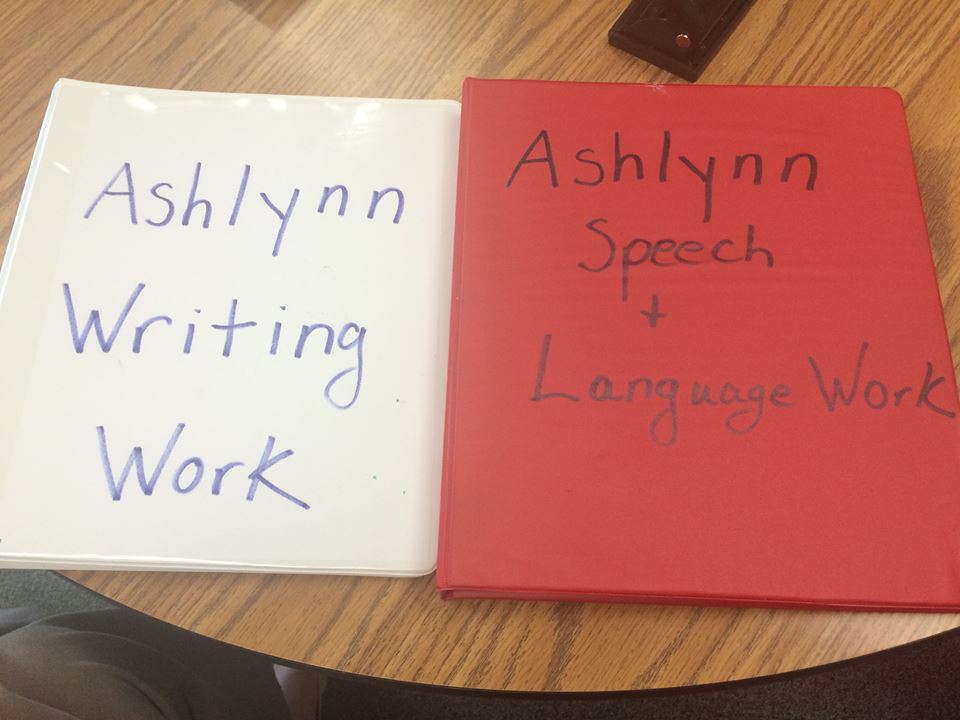
    So there it was!  Right under my nose.  We are statistic breakers.  We are hard workers, and Ashlynn is no exception. She always wants to work, do homework, practice writing, ball skills, pedaling, speech, read..you name it.  She attacks it, and I realized, I may not have success stories for her EXACT same situation, but I do have success stories for many other hard or seemingly impossible situations and she will be one too…..if we just keep our head down and

    working.

    7e94b6ca15764dd139ba2f8146844331ashlynn work


  • Global apraxia, you brought your “A game,” but my daughter’s game is better.

    Global apraxia, you brought your “A game,” but my daughter’s game is better.

    My friend introduced me to an AWESOME website call “The Mighty.”  During the month of March, they challenged readers to write an open letter to a disability that a loved one faces.  I have no idea if I’ll get accepted, but hey, at least I have a blog.  For as much writing I do about apraxia, it was definitely high time to talk to apraxia myself.

    Hello apraxia.  Hello global apraxia.  It’s hard to believe we’ve never talked, especialaughlly since I’ve certainly done my fair share of talking about you.  When I gazed into my new baby girl’s eyes, and laughed along happily to her hearty giggles, I had no idea then that you were there, lurking in the shadows.
    The day I discovered you were behind the delayed motor milestones and the lack of speech I cried heavy tears and felt a weight I don’t think I quite have shaken yet.  You certainly brought your “A game” global apraxia.  I hate to admit I have felt defeated by you before.  However, you never managed to crush a small little girl’s determination, attitude, resilience and perseverence.  We are told you will never go away.  Anything requiring a motor plan will always take “more repetition than most.”  Oh how many times have we heard that?  I hated you once.  I hated watching my baby girl struggle to: speak, to jump, to ride her bike, to drink without choking. In fact I still hate you as I continue to see her struggle to: dress herself, feed herself, and write her name.  In fact, I don’t think I’ll ever quite forgive you when I think about the day she almost drowned.

    Mostly though, I feel sorry for you.  You have no more power here in this house, because my little girl has shown she can beat you time and time again.  She is a hero who wins daily, weekly, and monthly battles, and that winning is something you will never know.  Bet you didn’t expect something so strong to come out of something so small did you?   Well, we actually have that in common.  My daughter’s bramightyvery took me by surprise too.

    You will never know winning here, but because of your stubborness, we only grow stronger and more confident, knowing that any obstacle in our way can be defeated with faith, tenacity, and an unrelenting positive attitude.


  • Experience is the Key Architect of the Brain in Childhood Apraxia of Speech

    Brain


    I went to my state’s annual school based symposium for SLP’s this weekend and one of the keynote speakers was Dr. Amy Meredith CCC-SLP.  She is a professor at Washington State University and specializes in Childhood Apraxia of Speech with a focus on Early Literacy Skills.  Of all the things she said, the one quote that really stood out to me was this:

    “Experience is the key architect of the brain.”

    What does this mean?  Well,  you could interpret it in different ways I suppose, and put your own twist and connotations on it.  For me though, it means this.

    The brain is adaptable and can change.  For someone with a neurological disorder like apraxia, it means those pathways can be re-written.   Oh and haven’t I seen that already with Ashlynn?  Occupational Therapy, Physical Therapy, Speech Therapy, and swimming have already been re-wiring her pathways.

    An architect is defined as a person who designs and makes buildings.  Studies show the brain is literally capable of changing structure!

    Dr. Meredith cited a very recent study (Kadi et al., 2014) that found children with idiopathic apraxia (idiopathic meaning of no known origin), had significantly thicker left posterior supramarginal gyri than controls.  However, kids treated with a motor based approach to apraxia showed a significant decrease in the cortical thickening area after 8 weeks, and resulted in improved speech as well.

    That is amazing people!  Therapy literally changed the structure and size of the brain!! We know therapy changes function.  That’s why we all spend thousands of dollars on therapy, but to know that it actually changes the structure?  To me, that’s really something.

    This also tells me to never give up.  Not that we would, but now we have research to back us up!

    Literacy:

    Of particular interest to me was the literacy piece.  I know Ashlynn is at risk for learning disabilities.  One sobering study she cited was a Raitano et al. (2004) study which examined pre-literacy skills in subgroups of children with speech sound disorders (not CAS specific).

    Basically, the results indicate children with SSD’s  (speech sound disorder) performed more poorly than the controls, and children with SSD and LI (language impairment) add an additive risk factor for deficits in pre-literacy skills.    Lewes et al. (2004) conducted a follow up study and found children with CAS improved articulation but continued to have difficulties with:

    syllable sequencing
    nonsense word repetition
    language abilities
    reading and writing

    Right.  Okay.  So, what do we do about this?!?  Well

    Experience is the Architect of the Brain

    Let’s amp up their pre-literacy skills and give them more exposure and experience to things like:

    naming letters and letter sounds
    categorizing pictures by rhyme or initial sound
    identifying things in their environment that start with a certain sound etc

    Programs she recommended were Phonic Faces and the Lindamood Bell Program.  Dr. Meredith runs “Camp Candoo” over the summer for kids with apraxia focusing on speech sound production and early literacy using Phonic Faces.  Her data taken over the past three summers shows significant improvement in all pre-literacy skills after the two week intensive.  It was so compelling, I’m seriously going to try and get Ashlynn in this summer.  I’m also actually thinking of doing a small group a day with the kids I see in private practice with apraxia and Ashlynn.  It would give me experience, and benefit Ashlynn while also benefiting all the other kids.  We’ll see.  I always have big plans.


  • Why nature weighs more heavily than nurture

    Why nature weighs more heavily than nurture

    Nature versus nurture.  It’s a phrase that comes up in my profession, even if it’s unspoken.  I’m in the business of child language development, and nothing raises more eyebrows about nurture than a child who can’t talk…. or who has poor vocabulary knowledge…… or is lacking in language skills.

    Oh it comes up in psychology too.  We’ve all heard the stories of twins separated at birth and raised in different environments.  How do they turn out?  Are they a product of their environment, or did nature play a bigger part?  I don’t really know the answers to those particular studies except what I’ve seen on talk shows like all of you.

    However, I’m here to talk about speech and language development.   I’m a professional in it, but nothing could have taught me more about nature versus nurture than having two of my own children.

    Maybe that’s why it took me until my daughter with CAS was almost three to get tested.  Was I in denial?  What the heck?  Well,  I’ve seen the eyebrows from fellow colleagues about children I’ve treated.  I’ve been privy to the comments, “well, his parents just never read to him!” or  “they just don’t talk to their children” or “those parents anticipate all of his needs that he has no NEED to talk.”  So yeah, I’m pretty sure THOSE comments were exactly why I waited so long.

    Deep breath.

    Teachers and speech/pathologists, we need to talk.  This talk is cancerous.  If only you KNEW what a parent who has a child with delays goes through on a daily basis, you would instantly take back your words.

    I am a speech/language pathologist, and had been practicing five years prior to the birth of my daughter.  I might have been unknowingly pompous once.  Let’s face it, I was.  I was convinced my first child, my daughter, would come out practically gifted.  Heck, I had a master’s degree in childhood language development and disorders.  If anyone could give their child the upper hand, it was going to be this mama.  I remember when she was very young, maybe a month, I had a red and green light rattle that I would slowly move around her visual field.  I even think I wrote on facebook I was having withdrawals from my job and was just doing some “speech therapy” with my child.

    I remember cooing at her, using “motherese,” talking to her while I went about my activities, and even using baby sign with her paired with visual models each time she went to “eat” “drink” or wanted “more.” I remember locking toys out of reach so she would have to request them, demanding some sort of verbal response before she received anything of interest, and having her use AAC on my iPad. We (I) sang nursery rhymes, sang our ABC’s, and had letters all over the house like in the bathtub and on the fridge.  I read religiously to her EVERY, SINGLE, NIGHT.  She was going to be a prodigy.  I just knew it.

    It pains me to write her whole story in this post.  I have an entire blog for that.  Suffice it to say, things didn’t quite turn out as I had envisioned.  Her SLP mama who knew the tips and tricks didn’t seem to know the key to unlocking her voice, or her other motor skills.  Despite nightly therapy sessions, it seemed I was to be the only SLP on the planet who had a child who couldn’t talk.  Who I couldn’t TEACH to talk.  Despite going to work everyday and helping my students find their voice, my daughter struggled with hers.

    Despite throwing myself in research, attending conference after conference on early intervention, or consulting with my colleagues, my daughter STILL struggled to speak.

    I’ve come a long way in this journey, but let’s just say my guilt and feelings of failure for Ashlynn were so strong that I specialized in the disorder.  I love what I do, and I love CAS, but I thought at least if I were a specialist I could finally and truly say I really did EVERYTHING I could to help her.

    “You’re an SLP” you might be saying.  “I have parents who don’t care like that.”

    Let me just tell you, that your parents are now MY parents and I have treated many kids with CAS….and I can tell you with absolute, positive, and definitive truth, that EVERY mother feels or has felt like me.  They may manifest it in different ways, but isn’t that to be expected?  We are all individuals after all.  However, every mother I have met is worried.  Every mother I have met is a praying woman.  Every mother I have met feels helpless.  I felt helpless and I’m a speech pathologist!!!

    My dear colleagues, I don’t want to get another phone call from a mother in Arizona who has a bubbly voice and seemingly carefree personality, confess that despite every night that she lays her head on her pillow pleading with God that her child gets better and praying it was nothing she did, the SLP told her if she had just read to her daughter more, she would have been in a different position.

    This is not okay.

    If you don’t believe that mother, than believe me.  I have finally come to terms with the fact that nothing I could have done would have made my daughter talk on time.  Please, please, don’t add to that mother’s guilt.  I assure you, she is full to the brim already with it….despite the fact there is nothing she could have done.

    I have another SLP mommy I have met now with a child who has CAS get a note from an SLP that stated,”still remains delayed despite excellent familial support.”

    That statement, seemingly benign, implies that that SLP believes nurture plays more than nature, and she is having a difficult time reconciling such delays that are accounted for….GASP…..an actual disorder.

    Friends, speech and language disorders are your livelihood.  Please stop assuming nurture played more of a part.  My son was born in the midst of my daughter’s diagnosis.  He never received the FRACTION of therapy my daughter did, and he said mama at 8 months old.  He went onto to say and do things that left me speechless.  Not  because I doubted him, but because based on my experience with my daughter with global apraxia, I didn’t have to TEACH him any of it!  Time after time, I shook my head asking him, “how can you say that?” or “how can you do that?  I haven’t taught you that yet!”

    If this journey has taught me anything, it’s that speech and language delays really ARE an actual disorder like we all learned in graduate school; and SLP’s, your role couldn’t be more important.  Please don’t taint it by coming in with an assumption “if only they had…..”

    Come in with the assumption that “they have….and they are spent.”  Please, please be the parent’s champion as much as you are the child’s.


    nature vs nurture