Category: Childhood Apraxia of Speech

  • Where we are at: apraxia, articulation, language

    Where we are at: apraxia, articulation, language

    It has been awhile since I posted directly about Ashlynn’s speech.  Once we all started to understand her, it didn’t seem as pressing anymore.  Her dyspraxic components (gross and fine motor skills) definitely started to take precedence.  However, she is still in speech for a reason, and that reason being percentile ranks well, well, well below average.

    Ashlynn is 6 years and 2 months.  She can say every single sound in the English language correctly, including an /r/, which is a victory for me!  If you’re an SLP you understand immediately; but if you’re not, you should know that an /r/ error is basically an entirely different monster that usually takes years to remediate.  Unfortunately, she also has a profound frontal lisp.  If you’re an SLP, again you understand immediately why I added unfortunately; but if you’re not, you should know that a lisp is also an entirely different monster that takes A LOT of time to remediate.

    Though I am paying for private therapy, a lisp is pretty low on the priority list.  She is understood in most contexts with varying communicative partners.  You might ask, “What is she in speech for then?”

    Oh baby, that is a loaded question.  We are called speech/LANGUAGE pathologists for a reason.  Where there is a speech delay (referring to sound production), there is frequently a language delay.  Language runs the gammit from receptive (what you understand), to expressive (what you say).  Expressive language includes but is not limited to: vocabulary, grammar, syntax, narrative language, and word finding.  Ashlynn has deficits in EVERY…SINGLE….ONE of those language areas.

    Her “speech” goals span the spectrum of just understanding complex directions and sentences, to actually producing sentences with a variety of nouns, verbs and adjectives.

    There is a physical therapist overseas who is marketing a therapy strategy that is supposed to be amazing for apraxia.  He doesn’t understand the uproar about a PT marketing therapy for a very specific and misunderstood speech disorder like apraxia.  May I direct your attention to my above statement about us being language therapists too.  He may have found some style that helps speech sound production, but is he the guy you want when your child has a low vocabulary?  Struggles with word finding?  Can’t get pronouns or tenses straight?

    Um yeah.  Probably not.  He won’t have a clue what to do, and an SLP will be automatically incorporating these elements into therapy.  Oh, but I digress.  That’s another topic!

    So for Ashlynn, she is working to her expand her vocabulary using more verbs and adjectives, but also to make sure she is using the correct pronouns, verb tenses, and temporal concepts (tomorrow, yesterday, last night etc).

    Word finding is a huge piece, but also vocabulary.  Vocabulary encompasses skills such as describing, defining, telling how two things are alike or different, categorizing, etc.   We are working on it though.

    Pronouns are getting better after correcting her for at least a year.  She knows the difference, but when she is speaking she messes them up. She is doing pretty good with subject/verb agreement and using present and regular past tense, but still needs to work on irregular past tense.

    Receptive language is also low.  I’m hoping we will see this improve as she is on her attention medication now and better able to focus.  She knows most of her positional concepts, but other ones like farthest, widest, etc are more difficult.  She knows the difference between all wh? questions (what, when, where, who, why), and can answer basic questions; but she is lost as they become more complex, particularly with a book that contains a lot of text.

    Oh and I forgot to mention phonemic awareness.  She is stuck at around 50% accurate for identifying rhymes and initial sounds.  Her SPED teacher is using both whole language and phonics approaches for her reading.  Edmark is a program that she uses and I have seen amazing progress with in regard to her other students, so I hope Ashlynn will be the same.

    Sometimes it’s a blessing a curse because I feel like I know too much.  I know her deficits, and I know if not remediated, what additional deficits they will cause.  I also hate that lisp, but seriously, priorities.  Everyone can understand her…..lisp or not, so that’s going to wait.

    Her next IEP will be this coming Spring.  I’m looking forward to all the growth she will make between now and then. We’ll keep on keeping on, and I’ll believe, like I always believe, that great things are waiting to happen.  When we look for negative things, we will find them, but the opposite is true too!  Here’s to 2016! Cheers!

    20160101_154202544_iOSAlways-believe-that-something-wonderful-is-about-to-happen

  • SLPMommyofApraxia Top Posts of 2015

    SLPMommyofApraxia Top Posts of 2015

    Untitled
    Graphics by MyCuteGraphics

    This year was definitely a big year for me and for apraxia awareness!  I coordinated the Walk for Apraxia in Denver, I was honored to be published in the ASHA blog and on The Mighty twice; and of course as you all know, my story on Ronda Rousey having apraxia went viral and was featured in national publications and on Good Morning America! This lead to our popular facebook group Ronda Rousey: Knock out Apraxia, and numerous posts featuring our apraxia fighters attached to the hashtag #knockoutapraxia.  It has been quite a year!

    Thank you to all who follow along, everyone who helps raise awareness, and all who have reached out via email or phone and connected to me!

    Here are my most viewed posts of 2015!

    1.) Her Fight our Fight: The day we met Ronda Rousey. Read here

    2.) Strategies to promote speech and language in the pre-verbal, or minimally verbal child with apraxia.  Read here

    3.) What is Childhood Apraxia of Speech? Read here

    4.) Repetitive books that are great for speech and language. Read here

    5.) Why nature weighs more heavily than nurture. Read here

    6.) Prognosis is not just a funny word, there is nothing funny about it. Read here

    7.) Global Apraxia, you brought your A-Game, but my daughter’s game is better.  Read here

    8.) Interview with Reagan, a 17 year old with CAS. Read here

    9.) Feed the Snowman Articulation Game for high repetitions. Read here

    10.) Interview with Sharon Gretz, the Executive Director of CASANA (apraxia-kids.org) about what you should be seeing in therapy.  Read here

    In case you missed it

    These are some of my personal favorites and topics since I started blogging throughout the years

    1.) IEP on the other side of the table chronicled Ashynn’s first IEP meeting and how I experienced first hand how difficult they are on a parent.  Read here

    2.) Ashlynn Play Boats with Daddy details persistent language and dyspraxic issues, but also progress and success.  Read here

    3.) DTTC: Evidence based treatment in CAS is an interview with national expert Ruth Stockel from the Mayo Clinic on treatment using this method.  Read here

    4.) Wait…is she the….R word? Read here

    5.) Experience is the Key Architect of the Brain in CAS. Read here

    6.) If We Don’t Say We’re Scared, Does it Mean We Don’t Have Fears? Read here

    7.) Did I Cause her apraxia? Read here

    8.) Lessons of a tricycle. Read here

    9.) ABC song and Happy Birthday Jace.  Read here

    10.) What if We Don’t Prove Them Wrong? Read here


    Happy New Year Everyone!

  • On the other side: Interview with Kelly, a mom who has a teenager with CAS

    On the other side: Interview with Kelly, a mom who has a teenager with CAS

    Hi Kelly!  I’m so thrilled to have you guest post!  Your daughter Reagan’s post was a hit.  Parents, especially in the early stages of an apraxia diagnosis, are really looking for hope.  Since CAS was not officially recognized until 2007 by the American Speech and Language Hearing Association (ASHA), older children like Reagan, or adults with CAS may or may not have known that was their speech disorder.  If you are familiar with my story and Ronda Rousey, she did not know until I handed her the CASANA brochure that she had apraxia!

    That being said, I have so many questions for you!  I know parents and my readers will find you just as inspirational as Reagan!

    • In the TV interview, you said she was dx at 2 ½ by a developmental pediatrician. That is very early to be dx, and impressive to me since CAS was not well known then.  Also, not many people today, including myself a couple years ago, know that there is such a doctor as a developmental pediatrician who is different than just your regular pediatrician.  Can you elaborate on your journey to her diagnosis?

    Reagan’s pediatrician told me she would talk when she felt like it – Reagan had repetitive ear infections and had her 1st set of tubes at 2 ½.  Her pediatrician said they would send a referral for the county to interview Reagan for speech and hearing.  I also went to an audiologist.

    I found out from the audiologist that Reagan had spent most of her life not hearing because of the fluid in her ears.  I fired the pediatrician and went to a new pediatrician with a background in speech pathology.    Reagan started speech, OT & PT 3 times a week at her daycare.

    When Reagan was 5, Dr. Nancy Roizen, developmental pediatrician moved to Syracuse University Hospital.  Her husband, Michael Roizen was the Dean of the medical school.  And also partners with Dr. Oz.  Dr. Nancy Roizen did extensive testing and was diagnosed formally with severe speech apraxia.

    2.) The TV reported that Reagan was enrolled in speech therapy every day.    It was fascinating for me to read that she didn’t remember her early days of speech therapy, especially since the news reported she had it every day.  What did therapy look like and where did she receive it?

    Reagan was enrolled in a day school which was very structured.  She would have speech therapy on the playground – swinging learning her a, b, c’s.  Counting.  They made speech, OT and PT very fun so it was always part of her day and not “therapy”.  One of the schools she attended was Jowonio in Syracuse, New York.

    • You said that Reagan didn’t speak a sentence until she was 9. I may have had my over-sensitive apraxia mommy radar on, but it looked to me like you were trying not to cry.  I truly understand as a fellow apraxia mommy how heartbreaking that must have been.  What was your most heartbreaking experience with apraxia and what would you say to parents who have children right now who are school age and still struggling to speak a word or sentence?

    Your mommy radar was spot on.  I was ready to lose it.  Reagan was 5 and my other daughter Riley was 2 ½.  A therapist at school stopped me in the hall as I was leaving to head to work.  She said, “I just don’t know how you manage it all.”  I burst into tears.  I had never cried over Reagan’s diagnosis.  Jowonio school is well known for working with special needs children and typical children.  When I would look around at children in wheelchairs, children with chronic health issues, I felt fortunate that Reagan was healthy and very happy.

    On your journey with your child you must remember that they are children.  You need to sometimes just let them go play and loosen the reins on therapy and homework.  It can be overwhelming to you and your child. 

    Reagan is a typical child with a speech disorder that affects her reading and writing.  Reagan has always thought she was fine; it was the person listening to her that had the problem.

    4.)  Many parents, including myself are terrified of bullying and just the ability to make friends.  Reagan appears to be so self-confident and well rounded.  Did she experience any bullying and how has her friendships been?  What do you advise parents in regard to ensuring our children grow up with Reagan’s confidence?

    Reagan was made fun of in 4th grade.  They thought she was deaf.  Reagan and her speech pathologist put on a presentation in front of the class so that she could educate her classmates on apraxia.  Reagan has a few friends and knows many people.  Reagan works and is a senior in high school.  She is quite busy so she may see her friends for an outing once on the weekend and that’s about it for the week.

    If someone made fun of Reagan, Reagan thought it was their problem, not hers.  Having a sibling close in age made it easier for Reagan to manage friends. 

    5.)  I always say life is about lessons, and I’m sure you have learned many through Reagan.  What has your experience with Reagan and apraxia taught you, if any?

    Reagan can do anything she sets her mind to.  I just need to back away and let her grow on her own time table.  No helicopter mom for her.

    Example…When you drop your child off for swim lessons and you want to tell the teacher she has speech apraxia and she understands but cannot speak that well….that’s it.  Don’t say anything else. Reagan just wants to be treated like every other kid.

    6.) Is there anything else you would like to add?

    Patience and perseverance.  If you have any questions, don’t hesitate to email me.  I would be happy to answer any questions.

    Thank you so much Kelly for agreeing to this interview.  It has truly been a pleasure getting to know Reagan, and I’m thrilled to speak to the mama who knows the intimate details.  Your daughter is a gem, and she is so fortunate to have a mother like you.

    Thank you!  When Reagan was little and the doctors asked me if Reagan had discipline problems, I would laugh and say,

    “Reagan was born with wings.  She is an angel.”  And she is 🙂

    IMG_2994


    KelFullSizeRender (1)ly is a married mother of 2 teenage girls.  She’s from Syracuse, New York but is currently residing in Iowa.  She worked full time in Syracuse as a paralegal, and now works as a mortgage analyst in Des Moines.   If you would like to contact her, she is happy to answer any questions via email@ klcrabtree7@gmail.com


  • Is medication a last resort, or is it a stone left unturned?

    Is medication a last resort, or is it a stone left unturned?

    If you really know me, I come from a family who believes in natural health.  That’s not to say I didn’t see a pediatrician; but it IS to say, I would see a chiropractor before I saw a pediatrician.

    I’m not here to debate this with you. I’m only mentioning it to describe my background.

    When I was pregnant and dreaming of my future children, medication for ADD was definitely no where in the schema.  Written in the said future schema included: one would look like my husband and be mischievous ( in a cute, I’ve never been a parent yet way), and one would look like me and follow all the rules.

    Sigh.  Smile.  Perfect.  Yes.

    I quickly figured out, God had other plans and they can be summarized basically by, “bahahahahahahahaha.”

    Okay, I might be exaggerating, but that is how it feels.

    The blow that Ashlynn had apraxia was blunt and powerful.  Ugh. Even as I write that, I can’t think of a word to describe how forceful the blow was.  It took my breath away.  It knocked me out.

    Why?

    Why MY baby?  My beautiful, sweet, kind, loving, baby.  Why her???  How dare it. Life is sooo not fair.

    I’ve reflected now, years later….and there is no ideal person to get apraxia.  How silly.  I was so indignant at the the time though.  MY baby didn’t deserve it.  Okay….but does that mean someone else’s did?  I see “someone else’s” babies in my work everyday, and I can tell you, they don’t “deserve” it either.

    Oh, but I’m off topic.

    When she first started her preschool center program at 3, I finally felt a small weight lifted off of my shoulders, thinking I finally had her started on a solid program to help her between school and private therapy.  That was until not even a week in and they told me they were ‘VERY CONCERNED” with her attention, and it was so bad, they wanted to put her on a behavior plan to help her.

    “No, no, no” I just remember thinking in my head.  I can’t handle more.  Apraxia is enough. Please don’t give her more….please don’t give me more.  I wrote about that day in my post: New Worries

    Since that time, attention has always come up in almost every parent teacher conference and IEP meeting.  I finally came to terms she did indeed have attention issues, but I was convinced it was part of her sensory processing disorder.  I actually still do believe that, but I’ve also discovered through the support groups, that almost every single kid with global apraxia and SPD also has attention issues.  Some have medicated and found great success, others were holding out like me, trying a variety of other things to help improve it.

    Recently, I was really happy  to see that the sensory breaks before and during school seemed to be really helping her “pay attention.”

    “Pay attention.”

    I put that in quotes because Ashlynn definitely looks like she’s “paying attention.”  She is sitting quietly and looking at the teacher most of the time.  I started to notice though, just because she learned how to look like she was paying attention, it wasn’t helping her learn.  She seemed to be allocating so many cognitive resources to the very act of looking like she was paying attention, there didn’t seem to be much room for processing things being taught.  Even basic questions she wasn’t answering.

    My husband had decided long ago she needed medication.  He was just waiting for me to come to terms with it.

    Sigh.  What to do, what to do.  She is learning, but could she learn more if she could free up resources going to “paying attention?”

    Pray.  Cry.  Pray. Worry.  Repeat.

    Then it came.  A “coincidence.”

    The ASHA conference came to Denver.  I got to see Sharon Gretz, the executive director of CASANA and talk to her for a bit 1:1.  We had just come out of a session that was summarizing longitudinal data showing that kids with apraxia were more at risk for psychosocial disorders (anxiety, ADD, etc) than typical and speech delayed peers.

    The topic leant itself to me talking about my worry regarding Ashlynn’s attention.

    “Laura,” she said, “why does it seem you are looking at medication as a last resort?”

    “Because it is.”

    “I disagree.  Why can’t you look at it as just something else to try?  If it doesn’t work so be it, try something else.”

    Silence

    “I…I…I feel like it’s so final.  I don’t know, like  I gave up on her and took the easy way out.”

    Her advice?

    “Try it for three months.  See what happens.  If it doesn’t work or there are ill affects, so be it.  Then you can try something else.”

    That was a couple weeks ago at least now.  I’ve been chewing on that.  Tossing it around in my head.  Cody just smiles and says he’s already come to terms with it.  He’s just waiting on me.

    Yes.  I know.

    I picked up the phone the next day, and put it down.

    I picked it up again and called, and then hung up.

    Sigh.

    I finally made the call.  She will start a very low dose this weekend.  I still can’t help feeling like I have given up.


    12341108_10208104144991065_2172785747545902086_n


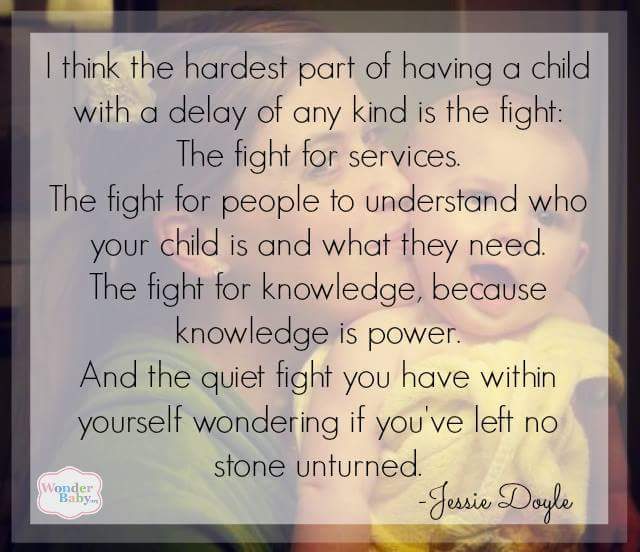
    It will always be an internal fight wondering if I’ve left no stone unturned.

  • Walker Spotlight: Why I walk for CASANA, by Monica Mayhak

    Our story is much like many other families’ stories. A relatively quiet baby, the missing “mama” and “dada,” the doubt creeping in. For us, it was easy to know that something was off. Our little Emmett is the youngest of six. We knew how this all worked and something wasn’t working here. After five typical and healthy children, when Emmett was 18 months old we had our first experience of asking our pediatrician if something might be wrong. Looking back, I realized I felt embarrassed—was I overreacting? I didn’t want to bother her with this if it was just that he was a bit different from our other children.

    But she was concerned too and referred us to early intervention services. I remember going for Emmett’s evaluation. We walked in, just Emmett and me, to what felt like a roomful of people. It was only about three evaluators, but it scared me. They played with Emmett one-on-one, having him try to go down a slide, stack blocks, do pretend play. As I watched, it slowly dawned on me that he couldn’t do any of these things. When one of them looked at me and asked, “Does he always drool this much?” my heart sank. Why yes, he does, and that is concerning me too. They didn’t give me any answers then, but when I got in the car and called my husband, I told him, something is really wrong here. I think really, really wrong.

    But I didn’t know what. Emmett qualified for services, so a speech therapist came to our home one day a week. This was supplemented with some meetings with an OT. Then, because Emmett couldn’t get through a therapy session without shutting down or hitting or just doing his own freaky things, they called in a DI. “What is a DI?” I asked. A developmental interventionist. Hmmm, what is that? We were told they used to be called “behavioral therapists.” Great I guess. She’ll help us, but what is going on? No one could tell us.

    So I did what probably every other confused mother does—turned to Google. I typed “2 year old can’t talk.” And boom—got lots of hits. Ok, not as helpful as I thought. Lots of ideas to encourage kids to talk and lots of reassurances that it all gets better on its own. Hmmm…ok, let’s try “3 year old can’t talk.” And again, boom—lots of links. But this time, they start referring to the possibility of autism. Emmett doesn’t have autism, so this wasn’t making sense to me either. Keep digging, going up in age, and deeper into links and I ran into my first encounter with apraxia.

    This was also my first encounter with CASANA. I read and read and read and read.  And cried and cried and cried, because this was describing my son. At our next speech therapy session, I asked the SLP about it. She said, “I’m not really familiar with that and it isn’t diagnosed until they are older.” And that was that. For her. But not for me. Back to the internet and reading more and more.

    And then, God mercifully gave us hope. In looking around I found that CASANA was putting on a small workshop here in Denver. Perfect! I’ll go to that! Looking back now, I realize how extraordinarily blessed we were to have this all line up like this. I could have easily missed this workshop, it could have easily not been scheduled here in Denver, I could have easily thought it wasn’t worth it. Sharon Gretz was the presenter. Didn’t know anything about her, but like many families with a child with CAS, I do know her now. And she is our hero!

    I attended the small workshop, absorbed everything, and then cried all the way home. Sobbed really. I went home to my husband and told him “we are doing everything wrong!” I realized that we had not been addressing his needs correctly because we simply did not know how. But this moment of despair disappeared quickly, and I realized that I had found something else besides information at that workshop. It was hope.

    But that fear that I felt when I first took Emmett to be evaluated got big and ugly. I was so very, very afraid. I told my husband, “I can’t do this.” He is a rock and said to me, “You are going to do this. We are going to do this. This is what God is asking us to do. He gave us Emmett…how can we say no?”

    So now we knew. But what to do from here? We found a private SLP who understood apraxia. She helped us to understand and started to work with Emmett. For a couple of years we worked with her and made some progress. Emmett’s behavioral issues constantly got in the way, but she was able to help him with that and help us understand. It was eye opening to see how I could help Emmett.

    And I began devouring everything I could find about CAS. I turned to CASANA’s resources more and more. And then another miracle! I learned that the national conference was to be held in Denver—it felt like my own private miracle, that God worked it so that I could go! I could never have attended it without it being in my own backyard.

    It may sound melodramatic, but that conference changed our lives. My mother had passed away a few short weeks before, and because I had spent six weeks caring for her in my home, Emmett’s needs got lost in the shuffle. That conference was an incredible boost for us, a new beginning in a way. I was exhausted at the end of those days—my brain trying to keep everything. Exhausted!

    And it was like meeting rock stars! David Hammer! Ruth Stoeckel! Dee Fish! Nancy Kaufman! (I sat down at her session and thought, “I HAVE HER CARDS!!!” That is how geeked out I was.) I absorbed everything. And learned and learned and learned. So I left there with information, motivation, ideas, and most of all hope.

    I discovered CASANA’s webinars. Fantastic! It is like being able to have those conference sessions in your own home. I have attended many of them and besides learning more and more, they became important periodic motivators for me. They are a reminder that I need to keep building knowledge and keep fighting every day for him. It is so, so easy to get discouraged–these webinars are great helps for my heart. The webinar presenters are familiar faces from the conference. It is like having a friend, who really cares about my child and my family, sit down with me to give me new information and some needed encouragement. unnamed (5)
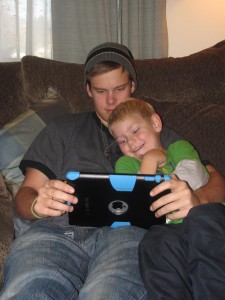
    We then threw our hat in the ring to see if we could qualify for an iPad for Emmett through CASANA’s iPad for Apraxia Project. Our SLP helped us with the application and we did qualify! Emmett’s iPad is just his. He doesn’t share it with anyone else and it is loaded with speech apps and learning games. The ease of using the Ipad with Emmett gave us a new way to help him, and that now familiar dose of hope that only CASANA could provide us.

    It was after that we had a change in health insurance and thought that for the first time, we had a shot at getting coverage for Emmett’s treatment. While we were sad to leave our SLP, I realized what an opportunity this was for us. I looked around, and in doing so ran across mention of CASANA’s bootcamp attendees. I wondered if there was anyone from our area who had attended. I can’t remember how I stumbled across it, but I saw mention that Laura Smith from the Denver area was in the current class. Score! I then found out that she was working at a clinic that could help us with insurance. Score again! Our insurance didn’t change until October, so I began to see if I could make this work. To be honest, I began stalking Laura a bit on the internet—even found her picture!

    So, as you can imagine, when I saw her at the Denver Walk for Apraxia, I had to talk to her! I don’t know if she remembers, but I probably came across as a crazy person. I went up to her and I think I said something like, “Are you Laura Smith? I’ve been stalking you on the internet!” Great start! But thankfully I did not scare her off. I began to tell her about us and she patiently listened and then gave me her contact information. She gently told me she had to go be with her kids, and I then realized that I was keeping her hostage. She walked off and I felt like I had won the lottery!

    We were able to get scheduled with her and begin therapy the next week. I learned that she had a little girl the same age as Emmett with CAS. I watched her work with him that first time. I soaked in her gentle reassurances to me. I got in the car at the end of the session and cried and cried. She is just perfect for Emmett and just perfect for me. What CASANA gave to Laura through support and the bootcamp was trickling down to me. Laura, just like CASANA, gives me the tools and information and support I need to help Emmett. But more than that, we have been given hope!

    I started this out by saying that our family’s story is much like that of other families who have a child with CAS. But I know that our ending is not the same as many. At the conference in Denver, there was a final question and answer session. I chose to go the one offered for parents new to a CAS diagnosis with younger children. In the middle of the session, a mother approached the microphone with her question. She said that she was overwhelmed with information, but had a specific question for the panel. Her son was 15 and had just finally been diagnosed with apraxia. He had floundered in the school system and never had appropriate treatment. She asked, “Is there hope for him now?”

    The panel was gracious and so helpful, but I think everyone there felt a knot in their stomachs and knew how serious and devastating that situation was. When treatment is started early, yes, there is hope. For a child that age, it is difficult. The SLPs on the panel spent a good amount of time talking with her and did their best to help her.

    And again at a more recent visit by Sharon Gretz to Denver for another workshop, there was a mother who asked about how to help her nine year old son who had not received appropriate treatment. She said he was resisting all her efforts. She also asked, “Is it too late? Is there hope for him?”

    I think of those women often. That could have been me in a few years, confused and despairing. But we are not in that place. CASANA has provided a lifeline for our family. They offer workshops and the conference and webinars and more. They fund research and educate the world about this disorder. They provided the training that Laura uses to help Emmett. They helped us to see that we are not alone. But the most important thing they give to all of us is hope. And truly it is only with that hope that we can continue this fight and do this work with and for our kids.
    unnamed (1) unnamed (3) unnamed (4) unnamed (2)


  • Apraxia Walker Spotlight: Team Power – Why I Walk

    Why I Will Walk for Children with Apraxia of Speech on September 19th.

    by Linda Power

    Many kids get medals in school and on sports teams as recognition of their abilities relative to peers. More subtle, but no less deserving, are the achievements made by our children with special needs. Such is the case with our 3 year old son Ashton, who was diagnosed with severe apraxia of speech last year.  Something as seemingly simple as speech doesn’t come easy to him.  It’s glaringly obvious every day how frustrated he is.  He wears in emotions on his sleeve.

    This year has been a roller coaster for our family.  A few months ago, Ashton developed a severe stutter (common in apraxia) which took away the words that he had learned and regressed his speech into “Ada ada ada.”  We were terrified that his stutter, which progressed rapidly, would become permanent.  It was painful to hear and to watch him struggle every time he wanted to say something.  I received the ultimate gift on Mother’s Day when Ashton walked up to me with a huge smile, holding a card he’d made in speech therapy and fluently said, “Happy Modders Day Moddy.”  My eyes well up with tears just recalling that moment.  While his stutter is essentially gone, Ashton still has Apraxia of Speech and gets “tongue tied” when trying to talk.  His brain has trouble coordinating the muscles of his mouth to produce intelligible words.  He still has years of speech therapy ahead of him, which is specialized and evidence based courtesy of a wonderful non-profit organization called CASANA.  CASANA funds research and training, and helps educate the community about Apraxia.  CASANA even provides scholarships for selected Speech and Language Pathologists to attend training events so they can disseminate information to the community and provide the highest quality treatment to children such as Ashton.  We feel extremely fortunate that Ashton’s SLP Laura Smith was one of those selected to receive advanced training to become a CASANA recognized expert in Childhood Apraxia of Speech.

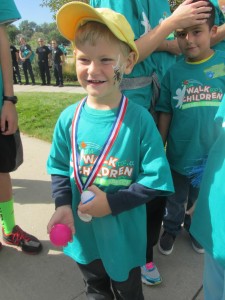
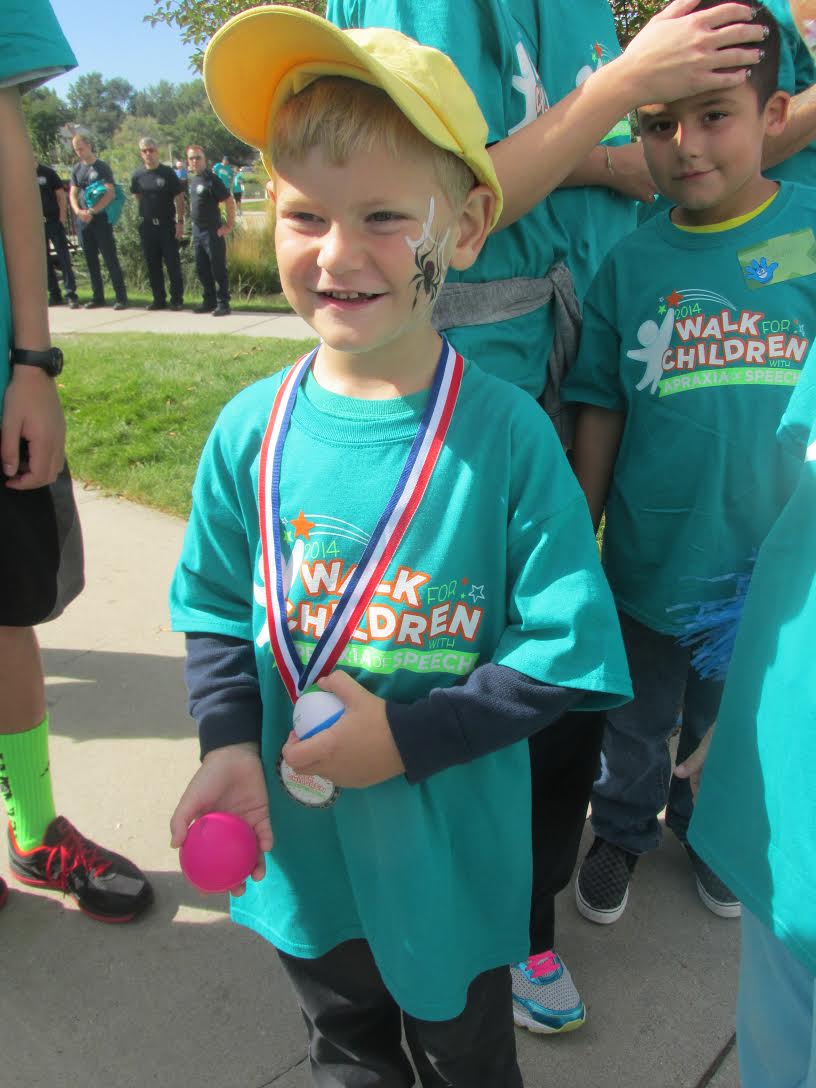
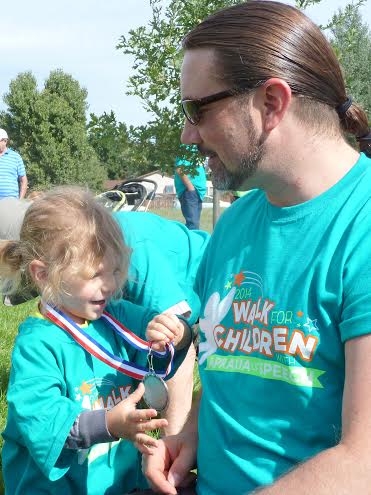
    Whereas we, as parents, have Mother’s and Father’s Day to celebrate our hard work throughout the year, our kiddos with Apraxia, will have their day at the Apraxia Walk.  We will celebrate their accomplishments during the medal ceremony where each and every child with Apraxia will have their name called and proudly walk up and receive a medal.  Ashton, representing “Team Power” loved his and learned to say a new word that day, “Medal.”  To his older brother, he referred to it as “My medal.”

    unnamed (1)unnamed (3)

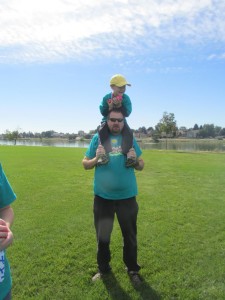
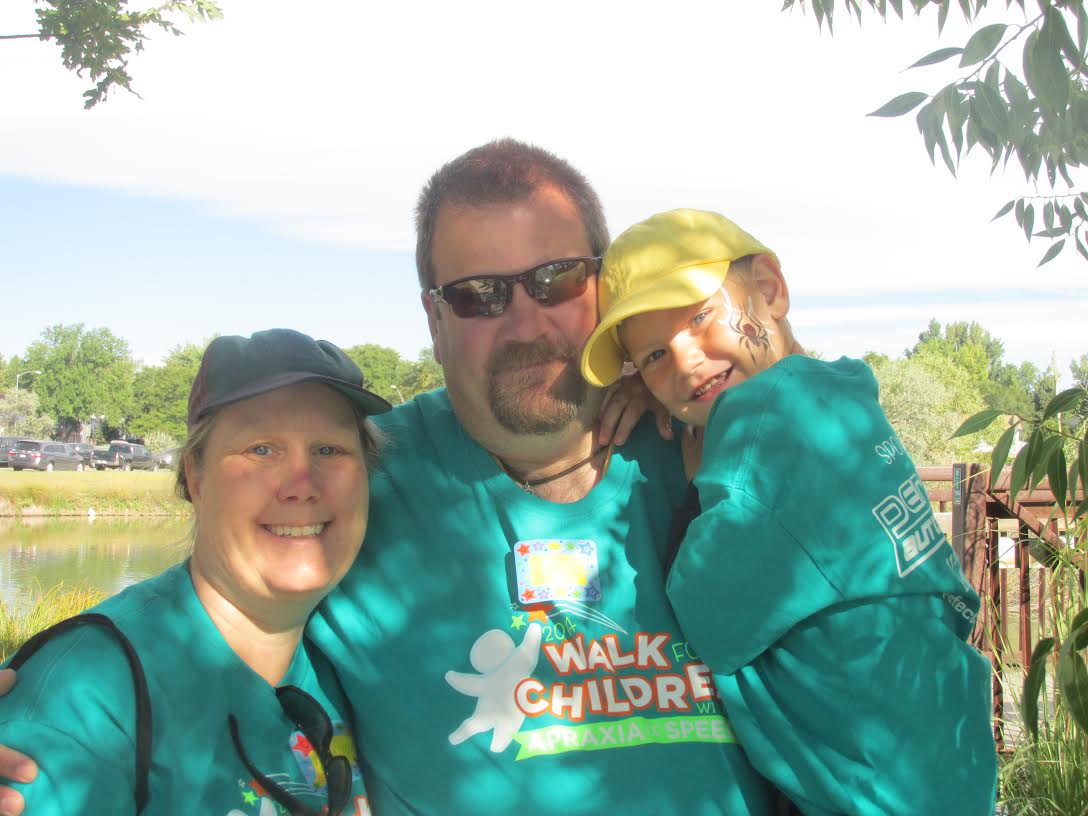
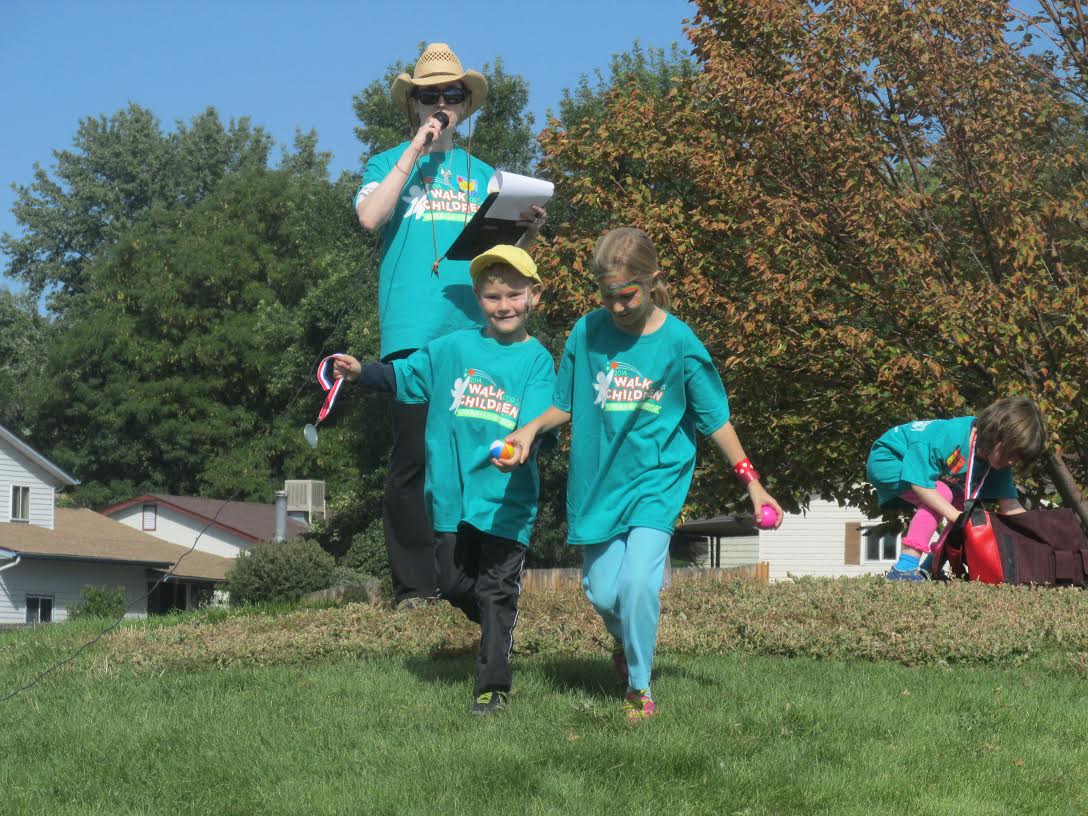
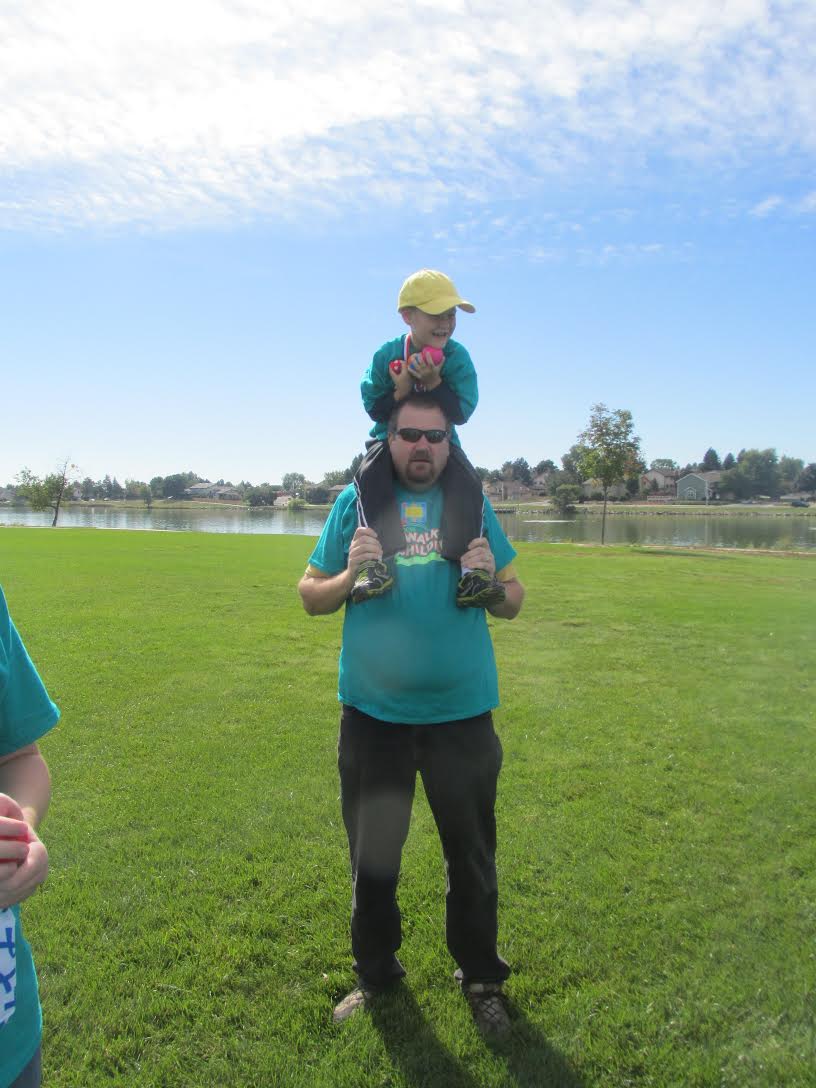
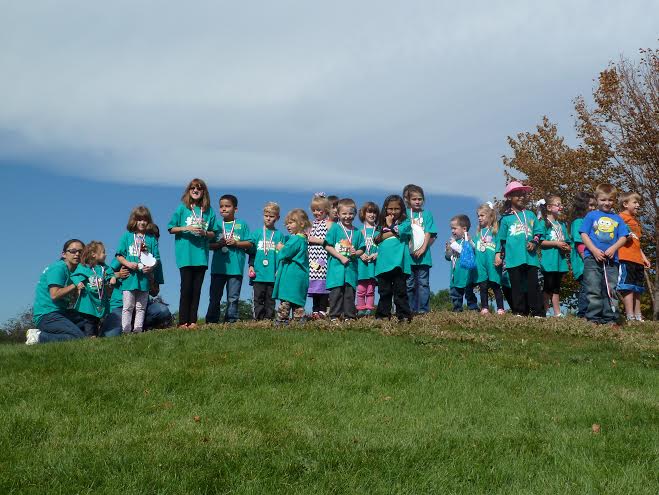
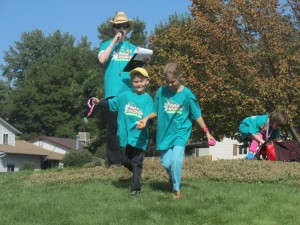
    The award ceremony is only one part of the wonderful day for kids.  Ashtunnamed (4)on’s 5 year old brother, Adam, also had a wonderful time.  They got to have their face painted, get to see a big red fire truck, get to walk (or hitch a ride on shoulders) around a beautiful lake with us, their supporters, all wearing Apraxia Awareness T-shirts.  For our children with Apraxia, they get to meet and play with other children who understand their struggle to communicate.  They get to see that they are not alone, and that they are supported in every direction they look.

    unnamedunnamed (2)