I recently posted a quote from my book Overcoming Apraxia on social media that garnered quite a bit of attention. It wasn’t to criticize or disparage SLP’s. It’s just a fact many of us speech-language pathologists, (myself included) didn’t get adequate training in graduate school on how to treat apraxia. I had maybe 15 loose leaf pages on it, and that wasn’t about treatment.
Many SLP’s asked what trainings I would recommend and many parents asked what questions they should ask. I’ve compiled a list of trainings and resources on childhood apraxia of speech for speech-language pathologists.
SLP training and resources
There are numerous online free trainings for apraxia, believe it or not.
Currently Edythe Strand has a free course on DTTC (dynamic temporal tactile cueing) that gives you CEU’s through the University of Texas at Dallas found at Child Apraxia Treatment.
Apraxia-Kids.org offers on demand videos that can be accessed through a yearly subscription fee that is relatively cheap (around $90 for the entire year).
ASHA.org has a recently updated practice portal on CAS.
A newer and AWESOME book targeted for parents and early intervention professionals is “Let’s Get Talking,” by Mehreen Kakwan. It explains direct therapy tips to use when a child has suspected motor planning difficulties including visual and verbal cueing ideas.
*Both DTTC and ReST have the current highest evidence base in the research on apraxia*
Fellow speechies, here’s the deal. Yes we come out of graduate school with a wealth of knowledge, and yes, the Certificate of Clinical Competence behind our name makes us qualified to treat speech/language disorders; however, the field is VAST. We should not apologize or feel bad about not being an “expert” in every speech and language disorder from birth to geriatrics.
However we DO have a responsiblity to be honest with parents, clients, and families about our level of expertise in a given area, and whenever possible, try to gain additional training and expertise in that area if we are lacking.
Laura Smith, M.A. CCC-SLP is a 2014 graduate of Apraxia Kids Boot Camp, has completed the PROMPT Level 1 training, and the Kaufman Speech to Language Protocol (K-SLP). She is the author of Overcoming Apraxia and has lectured throughout the United States on CAS and related issues. Currently, Laura is a practicing SLP specializing in apraxia at her clinic A Mile High Speech Therapy in Aurora, Colorado.
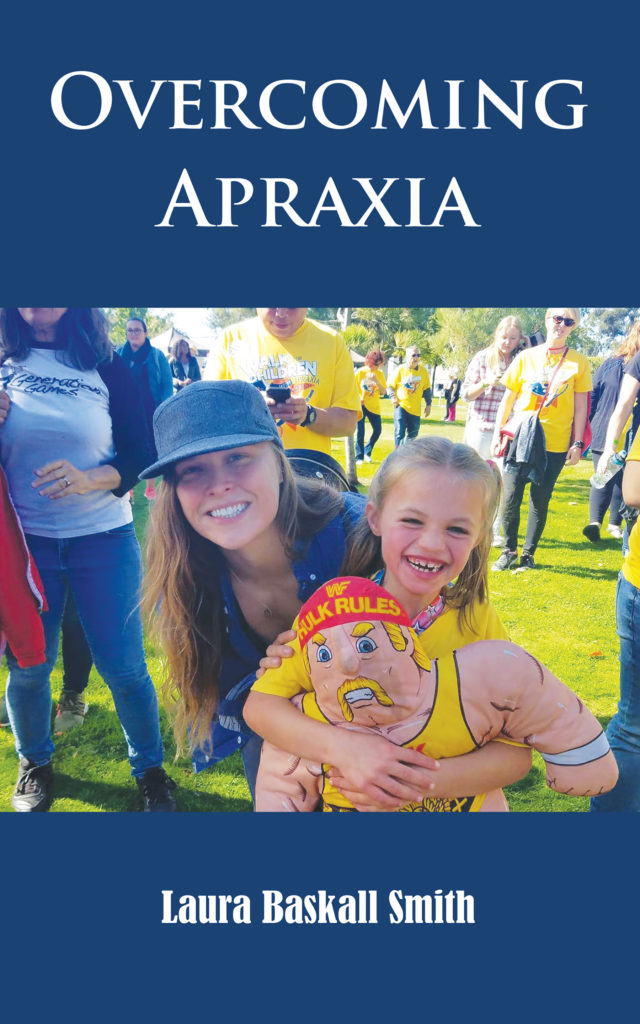
Ashlynn actress and WWE star Ronda Rousey who overcame apraxia as well
Almost seven years ago to the day, before my daughter Ashlynn’s 3rd birthday, I received news so significant, my life has never been the same. Though devastating at the time, the life lessons I have learned from it have far outnumbered any loss.
What was this news?
My daughter Ashlynn was diagnosed with one of the most severe neurological speech disorders in children. It is called “childhood apraxia of speech (CAS).
Not only was this diagnosis devastating to hear as a parent, I was also a practicing speech/language pathologist and the diagnosis flew me into a tailspin. Reeling that I didn’t know enough about apraxia, I threw myself into education.
Overcoming Apraxia is the culmination of this seven year journey.
There has been hard ache, triumphs, incredible highs (like meeting famous UFC and WWE super star Ronda Rousey who had CAS) twice and desperate lows (bullying, financial cost of therapy, the toll on the family).
Through it all though, Ashlynn maintained a positive attitude, incredible resiliency, kindness and bravery that I have never witnessed firsthand in another human being.
Overcoming Apraxia is this story. Interspersed throughout are also professional definitions, advice, and tips and tricks for parents and professionals that I utilize in my professional practice. I cover topics such as: comorbidities, financial cost, the effect on siblings, advocacy, educational concerns, genetics, specialists and of course, Ashlynn’s story to success.
Laura Smith, M.A. CCC-SLP is a 2014 graduate of Apraxia Kids Boot Camp, has completed the PROMPT Level 1 training, and the Kaufman Speech to Language Protocol (K-SLP). She has lectured throughout the United States on CAS and related issues. Laura is committed to raising and spreading CAS awareness following her own daughter’s diagnosis of CAS and dyspraxia. She was the apraxia walk coordinator for Denver from 2015-2019, and writes for various publications including the ASHA wire blog, The Mighty, and on a website she manages slpmommyofapraxia.com. In 2016, Laura was awarded ASHA’s media award for garnering national media attention around apraxia detailing her chance meeting with UFC fighter Ronda Rousey, and also received ASHA’s ACE award for her continuing education, specifically in the area of childhood motor speech disorders. Currently, Laura is a practicing SLP specializing in apraxia at her clinic A Mile High Speech Therapy in Aurora, Colorado.
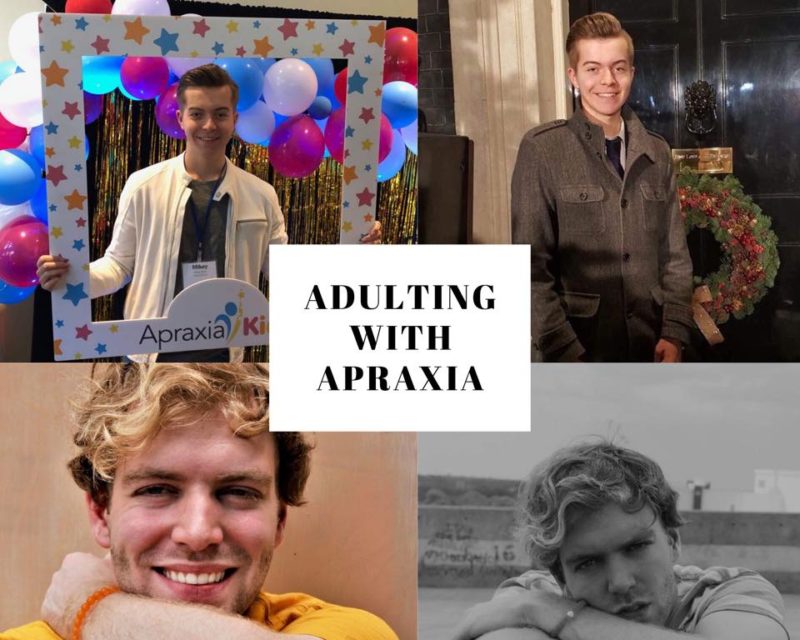
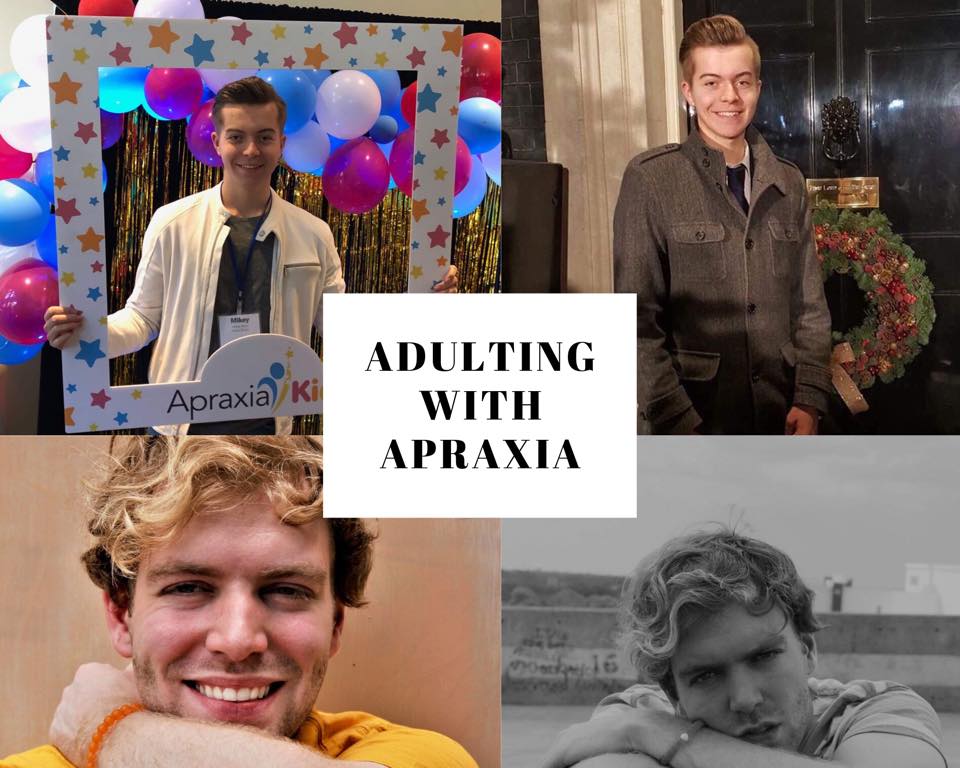
I’m so excited to have some of the two largest apraxia social media influencers with me today to talk about what it is like to be “Adulting with Apraxia.” Mikey Akers from Mikey’s Wish and Jordan LeVan from Fighting for my Voice are both young men living with verbal apraxia. In the UK, verbal apraxia is known as verbal dyspraxia.
Jordan and Mikey were talking one day about various issues that affect them in their adult life and wanted to write a piece together. I think it’s such an important topic, as apraxia cannot be cured and many adults live with residual effects and experience difficulties in which others might not even be aware. For example, Jordan once was talking about his struggle to find a job. It took him around a year just to find gainful employment. Today our hope is to go beyond the misconception that apraxia is just a speech disorder of childhood and talk about what it’s like, “adulting with apraxia.”
Let’s get to it!
Let’s begin by talking about some of the residual effects both of you deal with today. Let’s start with word finding. Mikey, you have said before that your word finding issues make it look like a lack of confidence when that is not the case at all. Jordan, you have described moments when the word is in your head but it simply will not come out of your mouth. Will you both elaborate on this?
Jordan: Essentially, my speech disorder is known for the following: your brain having trouble sending your mouth signals, for accurate movements of speech. So, at times, I’ll know the exact word I want to say; however, my brain simply didn’t send that signal to my mouth. More occasionally, words are harder to get out, as well as words with multiple syllables. I also do struggle vocal fluency, so my voice is essentially monotone a lot of the times. I have to be putting effort in directly in the given situation to create those various tones people display in their voice when they’re happy, excited, and sad.
Mikey: Word finding is one of my biggest struggles now that I have found a voice. It is what holds me back, where my speech is concerned. It is what stops me from engaging in conversations with people that I don’t know. It affects my confidence and self esteem and it is the main cause of the anxiety that I have surrounding my speech. At times I stop mid sentence because the word I need isn’t there. This makes my speech disjointed as I pause, frantically looking for the word I need or one that means something similar. Everyone’s had those “the word’s on the tip of my tongue” moments, right? Well it’s like that but it’s every time that i want to talk. As far as talking is concerned I lack confidence but I am confident in every other area of my life.
2. Mikey you have been open about your anxiety. Does this exacerbate your word finding difficulties or is this a separate issue altogether? Jordan, do you struggle with anxiety as well and if so how?
Jordan: I was diagnosed with Generalized Anxiety Disorder, as well as Anxiety due to chronic health issue known as Apraxia. I first received help whenever I was twenty years old. My anxiety related to Apraxia relates to thoughts about, “What are they gonna think about my speech?” “Does she/he/they think I’m “dumb” if I can’t get a word out?” Naturally, not being able to get words out is so anxiety provoking. You go in for the word, but it just hesitated to come out from your lips. Your face feels tense now, your palms are sweaty now, and you’re trying to catch your breath back from having trouble over trying to get that word out. You would feel one of the things I just mentioned most likely just from occasionally not getting a word out right the first time. I’ve learned how to cope with my Anxiety with therapy. Therapy is now becoming socially accepted in our generation, as it should be. It’s the one resource that’s made me okay with essentially owning my voice.
Mikey: It’s a vicious cycle. I have huge anxiety where my speech is concerned, this stems from the years of people not understanding what it was that I was trying to say. I know that I now have a voice that others can understand but I worry when I try to talk to someone who doesn’t understand my difficulties that my words won’t come. I worry that they won’t be able to understand what it is that I am trying to say or that they will think that I am stupid for being an adult and not being able to speak properly. Then because I am worrying so much and feel anxious the words really won’t come, no matter how hard I try to force them out, even though I know in my mind what I want to say. Frustrating is an understatement but I am determined to keep fighting to overcome this debilitating anxiety.
3. It has been reported that many individuals with apraxia have difficulty with modulating vocal volume. This can be where the person is speaking too softly and cannot be heard over ambient background noise, or conversely may be speaking too loudly and not realize it. Do either of the above scenarios happen to you and if so how?
Jordan: I speak to softly. This happens typically in my day to day life when a person will tell me they can’t hear me. Even when I’m trying my best to speak louder. I can speak louder, but it often comes out louder than I would like it too. People have even been shocked at me yelling. My own mom said to my own speech therapist, “So, he can yell?” A little funny story. Scenarios of this currently happen to me in classroom settings, work, and on the phone.
Mikey: When I was younger I had a very loud, high pitched voice when I was at home and felt at ease with those around me. I never realised just how loud I was but I was constantly being told not to shout. When I was at school or around unfamiliar people I would choose not to speak. Now I have a normal level of speech when I feel comfortable but the minute I am out and about amongst people I don’t know my voice reduces to little more than a whisper. My mum always asks me why I am whispering as she can’t hear me, I don’t even realise that I am doing it.
4. Both of you have mentioned that it may take you slower than some people to process language. In the apraxia community at large we have a saying, “I know more than I say, I think more than I say, I notice more than you realize.” Do either of you relate to this saying?
Jordan: I do with some of the following, I don’t believe so much with the “…I notice more than you realize.” Because if somebody makes a misconception about my speech, I’ll directly inform them. I usually will express my thoughts in given situations, however, I won’t expand further into the conversation because of difficulty. I can feel mental exhaustion from speaking, and sometimes I simply need a break to recharge. I’ve been able to expand on conversations even further now in my adult life with incorporating hand movements and hand gestures.
Mikey: I can definitely relate to this. People assume that because I struggle to verbally express my thoughts and feelings that I have no opinion on subjects that are being discussed, which just isn’t the case. This happens more when I am in a larger group as the conversation flows so quickly that by the time I have processed the beginning of the discussion and have found the words to reply the conversation has usually moved on to the next topic. If people just slowed down the conversation they would realise just what I ‘know’, ‘think’ and ‘realise’.
5. With this flurry of struggles hiding beneath the surface, how does this present in social situations? Work situations?
Jordan: I believe in social situations a majority of people assume I’m either nervous or shy. I get told quite often that I am so shy. In reality, I’m not really that shy. I believe everybody can be to a certain extent. It may also look like in work situations that I don’t know what I’m doing, since my speaking is at a slower pace than others with word difficulty. Others have came up to me and asked, “Have you got that ‘good good’?” I asked, “No, why do you ask that?” He asked “Aren’t you high?” I said “No, what would make you think that?” Then he didn’t answer, and he handed me my tray of food. Other assumptions about me being under the influence of drugs has also happened with police officers and doctors. We will get to that part soon.
Mikey: In social situations, with friends, I am very confident and outgoing but it takes a long time to reach this level of comfort. I put up protective walls and only those with the patience to keep chipping away and get to know me get to meet the real me. If it’s a social event where I don’t know many of the people attending then I probably come across as extremely quiet and shy. Maybe even being mistaken as rude, although this really isn’t the case.
6. It has been reported that individuals with apraxia struggle with foreign language in highschool. Did either of you and if so what accommodations were made?
Jordan: I did struggle with foreign language, since it does rely on pronouncing the words correctly. Because of my speech disorder, grading based on pronunciation isn’t practical. In high school, they essentially counted the credits without participation in class. In college, I’m actually exempted from foreign language classes. The accommodation board wants to make sure my speech isn’t critiqued by professors.
Mikey: I never studied a foreign language in school. I was so far behind in all my other lessons, due to my severe struggles with literacy, that I had extra English lessons when everyone else was learning French. Everyone thought that this would be more beneficial to me than trying to learn a foreign language.
7. Have you found people in the general public to still be rude or intolerant of your speech differences? If so how?
Jordan: Yes. I’ve had people in customer service tell me if I don’t speak so slow they’d take my order. I’ve had doctors say “Well, Verbal Apraxia seems to be a speech issue. This doesn’t affect your reading or anything else.” Meanwhile I didn’t grasp reading until I was nine years old. I’ve had people try to rush my speaking, laugh at me, and say “Any day now buddy.” The general public wants fast and immediate speech responses. It’s because we live in a world where we are constantly going. My general speaking may take some more time. It doesn’t make it a bad thing, everybody’s voice is different. It just seems like if you don’t fit the “norm” you can be considered an inconvenience.
Mikey: I have very rarely experienced any rudeness or intolerance because of my speech issues. I have only had 1 incident when a bus driver asked why I was being stupid as he didn’t understand me and this situation was very quickly dealt with, ending in an apology and another person being educated in Verbal Dyspraxia. I have had some people ask about my speech as they are genuinely interested in learning more about my diagnosis. When we get into a conversation with people that we meet in social situations (as a family) we find out that they had just assumed that I was hard of hearing, like my dad. I am still very much in the safety net of education though as I haven’t ventured out into, the slightly less forgiving, working world yet.
8. Have either of you had a run in with law enforcement and were mistaken for being under the influence of alcohol or drugs? If so, how was it handled?
Jordan: I was pulling out of a gas station one night, and I forgot to immediately turn on my headlights until I pulled out. The police officer pulled me over, and I asked why was I pulled over? He said it was because I didn’t turn on my headlights until after. I responded with “Oh yeah, I didn’t realize I didn’t have them on until after I left. I’m sorry.” He then asked me, “Are you drunk?” I said, “No sir.” He then asked, “Are you high then?” I said, “No sir?” He then asked me if I’d ever drank, ever smoked, and continually asked these two questions five times over each. Each time he would re-ask the question, in this ten question trivia game of his, my speech would become more disorganized, because of the pressure of the situation. He was smirking. I’m sure in his mind the assumption was “When people lie, their speech becomes more disorganized.” He then let me go after his game was over.
Mikey: No, thankfully I have never had a run in with the law.
9. Person first language (I’m a person with apraxia versus I’m apraxic/dyspraxic) is a hot button topic. It used to be, person first language was the law of the land until individuals with autism started saying they wanted to be referred to as autistic. Do either of you have a preference?
Jordan: I don’t really have a preference. I feel like the message that comes with “I’m an individual who has Apraxia” serves a reminder to me, that I am more than my Apraxia. However, I know this even if this is said or not. I feel like in our day and age, more people are owning what makes them who they are. I feel like saying I’m apraxic, doesn’t take away that at core, I’m a human being.
Mikey: I have no preference, it’s not something that bothers me. I am a person who lives with verbal dyspraxia/apraxia and in my mind that is not going to change whatever term someone else chooses to use.
10. What final message do you have for others who may be “adulting with apraxia” in the shadows?
Jordan: Apraxia is a tricky, still very poorly understood, neurological based condition that isn’t outgrown. I’m sorry if the term, Childhood Apraxia of Speech, made you also believe as a kid, that this is only a condition present in childhood. You didn’t do anything wrong, so please don’t ever blame your child self. Have compassion for yourself and how far you’ve come. Self comparing yourself to a person without your condition is a toxic. Would you ever compare an individual in a wheelchair with an able bodied person? If you would like to go back to speech therapy, it isn’t just for kids. If you’re ever feeling any negative mental health side effects from living with Verbal Apraxia, reach out for help. I know these resources aren’t always accessible for everybody, but at least talk with someone. Know that you aren’t alone. I hope one day I can hear your story. I want to actually. Literally message me, I’ll be cheering you on.
Mikey: Don’t be ashamed of your diagnosis, talk to others, let your employers know which areas you struggle with. Be honest about your feelings with those around you and more importantly be honest with yourself. The term Childhood Apraxia of Speech is misleading, this diagnosis doesn’t just disappear when you become an adult. You really are not alone, there are many of us living with verbal dyspraxia/apraxia as adults. If anyone ever needs to talk, I am always ready to listen.
You two are amazing and as a mother to a child with apraxia but also as a speech/language pathologist I can’t thank you enough for your bravery, insights, transparency, hope, honesty and encouragment to those living with your diagnosis. I can’t wait to see what the future has in store for you both!
SLP Mommy of Apraxia is a website dedicated to disseminating research, information, and stories about Childhood Apraxia of Speech (aka verbal apraxia, aka verbal dyspraxia). Follow us on Facebook, Instagram, YouTube
In a recent study, researchers found potential clinical
“red flags” in infants and toddlers that could assist in the later
identification of Childhood Apraxia of Speech (CAS).
August 2019
In a first of its kind retrospective study, researchers
assessed the speech-language skills of 17 children between the ages of 3 and 9
years old using home videos obtained through their parents. Though infant early
vocalizations have been studied to help aid the communication disorder
literature, few have been done specifically with children who later received a
diagnosis of Childhood Apraxia of Speech (CAS).
Why did the researchers study this?
Previous studies have found a correlation with CAS and low
infant volubility, limited consonant emergence, and limited syllabic structure.
Volubility refers to the amount of talk or vocalizations. Consonant
emergence is looking at the amount of different consonant sounds
produced as well as the number of voiced sounds (sounds produced while the
vocal cords vibrate like /b/ or /d/) and unvoiced sounds (sounds produced in
absence of the vocal cords vibrating (like /p/ or /t/). Syllabic structure refers to theway
consonants (C) and vowels (V) are grouped within words. For example, words within a CV syllable shape
include: ma, da, me. Words in a CVCV
syllable shape are words like: mama, dada.
Studies investigating speech sound development in infants
later diagnosed with childhood apraxia of speech (LCAS) could assist in early
intervention methods providing more targeted treatments.
There were two aims of
the study.
To
compare three areas of infant vocalizations: volubility, consonant emergence,
and syllabic structure observed through home videos
To
contribute to the literature findings on infant speech sound development.
What did the researchers do?
There were seventeen participants in the study. Seven children had a later diagnosis of childhood
apraxia of speech (LCAS), five had speech sound disorder (SSD) and five were
typically developing (TD). Participants
were evaluated and placed in their respective groups using a formal
speech-language and motor speech assessment.
The researchers obtained home video recordings (from birth
to 24 months), videos were coded, and data was collected on volubility,
consonant emergence and syllable shape as defined above.
What did the researchers discover?
The findings revealed a few key differences between
children who received a later CAS diagnosis (LCAS) and the other participants.
Vocalizations from the LCAS were less voluble
(less robust)
Vocalizations used fewer resonant consonants (those consonants
that could be transcribed by IPA. That is, consonants that were recognizable to
be English phonemes).
LCAS participants had a
less diverse phonetic repertoire
Resonant consonants were acquired later than
the other groups.
Summary:
Overall, the findings indicate compelling and preliminary
data that suggest infant and toddler vocalizations may provide red flags that
could assist in future diagnosis of CAS. These red flags include:
Limited vocalizations during the child’s first
2 years, particularly for resonant sounds. As mentioned above, resonant
consonants refer to consonants that can be transcribed as English phonemes.
Lack
of resonant consonants by 12 months of age supporting the possibility that
delayed resonant consonant acquisition may be predictive of a later CAS
diagnosis.
Acquisition
of three or fewer resonant consonants between 8-16 months and/or five or fewer
resonant consonants between 17-24 months.
Less
frequent productions of velar consonants (/k/, and /g/)
Preference
of stops (sounds like /t/ or /p/ in which airflow is stopped) and nasals
(sounds like /n/ and /m/ that resonate in the nasal cavity).
Productions
at 13-18 months remain largely vowels with little use of simple sequences (i.e.
consonant-vowel, consonant-vowel-consonant).
Limitations of the study are many. The study was a small-scale design with no
experimental control over a variety of factors including duration and number of
videos. Not all months were recorded,
rendering the possibility that some vocalizations were not captured. Participants in the study had no comorbid
conditions or syndromes even though comorbidities are common in children with
CAS. All participants were white from monolingual two-parent families with
little linguistic, ethnic, or socioeconomic diversity.
Laura Smith, M.A. CCC-SLP is a 2014 graduate of Apraxia Kids Boot Camp, has completed the PROMPT Level 1 training, and the Kaufman Speech to Language Protocol (K-SLP). She has lectured throughout the United States on CAS and related issues. Laura is committed to raising and spreading CAS awareness following her own daughter’s diagnosis of CAS and dyspraxia. She is the apraxia walk coordinator for Denver, and writes for various publications including the ASHA wire blog, The Mighty, and on a website she manages slpmommyofapraxia.com. In 2016, Laura was awarded ASHA’s media award for garnering national media attention around apraxia detailing her encounter with UFC fighter Ronda Rousey, and also received ASHA’s ACE award for her continuing education, specifically in the area of childhood motor speech disorders. Currently, Laura is a practicing SLP specializing in apraxia at her clinic A Mile High Speech Therapy in Aurora, Colorado.
A new study finds a marked advantage for more practice, as opposed to less practice, in the treatment of Childhood Apraxia of Speech and that there is support for massed practice of speech targets versus distributed practice.
August 2019
The primary purpose of the study by Maas and colleagues,
detailed in the recent publication “Bang for Your Buck: A Single Case
Experimental Design Study of Practice Amount and Distribution in Treatment for
Childhood Apraxia of Speech” was to study treatment intensity in treatment for
CAS. The specific aspects of intensity
addressed in this study included both practice amount and practice distribution.
Practice amount refers to the cumulative
amount of practice trials and treatment sessions provided, while practice
distribution relates to how the practice amounts are divided – or distributed-
across the treatment period.
A secondary aim was to further examine the efficacy of a
therapy approach called “integral stimulation” (in this article the form of
integral stimulation is termed ASSIST.
ASSIST stands for “Apraxia of Speech Systematic Integral Stimulation
Treatment” and was specifically developed to facilitate replication,
experimental control, and consistency in research studies using the approach.
Why
did researchers study this?
Anecdotally, and in several small studies, children with
apraxia of speech reportedly benefit in their speech improvement when speech
therapy incorporates what are known as “principles of motor learning.” These
principles are essentially several factors that have been demonstrated to
facilitate the retention and transfer of motor skills. Principles of motor
learning includes specific factors such as how someone practices a motor
skill as well as the feedback they receive when they practice the skill. These
“principles” of both practice and feedback influence the permanent retention of
a motor skill, according to motor learning research.
In this study, researchers were focused on conditions of
practice. Conditions of practice includes
the intensity of practice, i.e. how much practice of the skill should occur and
if that practice should occur in a “massed” way (a set amount of practice in a
short period of time) or distributed way (a set amount of practice occurring
over a longer period).
The diagnosis of Childhood Apraxia of Speech relates to a
child’s ability, or lack of ability, to plan and program the series of highly
specific movements that underlie intelligible speech. Researchers have wondered
if aspects of how people learn and retain other movement and motor skills and
achieve skilled movements could impact how children with apraxia of speech
learn speech motor skills (i.e. the motor planning and programming that
underlie speech).
However, principles of motor learning which originated through
studying physical movements vs speech arose from motor learning research that
is primarily based on studies of average adults, not on children, and not on
children with speech motor problems like apraxia. Therefore, while motor
learning principles provide a possible framework for how one might learn and
retain the motor skills needed for speech, research using these principles,
specifically on children with apraxia of speech, is needed.
Finally, the authors point out that results from motor learning
research as it relates to intensity differ from results from another body of
research in neuroplasticity. Specifically, motor learning research has found
that distributed practice results in better outcomes than massed practice
conditions. The reverse is true,
however, in neuroplasticity research.
What
did the researchers do?
Participants were a group of six children with CAS who were
carefully chosen using well-defined criteria for inclusion in the study. Data was taken over approximately 24 weeks.
The study design was described as an “alternating treatments design.” In this
type of study design, all the participants receive all the experimental
conditions in the full course of the study., All participants received massed
and distributed practice. Additionally, depending on the practice distribution,
the number of practice targets varied per session (allowing amount of practice
to also be manipulated and examined).
What
did they find out?
Regarding the amount of practice, the study results
indicate that, four of the six children showed greater improvement and effect
sizes with more practice of a smaller set of targets. Targets practiced with a
low amount of practice were, overall, not different than the untreated targets.
Both individual and group data suggests there is a greater advantage for more
practice and supports the assertion and previous research that children with
CAS benefit from more practice.
Regarding practice distribution, the study found that 5 out
of the 6 participants most benefitted from massed versus distributed practice.
As a group, there appears to be an advantage to massed practice as shown byeffect
size and percent change. The researchers indicate that this finding is more
aligned with neuroplasticity research than it is motor learning literature.
Finally, this study contributes to existing research
demonstrating that the “integral stimulation” approach to speech therapy for
children with CAS is an effective approach.
Integral stimulation approaches include a focus on tactile cues, slowed
rate, fading of cues over time, and a focus on movement accuracy of complete
speech targets (vs. the segmentation of targets).
Summary
In this study, researchers found that children with apraxia
of speech benefit from more speech practice opportunities, especially when the
practice of the speech targets is massed, i.e. a set amount of practice that happens
in a short period of time. Integral stimulation methods are an important tool
in treatment for children with CAS.
Limitations of the current study include the small sample
size and modest effect size, likely due to a relatively small amount of overall
practice. More research is needed with larger sample sizes and greater differences
between conditions.
Source:
Maas, Edwin, et al. “Bang for Your Buck: A Single-Case Experimental Design Study of Practice Amount and Distribution in Treatment for Childhood Apraxia of Speech.” Journal of Speech, Language, and Hearing Research (2019): 1-23.
This article was written in collaboration with contributors to SLP Mommy of Apraxia.
Laura Smith, M.A. CCC-SLP is a 2014 graduate of Apraxia Kids Boot Camp, has completed the PROMPT Level 1 training, and the Kaufman Speech to Language Protocol (K-SLP). She has lectured throughout the United States on CAS and related issues. Laura is committed to raising and spreading CAS awareness following her own daughter’s diagnosis of CAS and dyspraxia. She is the apraxia walk coordinator for Denver, and writes for various publications including the ASHA wire blog, The Mighty, and on a website she manages slpmommyofapraxia.com. In 2016, Laura was awarded ASHA’s media award for garnering national media attention around apraxia detailing her encounter with UFC fighter Ronda Rousey, and also received ASHA’s ACE award for her continuing education, specifically in the area of childhood motor speech disorders. Currently, Laura is a practicing SLP specializing in apraxia at her clinic A Mile High Speech Therapy in Aurora, Colorado.
A new study finds that 65% of children with a history of suspected
Childhood Apraxia of Speech (sCAS) are low proficiency readers, suggesting that
early literacy intervention is justified for this group of children.
August 17, 2019
Research recently published in the American Journal of Speech
Language Pathology (AJSLP) suggests children with sCAS are at increased risk
for reading disorders and should receive early intervention targeting early
literacy and language skills, along with the speech motor planning component in
their speech therapy program.
” The
current conceptualization of CAS as primarily a motor speech disorder may
encourage interventions that rely largely on habituating accurate motor speech
plans with little attention paid to the development of literacy skills. Viewing
CAS as a motor speech disorder that commonly includes reading impairment may be
more useful to clinicians given the high percentage of children with CAS who
exhibit decoding difficulties. “
The study by Miller, Lewis and colleagues had several
aims. First, the researchers wanted to
identify the frequency of reading disorders in children with sCAS and Speech
Sound Disorder (SSD). Also, researchers
wanted to learn how children with sCAS differed from one another and also how
they differed from children with SSD in various levels of reading proficiency
and performance.
Participants were a group of 40 children ranging in age from
7-18 with sCAS and 119 participants ranging in age from 7-18 with SSD. All the
study participants were tested and then compared on various measures for
speech, language, reading, and cognitive-linguistic skills.
Several findings are of interest:
Sixty-five percent of children with sCAS were
low proficiency readers, which is substantially more than the percentage of low
proficiency readers in the general population.
Specific risk factors for literacy difficulties
in children with sCAS were oral language and phonological skills.
While speech motor skill deficits were
identified in all children with sCAS, the participants’ speech difficulties did
not predict their reading proficiency.
Overall, the findings indicate that viewing CAS solely as a
motor speech disorder may be a disservice as SLP’s might miss out on the
opportunity to address the intertwining of speech, language and literacy
deficits as early as preschool. The current study provides justification for
providing early literacy intervention coupled with appropriate speech and
language therapy for children with sCAS to strengthen weak phonological
processing skills found in the population and which negatively impact later reading
proficiency.
Future research needs to explore the differences or
similarities in the trajectory of reading achievement between groups considered
resolved or with persistent CAS as well to explore what specific interventions
are particularly helpful for kids with CAS and reading impairment.
Laura Smith, M.A. CCC-SLP is a 2014 graduate of Apraxia Kids Boot Camp, has completed the PROMPT Level 1 training, and the Kaufman Speech to Language Protocol (K-SLP). She has lectured throughout the United States on CAS and related issues. Laura is committed to raising and spreading CAS awareness following her own daughter’s diagnosis of CAS and dyspraxia. She is the apraxia walk coordinator for Denver, and writes for various publications including the ASHA wire blog, The Mighty, and on a website she manages slpmommyofapraxia.com. In 2016, Laura was awarded ASHA’s media award for garnering national media attention around apraxia detailing her encounter with UFC fighter Ronda Rousey, and also received ASHA’s ACE award for her continuing education, specifically in the area of childhood motor speech disorders. Currently, Laura is a practicing SLP specializing in apraxia at her clinic A Mile High Speech Therapy in Aurora, Colorado.