Category: Apraxia

  • There are no easy answers, only tough choices

    There are no easy answers, only tough choices

    image5-300x225

    I didn’t expect to cry today,  yet that’s how the cards fell.  I dropped Ashlynn off at school today, and asked her teacher if she had talked to the OT about changing her name card to all capitals per the private OT recommendation given in my last post .  Her face kinda dropped and she said she had talked to the OT, but she wanted to talk to the SPED teacher first, could we talk after school?

    Oh sure, I said.  Inside though, I felt that pit in my stomach.  They don’t agree with that.  I guess I’ll find out why in a couple of hours.

    I went back to school and the SPED teacher, teacher, and SLP were there.  The SLP kinda accidentally walked in, but I had her stay.  So basically in a nutshell, there are two theoretical professional recommendations for this issue.  The SPED and classroom teacher both have research to show that kids need to be writing their name in both upper and lower case because that will be the automatic expectation when they go to Kindergarten.  At a recent conference, the teacher said the one of the speakers pleaded that if they are still focusing on uppercase, to please at least expose them to lowercase because lowercase letters are what they will predominantly see in literacy.

    The OT’s position (and I ran this past the school OT too who agreed with my private OT) is that developmentally, uppercase letter formation comes before lowercase.  Basically, uppercase letters contain more pre-writing strokes like basic horizontal, vertical and diagonal straight lines that are still hard for Ashlynn to visually interpret and copy correctly.  It’s a problem with the praxis, or motor plan, not a problem with her perception.  So for example if she sees an M she can point to an M not a W, but when she goes to write it, it looks completely messed up.

    Hmm.  Sounds familiar.  Sounds like speech apraxia.  She understands what people say. She understands correct and incorrect production, but when she goes to say it, it’s all messed up.  Apraxia.  Yup.  Nothing new there.

    Back to the situation though.  The SLP voiced what I was thinking  She sees writing and literacy almost as two separate entities.  Why can’t she write in uppercase but still be taught and exposed to both?

    Well, they felt that writing reinforces reading and vice versa.

    Okay, but my kid could write her name almost legibly last Thanksgiving, and this Thanksgiving she can’t write it all. Her motor plan is completely confused. Don’t you guys see how concerning that must be to me?

    But we’ve gone half the year doing it this way, the teacher said.  I keep thinking it’s going to click.

    SPED teacher: Yes and again, don’t you want her to practice this early so she gets extra time with these skills?  She needs to be writing two sentences with correct punctuation, which includes capitalizing the first letter….by the end of Kindergarten.

    Insert lump in throat. I can’t talk.

    We just want to get her ready for Kindergarten.  That’s our job.

    Me: Lump still in throat.  “So, I’ve been told by experts in writing development that they must learn uppercase before lowercase.  I have personally seen the regression in writing her name.  I’m not talking about literacy.  I’m talking about writing, and, do you think, I mean, I hate to say this but

    this is hard for me to even say but

    Is it really realistic to think that Ashlynn will be able to learn 52 graphemes by the time she hits Kindergarten when it took her a year to consistently write 5, and now those are gone?

    Silence

    It kills me to say this.  I WANT to say that by having THREE years in Pre-K she would be Kindergarten ready, and now I have to say, out loud to you all, that writing both uppercase and lowercase letters is just not in the cards for her right now.  I hear your research and I appreciate it, but my daughter has GLOBAL apraxia.  Have any of you actually had a child with global apraxia?

    Crying. Nope, not one of them had.  Neither had I, until now.  Ashlynn is our guinea pig, but she’s MY daughter.  What do I do?

    The teacher folded slightly and said she was willing to do whatever I decided, but she did want it to be consistent across disciplines so that she gets the most bang for her buck.  We all kinda left with a question mark and promise to consult with various professionals and come back with our recommendations.

    I left and cried again.

    Such is my journey in GLOBAL apraxia.  When I asked them if they had ever had a student with global apraxia, they all had to admit they hadn’t.  I started thinking. I hadn’t either, except recently.  One out of my 6 kids with apraxia have it globally.  Most have other soft signs, but only one has it everywhere. The three I saw in the schools before Ashlynn only had verbal and some fine motor issues.

    Wow.  I guess since I’m part of a support group online, I don’t see it as rare as it really is.  This is rare.

    REALLY, REALLY RARE.

    Sucks.

    I spent the last 2 plus years thinking if we could resolve the speech, she would be ready for Kindergarten.  I’ve read many books.  Speaking of Apraxia is a popular book, but yeah…only dealing with CAS and SPD. Not global apraxia.

    My daughter fits into two columns: her can do’s, and her cannot’s.  My husband usually lives in the can do’s, and I live in the cannot’s.  Why?  I guess because I feel so crazy responsible for getting her from the cannot to the can, but then when I get to the can, I immediately give a sigh of relief and then go back to the cannot column to work on the next goal.

    It sucks, and today was low.  I had to admit out loud that I can’t remediate the cannot column, because that column contains more than speech.  It’s just too much.  To be honest, the speech was too much too, it’s just that I felt such responsibility and I went on an exhausting mission to specialize in it. However, I can’t specialize in it all.

    I’m vulnerable now.  I have to be a mom now, and I tell people all the time mom’s are the expert on their child, despite all the experts on the various disorders their child might have.  So, I’m taking my own advice, and it’s scary, because what if my decision negatively impacts her entire academic career.

    But, here we are.  Here we are, and I have decided, and I’ve felt all along, the experts in writing, the OT’s, know what they are talking about when it comes to writing, and Ashlynn needs to stick to upper case for writing.

    That said, she will continue to be exposed to both uppercase and lowercase letters, but to write…we have to stick with uppercase.

    I wish there was a cookbook.  Heck, I wish there was some credible info on GLOBAL apraxia.

    For now though, I have to trust my mommy instinct, and my mommy instinct say that although I wish to God…I would wish my life on this Earth that Ashlynn could learn like the other students and handle both upper and lower case; deep down, I know she can’t.  At least not yet.  I know I have to just stick with the uppercase until mastery, and then when she masters it, we’ll cross the lower case bridge when we get there.

    No one said life would be easy, only that it would be worth it, and she is worth it.  There are no easy answers, only tough choices, and today was very hard.
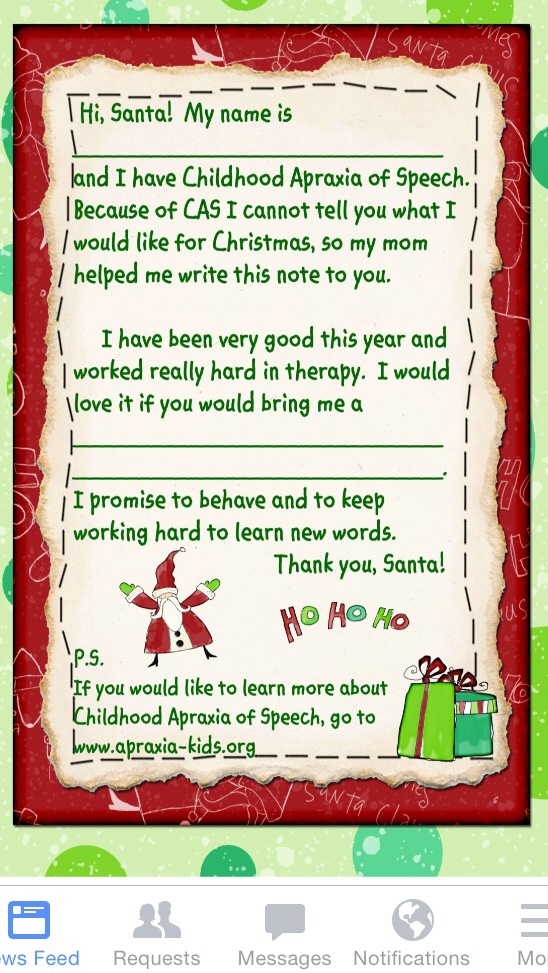
  • Christmas note for Santa’s lap

    Christmas note for Santa’s lap


    image


    When I had Ashlynn, I definitely never thought she wouldn’t be able to talk to Santa and tell him what she wants for Christmas, and I’m sure other parents of kids who are/were nonverbal have felt the same way.  A parent friend of mine made these cards for kiddos who want to talk to Santa, but who can’t yet use their own voice.  Thanks so much to Shelley for sharing with all of us!


    CAS Christmas Note


  • What is your future like when you have GLOBAL apraxia?

    My friend Kim, (a fellow apraxia mom and SLP) and I talk a lot about how most people, including professionals and pediatricians, just have NOT SEEN global apraxia.  What is global apraxia?

    Well, it’s not an official diagnosis.  You’re not going to find it in the DSM 5, and when you google it, you’re not going to find some great scholarly articles.  Nope.

    Instead, you can google Childhood Apraxia of Speech and get some great information now on verbal apraxia thanks to CASANA of apraxia-kids.org.  Members of their advisory panel were critical in the recognition of the actual disorder from ASHA (The American Speech/Language Hearing Association).

    Google oral apraxia, and a lot of information comes up for verbal apraxia, even though they are two very different things.

    Oral apraxia refers to difficulty coordinating non speech oral movements.  These include: sucking, blowing, puckering, lip rounding, etc. whereas Childhood Apraxia of Speech refers to difficulty planning the precise movements for speech.

    Google  plain old “apraxia” and the first two references are to apraxia-kids and ASHA, both referencing Childhood Apraxia of Speech.

    The third entry is from Wikipedia, which references acquired apraxia of speech only.  This is for adults with brain insults for the record.

    The fourth result is from WebMD which does acknowledge it as a developmental disorder as well, but says “typically, it is found in adults.”

    Google “dyspraxia” and the first entry form ncld.org indicates “people with dyspraxia have trouble planning and completing fine motor tasks.”

    Okay, so she now has: Childhood Apraxia of Speech aka verbal apraxia, oral apraxia, and dyspraxia.

    Hmm…but she also has trouble with motor planning gross motor movements as well.  So what label is that?  Oh, and she also has trouble with visual motor planning as well.  So….what label is that?!?

    So let’s see here.  According to a lot of testing, my sweet little Ashlynn has motor planning difficulties in these areas:

    Verbal, Oral, Fine Motor, Gross Motor, and Visual Motor skills.

    Does a human have any other motor planning skills?  Right now as I type this, I can’t think of any and it makes me so sad.  How does that sweet baby with normal cognition, have motor planning deficits in literally every part of her little body?

    That my friends is why there is the term “global apraxia.”

    You’re not going to find it with a search from google.  You’re not going to find it in a scholarly article, but if you do I implore you to email it to me because I have looked!!

    You’re not going to find the term global apraxia in the Childhood Apraxia of Speech research, or the developmental motor planning research, on the dyspraxia websites, or searching under the term developmental coordination disorder.  I think this is because the research is already so lacking in these specific areas, that we are still a ways away from collectively combining all these separate disorders into diagnosing one “global apraxia.”

    However, if you have a child with motor planning deficits in ALL of these areas, I don’t have to tell you, the term “global apraxia” makes absolute, unequivocal sense.

    Can you imagine??  A pure definition of apraxia according to medicinenet.com is simply,

    “The inability to execute a normal, voluntary motor movement despite being able to demonstrate normal muscle function.”

    So as my friend Kim, another SLP put it: her son is essentially trapped inside his body.  How awful is that?  They know what they WANT their body to do.  They see peers or younger siblings executing the same things seemingly effortlessly…..and there they stand. Knowing what they need to do.  Knowing what they are ASKED to do.  Knowing what they WANT to do, but unable to do so.

    It’s almost like being paralyzed, except everyone knows you’re not; so they expect you to do things you simply cannot do.

    How does a sweet child respond to that situation?  How would you respond?  You can’t  tell someone you can’t do it, yet they see you as any other child.  Normal muscle function, seemingly normal cognition….

    I ask you again.  How would you respond??

    I can tell you how my daughter responded.  She would laugh and act cute.  Dang she is so socially competent.  It worked.  Sure they thought her receptive language skills were low and she didn’t understand what they were saying (read into this low cognition aka mentally retarded), but at least it gave her a pass.  Other times she just acted like she didn’t hear them. She still does that.  Oh…”attention problems” they say.

    I ask you again though!  How would you respond when adults think you can do something, demand you to do things,  that you cannot do?! Oh and remember, you can’t TELL them you can’t…because,  well,  motor planning has got your tongue.

    I can tell you about my friend Kim’s son.  He hangs by the door.  He tries to escape!  Poor baby is so smart!! Does the staff see that though?  Not really.  They see behavior problems.

    I’m also not trying to down professionals.  Look.  I get it.  Apraxia of anything is RARE, much less apraxia of EVERYTHING.

    I’m an SLP too.  Before Ashlynn, would I have been one of the misguided staff?!?

    This leads me to my question though.  What is a future like for global apraxia? I honestly don’t know.

    I know that my husband is right when he says my daughter always conquers all the mountains.  She does.  But is conquering the mountain the same as owning the mountain?  Will she have a skill, a gift, or something else?

    Things were so cut and dry for me.  I was good at English not at Math.  I was a great speller and poor mathematician. I was athletically inclined and was naturally good at basketball.  What about Ashlynn?  What will she have?

    I know already she has this incredible ability to unite people, to make people happy.  Everywhere she goes, despite when she was nonverbal or now verbal, people engage her.  They are drawn to her.  She is kind.  She is accepting.  She is sweet to a fault. She doesn’t see bullying, she sees hurting. She is naturally inclusive.  She makes people feel good about themselves.

    These things make me incredibly  proud.  But can I tell you a secret?  I’m scared to death these “strengths” will kill her inside.  Society is cruel.  Kids are cruel.  Will this be enough to carry her through?

    I want her to feel proud of herself.  I want her to feel and to know there is something she is amazing at.  I want her to know I am always and forever will be proud her…but I want her to feel that for herself.

    I already know she’s resilient.  I already know she’ll overcome her obstacles.  At what price though?  What will she be interested in?  What will her passion be?  Right now, I don’t know those answers, but I know this one.

    Whatever her passion is, I will do everything in my power to support it.  When she wants something…like to talk…she will work tirelessly and endlessly, equipped with a positive attitude to make it happen, and I will be right there making it happen with her.

    dyspraxia_chart (1)


  • Apraxia? How does that affect her vision and hearing?

    So today I took Ashlynn to her 5 year checkup at the doctor’s office.  Her pediatrician is one I met at a pediatrician’s office, but who decided to go work at a family medicine facility.  I love the pediatrician, but having her housed in a general practice creates some challenges….such as today.

    The regular physician assistant was out on vacation, so  another one was there to fill in.  Though she was friendly and seemed good with kids, she really had no clue.

    This was the first year they did a vision and hearing screening on Ashlynn.  I didn’t know what they were doing until she asked,

    “Is she better with shapes or letters?”

    Huh?  Oh.  I realized then she was talking about the vision board.  Oh Lord help me, “The shapes I guess.”

    Ashlynn knows her shapes, and knows many of her letters, but as I’ve written about before, word recall really gets in her way.  I’ve had to tell professional after professional, “You need to have her point for it to be a better indicator of what she really knows.”  Today though I thought screw it.  Whatever.  Let’s just see what happens.

    She takes her out into the hallway and has Ashlynn stand back at a distance.  She points to a star.  “What’s this?”

    Ashlynn, “A rectangle.”

    Me (talking silently to myself): Oh boy, I can see how this is going to go.

    And it went.  She missed every single shape.  When the P.A asked her simple yes/no questions, “Is this a star?” she decided to answer, “no.” For EVERYTHING.

    “Any concerns with her vision?”

    Me:  “No.  She has apraxia.  When she gets put on the spot she has severe word finding issues and just gives you an answer trying to please you.”

    P.A. looks at me skeptically.

    Sigh.  I hate apraxia. This girl can spot a spider on the wall an entire room away, notice her daddy’s new haircut within seconds, or when decorations in the house change, within minutes.  No…I have zero concerns about her vision.

    Back in the room, we wait for the hearing test.  She comes back with a hand held device.

    P.A. “Now raise your hand when you hear the beep.”

    I mean really?  I wanted to start laughing.  My daughter has global motor planning issues!  I should have laughed, because as the saying goes, if you don’t laugh, you’ll cry.

    P.A. “Do you hear that?”

    Ashlynn: “No”

    P.A. turning up volume.  Ashlynn’s eyes dance in recognition. “Did you hear that sweetie?”

    Ashlynn: “No”

    My mind starts to wander.   I have absolutely NO concerns at this point in time with vision and hearing.  She’s passed all of her school screenings and this girl can be distracted by the tiniest noise.  Just ask all of her teachers, including in swimming.  This girl can hear. However, here I am watching this and I wonder, how many more professionals will underestimate her?  This P.A. was ready to pass on a referral for hearing and vision.  It’s not fair.  This is why I don’t want a cognitive test in the spring.  This is why……

    P.A. “Ma’am?”

    Okay, reel yourself in Laura.

    The rest of the visit went great.  Her pediatrician praised her speech and was genuinely impressed.  She laughed when I told her about the screening, and said if I didn’t have concerns she doesn’t either. That’s why I love this woman.  She has a son with autism, and she knows, just like I know, a mother is your best reporter.  She is the expert on her child.  She respects my decisions even if she doesn’t agree with me, and that is the kind of person I need helping me and my child.


    fcef745bba7298fd9b4b7952660573ae

  • A tale of two roles: navigating my role on both sides of apraxia.

    A tale of two roles: navigating my role on both sides of apraxia.

    I first met a fellow mommy of apraxia at the Denver Apraxia Walk.  She was pleasant with kind eyes, and said she felt her 5 year old son needed a change up in speech therapy services.

    The next week her son was scheduled for therapy at the private clinic in which I work.

    In most cases, I have my parents come with their child into my office.  I NEED them to see what I see.  I NEED them to do what I do.  They are with their child the most, and they are completely capable of carrying over what I am doing, as long as they know WHAT I am doing.

    Normally the child might be somewhat distracted by the parent; however, this day, I was the one distracted.  Not by my client, but by his mom.  There isn’t one word to describe her face, but there were multiple adjectives rolled into one: worry, anxiety, fear, hope.

    These are only a few, and honestly, they killed me.

    I understood more when she said she had successfully home schooled 4 other children, some even in college.  I admired her.  She not only stayed home and raised her kids, but she taught them school as well.  Their entire childhood development rested on her shoulders and she had done a good job.

    But her baby.  Her last child.  This one was different.

    I felt her pain.  I absorbed her worry.  I took responsibility for her hope.

    I knew I could help her son.  He wasn’t receiving the right therapy.  That was evident from his first session.

    I was so moved, I came home and told my husband.  I described her face and how it was hard for me to take because I kept absorbing all of her emotions.

    It’s hard to watch a mother visibly show almost every emotion I went through with Ashlynn’s dx, but then be able to turn that off and be the professional SLP I need to be.

    I recently watched an initial video I took when I saw him.  Again, though I was trying my hardest to focus on him, I couldn’t help but look at his mom in the background.  The worry on her face is tangible.  I just want to yell out, “I will help him mom.”  “Slow down.”  “Stop worrying.”  “He is going to be okay.”

    Unfortunately, I know saying all of those things is like telling the sun not to rise.  A mother’s worry cannot be extinguished.

    Last week though, something was different about her demeanor.  A softness was in her face. Upon further questioning, I discovered her oldest daughter came home from college and told her she saw a difference in her little brother’s speech.

    That’s all it took.  Outside validation from an inside source.

    I’m sure that doesn’t mean she’s still not worried, but I hope a small weight, even if ever so tiny, was taken off her shoulders.

  • Spooky Spider Web Game For Apraxia

    Spooky Spider Web Game For Apraxia

    Since Childhood Apraxia of Speech requires a different approach to treatment, principles of motor learning theory need to be driving therapy.   You can read more about this in my two interviews: Sharon Gretz interview and Ruth Stoeckel Interview

    Since getting 100-200 reps per session can be tedious and difficult to keep new and fresh, I came up with this fun Halloween game to play while you work on the child’s target sounds.
    Download it at my TpT store: Spooky Spiderweb game
    Happy Halloween!