Category: Apraxia

  • Her fight, our fight: The day we met Ronda Rousey

    Her fight, our fight: The day we met Ronda Rousey

    It started with an intriguing title: Ronda Rousey: The World’s Most Dangerous Woman, and then a picture of a James Bond beauty type.

    1035x703-R1236_FEA_Rousey_lay_D (1)


    Now, I normally wouldn’t click on stuff like this, but today I had a day off, the kids weren’t fighting, and I thought, okay…sure.  Let’s see.  A beautiful James Bond girl is the most dangerous woman in the world?  Sure.  Let’s read about this.

    And then I read this

    “In her first six years, nobody knew whether she’d ever speak an intelligent sentence, such were the after effects of being born with an umbilical cord wrapped around her neck. It could be that her gibberish and mumblings were signs of brain damage. No one knew, and her parents — Ron, an aerospace-industry executive, and De Mars, an educational psychologist and statistician — moved when she was three from Riverside, California, to Jamestown, North Dakota, in part to be near the Minot State University speech therapists, who set about bringing her vocal cords to their senses. It wasn’t easy, and it took time. And it was especially frustrating for Ronda given how advanced her sisters were. “I’m dumb, Mom,” she once said. “Maria and Jennifer have the words. I don’t have the words.” “No, you’re not, you’re very smart,” her mother told her. ”

    And then I was hooked.  I started googling her name.  I read every interview.  In almost every interview she made mention of her “speech impediment.”  Each time she talked about it, the more my mind thought, “this is apraxia.”

    I threw up the question to the apraxia kids facebook group.  Yes, people had heard of her, but no, they never heard she had a speech impediment and they sure didn’t think she had apraxia.  Hmm.

    Did I mention I had the day off and my kids were being good?

    So, I started to research some more.  In one interview she said her dad called her “sleeper.”  She was just waiting to bloom.  He told her things like she was going to be an Olympic gold champion, or the president of the United States. He died tragically when she was young and he never lived to see her accomplishments.  My heart ached for them.

    In another interview they said one time she said a word that was unintelligible, but it was what she wanted for her birthday.  Her dad took her to the toy store and made the store clerk take them to every item until they discovered her jumbled words were trying to say Incredible Hulk.  Man, how many of us have been there?  Damn birthdays.  When your kid can finally tell you what they want, you would sell your house to get it and you say a prayer of thanks they could at least try and say something and tell us what they want.  She HAS to have apraxia.  I have to at least ask.

    One problem.  Ronda Rousey is incredibly famous.  What could I even write that her PR people would read and then pass on to her?  Could I try her fb page?  Twitter?  I settled on the “contact me” form on her website.  I started writing to her PR people, but it emphatically turned into me writing to her.  I didn’t hold out much hope, but hey, might as well put it out there.  Apraxia needs a face….and what better face then this badass female!  She’s smart, talented, driven, resilient…man.  Doesn’t she sound like our kids with APRAXIA?

    Before I closed my computer one last thing on her website caught my eye.  She wrote a book.  Hmm.  Maybe she writes more about her speech impediment in her book?

    I saw that she was going to have a Colorado book signing.


    Interesting.  I clicked on it.

    May 29th 2015

    Wait….that’s…..today!?  Oh my gosh.  She is in Colorado!!  She is in Denver tonight!

    Insert internal struggle.

    I have to go!  This is amazing.  I have to ask her.  I can ask her in person!  Laura, are you crazy?  A has speech therapy and swimming tonight.  You can’t go down there.  Plus, are there even any tickets left?  It’s the day of.  Well, I could check.  I could check….and then if there aren’t any tickets left I can wipe my hands of it and know it wasn’t meant to be.

    So I called Tattered Cover.  There are tickets left, but they are almost gone.  I have to buy the book to get a ticket.  Do I have to come in and buy the book?  Oh, I can order it over the phone and pick it up at the book signing with my ticket?  Do I want one?  Um…um….this is crazy right?  I’m crazy.  Oh what the hell.  Yes.  I’ll buy one.  Yes thank you. I’m number 422 out of an allotted 500.

    What did I just do?  I don’t watch MMA.  Just this morning I didn’t even know who Ronda Rousey was and now I have bought her book and a ticket to go to her book signing on a night we are slammed with appointments.  My husband is going to think I lost my mind.

    Okay, I won’t tell anyone.  It’s only crazy if she doesn’t have apraxia right?

    I feed my kids lunch.

    Who am I kidding?  I can’t keep a secret.  I text two of my apraxia mommy friends.

    “Do you believe that coincidences are not really coincidences?” and I tell them the story.  The consensus?

    “Go”

    I tell my daughter’s SLP…her response?

    “You have to go!” and “You should bring your walk flyer!”

    Yep.  Definitely going.  I packed a CASANA apraxia brochure and inserted my walk poster and off we went.

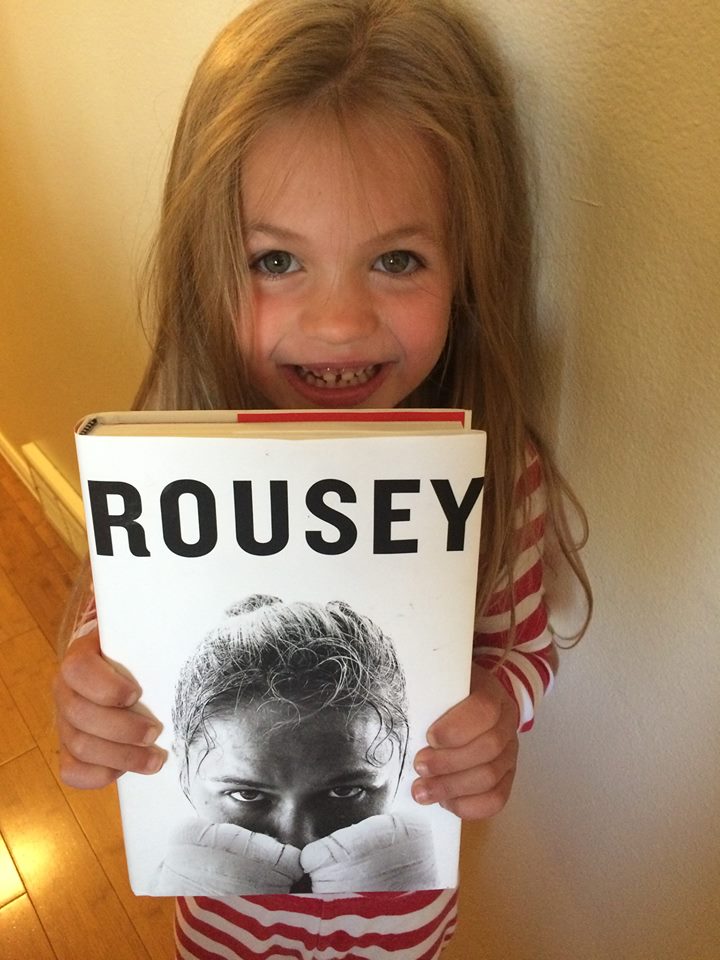
    A was STOKED.  She LOVES books.  She could not believe this big book was for her.  She held it like a prize and she would NOT let me hold it.

    We stood in line and people thought she was adorable.  Ronda’s youngest fan.  Well…maybe….if Ronda has apraxia this moment is epic.  I started to get nervous.  What am I doing here?  I dragged my 5 year old baby to a book signing on a mother’s intuition.  Oh well.  If nothing else, this woman is pretty kick ass.  She’s not famous for her good looks (even though she’s beautiful), she’s not famous for being a reality star, she’s famous for being freaking talented and smart.  I started liking her in spite of anything.

    Finally it was our turn.  As we got closer, her bodyguards were crabby and everyone on her team seemed tired.  They were literally pushing people after their book was signed so they wouldn’t take up more time for selfies or whatever. She wasn’t personalizing books.  In fact, you couldn’t even hand her your book.  They handed it to her for you.  Sigh.  I took out my hidden apraxia brochure.

    Damn.

    Oh well, maybe we’ll still be able to talk.  Those body guards though.  Gulp

    “Okay sweetie, your turn.”

    I sent A up to the counter by herself because I read in one interview that Ronda has a soft spot for kids who seem to have the same speech disorder she did, so she really tries to take time for them.  This was no exception.

    A walks shyly up to the counter.

    “What’s your name?” Ronda asked.

    A answered but she couldn’t understand so she leaned over and asked again.  I only got this one picture 11393018_10205134887824400_1278270075692218729_n


    before I went over to clarify.

    Ronda started signing her book.  I said quickly, “A has a neurological speech disorder like you did and we are inspired by you because you overcame that and so much more.”

    Almost on auto-pilot Ronda responded, “Yep, I had to overcome a lot to get here.”

    I’m crazy nervous now.  I have to ask her like ASAP.  Luckily she’s taking a long time to sign the book.  Laura say it!!

    “Did you have apraxia?”

    Ronda stops signing dead in her tracks and looks me in the eye and says, “What did you just say?”

    “uh uh apraxia?  dyspraxia?  Was that your speech impediment?”

    She looks incredulous and repeats “apraxia, yes, this is what they think I had.”

    I smiled.  I knew it.  Un-freaking believable.  I look over at the body guards.  What the heck.  I throw the CASANA brochure on the counter.  They move in, but she motions them to stop.  I say,

    “This is information on apraxia.  If you really did have it, will you say that in your interviews instead of speech impediment.  It would mean so much to our kids who are struggling with it.”

    She again looked at the brochure before looking back up at me and said, “I will.  I really will.”

    She seemed sincere.  I instantly believed she would.  I have A give her a hug and try to push her along (bodyguards are watching) and she says,

    “You know, my mom is a PhD psychologist, and SHE had never heard of it.  She took me to the Universities and many of them had never heard of it.”

    “Yes!” I replied.  “Yes!  It’s still not well known or understood.”

    She starts to get really worked up now.  Emotions start spilling out of her.  I read in an interview people think she’s so tough, but really she wears her heart on her sleeve and she was, right then, in that moment.

    “They wanted to put me in a special classroom away from my friends.  They thought I was stupid!!  But by 4th grade I was top of my class in algebra, and by highschool I tested gifted.”

    “Yes!” I again replied.  “Yes, these are our kids.”

    She looked back down at the brochure before looking up again and said, “I will.  I really will.”

    A and I ran out of there.  Before we left I pointed at Ronda and said “Look!!  She has apraxia,” and then I pointed to a line of almost 100 people who were still waiting and said, “and all these people want her autograph!!”

    My daughter smiled.  We ran out into the rain laughing.

    “You’re going to be famous!” I said, and we laughed.

    It was very late by this point and we still had a 30 minute drive home.  I stopped by my parents house to tell them the story.  They couldn’t believe it!

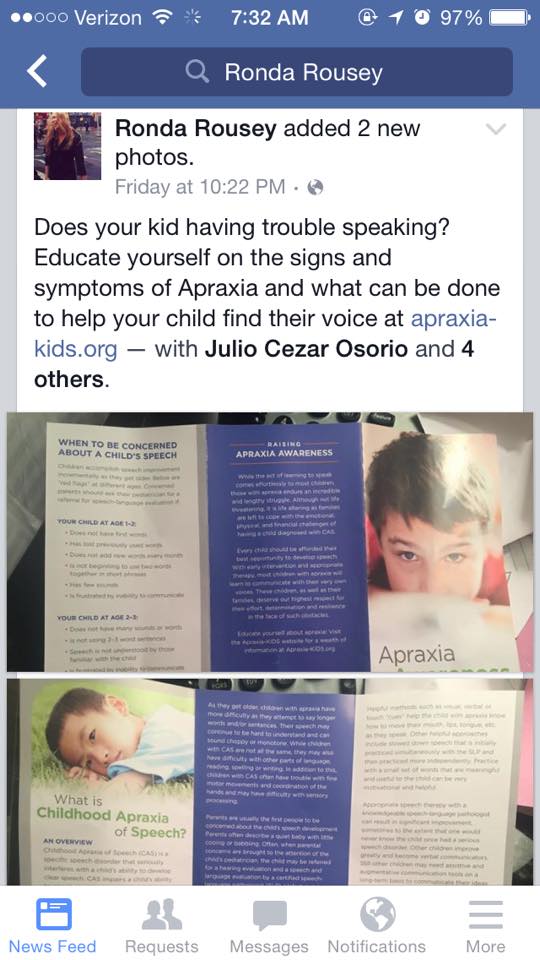
    I finally got home and ate dinner while my husband put A to bed.  I fired up my computer to start writing this blog post, but checked fb.  Just for the heck of it I went to Ronda’s fb page to like it, and that’s when I saw this:
    11351185_10205152491424479_6279279109440234371_n

    She reposted the brochure I gave her!!  She must have done that first thing upon completing the book signing!!  She IS one of our kids!  So freaking awesome!!

    Even if she doesn’t do anything else, even if she doesn’t say she has apraxia (but I think she will), A and I will always have that moment…..that moment when we met a true fighter who beat apraxia and so much more, just like A will.

    We will always have that book confirming what I have hoped all along:

    “I never would have been able to do any of those things without hope.  The kind of hope I’m talking about is the belief that something good will come.  That everything you’re going through and everything you’ve gone through will be worth the struggles and frustrations.  The kind of hope I’m talking about is a deep belief that the world can be changed, that the impossible is possible.” – Ronda Rousey
    11351169_10205152550145947_2841047692327843802_n

    *Note: This post contains affiliate links*
  • A confession, and a hope for A

    A is about to graduate from preschool tomorrow and embark on her Kindergarten experience.  She is ready and excited.  Her preschool teacher this year is retiring, and what a teacher she was!  Ashlynn mimicked and learned SO much from her.  I can’t even begin to start with all the things Ashlynn has learned.  This woman set everything to a tune paired with some large gross motor movements, and the combination was pure gold for A.  I hear what she has learned every night before bed, during her pretend play of being the “teacher,” and with her songs she will randomly bust out when in a good mood.

    Great right?

    Well, yes of course….and well no, not really.  No?  Why you ask?  Well, I don’t believe this teacher ever really believed in A.  It’s a sad and maybe terrible thing to say.  I know the teacher liked her.  In fact, she called her dolly. It’s just that, there was maybe only one time in all the meetings and conferences that the teacher knew what A could really do, and when I would tell her of all the amazing things Ashlynn learned, she would just smile a half smile.  I thought she would be so proud.  I always waited for her to tell me that, but it never came.  Sigh.  Oh well.

    In fact, though A is well liked, there was never any teacher who exclaimed how proud they were of her.  Who noticed how hard she works.  Tirelessly really.  Truly. She is always begging for me to do homework.  She is always going over what she learned, or practicing flash cards, or hand writing.  It’s really sad to me that no one sees that but me.  In fact, it felt like they were against her when they were trying to force cognitive testing on me…as though giving her a number would make me see what they see, or rather, didn’t see.

    I’m part of a lot of groups now for apraxia.  Basically, my facebook newsfeed is apraxia news 24/7.  I have friends I never would have had if not for apraxia.  Some are experiencing highs, some lows, all riding the roller coaster.  I have a few who are having incredible highs and I am SO happy for them.  THRILLED!  TRULY.  At the same time, I can’t help but feel jealous, sad, but also hopeful that A will meet that right professional who will change her life, and to be honest….I really don’t want that professional to continue to be me.   I really think next year we will have them. The team she is going to is MY special education team that I actually work with at my job, and ALL the professionals care about their kids, know their kids, fight for their kids.  I’m pretty sure A is going to have a dream team next year, but of course, one can never be sure.

    Throughout all this I keep being reminded of something I said earlier in my career.  It’s been haunting me now, and I really hesitate to confess it.  However, that’s never stopped me before, so here goes.  I had been at the job for awhile when I was paired with an awesome SPED teacher.  She was young, enthusiastic and passionate (much like me).  We were both problem solvers and would talk rounds and rounds about kids and how they learn.  We were going to change the world.  I believed in the kids as much as her.  I just knew with our help they were all going to thrive.  I remember though, she would call all of her kids “smart.”  At the time, I had enough experience with cognitive testing results to make me knowledgeable, but not enough experience with cognitive tests it made me dangerous.  At least, that’s how I see it now.  At the time though, I really felt I had this learning disability thing down.  In fact, I was praised by numerous psychologists for knowing it so well, and for being a great diagnostician myself.  Maybe it inflated my ego.  I didn’t think so at the time, but I just could cringe now.

    Okay I’m stalling.  I’ll just say it.

    After one IEP meeting for a kid who had come out below 80 on cognitive testing, I had a conversation with this SPED teacher that went something like this:

    Me: Jamie, we both believe in this kid, and we both know he’s going to make growth and that he’s got so much potential, but do you really think you should be saying he’s smart?

    Jamie: But he is smart!  He can do………..

    Me: I know!  I know!  I mean, don’t you think though that we should be honest and not give false hopes?

    Jamie: You don’t think he’s smart?

    Me: I think he’s……capable.  I think we should say he’s capable, because he is, but telling parents he’s smart doesn’t seem ethical.  His IQ is in the 70’s.

    I cringe again to say I think I won that argument.

    How dare I??  How DARE I tell a teacher who believes in her student that he isn’t smart.  Who was I?  Who was the psychologist?  What is in ONE number given on ONE day, when a CHILD IS STILL DEVELOPING?

    Oh I’m so mad at that Laura, and prouder than ever to have worked with that Jamie.  So Jamie, you probably don’t read this, but if you’re out there, you are a DAMN good SPED teacher, and if your think your student is SMART in spite of a stupid cognitive test, then I hope you never listened to me and say it.

    11263921_10153355902883708_2276161331477759530_n


    I desperately need a teacher like you right now.  I desperately need to hear that someone else other than me and her grandparents think she is smart.  I desperately want just ONE professional at some point at least see what I see.  I don’t know why I need to hear it.  I know in my heart she is not only capable but smart too, but to hear it, just the thought that maybe someday I will hear it……. is bringing tears to my eyes.

    I always quote her, but it’s always appropriate.

    when-you-know-better-you-do-better


    My dad always said you have to be humbled to make growth.  *gulp*   For A, I take a bite of my humble pie.

  • Ignorance is bliss, but Awareness is POWER

    Ignorance is bliss, but Awareness is POWER

    Ignorance is bliss.  Yes, yes it is.  I can tell you this from personal experience.  If ignorance is bliss, what is hindsight?  Oh right, yes, I know.  Hindsight is 20/20, meaning looking at events afterward seem so much clearer than in the moment.  That much may be true.

    I was going through some old home movies.  Our 10 year wedding anniversary is coming up, and I guess I was feeling nostalgic.  Of course, there were other videos in the pack too.  A lot of Ashlynn, our first born.  Everyone always remarks how they had so much time to document everything with the first born, and Ashlynn was no exception.  I waited until she was 2:11 to get her evaluated, partly out of pride, partly out of denial, and partly out of a love greater than anything I had ever known.

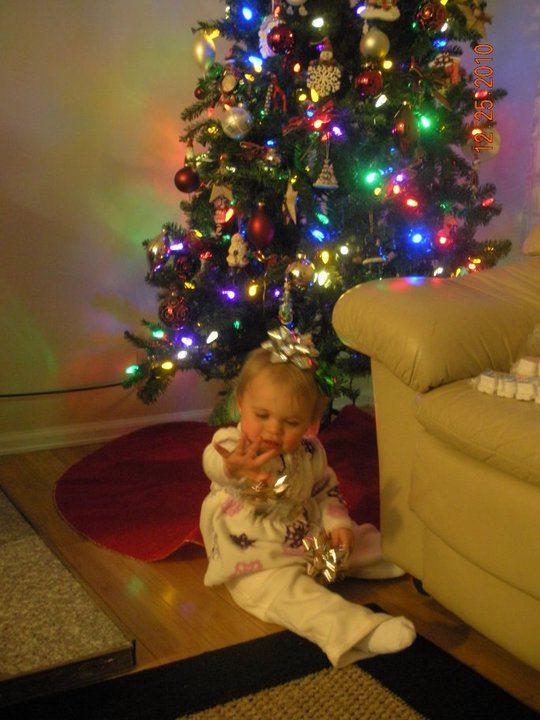
    Tonight my husband and I watched a Christmas video we had rolling in December of 2010. Ashlynn would have been 1 year 2 months.  At the time, we are two young parents happy in love, and giddy with our baby.  Dear Lord she was perfect.  I remember that night.  Everything about her was perfect to me.  I remember a picture of her I posted on facebook, bow in her hair, wide eyed, wondrous, in front of our tree….and I had said “everything about this picture is beautiful to me.”

    165089_1650594297312_2248739_n

    Looking back on it tonight, I see things I didn’t see before……I didn’t want to see before.  I see her flat head.  Yes I saw this before, but it was really noticeable.  I remember desperately trying to do tummy time with her, and her hating it, not being able to push herself up, and she felt like she was suffocating.  I tried everything to keep her off her head, but delayed gross motor milestones meant she was frequently on her back.

    My husband remarked on the silence.  If you were not looking at the video, you would have no idea a 1 year old is present.  Her silent voice was deafening to us now.  Especially since we went onto have a son, a VERY loud son.

    At 14 months, she was pulling herself up with the furniture, first starting on the top part of her foot and then rolling it to stand in position.  She was floppy.  She fell….. A LOT.  In fact, there was a bruise on her temple. “She’s just so little” my husband would say.  We didn’t see the apraxia then, glaring at us now.

    The video panned to a few later random events.  Each time her daddy would walk in  she would smile the biggest smile and give a shaky closed fist wave.  Back then we saw a a baby girl in love with her father….today we saw a baby with global apraxia.  I thought to myself though…oh how ignorance was bliss.  How we doted and awed at her.  She still was nothing short of perfect.

    We saw a video of her self-feeding scrambled eggs.  She would shove them in closefisted ( a delayed milestone we realize now).  She became red at one point, wide eyed, looking panicked.  In the video I playfully asked if she was pooping.  I had no idea.  As I sat watching, my husband said it for me….”she’s choking.”

    Yes, she was choking.  Gotta love that oral apraxia and the fact she never had an oral phase or chew to her swallow.  🙁

    I thought she was adorable though, and went on to praise her and tease her as only a mother could.

    She’s come so far.  Her re-eval revealed articulation skills in the low average range which is incredible.  With apraxia awareness day upon us, I shot a video of her.  Granted she was speaking on the spot with a script, but I always say the apraxia is almost resolved, and it is…I think.  But with this format, as I watched her, I saw every single diagnostic marker glare at me again as  I watched her sweet face on video.

    In fact, prosody, or the melody of speech is one thing I have always thought she was amazing at….but when asked to do a script, I saw….the slow pauses, inappropriate stress patterns, decreased intelligibility with longer phrases…….and I have to tell you it hits me like a ton of bricks.  My entire career now is based on working with kids with apraxia.  I know what I am looking for and I see these things on a daily basis.  Seeing them in my own child thought still has me blind….until I see her on video.

    My message this apraxia awareness day is to remember, every child is “fearfully and wonderfully made” in their mother’s eyes and ears, even if that eye and ear is now professionally trained to see and hear apraxia.  My message is that despite so many odds against her, I cannot help but believe the world for her.  That despite so many barriers, I cannot help but believe she will not knock those down too, like all the ones that have come before her.

    My message on this third annual apraxia awareness day is to tell you that every mother sees nothing but perfection in their child, and they need YOU…the SLP….the OT….the PT….the teacher…..to believe in them too.  They need you to know this because apraxia can be overcome.  It can….. but they need a dream team of therapists and teachers.  We NEED you.  We NEED you to know that frequent and intense therapy does and CAN make a difference, but we don’t want to have to fight you for it at every IEP.  We NEED you to realize it too.

    That’s why awareness is so important.

    Our children may have apraxia, but it DOESN’T have them….especially with your help.

    20150508_181144956_iOS (1)


  • Interview with “Speaking of Apraxia”

    Interview with “Speaking of Apraxia”

    Hi Leslie!  I’m so happy to have you.  I want to start by asking, what made you decide to write this book?

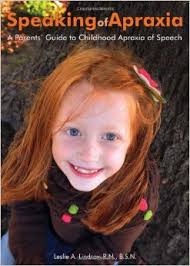
    Oh, I am happy to be here, Laura.  I won’t pretend that SPEAKING OF APRAXIA was in any way ‘easy,’ but it did sort of present itself to me…in the form of my oldest daughter!  I may have been a first-time mom, but I was also a child/adolescent psych/RN and *knew* something was a little amiss with my Kate’s verbal development.  We didn’t want to admit that our baby wasn’t anything less than perfect; still something niggled in the back of my head when she wasn’t cooing and gurgling like most little babies.  I cringed when others told me of their child’s first words.  Mine pointed and grunted.  My heart broke. When Kate was diagnosed (about 2.6 years of age), I wanted a book.  I’m very bookish – and tangible – I like to be able to hold things and refer to them time and time again.  Websites are great, but they can lead to a spiraling search.  SPEAKING OF APRAXIA is a part of a mother’s mission to help her child, but most of all – I wanted a book, I figured there had to be others out there who wanted – and needed – this resource too.

    You are quick to point out you aren’t an SLP, but did enlist the help of an advisory review board to include the latest research and technical information.  Who was on the board and how long did this take for your research?

    This was one of the more tricky aspects of writing a book about a motor neurological speech disorder for the parent community.  I wanted it to be accessible to parents, but I also wanted to get the information right.  Over the course of writing and researching SPEAKING OF APRAXIA, I had “bumped” into some extremely knowledgeable professionals at various conferences, schools, the community, and social media.

    Diane Bahr, CCC-SLP provided much of the technical assistance when it comes to speech and language development.  She practices in Las Vegas, NM and is the author of several books herself. Teri Kaminski-Peterson, CCC-SLP in in Minnesota and works so well with children and her book,  THE BIG BOOK OF EXCLAMATIONS prompted me to connect with her.  Amy, an astute mother raising girls in St. Louis, one of whom suffered from CAS chimed in with the “parent readability;” as did her child’s SLP on some of the more finer points of private practice speech therapy. A preschool-school based SLP who worked with my daughter read over the sections on school, as did Kate’s very first classroom teacher, Lisa Circelli.  I knew shew as a winner when she lowered herself to the floor and spread her arms for a big embrace from my little redheaded sprite bringing me to tears.  Kate was literally in ‘good hands.’

    How long did it take?  I don’t know…it’s like childbirth that way.  Awful and tiresome and painfully intense.  And then it’s over.  You don’t remember, but somehow you have battle scars.  And a precious reminder of your labors.  Conception to shelf: 4 years.

    You describe this in your book, but to give some background to those who might not know you, what age was your daughter Kate diagnosed?  How frequent and often were her therapy sessions, and when would you say she resolved?

    As mentioned earlier, Kate was 2.6 years old when she was finally diagnosed.  I say ‘finally’ as if it were a long wait, but it really wasn’t.  Most speech-language pathologists (SLPs) are more comfortable waiting to diagnose until the child is three years old.  But three years (even two-and-a-half) is a long time to wait and to worry and to schlep your child to appointments.  And have no answers.  Kate was evaluated by her pediatrician who was concerned at 12 months.  And again at 18 months.  We saw a speech-path for the first time around 19 months.  She told us Kate was “definitely delayed.”  A baby sister was born.  My husband was transferred out-of-state.  We moved.  We worried.  We got a definitive diagnosis once we settled in Chicagoland.  The diagnosing SLP still recalls how determined I was to get a “label,” saying I was probably the only parent who just came out and said, “So what is it?!”  She said she knew without a doubt we were dealing with apraxia.  An overwhelming sense of relief and then ‘now what’ enveloped me.  I rolled up my sleeves and dug in!  We were intense about our therapy sessions.  Twice a week for about two years.  Then we added feeding therapy (more on that below) so for awhile she was going to therapy three times a week!  Gradually, we cut it down to twice a week (speech), then once a week (speech) and once a week occupational therapy (OT).  By the time she was a first grader (6 years) we were finished with private therapy – Yahoo!

    Many kids with CAS have co-morbidities such as Sensory Processing Disorder, Autism Spectrum Disorder, and/or Attention Deficit Disorder.  These can all affect prognosis.  Did Kate have any co-morbidities, and how is she doing now?

    “You bet she does!” I say with a grin.  It’s true: CAS is often a ‘package deal;’ a combo platter of CAS and…what-have-you.  In our case, Kate had some sensory integration issues as a younger child (3-5 years old) requiring occupational therapy and feeding therapy (food textures, ‘remembering’ to chew, etc.–quite common for kids with CAS). We absolutely loved the combination of OT and Speech therapy (ST)!  It was the wining combination for our daughter.  There’s actually something to that: the vestibular system works in tandem with the speech centers in the brain – this is one reason why playgrounds are a great place to practice speech work.  When Kate was five, her SLP thought there may be “something more going on,” and that’s when she was diagnosed with AD/HD. We added medication to help control the AD/HD when Kate was a first grader and it helped immensely.  Kate’s speech became more organized as did her behavior.  These things *can* affect prognosis, but there are so many other factors that come into play: parent involvement, school support, the child’s awareness of her (dis)abilities and her ability to self-correct speech mistakes, child’s temperament/intelligence, motivation.  I may be missing some, but you get the idea.  I’m happy to report that Kate is a happy, successful 4th grader – one of her teachers call her ‘wildly creative.’  She even has the writing bug like her ol’mom!

    What do you see as the most important thing an SLP can do to help the parent in this journey?

    Wow.  This is tough.  We’re all different and we all seek different services at different stages in the apraxia journey.  I loved when our SLP listened.  It sounds simple, but having an ear to bend and some validation is huge.  As parents, we’re often at a loss of what to do – but we love our kids so much, we’d move mountains.  Let us be partners, too.  Tell us how and what we can do at home to stimulate and encourage speech.  Don’t disregard our efforts or belittle our worries or concerns, invite us on-board and let us know our efforts matter.

    How have you seen CAS awareness and information change over the years, or have you?

    It’s changed incredibly!  When I first started this journey, I didn’t know where to go for information – aside from the internet -and I felt kind of stigmatized sharing Kate’s “problem” with other parents, neighbors, even family.  Maybe that’s part of the process of coming to terms with things, or maybe there’s just greater awareness.  Over the years, walks have been added to most metropolitan areas, support groups have sprouted up, and now we even have Apraxia Awareness Day in May!

    What would be your biggest piece of advice for parents when faced with this diagnosis?

    Have faith. Partner with your child’s school and/or private SLP.  Do your own research, but don’t freak out about everything you hear or read; you’ll need to access all your critical thinking skills because it’s easy to get overwhelmed or feel as if a diagnosis is all gloom-and-doom.  It’s not, there is a light at the end of the tunnel.  Apraxia is often short-lived; there’s a reason it’s called *childhood* apraxia of speech: it’s typically resolved (or resolving) by the time a child is ten years old. Sure, there may be qualities that remain at times, but this is something your child will overcome with the proper support and therapy from a trained SLP.

    I really liked your chapter on things parents can do at home to help their child.  You have so many creative ideas!  Did you do all of these things and how often would you say your worked with Kate at home on her speech?

    Thanks!  Wow – that means a lot!  We did most *all* of those things listed in the book – either at home, or they may have been things she did with her teachers at the school or her SLP in therapy.  We took the approach of “every-moment-is-a-learning-moment” and pretty much exhausted ourselves (and Kate!) in the process.  But that’s not to say parents *should* be super-tenacious in speech work at home.  It’s not for everyone and kids need time just to be kids – exploring, getting dirty, crafting, experimenting, babbling with their toys.  Encourage and be open to that.  Instead of hovering, to be a ‘hummingbird parent,’ popping in when needed and allowing your child to take the reins/direct her own interests while you support.

    Thank you so much Leslie for your time, spreading CAS awareness, and sharing your book with us for Apraxia Awareness Day!!

    To get this book go here!

    Author Biography

    Leslie Lindsay is a former child/adolesent psychiatric RN at the Mayo Clinic and mother of a daughter with CAS. She is an award-winning author of Speaking of Apraxia: A Parent’s Guide for Childhood Apraxia of Speech (Woodbine House, 2012). Leslie and her family live in the Chicago area where she supports the apraxia community, volunteers at the elementary school, and has turned to her time to writing fiction. She hosts a blog of bestselling and debut fiction author interviews at www.leslielindsay.com.  Like her and follow her on Facebook at: https://www.facebook.com/pages/Speaking-of-Apraxia-A-Parents-Guide-to-Childhood-Apraxia-of-Speech/235772599837084?ref=hl

    Leslie A. Lindsay, R.N., B.S.N. 
    Award-Winning Author of Speaking of Apraxia www.speakingofapraxia.com, www.woodbinehouse.comLeslie Author Pic
    Author interviews, give-a-ways, excerpts, & so much more at www.leslielindsay.com
    Like my Author Facebook Page https://www.facebook.com/LeslieALindsay1?ref=hl
    Follow Me on Twitter www.twitter.com/LeslieLindsay1

     * Note, this post contains affiliate links*

  • Speech Stickers App for Apraxia Giveaway!

    Speech Stickers App for Apraxia Giveaway!

    I’m keeping up the momentum now until May 14th, offering giveaways and prizes in honor of Apraxia Awareness Day!

    Next up is the app Speech Stickers.

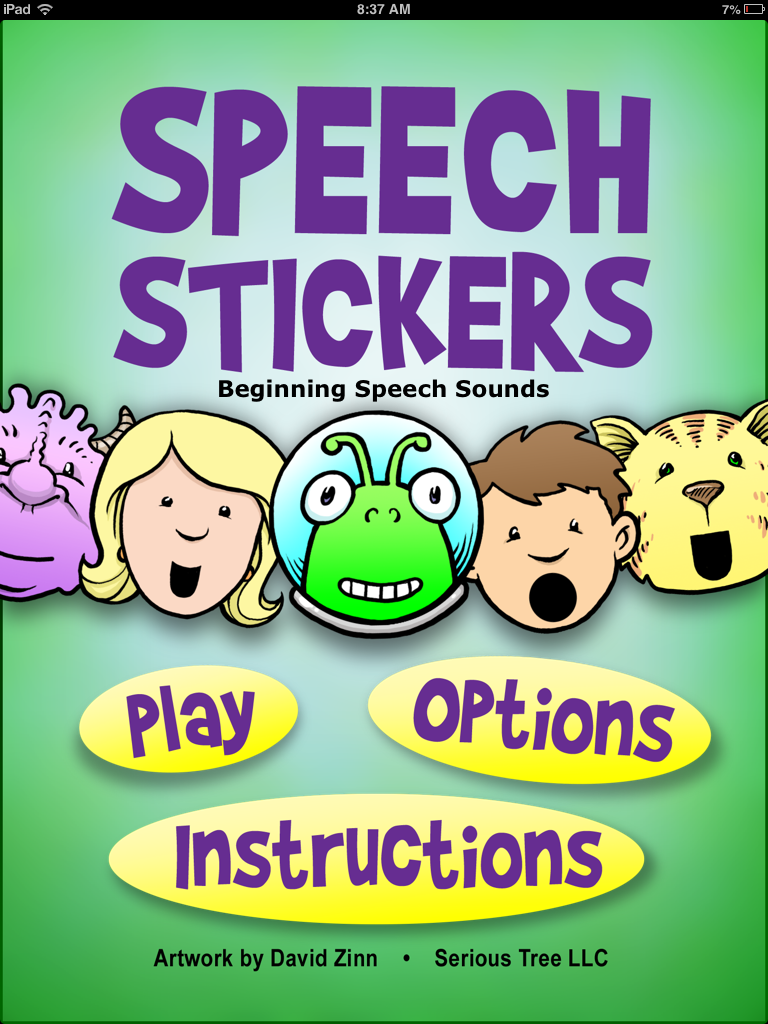
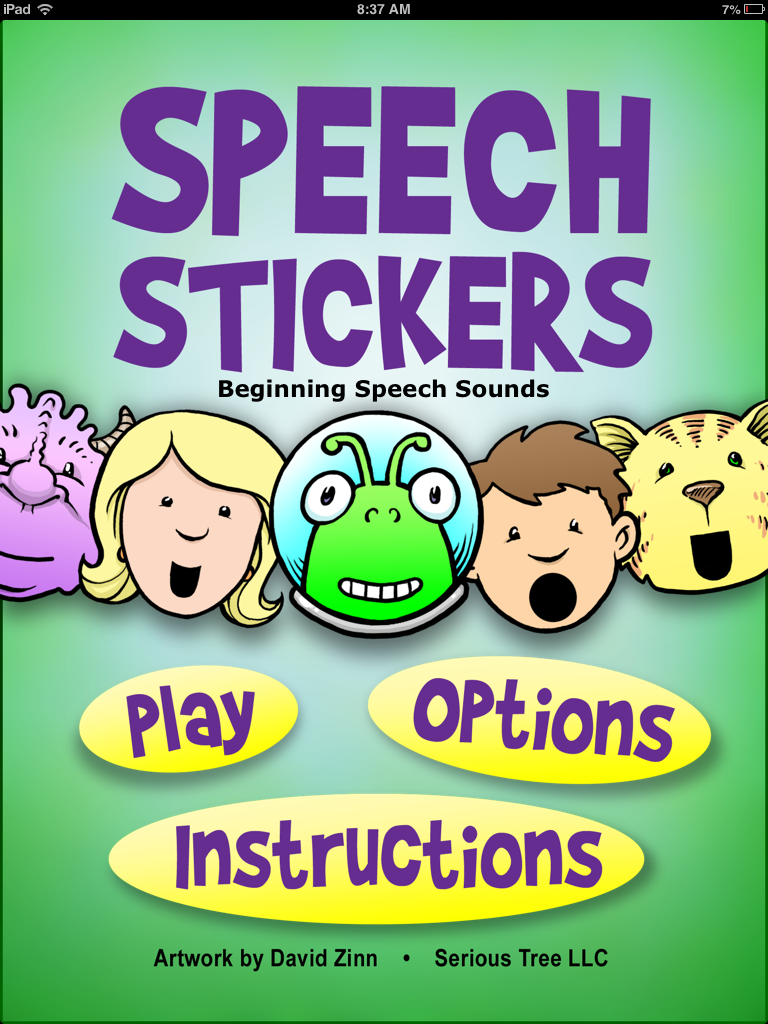
    Speech Stickers is the first app that I downloaded for Ashlynn (my daughter with apraxia) when she had first turned three.  I chose it because it was cheap, and said it was developed for children with apraxia.  The app is simple in design with not a lot of bells and whistles; however, my daughter loved practicing her speech with this app.

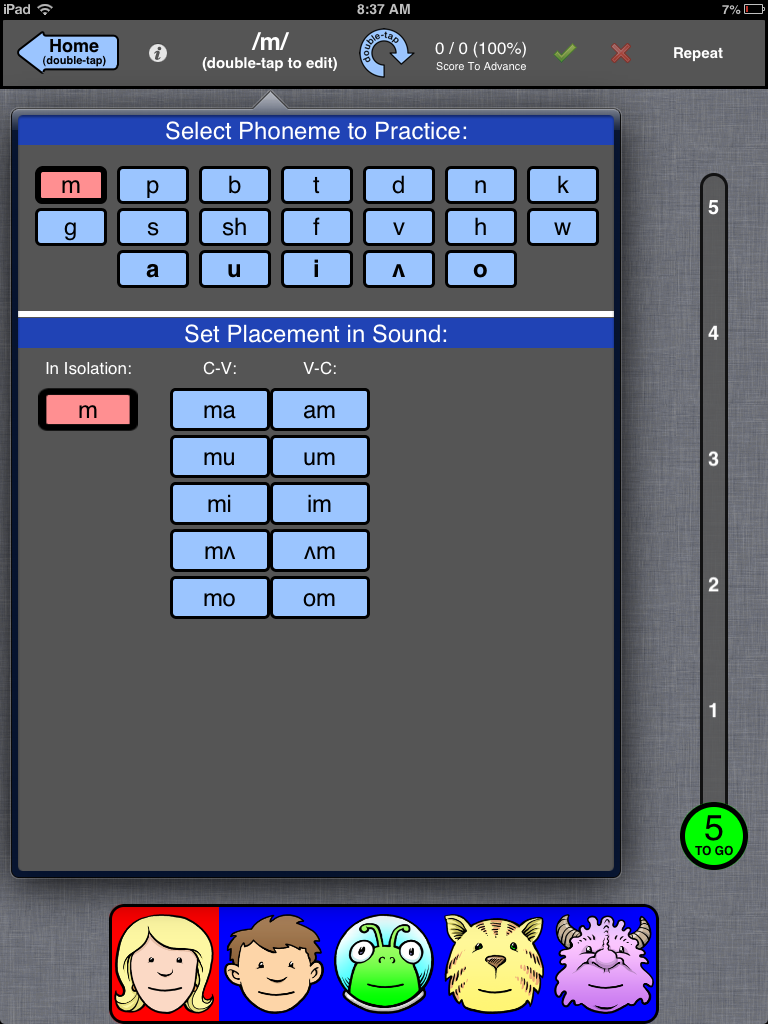
    The app is set up for kids in the very early stage of apraxia therapy.  The child can practice sounds in isolation and in CV(consonant-vowel) and VC(vowel-consonant) combos. The app is based around blocked practice with a lot of repetition that is necessary for apraxia therapy.

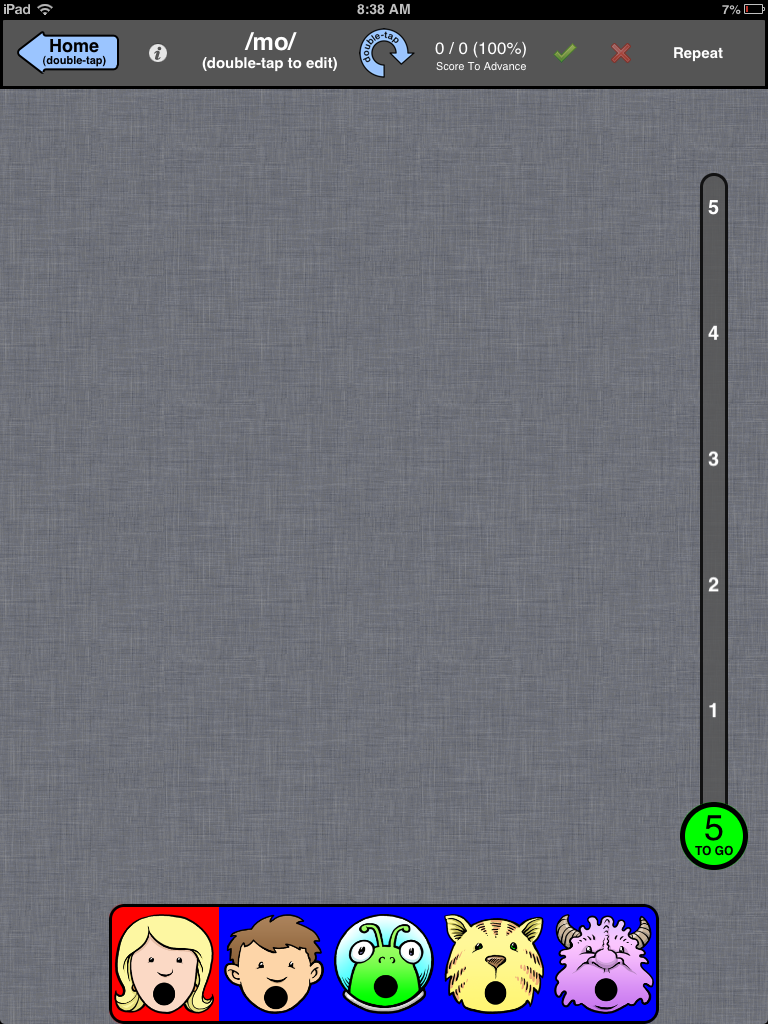
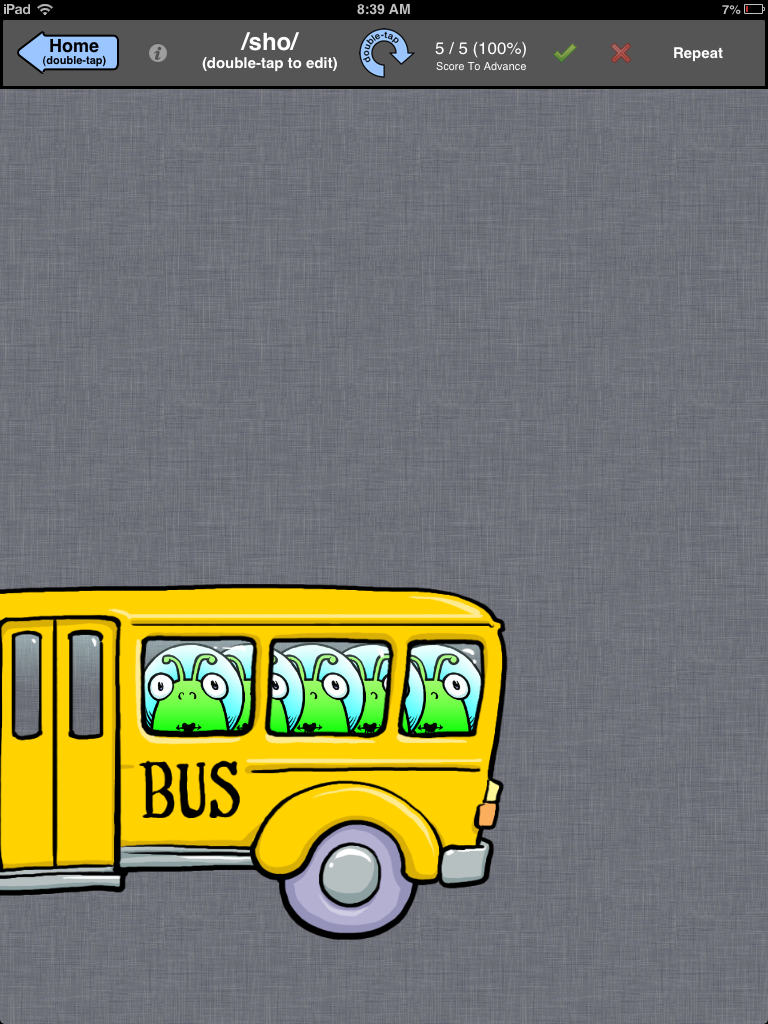
    After you pick your sound or sound combo, you can then decide how many times times the child has to say it before they get a “sticker” or a little animation as a reward.  Then, the child chooses between five characters on the bottom, all of which have a different pitch to their voice.  This is a bonus too, because children with apraxia have difficulty with “prosody” or the melody of speech.  The characters’ mouths model the correct placement.  The above picture is showing ‘m.’  Below the characters are modeling ‘mo.’ This is also great because it gives the kids a visual cue for the correct mouth posture.

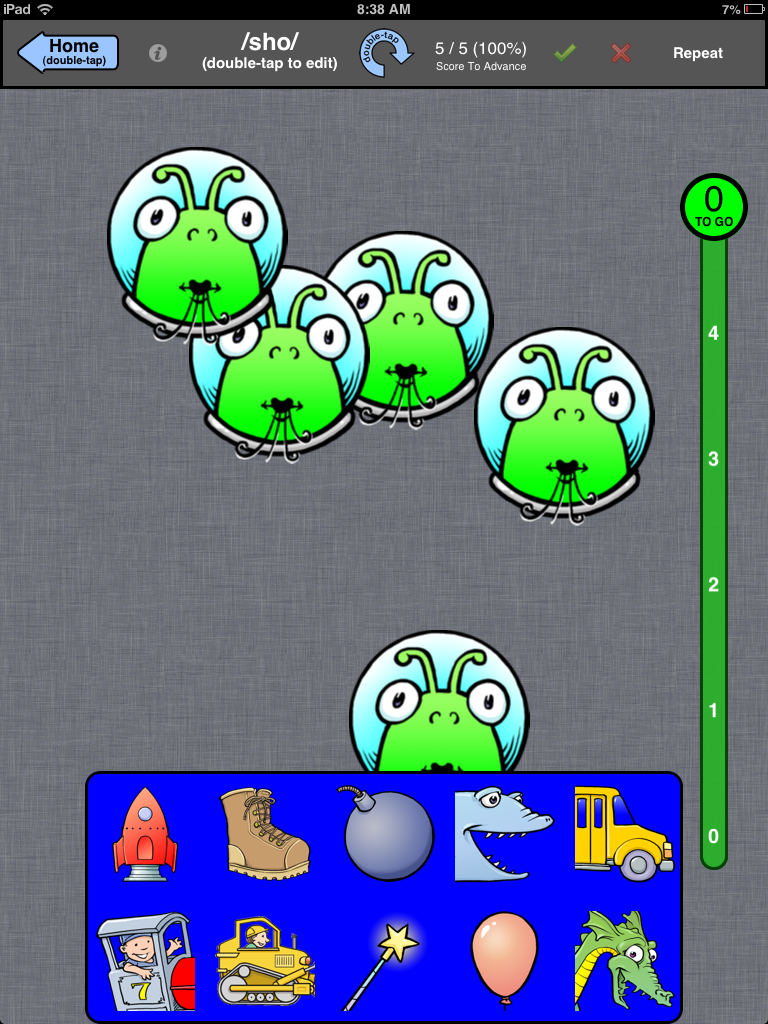
    A scoring bar at the top help score and keep track of data. You must press the green check or the red x to move onto the next practice sound.  The app is designed so that the bar can also turn upside down so that the therapist can discreetly score; however, my daughter picked up on this in a heartbeat and would push the buttons haphazardly just so she could move on!    Once you reach the set number you earn a “sticker” or reward.  You can choose from eight stickers seen below:

    They are so simple, but my daughter loved them.  I chose the bus just so you can get an idea of the animation.

    It has been almost three years since I have used this app for Ashlynn, but the app lives on with all of my clients!  Kids of all ages and disabilities LOVE this app.

    I have a 5th grade boy with Down Syndrome who laughs every time he earns a sticker and watches the animation.

    I have a 3 year old who loves picking the alien because it reminds him of a popular TV show right now “The Octonauts!”

    I could go on!  Really, I can’t say enough about this app, and when I reached out to the creator Carol Fast MSPA, CCC-SLP I realized why this app is soo good.  Here are some comments from her:

    “It’s truly been a labor of love for me and I’m always gratified to find that other SLPs appreciate what we do. I’m glad that you found Speech Stickers to be helpful for your daughter and other students.  I work mostly with preschoolers and have found a special interest and passion in my little nonverbal CAS kids. I really love helping find their true voice. This is probably the most rewarding work I’ve done in over 30 years as an SLP.”

    Thank you Carol!  Thank you for your passion for working with kids who have CAS and for a great app that allows us to get a lot of repetitions of targeted syllable shapes in a fun and engaging way for the kids.

    To Enter: Use the rafflecopter widget below to enter.  Good luck!

    a Rafflecopter giveaway


  • Why we’ll never stop working

    Why we’ll never stop working

    I’ve been down lately.  Really, really down.  It pretty much started at Ashlynn’s re-evaluation meeting and went downhill from there.  For all the work she’s done, for how far she has come, for what she knows in the face of so many challenges,  it was like a slap in the face.

    It’s really not anyone’s fault.  It’s just the way it is.  I’m dealing with mixed expressive/receptive language issues now.  I knew this, I did….it’s just seeing those damn numbers.  1st percentile, .5th percentile.  Phew.  Deep breath

    There were also awesome numbers.  Articulation is in the average range.  The AVERAGE range!  That’s phenomenal.  Ashlynn is intelligible to perfect strangers in and out of context.  For someone with apraxia of speech, she beat it in 2 years with a TON of therapy, but she overcame it.

    Now we’re faced with new deficits.  Word finding, expressive language, grammar, syntax, receptive language, memory, attention, writing.

    It was overwhelming.  My husband had tears, and he’s the one who always finds the positives and the “what she can do’s.”

    Even her receptive vocabulary test came back just under the average range.  Receptive vocabulary tests have been shown to correlate with IQ tests (even though I didn’t give her an IQ test), and even though I don’t think the test was totally valid since I’m sure her attention played a factor…..

    It still made me pause.  For once I started thinking, maybe we don’t have this.  Maybe I am dealing with limitations.  Maybe I am in denial.  Maybe I’m not seeing things because I don’t want to see them.

    I would read stories and updates on other blogs and get jealous someone’s child ONLY had apraxia of speech.  CAS is no joke either, but if Ashlynn only had CAS then she would almost be over speech forever!  Sigh.  You know you’re down when you’re jealous of other kids’ disabilities.  That is wrong on so many levels.

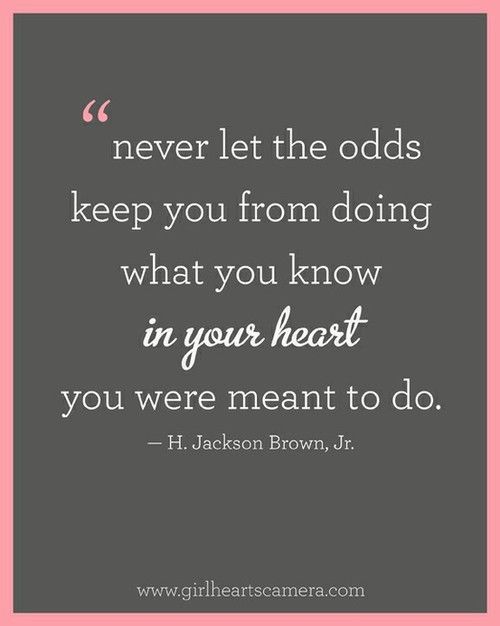
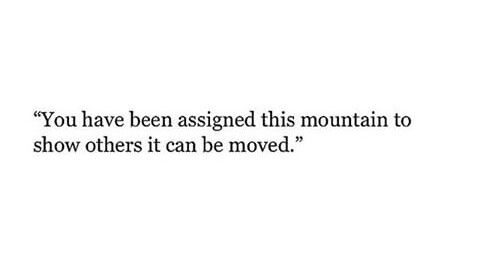
    I looked everywhere trying to get my positivity back.  I talked to family, to friends going through this journey too, co-workers…nothing helped.  I poured over pinterest looking for inspirational memes and quotes that were going to change my negativity and squash my doubts.  I found nothing.

    I scoured the internet looking for success stories for global apraxia.  One I found was on disability now but at least happy she had made it through childhood.  That wasn’t exactly lifting my spirits.

    At the same time, I finally read a new research article on Apraxia that’s been in my pile.  The article describes kids with motor planning deficits (kids with apraxia) rely heavily on auditory feedback which was proven when they demonstrated diminished speech articulation in the presence of noise.  Gee, I thought. That’s great these kids found a compensatory strategy to make up for their motor planning deficit, but what happens when you have sensory processing disorder and possibly some receptive language issues that makes that feedback unreliable.  UGH

    But then I found it.  My inspiration was sitting right under my nose.

    I know this guy who has bipolar disorder.  When I met him he was kind of a hot mess.  He hadn’t gone to college, was partying, and constantly getting fired from his jobs.  Of course, having bipolar disorder is very difficult.  There are daily struggles in his mind I will never know.  The statistics for someone with bipolar disorder are less than impressive: 90% of marriages end in divorce when one person is Bipolar.  Less than 50% of people with bipolar take their meds, and 1 in 5 commit suicide.  Many live on disability.  Many are homeless.  This guy though, he’s been married for 10 years with no sign of stopping.  He’s loyal, faithful, hardworking, finished college AFTER his diagnosis, and stays on his medication.  Who is he?

    He’s my husband.  He’s Ashlynn’s dad.  Everything he shouldn’t be doing he’s doing.  Everything he shouldn’t be, he is.  My husband, Ashlynn’s dad, defies statistics.

    Then I started thinking, I know this other guy.  He was raised under an extremely physically abusive, alcoholic father.  His parents ultimately divorced.  He was forced to go to war and and live in actual nightmares.  What are the stats on a guy like this?  Well, since he’s the product of divorce, he’s 40% more likely to end up divorced himself.  He’s four times more likely to be an alcoholic.  As a vet, he faces a higher possibility of homelessness.  What did the future hold for this guy?

    Well, he’s my dad, father of three. Married for 45 years and happily retired.  He’s healthy and has a drink maybe once a year.  My dad, Ashlynn’s grandfather, defies statistics.

    And that’s when I started to realize.  Ashlynn comes from a long line of statistic breakers.  It’s in her blood.

    I thought of me.  Had I defied statistics?  Well, neither of my parents went to college, so it would be less likely I would receive a college degree or much less an advanced degree….yet here I am. It was highly unlikely I would have ended up at Duquesne University for an elite group of SLP’s, yet there was I was last summer.  Maybe I do defy statistics.

    My dad’s nephew years ago was on the wrong track.  He was in jail, and he didn’t know how to make a life for himself after he got out.  He was lost.  He asked my dad for advice and my dad said “keep working.  All I know is to work.”  Years later that same nephew had kept a job and was raising adopted children.  He was not in jail and will never go back.  He told my dad he always remembered his words to just keep working.

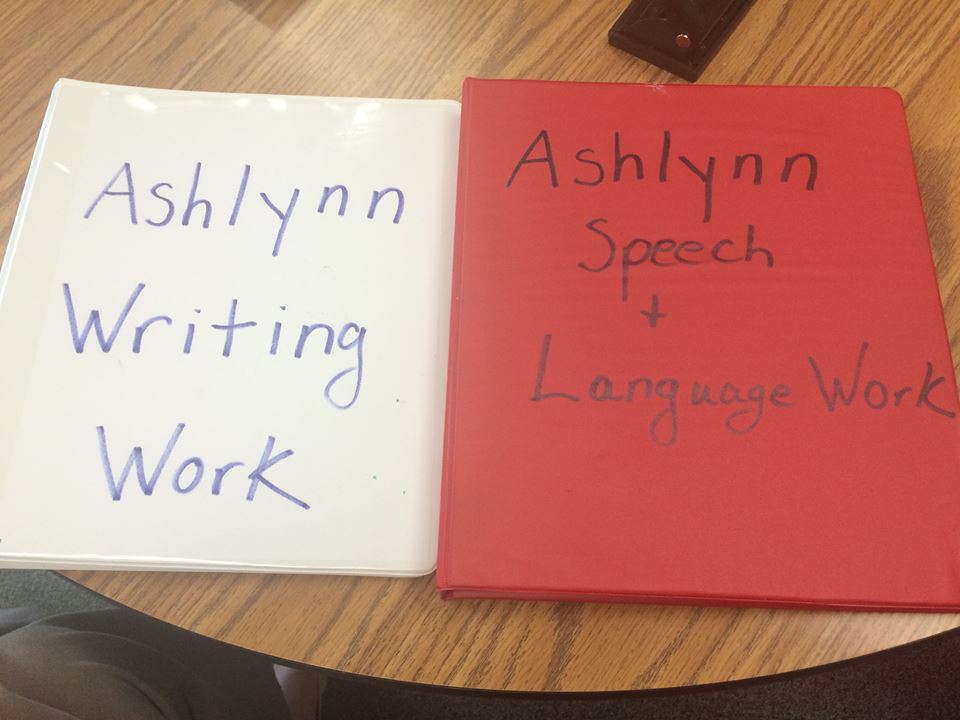
    So there it was!  Right under my nose.  We are statistic breakers.  We are hard workers, and Ashlynn is no exception. She always wants to work, do homework, practice writing, ball skills, pedaling, speech, read..you name it.  She attacks it, and I realized, I may not have success stories for her EXACT same situation, but I do have success stories for many other hard or seemingly impossible situations and she will be one too…..if we just keep our head down and

    working.

    7e94b6ca15764dd139ba2f8146844331ashlynn work