Category: Apraxia

  • Feels like we’re falling down the hill again…..

    Feels like we’re falling down the hill again…..

    I’ve been sad.  Really sad.  What’s the point in sugar coating it.  It’s interesting, because I didn’t really start blogging until after we were really seeing progress in Ashlynn’s speech.  I was able to be upbeat and positive in most of my posts.  Sure there were some sad ones, or some angry ones, or some worried ones, but for the most part, I was feeling and had been until recently,  pretty optimistic.

    I can assure you though, I had very, very, VERY dark and sad days.  Days I felt the worry would consume me.  Days I felt the guilt and the weight would be too heavy and I would have to admit I didn’t do enough.  I didn’t help her enough, and then I would be upset about this potential future outcome and obsess over what I could do more to help her.  It’s a vicious cycle I tell you.

    Ashlynn has now overcome my greatest fear.  She can speak.  She will be an intelligible speaker and she will be a verbal communicator.  She will probably be slower.  She will probably have continued word finding issues, but she will speak.  For so long when she wasn’t speaking, I would imagine a hill.  At the top the hill, was the trophy, which was intelligible, verbal, communication.  As she failed to gain speech, I felt like each day had us slipping further down the hill.  I was desperate and worried.  How would we ever catch up?  At least if we were climbing the hill, I have hope.  However, it felt we were grasping yet slipping, and then stumbling even further back….and that feeling friends, is probably one of the worst feelings  you can feel as a parent.

    I haven’t faced “the hill” in awhile.  I mean I have, but at least not in a negative way.  We have been steadily climbing the hill.  We have been getting closer and closer to the top.  In fact, in regard to speech, we reached the top.  Language is still an issue, but we are closing in.  I see the prize.

    Then came school…more specifically, reading.  Writing.  I found us on a new hill, and on this hill, we are very, very far down.  Through Kinder, though I felt we weren’t necessarily closing the gap, it also didn’t feel like we were tumbling backwards either.

    Enter 1st grade.  Commence tumbling.  Commence somersaulting.  Down.  Down.  Down we went.  The pace of the classroom curriculum is VERY fast.  Too fast.  We need about 1000x more repetitions than the typical peer, and honestly, there just isn’t that many hours in a day. I have had to face some very, VERY uncomfortable, okay painful truths, with the main one being this:

    Ashlynn is going to have to live with some degree of disability for her entire life.

    Call me delusional, but I really thought I could fix this. I really thought I could expert in this and get her all the help…and the RIGHT help she needed and we would overcome this, and by overcome, I mean soon.  Like, really soon.

    It has been very, very, very painful to realize this isn’t going to happen on my timetable.

    My husband has told me before he feels he has a better understanding of Ashlynn’s reality than me.  I would scoff.  Impossible.  He doesn’t know anything.  (love you babe).  I’m the expert in this.  I am NOT in denial.  I know the problems and we’re going to attack and beat them.

    Well, I think this year has been revealing to me what my husband knew all along.  I have been in denial.

    I should have known.  I mean, afterall, I’m the mom who when filling out a disability state park pass to get a discounted rate, actually felt guilty about it telling myself that even though Ashlynn will grow out of it, if the state approved it I wasn’t cheating.

    Hah!  I actually felt like I was cheating when filling out a state disability pass and I didn’t think I was in denial?

    Can I shake my head anymore??  It’s an approved disability because Ashlynn HAS a disability.

    UGH

    Do I need to write that in black and white to sink in?  It should be obvious by now.  I can’t fix this.  No matter how many continuing education credits or certifications I get, I can’t fix this.  A wise woman who has walked this road before me, had a “hard” conversation with me recently (which I appreciated). However, it went something to the effect of how she wasn’t sure I was truly accepting Ashlynn for who she is, and if I don’t, how that could truly be to her detriment.

    Deep breath. Breathe in…..breathe out.

    Everything I do is for her benefit.  Could I truly be behaving in a manner that was to her detriment?

    I have realized that I have.   I need to realize there is another hill we are yet again tumbling down, and after we reach the top, there will be yet another hill quite possibly that we will be facing, and at first falling backward on.

    As I type that though, I think of life in general.  My life without a disability.  The hill metaphor is still relevant.  Life is not a ride on smooth waters.  Life always throws a wave, a dip, or a hill in the way, regardless. Though I would trade places with Ashlynn in a second, perhaps she is learning early what some adults may spend their entire life trying to learn.

    A life worth living is about struggles, because without struggles you could never feel triumph.
    A life worth living is about sadness, because without sadness, you could never truly feel happiness.
    A life worth living is about defeat, because without defeat, you could never truly feel success.

    A young man with apraxia in the UK, Mikey from Mikey’s Wish, reminded me recently that learning issues Ashlynn will have to tackle herself, but the greatest gift I can give her is just my support.

    It doesn’t seem like enough, but I don’t think I can “fix” her anymore.  I can though, hold her hand and squeeze it when she’s sad or when it’s hard.  I can’t take away her disability, but I will walk through every fire with her to overcome it.

    I still feel like we are tumbling down another hill, and though I can’t promise her I can carry her to the top, I can at least promise I will hold her hand and die trying to get there

    .15181211_10209008780669300_4242155661454607639_n


  • The decline of the therapeutic relationship and why you don’t have to stand for it.

    The decline of the therapeutic relationship and why you don’t have to stand for it.

    I’ve noticed something since I’ve had my daughter in therapy.  Therapy offices that are small, with only a couple therapists and an actively involved owner, yield happy clients.  Conversely, therapy offices only interested in expanding their brand, that staff numerous therapists and have a relatively un-involved owner, have more unhappy clients.

    I used to work at a place this happened actually.  The owner was fantastic.  Smart, personable and caring, her clients improved, her families were happy, and her reputation grew.  Soon, she was staffing multiple therapists from two different disciplines and opened up a second location.  She became  stretched so thin, that she outlined a list of policies and procedures, and then delegated a supervisor and receptionist to enforcing them.  The result?  Common sense flies out the window.  The parent/therapist relationship becomes strained.  People leave.  I know personally now why this happened.

    Recently I was on the receiving end of this.  I took my daughter to what was supposed to be a well reputed therapy place in Denver, Amaryllis Therapy Network in the Highlands.  I wasn’t too pleased with the evaluation, because Ashlynn has been evaluated three times before with the very same test and this time she scored 20 points lower.  20??  I had to ask myself if that was really accurate and I had quite a long conversation with the therapist who said attention could have played a factor or this or that.  Ok.  Fine.

    However, then she was transferred to a different OT for treatment.  They initially wanted to have her see an assistant.  I have no problems with assistants.  I used to be an SLPA (which is an SLP assistant) and an assistant is more than capable of doing therapy.  However, what they are not able to do, no let me correct that, what they are not allowed to do,  is  change a treatment plan when they see something isn’t working.  They are required to consult with the supervising therapist who IS qualified to develop treatment plans before they change it, and that’s just assuming you have an assistant who is experienced enough to know it needs changing.  Anyway,   I needed someone who can change a treatment mid session if they see something is or isn’t working.  My daughter is not a typical case.  She’s involved and I don’t want to waste time.  I’m not trying to sound rude, but it’s just the way it is.  As a side note though, it does make we wonder how many parents reading this even know if their child is seeing an SLPA or a CODA.  If they are, just know that you want to make sure a supervising therapist is really staying on top of things in regard to your child’s treatment approach…just sayin.

    Anyway, they complied, and I was given a different OT.  I wanted a conference call set up between the new OT, me, and Ashlynn’s school OT who is also my colleague, a therapist I trust, and has been with Ashlynn since preschool.  When she called, it was clear she had not thoroughly read Ashlynn’s report and then mentioned how Ashlynn had done a “group” therapy.

    I’m sorry what? Group therapy?  Ashlynn can get group therapy in school.  I’m paying for private therapy.  I need INTENSE private therapy.  She quickly reassured me it was still 1:1 kid to therapist just participating in a group activity.  Ok…maybe….but that’s not what I was paying for which even furthered my resolve that we needed a group conference call.  I asked if she would email me and she agreed to set up a time.  I NEVER received an email.

    I’m reasonable.  Ok.  Maybe she entered my email address wrong?  I call the next week before another session has come and gone and tell the receptionist I never received an email, would she email me again.  She check the email address on file.  It’s correct.  Hmm.  Okay.  She’ll send another one.  Perfect, thanks.

    ANOTHER week goes by.  NO email.  My husband is the one that takes Ashlynn so I can’t just bring it up.  I’m pretty ticked about this to be honest, but it can still be dealt with…worked through.  Probably an honest mistake.  However, I’m going out of town and I don’t think I can make the carpool arrangements work to get Ashlynn there this week.

    Now, yes.  I know I signed  48 HOUR cancellation policy paper.  I actually remember signing it because it struck me as outrageous.  Who has a 48 hour cancellation policy?  Oh well.  There are people who do chronically abuse the system, and cancellation policies are in place to protect and respect the therapist’s time.  I get that….not only because I just get that…but because I AM A THERAPIST WHO DOES THIS EXACT SAME THING AS A JOB.

    Dang!  Why is that in caps you ask? Well, it’s because even when therapists, or doctors, or people in a field where they are to care about people have a cancellation policy, it’s usually only enforced to the chronic problem clients.  Any person with a heart and common sense, understands that things come up.  If someone is abusing the system, then yes.  A cancellation policy should be enforced.  I was NOT abusing the system.  I called 30 hours in advance, choosing to wait until the morning instead of the hour they closed.

    This was my first time cancelling, we aren’t late, and my husband probably spends close to 3 hours round trip getting her down there through rush hour traffic and back home. Not to mention the financial hardships families are already going through. You would think someone who actually has a heart and interest in caring about children would have been understanding. I know I am! I don’t even have my clients sign a cancellation fee policy, and if I did…I would give them chances. Unbelievable and SO sad. It’s not right we go through this when we are already bled dry from the cost of therapy. So now, I have to find a NEW place and begin the process again.

    Oh, and one more thing. The email situation?  The supervisor said it was documented she emailed me twice.  “Maybe I didn’t get it due to spam filters?”  I went along with it.  Afterall, I hadn’t yet checked spam, even though it’s ironic that I DO get all of THEIR spam email.  Well, low and behold I DID check, and by check I mean SCOUR my spam email and there was nothing.  NOTHING.  NO email from her…so now on top of it I can add lying.

    Anyway, I digress.  I have to find a new place and begin the process again.

    Oh…but I WILL begin it again, because I know there are places and therapists who do not feel the need to run their therapy office like a corporation and treat people, actual human beings, as only dollar signs.  I know, because I’m one of those people, and I know many, many other good therapists who are ALSO one of those people.

    My message to any parent reading, is if you feel like your child and your appointments are nothing but a dollar sign, then you need to leave.  That is so unacceptable.

    My message to any professional reading this, is you need to know and understand we are counting on you! We are putting our faith and literally our children’s success and outcomes in your hands.  Meet us halfway. We are your paycheck, but we are also human.  If you are a person running a therapy office like a corporation, take heed.  YOU may be an honest and awesome therapist, but don’t get caught in some black and white policy and procedures BS.  These are humans, humans with disabilities no less, that you are dealing with.  Have some freaking compassion beyond your rules and regulations.

    Oh, and for anyone considering Amaryllis Therapy Network in Denver, scratch them off your list and move on.  Developmental Fx is where I’m headed, and unlike Amaryllis, I know many families who have been happy with the outcome.

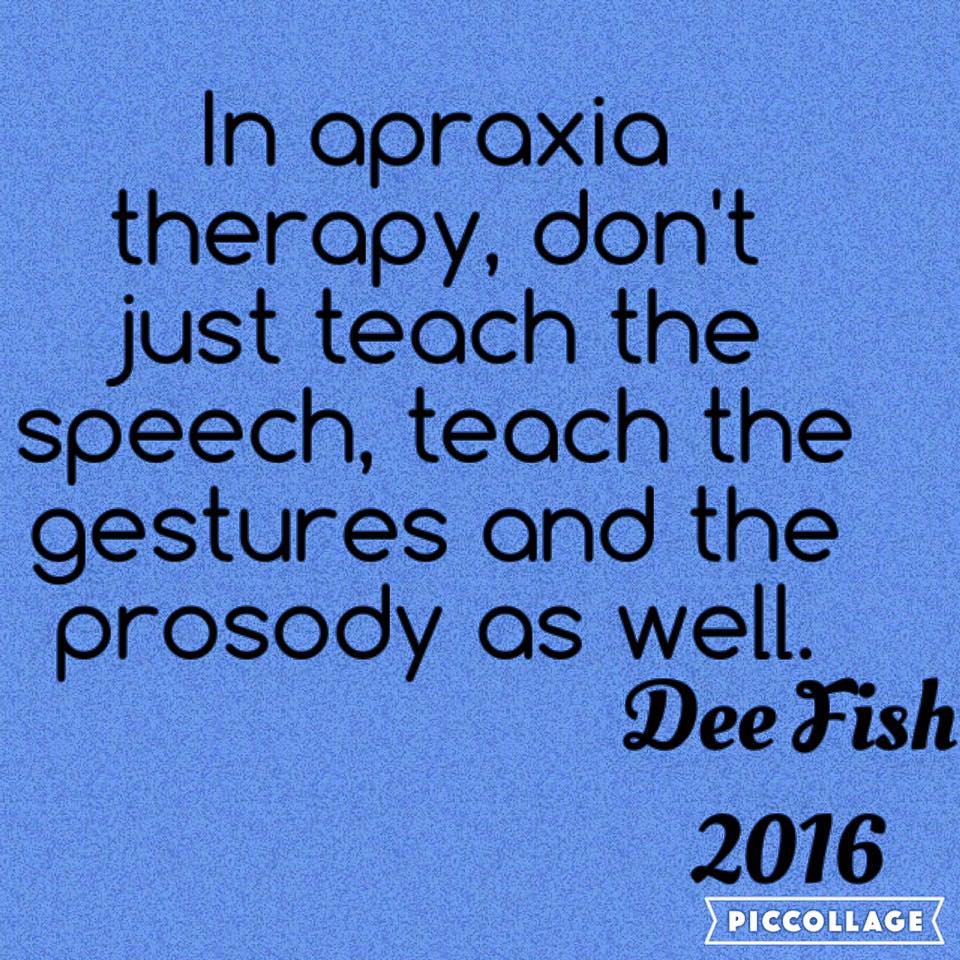
  • Don’t just teach the speech.  The importance of co-articulation and prosody in the treatment of CAS

    Don’t just teach the speech. The importance of co-articulation and prosody in the treatment of CAS

    Co-articulation.  Prosody.

    Those are two words you might have seen when researching apraxia.  If you are treating a kid with apraxia or you have a child with apraxia and are not familiar with these terms, you NEED to familiarize yourself with them.

    To have a diagnosis of apraxia, you need three main criteria:

    1. Inconsistent productions with sounds
    2. Difficulty with co-articulatory transitions
    3. Errors with prosody (stress, intonation, pitch, rate, volume)

    Recently, I’ve noticed (maybe hoped) that information is getting out there, and SLP’s who are treating apraxia are at least using principles of motor learning and focusing on movement gestures (sound sequences) and NOT sounds or sound patterns.  This is awesome because this step and this step alone will help take a child from nonverbal to verbal.  Common approaches such as Kaufman and PROMPT teach SLP’s to do this step, and do it well.  I can speak as an authority on this matter because I made it a point now to be trained in both.

    Here’s the problem. I’m not seeing a lot of emphasis on co-articulatory transitions or prosody.

    “It’s okay, I just want my kid to talk!” you might say, and YES.  This is the most important thing.  HOWEVER, our kids’ fate doesn’t have to be one of disordered prosody and odd sounding speech as they get older.  Depending on the severity it may be, but it doesn’t HAVE to be, and that is where we come in.

    I would like to see SLP’s who have a good understanding of motor planning now also focus on helping the child “sound” more natural in their speech.

    Here’s the thing about apraxia.  When kids with apraxia learn a certain motor plan, they learn it well and they say it the same way consistently.  This is a good thing in terms of learning the appropriate sound sequences, but if we don’t also consider prosody and co-articulation, we are teaching them to sound robotic, staccato, or monotone; and they WILL learn this motor plan for these features as well, and not necessarily grow out of it.

    Okay, so let’s focus on co-articulation and prosody.  How do we incorporate it?

    Prosody

    Prosody is actually one of my favorite activities to incorporate in therapy.  You can choose to do it in both structured and unstructured tasks, which makes it dynamic and versatile in terms of weaving it into therapy.  The most obvious way is to make sure, even when you are doing the very direct and structured work of making sure a child is articulating every sound in a word, you do so with varying your intonation.  For example, let’s take the word “daddy.”  This was my daughter’s favorite word.  Ashlynn would frequently omit the medial /d/ and say “da-eee.”  When we corrected her, we would make a point of stressing the medial /d/ sound, effectively causing a staccato type prosody.  Think about it.  We would make her say “daDEE.”  We don’t say “daDee” in everyday speech.  We say “DAdee.”  If we don’t go back and try and get this natural stress pattern along with the correct articulation, we are teaching the child to say “daDEE”  which sounds off.  This is something we should be conscious of starting from the very early beginning of therapy.

    Focused and direct work with prosody should also be targeted.  Not to be self-serving, but I created a game I sell on teachers pay teachers just because I wanted something fun to specifically target this area.  I called it, “say it like a costume character” and I have various characters and the child has to say the target word the way the “costume character”would say it.  This provides not only practice for articulatory accuracy, but also variation at the supra segmental level.  The kids LOVE it.

    Other activities I’ve done include singing songs that vary the volume.  Recently, I just had a child sing BINGO with me, and we shouted the first letter and then had to be quiet the remaining letters.  Obviously, this child is more verbal and in a later stage of apraxia resolution; however, even in the early stages, the SLP could request a child say a target word loud vs soft.

    As with everything else, I love using books.  A recent one I read was “Going on a Bear Hunt” and the child had to say the repetitive phrase “I’M not scaaared” each time it came up in the book varying the stress and rate.  Right now I’m moving into the “Old Lady” books.  If you haven’t seen them, they seem to have one for every holiday, event, or season and you can have the child “sing” certain parts with you.

    Co-articulation

    Kids with apraxia already have an extremely difficult time sequencing longer syllables or putting words together.  You may notice, that when kids with apraxia do start combining words, they articulate every single sound.  That’s what we want right?

    Yes and no.

    Let’s take the the phrase “come here.”  A typical English speaker will say “com-ear” when beckoning someone.  Say it out loud as though you are calling someone.  I doubt you articulated the /h/ in “here.”  If you did, you would end up having a slower rate and maybe sounding more robotic.  Let’s do another one.  Let’s take the phrase, “Put it on.”  How many times do we say that to our kids?  Now say it out loud.  Did you articulate every single sound, or did it sound something like, “pudi-on.” My bet is on the latter.

    Though our kids do need to know how to articulate all sounds correctly in various syllable shapes, they ALSO need practice sounding more natural and it’s up to us, SLP’s and parents, to help them.


  • Ronda Rousey changes public perspective about disability

    Ronda Rousey changes public perspective about disability

    In the facebook group, Ronda Rousey: #knockoutapraxia, I love hearing from people who were inspired by Ronda, and recently, a member named Shawna posted that she wrote a school paper on the very subject.

    When I met Ronda and wrote my article, it was never about making her a spokesperson for CASANA (even though Ronda that would still be awesome if you are reading this).  It is the fact that parents, who experience many dark, lonely, and worrisome hours when their child is dx with a rare disability people don’t know much about, can see someone who made it out on the other side, and did so successfully.  That was my goal along with raising awareness.  The goal was HOPE and INSPIRATION.  Love this story.  Thanks Shawna for sharing!

    For this journal I chose an article about Ronda Rousey because she has apraxia of speech.

    Ronda is an example of changing public perspective about disability because she became famous before anyone ever learned of her condition.  My youngest son has apraxia of speech.  When he was younger I was obsessed with understanding his potential outcome.  He began intense speech therapy shortly before his second birthday.  By this, I mean I took him to three different therapists, four days a week for intense one-on-one sessions.  I wanted to know how it might help him because having your two year old committed to such a schedule can make you feel awful about forced learning.

    Ronda’s story is an example of how a person can overcome a tremendous amount of social anxiety and change how the public views disability.

    Within this article we learn how Ronda experienced anxiety related to public speaking and had her sister help her at speaking engagements early in her career.  To know that she was possibly affected, at birth, by deprivation of oxygen which led her to have this condition is paramount.  The general public tends to assume if someone sounds differently-abled then they must have a mental deficit.  To see Ronda achieving great things in life while dealing with a communication issue helps people understand disability has many different meanings.  Tragically, many people will excuse a disabilities importance if they can find a way to blame it on a factor such as environment or self infliction.  I do not agree with this perception, but having Ronda talk about how she was given this disorder by no other contributing factor than deprivation of oxygen, forces people to accept it.  The public views her as competent in all areas of life including her ability to speak. Therefore, she is educating the general public in a way they do not realize.

    She’s obviously beautiful and a lot of men would like to date her.  Some might shy away from her if they heard her struggling to speak.  They would be uneducated enough to assume she has mental disabilities.  She has presented herself as a strong, successful fighter and now we learn of her struggles to speak. 

    Before anyone knew her disability they knew only of her abilities. 

    I think this personal story of Ronda might encourage people to be more compassionate.  If you watch her interviews there are moments where you see her still struggling to find words.  I would never have the deep understanding of facing a communication disability if I did not witness it firsthand from someone I love with my whole heart.  In the article she talks about how her sister remains someone who speaks for her when she has moments where the words will not come out of her mouth.  In general, everyone has some minor symptoms of apraxia. Have you ever struggled to remember the name of an actor in your favorite movie?  You can see their face but you cannot recall their name?  Does it ever frustrate you so much you have to grab your phone to Google their name?  That is what it is like for someone with apraxia to even make sounds for speech.  For the public to realize someone as big and strong as Ronda faces adversity with something we all tend to take for granted, undoubtedly leads to understanding.

    The correlation between Ronda being an MMA fighter and the struggles of all children with apraxia of speech does NOT go unnoticed within the apraxia community I am deeply involved with. 

    For us, being able to show our children someone they can relate to, and show their success in every aspect of life, is difficult to express in words.  Apraxia is also something diagnosed in adult stroke victims-people who once had an ability to speak but now struggle with words to define things they know full well the meaning of.  These are people who fight to develop or regain skills we are normally given with ease.

    The analogy of her fighting and the fight of all people struggling to communicate does not go unnoticed.

    In closing, this is an issue I have a difficult time speaking about. Ironic, given the struggles of a population trying to learn how to communicate basic wants and needs.  When I first learned of Ronda’s diagnosis of apraxia I immediately looked for videos of her speaking.  I thought, “This is someone who is already a success in the eye of the public. To hear her speech and to know her struggle will encourage compassion because people will see she has all her other abilities.”  This is a big deal for the apraxia community.  Families of those struggling with apraxia feel like info-mercials. 

    |Some of us have been known to hand out pamphlets about our child’s condition just so that people will quit staring in public. 

    I have been known to give out little business cards with a brief description of my son’s condition.  Not only to get people to quit making him feel anxious, but to make people see that you never know the struggles of the person next you in line at the store.  Ronda is helping people to have empathy because she expresses her social anxiety.  She is a person who could knock someone out for making fun of her, yet she talks about shutting down and becoming overwhelmed with emotion when faced with communication struggles.  That is profound when thinking of others and their struggles.

  • Anxiety as a special needs parent feels like…..

    Anxiety as a special needs parent feels like…..

    Anxiety as a special needs parent of Childhood Apraxia of Speech feels like……

    It’s my fault. Endless intrusive thoughts wondering what caused it, and despite coming up empty, still feeling like somehow it must have been something you did.

    I’m not doing enough. Despite working tirelessly and endlessly for your child, you will continue to see her struggle, and it feels like you have missed something; and the enormity of the responsibility is crushing.

    Doubt, doubt, and more doubt. There is always a decision to make in parenting, and it feels like there are never any easy answers, only tough choices, and you’re never sure you have made the right one.

    I’m failing. Thousands of dollars dumped into therapies that help, endless restless nights, tireless fights, but still seeing low scores leaves feelings of failure…and nothing is worse than feeling like you’ve failed your own child.

    Getting on and off the bus at the wrong stop over and over. Even after months, sometimes years of therapy, you still feel like there is no end. When one area seems to improve, another area of concern arises.

    I’m falling. Out of touch with friends, family, life outside of therapies, and yourself.

    Exhaustion. Physically. Mentally. Emotionally.

    Never ending worry. Am I doing enough? Will my child make friends? Will he/she be successful? Will people see past their disabilities and see their abilities?

    The weight of the world at times. A result of all of the above.

    Lonely. Finding support and others who truly understand this journey is difficult. Isolation is real.


    Thank you to Kendra Jenkins, an apraxia mom and advocate who commiserated and collaborated with me to write this simple, but hopefully powerful post.  There is nothing easy about being a special needs parent, but there is always a silver lining, and the silver lining is finding others who can bring you comfort simply by saying “me too.”

    10462352_321900191324982_8907452225282653177_n
    Me and Ashlynn
    14797513_10210893354199552_68844369_n
    Kendra and Talan


  • An open letter to millennial cynicism, indifference or neither?

    An open letter to millennial cynicism, indifference or neither?

    Non-profit.

    What does that word mean to you exactly?  No really, I have over 300 email subscribers, 1300 fb subscribers,  and….this can’t be right…but according to my statistics I see 10,000 visitors per month.  That’s crazy considering I get maybe 40 likes on a good day on my fb page and a couple comments per month on the blog.  I know SOMEONE is reading this blog though,  so sincerely, I want to hear from you.

    I never thought about non-profits much before I became involved with CASANA. My family is Catholic, so my mom donated (and still does) to Little Sisters of the Poor, St. Jude’s, and I think…maybe some veterans group because my dad and her dad are veterans.

    When I started a family of my own, I followed in my mom’s footsteps donating to St. Jude’s and a couple of  times to March of Dimes.  My sister donate (s) (ed) to St. Jude’s too and at one point we had the conversation that the free stuff they send us with their mailers, which include note pads and address labels has at this point, exceeded the price in the donation we actually sent in!  Basically, what good was our donation actually doing?  It didn’t stop us from donating though.

    Well, then I had a daughter, and then she went onto have delayed milestones, and THEN she went on to be diagnosed with Childhood Apraxia of Speech, and THEN, I found CASANA.  CASANA…which in my mind was this HUGE non-profit.  Actually, though, I didn’t KNOW I had found CASANA at the time.  In my sad, lonely hour of desperation, I found a facebook group called “Apraxia Kids: Every Child Deserves a Voice.” It had a bunch of followers, so it seemed legit.  Only problem was, I had to request to join!  Why is that a problem, you ask?  Well, let me put it this way.  When your children go to bed, and you are awake, and one of them has just been diagnosed with a rare disorder….you have questions, you are sad, you want to meet someone….ANYONE…who knows what you are going through. Oh, and I’m a millennial, and I like things NOW.

    I was approved very quickly. Yes!  Score!  I read through some posts and posted my own.  I was sad and lonely and needed someone to tell me it would be okay.  Numerous people responded quickly.   I liked that. I hate to admit I’m that typical millennial…but instant gratification..yep.  This was my group!  One of them was Sharon Gretz.  That name meant nothing to me at the time, but she was kind, and welcoming, and seemed to understand.  I went on to post many, many more posts from my first.  Each time I was met with wonderful and supportive comments, and most of the time, Sharon would comment as well.  I’m not quite sure how long I was in the group, but I realized Sharon knew her stuff.  This Sharon lady got it.  Then I realized, this Sharon lady was the admin to the group.  She basically ran it and moderated it.  I appreciated her dedication to not only helping and responding to me, but to most of the posts that were written.

    Through the group I found out an apraxia conference was coming to Denver, where I lived.  My daughter was dx the previous year and I KNEW I had to go.  The conference seemed big and important.  I knew Sharon would be there and she asked people to say hi to her.  I still had not connected CASANA to apraxia-kids.org in my mind.  I actually never gave it a though that Sharon ran a non-profit and was behind the fb group but also the conference.  Seriously, not one thought in my mind.  I knew she was connected to apraxia though and she would be there.

    I met her and it was awesome.  There are only so many times I can talk about the encounter, so read more of my blog if you are interested.  I sat with a group of SLP’s who talked about a bootcamp.  This was when I first realized that apraxia-kids, the fb group and the website, was connected to a non-profit called CASANA.  I started to realize that Sharon was the founder.  After that conference, I had decided I wanted to get into bootcamp, but I also felt guilty because I had no money or funds to donate to CASANA.  I remember telling a previous bootcamp graduate and excellent SLP in NY Christine Murphy, that I felt incredibly guilty to know I had taken so much from CASANA and wasn’t able to give back.  As many parents who read this know, having a kid with apraxia means a lot of money goes to therapies since most insurances don’t cover.  She told me not to worry.  She said she had seen I was active in the apraxia-kids fb group, and THAT was giving back to CASANA.

    That really hit home with me.  It made me wonder why that was giving back.  Why would responding to posts be giving back to CASANA?  Then I realized.  Sharon takes her job as admin to that group very seriously.  She wants to give people help and advice, and not just ANY help and advice, but quality advice.  I remembered how she had approved my request to join late at night, and then answered my post. I realized in that moment, Sharon works more than her 9-5 for that non-profit.  She literally works around the clock.

    I was accepted to the bootcamp, and that’s where I REALLY understood the connection.  I met most of the CASANA staff members and was blown away.  These two women were once moms like me, who founded this non-profit not only of the love for their children, but to help other moms in their situation…moms like…ME.

    CASANA was offering this costly intensive training for minimal cost to the SLP’s attending it, so that quality therapy and expertise would be available to families spread out through the entirety of North America.  Yes friends.  Many neighbors to the north…aka…Canadians were there.  Sharon was VERY clear at the start of bootcamp that her expectation for every SLP in that room sitting before her would be dedicated to CAS education and awareness.  I actually was a little scared of disappointing her, her expectations seemed so large.  However, I KNEW this was a woman dedicated to the cause and dedicated to her non-profit.

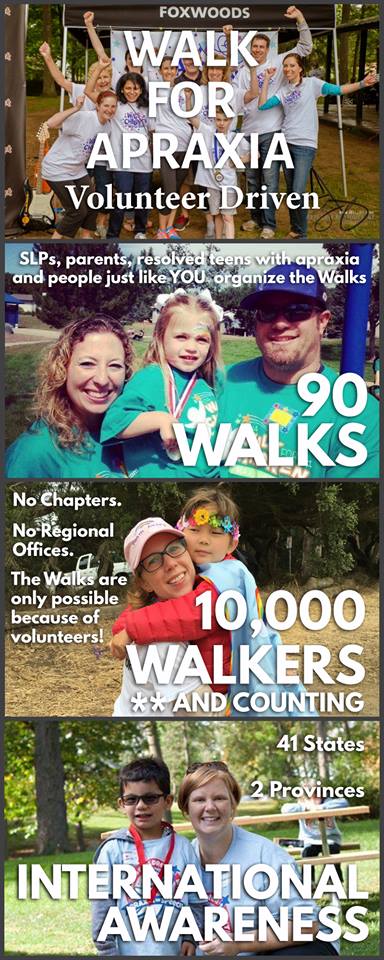
    After bootcamp, I went back to my Denver community and through a course of a conversation with Sharon realized the Denver Walk wouldn’t happen. As most of you know, this is what prompted me to become a walk a coordinator, and actually, my last post highlighted for me that this is how MOST walk coordinators around North America find themselves in the same position.  That was kinda news to me.  As I mentioned in my last post, I met another CASANA staff member through this endeavor named Justin, and if there were ever a person meant for his job as event manager…it’s him.  Calm, encouraging, kind, and supportive; despite 90 other walks taking place nationwide, Justin never makes you feel rushed or that you don’t matter.  Encouraging, passionate, and ALWAYS positive, Justin will help any person coordinating a walk feel they are the best.  We need him!  He talks to ALL 90 of us every year as part of his paid position.  The walks literally could not happen if we weren’t taking directions from Justin.

    That is why I was so taken aback to receive a private message the night after my walk from a random person in the U.S.  She was concerned about a post I made in the Ronda Rousey: Knock out Apraxia group in which I said 85% of funds go back to the community.  She said I was “mis-leading” donors.

    People, let’s just say she caught me on the wrong day.  I literally get this post after I am sitting on my couch, utterly worn out and exhausted from coordinating a walk of over 400 people….for FREE.  Literally, the last thing I need/want to hear after spending months and hours of my free time coordinating a walk for a non-profit I know personally now and believe in, is how I am misleading people.

    NO

    F that.

    What is wrong with this generation?  I actually typed that in and found this enlightening article. http://www.givinginstitute.org/news/258798/Breaking-Through-Millennial-Cynicism.htm

    Why doesn’t my generation trust non-profit’s anymore?  I wish I could say this woman was an outlier, but I don’t think she is.  My own husband the year I first coordinated the walk (and this was after I had received all this education from CASANA for only $500 and a plane ticket to go to bootcamp) asked me about the company’s money.  We actually pulled up the public IRS form.  I can’t recall exactly what it said Sharon made, but it was less than our salaries and I reminded him she literally worked around the clock.  She answered me in the wee hours at night when I needed her.  I’m not saying she does that all the time, but she  did that time.

    Something being touted this year, by others and by myself was that 85% of donations go directly back to the community via research, education, grants for therapy, and iPads for kids. This percentage was based on an independent audit of the 2014 form.  The reason for an audit and not just looking at numbers like the public can do on the IRS form is, if one were to JUST look at the money spent on grants or on iPads, it does NOT take into account the person (or persons) behind the scenes getting paid to process that paperwork and do the dirty work.  You can’t just look at one number that shows what is donated, without taking into account that some salary money ALSO made that happen.  It’s just common sense.  You can’t have CASANA donating this and that without someone behind it actually processing it.

    Oh..and what about the walks that actually bring in most of the donations.  They have two staff members helping 90 volunteer walk coordinators with that task.  TWO.  They rely on volunteer coordinators to  maximize the amount of money going directly back into programs and grants.  These people shouldn’t have to work for free!!  Yes…gasp.  They have a salary.  If they weren’t there, no walks could happen period. Volunteers can do a lot, but we can’t do everything.  Let me tell you, these two people work beyond their 9-5.  I have had them email and message me back and give me their private telephone numbers so they would be available on the weekend when walks take place.  That should speak volume to their dedication. They DESERVE their salary and work over their salary and shouldn’t be scrutinized and judged.

    I told this person that the Denver community had benefited greatly.  I knew numerous families who had received an iPad, and literally know tons of families, including myself,  who have now received the grant from Small Steps for therapy.  Oh, and we also have THREE SLP’s in the area who have been trained by CASANA under their “education” agenda.  That’s three SLP’s available to consult, provide differential dx, and to also see kids with apraxia for therapy ensuring they get the best possible therapy.  Folks, that is DIRECTLY affecting our community, and just because it’s not categorized under “therapy” on an IRS document, it doesn’t mean it wasn’t the outcome.  Just ask my clients, or the other bootcamper’s clients, or the people who have attended any presentation we have given.

    That brings us to research.  This person was concerned that in 2014, 30K was given to a research study.  Gasp.  How dare they?  I mean, really, what is the alternative?  CASANA should invest thousands of dollars into helping kids get speech therapy that doesn’t work for apraxia?  Seriously people, that is not an exaggeration.  Apraxia is THAT serious of a speech disorder.  If you are reading this blog and have any familiarity with apraxia at all, you know that is a potential outcome of the disorder, no matter HOW MUCH therapy you have.  We need research so we know what to do!!  So that the future generation of SLP’s currently in graduate school are TAUGHT what to do, unlike me.  If it wasn’t for CASANA, I still wouldn’t know how to help my kid!  I helped her for a year using what I thought were “research based” interventions….and they were…but NOT for apraxia!

    Finally, lets talk awareness.  Have you ever told someone  your kid has apraxia and they didn’t know what that was?  Okay let’s all have a good laugh now!  bahahahahahahaha

    I mean, parents reading this are ALL nodding their head right now and being like yeah…most people I say apraxia to don’t know what is is.  So guess what we need?  AWARENESS.  We need people to be aware so our kids can get the help and understanding they need for their unique needs and profile.  Guess what this takes?  A PERSON driving that.  A person who gets  a salary.  CASANA makes TONS of graphics, informational brochures, inspirational and informational memes for all of us to share spreading awareness. Apraxia Awareness Day is now a THING thanks to them.  I’m not quite sure what category that falls under on the IRS form..but I’m thinking it’s probably salary.   I could go on but this post is getting long.

    Bottom line is, why are we so cynical of non-profits?   I know it’s partly because major ones make the news14344244_1657729304539794_3707920287651978254_n about scandals, but people, CASANA is not this organization.  If it were, do you really think 90 volunteers nationwide would commit to coordinating walks that take an unfathomable amount of work and time?  All 90 of us know the staff members at CASANA and we don’t get ANYTHING in return than what CASANA offers to EVERY child and family affected by apraxia: quality research, education for parents and professionals, speech therapy grants, and iPads for kids.  We don’t get anything more, oh wait, I take that back.  They gave us a picture frame last year to frame our favorite walk picture.
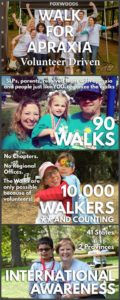
    Come on!  Stop the cynicism.  Support the cause!  Our children need you!  Our children deserve a voice, and CASANA is working tirelessly!  With event managers texting on weekends, to the executive director responding to fb posts written by  desperate sad parents at night, CASANA is a non-profit dedicated to making sure every family feels supported and EVERY child has a voice!

    Oh, and as a last word, I do really want to hear from you.   What does the word non-profit mean to you?  Does it incite doubt and suspicion or hope and inspiration?  Maybe, you just have never thought about it much and indifference is the best word to use?  I don’t know.  That’s why I’m asking this last one is NOT rhetorical.  Tell me your thoughts.