Hi readers! Not only another year, but another decade is coming to a close! My daughter Ashlynn was born in 2009, and it’s astounding all of the changes that set off in my life throughout the past ten years! This past decade was one of joy as a I built my family, but also sorrow facing numerous challenges with Ashlynn.
I have faith though that this next decade will be one of overcoming! I know ten years from now I’m going to be writing another success and triumph story, much like I did in the book I published this year called “Overcoming Apraxia.” I also want this next decade to be one of exponential growth in apraxia awareness and information so all children have the access to the best therapy.
Hi Alexis! I remember first seeing you on the facebook page apraxia awareness and hearing you do a very real and raw live Q&A. That was very brave of you! You were so gracious to answer so many questions openly and honestly. This past year, I set a goal to reach people outside of the United States. I want to help those who have apraxia worldwide get the help they need and deserve!! Having you on this blog post to start May and Apraxia Awareness month is helping achieve just that!! Thank you for your bravery!
To start, can you begin by telling us a little about yourself and your journey with CAS?
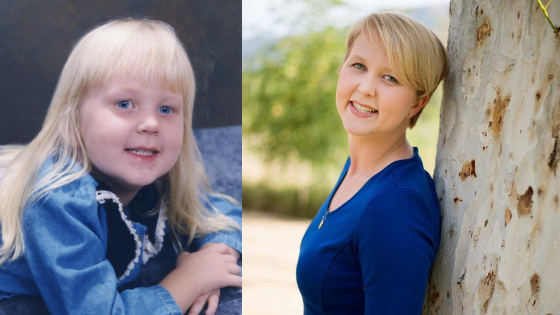
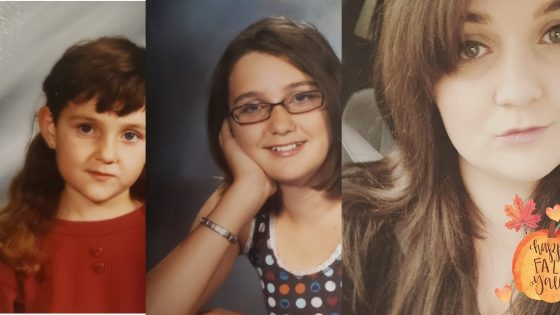
I am 23 years old. I am an insurance advisor in Alberta, Canada with the Co-operators. I took speech therapy from kindergarten until grade 5. I remember really realizing for the time that I had a speech impediment when I was about 7. I became interested in learning more about it in grade 6 – what it was & why I had it.
What do you remember as a child with CAS and speech therapy?
Like I said, I started speech therapy in kindergarten. I have really vivid memories of the hearing test they would do. Putting a headset on and listening for the beeping. You’d have to tell the person what side the beeping was coming from. I was always so proud because I aced those tests every time. The pride was usually met with confusion the first few times though. I did so well, you told me I got all of them right, so why do I have to come meet with you for lessons?
I remember being told I had a speech impediment. I remember all of the “that’s not how you pronounce that”, “listen to me”, “watch my mouth”, “it still doesn’t sound right”, but I didn’t get it. I can remember being frustrated and angry. This woman would tell me all these things over and over again and I was sitting there thinking lady, I just heard myself say it, it sounds exactly the same as when you do it. Of course, it didn’t.
When I say the first time I remember really knowing I had this was 7, it’s because I’m fairly sure that was the first time my speech therapist used a tape recorder. This thing was the bane of my existence. I’m 7, over confident, and a little annoyed with this woman because we’re saying the same thing. Was I ever showed up. This tape recorder comes out because after give or take two years my speech therapist must of realized I really didn’t hear what she was hearing. My voice in my head has no speech impediment and I was too young to understand that I just wasn’t hearing it right. I was about to have my little world crushed.
Every session started with me telling her about my last week. This session, she recorded it. The moment she hit play and I had to hear my actual voice, instead of the one in my head, I wanted to disappear forever. She’s not wrong when she says my sounds aren’t right. All of a sudden two years of fighting this woman came crashing down around me. I was wrong, she was totally right, and I sounded (to my very young self) weird. I can not tell you how miserable I was hearing this recording. I did everything I could after that to prevent her from using the tape recorder again. It did help though. My sessions went better and I got more done, because I knew I actually was saying the sounds wrong, even if I couldn’t hear it.
Were you ever bullied?
I know this isn’t what parents are going to want to hear, but yes, I was bullied a ton. The bullying continued all the way into highschool. Luckily for me, I had a great few friends and family members. We really started to look at people who said anything about it as just being sad, or a little pathetic. It might sound harsh, but really of all the things to choose to pick on someone for, this was pretty ridiculous (it’s always ridiculous though). Honestly, “they talk a little different then me so I’m going to bully them”. We’d think about their bullying in that really point blank way, and just laugh at them. That train of thought is may more ridiculous sounding then I’ll ever be.
How has apraxia affected your life, or has it? Do you have any residual issues?
The bullying did affect my life. Most days my above tactics worked great, but of course everyone has their off days where it just sucks. It still does just suck sometimes, but that’s not the end of my world. I still can’t say any of my R sounds. R sounds were the last thing to work on when I was in grade 5, and due to a lack of speech therapists in the school and time, I was seen 3 times that year. Once I got into middle school it wasn’t provided through the schools anymore and the cost was too high to do it privately. Now, I’m 23 years old with no real talent for R sounds. My last name is Berger and I work in the insurance field. Good choice, self. Other than that I have no real side effects or issues concerning my Apraxia.
Most parents are so worried about the future when their child gets an apraxia diagnosis. What would you tell them?
Your child is going to find their voice, it might be missing a few sounds or it might be through something less conventional than talking, but they will find it. We look at speech as so important, and it is, but you can live such a full life without being perfect at it. They are going to have talents and skills all their own that have nothing to do with how they talk, and chances are their speech being a little off won’t affect it at all. Support them, be there for them, and be ready to answer questions if they have them, but don’t make their entire life be Apraxia. You can find your voice without talking perfectly; talking is really the smallest part of it.
What do you wish more people knew about apraxia?
That it existed. No, really, just that it existed. I have been explaining this to people for about 11 years now. What it is, what it does, why I sound the way I do, and answering their questions. I just feel like if more people had known what it was when I was in school, it wouldn’t have been such a big deal to them.
What would you tell a child who is currently struggling to speak or who lives with a dx of CAS?
Don’t feel pressured to tell people it’s an accent. Most of my life people have thought that’s why I sound like I do. On an almost daily basis people ask me where I’m from. I always politely tell them it’s a speech impediment and give them some basic info. I want them to learn what it is. The most common response? “Oh, you should just tell people it’s an accent”. This is my absolute biggest pet peeve. The truth is, if someone tells you to say it’s an accent it is because they are uncomfortable with your explanation and with the truth. They feel a bit bad that they asked you where you from and they were wrong about it. They wouldn’t have to feel that little awkwardness if you had told them it was an accent and played along. I can promise you this is the real reasoning 99% of the time, even if people deny it. Do not let someone tell you to say you have an accent, unless that is truly more comfortable for you and what you want to do. You have a speech impediment. It is a part of you and there is absolutely nothing wrong with having one.
Aside from that, if you are working through your speech therapy at the moment, listen to them when they tell you to practice at home. I was supposed to practice my sounds in front of a mirror for at least 20 minutes a night and I flaked on it all the time. Don’t flake on it. Practice the sounds, it really will help things.
What do you think professionals such as teachers and therapists need to know about CAS?
Number one thing is that it exists and what it is. I have had so many awkward moments with teachers over the years. The second thing is how to handle it. If the student is old enough, ask them if you can help in some way. If they are still quite young, ask the parents.
I had teachers make me repeat an answer in class (in middle and high school) over and over and over because they couldn’t understand what I was saying. It was embarrassing. The other students would laugh and the teacher still wouldn’t realize that they should probably just stop. I would go up and just write what I was saying on the board. Then I’d get in trouble because it was unnecessary to do. Let your students help themselves and help you understand them.
If a teacher didn’t understand me after a few tries often one of my friends would just repeat my answer to them. This was great for me. I loved and appreciated them for doing this. Sometimes the teachers would get angry about it though. Let them help if need be!
Another big one is if you pick me to read something out loud I might take an extra second to read a word out. I would be thinking of how to pronounce it and trying to be sure it was going to come out properly. The teacher would just interrupt and say the word themselves. Let your students at least try to get it out. If they do happen to mispronounce it, see if they correct themselves. If they don’t correct themselves and just keep going, then leave it. Do not point out their mispronunciation in front of an entire body of students. If they are still in speech therapy you could try writing it down and letting them know after class which words came out wrong. Then they can take that to their next session as helpful information.
Thank you Alexis! This has been one of my favorite interviews. Your honesty and candidness are exactly what people need to here. I love your perspective. I just can’t say enough. Thank you for your willingness to share your story!
Growing up CAS is part of an ongoing series that aims to celebrate neurodiversity and highlight those who have grown up with Childhood Apraxia of Speech and related struggles. If you are interested in being featured, send an email to lauraslpmommy@gmail.com
I’ve been on this special needs journey with Ashlynn for a long time now.
I have grieved, recovered, grieved, and recovered again. I have developed thick skin. I have felt guilt, then peace, more guilt, and then peace.
I thought I was past all the BS. I have accepted Ashlynn has severe needs. I have accepted my journey with Ashlynn is going to be MUCH longer than I ever anticipated and I have embraced it. This girl goes to school from 8 to 2:45, and almost every day after school she has some sort of therapy or tutoring strategically scheduled to help her overcome all of her learning disabilities.
I’ve been done making excuses for not doing homework.
I finally just started being honest and saying “We will see. She is a very busy and overscheduled little girl,” when therapists would ask about homework . Ashlynn goes to school and then has therapies after school, and then we hope to get home to eat and then finally do her SCHOOL homework.
That doesn’t mean there isn’t any other homework. Oh no. For all the therapies she receives after school there is also homework. Always homework. So not only does the average kid NOT go to therapy or tutoring everyday after school, they also then don’t have the homework assignments from said appointments after school.
My daughter has it all.
Go to school and get homework, and then attend therapy and tutoring that takes away from homework time after school and receive MORE homework on top of school homework for the extra after school services. Oh, and my daughter has global motor planning issues, so any homework assigned is usually homework that needs to be done everyday.
Everyday my daughter is expected to do regular school homework and then follow through homework for OT, PT, Speech and tutoring as well.
If for some reason said homework isn’t done or done to the fidelity of a therapist’s expectations, I get to see the raised eyebrows and judgemental eyes. I know what they are thinking even if they don’t say it. “You couldn’t carve out 5 minutes for some simple yoga poses? Speech word practice? Sight word drills?”
Again, I thought I was past this. I was done feeling guilt. My whole life is running around trying to get my daughter the help she needs and then coming home and trying to be a mom and get dinner and then at least getting through her school homework. I have been done for a LONG time apologizing for not getting the therapy homework done.
That was until today
Two weeks ago I put Ashlynn into a therapy called oral facial myology to help with her mouth breathing, tongue thrust and immature swallow. I knew going into this the homework component was going to be big. I knew this! We received a sticker chart to keep us honest. Ideally she would do the exercises 2x – 3x a day and we would reconvene in 10 days.
Today was our second follow-up appointment. I was so proud of Ashlynn! We had done the exercises every single day! A handful of days we managed 3x, most days we did 2x a day, and on three days including one where she spent the night at her grandma’s we did 1x a day.
I was proud of us. That was no easy feat. Sometimes it cut into bedtime but I knew this was important and I was willing to go the extra mile.
My sails were immediately shredded within 5 minutes of our second visit.
The swallowing therapist was warm and inviting as usual. We were seven minutes late because we were driving from PT and I had forgotten to ask the physical therapist to end 5 minutes before and instead she ended 5 minutes late. We still made it though! School ended at 2:45, we were at PT at 3:30 and then we were at swallowing therapy at 4:25. I was proud of myself for getting her to all these places.
“How did the homework go? Did you complete it?” the therapist asked Ashlynn. Ashlynn enthusiastically nodded yes as I took out the sticker chart and the therapist looked on disapprovingly. So there are three days here you could only do one practice session? For this program to be successful, she needs to be doing the exercises at least 2x a day.
“There are a couple days we did three! Does that cancel out the three days we could only fit in one?” I laughed nervously.
I looked up to a face of disapproval.
“For this program to work, you really need to be more consistent,” she lectured.
I swallowed a big swallow and collected our things. I think I literally gulped back tears. I was paying a lot of money for this therapy. Of course I wanted to see it be successful. Of course I wanted to practice with Ashlynn as much as I could. Guess what though? I also needed to make sure we completed her homework and read at least 10 minutes per night. Then and only then did I need to make sure she was doing her homework for reading tutoring, OT, PT, and speech as well. Oh and she also needed to eat at some point and take a shower. Being a kid? Nope. That’s not in the cards apparently.
The guilt and responsibility is overwhelming
I cried as I left the swallowing woman’s office. I was trying! I thought Ashlynn and I had done amazing! We practiced what seemed like every spare minute we had together, which actually is very little spare time together! I was proud of our dedication, but this woman had only criticism. She told me if the program was to work, I really needed to get more serious about practice.
I went home that night in a state of anger.
I was yelling at my kids, my husband, the computer..really anyone who would listen. I was devastated at having a therapist, a well respected therapist basically tell me if I didn’t take the homework seriously and with the fidelity it needed to be, my child wouldn’t improve.
I railed against everyone and then I messaged an ally.
The ally I messaged is an SLP who specializes in apraxia and oral facial myology. I was so lucky to meet her at L.A.’s Walk to Talk for Apraxia when I took Ashlynn at 8 years old. Her name is Lisa Klein and she has a reputation for not only being an amazing therapist, but being an incredible friend, mentor, and encourager. I barely know her yet knew I needed to talk to her. Fortunately for me, she told me I could call her on my way home and like a crazy mom who is desperate I did. I talked in a long winded series of run on sentences and questions and when I stopped she said the most impactful thing to me that brought me to tears.
Laura, first of all, you are a great mom and that girl has come so far because of you.
I started balling. Not like crying either or tearing up. No. Chest heaving ugly cry balling. I just needed that validation. She went onto say things that our myofunctional therapist suggested too like going every other week. She brainstormed how to get in practice or what exercises we absolutely couldn’t miss. She said all of this though with compassion and free from judgement, and that is exactly the type of therapist I aim to be too. We need to meet parents where they are at and we need to know parents are under an insane amount of pressure and are doing the best they can with the tools that they have. I need a therapist to understand that. I’m constantly shocked by the number of therapists who have so most judgement. I say this all the time but I say it again. Please, if you are a therapist reading this please have compassion and understanding for the parents. We are fighting daily battles and crying tears no one ever sees. Please be kind. Please.
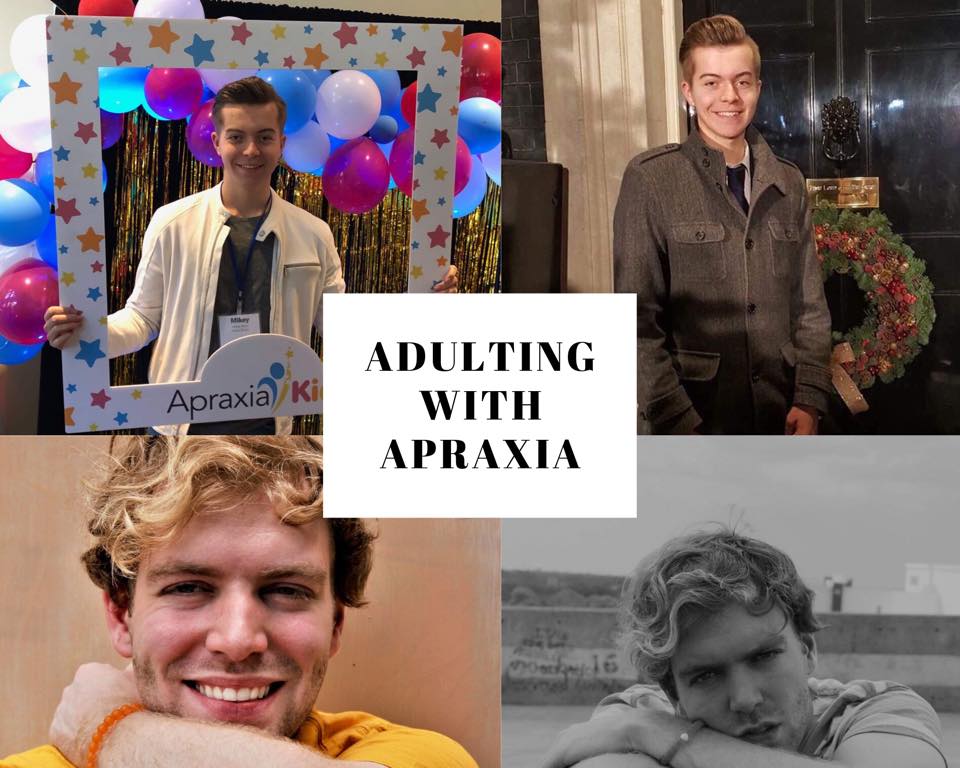
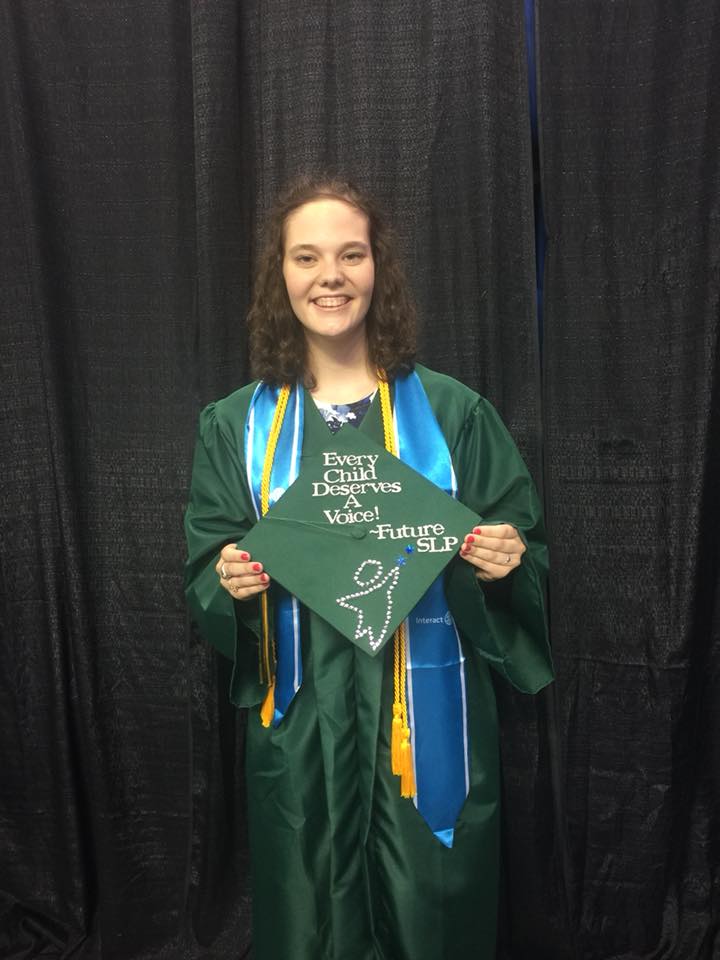
Hi Natalie! I had so much fun meeting you in person at the Apraxia National Conference this past July! I had already heard so much about you within the apraxia walk community, as you overcame apraxia and are now a walk coordinator for your area! All by the age of 16! That’s amazing! Let’s start with you telling us a little bit about yourself.
What do you remember about speech therapy and how long were you in it?
I just remember playing games and making crafts. I was in speech when I was 2 through second grade.
When did you know you had apraxia?
I was diagnosed with apraxia when I was two and a half.
How has apraxia affected your life, or has it? Do you have any residual issues?
Yes, apraxia has affected my life on multiple levels. I have been diagnosed with anxiety because of the slow processing. I don’t feel like I have enough time to finish tests. I also still have problems with my sensory. Also when I get tired my speech starts to slip.
What was your school experience like?
My parents and I have had to fight for everything I have in place. I have a 504, which allows me more time on test, but the 504 is for my anxiety and not for apraxia because no one understands what apraxia is at my school. I have to tell my teachers what I have and explain what it means.
Most parents are so worried about the future when their child gets an apraxia diagnosis. What would you tell them?
Apraxia is a long journey. It takes time. Don’t rush your kid’s speech, it will come. Everything happens for a reason and apraxia has influenced their life for some reason or another.
What do you wish more people knew about apraxia?
Apraxia doesn’t just affect your speech, it affects your processing speed and much more.
What inspired you to become a walk coordinator at such a young age?
I want to help families with kids with apraxia. My family has gone through the same things as others have. My parents didn’t know if I would ever be able to talk and live on my own. I want to give families hope, the same hope my parents got from Kate Hennessey.
Thank you so much Natalie, for all of your advocacy work and continued mission to spread awareness and help other kids with apraxia! You are absolutely a face of hope and inspiration!
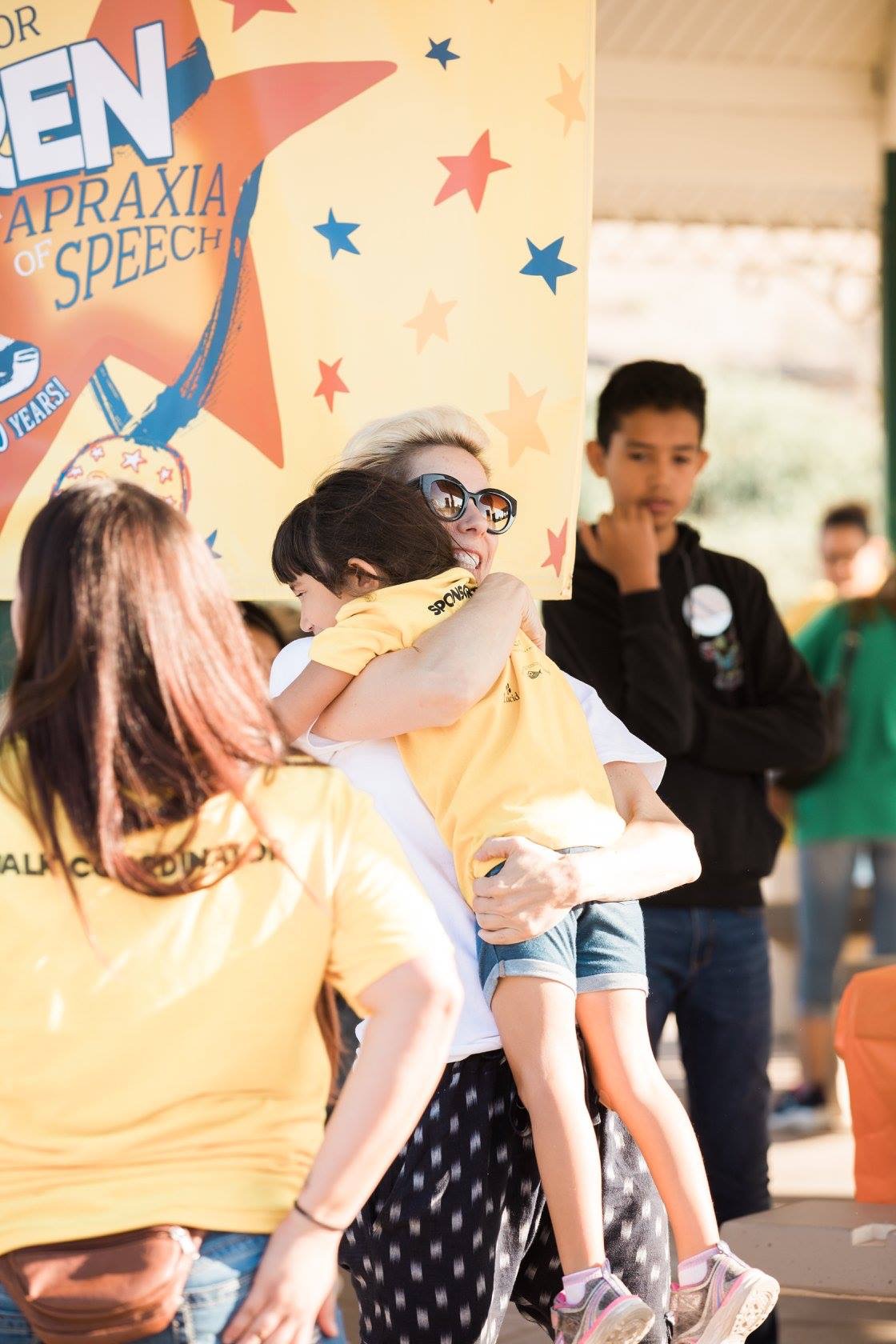
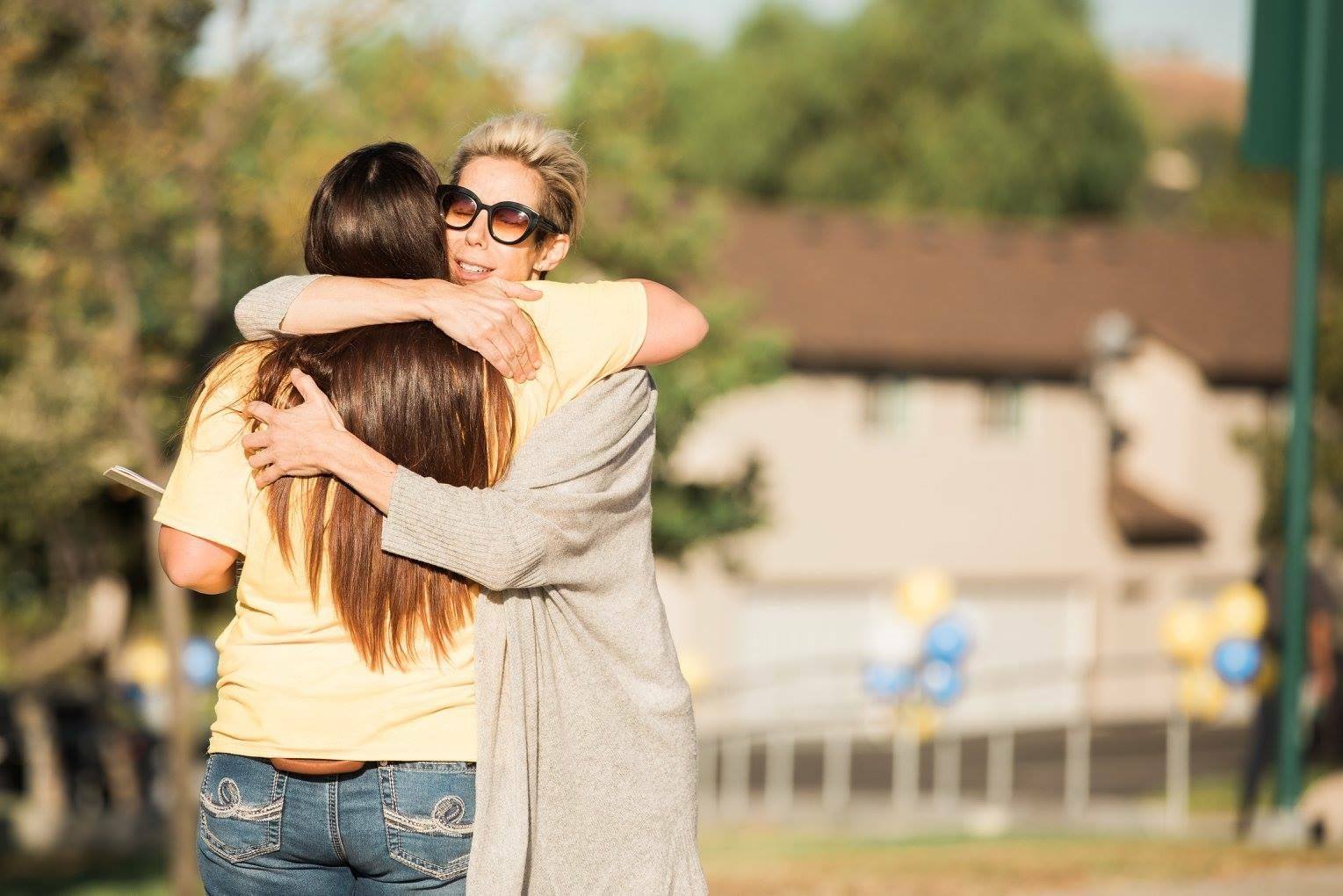
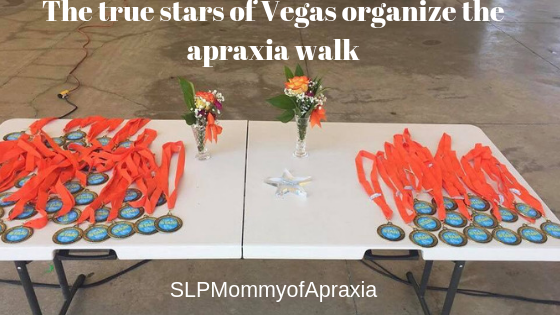
This weekend I was the guest speaker at the Nevada Walk for Apraxia and stayed with the walk coordinator Alyssa Hampson and her family.
I flew in the day before the walk, and her house looked very typical of any other walk coordinator.
It was bursting with items such as goody bags for the kids, prizes for the silent auction, food and beverages for breakfast, signage, T-shirts, and so much more.
If you are a walk coordinator, or help coordinate a walk for any charity event, then you are probably very familiar with this typical décor that hijacks your living room the day before walk day.
I am the mother to a child with apraxia.
Being a walk coordinator is not just professional, it’s personal.
I’m literally fighting to raise funds to go back directly to apraxia research , education, and programs so that each child who has apraxia in subsequent years has access to appropriate professional services. It seems expected, or at least natural as to why I would have such as invested interest. I’m fighting for my child and those like her.
That’s why watching someone like Alyssa and her family was more than inspiring.
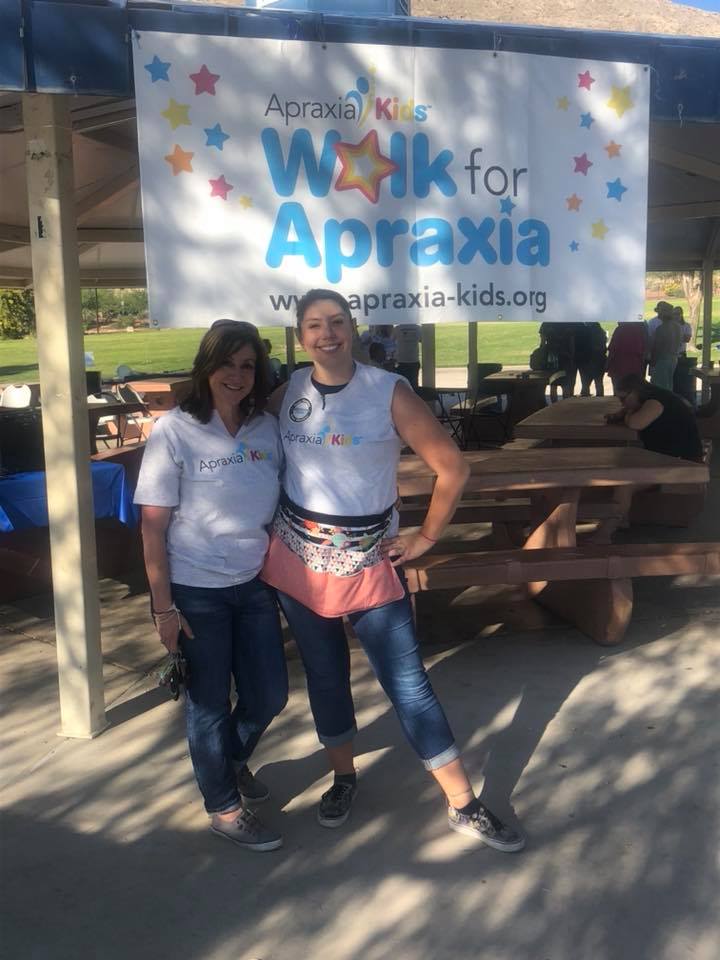
Alyssa is the walk coordinator for Nevada, but she is also a wife of almost 30 years, a mother to two beautiful, young adult children (who don’t have CAS), and an SLP with a passion for Childhood Apraxia of Speech. At her house for the past 3 years, the Walk for Apraxia has been a family affair.
Her daughter came down from college with her friends to help Alyssa run the walk. I was there because Alyssa had asked me to attend as the guest speaker.
Lauren on the left with college friends to help out on walk day.
The night before the walk, her husband helped pick up the bagels and balloons as her daughter printed out forms and signage that were to be used at the walk. As I perused the silent auction items and game station activities, I discovered that Alyssa and her family had paid for much of these themselves. As a fellow walk coordinator, I was struck by their generosity and willingness to spend so much of their own money to ensure the walk was a success.
The day of the event was a full family affair, with another apraxia mom, Ashley Winter joining the crew with her husband. Everyone worked diligently setting up an event that had been in the works for months. Alyssa’s husband Dennis set up the silent auction, while his sister and their daughter’s friends helped decorate the park and set up for registration.
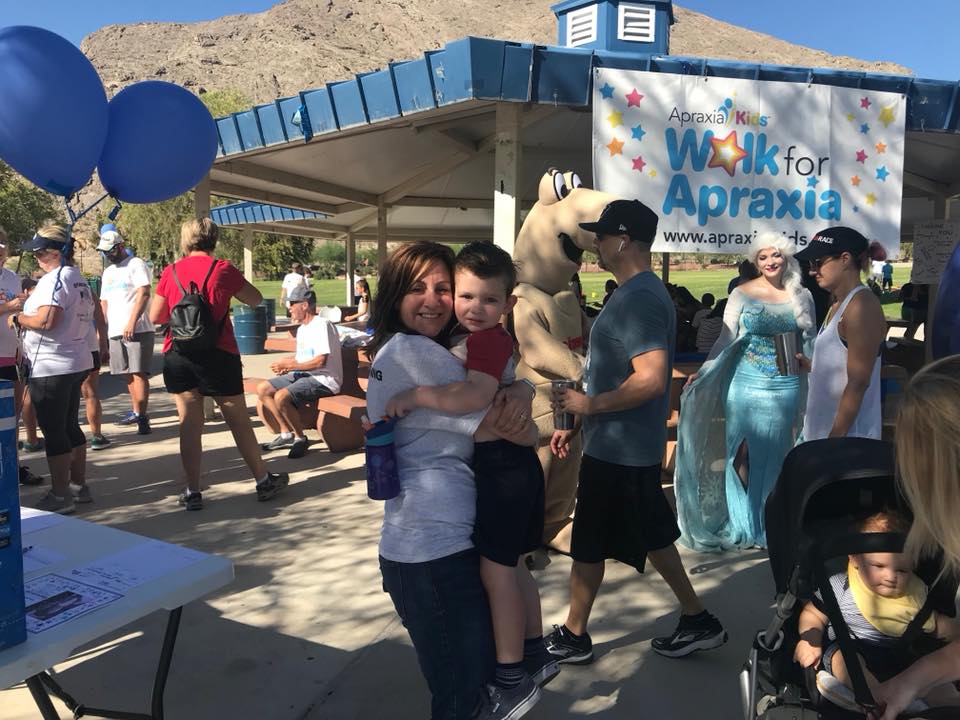
Characters that had been secured such as a clown, the princess Elsa, McGruff the crime dog, and Deputy Dripp for the Clark County Police Department all showed up on time to provide photo ops and entertainment for the kids.
I talked to many families and some SLP’s who specialized in apraxia and did my best to connect members from the community with each other.
That is what these walks are about. Community.
The walk is the chance for families to connect with their people. The walk is the place a family can go and not feel judged and just let their kids be themselves free from criticism. There was one child who had to sit on the side watching the event for around 20 minutes before he felt comfortable to join in, and no one batted an eye. There was another child who had a sensory meltdown during picture time and a parent looked at me and said,
“ I want to just give her a universal sign that says, I’ve been there and I feel you. You’re doing a great job.”
Before the walk started, the coordinator Alyssa went live in her event facebook group and talked about the day to come. Another apraxia mom in California commented that she was moved to tears that Alyssa was an SLP, not a mother, but who still was coordinating the walk. Alyssa didn’t know why until I explained.
Alyssa with one of her clients
As a mother to a child with apraxia, my motive for coordinating the walk is clear. I walk for my daughter. For Alyssa, she has developed a special bond with kids like mine, so much so that it compelled her to donate and volunteer her time for kids like MINE. For kids like YOURS! It’s touching that a therapist cares so much for kids with apraxia that she is willing to give up her personal time, energy, and money to coordinating a charity even like that for the Nevada Walk for Apraxia. It’s amazing that she in turn inspired her entire family to do the same!
Usually my favorite part of the walk is the medal ceremony, where the kids are honored with medals for all the hard work they put in every day to learn how to do the one thing many of us take for granted: learn how to speak.
That was still a great part, but at the Nevada Walk for Apraxia this year, I had a different favorite part.
I witnessed a family brought together by the shared mission to help kids like mine.
They had no personal investment accept that the matriarch of the family was passionate about these kids and in turn, had made them passionate too.
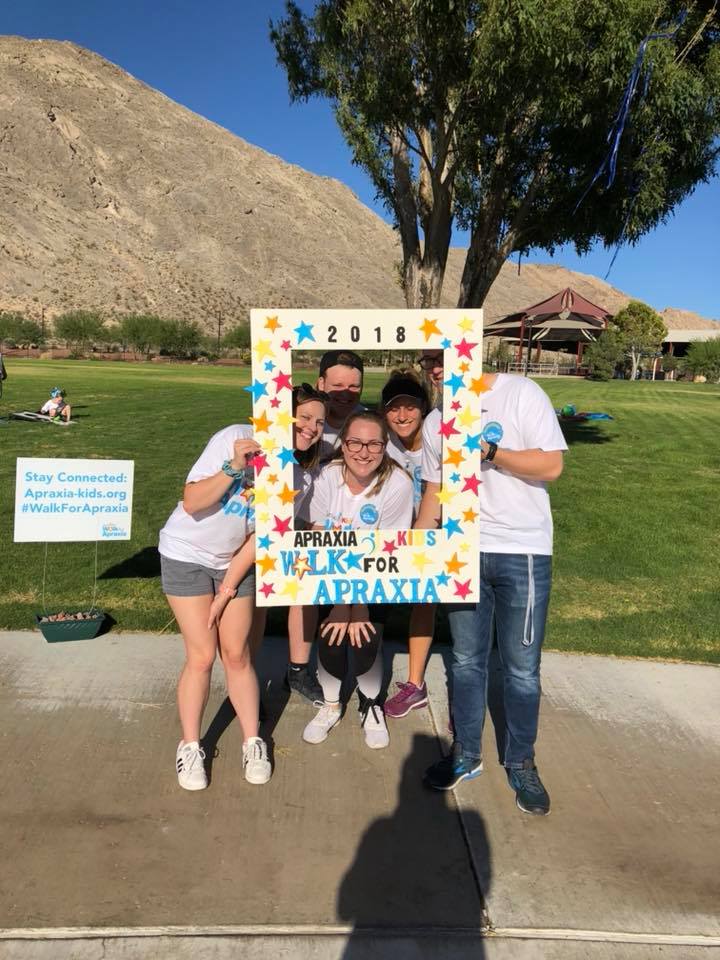
I marveled at her sister in law who made the beautiful crafts and decorations like the photo booth picture frames. I looked on in amazement as her daughter, clipboard in hand, managed the day of event details with professionalism and meticulousness. I looked on in admiration, and also amusement as her husband manned the silent auction and was so invested he took every donation personal.
“No one is bidding Alyssa,” he exclaimed in his New York Accent. “Whatevah, it doesn’t mattah,” he continued. “If no one buys it then we will just buy it and that’s it. We’ll buy it all and forgettah about it,” he said before storming off.
As much as I was amused by his accent, I was more inspired by his passion.
What did this man care that no one was bidding? He didn’t have a child with apraxia. He only had client stories from his wife, but he had also become so personally invested and fell such in love with kids like mine that the success of the silent auction to benefit apraxia was now personal to him.
Alyssa and Dennis
Where did people like him come from? I was amazed and touched. My daughter and others like her benefitted from a New York Jew (his words not mine) living in Las Vegas who cared about kids like mine.
How can one NOT be touched by that? How can anyone who loves a child with apraxia not be touched by the dedication of this family? What is more, is how are families who DO have a personal interest in apraxia NOT this dedicated to the cause?
It’s inspiring and the walks for apraxia around the country all have a personal and unique story like theirs.
As I was leaving today, Alyssa pointed out that it was Rosh Hashanah. Other than knowing it was a Jewish Holiday, I asked her the meaning of it. She sent me information that read,
“Rosh Hashanah marks the beginning of the Jewish New Year. We review the choices we have made over the past year, our actions and our intentions, as we attempt to honestly evaluate ourselves.”
I couldn’t help but think of how symbolic it was to have Rosh Hashanah fall on this day I met a Jewish family coordinating the Walk for Apraxia.
My friendship with Alyssa and her family grew this weekend marking the beginning of what I knew was great things to come in the future. In addition, as a time of reflection and introspection, I hope that when her family evaluates themselves this holiday, they are proud for all that they do in their small part of the world raising funds and awareness for children with apraxia.
I was blessed this weekend to get to know Alyssa and her family more intimately than I ever had. In the spirit of Rosh Hashanah, I spent time on the plane reflecting on my last year and my choices, intentions, and actions. Am I living my life with authenticity? Am I true in my intentions and my actions? This is a great task for any of us to participate in, regardless of if we are Jewish or not.
Ghandi once said, “The best way to find yourself is to lose yourself in service to others.”
I started this blog in 2012, shortly after my daughter’s diagnosis of apraxia when she was just under three. Since that time, she has made tremendous growth. She speaks, she speaks clearly, and she can tell me about her day. She can tell me when people are mean to her, what her teacher said that was funny, and what she had for lunch. These were all things she couldn’t do and I worried she would never be able to do when she was first diagnosed.
We’ve added more diagnoses through the years including a language disorder, dyspraxia, ADHD, dysarthria, and this year….dyslexia.
In spite of all of these challenges, watching my now 8 year old daughter wake up each morning and attack the day with happiness, kindness, bravery, and a resilience that is unmatched inspired me to do the same. I always think, I have NONE of her issues….what’s my excuse?
This blog/website has grown with an average of 300 visitors daily. Whether you are a professional, parent, or just someone who cares, thank you so much for following along and being part of my desire to spread apraxia awareness in the hopes of helping every child with apraxia to achieve intelligible speech.
Here is the Top Ten Countdown to my most read posts of 2017. Cheers to 2018!
“I have to say I want to give up sometimes. It seems like no one is going to care and sometimes the fight just doesn’t seem worth it anymore. But then I look at these smiling faces who never give up, and like the song says, I need to get up again to see what’s next.”
“Have you ever stopped to think, and then believe, that one person, ONE, could change the life of hundreds; if not thousands, if not millions of others?”
“Sometimes I wonder what it would be like to justworry about the speech, or justworry about the motor skills, or justworry about homework or just worry about executive functioning, or justworry about language processing.”
“I don’t want professionals to tell me she’s a puzzle. I don’t want to know that she’s so unusual that her very being challenged your knowledge, or that you are confused by her.”
“Everyone is handicapped either physically, mentally, or emotionally. It’s all about maximizing what you have. As a kid I had trouble speaking. It’s all about overcoming adversity.”
“They cannot “refer out” or “discharge for lack of progress” as an can be done in private speech. No, the school SLP is expected to figure it out regardless of the lack of resources, lack of funding, or lack of time.”
Sign up for my newsletter to get all the info related to apraxia, dyspraxia, and dylexia for 2018.